
 Download PDF
Market Overview
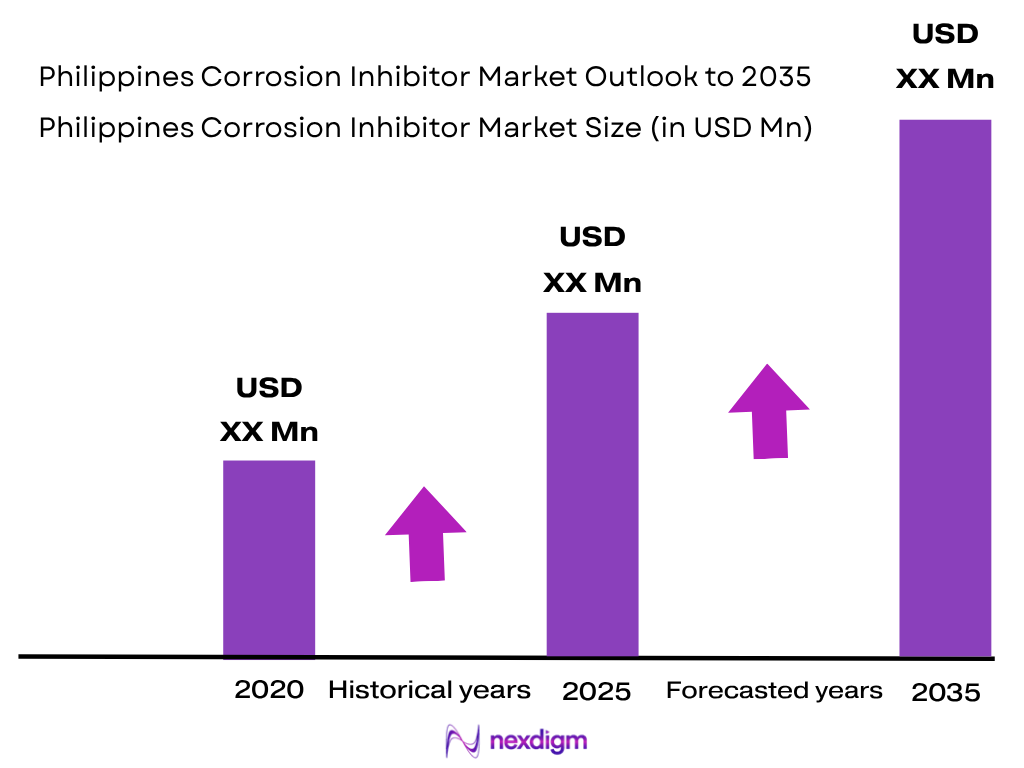
The Philippines Corrosion Inhibitor Market is valued at approximately USD ~XX million, based on historical demand from power generation, industrial water treatment, mining, refining, electronics manufacturing and offshore energy. Industrial activity provides a substantial treatment base: PEZA-approved investments reached PHP 214.176 billion, compared with PHP 175.709 billion in the preceding period, while metallic mineral production value increased from PHP 249.71 billion to PHP 252.90 billion, supporting recurring corrosion-control requirements across process equipment.
Laguna, Cavite, Batangas, Metro Manila, Cebu and other CALABARZON industrial centers dominate Philippine corrosion-inhibitor consumption because they combine electronics manufacturing, process industries, power infrastructure, ports, water systems and petroleum assets. Electronics and semiconductor investment increased from PHP 61.5 billion to PHP 80.6 billion, while nationwide electronic-product exports reached USD 39.09 billion. Batangas also hosts major industrial and energy facilities, while Bataan operates the country’s 180,000-barrel-per-day integrated refinery, reinforcing process-corrosion demand.
Market Segmentation
By Chemistry Type
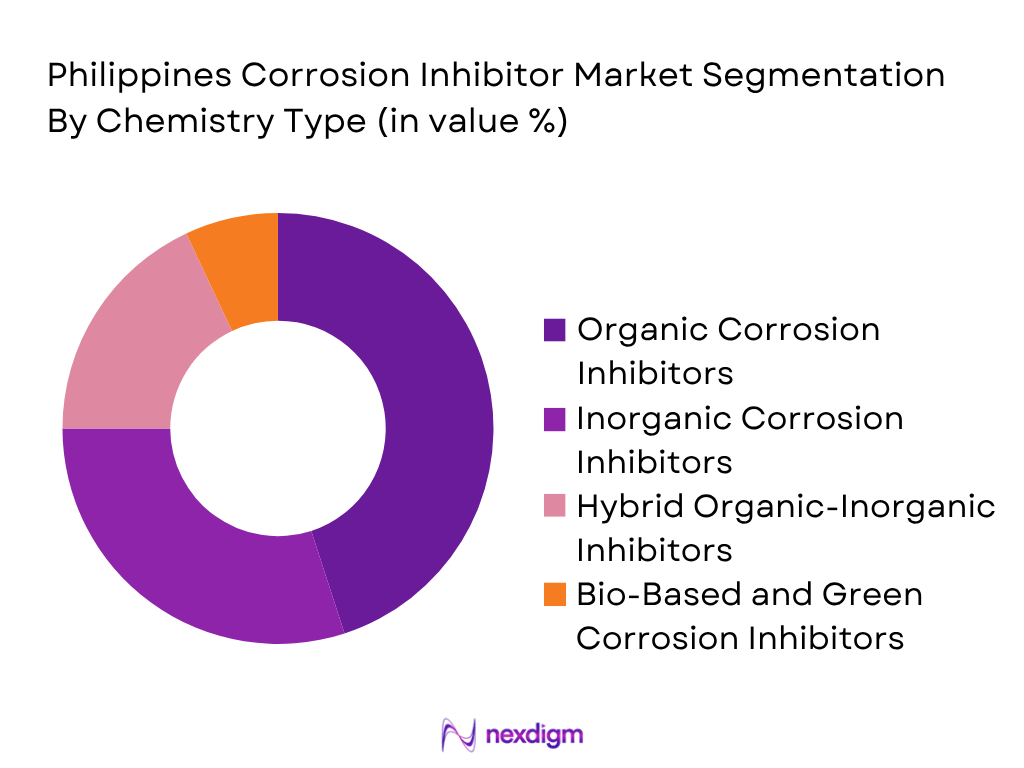
The Philippines Corrosion Inhibitor Market is segmented by chemistry type into organic corrosion inhibitors, inorganic corrosion inhibitors, hybrid organic-inorganic inhibitors, and bio-based and green corrosion inhibitors. Organic corrosion inhibitors hold the dominant market share because the country has substantial demand from cooling-water systems, boiler circuits, petroleum processing, metalworking, electronics manufacturing and energy assets requiring film-forming and adsorption-based protection. Amines, imidazolines, azoles, carboxylates and related organic chemistries are particularly relevant where suppliers must protect carbon steel, copper alloys and mixed-metallurgy equipment under variable operating conditions. The dominance is reinforced by a manufacturing base where electronic products generated USD 39.09 billion in export earnings, alongside large industrial estates containing cooling systems, process piping and precision-metal equipment. Inorganic systems such as phosphates, nitrites, molybdates, silicates and zinc compounds remain important in industrial-water applications. Hybrid inhibitors are gaining relevance because combined formulations can address corrosion, scaling and mixed-metallurgy protection within a single treatment program.
By End-Use Industry
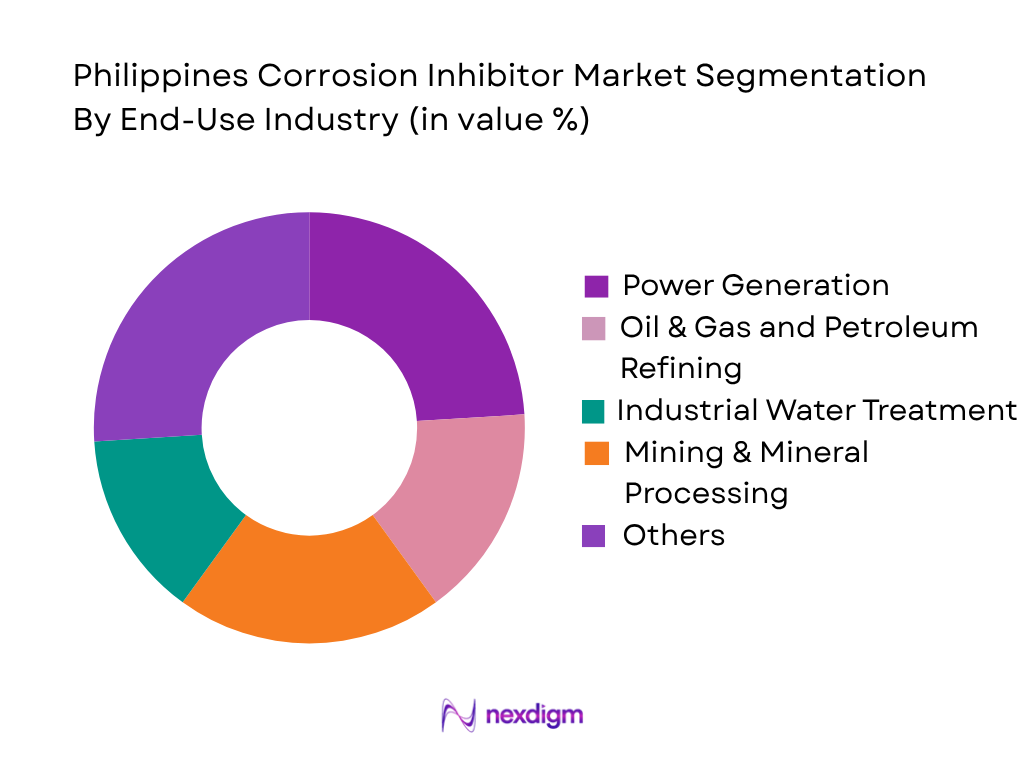
The Philippines Corrosion Inhibitor Market is segmented into power generation, oil and gas and refining, industrial water treatment, mining and mineral processing, electronics and semiconductor manufacturing, marine and shipbuilding, and other industrial applications. Power generation and industrial utility systems represent the dominant application cluster because geothermal, thermal and industrial facilities require recurring corrosion control in boilers, condensate systems, cooling towers, heat exchangers and closed-water circuits. Mining is another significant application because metallic mineral production reached PHP 252.90 billion, including 28,870 kilograms of gold, 256,769 dry metric tons of copper concentrate, and 33.43 million dry metric tons of direct-shipping nickel ore. These operations expose pipelines, process-water systems, tanks and processing equipment to chemically aggressive environments. Electronics manufacturing further expands demand for high-purity water treatment and metal protection, while refinery and offshore assets require specialized film-forming inhibitors capable of operating under hydrocarbon, water and gas exposure.
Competitive Landscape
The Philippines Corrosion Inhibitor Market combines multinational industrial-water treatment companies, energy-production chemical specialists, domestic chemical distributors and construction-chemical suppliers. Competitive advantage depends less on standardized chemical supply and more on application engineering, local inventory, water analysis, dosing capability, corrosion monitoring and the ability to address highly different operating environments, ranging from industrial cooling-water systems and offshore production equipment to mining circuits and chloride-exposed concrete infrastructure.
| Major Player | Establishment Year | Headquarters | Core Corrosion Chemistry | Philippines Application Focus | Water-Treatment Capability | Energy/Process Capability | Local Supply Position | Technical Service Capability |
| Ecolab / Nalco Water | 1923 | St. Paul, USA | ~ | ~ | ~ | ~ | ~ | ~ |
| Kurita Water Industries | 1949 | Tokyo, Japan | ~ | ~ | ~ | ~ | ~ | ~ |
| Veolia Water Technologies | 1853 | Paris, France | ~ | ~ | ~ | ~ | ~ | ~ |
| Sika | 1910 | Baar, Switzerland | ~ | ~ | ~ | ~ | ~ | ~ |
| SLB | 1926 | Houston, USA | ~ | ~ | ~ | ~ | ~ | ~ |
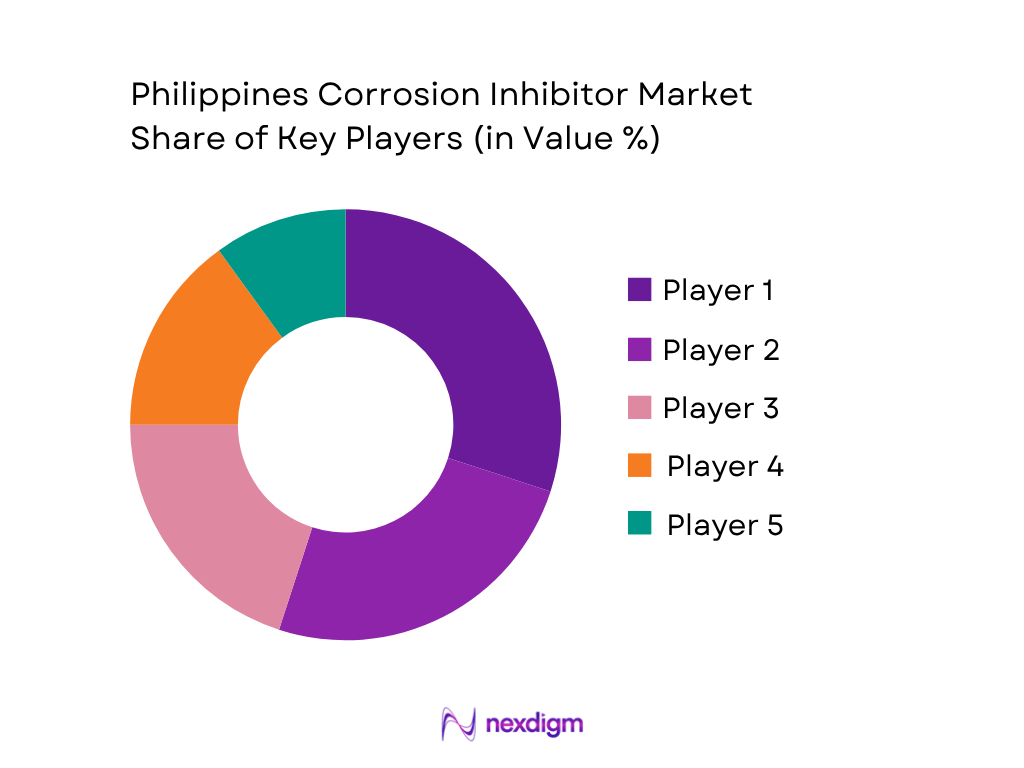
Philippines Corrosion Inhibitor Market Analysis
Growth Drivers
Expanding Power and Geothermal Asset Base Strengthens Recurring Corrosion-Control Demand
The Philippines’ large power-generation infrastructure creates recurring demand for corrosion inhibitors used in cooling-water circuits, boilers, condensate systems, heat exchangers, geothermal steam systems and auxiliary equipment. Department of Energy statistics record 29,706 MW of total installed generating capacity in 2024, including 1,952 MW of geothermal capacity and 3,732 MW of natural-gas capacity. Geothermal facilities are particularly relevant because high-temperature brine, steam, dissolved minerals and process gases expose wells, pipelines and surface equipment to corrosion and deposition simultaneously, supporting specialized corrosion-and-scale treatment programs. The DOE also recorded Mindanao geothermal generation of 724 GWh in 2024, while total Mindanao electricity generation reached 20,572 GWh, illustrating the scale of continuously operated equipment requiring water and metallurgy management. The broader economic environment supports continued industrial utilization: World Bank data place Philippine GDP at USD 461.62 billion in 2024 and GDP per capita at USD 3,984.8. Consequently, corrosion inhibitors have an established operational role in protecting existing energy assets, reducing unplanned equipment deterioration and supporting reliability across geothermal, thermal and gas-fired facilities.
Manufacturing, Electronics and Mining Activity Expands the Addressable Industrial Treatment Base
Philippine industrial expansion directly supports corrosion-inhibitor consumption because export manufacturing, semiconductor fabrication, mineral processing and associated utilities operate cooling towers, boilers, chilled-water networks, process-water circuits, metal-treatment lines and precision equipment. PEZA recorded PHP 214.176 billion of approved investments in 2024 across 255 projects, including 122 export-manufacturing projects. Electronics and semiconductor investment reached PHP 80.6 billion, compared with PHP 61.5 billion in the preceding period, while the Philippine Statistics Authority reported USD 39.09 billion of electronic-product exports in 2024. Mining provides another corrosion-intensive customer base: the Mines and Geosciences Bureau recorded PHP 252.90 billion of metallic mineral production, including 33,431,483 dry metric tons of nickel direct-shipping ore, 256,769 dry metric tons of copper concentrate, and 28,870 kilograms of gold. These industries require corrosion protection across process-water pipelines, tanks, pumps, heat exchangers and metal surfaces. World Bank data place national GDP at USD 461.62 billion in 2024, providing the macroeconomic base supporting industrial chemical consumption and asset-maintenance activity.
Market Challenges
High Import Dependence Creates Supply-Chain Exposure for Specialty Corrosion-Inhibitor Chemistry
The Philippines has a substantial chemical and industrial-input import requirement, creating procurement and inventory challenges for corrosion-inhibitor suppliers dependent on specialized organic compounds, phosphonates, azoles, molybdates, polymers and other treatment inputs that are not manufactured domestically at sufficient industrial scale. Philippine Statistics Authority data show that total merchandise imports reached USD 127.60 billion in 2024, compared with USD 126.21 billion in the preceding period. Imports included USD 27.38 billion of electronic products, USD 19.06 billion of mineral fuels, lubricants and related materials, and USD 11.36 billion of transport equipment, demonstrating the broader dependence of Philippine industry on internationally sourced production inputs and equipment. This matters for corrosion treatment because suppliers must maintain sufficient domestic inventory while servicing geographically dispersed industrial customers across Luzon, Visayas and Mindanao. The World Bank recorded Philippine GDP at USD 461.62 billion in 2024, indicating a sizable industrial economy despite the imported-input constraint. For corrosion-inhibitor suppliers, shipment lead times, raw-material availability, port logistics, warehousing and inter-island distribution therefore become critical competitive requirements alongside chemical performance and application engineering.
Diverse Operating Environments Increase Formulation, Monitoring and Application-Engineering Complexity
Corrosion-inhibitor suppliers in the Philippines must address unusually diverse operating environments spanning geothermal brines, thermal-power cooling systems, mineral-processing circuits, marine chloride exposure, petroleum infrastructure and high-purity manufacturing utilities. DOE statistics record 1,952 MW of geothermal capacity, 12,706 MW of coal capacity, 3,732 MW of natural-gas capacity, and 3,748 MW of oil-based generating capacity in the 2024 power system, creating markedly different metallurgy, temperature, water-quality and treatment requirements. Mining adds further chemical variability: MGB recorded 33,431,483 dry metric tons of nickel ore, 71,801 dry metric tons of mixed nickel-cobalt sulfide, 256,769 dry metric tons of copper concentrate, 127,613 dry metric tons of chromite, and 130,161 dry metric tons of iron ore in 2024. These processes can expose equipment to abrasive solids, dissolved salts and chemically aggressive process water. The World Bank records national GDP of USD 461.62 billion in 2024, reinforcing the scale of industrial assets involved. Suppliers consequently require application-specific formulation, corrosion monitoring, water analysis and dosing expertise rather than a single standardized inhibitor program.
Market Opportunities
Industrial Localization Creates Scope for Domestic Blending, Inventory and Technical-Service Expansion
The expanding Philippine ecozone and manufacturing ecosystem provides a strong foundation for future localization of corrosion-inhibitor blending, warehousing, chemical dosing and application-engineering services. PEZA approved PHP 214.176 billion of investments across 255 projects in 2024, including 122 export-manufacturing projects, 18 facilities-development projects, 9 logistics projects and 2 utility projects. The subsequent investment pipeline strengthened further, with PEZA reporting PHP 237.10 billion of approved investments across 307 projects in 2025. This expanding installed base creates prospective demand for locally available corrosion-control chemicals used in cooling towers, boilers, chilled-water systems, process-water networks and metal-treatment operations. Electronics and semiconductor investment alone reached PHP 80.6 billion in 2024, while electronic-product exports generated USD 39.09 billion, demonstrating the scale of high-value manufacturing requiring dependable utility-water and equipment protection. World Bank data put Philippine GDP at USD 461.62 billion in 2024. These current indicators support an opportunity for suppliers to reduce imported finished-product dependence through domestic formulation, regional inventory hubs and technical teams serving industrial concentrations in CALABARZON, Central Luzon, Cebu and other economic zones.
Mining and Energy Assets Create Scope for Specialized High-Performance Corrosion Programs
Future market development can increasingly focus on corrosion inhibitors engineered for geothermal operations, mineral processing, power utilities and other severe-service applications rather than conventional general-purpose water-treatment chemistry. The Mines and Geosciences Bureau recorded PHP 252.90 billion of metallic mineral production in 2024, with mineral exports reaching USD 7.38 billion and mining employment totaling 291,672 workers. Production included 33,431,483 dry metric tons of nickel direct-shipping ore, 256,769 dry metric tons of copper concentrate and 71,801 dry metric tons of mixed nickel-cobalt sulfide, supporting opportunities for inhibitors used in process-water systems, pipelines, pumps, tanks and associated utilities. Energy infrastructure provides a parallel opportunity: DOE records 29,706 MW of total installed generating capacity in 2024, including 1,952 MW of geothermal capacity, while geothermal generation in Mindanao alone reached 724 GWh. World Bank data record Philippine GDP of USD 461.62 billion in 2024. These current operating indicators support future demand for high-temperature film-forming inhibitors, corrosion-and-scale packages, automated dosing, corrosion monitoring and application-specific programs designed around Philippine geothermal and mineral-processing conditions.
Future Outlook
The Philippines Corrosion Inhibitor Market is expected to expand at approximately ~XX% CAGR during 2026-2035 as industrial assets become more technically complex and maintenance requirements shift toward preventive corrosion management. Demand is expected to broaden beyond conventional boiler and cooling-water treatment into geothermal systems, mineral processing, semiconductor manufacturing, offshore production, marine infrastructure and reinforced concrete protection. Suppliers combining chemistry with dosing equipment, condition monitoring and application engineering should gain greater strategic importance.
Mining is particularly relevant to future corrosion-control consumption. The Mines and Geosciences Bureau reported metallic mineral output valued at PHP 252.90 billion, including gold production valued at PHP 126.36 billion, nickel and nickel products at PHP 94.23 billion, and copper at PHP 27.24 billion. Mining operations create recurring exposure across slurry lines, process-water systems, hydrometallurgical circuits, pumps, tanks, heat exchangers and associated utility systems.
Major Players
- Nalco Water / Ecolab Philippines
- Kurita Water Industries / Trans World Trading Company
- Veolia Water Technologies Philippines
- Solenis
- Sika Philippines
- SBS Philippines Corporation
- BAUER International Philippines
- Gems Minerals Chemicals Inc.
- Henkel Philippines
- SLB
- Baker Hughes
- Halliburton
- Cortec Corporation
- Master Builders Solutions
- Tradeasia International / Chemtradeasia Philippines
Key Target Audience
- Corrosion Inhibitor and Specialty Chemical Manufacturers
- Power Generation and Geothermal Operators
- Oil & Gas, Refinery and Petroleum Infrastructure Operators
- Mining, Mineral Processing and Metals Companies
- Electronics, Semiconductor and Industrial Manufacturing Companies
- Investments and Venture Capitalist Firms
- Government and Regulatory Bodies (Department of Energy, Department of Environment and Natural Resources, Mines and Geosciences Bureau, Environmental Management Bureau, Philippine Economic Zone Authority)
- EPC Contractors, Industrial Water Treatment Companies and Strategic Industrial Investors
Research Methodology
Step 1: Identification of Key Variables
The initial phase involves constructing an ecosystem map covering corrosion-inhibitor manufacturers, chemical importers, distributors, water-treatment providers, energy companies, mining operators, industrial manufacturers, infrastructure owners and EPC contractors. Variables include geothermal operations, refinery capacity, cooling-water systems, boiler installations, mineral-processing activity, electronics manufacturing and coastal exposure. These parameters establish the underlying demand structure of the Philippines Corrosion Inhibitor Market.
Step 2: Market Analysis and Construction
Historical market construction uses parallel top-down and bottom-up methods. The top-down assessment evaluates industrial production, power and energy infrastructure, mining output, refinery operations, manufacturing investment and trade activity, while the bottom-up model analyzes supplier revenues, corrosion-inhibitor volumes, application dosage, replenishment frequency and customer installations. Estimates are subsequently allocated across chemistry type, application, end-user industry and geographic demand clusters.
Step 3: Hypothesis Validation and Expert Consultation
Market hypotheses are validated through computer-assisted telephone interviews with corrosion engineers, water-treatment specialists, chemical distributors, power-plant personnel, mining companies, industrial-maintenance executives, petroleum-sector professionals and construction-chemical specialists. Interviews assess chemical selection, dosage practices, procurement channels, inhibitor compatibility, domestic inventory, imported chemistry dependence and service requirements. Findings are used to refine preliminary segment allocations and competitive positioning.
Step 4: Research Synthesis and Final Output
Primary findings are triangulated against data from Philippine government agencies, company disclosures, industrial-investment records, trade statistics and mineral-production information. Bottom-up consumption estimates are reconciled with installed industrial assets to avoid double counting across cooling water, boilers, petroleum processing, mining and manufacturing applications. The validated model is then used to establish market sizing, segmentation, competitive structure and the long-term Philippines Corrosion Inhibitor Market outlook.

- Executive Summary
- Research Methodology (Market Definition and Scope, Philippines Corrosion Inhibitor Market Classification, Industrial Corrosion Inhibitor Demand Assessment, Geothermal Corrosion and Scale Control Mapping, Cooling Water and Boiler Corrosion Inhibitor Demand Assessment, Oil and Gas Corrosion Inhibitor Consumption Mapping, Domestic Formulation and Distribution Capacity Assessment, Import Dependency Analysis, Imidazoline Amine Phosphonate Nitrite Molybdate Azole and Silicate Raw Material Assessment, Chemical Blending Dosing and Corrosion Monitoring Technology Mapping, Installed Industrial Equipment Base Assessment)

- Definition and Scope
- Philippines Corrosion Inhibitor Industry Evolution and Development of Geothermal Corrosion Control, Industrial Water Treatment Inhibitors, Oilfield Production Chemicals, Metal Protection Chemicals and Reinforced Concrete Corrosion Protection Ecosystem
- Organic Corrosion Inhibitor, Inorganic Corrosion Inhibitor, Film-Forming Inhibitor, Passivating Inhibitor, Volatile Corrosion Inhibitor, Migrating Corrosion Inhibitor and Multifunctional Corrosion-and-Scale Control Industry Structure
- Philippines Corrosion Inhibitor Value Chain Analysis
- Philippines Corrosion Inhibitor Supply Chain Analysis
- Specialty Chemical Feedstock Supplier, Imported Active Ingredient Supplier, Local Chemical Formulator, Industrial Water Treatment Provider, Oilfield Chemical Supplier, Specialty Chemical Distributor, Chemical Dosing Provider, Corrosion Monitoring Contractor, EPC Contractor and Industrial End-User Ecosystem Analysis

- Growth Drivers (Large Geothermal Power Equipment Installed Base, Thermal Power Cooling Water and Boiler Treatment Demand, Geothermal Steam and Brine Corrosion Control Requirements, Oil and Gas Asset Integrity Demand, Industrial Water Treatment Expansion, Mining and Mineral Processing Activity, Electronics and Precision Manufacturing Growth, Marine and Coastal Corrosion Exposure, Infrastructure Durability Requirements)
- Market Challenges (Dependence on Imported Specialty Active Ingredients, Variable Geothermal Brine Chemistry, High-Silica and Mineral Deposition Interaction, Limited Domestic Manufacturing of Advanced Corrosion Inhibitor Actives, High-Chloride Marine Environments, Corrosion Scale and Microbiological Interaction, Industrial Chemical Qualification Requirements, Environmental Discharge Restrictions, Fragmented Distribution Across Islands)
- Market Opportunities (Geothermal Corrosion-and-Scale Control Programs, Local Blending of Cooling Water Inhibitors, Power Plant Boiler Treatment Programs, Offshore Oil and Gas Asset Integrity Chemicals, Refinery Process Corrosion Management, Mining Pipeline and Process Water Protection, Electronics-Grade Metal Protection Chemicals, Volatile Corrosion Inhibitors for Export Manufacturing, Marine Corrosion Protection, Migrating Corrosion Inhibitors for Coastal Concrete)
- Market Trends (Non-Phosphorus Cooling Water Programs, Multifunctional Corrosion-and-Scale Inhibitors, Geothermal Silica and Iron Sulfide Control, Film-Forming Amine Adoption, Azole and Non-Azole Yellow-Metal Protection, Volatile Corrosion Inhibitors, Migrating Concrete Corrosion Inhibitors, Automated Dosing, Online Corrosion Monitoring, Lower-Toxicity Chemistry)
- Regulatory and Standards Landscape (Department of Environment and Natural Resources Requirements, Philippine Clean Water Act Requirements, Department of Energy Power and Petroleum Regulations, Environmental Compliance Certificate Requirements, Chemical Import and Hazardous Substance Regulations, Occupational Chemical Safety Requirements, Philippine National Standards, Industrial Wastewater Discharge Requirements, Boiler and Pressure Vessel Safety Requirements)
- SWOT Analysis
- Porter’s Five Forces Analysis
- PESTLE Analysis
- Stakeholder Ecosystem
- Competition Ecosystem

- By Market Value (2020-2025)
- By Corrosion Inhibitor Consumption Volume (2020-2025)
- By Power Generation Corrosion Inhibitor Consumption Volume (2020-2025)
- By Oil and Gas Corrosion Inhibitor Consumption Volume (2020-2025)
- By Cooling Water and Boiler Corrosion Inhibitor Consumption Volume (2020-2025)
- By Mining and Mineral Processing Corrosion Inhibitor Consumption Volume (2020-2025)
- By Domestic Corrosion Inhibitor Formulation and Distribution Value (2020-2025)
- By Corrosion Inhibitor Import Value (2020-2025)
- By Average Selling Price (2020-2025)

- By Chemistry Type (In Value %)
Imidazoline-Based Corrosion Inhibitors
Amine-Based Corrosion Inhibitors
Quaternary Ammonium Compound-Based Inhibitors
Carboxylate-Based Corrosion Inhibitors
Azole-Based Corrosion Inhibitors
Phosphonate-Based Corrosion Inhibitors
Phosphate-Based Corrosion Inhibitors
Nitrite-Based Corrosion Inhibitors
Molybdate-Based Corrosion Inhibitors
Silicate-Based Corrosion Inhibitors
Zinc-Based Corrosion Inhibitors
Hybrid Organic-Inorganic Corrosion Inhibitors
Bio-Based and Green Corrosion Inhibitors - By Inhibitor Mechanism (In Value %)
Anodic Corrosion Inhibitors
Cathodic Corrosion Inhibitors
Mixed Corrosion Inhibitors
Film-Forming Corrosion Inhibitors
Adsorption-Type Corrosion Inhibitors
Passivating Corrosion Inhibitors
Volatile Corrosion Inhibitors
Migrating Corrosion Inhibitors
Neutralizing Corrosion Inhibitors
Oxygen Scavenger-Assisted Corrosion Control Systems - By Application Medium (In Value %)
Geothermal Brine and Steam Systems
Cooling Water Systems
Boiler Feedwater and Steam Systems
Closed-Loop Water Systems
Oilfield Produced Water Systems
Natural Gas and Condensate Systems
Refinery Process Streams
Industrial Process Water
Acid Cleaning and Pickling Solutions
Metalworking Fluids
Electronics and Precision Metal Systems
Marine and Seawater Systems
Reinforced Concrete Systems
Temporary Metal Preservation Systems - By End-Use Industry (In Value %)
Geothermal Power Generation
Coal and Gas-Fired Power Generation
Upstream Oil and Gas
Petroleum Refining
Industrial Water Treatment
Mining and Mineral Processing
Electronics and Semiconductor Manufacturing
Steel and Metal Processing
Food and Beverage Processing
Marine and Shipbuilding
Automotive and Components
Cement and Construction Materials
Reinforced Concrete Infrastructure
Pulp and Paper
General Manufacturing

- Market Share of Major Players (By Philippines Revenue, Corrosion Inhibitor Sales Volume, Industrial Water Treatment Sales Volume, Product Chemistry, End-Use Industry, Power Geothermal Oil and Gas and Mining Exposure, Philippines Distribution Footprint, Technical Service and Corrosion Monitoring Coverage)
- Cross Comparison Parameters (Philippines Corrosion Inhibitor Revenue, Organic-Inorganic-VCI-MCI Chemistry Portfolio Breadth, Geothermal-Power-Oil and Gas-Water Treatment Application Coverage, High-Chloride-High-Silica-High-Temperature Corrosion Control Capability, Philippines Local Inventory-Distribution and Formulation Capability, Cooling Water-Boiler-Mining-Metal Protection Product Coverage, Luzon-Visayas-Mindanao Technical Service and Chemical Dosing Footprint, Laboratory Testing-Corrosion Monitoring and Application Engineering Capability)
- SWOT Analysis of Major Players
- Competitive Positioning Matrix
- Corrosion Inhibitor Chemistry and Product Portfolio Benchmarking
- Pricing and Corrosion Inhibitor Product Category Benchmarking
- Formulation, Chemical Dosing and Corrosion Monitoring Technology Assessment
- End-Use Industry and Critical Corrosion Application Exposure Assessment
- Domestic Formulation Versus Imported Corrosion Inhibitor Supply Positioning
- Detailed Profiles of Major Companies
Nalco Water / Ecolab Philippines
Kurita Water Industries / Trans World Trading Company
Veolia Water Technologies Philippines
Solenis
Sika Philippines
SBS Philippines Corporation
BAUER International Philippines
Gems Minerals Chemicals Inc.
Henkel Philippines
SLB
Baker Hughes
Halliburton
Cortec Corporation
Master Builders Solutions
Tradeasia International / Chemtradeasia Philippines

- Geothermal Power Operator Corrosion and Scale Treatment Requirement Assessment
- Thermal Power Plant Cooling Water and Boiler Corrosion Inhibitor Requirement Analysis
- Oil and Gas Operator Corrosion Inhibitor Procurement Assessment
- Refinery and Fuel Infrastructure Corrosion Control Requirement Analysis
- Industrial Water Treatment Corrosion Inhibitor Requirement Assessment
- Mining and Mineral Processing Corrosion Control Assessment
- Electronics and Precision Manufacturing Metal Protection Requirement Analysis
- Marine and Shipbuilding Corrosion Inhibitor Requirement Assessment
- EPC Contractor Project Corrosion Inhibitor Procurement Analysis
- Reinforced Concrete Infrastructure Corrosion Protection Assessment

- By Market Value (2026-2035)
- By Corrosion Inhibitor Consumption Volume (2026-2035)
- By Power Generation Corrosion Inhibitor Consumption Volume (2026-2035)
- By Oil and Gas Corrosion Inhibitor Consumption Volume (2026-2035)
- By Cooling Water and Boiler Corrosion Inhibitor Consumption Volume (2026-2035)
- By Mining and Mineral Processing Corrosion Inhibitor Consumption Volume (2026-2035)
- By Domestic Corrosion Inhibitor Formulation and Distribution Value (2026-2035)
- By Corrosion Inhibitor Import Value (2026-2035)
- By Average Selling Price (2026-2035)


 Request a Sample
 Ask for Customization
 Get a Quote
 Enquire Now