
 Download PDF
Market Overview
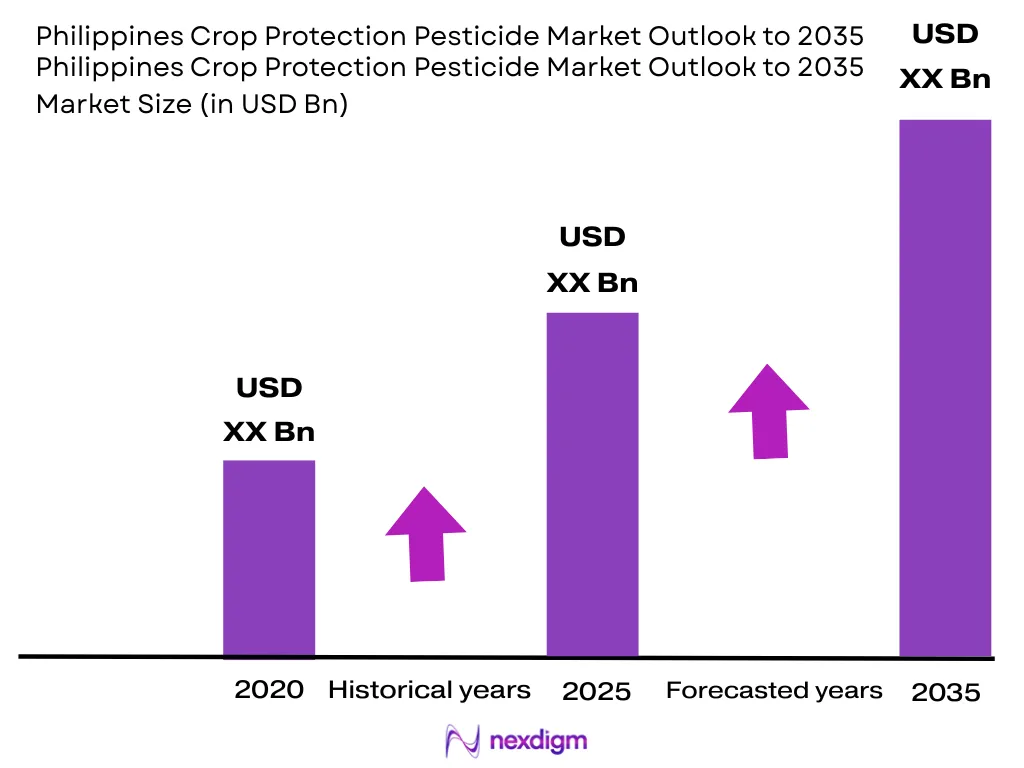
Philippines Crop Protection Pesticides Market is valued at USD ~ Billion based on a comprehensive historical assessment of pesticide sales across agricultural production systems. The market is primarily driven by the Philippines’ position as one of Southeast Asia’s most agriculturally active economies, with rice and corn cultivation spanning millions of hectares across Luzon, Visayas, and Mindanao, while high-value export crops including banana, pineapple, sugarcane, coconut, and mango generate substantial additional pesticide demand across the archipelago’s diverse agro-ecological zones, according to the Philippine Statistics Authority and the Fertilizer and Pesticide Authority. The country’s tropical monsoon climate, high year-round pest and disease pressure, frequent typhoon events that intensify fungal and bacterial disease incidence, expanding commercial plantation agriculture, and strong government focus on rice sufficiency and agricultural productivity improvement through the Philippine Rice Industry Roadmap continue to stimulate pesticide consumption across smallholder and commercial farming systems throughout the country.
Market Segmentation
By Product Type
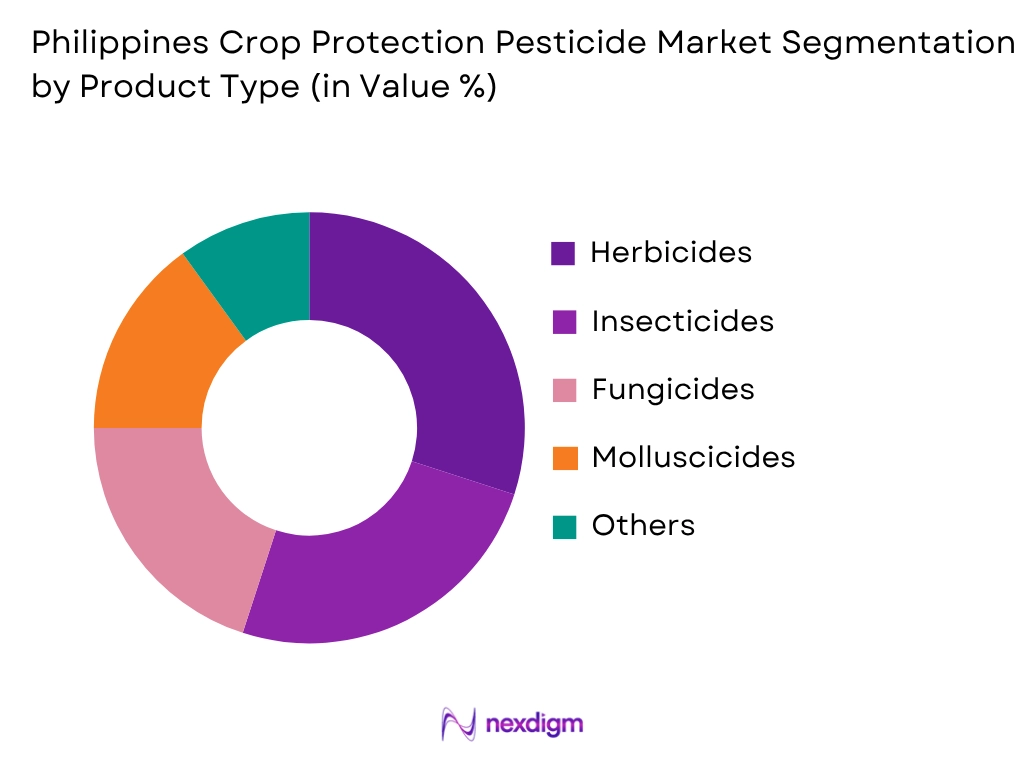
The herbicides segment dominates the Philippines Crop Protection Pesticides Market due to the country’s extensive rice and corn cultivation, where weed management represents one of the largest yield-limiting constraints and labor cost components for smallholder farmers across rainfed and irrigated production systems. The Philippines’ tropical climate with year-round warmth and abundant monsoon rainfall sustains aggressive weed populations across both lowland irrigated rice paddies and upland rainfed corn farms, making herbicide application a critical and frequently repeated agronomic intervention throughout multiple cropping seasons per year. The widespread adoption of glyphosate, butachlor, pretilachlor, and 2,4-D-based herbicides among smallholder rice farmers, combined with rising demand for selective pre-emergence and post-emergence herbicides in commercial corn, sugarcane, and banana plantation management, has reinforced the herbicide segment’s dominant position within the overall market. Labor shortages in rural farming communities driven by urban migration and rising agricultural wage rates are accelerating herbicide adoption as a cost-effective and time-saving substitute for manual hand weeding across rice paddies and upland crop fields. Continuous innovation in selective rice and corn herbicide formulations, resistance management programs for Echinochloa and Leptochloa weed species, and affordable smallholder packaging formats has enabled growers to maintain yield while managing escalating labor costs, reinforcing herbicides as the largest product category within the Philippines crop protection market.
By Crop Type
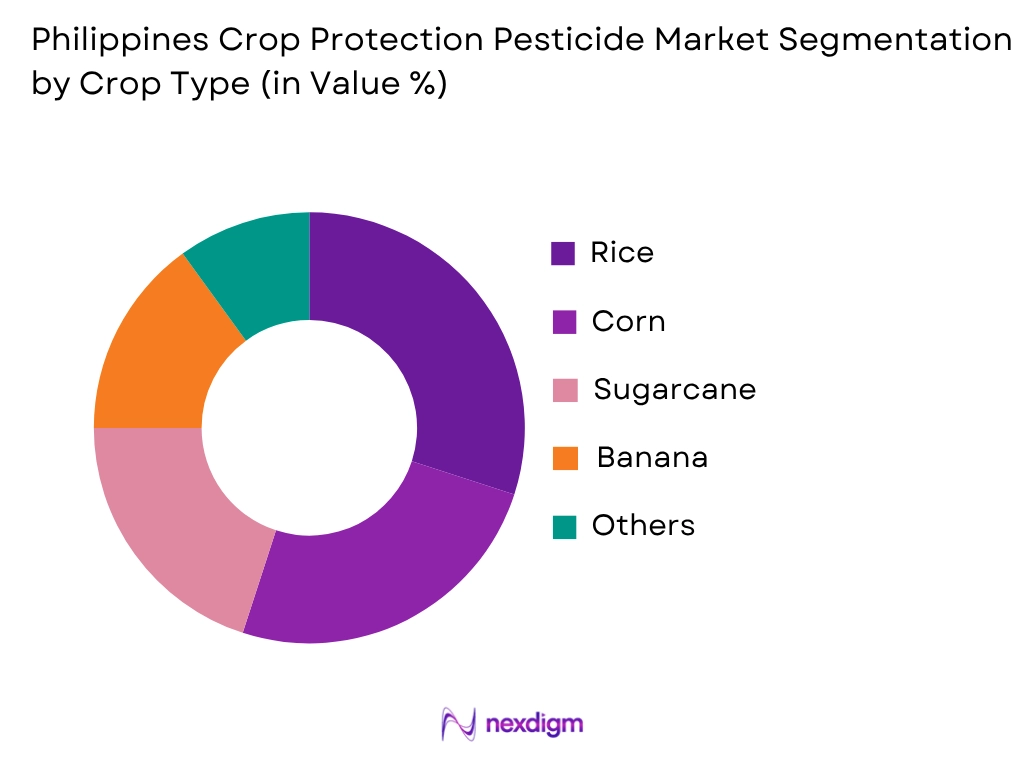
Rice accounts for the largest share of pesticide consumption owing to the Philippines’ status as one of Asia’s major rice-producing and rice-consuming nations, with palay production spanning approximately 4.8 million hectares of irrigated and rainfed lowland and upland fields across all major island groups and serving as the primary staple food for over 110 million Filipinos. Large government-supported irrigation systems across Central Luzon, Cagayan Valley, and Mindanao’s Cotabato Basin, combined with millions of smallholder rice farmers operating on average farm sizes of less than two hectares, require comprehensive crop protection against weeds, rice blast, bacterial leaf blight, brown planthopper, stem borers, and golden apple snails throughout multiple annual cropping cycles. The brown planthopper remains one of the most economically damaging rice pests in the Philippines, periodically causing widespread crop losses across major rice-producing provinces and driving substantial insecticide consumption during outbreak years. Blast disease caused by Magnaporthe oryzae and bacterial leaf blight caused by Xanthomonas oryzae represent significant fungicide and bactericide demand drivers across lowland irrigated rice systems susceptible to high humidity and dense canopy conditions. Continued government investment in the National Food Authority rice procurement program, Philippine Rice Research Institute improved variety releases, and Department of Agriculture rice production support initiatives reinforces rice cultivation’s dominant role in generating pesticide demand across the Philippines.
Competitive Landscape
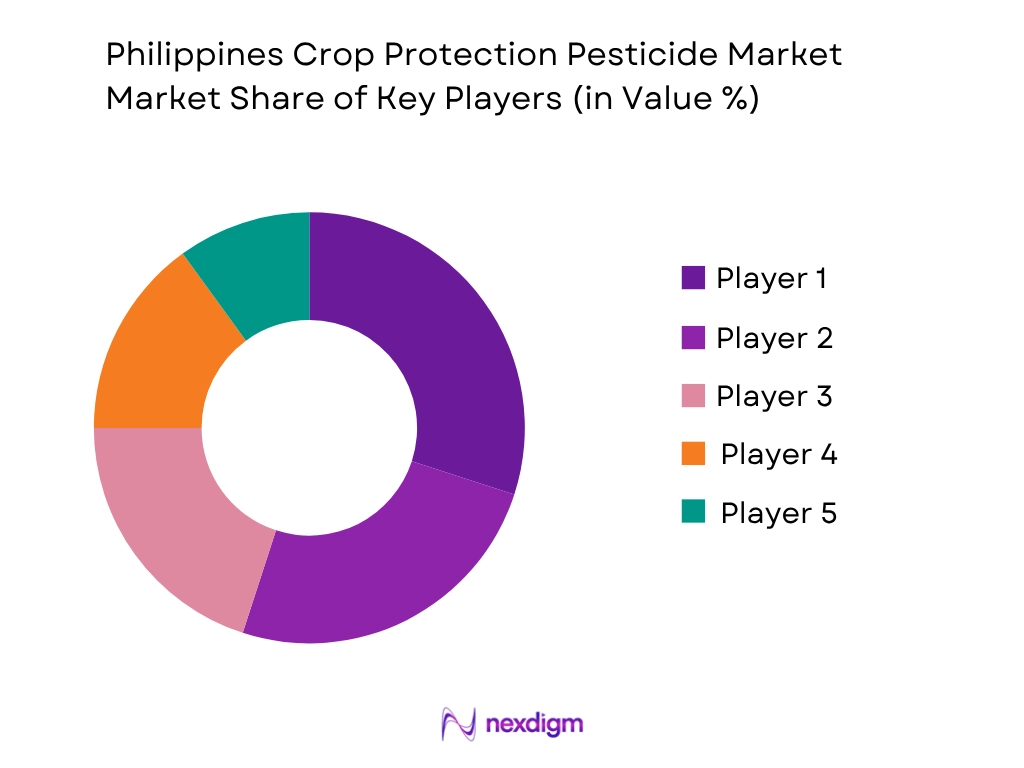
The Philippines Crop Protection Pesticides Market is characterized by a well-established combination of multinational agrochemical companies operating through local subsidiary offices and authorized distributors, alongside influential domestic agrochemical companies with deep rural distribution networks reaching smallholder farmers across the archipelago’s diverse island geography. Leading multinational firms including Bayer Crop Science Philippines, Syngenta Philippines, BASF Philippines, FMC Philippines, and UPL Philippines maintain strong market positions through extensive Fertilizer and Pesticide Authority-registered product portfolios, robust technical agronomic support services, and commercial partnerships with rice, corn, banana, and sugarcane producers across major agricultural regions. Domestic companies including Philagro Philippines and Agrophil Inc. compete through established agri-dealer networks, affordable formulation pricing, and deep familiarity with the pest management challenges facing Filipino smallholder farmers. Competition increasingly focuses on integrated crop protection solutions for rice and corn, extension services and field demonstration programs, smallholder-oriented packaging formats, and digital farm advisory platforms to address the fragmented distribution landscape across the Philippines’ geographically dispersed island farming communities.
| Company | Establishment Year | Headquarters | Product Portfolio | Biological Products
|
Manufacturing Presence | Major Crop Focus | Distribution Network | R&D Focus |
| Bayer Crop Science | 1863 | ~ | ~ | ~ | ~ | ~ | ~ | ~ |
| Syngenta Philippines | 2000 | ~ | ~ | ~ | ~ | ~ | ~ | ~ |
| FMC Philippines | 1883 | ~ | ~ | ~ | ~ | ~ | ~ | ~ |
| Philagro Philippines | 1971 | ~ | ~ | ~ | ~ | ~ | ~ | ~ |
| UPL Limited | 1969 | ~ | ~ | ~ | ~ | ~ | ~ | ~ |
Philippines Crop Protection Pesticide Market Analysis
Growth Drivers
Expansion of Rice and Corn Cultivation Under Government Food Security Programs
The Philippine government’s sustained investment in rice and corn production through the Rice Competitiveness Enhancement Fund, the Philippine Rice Industry Roadmap, and the Department of Agriculture’s corn production support programs remains the primary structural growth driver for the Crop Protection Pesticides Market, directly stimulating pesticide procurement and application across millions of smallholder rice and corn farms throughout the archipelago. The Rice Tariffication Law of 2019, while liberalizing rice imports, simultaneously established the Rice Competitiveness Enhancement Fund allocating several billion pesos annually for farm inputs including certified seeds, fertilizers, and crop protection products distributed to smallholder rice farmers through the Department of Agriculture’s regional field offices and cooperatives. Rice palay production spanning approximately 4.8 million hectares and corn cultivation covering over 2.6 million hectares across all major island groups collectively generate enormous pesticide demand from weed management, insect control, and disease management programs applied across two to three cropping seasons annually in irrigated and rainfed production systems. Commercial banana plantation expansion in Mindanao, particularly in Davao, Bukidnon, and Cotabato provinces, has added substantial demand for fungicides targeting black Sigatoka disease, insecticides for banana weevil borer control, and nematicides for root-knot nematode management across large-scale export plantation systems. Sugarcane cultivation in Negros Occidental, Bukidnon, and La Union, alongside tobacco production in the Ilocos Region, further diversifies pesticide demand across the Philippines’ multi-crop agricultural economy. Continuous government investment in irrigation infrastructure expansion, improved variety distribution, and agricultural credit programs is increasing crop production intensity and cultivated area across priority commodities, directly supporting sustained pesticide market growth.
High Tropical Pest and Disease Pressure Intensified by Typhoon Events
The Philippines’ geographic position within the Pacific typhoon belt, which exposes the archipelago to an average of twenty typhoons annually, creates a unique and recurring agricultural pest and disease dynamic that significantly elevates pesticide demand beyond what tropical climate conditions alone would generate. Typhoon damage to rice, corn, and banana crops creates large volumes of decaying plant material and standing water that serve as ideal breeding environments for fungal pathogens, bacterial diseases, and insect pest populations in the weeks and months following major weather events, triggering substantial post-typhoon fungicide and insecticide application campaigns across affected production areas. Rice blast, bacterial leaf blight, sheath blight, and tungro virus incidence typically increases significantly following typhoon seasons, driving fungicide and bactericide consumption across Central Luzon, Cagayan Valley, Eastern Visayas, and Bicol’s major irrigated rice systems. Black Sigatoka fungal disease in banana, which thrives under the high humidity and leaf wetness conditions that follow typhoon rainfall events, requires intensive preventive and curative fungicide spray programs across Mindanao’s export banana plantations to maintain export fruit quality standards demanded by Japanese, Korean, and Middle Eastern market buyers. The brown planthopper, which periodically erupts to outbreak population levels particularly following weather disruptions that eliminate natural predator populations, drives cyclical spikes in insecticide demand across Philippine rice production regions. Fall armyworm establishment across Philippine corn production regions from 2019 onwards has added a new recurring insecticide demand driver that compounds existing stem borer and aphid management requirements throughout the corn production calendar.
Market Challenges
Proliferation of Counterfeit and Substandard Pesticide Products
The widespread presence of counterfeit, adulterated, mislabeled, and substandard pesticide products throughout the Philippines’ agricultural input supply chain represents one of the most serious challenges undermining market integrity, farmer welfare, and sustainable crop protection adoption across the country’s rice, corn, and vegetable production regions. The Fertilizer and Pesticide Authority estimates that a significant proportion of pesticide products available through informal rural trading posts, wet markets, and unregistered agri-supply outlets fail to meet label specifications for active ingredient content, formulation quality, or shelf life, resulting in crop protection failures that erode farmer confidence in commercial pesticide products. Smallholder farmers purchasing counterfeit insecticides or fungicides for rice blast, brown planthopper, or banana black Sigatoka management experience inadequate pest control, crop damage, and financial losses that undermine their willingness to invest in crop protection products in subsequent seasons. The Philippines’ archipelagic geography, with over 7,600 islands and a highly decentralized rural economy served by thousands of informal agri-supply traders, creates immense practical challenges for Fertilizer and Pesticide Authority enforcement officers seeking to monitor and regulate the full breadth of pesticide retail distribution points across the country. Substandard product proliferation places compliant pesticide manufacturers and distributors at a competitive disadvantage relative to counterfeit operators who avoid registration, quality assurance, and compliance investment costs, creating pricing pressures throughout the legitimate market. Strengthening Fertilizer and Pesticide Authority enforcement capacity, implementing pesticide product authentication technologies, expanding farmer education on product verification, and prosecuting counterfeit supply chain operators are essential priorities for sustainable market development.
Fragmented Distribution and Geographic Accessibility Challenges
The Philippines’ archipelagic geography comprising over 7,600 islands creates fundamental distribution infrastructure challenges that limit timely pesticide access for smallholder farmers in remote island communities, increase logistics costs throughout the supply chain, and complicate inventory management for distributors seeking to maintain adequate product availability across geographically dispersed provincial agricultural markets. Inter-island shipping requirements, ferry schedule dependencies, port handling inefficiencies, and elevated freight costs for agricultural inputs traveling from major distribution centers in Manila, Cebu, and Davao to smaller island farming communities significantly increase the landed cost of pesticide products in remote provinces relative to mainland distribution markets. Typhoon seasons periodically disrupt inter-island shipping routes and road networks during precisely the agricultural periods when pest and disease outbreaks are most acute, creating critical supply gaps when farmers most urgently require crop protection products to salvage typhoon-affected crops. Rural road conditions in upland farming communities across Cordillera Administrative Region, Eastern Visayas, Caraga, and BARMM limit the physical reach of organized agri-dealer distribution networks, leaving many smallholder farmers dependent on informal local traders who may stock limited product ranges of inconsistent quality. Smallholder financial constraints, limited access to agricultural credit, and income seasonality tied to harvest cycles further restrict pesticide purchasing capacity and timing, complicating distributor inventory planning and cash flow management throughout the agricultural input supply chain. Digital input procurement platforms and mobile-based agricultural advisory applications are beginning to address connectivity and information gaps in some regions, but logistics and physical distribution infrastructure constraints continue to limit their practical impact on remote farming community pesticide access.
Market Opportunities
Expansion of Biological and Integrated Pest Management Solutions
Growing government and development organization support for sustainable agricultural intensification presents significant opportunities for biological crop protection products and integrated pest management programs across the Philippines’ rice, corn, banana, and vegetable production systems. The Philippine Rice Research Institute’s promotion of integrated pest management principles among rice farmers, the Bureau of Plant Industry’s biological control programs, and the Department of Agriculture’s climate-resilient agriculture initiatives collectively create institutional frameworks that support broader adoption of microbial insecticides, biofungicides, botanical pesticides, and beneficial insect releases within national crop protection programs. The rice golden apple snail management challenge, which affects millions of hectares of transplanted lowland rice across the Philippines and has historically driven significant molluscicide consumption, is increasingly being addressed through integrated management combining biological control using duck rearing, physical barriers, and reduced-chemical approaches alongside targeted molluscicide applications. Banana export plantation operators in Davao, Bukidnon, and Compostela Valley are progressively incorporating biological fungicide tank mixes and reduced-spray-interval programs within black Sigatoka management protocols to maintain export certification standards demanded by international buyers increasingly requiring pesticide residue compliance documentation. Organic and sustainably certified vegetable production for Metro Manila’s premium supermarket channels and export markets in Japan and South Korea creates growing demand for approved biological pesticide inputs that comply with private and public residue certification standards. International development organizations including the International Rice Research Institute, the Food and Agriculture Organization, and the Asian Development Bank continue to fund integrated pest management training and biological control demonstration programs across Philippine rice and corn growing regions, building farmer knowledge and demand for sustainable crop protection alternatives.
Growth of Precision Agriculture and Digital Farm Advisory Platforms
The rapid expansion of mobile internet connectivity across the Philippine archipelago, growth of digital financial services through GCash and Maya platforms, and increasing smartphone penetration among farming communities creates substantial opportunities for digital agricultural advisory services, precision pest management applications, and e-commerce input procurement platforms that can improve smallholder farmers’ access to quality crop protection information and products across geographically remote island farming communities. Agricultural technology companies including Mayani, Agrilink, and Cropital are integrating pesticide procurement, pest advisory services, and farm financing within digital platforms that allow smallholder rice, corn, and vegetable farmers to access registered crop protection products, agronomic recommendations, and payment solutions without requiring physical travel to distant agri-dealer outlets. The Department of Agriculture’s Bantay Presyo and DA Digital platforms, alongside the Philippine Rice Research Institute’s Rice Crop Manager mobile advisory tool, are establishing the digital extension service infrastructure through which precision pest monitoring data, weather-based disease outbreak alerts, and integrated pest management recommendations can be delivered directly to smallholder farmers on their mobile devices. Drone-based aerial pesticide application services for commercial banana, sugarcane, and corn plantations are expanding across Mindanao and Central Luzon, improving spray coverage uniformity and reducing pesticide volume requirements through precision application while addressing the labor scarcity challenges affecting large plantation operations. The Philippine government’s Digital Agriculture Transformation Roadmap under the Department of Agriculture and the Department of Information and Communications Technology identifies precision pest management and digital farm advisory services as priority investment areas, creating favorable policy conditions for AgriTech companies seeking to deploy digital crop protection platforms across the Philippines’ diverse island farming communities.
Future Outlook
The Philippines Crop Protection Pesticides Market is expected to maintain steady growth over the forecast period driven by continued government investment in rice and corn productivity programs, expanding commercial plantation agriculture in Mindanao, rising adoption of biological and integrated pest management solutions, and increasing digital connectivity enabling greater smallholder access to quality crop protection products and information. Sustainable agricultural practices, fall armyworm management technologies, biological crop protection innovation, and digital farm advisory platforms are expected to progressively reshape the competitive landscape. Regulatory modernization under the Fertilizer and Pesticide Authority, strengthened enforcement against counterfeit agrochemicals, and investments in rural distribution infrastructure are anticipated to improve market quality and expand access to registered crop protection products across the archipelago. Furthermore, continued expansion of export banana, pineapple, and high-value vegetable production, coupled with increasing investments in integrated pest management and drone-based application services, will support long-term market development across the Philippines’ major agricultural regions.
Major Players
- Bayer Crop Science Philippines
- Syngenta Philippines
- BASF Philippines
- FMC Philippines
- UPL Philippines
- Corteva Agriscience Philippines
- Nufarm Philippines
- Sumitomo Chemical Philippines
- ADAMA Philippines
- Philagro Philippines
- Zenith Agrochemicals
- Philippine Crop Protection Institute
- Agrophil Inc.
- Farmlink Philippines
- Rainbow Agro
Key Target Audience
- Crop Protection Product Manufacturers and Authorized Distributors
- Agricultural Cooperatives and Farmers Associations
- Commercial Plantation Operators and Agribusiness Enterprises
- Agrochemical Importers, Agri-Dealers and Rural Retail Outlets
- Biological Crop Protection and Biopesticide Manufacturers
- Investments and Venture Capitalist Firms Active in Philippine Agriculture
- Government and Regulatory Bodies (Fertilizer and Pesticide Authority, Department of Agriculture, Philippine Rice Research Institute, Bureau of Plant Industry, National Food Authority)
- Precision Agriculture, AgriTech and Digital Farm Advisory Solution Providers
Research Methodology
Step 1: Identification of Key Variables
The initial phase involves constructing an ecosystem map covering pesticide manufacturers, active ingredient importers, authorized distributors, agri-dealer networks, commercial plantation operators, smallholder farmer cooperatives, government agencies, and development organizations within the Philippines Crop Protection Pesticides Market. Extensive secondary research using public databases, Philippine Statistics Authority reports, Fertilizer and Pesticide Authority registration data, and proprietary industry sources is undertaken to identify the variables influencing market performance.
Step 2: Market Analysis and Construction
Historical information relating to pesticide imports, domestic formulation activity, crop acreage by commodity, pesticide consumption volumes, application intensity by crop and region, pricing trends, and farmer purchasing behavior is compiled and analyzed. Market revenues are estimated through both supply-side import and distribution analysis and demand-side crop-wise pesticide consumption, ensuring comprehensive market sizing and segmentation across the Philippines’ diverse island agricultural economy.
Step 3: Hypothesis Validation and Expert Consultation
Market assumptions are validated through structured interviews with pesticide manufacturers, authorized distributors, agri-dealer network operators, plantation managers, smallholder cooperative leaders, Fertilizer and Pesticide Authority officials, and agricultural extension workers. Computer-assisted telephone interviews and in-depth executive discussions provide operational insights that strengthen the accuracy of market estimates and competitive assessments across the Philippines’ regional agricultural markets.
Step 4: Research Synthesis and Final Output
The final phase integrates insights from primary interviews with secondary research findings using bottom-up and top-down estimation techniques. Cross-validation ensures consistency across market segments, island region analysis, competitive benchmarking, pricing analysis, and future projections, resulting in a comprehensive and reliable assessment of the Philippines Crop Protection Pesticides Market.

- Executive Summary
- Research Methodology (Market Definitions and Assumptions, Abbreviations, Market Sizing Approach, Top-Down Analysis, Bottom-Up Analysis, Demand-Side Assessment, Supply-Side Assessment, Primary Industry Interviews, Channel Partner Validation, Distributor-Level Assessment, Data Triangulation, Forecasting Framework, Limitations and Future Conclusions)

- Definition and Scope
- Market Evolution and Industry Genesis
- Timeline of Major Industry Developments
- Philippines Crop Protection Industry Value Chain Analysis
- Crop Protection Pesticides Supply Chain Analysis

- Growth Drivers (Expansion of Rice and Corn Cultivation, Rising Pest and Typhoon-Related Disease Pressure, Increasing Smallholder Farmer Access to Inputs, Growth in High-Value Commercial Crop Exports, Rising Demand for Food Security and Agricultural Productivity, Expansion of Precision Agriculture Initiatives, Adoption of Biological Crop Protection Solutions)
- Market Challenges (Counterfeit and Substandard Agrochemicals, Active Ingredient Import Price Volatility, Frequent Typhoon Disruptions to Agricultural Production, Resistance Management Issues, Regulatory Capacity Constraints, Post-Harvest Losses and Storage Pest Pressure)
- Market Opportunities (Bio-Based Crop Protection Products, Drone Spraying Services, Precision Agriculture Integration, Digital Pest Monitoring Platforms, Sustainable Integrated Pest Management, Premium Seed Treatment Solutions)
- Market Trends (Shift Towards Biologicals, Herbicide Resistance Management Programs, Tank Mix Optimization, Smart Spraying Technologies, Low-Dose High-Efficiency Molecules, Sustainable Formulation Technologies, AI-Based Pest Forecasting)
- Government Regulations (Fertilizer and Pesticide Authority Registration Framework, Department of Agriculture Guidelines, Philippine Rice Research Institute IPM Programs, Maximum Residue Limits, Good Agricultural Practices Compliance, Integrated Pest Management Guidelines, Traceability Requirements)
- PESTLE Analysis
- SWOT Analysis
- Porter’s Five Forces Analysis
- Stakeholder Ecosystem
- Competition Ecosystem

- By Market Value (2020-2025)
- By Volume Consumption (2020-2025)
- By Average Selling Price (2020-2025)

- By Product Type (In Value %)
Herbicides
Insecticides
Fungicides
Seed Treatment Chemicals
Plant Growth Regulators
Biological Crop Protection Products
Nematicides
Molluscicides
Rodenticides
Adjuvants and Spray Additives - By Chemical Origin (In Value %)
Synthetic Crop Protection Products
Biological Crop Protection Products
Botanical Pesticides
Microbial Pesticides
Biochemical Pesticides
- By Active Ingredient Class (In Value %)
Glyphosate-Based Products
Glufosinate-Based Products
2,4-D Products
Atrazine Products
Pyrethroids
Neonicotinoids
Organophosphates
Triazoles
Strobilurins
SDHI Fungicides
Diamides
Copper-Based Products
Sulfonylureas - By Crop Type (In Value %)
Rice (Palay)
Corn (Maize)
Sugarcane
Banana
Coconut
Vegetables
Pineapple
Mango
Tobacco
Rubber
Coffee
Cacao - By Region (In Value %)
Luzon
Visayas
Mindanao
Cagayan Valley
Central Luzon

- Market Share of Major Players (By Value, Volume, Product Type, Crop Type, Biological Products, Distribution Network)
- Cross Comparison Parameters (Registered Active Ingredients Portfolio, Biological Product Portfolio, Distribution Network Strength, Manufacturing and Formulation Capacity in the Philippines, R&D Pipeline for New Molecules, Seed Treatment Portfolio Strength, Digital Agriculture & Precision Farming Solutions, Crop Coverage Across Major Philippine Crops)
- SWOT Analysis of Major Players
- Pricing Analysis by Active Ingredient, Formulation Type and Crop Segment
- Product Portfolio Benchmarking
- Detailed Profiles of Major Companies
Bayer Crop Science Philippines
Syngenta Philippines
BASF Philippines
FMC Philippines
UPL Philippines
Corteva Agriscience Philippines
Nufarm Philippines
Sumitomo Chemical Philippines
ADAMA Philippines
Philagro Philippines
Zenith Agrochemicals
Philippine Crop Protection Institute
Agrophil Inc.
Farmlink Philippines
Rainbow Agro

- Crop Protection Product Consumption Analysis (Application Frequency, Seasonal Usage, Crop-Wise Consumption Intensity, Pest Pressure)
- Farmer Demographic Analysis (Farm Size, Commercial Orientation, Mechanization Level, Irrigated vs Rainfed Farming)
- Input Spending Analysis
- Purchase Decision Parameters
- Brand Loyalty Assessment

- By Market Value (2026-2035)
- By Volume Consumption (2026-2035)
- By Average Selling Price (2026-2035)


 Request a Sample
 Ask for Customization
 Get a Quote
 Enquire Now