

 Download PDF
Market Overview
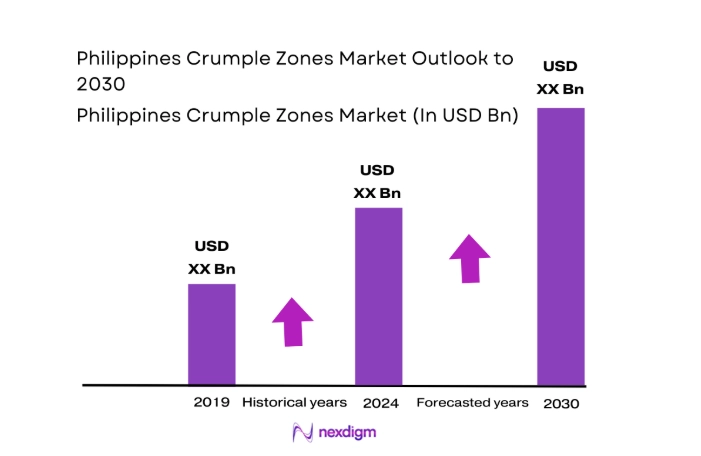
The Philippines Crumple Zones market current size stands at around USD ~ million, reflecting steady demand from passenger and commercial vehicle manufacturing ecosystems. In the most recent period, the market recorded an estimated shipment base of ~ units, rising from ~ units in the preceding cycle as OEM safety integration intensified. Installed structural safety systems reached nearly ~ systems, supported by higher model refresh activity and compliance-driven upgrades across assembly lines. Average revenue per integrated crash structure stabilized at close to USD ~ thousand, driven by multi-material adoption.
Metro Manila and adjacent industrial corridors dominate the market due to the concentration of vehicle assembly plants, tier suppliers, and logistics hubs. CALABARZON continues to attract investments in metal forming and crash management systems, supported by established economic zones and supplier parks. Cebu and Davao are emerging secondary demand centers, benefiting from growing vehicle sales density and regional fleet modernization programs. Policy focus on transport safety and the strengthening of automotive standards further reinforce regional leadership patterns.
Market Segmentation
By Application
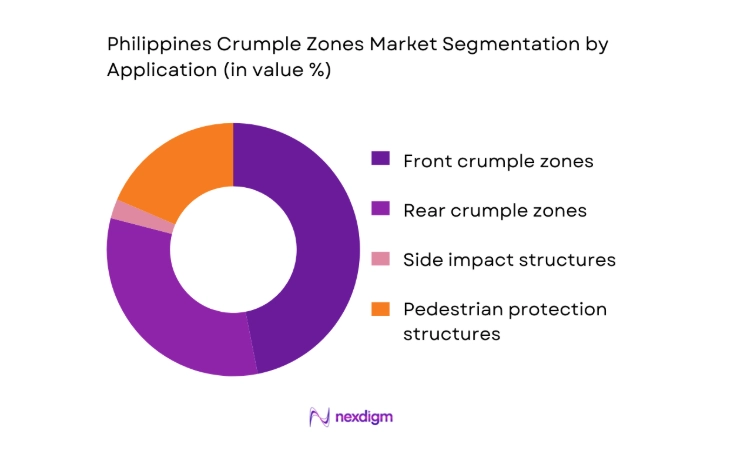
Front and rear crumple zones dominate application-based demand due to their direct role in frontal and rear collision energy absorption. Over recent cycles, OEMs have prioritized advanced front-end crash structures to meet evolving safety protocols and consumer expectations for occupant protection. Side impact and pedestrian protection structures are gaining traction, particularly in urban vehicle platforms, where collision profiles increasingly involve lateral impacts and vulnerable road users. The dominance of frontal systems is further supported by supplier specialization, higher bill-of-material value per vehicle, and deeper integration with airbag and restraint architectures, making this segment central to both revenue generation and technological differentiation.
By End-Use Industry
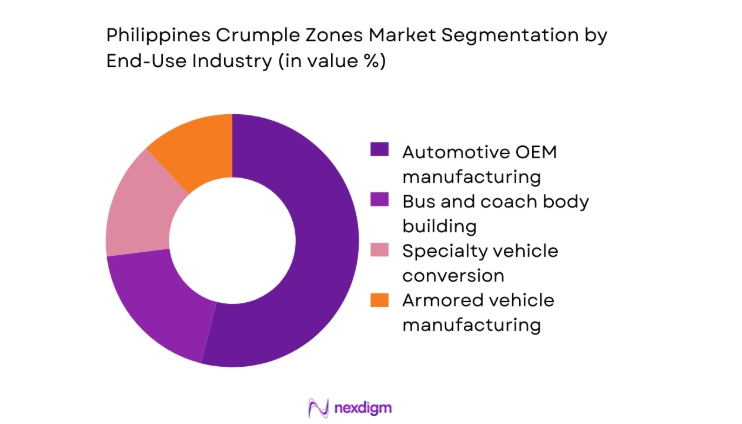
Automotive OEM manufacturing remains the primary end-use segment, driven by consistent vehicle production pipelines and the integration of safety systems at the design stage. Bus and coach body building represents a growing niche as public transport modernization initiatives emphasize passenger safety and structural resilience. Specialty vehicle conversion and armored vehicle manufacturing contribute smaller but higher-value demand, given their reliance on reinforced crash management structures. The dominance of OEM manufacturing is reinforced by long-term supply contracts, standardized safety validation processes, and the increasing tendency of automakers to localize structural components to improve supply chain reliability and cost efficiency.
Competitive Landscape
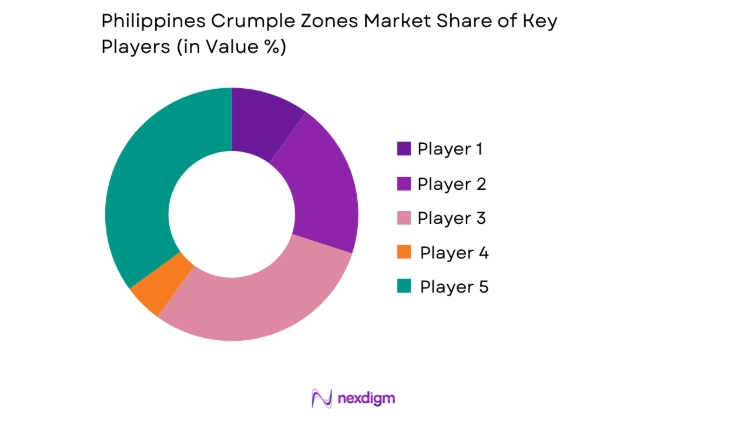
The Philippines Crumple Zones market exhibits a moderately concentrated structure, characterized by the presence of global automotive safety suppliers alongside strong local OEM operations. Competitive dynamics are shaped by long-term supply agreements, technical validation cycles, and regulatory alignment rather than short-term pricing moves. Market entry barriers remain high due to certification requirements and the capital intensity of crash testing and material engineering.
| Company Name | Establishment Year | Headquarters | Formulation Depth | Distribution Reach | Regulatory Readiness | Service Capability | Channel Strength | Pricing Flexibility |
| Toyota Motor Philippines Corporation | 1988 | Philippines | ~ | ~ | ~ | ~ | ~ | ~ |
| Mitsubishi Motors Philippines Corporation | 2015 | Philippines | ~ | ~ | ~ | ~ | ~ | ~ |
| Honda Cars Philippines Inc. | 1990 | Philippines | ~ | ~ | ~ | ~ | ~ | ~ |
| Ford Motor Company Philippines | 1997 | Philippines | ~ | ~ | ~ | ~ | ~ | ~ |
| Hyundai Motor Philippines | 2022 | Philippines | ~ | ~ | ~ | ~ | ~ | ~ |
Philippines Crumple Zones Market Analysis
Growth Drivers
Rising vehicle safety awareness among Filipino consumers
In the last two market cycles, consumer demand for safer vehicles increased measurably, with annual new vehicle registrations exceeding ~ vehicles and safety-feature-equipped models accounting for ~ units of this volume. Dealer-reported test drive conversions for vehicles with enhanced crash protection rose by ~ units compared with the prior period. Insurance-linked vehicle assessments recorded ~ systems fitted with upgraded crumple structures, reinforcing the link between safety perception and purchasing behavior. These shifts translated into an estimated incremental market value of USD ~ million from safety-driven upgrades alone.
Increasing adoption of ASEAN NCAP safety standards by OEMs
Over the recent regulatory cycle, ~ models assembled locally aligned their structural safety design with ASEAN NCAP protocols, compared with ~ models in the previous phase. This transition required the integration of approximately ~ systems of advanced crash management components across production lines. OEM capital allocation toward safety validation and tooling reached close to USD ~ million, underscoring compliance-led demand momentum. As a result, installed base expansion of standardized crumple zone architectures added roughly ~ units to the market’s active structural safety footprint.
Challenges
Cost sensitivity in mass-market vehicle segments
In price-sensitive vehicle categories, manufacturers face persistent pressure to cap bill-of-material increases below USD ~ thousand per vehicle, limiting the adoption of premium crash materials. Over the last two cycles, ~ units of entry-level vehicles retained conventional steel structures instead of higher-performance alternatives due to affordability thresholds. This constrained the potential market expansion by an estimated USD ~ million in forgone advanced safety component uptake. Fleet buyers in logistics and public transport segments similarly deferred upgrades across ~ vehicles to manage total ownership costs.
Limited local manufacturing of advanced crash materials
Domestic production capacity for high-strength steel and composites remains limited to ~ facilities, compared with ~ regional suppliers serving the broader ASEAN market. As a result, local assemblers rely on imported material volumes of approximately ~ tons annually, elevating lead times and inventory carrying costs. These constraints translate into incremental logistics expenses approaching USD ~ million across the supply chain. The dependency also reduces responsiveness to design changes, delaying the deployment of next-generation crumple zone configurations in new model introductions.
Opportunities
Localization of crash structure manufacturing in economic zones
Economic zones currently host ~ automotive component plants, presenting a scalable platform for localizing crash structure production. Feasibility assessments indicate potential capacity additions of ~ units annually through modular stamping and welding lines, with capital requirements estimated at USD ~ million per facility. Local production could replace imported volumes of ~ units, shortening supply cycles and reducing cost volatility. This shift would not only strengthen domestic value addition but also position the Philippines as a regional export hub for standardized crash management components.
Integration of smart materials with ADAS safety platforms
The convergence of passive and active safety systems creates demand for ~ systems of sensor-integrated structural components across new vehicle platforms. Recent pilot deployments covered ~ vehicles equipped with data-enabled crash structures that interface with onboard diagnostics and ADAS modules. Engineering investment into smart material integration reached nearly USD ~ million in prototype development and validation. This trajectory opens pathways for differentiated safety offerings, enabling OEMs to monetize advanced protection features while enhancing real-time crash response capabilities.
Future Outlook
The Philippines Crumple Zones market is poised for steady advancement as vehicle safety becomes a core differentiator across passenger and commercial segments. Ongoing regulatory alignment with regional standards and the gradual shift toward electric and connected vehicles will reshape structural safety design priorities. Localization of manufacturing and the emergence of smart crash systems are expected to redefine supplier strategies. Over the coming years, collaborative ecosystems between OEMs, material innovators, and policy agencies will play a decisive role in shaping market maturity.
Major Players
- Autoliv Inc.
- ZF Friedrichshafen AG
- Magna International Inc.
- Gestamp Automoción
- Benteler Automotive
- Thyssenkrupp Automotive Technology
- ArcelorMittal Tailored Blanks
- Aisin Corporation
- Toyota Motor Philippines Corporation
- Honda Cars Philippines Inc.
- Mitsubishi Motors Philippines Corporation
- Ford Motor Company Philippines
- Hyundai Motor Philippines
- Isuzu Philippines Corporation
- Nissan Motor Philippines
Key Target Audience
- Automotive OEMs and local vehicle assemblers
- Tier I and Tier II automotive component suppliers
- Fleet operators in logistics and public transportation
- Insurance and risk management companies
- Investments and venture capital firms focused on mobility technologies
- Department of Transportation, Philippines
- Land Transportation Office, Philippines
- Department of Trade and Industry, Philippines
Research Methodology
Step 1: Identification of Key Variables
Key demand indicators, production linkages, and regulatory parameters were mapped across vehicle segments and safety systems. Market boundaries were defined around structural crash management solutions. Core value chain participants and technology nodes were identified to frame the analytical scope.
Step 2: Market Analysis and Construction
Historical performance trends were synthesized with current production and safety adoption patterns. Segmentation frameworks were constructed to reflect application and end-use dynamics. Market sizing logic was validated through triangulation of supply, demand, and installation metrics.
Step 3: Hypothesis Validation and Expert Consultation
Assumptions on safety adoption, localization potential, and material transitions were stress-tested. Insights from industry practitioners informed scenario refinement.
Regulatory trajectories were assessed to validate long-term demand drivers.
Step 4: Research Synthesis and Final Output
Findings were consolidated into a cohesive market narrative. Strategic implications were derived for stakeholders across the ecosystem. Quality checks ensured consistency in data logic and presentation standards.

- Executive Summary
- Research Methodology (Market definitions and scope boundaries, crumple zone system taxonomy across front rear and side impact structures, market sizing logic by vehicle production and safety content value, revenue attribution across components materials and integration services, primary interview program with OEMs Tier 1 suppliers and safety engineers, data triangulation validation assumptions and limitations)

- Definition and Scope
- Market evolution
- Care or usage pathways
- Ecosystem structure
- Supply chain or channel structure
- Regulatory environment

- Growth Drivers
Rising vehicle safety awareness among Filipino consumers
Increasing adoption of ASEAN NCAP safety standards by OEMs
Growth in SUV and crossover sales requiring advanced crash structures
Expansion of public transport modernization programs
Strengthening of local vehicle assembly and CKD operations
Insurance industry push for higher safety-rated vehicles - Challenges
Cost sensitivity in mass-market vehicle segments
Limited local manufacturing of advanced crash materials
Dependence on imported high-strength steel and composites
Fragmented aftermarket safety modification ecosystem
Slow fleet renewal in commercial vehicle segments
Inconsistent enforcement of vehicle safety regulations - Opportunities
Localization of crash structure manufacturing in economic zones
Integration of smart materials with ADAS safety platforms
Growth in electric vehicle platforms requiring redesigned crumple zones
Fleet safety upgrades in government and logistics sectors
Partnerships between OEMs and material science innovators
Expansion of safety-led vehicle differentiation strategies - Trends
Shift toward lightweight multi-material body structures
Adoption of modular front-end crash management systems
Increasing use of simulation-led crash design and validation
Integration of pedestrian protection structures in urban vehicles
OEM focus on total cost of ownership safety benefits
Growing role of safety ratings in consumer purchase decisions - Government Regulations
- SWOT Analysis
- Stakeholder and Ecosystem Analysis
- Porter’s Five Forces Analysis
- Competition Intensity and Ecosystem Mapping

- By Value, 2019–2024
- By Volume, 2019–2024
- By Installed Base, 2019–2024
- By Average Selling Price, 2019–2024

- By Fleet Type (in Value %)
Passenger vehicles
Light commercial vehicles
Heavy commercial vehicles
Public transport buses - By Application (in Value %)
Front crumple zones
Rear crumple zones
Side impact energy absorption structures
Pedestrian protection structures - By Technology Architecture (in Value %)
High-strength steel structures
Aluminum energy-absorbing structures
Composite crash management systems
Modular crash box systems - By End-Use Industry (in Value %)
Automotive OEM manufacturing
Bus and coach body building
Armored and security vehicle manufacturing
Specialty vehicle conversion and upfitting - By Connectivity Type (in Value %)
Non-connected passive safety structures
Sensor-integrated smart structures
ADAS-integrated crash management systems
V2X-linked vehicle safety systems - By Region (in Value %)
National Capital Region
Luzon (excluding NCR)
Visayas
Mindanao

- Market structure and competitive positioning
Market share snapshot of major players - Cross Comparison Parameters (local manufacturing footprint, material technology portfolio, OEM partnerships, cost competitiveness, regulatory compliance capability, supply chain resilience, R&D investment intensity, aftermarket support reach)
- SWOT Analysis of Key Players
- Pricing and Commercial Model Benchmarking
- Detailed Profiles of Major Companies
Autoliv Inc.
ZF Friedrichshafen AG
Magna International Inc.
Gestamp Automoción
Benteler Automotive
Thyssenkrupp Automotive Technology
ArcelorMittal Tailored Blanks
Aisin Corporation
Toyota Motor Philippines Corporation
Honda Cars Philippines Inc.
Mitsubishi Motors Philippines Corporation
Ford Motor Company Philippines
Hyundai Motor Philippines
Isuzu Philippines Corporation
Nissan Motor Philippines

- Demand and utilization drivers
- Procurement and tender dynamics
- Buying criteria and vendor selection
- Budget allocation and financing preferences
- Implementation barriers and risk factors
- Post-purchase service expectations

- By Value, 2025–2030
- By Volume, 2025–2030
- By Installed Base, 2025–2030
- By Average Selling Price, 2025–2030


 Request a Sample
 Ask for Customization
 Get a Quote
 Enquire Now