
 Download PDF
Market Overview
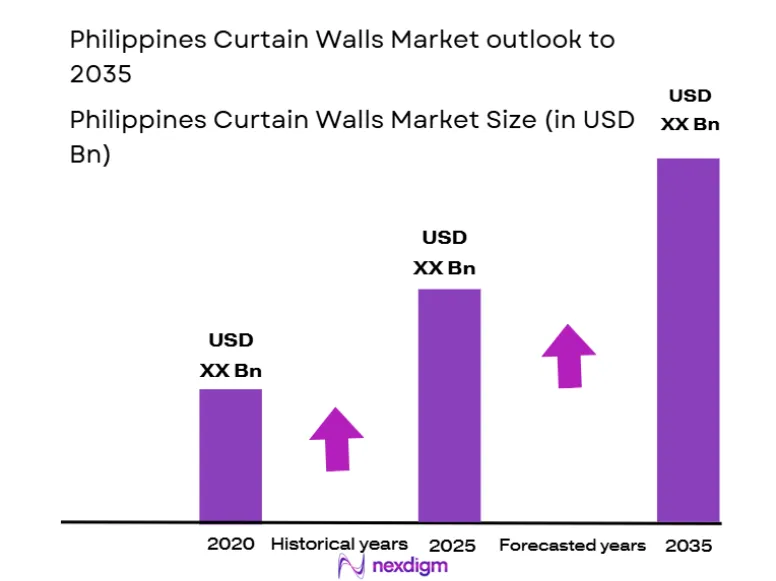
The Philippines Curtain Walls Market recorded an assessed market value of USD ~ billion based on a recent historical assessment, supported by construction expenditure data from the Philippine Statistics Authority and project pipeline disclosures from the Department of Public Works and Highways. Market expansion is driven by sustained high-rise commercial development, large-scale residential condominium projects, and mixed-use urban complexes. Strong demand for energy-efficient façades, compliance with updated building codes, and increased adoption of unitized curtain wall systems continue to support procurement volumes. Imports of aluminum systems and architectural glass remain critical to meeting specification requirements.
Metro Manila dominates the Philippines Curtain Walls Market due to concentrated commercial real estate development, infrastructure density, and the presence of major property developers. Cities such as Makati, Bonifacio Global City, and Ortigas serve as primary demand centers driven by office towers, premium residential buildings, and mixed-use developments. Cebu and Davao follow as secondary hubs due to regional urbanization and tourism-linked construction. Dominance is further supported by access to skilled façade contractors, logistics infrastructure, proximity to ports, and alignment with international architectural and safety standards.
Market Segmentation
By Product Type
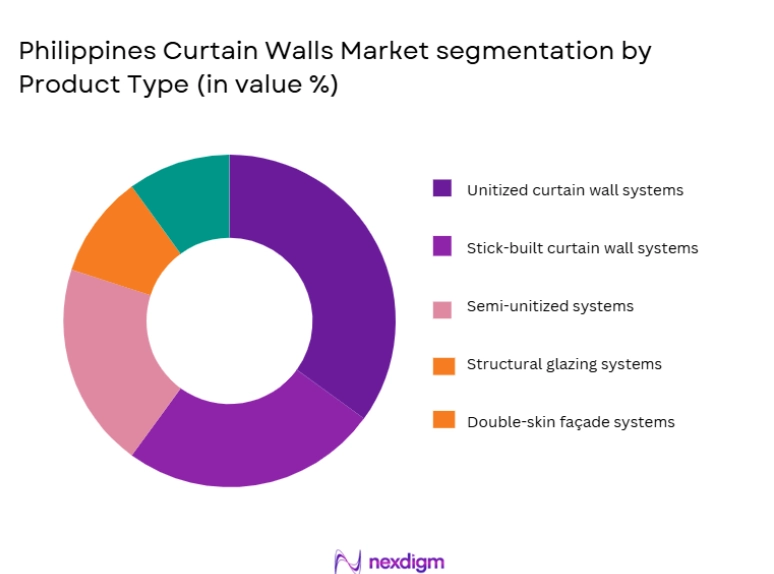
By product type, the Philippines Curtain Walls Market is segmented into unitized curtain wall systems, stick-built curtain wall systems, semi-unitized systems, structural glazing systems, and double-skin façade systems. Recently, unitized curtain wall systems have held a dominant market share due to faster installation timelines, superior quality control, and reduced on-site labor dependency. Large-scale commercial and residential high-rise projects increasingly favor unitized systems because they are factory-assembled, ensuring consistency and compliance with performance standards. The ability to handle wind load, seismic considerations, and water penetration efficiently makes them suitable for dense urban environments. Developers also prefer unitized systems for predictable project scheduling, reduced construction risk, and compatibility with modern architectural designs. These advantages collectively reinforce their dominance.
By End User
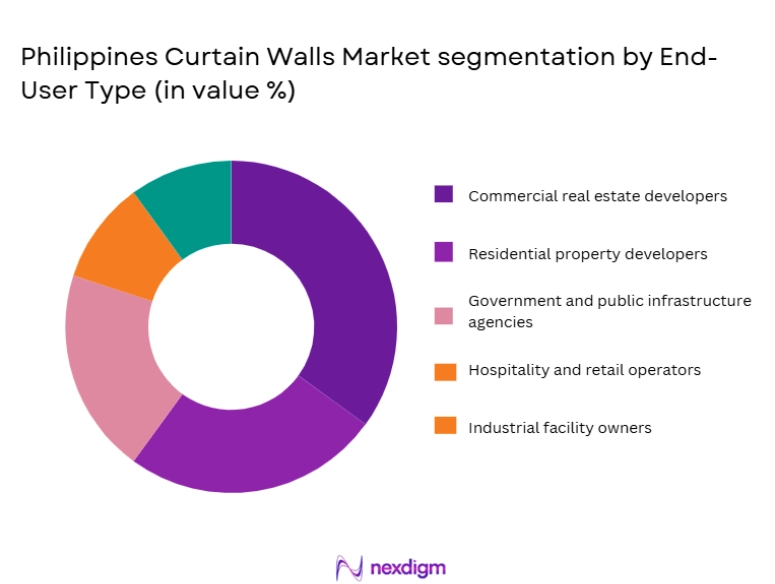
By end user, the Philippines Curtain Walls Market is segmented into commercial real estate developers, residential property developers, government and public infrastructure agencies, hospitality and retail operators, and industrial facility owners. Recently, commercial real estate developers have accounted for the dominant market share due to sustained investment in office towers, business districts, and mixed-use developments. Demand is driven by requirements for high-performance façades that enhance building aesthetics, thermal efficiency, and long-term asset value. Commercial developers prioritize premium materials and advanced glazing to meet tenant expectations and international building standards. The concentration of corporate offices and multinational tenants further strengthens this segment’s influence. Continuous redevelopment and vertical expansion support its leading position.
Competitive Landscape
The Philippines Curtain Walls Market exhibits moderate consolidation, with international façade system providers and established regional manufacturers exerting strong influence through technology leadership and project execution capabilities. Global players partner with local fabricators and contractors to strengthen market reach and compliance. Competitive intensity is shaped by pricing, customization capability, supply reliability, and after-sales technical support.
| Company Name | Establishment Year | Headquarters | Technology Focus | Market Reach | Key Products | Revenue | Local Manufacturing Presence |
| AGC Flat Glass Philippines | 1907 | Philippines | ~
|
~
|
~
|
~
|
~
|
| Saint-Gobain Philippines | 1665 | France | ~
|
~
|
~
|
~
|
~
|
| Guardian Glass Philippines | 1932 | USA | ~
|
~
|
~
|
~
|
~
|
| YKK AP Asia Pacific | 1934 | Japan | ~
|
~
|
~
|
~
|
~
|
| Schüco Philippines | 1951 | Germany | ~
|
~
|
~
|
~
|
~
|
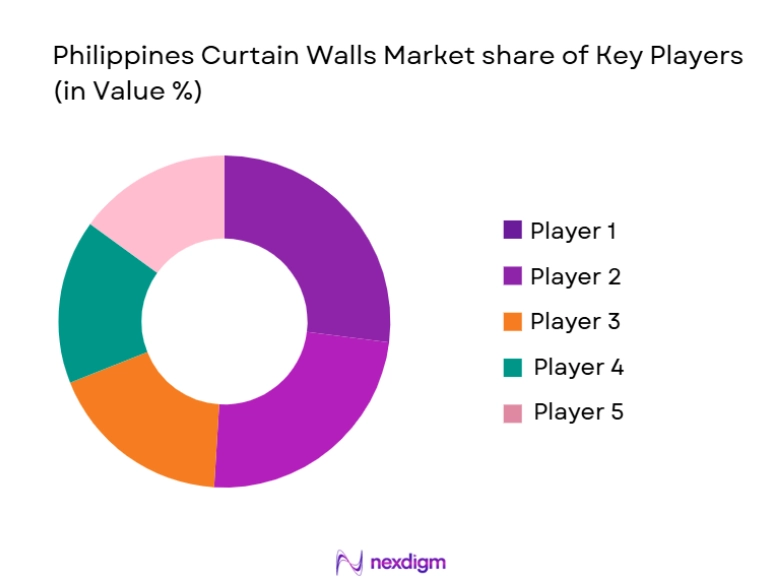
Philippines Curtain Walls Market Analysis
Growth Drivers
Urban High-Rise Construction and Commercial Real Estate Expansion
The Philippines Curtain Walls Market is strongly supported by sustained vertical development in major metropolitan centers driven by population density, land constraints, and corporate expansion. Developers increasingly favor high-rise structures to optimize land use and improve commercial returns. Curtain wall systems enable modern architectural designs while meeting structural and safety requirements in dense urban environments. Office towers, mixed-use complexes, and premium residential buildings require high-performance façades to address wind load, seismic conditions, and thermal efficiency. Public and private investments in business districts reinforce continuous construction activity. The demand for faster construction timelines further supports the adoption of advanced curtain wall technologies. Regulatory compliance and international building standards increase the use of certified façade systems. These combined factors maintain consistent procurement volumes. The resulting ecosystem supports manufacturers, fabricators, and installers across the value chain.
Energy Efficiency and Building Performance Regulations
Regulatory emphasis on sustainable construction directly accelerates demand in the Philippines Curtain Walls Market by mandating higher thermal and energy performance standards. Curtain wall systems with advanced glazing help reduce heat gain and energy consumption in commercial buildings. Developers adopt these systems to comply with green building certifications and national energy efficiency frameworks. Improved indoor comfort and reduced operational costs enhance building value and tenant appeal. Government incentives and awareness programs support the adoption of compliant materials. Architectural firms increasingly specify high-performance façades during design stages. Imported glazing technologies further elevate performance benchmarks. Compliance-driven procurement reduces substitution risk. These regulatory dynamics create long-term structural demand.
Market Challenges
Dependence on Imported Façade Materials and Components
The Philippines Curtain Walls Market faces operational constraints due to heavy reliance on imported aluminum systems and architectural glass. Global supply chain disruptions can affect project timelines and cost predictability. Currency fluctuations influence procurement budgets and pricing stability. Limited domestic manufacturing capacity restricts rapid response to demand surges. Import documentation and customs procedures add administrative complexity. Developers must manage extended lead times for specialized components. Technical specifications often require international certification, narrowing supplier options. These factors increase project execution risk. The challenge impacts both large and mid-scale developers.
High Installation Costs and Skilled Labor Constraints
Curtain wall installations require specialized engineering, precision fabrication, and experienced installation teams. The limited availability of trained façade professionals increases labor costs and scheduling risks. Complex building geometries demand advanced installation expertise. Safety compliance and quality assurance requirements further raise operational expenses. Smaller contractors face barriers to entry due to capital and training needs. Project delays can escalate costs and affect developer margins. Training programs remain insufficient to meet growing demand. These constraints slow market scalability. Cost sensitivity remains a persistent challenge.
Opportunities
Adoption of Smart and High-Performance Façade Technologies
The Philippines Curtain Walls Market presents strong opportunities through integration of smart glass and adaptive façade systems. Developers increasingly seek façades that enhance energy efficiency and occupant comfort. Technologies such as low-emissivity coatings and dynamic glazing attract premium projects. Smart façades support building automation and sustainability goals. International technology transfer enhances local capability. Demand from commercial and institutional buildings accelerates adoption. Suppliers offering integrated solutions gain competitive advantage. Innovation-driven differentiation strengthens market positioning. This opportunity supports value-added growth.
Public Infrastructure and Urban Redevelopment Initiatives
Government-led urban renewal and infrastructure programs create new demand channels for curtain wall systems. Transport hubs, civic buildings, and public complexes increasingly adopt modern façade designs. Compliance with safety and durability standards supports advanced system adoption. Public-private partnerships expand project pipelines. Urban regeneration increases construction density in established cities. Façade aesthetics contribute to city branding objectives. Standardization improves procurement efficiency. These initiatives broaden market participation. Long-term visibility supports investment planning.
Future Outlook
The Philippines Curtain Walls Market is expected to maintain stable growth over the next five years, supported by continued urbanization and infrastructure investment. Advancements in energy-efficient glazing and unitized systems will shape procurement preferences. Regulatory alignment with sustainability goals will reinforce demand for high-performance façades. Increasing private and public sector construction activity is expected to sustain consistent market momentum.
Major Players
- AGC Flat Glass Philippines
- Saint-Gobain Philippines
- Guardian Glass Philippines
- YKK AP Asia Pacific
- Schüco Philippines
- Reynaers Aluminium
- AluK Asia
- Alutech Systems Philippines
- Union Galvasteel Corporation
- Metro Glass & Aluminum Supply
- MGlass Philippines
- Alumina Glass Philippines
- DMCI Homes Façade Systems
- EEI Corporation
- Megawide Construction Corporation
Key Target Audience
- Commercial real estate developers
- Residential property developers
- Infrastructure project developers
- Investments and venture capitalist firms
- Government and regulatory bodies
- Construction contractors
- Architectural and façade engineering firms
- Building material suppliers
Research Methodology
Step 1: Identification of Key Variables
Market variables were identified through analysis of construction activity, façade specifications, and regulatory requirements influencing curtain wall adoption.
Step 2: Market Analysis and Construction
Data from government construction statistics, company disclosures, and trade data were analyzed to structure the market and segment demand drivers.
Step 3: Hypothesis Validation and Expert Consultation
Industry experts, contractors, and material suppliers were consulted to validate assumptions and ensure technical accuracy.
Step 4: Research Synthesis and Final Output
Findings were consolidated into a structured market framework ensuring consistency, relevance, and clarity.

- Executive Summary
- Research Methodology (Definitions, Scope, Industry Assumptions, Market Sizing Approach, Primary & Secondary Research Framework, Data Collection & Verification Protocol, Analytic Models & Forecast Methodology, Limitations & Research Validity Checks)

- Market Definition and Scope
- Value Chain & Stakeholder Ecosystem
- Regulatory / Certification Landscape
- Sector Dynamics Affecting Demand
- Strategic Initiatives & Infrastructure Growth

- Growth Drivers
Urban high-rise construction expansion
Rising demand for energy-efficient building envelopes
Growth in mixed-use and commercial real estate developments - Market Challenges
High initial installation and material costs
Dependence on imported façade components
Skilled labor and technical expertise constraints - Market Opportunities
Adoption of sustainable and green building façades
Integration of smart glass and advanced glazing technologies
Public infrastructure and urban redevelopment projects - Trends
Increasing use of unitized curtain wall systems
Rising preference for high-performance glazing
Integration of façade aesthetics with energy performance - Government Regulations
Building code compliance and façade safety standards
Energy efficiency and green building regulations
Import standards and material certification requirements

- By Market Value 2020-2025
- By Volume, 2020-2025

By System Type (In Value%)
Unitized curtain wall systems
Stick-built curtain wall systems
Semi-unitized curtain wall systems
Structural glazing systems
Double-skin curtain wall systems
By Platform Type (In Value%)
Commercial high-rise buildings
Residential towers and condominiums
Mixed-use developments
Institutional buildings
Hospitality and retail complexes
By Fitment Type (In Value%)
New construction installations
Retrofit and renovation projects
Façade replacement projects
Energy-efficiency upgrade installations
Seismic and wind-load reinforcement fitments
By EndUser Segment (In Value%)
Commercial real estate developers
Residential property developers
Government and public infrastructure agencies
Hospitality and retail operators
Industrial and logistics facility owners
By Procurement Channel (In Value%)
Direct procurement from manufacturers
EPC and turnkey contractors
Façade engineering consultants
Authorized distributors and suppliers
Public tender and government contracts

- Market Share of Major Players in Philippines Curtain Walls Market Basis Value/Volume, 2020-2025
- Competitive Benchmarking of Key Players Basis Parameters including
- Company Overview
- Business Strategies
- Revenues
- Future Plans
- Revenue by Project Type and Revenues by Region
- Manufacturing Plant
- Key Clients
- Number of Employees
- Pricing analysis
- SWOT Analysis of Key Competitors
- Pricing & Procurement Analysis
- Porter’s Five Forces
- Key Players
Seapac
Shiny Curtainwall
Leicorv
SOTA
Lakshmi BEMT
Intact
JN STW
AGC Flat Glass Philippines
Saint-Gobain Philippines
Guardian Glass Philippines
YKK AP Asia Pacific
Schüco Philippines
AluK Asia
Reynaers Aluminium Asia
Alutech Systems Philippines
CW Home Depot Building Solutions
Metro Glass & Aluminum Supply
Alumina Glass Philippines
Philippine Foremost Milling Glass Division
Union Galvasteel Corporation
MGlass Philippines
DMCI Homes Façade Systems

- Commercial developers prioritize façade performance and aesthetics
- Residential developers focus on cost efficiency and thermal comfort
- Public sector emphasizes safety and regulatory compliance
- Hospitality sector demands customized and premium façade designs

Forecast Market Value 2026-2035
Forecast Volume 2026-2035


 Request a Sample
 Ask for Customization
 Get a Quote
 Enquire Now