
 Download PDF
Market Overview
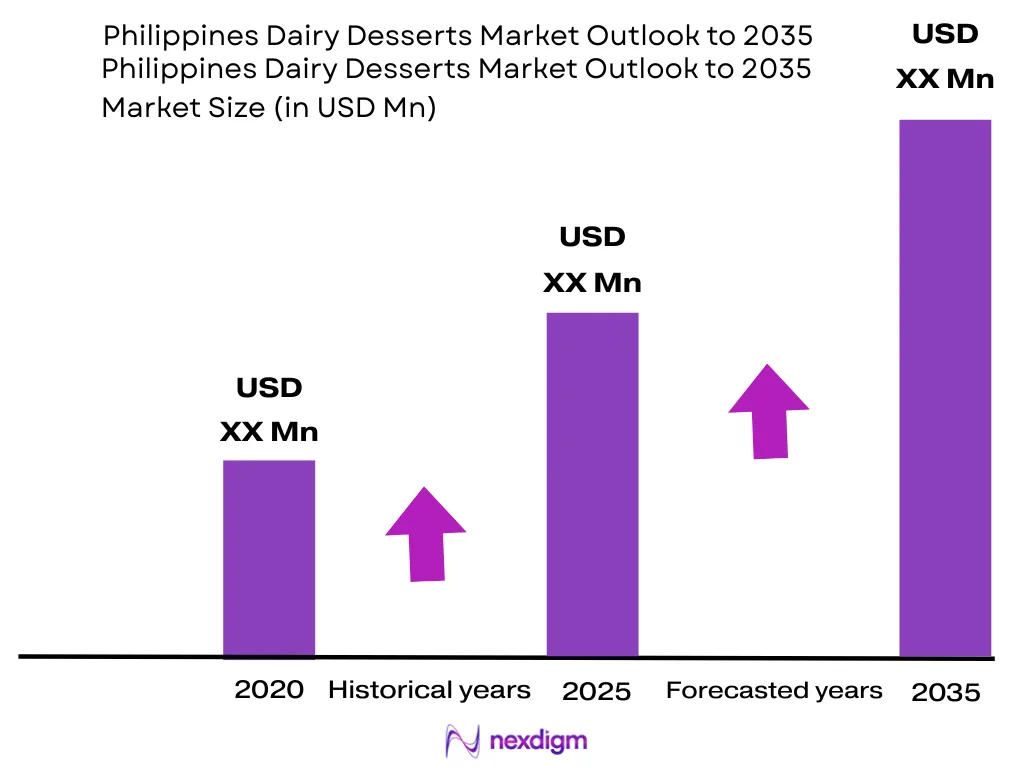
The Philippines Dairy Desserts Market was valued at approximately USD ~ Million in 2024, compared to USD ~ Million in 2023, based on historical analysis of packaged dairy desserts, chilled dairy snacks, puddings, custards, mousses, and yogurt-based dessert products. The market is supported by increasing dairy consumption, expanding modern retail infrastructure, and rising demand for convenient ready-to-eat food products. The Philippine Statistics Authority reported national milk production of over 27 million liters in 2024, while dairy imports continued to exceed 3 million metric tons milk equivalent, supporting the availability of dairy-based processed foods and desserts across the country.
Market Segmentation
By Product Type
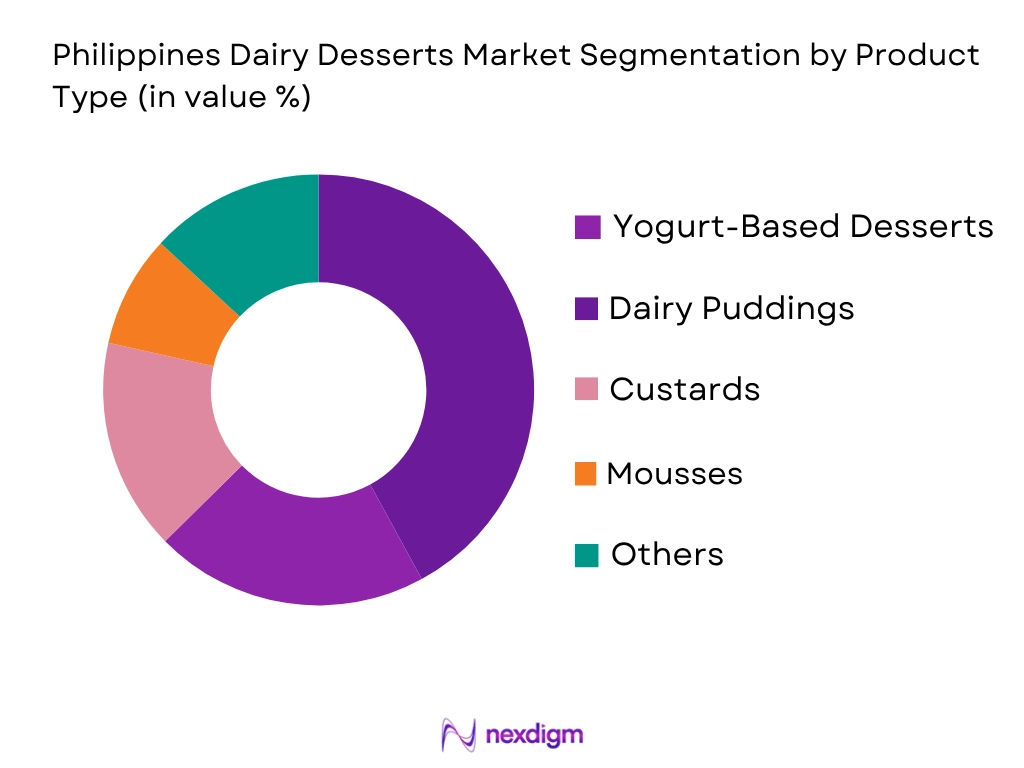
The Philippines Dairy Desserts Market is segmented by product type into yogurt-based desserts, dairy puddings, custards, mousses, flans, dairy gelatin desserts, and cheesecake & specialty dairy desserts. Recently, yogurt-based desserts have maintained the dominant market share under this segmentation due to their strong association with health, digestion, and convenience. Consumers increasingly prefer chilled dairy snacks that offer both nutritional benefits and indulgence. Major brands have expanded their yogurt dessert portfolios with fruit flavors, probiotic formulations, and single-serve packaging formats. The availability of yogurt products across supermarkets, convenience stores, and online grocery channels further strengthens their market position. In addition, growing awareness regarding protein-rich snacks and digestive wellness continues to drive consumption. Product innovation, premium variants, and attractive packaging have enabled yogurt-based desserts to remain the most widely consumed category in the Philippines dairy desserts market.
By Distribution Channel
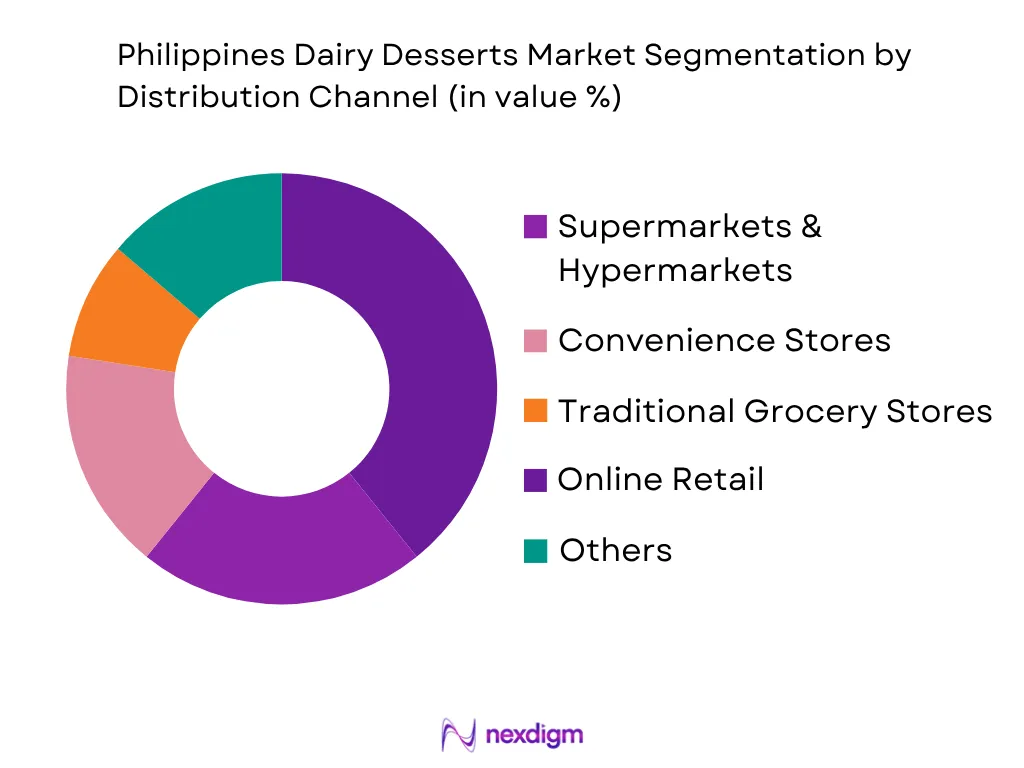
The Philippines Dairy Desserts Market is segmented by distribution channel into supermarkets and hypermarkets, convenience stores, traditional grocery stores, online retail, cash & carry stores, and specialty food stores. Supermarkets and hypermarkets currently dominate the market due to their extensive refrigerated infrastructure, broad product assortment, and ability to showcase premium and imported dairy desserts. Large retail chains provide dedicated chilled food sections that allow manufacturers to maintain product freshness and visibility. These outlets also serve as the preferred purchasing destination for middle-income and upper-income households seeking branded dairy desserts. Promotional campaigns, bundle offers, and new product launches are frequently conducted through modern retail channels, strengthening consumer engagement. The growth of organized retail across Metro Manila, Cebu, and Davao further supports the dominance of supermarkets and hypermarkets within the Philippines dairy desserts market.
Competitive Landscape
The Philippines Dairy Desserts Market is moderately consolidated, with multinational dairy companies competing alongside regional dairy processors and food manufacturers. Major players focus on product innovation, flavor diversification, premium positioning, and expansion of refrigerated distribution networks. The increasing popularity of healthy dairy snacks and indulgent chilled desserts has encouraged companies to introduce probiotic, low-sugar, and premium dessert offerings.
| Company | Establishment Year | Headquarters | Manufacturing Facilities | Product Portfolio | Distribution Reach | Cold Chain Strength | Functional Products | Key Brands |
| Nestlé Philippines | 1911 | ~ | ~ | ~ | ~ | ~ | ~ | ~ |
| Alaska Milk Corporation | 1972 | ~ | ~ | ~ | ~ | ~ | ~ | ~ |
| FrieslandCampina | 1871 | ~ | ~ | ~ | ~ | ~ | ~ | ~ |
| Danone | 1919 | ~ | ~ | ~ | ~ | ~ | ~ | ~ |
| Lactalis Group | 1933 | ~ | ~ | ~ | ~ | ~ | ~ | ~ |
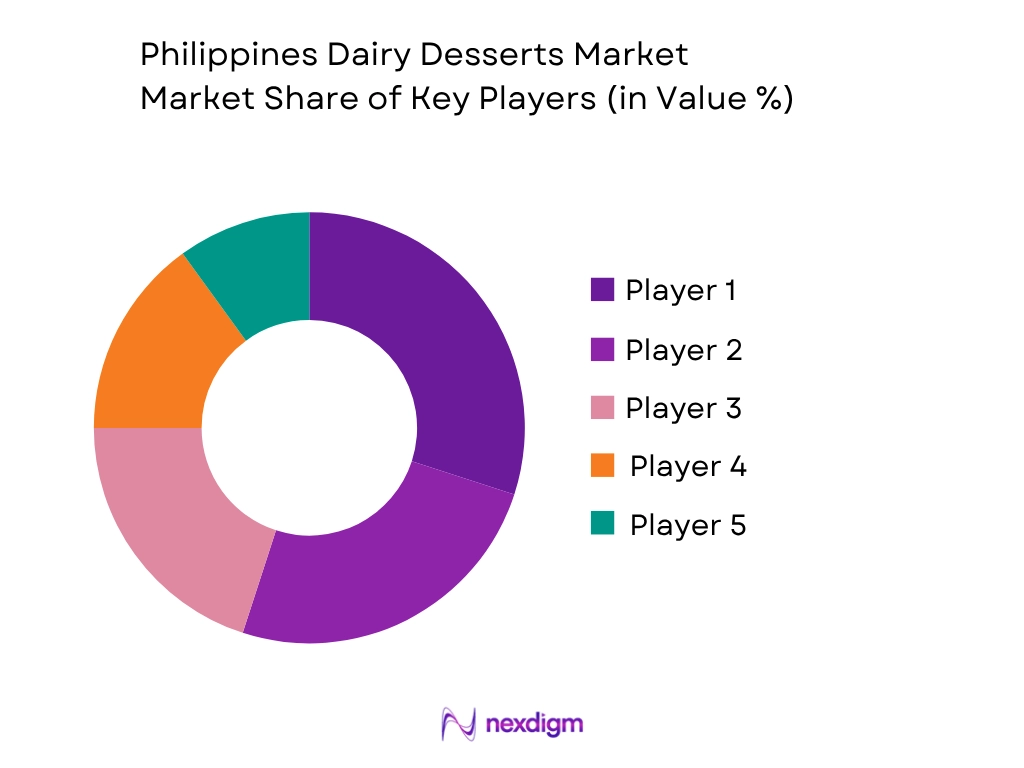
Philippines Dairy Desserts Market Analysis
Growth Drivers
Rising Urban Population and Expanding Middle-Class Consumption
The Philippines Dairy Desserts Market is benefiting from continued urbanization and rising consumer spending across major metropolitan regions. According to the World Bank, the Philippines population exceeded 117 million in 2024, with urban population surpassing 56 million people. The Philippine Statistics Authority reported Gross Domestic Product at over PHP 26 trillion in current prices, while household final consumption expenditure remained above PHP 19 trillion. Metro Manila, Central Luzon, and CALABARZON collectively account for a substantial concentration of middle-income households and organized retail infrastructure. Increasing workforce participation and changing lifestyles are driving demand for convenient chilled snacks, including yogurt desserts, puddings, mousses, and dairy-based indulgence products. The country also recorded more than 13 million overseas Filipino workers and migrant-linked beneficiaries, supporting household purchasing power through remittance inflows exceeding USD 38 billion. Urban consumers increasingly prefer packaged food products that offer convenience, taste, and nutritional value. The expansion of supermarkets, hypermarkets, and convenience store chains across urban centers further enhances accessibility to refrigerated dairy desserts. These demographic and economic fundamentals continue to strengthen consumption potential and support long-term demand for dairy dessert products throughout the Philippines.
Expansion of Modern Retail and Cold Chain Infrastructure
The growth of organized retail and refrigerated logistics infrastructure is creating favorable conditions for the Philippines Dairy Desserts Market. The Philippine economy exceeded USD 470 billion in nominal GDP according to IMF estimates, supporting investments in retail modernization and food distribution networks. The Department of Trade and Industry continues to support retail expansion, while the country maintains over 7,000 islands, increasing the need for advanced cold-chain logistics. Major retail chains continue expanding refrigerated shelf space for dairy products and chilled desserts. The Philippines handled more than 280 million tons of domestic cargo movement through ports and logistics facilities, improving food distribution capabilities nationwide. Furthermore, infrastructure investments under national development programs continue strengthening transportation connectivity between Luzon, Visayas, and Mindanao. The Department of Agriculture also continues promoting food security and cold storage expansion for perishable products. As dairy desserts require temperature-controlled transportation and storage, improvements in warehousing capacity, refrigeration facilities, and retail cold cabinets directly enhance product availability. The increasing presence of convenience stores, supermarkets, and online grocery platforms across urban and semi-urban areas further supports wider market penetration for dairy dessert manufacturers.
Market Challenges
Dependence on Imported Dairy Raw Materials
One of the major challenges facing the Philippines Dairy Desserts Market is the country’s heavy dependence on imported dairy ingredients. The National Dairy Authority reported that domestic milk production remains below 30 million liters, while national dairy requirements exceed several million metric tons of milk equivalent annually. The Philippines imports dairy ingredients from countries including New Zealand, Australia, and the United States to support domestic processing activities. According to the Philippine Statistics Authority, merchandise imports exceeded USD 130 billion in 2024, reflecting continued dependence on imported food ingredients and agricultural commodities. Fluctuations in global dairy supply chains, shipping availability, and international commodity markets can affect ingredient procurement for dairy dessert manufacturers. In addition, exchange-rate movements impact import-dependent industries because dairy processors rely on imported milk powder, whey products, and dairy fats. The country’s agricultural sector contributes approximately PHP 2 trillion to economic activity, but domestic dairy farming remains relatively small compared to demand. This supply imbalance increases exposure to international trade disruptions and creates operational challenges for dairy dessert producers seeking stable and predictable raw material availability.
Cold Chain Distribution Limitations Across Archipelagic Regions
The geographical structure of the Philippines presents significant logistical challenges for dairy dessert manufacturers. The country consists of more than 7,600 islands, creating transportation complexities for temperature-sensitive products. According to government transportation statistics, inter-island cargo movement exceeds 280 million tons annually, requiring extensive maritime and land logistics coordination. Dairy desserts typically require uninterrupted refrigeration throughout storage and distribution. While Metro Manila and major urban regions possess advanced retail infrastructure, secondary and rural markets often face limited cold storage capacity and inconsistent refrigerated transportation networks. The Philippine Statistics Authority reported that agriculture, food distribution, and logistics continue to face infrastructure bottlenecks in remote regions. Electricity reliability and operational costs for refrigeration systems also create challenges for retailers and distributors handling chilled products. Furthermore, expanding dairy dessert penetration into Visayas and Mindanao requires additional investment in cold-chain assets and temperature-controlled warehousing. These logistical constraints can affect product shelf life, inventory management, and retail availability, making distribution efficiency a critical challenge for market participants operating in the Philippines Dairy Desserts Market.
Market Opportunities
Growth of Functional, Probiotic, and Protein-Enriched Dairy Desserts
The increasing focus on health, wellness, and nutritional food choices presents substantial opportunities for the Philippines Dairy Desserts Market. The country’s population exceeds 117 million people, with a growing share of young consumers seeking healthier snack alternatives. According to the Philippine Statistics Authority, household expenditure on food remains one of the largest spending categories across income groups. Functional dairy products containing probiotics, protein enrichment, vitamins, and digestive health benefits are gaining consumer attention as lifestyles become increasingly health-conscious. The Department of Health continues promoting improved nutrition awareness, while rising education levels and internet penetration are expanding consumer knowledge regarding food ingredients and wellness benefits. The Philippines recorded more than 85 million internet users, creating stronger exposure to global health and nutrition trends. Dairy dessert manufacturers can capitalize on this shift through high-protein puddings, probiotic yogurt desserts, fortified dairy snacks, and reduced-sugar formulations. As consumers increasingly seek products that combine indulgence with nutritional value, functional dairy desserts offer a significant growth avenue for both local and international brands operating in the market.
Expansion of E-Commerce and Quick Commerce Grocery Channels
The rapid growth of digital commerce infrastructure creates new opportunities for dairy dessert manufacturers in the Philippines. According to government and industry statistics, internet users exceeded 85 million, while digital payment adoption continued expanding across urban and semi-urban areas. The Philippine economy, valued at over USD 470 billion, supports increasing investments in logistics, last-mile delivery, and online retail infrastructure. Major e-commerce platforms and grocery delivery services have expanded their refrigerated delivery capabilities, enabling consumers to purchase chilled dairy products conveniently. Metro Manila, Cebu, and Davao have emerged as important hubs for online food and grocery delivery services. Rising smartphone penetration and improving digital connectivity are encouraging consumers to purchase packaged foods through online channels. Furthermore, the Bangko Sentral ng Pilipinas continues supporting digital financial inclusion initiatives, strengthening the overall e-commerce ecosystem. Dairy dessert companies can leverage these developments by introducing subscription models, direct-to-consumer offerings, and premium product launches through online channels. The combination of digital retail growth and expanding refrigerated delivery networks provides a strong platform for future category expansion across the Philippines Dairy Desserts Market.
Future Outlook
The Philippines Dairy Desserts Market is expected to witness steady expansion during the forecast period, supported by increasing urbanization, rising disposable income, and stronger demand for convenient dairy-based snacks. Product innovation focusing on health-oriented formulations, probiotic ingredients, and reduced-sugar recipes is anticipated to drive category growth. Expansion of cold-chain infrastructure and online grocery platforms is expected to improve accessibility across secondary cities. Premiumization and localization of flavors will continue to shape consumer preferences in the market.
Major Players
- Nestlé Philippines
- Alaska Milk Corporation
- FrieslandCampina
- Danone
- Lactalis
- Fonterra
- Arla Foods
- Yakult Philippines
- Universal Robina Corporation
- Magnolia Inc.
- San Miguel Foods
- Century Pacific Food Inc.
- Emborg
- Yili Group
- Chobani
Key Target Audience
- Dairy Dessert Manufacturers
- Dairy Ingredient Suppliers
- Retail Chains and Supermarket Operators
- Convenience Store Operators
- Foodservice and Hospitality Companies
- Cold Chain and Logistics Providers
- Investments and Venture Capitalist Firms
- Government and Regulatory Bodies (Philippine Statistics Authority, Food and Drug Administration Philippines, Department of Agriculture)
Research Methodology
Step 1: Identification of Key Variables
The initial stage involves identifying all major stakeholders operating within the Philippines Dairy Desserts Market. Extensive secondary research is conducted through industry databases, company reports, trade publications, and government statistics. Key variables including production, imports, consumption, distribution, and retail penetration are analyzed to establish the market framework.
Step 2: Market Analysis and Construction
Historical market data is compiled and evaluated using both top-down and bottom-up methodologies. Product-level demand patterns, retail sales trends, and consumption behavior are examined to estimate market performance. Market revenues are validated through comparison of multiple industry data sources.
Step 3: Hypothesis Validation and Expert Consultation
Preliminary market findings are validated through interviews with manufacturers, distributors, retailers, and industry experts. Discussions provide insights regarding product demand, distribution trends, consumer preferences, and competitive dynamics. These findings are used to refine market assumptions and forecasts.
Step 4: Research Synthesis and Final Output
The final phase integrates primary and secondary findings into a consolidated market model. Data triangulation techniques are used to ensure consistency across all segments. Final market estimates and forecasts are developed after validating the findings against industry benchmarks and expert feedback.

- Executive Summary
- Research Methodology (Market Definitions and Assumptions, Abbreviations, Market Sizing Approach, Bottom-Up Analysis, Top-Down Validation, Primary Research Framework, Industry Expert Interviews, Demand-Supply Assessment, Data Triangulation Model, Forecasting Methodology, Limitations and Future Conclusions)

- Definition and Scope
- Market Genesis and Evolution
- Timeline of Key Industry Developments
- Philippines Dairy Industry Overview
- Dairy Desserts Consumption Lifecycle

- Growth Drivers (Growing Demand for Ready-to-Eat Dairy Snacks, Expansion of Modern Retail Infrastructure, Rising Urban Population and Household Spending, Increasing Exposure to Western Dessert Culture, Growth in Refrigerated Food Consumption)
- Market Challenges (High Dependence on Imported Dairy Inputs, Cold Chain Distribution Gaps Across Islands, Competition from Traditional Filipino Desserts, Shelf-Life Management Challenges, Rising Packaging and Logistics Costs)
- Market Opportunities (Protein-Enriched Dairy Desserts, Functional and Probiotic Product Expansion, Premium Indulgent Dessert Innovations, Expansion Through E-Commerce and Quick Commerce, Local Flavor-Based Product Development)
- Market Trends (Premium Chilled Dessert Cups, High-Protein Dairy Snacks, Reduced Sugar Product Launches, Ube and Mango Flavor Innovation, Clean Label and Natural Ingredient Positioning)
- Government Regulations (Food and Drug Administration Philippines Dairy Standards, Food Safety Act Compliance, Nutritional Labeling Requirements, Cold Chain Compliance Standards, Import Regulations for Dairy Ingredients, Packaging and Sustainability Requirements)
- SWOT Analysis
- Porter’s Five Forces Analysis
- PESTLE Analysis
- Stakeholder Ecosystem
- Competition Ecosystem

- By Market Value (2020-2025)
- By Volume Consumption (2020-2025)
- By Average Selling Price (2020-2025)

- By Product Type (In Value %)
Yogurt-Based Desserts
Dairy Puddings
Custards
Flans and Leche Flan Variants
Mousses
Cheesecake Desserts
Dairy Gelatin Desserts
Premium Chilled Dairy Desserts
Functional and Probiotic Dairy Desserts - By Flavor Type (In Value %)
Chocolate
Vanilla
Caramel
Strawberry
Mango
Ube
Coconut-Based Flavors
Mixed Fruit
Coffee and Mocha
Local Filipino Dessert-Inspired Flavors - By Distribution Channel (In Value %)
Supermarkets and Hypermarkets
Convenience Stores
Traditional Grocery Stores
Sari-Sari Stores
Cash & Carry Stores
Specialty Food Stores
Online Retail and E-Commerce
Quick Commerce Platforms - By Region (In Value %)
Metro Manila
Luzon
Visayas
Mindanao
Emerging Provincial Markets - By Packaging Type (In Value %)
Single-Serve Cups
Multi-Pack Cups
Family Packs
Pouches
Glass Containers
Tubs
On-the-Go Snack Formats

- Market Share of Major Players (By Value, Volume, Product Category, Distribution Channel, Premium Segment, Functional Segment )
- Cross Comparison Parameters (Product Portfolio Breadth, Dairy Dessert SKU Count, Manufacturing Capacity, Distribution Reach, Cold Chain Strength, Innovation Pipeline, Local Flavor Product Portfolio, Premium Product Presence)
- SWOT Analysis of Major Players
- Pricing Analysis by SKU and Product Category
- Detailed Profiles of Major Companies
Nestlé Philippines
Alaska Milk Corporation
FrieslandCampina Philippines
Danone Philippines
Lactalis Philippines
Universal Robina Corporation
Century Pacific Food Inc.
San Miguel Foods
Magnolia Inc.
Arla Foods
Fonterra Brands Philippines
Yakult Philippines
Chobani
Emborg
Yili Group

- Consumption Behavior Assessment
- Demographic Consumption Trends
- Household Dairy Expenditure Analysis
- Purchasing Power Analysis
- Urban vs Rural Consumption Analysis
- Consumer Preferences by Product Category
- Premium vs Mass Market Demand Assessment
- Health and Wellness Impact on Purchase Decisions
- Brand Loyalty and Switching Behavior
- Consumer Pain Point Analysis
- Decision-Making Process Analysis

- By Market Value (2026-2035)
- By Volume Consumption (2026-2035)
- By Average Selling Price (2026-2035)


 Request a Sample
 Ask for Customization
 Get a Quote
 Enquire Now