

 Download PDF
 Download PDF
Market Overview
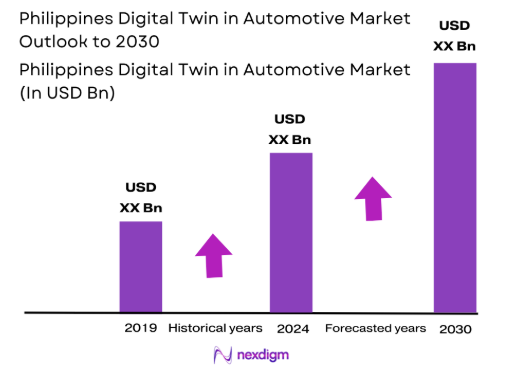
The Philippines Digital Twin in Automotive market was valued at USD ~ in 2023, reflecting the increasing integration of advanced technologies such as Internet of Things (IoT), Artificial Intelligence (AI), and machine learning into the automotive sector. Digital twins are being increasingly utilized for optimizing manufacturing processes, enhancing vehicle performance, and enabling predictive maintenance. This growth is driven by the country’s push for smart manufacturing, aligned with industry 4.0 initiatives, and the evolving automotive ecosystem focused on electric vehicle (EV) production and connected vehicle technologies.
Manila, the country’s capital, is the leading hub for automotive digital transformation. The region’s concentration of automotive OEMs, tier-1 suppliers, and a robust industrial infrastructure makes it the center of activity for digital twin adoption. Other regions, such as Cavite and Laguna, are also emerging as key automotive manufacturing zones due to their proximity to major industrial parks and government incentives promoting digitalization. The presence of global players like Siemens and IBM in the Philippines further amplifies the country’s role in shaping the market.
Market Segmentation
By Vehicle Application
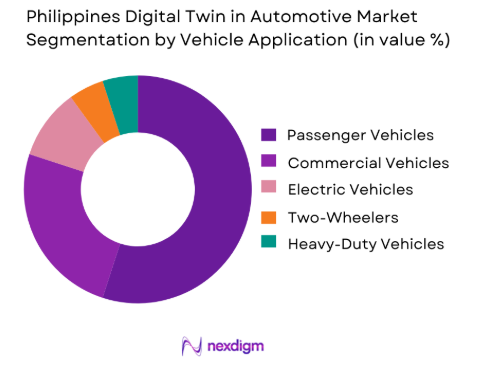
The Philippines Digital Twin in Automotive market is segmented by vehicle application into passenger vehicles, commercial vehicles, electric vehicles (EVs), two-wheelers, and heavy-duty vehicles. Among these, passenger vehicles hold the largest share in 2024. The dominance of this sub-segment can be attributed to the high demand for consumer cars and the need for efficiency in vehicle production and maintenance. As consumers increasingly look for smart features in vehicles, such as predictive diagnostics and autonomous capabilities, digital twin technology has become essential for manufacturers to meet these demands.
By Technology
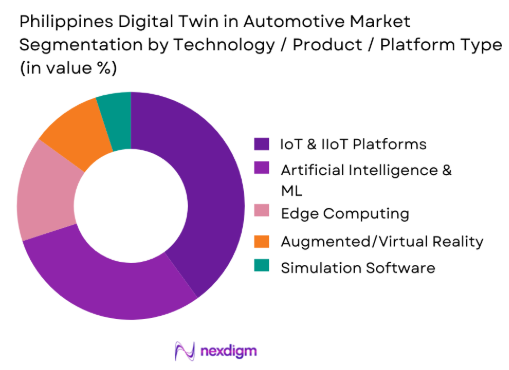
The market is also segmented by technology/product/platform type, which includes IoT & IIoT platforms, Artificial Intelligence & Machine Learning, Edge Computing, Augmented/Virtual Reality, and Simulation Software. IoT & IIoT platforms are expected to dominate the market share in 2024. Their growth is driven by the increasing importance of real-time data for vehicle health monitoring and predictive maintenance. The seamless integration of IoT sensors into vehicles and manufacturing environments is critical for the operation of digital twins, allowing manufacturers to optimize both production and operational performance.
Competitive Landscape
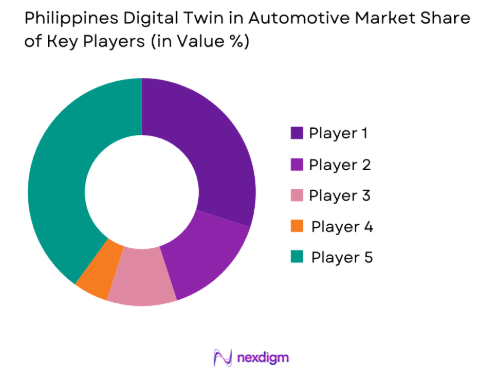
The Philippines Digital Twin in Automotive market is dominated by a few major players, including Siemens, IBM, and Microsoft, alongside regional players like PTC and Dassault Systèmes. This consolidation highlights the significant influence of these key companies in driving the technological innovations and solutions that shape the market’s development. These players leverage their strong product portfolios and strategic partnerships to remain at the forefront of the digital twin integration within the automotive industry.
| Company | Establishment Year | Headquarters | Digital Twin Product Portfolio | Technology Integration | Automotive Partnerships | R&D Investment | Market Expansion Focus |
| Siemens | 1847 | Germany | ~ | ~ | ~ | ~ | ~ |
| IBM | 1911 | USA | ~ | ~ | ~ | ~ | ~ |
| Microsoft | 1975 | USA | ~ | ~ | ~ | ~ | ~ |
| PTC | 1985 | USA | ~ | ~ | ~ | ~ | ~ |
| Dassault Systèmes | 1981 | France | ~ | ~ | ~ | ~ | ~ |
Philippines Digital Twin in Automotive Market Analysis
Growth Drivers
Push for Smart Manufacturing and Industry 4.0 Adoption
The global shift towards smart manufacturing and the adoption of Industry 4.0 technologies is a key growth driver for the manufacturing sector. Industry 4.0 encompasses advanced technologies such as the Internet of Things (IoT), artificial intelligence (AI), robotics, and automation, which enable greater efficiency, flexibility, and data-driven decision-making on the factory floor. Companies are increasingly investing in these technologies to optimize production processes, reduce downtime, and improve product quality. The push for smart manufacturing is transforming traditional manufacturing operations, making them more agile and connected, and driving the demand for advanced systems, tools, and solutions that support digitalization and automation.
Need for Faster Product Development and Virtual Validation
The need for faster product development cycles is pushing companies to adopt digital tools for virtual validation. This includes simulation software, digital twins, and virtual testing environments, which allow manufacturers to develop and test products in a digital space before physical prototypes are created. Virtual validation accelerates the development process by reducing the need for multiple physical prototypes, enabling quicker iterations and design improvements. By using advanced simulation techniques, manufacturers can reduce costs, enhance product designs, and improve time-to-market, which is especially important in industries with high competition and rapidly changing consumer demands.
Challenges
High Upfront Investment and Long ROI Cycles
One of the significant challenges in the adoption of smart manufacturing and Industry 4.0 technologies is the high upfront investment required. Implementing advanced technologies such as automation, robotics, and IoT-driven systems often requires substantial capital expenditure. Moreover, the return on investment (ROI) for these technologies may take several years to materialize, as businesses must first cover the costs of infrastructure, software, training, and system integration. This long ROI cycle can be a deterrent for smaller manufacturers or those with limited capital budgets, making it harder for them to embrace these innovations despite their long-term benefits.
Shortage of Skilled Simulation and Data Engineering Talent
The rapid advancement of simulation, data analytics, and Industry 4.0 technologies has created a shortage of skilled talent in areas such as simulation engineering, data science, and system integration. Manufacturers require professionals who can develop and manage complex digital models, run simulations, and interpret vast amounts of data to optimize production processes. The lack of skilled professionals in these fields is a significant barrier to the full implementation of smart manufacturing systems, as businesses struggle to recruit and retain the talent necessary to leverage these technologies effectively. This talent gap can hinder progress and delay the widespread adoption of Industry 4.0.
Opportunities
Greenfield Smart Plant Deployments with Twin First Design
Greenfield smart plant deployments, where entirely new manufacturing plants are built with Industry 4.0 technologies from the ground up, represent a significant opportunity for manufacturers. By incorporating digital twin designs early in the planning and construction phases, companies can optimize their plant layout, equipment selection, and production processes before actual physical construction begins. Digital twins enable the virtual modeling of entire manufacturing operations, allowing for the identification of inefficiencies, potential bottlenecks, and areas for improvement in a simulated environment. This approach minimizes risks, reduces costs, and accelerates time-to-market, making it an attractive strategy for companies looking to build state-of-the-art, smart manufacturing facilities.
Localization of System Integration and Engineering Services
The localization of system integration and engineering services offers an important opportunity to improve the implementation and customization of Industry 4.0 technologies. By bringing system integration and engineering services closer to manufacturing plants, companies can achieve more tailored solutions that meet specific operational needs. Localized service providers can offer faster response times, improved customer support, and better alignment with local regulations and industry requirements. Additionally, having access to region-specific expertise can help reduce costs related to international shipping, long-distance communication, and coordination, ultimately making the adoption of Industry 4.0 technologies more accessible and efficient for manufacturers around the world.
Future Outlook
In the coming years, the Philippines Digital Twin in Automotive market will continue to experience robust growth driven by advancements in digital technologies, the rise of electric vehicles, and the government’s push for smart manufacturing. As automotive manufacturers and tier-1 suppliers increase their adoption of digital twins, the market will see greater integration of real-time data collection, predictive maintenance, and optimized vehicle production processes. These factors will lead to improved vehicle performance, reduced costs, and enhanced customer satisfaction.
Major Players
- Siemens
- IBM
- Microsoft
- PTC
- Dassault Systèmes
- ANSYS
- Altair Engineering
- Hexagon AB
- SAP
- Rockwell Automation
- Bosch
- Oracle Corporation
- Accenture
- General Electric
- Emerson Electric
Key Target Audience
- Automotive OEM Manufacturers
- Tier-1 Automotive Suppliers
- Investments and Venture Capitalist Firms
- Fleet Operators
- Automotive Aftermarket Companies
- EV Manufacturers and Infrastructure Providers
- Government and Regulatory Bodies
- Smart Manufacturing Industry Leaders
Research Methodology
Step 1: Identification of Key Variables
The initial phase involves identifying the critical variables that influence the Philippines Digital Twin in Automotive market, including technology adoption rates, vehicle application needs, and regulatory influences. This is done through extensive desk research and data gathering from industry reports and government publications.
Step 2: Market Analysis and Construction
In this phase, historical data is compiled and analyzed to understand market trends and growth patterns. The focus is on evaluating market demand across vehicle applications and technology types, providing insights into which segments are driving the market forward.
Step 3: Hypothesis Validation and Expert Consultation
Market hypotheses are validated through direct interviews with industry experts, including automotive OEMs, technology providers, and tier-1 suppliers. These insights help to refine market assumptions and validate the direction of market growth.
Step 4: Research Synthesis and Final Output
The final phase involves synthesizing all gathered data and expert insights to create a comprehensive market analysis. This ensures that the report accurately reflects the current state of the market and provides actionable recommendations for stakeholders.

- Executive Summary
- Research Methodology (Market definitions and scope boundaries, terminology and abbreviations, digital twin taxonomy for automotive use cases, market sizing logic by software licenses and services value, revenue attribution across platforms integration and analytics, primary interview program with OEMs Tier 1s IT providers and plant operators, data triangulation and validation approach, assumptions limitations and data gaps)

- Definition and Scope
- Market Genesis and Adoption Maturity of Digital Twins in Automotive
- Manufacturing Footprint and Smart Factory Readiness in the Philippines
- Use Case Mapping Across Product Process and Plant Twins
- Ecosystem Structure Across OEMs Technology Providers and System Integrators

- Growth Drivers
Push for smart manufacturing and Industry 4.0 adoption
Need for faster product development and virtual validation
Rising complexity of EV platforms and software defined vehicles
Demand for higher plant efficiency and reduced downtime
Government support for advanced manufacturing capabilities - Challenges
High upfront investment and long ROI cycles
Shortage of skilled simulation and data engineering talent
Data quality and integration gaps across legacy systems
Cybersecurity and IP protection concerns
Change management resistance in traditional plants - Opportunities
Greenfield smart plant deployments with twin first design
Localization of system integration and engineering services
Expansion of predictive maintenance programs in Tier suppliers
Digital thread development across design build and service
Training and workforce upskilling through virtual environments - Trends
Shift from point solutions to enterprise wide digital twin platforms
Rising adoption of AI assisted simulation and optimization
Integration of digital twins with MES ERP and PLM stacks
Increased focus on real time twins for shop floor control
Use of immersive visualization and AR VR for twin interaction - Regulatory & Policy Landscape
SWOT Analysis
Stakeholder & Ecosystem Analysis
Porter’s Five Forces Analysis
Competitive Intensity & Ecosystem Mapping

- By Value, 2019–2024
- By Software and Services Revenue Split, 2019–2024
- By Number of Active Digital Twin Deployments, 2019–2024
- By OEM vs Supplier Adoption Share, 2019–2024

- By Fleet Type (in Value %)
Passenger vehicle manufacturing programs
Commercial vehicle manufacturing programs
Two and three wheeler assembly operations
Aftermarket and remanufacturing programs
Motorsport and performance engineering teams - By Application (in Value %)
Vehicle design and virtual prototyping
Manufacturing process simulation and optimization
Predictive maintenance and asset health monitoring
Quality control and defect root cause analysis
Supply chain visibility and production planning - By Technology Architecture (in Value %)
Physics based simulation driven twins
Data driven AI enabled twins
Hybrid physics and data fusion twins
Product lifecycle management integrated twins
MES and IoT integrated operational twins - By Connectivity Type (in Value %)
Standalone digital twin platforms
Cloud hosted and SaaS based twins
On premise enterprise deployments
Edge enabled real time operational twins
API integrated ecosystems for multi system data flow - By End-Use Industry (in Value %)
Automotive OEMs and assembly plants
Tier 1 and Tier 2 component suppliers
Engineering service providers and design houses
Aftermarket parts and remanufacturing operators
IT and industrial automation providers - By Region (in Value %)
NCR
CALABARZON
Central Luzon
Visayas
Mindanao

- Positioning driven by platform scalability industry domain depth and integration capability
- Partnership models between digital twin platforms OEMs and industrial automation firms
- Cross Comparison Parameters (simulation fidelity and accuracy, real time data ingestion capability, scalability across plants and lines, ease of integration with MES PLM and ERP, cybersecurity and IP protection features, AI and analytics depth, deployment flexibility cloud vs on premise, total cost of ownership)
- SWOT analysis of major players
- Pricing and commercial model benchmarking
- Porter’s Five Forces
- Detailed Profiles of Companies
Siemens Digital Industries Software
Dassault Systèmes
PTC
Autodesk
Ansys
Hexagon Manufacturing Intelligence
AVEVA
Rockwell Automation
IBM
Microsoft
SAP
Bosch Rexroth
Schneider Electric
Tata Consultancy Services
Accenture Industry X

- OEM digital transformation priorities and investment drivers
- Plant manager expectations for uptime and yield improvement
- IT and OT convergence challenges and governance models
- System integrator selection criteria and project delivery models
- Total cost of ownership considerations across software and services

- By Value, 2025–2030
- By Software and Services Revenue Split, 2025–2030
- By Number of Active Digital Twin Deployments, 2025–2030
- By OEM vs Supplier Adoption Share, 2025–2030


 Request a Sample
 Ask for Customization
 Get a Quote
 Enquire Now