
 Download PDF
Market Overview
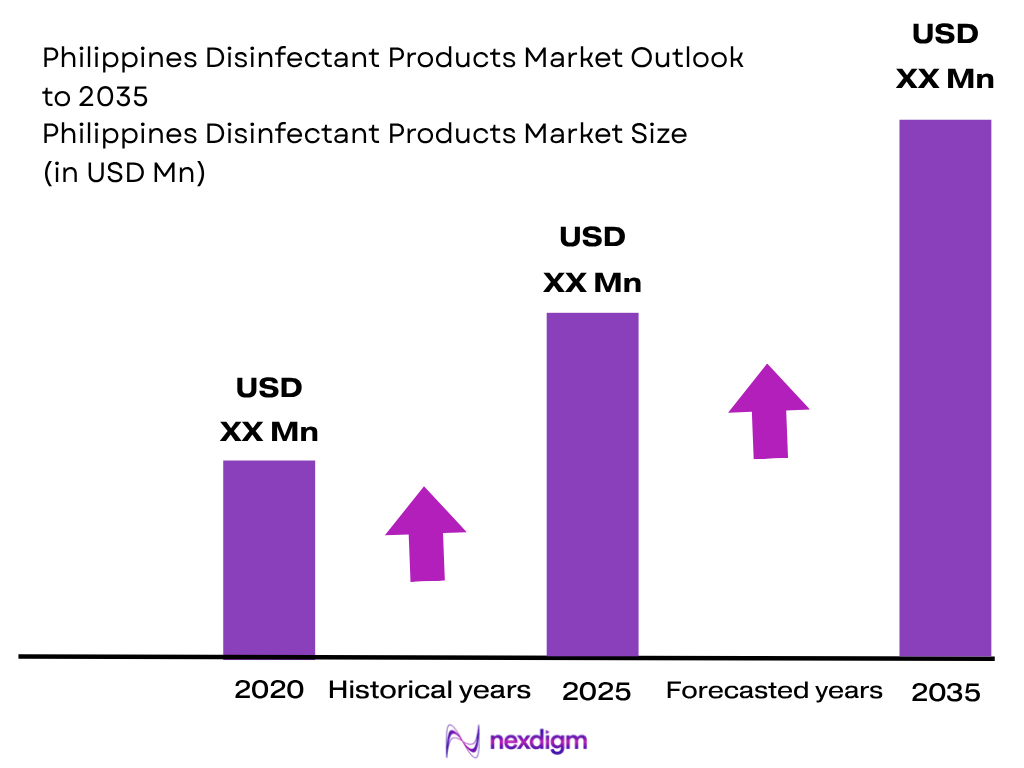
The Philippines Disinfectant Products Market is valued at approximately USD ~ bn, supported by increasing demand from healthcare facilities, residential households, commercial establishments, food processing units, and hospitality businesses. The market is driven by rising awareness regarding hygiene practices, increasing healthcare infrastructure development, post-pandemic sanitation requirements, and growing adoption of professional cleaning solutions. The country’s population of more than 115 million creates a broad consumer base for household disinfectants, while expanding hospitals, clinics, and institutional facilities support demand for specialized hygiene products.
The Philippines Disinfectant Products Market is concentrated in Metro Manila, Cebu, Davao, and other major urban centers due to higher healthcare facility concentration, commercial activity, population density, and industrial development. Metro Manila remains a key demand hub because of its large number of hospitals, offices, retail establishments, and government facilities. Cebu and Davao contribute significantly due to tourism activities, healthcare expansion, food processing operations, and growing commercial infrastructure. These cities demonstrate higher adoption of surface disinfectants, professional cleaning products, and institutional hygiene solutions.
Market Segmentation
By Product Type
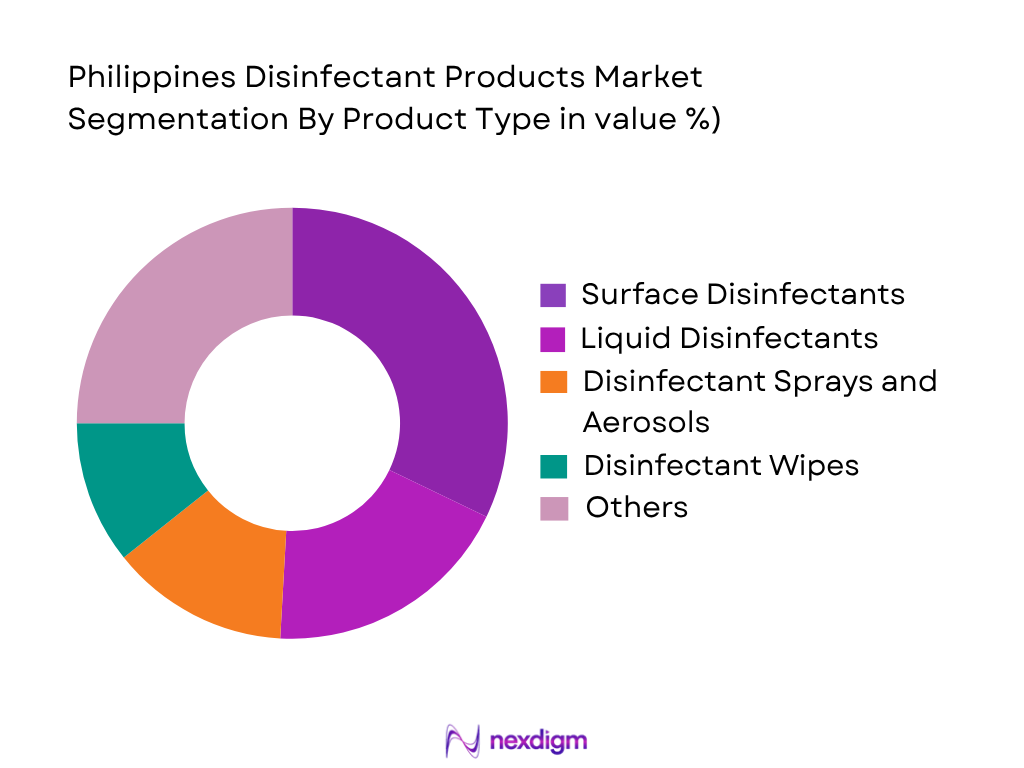
The Philippines Disinfectant Products Market is segmented by product type into surface disinfectants, disinfectant sprays and aerosols, disinfectant wipes, liquid disinfectants, concentrated disinfectants, ready-to-use disinfectants, air disinfectants, equipment disinfectants, and hand sanitizers. Surface disinfectants represent the dominant product segment due to their extensive application across healthcare facilities, households, commercial buildings, schools, and industrial environments. Hospitals and clinics require continuous surface sanitation for patient rooms, laboratories, medical equipment areas, and high-contact zones. Residential consumers increasingly use surface disinfectants for kitchens, bathrooms, and frequently touched surfaces due to increased hygiene awareness. Commercial establishments such as malls, offices, hotels, and restaurants also maintain regular cleaning protocols using surface disinfection products. The availability of multiple formulations, including quaternary ammonium compounds, alcohol-based solutions, chlorine-based disinfectants, and hydrogen peroxide formulations, enables usage across different applications.
By End-Use Industry
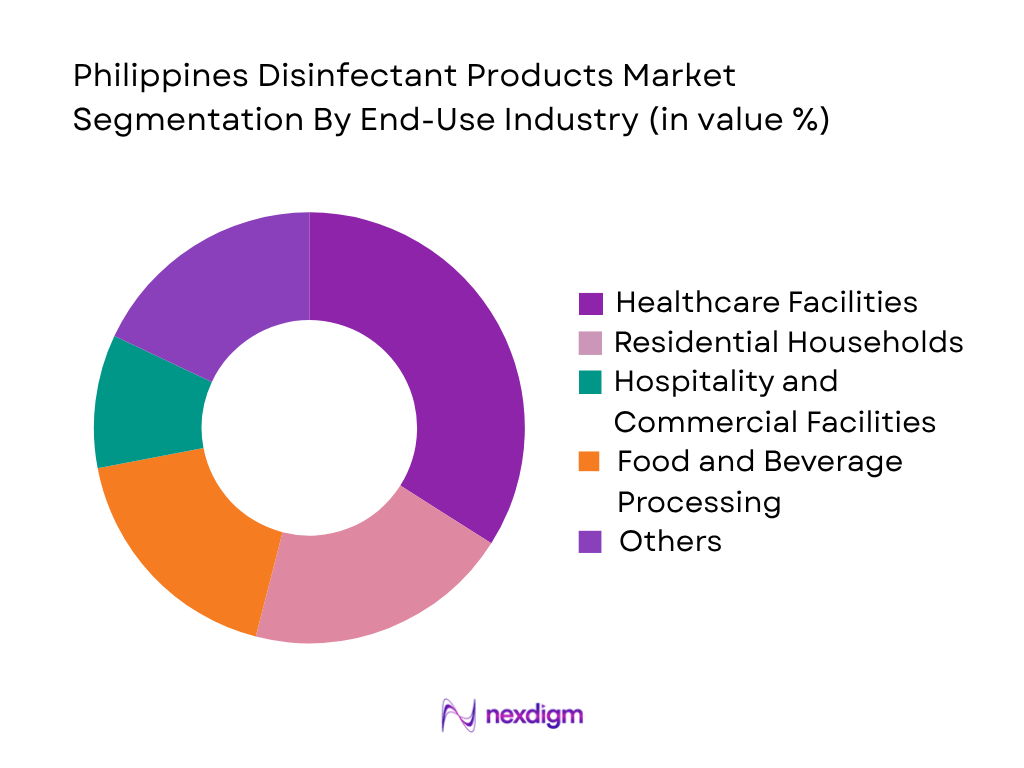
The Philippines Disinfectant Products Market is segmented by end-use industry into healthcare facilities, residential households, pharmaceutical manufacturing, food and beverage processing, industrial manufacturing, hospitality, educational institutions, government facilities, laboratories, and transportation infrastructure. Healthcare facilities represent the dominant segment due to continuous infection prevention requirements, increasing hospital capacity, and demand for medical-grade disinfectant solutions. Hospitals, clinics, diagnostic centers, and laboratories require disinfectants for patient areas, medical equipment, operating rooms, and healthcare environments. Food and beverage processing industries contribute significantly due to sanitation requirements for production facilities and food safety compliance. Hospitality facilities including hotels, resorts, and restaurants generate demand through routine cleaning and hygiene management. Educational institutions and government facilities further support market growth through sanitation programs and public hygiene requirements. The increasing number of commercial establishments and facility management services continues to expand demand for institutional-grade disinfectants.
Competitive Landscape
The Philippines Disinfectant Products Market includes multinational hygiene companies, global chemical solution providers, and regional manufacturers competing through consumer product portfolios, healthcare-grade solutions, institutional contracts, and extensive distribution networks. The competitive environment is shaped by companies focusing on product innovation, regulatory compliance, retail expansion, and partnerships with hospitals, commercial facilities, and professional cleaning service providers. Leading companies compete through disinfectant wipes, sprays, surface cleaners, specialized antimicrobial formulations, and sustainable hygiene solutions.
| Company | Establishment Year | Headquarters | Product Categories | Active Ingredient Portfolio | Healthcare Application Coverage | Distribution Network | Manufacturing Capability | Sustainability Focus |
| Reckitt Benckiser Philippines Inc. | 1823 | Slough, UK | ~ | ~ | ~ | ~ | ~ | ~ |
| Unilever Philippines Inc. | 1929 | London, UK | ~ | ~ | ~ | ~ | ~ | ~ |
| Ecolab Philippines Inc. | 1923 | St. Paul, USA | ~ | ~ | ~ | ~ | ~ | ~ |
| Diversey Philippines Inc. | 1923 | Fort Mill, USA | ~ | ~ | ~ | ~ | ~ | ~ |
| 3M Philippines Inc. | 1902 | St. Paul, USA | ~ | ~ | ~ | ~ | ~ | ~ |
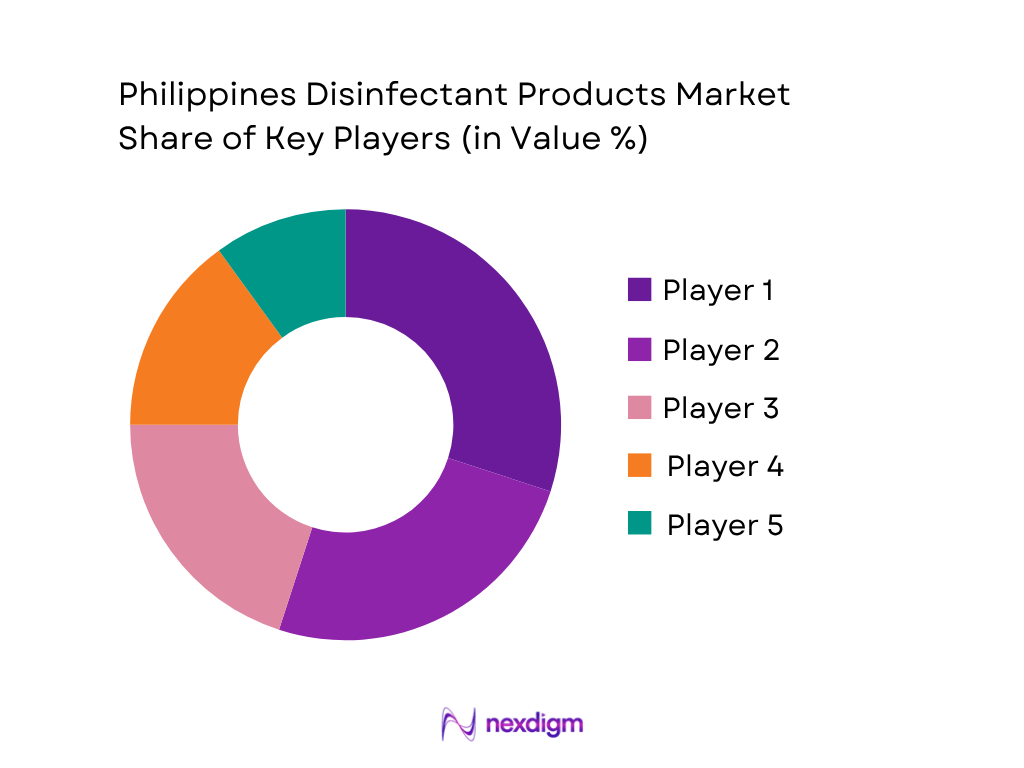
Philippines Disinfectant Products Market Analysis
Growth Drivers
Expansion of Healthcare Infrastructure and Increasing Infection Prevention Requirements
The Philippines Disinfectant Products Market is supported by continuous healthcare infrastructure expansion and increasing demand for infection prevention solutions across hospitals, clinics, laboratories, and healthcare facilities. The country has more than 115 million people, creating sustained healthcare demand and requiring regular consumption of surface disinfectants, medical equipment disinfectants, and specialized hygiene products. The healthcare sector recorded 8,181 formal establishments engaged in human health and social work activities, with the National Capital Region accounting for 2,469 establishments, followed by CALABARZON with 1,465 establishments and Central Luzon with 856 establishments. These regions represent major demand centers for healthcare-grade disinfectant solutions. The Philippines recorded 1,312 regulated hospitals, including 456 government hospitals and 856 private hospitals, creating recurring requirements for infection control products across patient areas, laboratories, operating rooms, and medical equipment facilities. Hospital bed capacity reached 114,623 beds, increasing the need for regular sanitation practices across healthcare environments. The expansion of private healthcare networks, diagnostic centers, and specialized medical facilities continues to increase consumption of disinfectants. Government focus on improving healthcare access and strengthening infection prevention practices supports long-term demand for antimicrobial solutions, surface cleaners, and institutional hygiene products within the Philippines Disinfectant Products Market.
Growth of Hospitality, Food Processing, and Commercial Hygiene Applications
The Philippines Disinfectant Products Market is driven by expansion of tourism, hospitality infrastructure, food processing activities, and commercial establishments requiring continuous hygiene management. Tourism recovery has increased demand for professional cleaning solutions across hotels, resorts, restaurants, airports, and entertainment facilities. The Philippines recorded 5,949,350 international visitor arrivals, compared with 5,450,557 visitors recorded previously, supporting increased hygiene requirements across tourism-related businesses. Tourism contributed approximately PHP 2.35 trillion to the Philippine economy, highlighting the importance of hospitality and service sectors that require regular disinfection procedures. Hotels, restaurants, and commercial properties increasingly adopt surface disinfectants, sanitizers, and professional cleaning products to maintain operational standards and customer safety. The food processing industry also supports demand because manufacturers require sanitation products for production areas, equipment cleaning, and contamination control. Commercial establishments in Metro Manila, Cebu, and Davao require disinfectant solutions due to high population concentration, business activity, and facility usage. The continued expansion of retail centers, offices, educational facilities, and transportation infrastructure further increases demand for routine cleaning and hygiene management solutions. These developments create sustained opportunities for disinfectant manufacturers serving institutional, commercial, and consumer segments.
Market Challenges
Dependence on Imported Raw Materials and Supply Chain Constraints
The Philippines Disinfectant Products Market faces challenges due to dependence on imported chemical ingredients, specialty compounds, and advanced formulation components required for producing high-performance disinfectant products. Many active ingredients, including quaternary ammonium compounds, hydrogen peroxide-based formulations, and specialty antimicrobial chemicals, rely on international supply chains. The Philippines has a growing chemical and manufacturing sector; however, domestic production capacity for several specialized disinfectant ingredients remains limited. This dependency creates challenges related to logistics, foreign exchange fluctuations, import lead times, and availability of critical raw materials. Disinfectant manufacturers supplying healthcare facilities, pharmaceutical companies, food processing units, and institutional customers require consistent access to approved ingredients to maintain product quality and regulatory compliance. The country’s geographic structure, consisting of more than 7,600 islands, also creates additional distribution challenges, particularly for companies supplying products outside major urban centers. Healthcare establishments outside Metro Manila, Cebu, and Davao require reliable access to disinfectant products despite logistical limitations. Companies must develop efficient supply chain strategies, regional distribution networks, and inventory management systems to ensure uninterrupted availability of hygiene products. These operational challenges increase the importance of local partnerships, supply diversification, and efficient distribution capabilities within the Philippines Disinfectant Products Market.
Regulatory Compliance and Product Standardization Requirements
The Philippines Disinfectant Products Market experiences challenges related to regulatory approvals, product registration requirements, chemical safety standards, and maintaining consistent product quality across different applications. Disinfectants used in healthcare facilities, food processing plants, commercial buildings, and public institutions require compliance with national safety and effectiveness requirements. Manufacturers must ensure proper documentation, labeling, active ingredient disclosure, and antimicrobial performance validation before supplying products to regulated industries. Healthcare facilities represent a particularly demanding customer segment because hospitals and laboratories require reliable disinfectants for infection prevention, medical equipment sanitation, and environmental cleaning. The Philippines has 1,312 regulated hospitals and thousands of healthcare establishments requiring compliance with hygiene standards, increasing the importance of approved and validated disinfectant solutions. Small and medium-sized manufacturers may face difficulties managing regulatory processes, product testing requirements, and documentation procedures. Environmental considerations also create challenges as authorities and customers increasingly focus on safe chemical usage, sustainable packaging, and reduced environmental impact. Companies operating in the Philippines Disinfectant Products Market must balance effectiveness, affordability, safety, and sustainability while meeting requirements from healthcare, industrial, food, and commercial users.
Market Opportunities
Development of Sustainable and Advanced Antimicrobial Disinfectant Solutions
The Philippines Disinfectant Products Market presents opportunities through development of sustainable formulations, environmentally responsible cleaning solutions, and advanced antimicrobial technologies. Increasing focus on hygiene quality across healthcare, hospitality, and commercial sectors is creating demand for products that combine effective pathogen control with reduced environmental impact. Healthcare facilities, hotels, food processing companies, and commercial buildings are increasingly seeking efficient cleaning systems that optimize chemical usage and improve operational performance. The country’s healthcare infrastructure, including 1,312 regulated hospitals and 114,623 authorized beds, creates opportunities for advanced healthcare-grade disinfectants, specialized surface protection products, and infection prevention technologies. Sustainable product opportunities include biodegradable disinfectants, concentrated formulations, recyclable packaging, and automated dispensing systems that reduce waste generation. The expansion of tourism activities, with 5,949,350 international visitors recorded, further supports demand for environmentally responsible hygiene solutions across hotels, restaurants, airports, and public facilities. Manufacturers introducing low-toxicity formulations, bio-based disinfectants, and smart hygiene management systems can address evolving requirements from institutional customers. Growing awareness of sustainability and improved hygiene standards creates opportunities for companies developing innovative disinfectant technologies suitable for healthcare, hospitality, industrial, and consumer applications.
Expansion of Institutional Hygiene Solutions Across Healthcare, Food Processing, and Commercial Sectors
The Philippines Disinfectant Products Market has significant opportunities through increasing adoption of professional hygiene solutions across healthcare, pharmaceutical, food processing, hospitality, and commercial industries. Healthcare expansion remains a major opportunity due to the increasing number of hospitals, clinics, laboratories, and diagnostic centers requiring continuous disinfection products. The country’s healthcare sector includes 8,181 formal health and social work establishments, creating demand for specialized hygiene solutions across different regions. Food processing facilities represent another opportunity because manufacturers require sanitation products for production areas, equipment, storage facilities, and quality control environments. The hospitality industry also provides growth opportunities as tourism activities increase demand for cleaning and disinfection solutions in hotels, resorts, restaurants, and entertainment venues. Commercial infrastructure expansion in urban centers such as Metro Manila, Cebu, and Davao supports adoption of institutional cleaning products for offices, malls, schools, and public facilities. Companies offering application-specific disinfectants, healthcare-grade formulations, and professional cleaning systems can address increasing demand from regulated industries. The shift toward organized facility management services and institutional procurement further creates opportunities for suppliers with strong distribution capabilities and technical support services.
Future Outlook
Over the next decade, the Philippines Disinfectant Products Market is expected to experience continued development driven by healthcare infrastructure expansion, increasing hygiene awareness, growth of food processing activities, and expansion of hospitality facilities. Demand is expected to increase for healthcare-grade disinfectants, sustainable formulations, ready-to-use products, and professional cleaning solutions. Manufacturers are expected to focus on advanced antimicrobial technologies, wider distribution networks, and environmentally responsible product innovation.
Major Players
- Reckitt Benckiser Philippines Inc.
- Unilever Philippines Inc.
- Procter & Gamble Philippines Inc.
- The Clorox Company
- Ecolab Philippines Inc.
- Diversey Philippines Inc.
- 3M Philippines Inc.
- Kimberly-Clark Philippines Inc.
- SC Johnson Philippines Inc.
- Henkel Philippines Inc.
- GOJO Industries Inc.
- STERIS Corporation
- PDI Healthcare
- Kao Philippines Corporation
- Lion Corporation Philippines
Key Target Audience
- Disinfectant Product Manufacturers
- Healthcare Hygiene Solution Providers
- Pharmaceutical and Biotechnology Companies
- Food Processing and Beverage Manufacturers
- Hospitality and Facility Management Companies
- Investments and Venture Capitalist Firms
- Government and Regulatory Bodies (Philippines Food and Drug Administration, Department of Health, Department of Environment and Natural Resources, Department of Trade and Industry)
- Chemical Raw Material and Specialty Ingredient Suppliers
Research Methodology
Step 1: Identification of Key Variables
The initial phase involves developing an ecosystem map covering manufacturers, chemical suppliers, distributors, healthcare institutions, regulatory authorities, and end-use industries operating within the Philippines Disinfectant Products Market. This stage identifies critical variables including product categories, active ingredients, application areas, distribution channels, and regulatory requirements influencing market development.
Step 2: Market Analysis and Construction
This phase involves compiling and analyzing historical information related to disinfectant consumption patterns, product demand, distribution networks, and application requirements. The assessment evaluates healthcare usage, household adoption, institutional demand, and industrial sanitation requirements to establish a detailed market structure.
Step 3: Hypothesis Validation and Expert Consultation
Market assumptions are validated through discussions with manufacturers, distributors, healthcare procurement professionals, facility management companies, and hygiene solution providers. These consultations provide insights regarding product performance, regulatory requirements, purchasing behavior, and competitive strategies.
Step 4: Research Synthesis and Final Output
The final stage integrates primary and secondary research findings to develop a comprehensive market assessment. Data collected from industry stakeholders is analyzed to validate segmentation, competitive positioning, market dynamics, and future opportunities within the Philippines Disinfectant Products Market.

- Executive Summary
- Research Methodology (Market Definition and Scope, Philippines Disinfectant Products Market Classification, Disinfectant Product Category Mapping, Chemical Composition Assessment, Active Ingredient Analysis, Quaternary Ammonium Compound Evaluation, Alcohol-Based Disinfectant Assessment, Chlorine-Based Disinfectant Assessment, Hydrogen Peroxide-Based Disinfectant Evaluation, Peracetic Acid-Based Disinfectant Assessment, Phenolic Disinfectant Assessment, Herbal and Natural Disinfectant Assessment, Formulation Technology Assessment, Ready-to-Use and Concentrated Formulation Mapping, Surface Disinfectant and Air Disinfectant Evaluation, Antimicrobial Claim Assessment, FDA Philippines Product Registration Assessment)

- Definition and Scope
- Philippines Disinfectant Products Industry Evolution and Development of Infection Prevention Practices, Healthcare Hygiene Standards, Surface Disinfection Technologies, Household Sanitization Awareness, Institutional Cleaning Solutions, Hospital Infection Control Practices, Food Processing Sanitation Requirements,
- Hospitality Hygiene Standards, Sustainable Disinfectant Solutions and Advanced Antimicrobial Technologies
- Disinfectant Products Value Chain Analysis
- Disinfectant Products Supply Chain Analysis
- Chemical Raw Material Suppliers, Active Ingredient Manufacturers, Specialty Chemical Producers, Formulation Developers, Disinfectant Product Manufacturers, Contract Manufacturers, Packaging Suppliers, Healthcare Hygiene Suppliers, Institutional Cleaning Distributors, Retail Distributors, E-Commerce Platforms, Hospitals, Clinics, Food Processing Facilities, Hotels, Commercial Establishments and Residential Consumers

- Growth Drivers (Expansion of Healthcare Infrastructure, Increasing Infection Prevention Awareness, Rising Demand for Hospital Hygiene Solutions, Growth of Food Processing Industry, Expansion of Hospitality Sector, Increasing Urban Population, Growth of Commercial Facilities, Rising Adoption of Professional Cleaning Services, Expansion of E-Commerce Distribution Channels, Increasing Demand for Multi-Surface Disinfectants)
- Market Challenges (Dependence on Imported Raw Materials, Regulatory Compliance Requirements, Limited Domestic Manufacturing Capability, Raw Material Price Volatility, Environmental Concerns Related to Chemical Formulations, Competition from International Brands, Distribution Challenges Across Islands, Consumer Price Sensitivity, Product Differentiation Challenges, Packaging Waste Management Issues)
- Market Opportunities (Sustainable Disinfectant Formulations, Healthcare-Grade Disinfection Expansion, Bio-Based Disinfectant Development, Pharmaceutical Manufacturing Hygiene Solutions, Food Safety Sanitation Applications, Smart Dispensing Systems, Institutional Cleaning Growth, Advanced Antimicrobial Technologies, Professional Cleaning Service Expansion, Environment-Friendly Packaging Solutions)
- Market Trends (Increasing Adoption of Ready-to-Use Disinfectants, Growth of Disinfectant Wipes, Sustainable Cleaning Product Adoption, Expansion of Online Hygiene Product Sales, Rising Healthcare Hygiene Standards, Growth of Institutional Cleaning Solutions, Low-Toxicity Formulation Development, Premiumization of Cleaning Products, Digital Procurement Expansion, Advanced Surface Protection Technologies)
- Government Regulations and Standards (Philippines Food and Drug Administration Product Registration Requirements, Department of Health Infection Prevention Guidelines, Department of Environment and Natural Resources Chemical Management Regulations, Occupational Safety and Health Standards, Food Safety Sanitation Requirements, Chemical Labeling Regulations, Hazardous Substance Control Requirements, Healthcare Facility Hygiene Standards, Import Product Compliance Requirements, Environmental Protection Standards)
- SWOT Analysis
- Porter’s Five Forces Analysis
- PESTLE Analysis
- Stakeholder Ecosystem
- Competition Ecosystem

- By Market Value (2020-2025)
- By Market Volume Consumption (2020-2025)
- By Average Selling Price (2020-2025)
- By Active Ingredient Consumption Volume (2020-2025)
- By Ready-to-Use Disinfectant Consumption Volume (2020-2025)
- By Concentrated Disinfectant Consumption Volume (2020-2025)
- By Professional-Grade Disinfectant Consumption Volume (2020-2025)

- By Product Type (In Value %)
Surface Disinfectants
Disinfectant Sprays and Aerosols
Disinfectant Wipes
Liquid Disinfectants
Concentrated Disinfectants
Ready-to-Use Disinfectants
Fogging and Misting Disinfectants
Air Disinfectants and Sanitizers
Instrument and Equipment Disinfectants
Hand and Skin Disinfectants - By Active Ingredient Type (In Value %)
Quaternary Ammonium Compounds (QACs)
Alcohol-Based Disinfectants
Chlorine-Based Disinfectants
Hydrogen Peroxide-Based Disinfectants
Peracetic Acid-Based Disinfectants
Phenolic Disinfectants
Iodophor-Based Disinfectants
Organic Acid-Based Disinfectants
Herbal and Plant-Based Disinfectants
Other Specialty Antimicrobial Formulations - By Application Area (In Value %)
Healthcare Facilities
Residential Cleaning
Commercial and Office Spaces
Food Processing and Foodservice
Pharmaceutical and Biotechnology Facilities
Industrial Manufacturing
Educational Institutions
Hospitality and Tourism Facilities
Transportation and Public Infrastructure
Water Treatment Facilities - By Distribution Channel (In Value %)
Supermarkets and Hypermarkets
Pharmacies and Drug Stores
Home Improvement Retailers
Specialty Cleaning Product Distributors
Professional Janitorial Supply Distributors
Healthcare Supply Distributors
Online Retail and E-Commerce Platforms
Direct Sales and Institutional Procurement - By End-Use Industry (In Value %)
Hospitals and Healthcare Facilities
Residential Households
Commercial Buildings
Food and Beverage Processing
Pharmaceutical Manufacturing
Industrial Manufacturing
Education Sector
Hospitality Industry
Government and Public Facilities
Transportation Industry - By Region (In Value %)
National Capital Region
Central Luzon
Calabarzon
Visayas
Mindanao

- Market Share of Major Players (By Philippines Revenue, Product Portfolio Breadth, Disinfectant Category Coverage, Active Ingredient Portfolio, FDA Registered Product Count, Healthcare Application Coverage, Institutional Customer Base, Retail Presence, Distribution Network Coverage, Manufacturing Capacity, Sustainability Portfolio, Innovation Pipeline, Regional Presence)
- Cross Comparison Parameters (Disinfectant Product Portfolio Breadth, FDA Registered Disinfectant Product Count, Active Ingredient Technology Coverage, Healthcare-Grade Disinfectant Capability, Ready-to-Use Product Portfolio, Disinfectant Wipes Manufacturing Capability, Island-Wide Distribution Network Reach, Sustainable Disinfectant Formulation Capability)
- SWOT Analysis of Major Players
- Competitive Positioning Matrix
- Consumer Disinfectant Product Innovation Assessment
- Detailed Profiles of Major Companies
Reckitt Benckiser Philippines Inc.
Unilever Philippines Inc.
Procter & Gamble Philippines Inc.
The Clorox Company
Ecolab Philippines Inc.
Diversey Philippines Inc.
3M Philippines Inc.
Kimberly-Clark Philippines Inc.
SC Johnson Philippines Inc.
Henkel Philippines Inc.
GOJO Industries Inc.
STERIS Corporation
PDI Healthcare
Kao Philippines Corporation
Lion Corporation Philippines

- Healthcare Facility Disinfectant Procurement Assessment
- Hospital Infection Prevention Requirement Analysis
- Medical Equipment Disinfection Demand Assessment
- Long-Term Care Facility Disinfection Requirement Analysis
- Commercial Building Cleaning Requirement Assessment
- Food Processing Sanitation Requirement Analysis
- Pharmaceutical Facility Disinfectant Qualification Assessment
- Industrial Hygiene Product Requirement Analysis
- Hospitality Facility Disinfection Demand Analysis
- Residential Consumer Disinfectant Usage Analysis
- Professional Cleaning Service Procurement Assessment
- Institutional Contract Purchasing Assessment
- Disinfectant Product Brand Preference Assessment

- By Market Value (2026-2035)
- By Market Volume Consumption (2026-2035)
- By Average Selling Price (2026-2035)
- By Active Ingredient Consumption Volume (2026-2035)
- By Ready-to-Use Disinfectant Consumption Volume (2026-2035)
- By Concentrated Disinfectant Consumption Volume (2026-2035)
- By Professional-Grade Disinfectant Consumption Volume (2026-2035)


 Request a Sample
 Ask for Customization
 Get a Quote
 Enquire Now