
 Download PDF
Market Overview
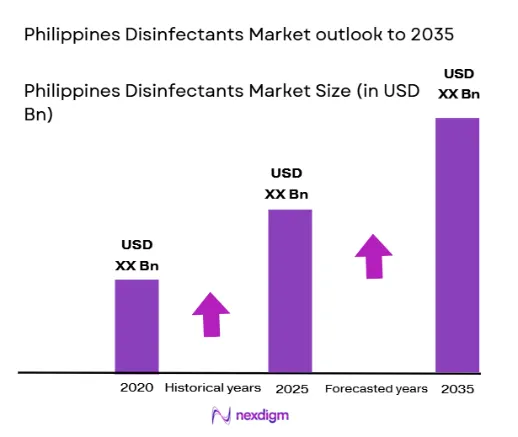
The Philippines Disinfectants Market is valued at approximately USD ~ billion based on a recent historical assessment, supported by data from industry sources such as Statista and World Bank-linked consumption metrics. The market is driven by increased hygiene awareness, expansion of healthcare infrastructure, and sustained demand across households and commercial sectors. Rising urban population density and institutional sanitation protocols continue to reinforce demand, particularly for alcohol-based and multi-surface disinfectants.
Metro Manila, Cebu, and Davao emerge as dominant regions due to their dense population clusters, advanced healthcare systems, and strong commercial presence. These cities benefit from higher retail penetration, better distribution networks, and increased institutional consumption in hospitals, offices, and hospitality sectors. Additionally, government-backed sanitation campaigns and urban infrastructure development further accelerate disinfectant usage, making these regions central to market growth dynamics.
Market Segmentation
By Product Type
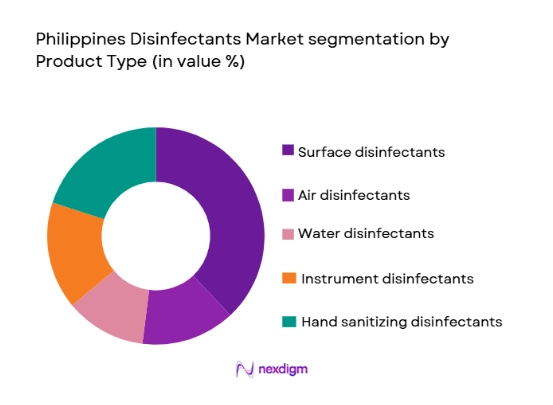
Philippines Disinfectants Market is segmented by product type into surface disinfectants, air disinfectants, water disinfectants, instrument disinfectants, and hand sanitizing disinfectants. Recently, surface disinfectants has a dominant market share due to factors such as high frequency of usage in both residential and commercial settings, strong brand presence, wide availability in retail channels, and consumer preference for multi-purpose cleaning solutions. The demand is further supported by institutional procurement from healthcare facilities, offices, and hospitality sectors where surface hygiene remains critical. Increased awareness regarding virus transmission through surfaces has also contributed to the dominance of this segment.
By EndUser
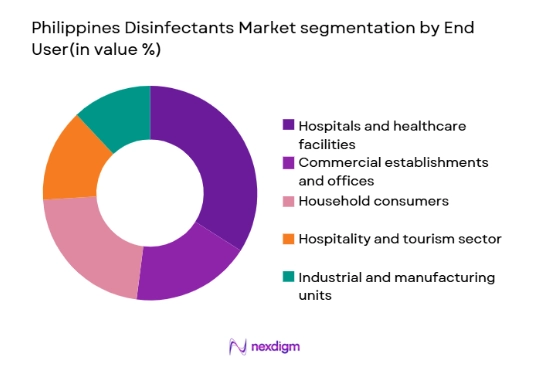
Philippines Disinfectants Market is segmented by end users into hospitals and healthcare facilities, commercial establishments and offices, household consumers, hospitality and tourism sector, and industrial and manufacturing units. Recently, hospitals and healthcare facilities has a dominant market share due to factors such as stringent hygiene regulations, high volume consumption, and continuous need for infection control products. The healthcare sector consistently demands high-quality disinfectants for equipment, surfaces, and personnel hygiene, supported by government investments in healthcare infrastructure and increasing patient inflow.
Competitive Landscape
The Philippines Disinfectants Market exhibits moderate consolidation, with a mix of multinational corporations and strong domestic players competing across product categories. Leading companies leverage brand recognition, distribution strength, and innovation in formulation to maintain competitive positioning. Multinational firms dominate premium segments, while local manufacturers capture cost-sensitive consumers through affordability and localized supply chains.
| Company Name | Establishment Year | Headquarters | Technology Focus | Market Reach | Key Products | Revenue (USD Billion) | Distribution Strength |
| Unilever Philippines Inc. | 1927 | Manila | ~ | ~ | ~ | ~ | ~ |
| Procter & Gamble Philippines | 1935 | Makati | ~ | ~ | ~ | ~ | ~ |
| Reckitt Benckiser Philippines | 1999 | Taguig | ~ | ~ | ~ | ~ | ~ |
| Green Cross Inc. | 1952 | Manila | ~ | ~ | ~ | ~ | ~ |
| Splash Corporation | 1985 | Valenzuela | ~ | ~ | ~ | ~ | ~ |
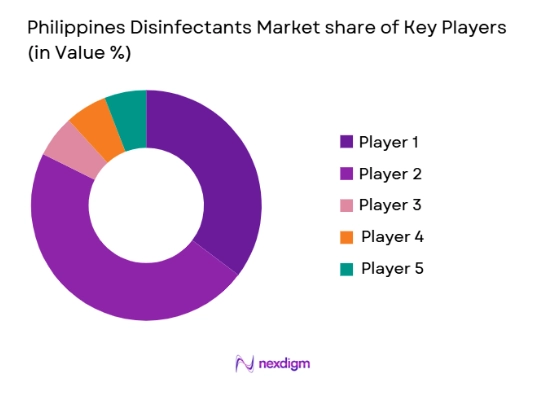
Philippines Disinfectants Market Analysis
Growth Drivers
Increasing Healthcare Infrastructure Investments::
The expansion of healthcare facilities across urban and semi-urban regions significantly drives disinfectant demand in the Philippines. Hospitals, clinics, and diagnostic centers require continuous supplies of disinfectants for infection prevention and control protocols. Government initiatives aimed at improving healthcare accessibility have resulted in the construction of new facilities and the modernization of existing ones. This expansion directly increases consumption of medical-grade disinfectants used for surfaces, instruments, and personnel hygiene. Additionally, rising patient volumes contribute to higher usage frequency, further boosting demand. Private sector investments in healthcare infrastructure also play a crucial role in enhancing market growth. The growing emphasis on quality healthcare services increases reliance on high-performance disinfectant solutions. Increased regulatory standards for sanitation further reinforce procurement practices among healthcare institutions. Furthermore, the integration of advanced medical equipment necessitates specialized disinfectants for maintenance and sterilization. Overall, the healthcare sector remains a primary growth engine for the disinfectants market.
Rising Consumer Awareness of Hygiene Practices:
Heightened awareness regarding personal hygiene and sanitation has significantly influenced consumer behavior in the Philippines. Public health campaigns and increased media coverage have educated consumers about the importance of disinfectants in preventing disease transmission. This awareness has translated into higher demand for household disinfectants such as sprays, wipes, and sanitizers. Urban households, in particular, demonstrate increased adoption of regular cleaning routines using disinfectant products. The influence of global health trends has also shaped local consumption patterns, encouraging frequent use of hygiene products. Additionally, the availability of a wide range of affordable disinfectant products has made them accessible to a broader population. E-commerce platforms have further facilitated product availability and convenience for consumers. Schools and workplaces also promote hygiene practices, indirectly boosting household consumption. Overall, behavioral shifts toward preventive health measures continue to drive market growth.
Market Challenges
Regulatory Compliance and Product Approval Complexity:
The disinfectants market in the Philippines faces significant challenges related to regulatory compliance and product approval processes. Manufacturers must adhere to stringent guidelines regarding chemical formulations, safety standards, and labeling requirements. These regulations are enforced by government bodies to ensure consumer safety and environmental protection. Compliance often involves extensive testing and certification procedures, which can increase operational costs and delay product launches. Smaller manufacturers may struggle to meet these requirements due to limited resources and technical expertise. Additionally, frequent updates to regulatory frameworks necessitate continuous monitoring and adaptation by market players. Non-compliance can result in penalties, product recalls, and reputational damage. Import restrictions and documentation requirements also add complexity for international companies entering the market. The regulatory landscape thus presents a barrier to entry and expansion, particularly for new and smaller firms. Overall, navigating compliance requirements remains a critical challenge for industry participants.
Price Sensitivity Among Consumers:
A significant portion of the Philippine population exhibits high price sensitivity, which impacts purchasing decisions in the disinfectants market. Consumers often prioritize affordability over brand preference, leading to increased competition among low-cost product offerings. This price-driven behavior can limit the adoption of premium disinfectant products that offer advanced features or higher efficacy. Local manufacturers often compete by offering lower-priced alternatives, which can put pressure on profit margins for established brands. Economic fluctuations and varying income levels further influence consumer spending patterns. Retailers also focus on promoting budget-friendly products to attract a broader customer base. As a result, companies must balance product quality with cost competitiveness to maintain market presence. Price wars among competitors can reduce overall profitability and hinder investment in innovation. Additionally, counterfeit or substandard products may enter the market due to weak enforcement in certain areas. This creates further challenges for maintaining product standards and consumer trust.
Opportunities
Expansion of Eco-Friendly Disinfectant Products:
The growing awareness of environmental sustainability presents a significant opportunity for eco-friendly disinfectant products in the Philippines. Consumers are increasingly seeking products that are biodegradable, non-toxic, and environmentally safe. This shift in preference encourages manufacturers to develop innovative formulations that minimize environmental impact while maintaining effectiveness. Regulatory bodies are also promoting sustainable practices, further supporting the adoption of green products. Companies investing in eco-friendly solutions can differentiate themselves in a competitive market. The hospitality and tourism sectors, in particular, show strong interest in sustainable hygiene products to enhance brand image. Additionally, partnerships with environmental organizations can strengthen product positioning. Advances in biotechnology enable the development of plant-based disinfectants with comparable efficacy to traditional chemicals. Marketing campaigns highlighting sustainability benefits can attract environmentally conscious consumers. Overall, the transition toward green disinfectants offers substantial growth potential for market players.
Adoption of Advanced Disinfection Technologies:
Technological advancements in disinfection methods provide significant opportunities for market growth in the Philippines. Innovations such as UV-based disinfection systems and automated fogging solutions are gaining traction across various sectors. These technologies offer enhanced efficiency and effectiveness compared to traditional methods. Healthcare facilities and commercial establishments are increasingly adopting automated systems to improve sanitation standards. The integration of smart technologies allows for real-time monitoring and control of disinfection processes. This enhances operational efficiency and reduces manual intervention. Additionally, technological advancements enable the development of multi-functional disinfectant products with extended efficacy. Companies investing in research and development can capitalize on these emerging trends. Government support for technological innovation further accelerates adoption across industries. Educational initiatives promoting the benefits of advanced disinfection methods also contribute to market expansion. Overall, technological innovation presents a strong opportunity for differentiation and growth.
Future Outlook
The Philippines disinfectants market is expected to witness sustained growth over the next five years driven by increasing hygiene awareness and expanding healthcare infrastructure. Technological advancements in disinfection methods and rising adoption of eco-friendly solutions will shape product innovation. Government regulations supporting sanitation standards will further strengthen demand. Growth in urbanization and commercial sectors will also contribute to expanding consumption patterns across the country.
Major Players
- Unilever Philippines Inc.
- Procter & Gamble Philippines
- Reckitt Benckiser Philippines
- Green Cross Inc.
- Splash Corporation
- Lamoiyan Corporation
- Peerless Products Manufacturing Corporation
- Chemrez Technologies Inc.
- Cleanmatic Services Inc.
- Zonrox Philippines
- Belo Essentials Inc.
- Ever Bilena Cosmetics Inc.
- Bioskin Tech Philippines
- Hygienix Philippines
- San Miguel Pure Foods Company Inc.
Key Target Audience
- Healthcare product manufacturers
- FMCG companies
- Retail and supermarket chains
- E-commerce platforms
- Pharmaceutical distributors
- Hospitality industry operators
- Industrial facility managers
- Government and regulatory bodies
Research Methodology
Step 1: Identification of Key Variables
Key variables such as product categories, demand drivers, pricing trends, and regulatory frameworks are identified through industry reports and secondary data sources to establish a comprehensive research base.
Step 2: Market Analysis and Construction
Market data is structured using both top-down and bottom-up approaches, integrating supply-side and demand-side analysis to build accurate market models and segmentation frameworks.
Step 3: Hypothesis Validation and Expert Consultation
Findings are validated through consultations with industry experts, manufacturers, distributors, and regulatory stakeholders to ensure reliability and real-world applicability of insights.
Step 4: Research Synthesis and Final Output
All data points are synthesized into a structured format, ensuring consistency, accuracy, and clarity in presenting the final market insights and forecasts.

- Executive Summary
- Research Methodology (Definitions, Scope, Industry Assumptions, Market Sizing Approach, Primary & Secondary Research Framework, Data Collection & Verification Protocol, Analytic Models & Forecast Methodology, Limitations & Research Validity Checks)

- Market Definition and Scope
- Value Chain & Stakeholder Ecosystem
- Regulatory / Certification Landscape
- Sector Dynamics Affecting Demand
- Strategic Initiatives & Infrastructure Growth

- Growth Drivers
Rising healthcare infrastructure expansion across urban and semi-urban regions
Increased public awareness of hygiene and infection control post-pandemic
Growth in hospitality and tourism sectors demanding sanitation solutions
Government campaigns promoting sanitation and disease prevention
Expansion of e-commerce enabling wider product accessibility - Market Challenges
Price sensitivity among low-income consumer segments
Regulatory compliance complexity for chemical formulations
Supply chain disruptions affecting raw material availability
Environmental concerns regarding chemical disinfectants
Limited awareness in rural areas about advanced disinfectant products - Market Opportunities
Development of eco-friendly and biodegradable disinfectants
Expansion into underserved rural and semi-urban markets
Integration of smart and automated disinfection technologies - Trends
Shift towards natural and plant-based disinfectant formulations
Growing adoption of disinfectant wipes for convenience
Increased demand for multi-surface and multi-purpose disinfectants
Rising use of automated and fogging disinfection systems
Brand differentiation through antimicrobial efficacy claims - Government Regulations & Defense Policy
Implementation of stricter product registration and safety standards
Promotion of local manufacturing under health security initiatives
Regulatory monitoring of antimicrobial resistance and chemical usage - SWOT Analysis
- Stakeholder and Ecosystem Analysis
- Porter’s Five Forces Analysis
- Competition Intensity and Ecosystem Mapping

- By Market Value, 2020-2025
- By Installed Units, 2020-2025
- By Average System Price, 2020-2025
- By System Complexity Tier, 2020-2025

- By System Type (In Value%)
Surface disinfectants
Air disinfectants
Water disinfectants
Instrument disinfectants
Hand sanitizing disinfectants - By Platform Type (In Value%)
Liquid-based disinfectants
Spray and aerosol disinfectants
Wipes-based disinfectants
Gel-based disinfectants
Powder and tablet disinfectants - By Fitment Type (In Value%)
Standalone consumer products
Institutional bulk systems
Integrated dispensing systems
Portable disinfection units
Automated fogging systems - By EndUser Segment (In Value%)
Hospitals and healthcare facilities
Commercial establishments and offices
Household consumers
Hospitality and tourism sector
Industrial and manufacturing units - By Procurement Channel (In Value%)
Direct manufacturer procurement
Retail pharmacies and supermarkets
Online e-commerce platforms
Government and institutional tenders
Distributor and wholesale channels - By Material / Technology (in Value %)
Alcohol-based disinfectants
Chlorine compounds
Quaternary ammonium compounds
Hydrogen peroxide-based solutions
UV and advanced oxidation technologies

- Market structure and competitive positioning
- Market share snapshot of major players
- CrossComparison Parameters (Product Portfolio Breadth, Pricing Strategy, Distribution Network Strength, Regulatory Compliance Capability, Brand Recognition, Innovation Pipeline, Production Capacity, Geographic Reach, Sustainability Initiatives, Customer Segmentation Focus)
- SWOT Analysis of Key Players
- Pricing & Procurement Analysis
- Key Players
Unilever Philippines Inc.
Procter & Gamble Philippines
Reckitt Benckiser Philippines
San Miguel Pure Foods Company Inc.
Green Cross Inc.
Splash Corporation
Lamoiyan Corporation
Peerless Products Manufacturing Corporation
Cleanmatic Services Inc.
Chemrez Technologies Inc.
Zonrox Philippines
Belo Essentials Inc.
Ever Bilena Cosmetics Inc.
Bioskin Tech Philippines
Hygienix Philippines

- Healthcare sector dominates demand due to strict hygiene protocols and infection control measures
- Household consumption driven by rising awareness and lifestyle changes
- Commercial offices and retail spaces increasingly adopting routine disinfection practices
- Hospitality sector focusing on enhanced sanitation to rebuild consumer confidence

- Forecast Market Value, 2026-2035
- Forecast Installed Units, 2026-2035
- Price Forecast by System Tier, 2026-2035
- Future Demand by Platform, 2026-2035


 Request a Sample
 Ask for Customization
 Get a Quote
 Enquire Now