

 Download PDF
Market Overview
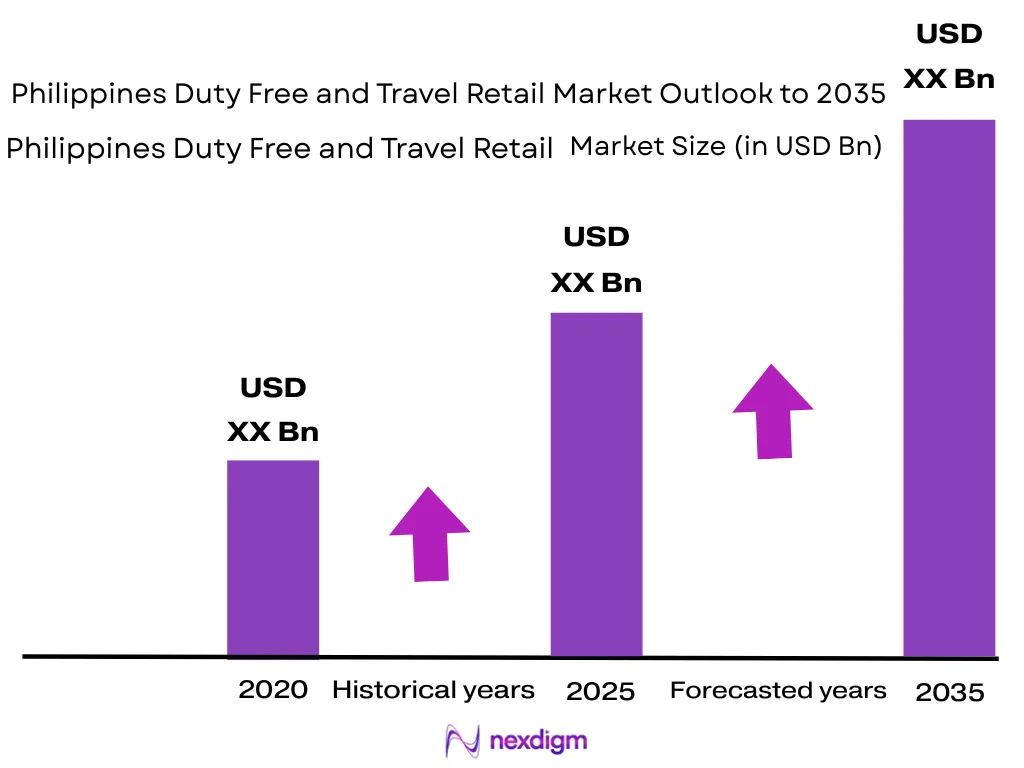
The Philippines Duty Free and Travel Retail Market is valued at USD ~ billion, based on a five-year historical assessment. Demand is driven by international passenger recovery, inbound tourism, OFW and balikbayan purchases, airport retail, pasalubong gifting and beauty/luxury consumption. Tourism revenue moved from PHP ~ billion to PHP ~ billion, while NAIA passenger volume rose from ~ million to ~ million, strengthening travel retail exposure.
Manila, Cebu, Clark, Davao, Kalibo and integrated resort corridors dominate the Philippines Duty Free and Travel Retail Market because they concentrate international airports, inbound tourists, OFWs, balikbayans, casino-linked visitors, premium malls and duty-free outlets. NAIA handled 50.1 million passengers versus 45.3 million earlier, Mactan-Cebu handled over 11.3 million, and Clark handled 2.4 million, supporting arrival duty-free, departure retail, confectionery, liquor, beauty and local souvenir demand.
Market Segmentation
By Product Category
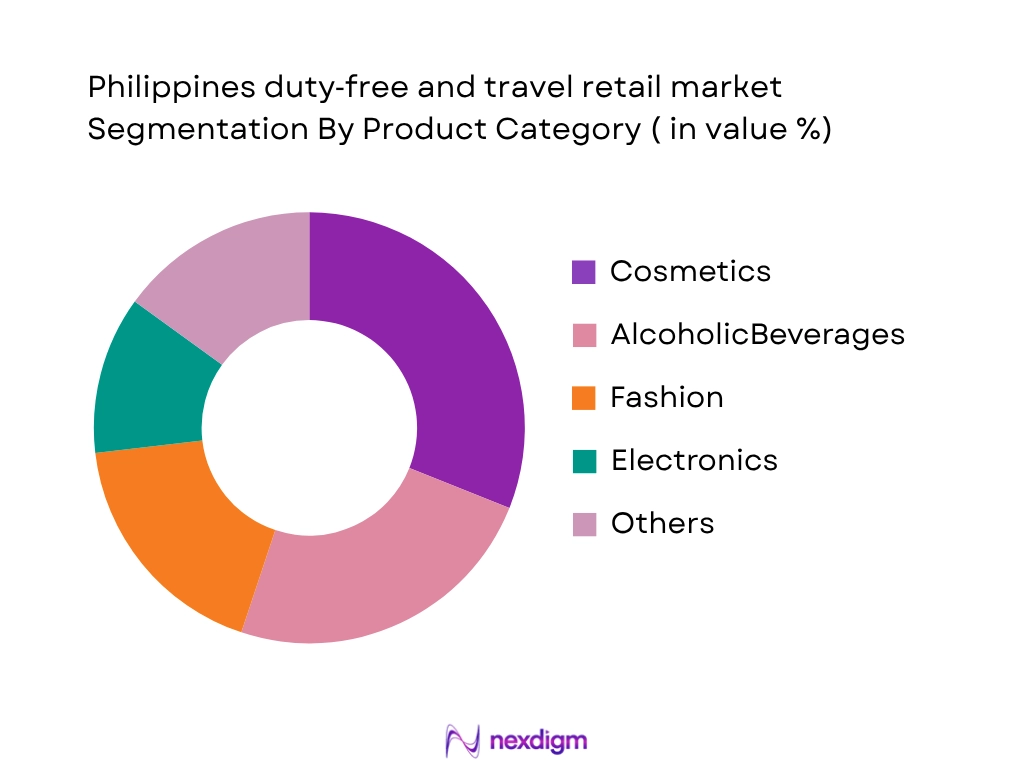
Philippines Duty Free and Travel Retail Market is segmented by product category into beauty, perfumes and cosmetics; liquor, wine and spirits; confectionery and food gifts; luxury fashion, bags, watches and jewellery; tobacco and cigarettes; and electronics, wellness, souvenirs and travel essentials. Recently, beauty, perfumes and cosmetics have a dominant market share in the Philippines under product category, due to strong gifting behaviour among OFWs, balikbayans and foreign tourists. Fragrances and skincare products are compact, premium, easy to carry, repeat-purchase oriented and suitable for family gifting. Duty-free stores in NAIA, downtown Manila and major gateways also use beauty counters, fragrance promotions and gift sets to convert arrival and departure passengers. Liquor remains important because customs privileges support limited personal-use purchases, but beauty benefits from broader buyer eligibility, wider gender appeal and stronger pasalubong positioning.
By Distribution Channel
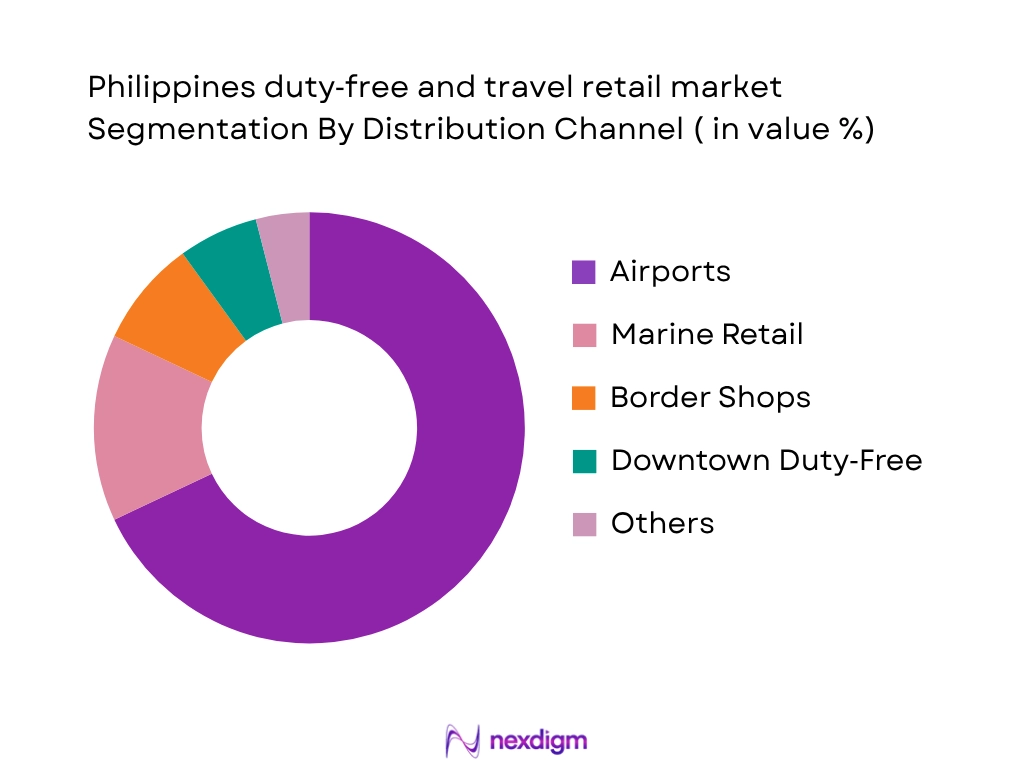
The distribution channel segmentation covers airports, cruise & marine retail, border shops, downtown duty‑free, and other travel hubs. Airport retail dominates the Philippines market due to high international and domestic passenger throughput at major aviation hubs—including Manila, Cebu, and Clark airports—which collectively handle the majority of international travel and generate substantial shopper traffic. Airports provide the most accessible and high‑frequency retail opportunities, particularly pre‑departure zones where travelers often make last‑minute purchases of high‑value goods. Cruise and marine retail, while growing, remains secondary due to a smaller cruise tourism base compared with air travel.
Competitive Landscape
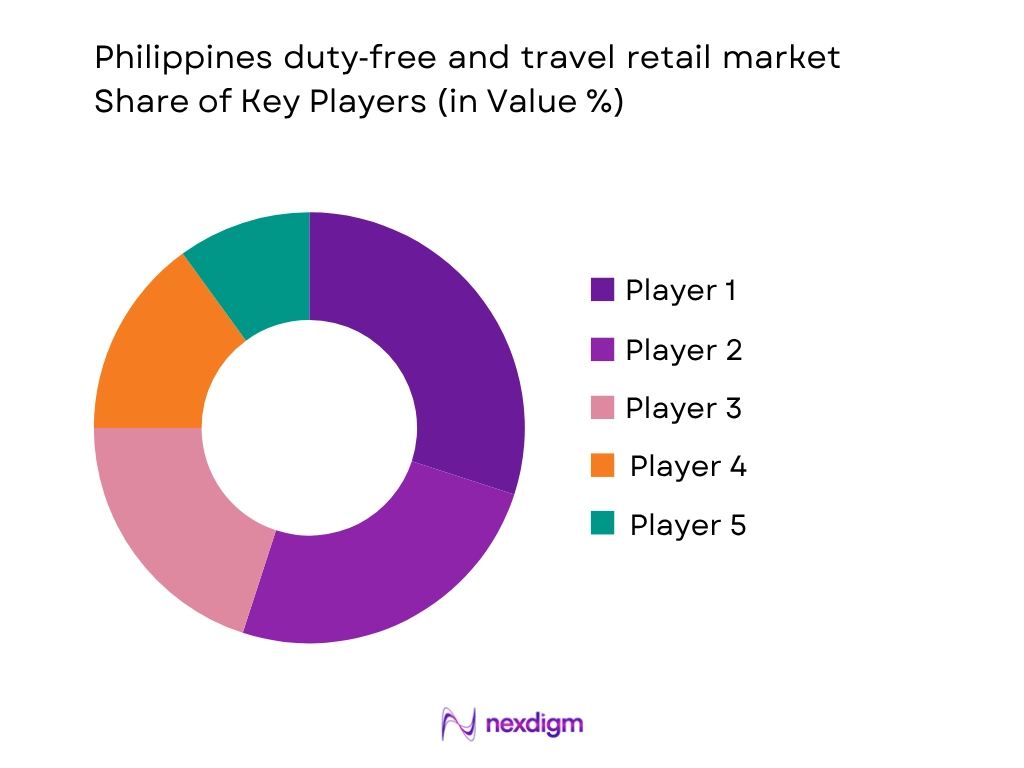
The Philippines Duty Free and Travel Retail Market is led by Duty Free Philippines Corporation in government-backed duty-free retail, while global operators and adjacent retailers compete through airport concessions, luxury retail, beauty, convenience, electronics, local gifts and integrated resort shopping. Competition is shaped by airport access, customs eligibility, product assortment, traveller cohort focus, online pre-order capability and partnerships with tourism, airport and brand stakeholders.
| Company | Establishment Year | Headquarters | Core Category Focus | Key Locations | Traveller Cohort Focus | Digital Capability | Market-Specific Strength | Competitive Position |
| Duty Free Philippines Corporation | 1987 | Parañaque, Philippines | ~ | ~ | ~ | ~ | ~ | ~ |
| Lotte Duty Free | 1980 | Seoul, South Korea | ~ | ~ | ~ | ~ | ~ | ~ |
| Avolta / Dufry | 1865 / 2023 rebrand | Basel, Switzerland | ~ | ~ | ~ | ~ | ~ | ~ |
| DFS Group | 1960 | Hong Kong | ~ | ~ | ~ | ~ | ~ | ~ |
| Stores Specialists Inc. | 1987 | Makati, Philippines | ~ | ~ | ~ | ~ | ~ | ~ |
Philippines Duty Free and Travel Retail Market
Growth Drivers
Airport passenger recovery supporting duty-free conversion at major gateways
The Philippines Duty Free and Travel Retail Market is supported by rising passenger movement across international gateways, which directly increases store exposure for beauty, liquor, confectionery, tobacco, electronics, travel essentials and pasalubong products. NAIA handled 50.1 million passengers in 2024 and 52.02 million passengers in 2025, while the Bureau of Immigration processed 14,733,597 arrivals in 2024 and 15,608,868 arrivals in 2025, including 6,704,007 foreign nationals. The macro base also supports travel-linked retail, with World Bank reporting Philippines GDP at USD 461.62 billion and GDP per capita at USD 3,984.8 in 2024. Higher airport throughput strengthens arrival-store conversion, departure-store browsing and pre-order duty-free retail because passenger traffic is the primary demand funnel for travel retail.
Tourism expenditure and household consumption supporting gifting-led travel retail
Duty-free demand in the Philippines is closely linked to tourism spending, returning Overseas Filipinos, balikbayan gifting and household consumption. PSA reported Tourism Direct Gross Value Added of PHP 2.35 trillion in 2024, compared with PHP 2.12 trillion in 2023, while inbound tourism expenditure moved from PHP 697.49 billion in 2023 to PHP 699.98 billion in 2024. Domestic tourism expenditure reached PHP 3.16 trillion in 2024, compared with PHP 2.71 trillion in 2023, reinforcing local travel and airport retail occasions. World Bank-linked data also reported household final consumption expenditure at 20,137,692,097,500 LCU in 2024, supporting beauty, confectionery, liquor, local gifts and family-oriented purchases. These indicators support travel retail because Philippine duty-free shopping is heavily driven by pasalubong, family baskets and arrival purchases.
Market Challenges
Customs eligibility complexity affecting traveller conversion and compliance
The Philippines Duty Free and Travel Retail Market faces conversion risk because shopper eligibility, duty-free timing, balikbayan status and product restrictions require clear passenger understanding. Bureau of Customs passenger guidelines state that arriving passengers can enjoy a one-time duty-free shopping privilege within prescribed days from arrival, while frequent travellers can access up to US$10,000 worth of duty-free shopping privileges in a calendar year. Balikbayans and OFWs are entitled to PHP 10,000 duty exemption on used personal and household effects, and OFWs have duty and tax-free privileges on used appliances limited to 1 unit of every kind within a PHP 10,000 total value. These rules create operational pressure for retailers to educate shoppers, check documents and avoid non-compliant transactions. World Bank’s USD 461.62 billion GDP figure shows economic scale, but compliance friction remains market-specific.
Dependence on tourism and international arrivals creates demand volatility
Travel retail in the Philippines remains exposed to route capacity, arrival flows, source-market recovery and airport congestion. The Bureau of Immigration recorded 14,733,597 arrivals in 2024 and 15,608,868 arrivals in 2025, while foreign nationals accounted for 6,704,007 arrivals in 2025. This traffic supports duty-free retail, but it also means category sales can weaken when flight schedules, tourist flows, visa conditions or airline capacity soften. PSA tourism data shows inbound tourism expenditure of PHP 699.98 billion in 2024 after PHP 697.49 billion in 2023, indicating travel-retail-linked demand depends on steady visitor spending and not only passenger count. World Bank reported GDP per capita at USD 3,984.8 in 2024, but the market’s airport, seaport and downtown duty-free formats remain more sensitive to international traffic than ordinary domestic retail.
Market Opportunities
Omnichannel duty-free expansion for OFWs, balikbayans and frequent travellers
The Philippines has a clear opportunity to expand online duty-free catalogues, pre-ordering, airport pickup and balikbayan-focused digital baskets because eligible travellers already have defined purchase privileges and large traffic flows. Bureau of Customs guidelines state that all passengers arriving from abroad can use a one-time duty-free shopping privilege with valid passport, flight ticket and boarding pass, while frequent travellers can access up to US$10,000 in duty-free shopping privileges during a calendar year. The Bureau of Immigration processed 15,608,868 arrivals in 2025, giving retailers a large identifiable customer base for digital reminders, eligibility education and click-and-collect offers. World Bank-linked household final consumption expenditure reached 20,137,692,097,500 LCU in 2024, supporting demand for family gifts, perfumes, confectionery, liquor, wellness and household-oriented products. This opportunity is strongest where digital retail reduces airport dwell-time pressure.
Regional gateway and local-brand travel retail development
Regional gateway retail presents a future growth opportunity because duty-free and travel retail can extend beyond Metro Manila into Cebu, Clark, Davao, Kalibo and seaport-linked corridors. NAIA handled 52.02 million passengers in 2025, while Bureau of Immigration arrivals reached 15,608,868 nationwide in the same year, showing continued concentration at major entry points but also a broad base for distributed airport retail. PSA reported outbound tourism expenditure of PHP 345.68 billion in 2024, domestic tourism expenditure of PHP 3.16 trillion, and employment in tourism industries at 6.75 million, creating a travel ecosystem that can support Filipino food gifts, local crafts, beauty, wellness, fashion accessories and pasalubong bundles. World Bank’s 2024 GDP of USD 461.62 billion and GDP per capita of USD 3,984.8 further support formal retail investment around gateways where tourist, OFW, balikbayan and domestic traveller flows intersect.
Future Outlook
The Philippines Duty Free and Travel Retail Market is expected to grow steadily over the forecast period, supported by airport modernization, tourism recovery, OFW homecoming purchases, balikbayan gifting, and rising demand for beauty, liquor, confectionery, local souvenirs and premium lifestyle goods. NAIA, Mactan-Cebu, Clark and Davao will remain central travel retail gateways, while downtown duty-free and integrated resort retail will support high-basket purchases.
Online duty-free and click-and-collect will gain importance as travellers seek pre-trip browsing, digital payment, product reservation and faster airport pickup. Retailers will increasingly use traveller cohort targeting, flight-linked promotions, holiday campaigns and balikbayan loyalty programs. Growth will depend on improved airport experience, customs education, product availability, store modernization, brand exclusives and source-market recovery.
Major Players
- Duty Free Philippines Corporation
- Lotte Duty Free
- Avolta / Dufry
- DFS Group
- The Shilla Duty Free
- Lagardère Travel Retail
- WHSmith
- Stores Specialists Inc.
- Rustan Commercial Corporation
- SM Retail
- Robinsons Retail Holdings
- Power Mac Center
- Bench / Suyen Corporation
- Kultura Filipino
- Newport World Resorts Retail
Key Target Audience
- Duty-free concessionaires and travel retail operators
- Airport authorities and terminal commercial teams
- Luxury, beauty, liquor and confectionery brand owners
- OFW and balikbayan-focused retail operators
- Casino, integrated resort and hotel retail operators
- Airport e-commerce and click-and-collect platforms
- Investments and venture capitalist firms
- Government and regulatory bodies
Research Methodology
Step 1: Identification of Key Variables
The initial phase involves constructing an ecosystem map encompassing all major stakeholders within the Philippines Duty Free and Travel Retail Market. This includes duty-free operators, airport authorities, customs regulators, tourism agencies, global brands, retailers, OFWs, balikbayans, tourists and airport concessionaires. The objective is to identify critical variables such as passenger traffic, traveller type, product mix, retail format and customs eligibility.
Step 2: Market Analysis and Construction
In this phase, historical data is compiled and analyzed for the Philippines Duty Free and Travel Retail Market. This includes tourism receipts, international arrivals, airport passenger traffic, store formats, category sales behaviour, customs rules and duty-free shopping eligibility. Revenue construction is validated through top-down market sizing and bottom-up category, channel and traveller-cohort mapping.
Step 3: Hypothesis Validation and Expert Consultation
Market hypotheses are developed and validated through computer-assisted telephone interviews with travel retail operators, airport commercial managers, brand distributors, beauty suppliers, liquor companies, concessionaires and retail category heads. These consultations provide operational insights into product performance, basket composition, traveller conversion, store productivity, digital readiness and regulatory barriers.
Step 4: Research Synthesis and Final Output
The final phase involves synthesizing secondary research, government data, airport traffic, company information, customs rules and expert inputs. Direct engagement with duty-free stakeholders and retailers validates segmentation, competitive positioning, growth opportunities and pain points. The final output provides structured analysis on market size, segmentation, competition, future outlook, target audience and recommendations.

- Executive Summary
- Research Methodology (Market definitions and assumptions, abbreviations, duty-free and duty-paid retail scope, airport and downtown travel retail classification, traveller allowance mapping, customs concession framework, airport passenger triangulation, tourism receipt mapping, retail sales estimation approach, category basket audit, concessionaire benchmarking, store visit analysis, primary interviews with retailers and airport operators, limitations and future conclusions)

- Definition and Scope
- Overview Genesis
- Timeline of Major Players
- Business Cycle
- Supply Chain and Value Chain Analysis

- Growth Drivers (International arrivals, airport passenger traffic, OFW and balikbayan shoppers, airport modernization, tourism receipts, middle-class consumption, travel retail digitalization)
- Market Challenges (Tourism recovery gap, customs compliance complexity, counterfeit and grey-market imports, airport infrastructure constraints, concession cost, passenger dwell-time pressure)
- Opportunities (Airport retail modernization, online duty-free, balikbayan loyalty, regional gateway retail, Filipino premium brands, luxury tourism retail)
- Market Trends (Pasalubong retailing, travel-exclusive bundles, airport retail digitization, Filipino local brands, premium beauty, convenience-led shopping)
- Government Regulation (Bureau of Customs rules, tax-exempt purchase limits, OFW and balikbayan privileges, regulated goods, liquor and tobacco allowances, customs declaration)
- SWOT Analysis
- Stakeholder Ecosystem
- Porter’s Five Forces

- By Retail Sales Value (2020-2025)
- By Gross Merchandise Value (2020-2025)
- By Average Basket Size (2020-2025)

- By Product Category (In Value %)
Beauty, Perfumes and Cosmetics
Liquor, Wine and Spirits
Tobacco and Cigarettes
Luxury Fashion, Bags and Accessories - By Retail Format (In Value %)
Airport Duty-Free Arrival Stores
Airport Duty-Free Departure Stores
Downtown Duty-Free Stores
Mono-Brand Luxury Boutiques
Multi-Brand Specialty Travel Retail Stores - By Traveller Type (In Value %)
Overseas Filipino Workers
Balikbayan Travellers |
Foreign Tourists
Departing Filipino Residents
Arriving Filipino Residents - By Location (In Value %)
Ninoy Aquino International Airport
Mactan-Cebu International Airport
Clark International Airport
Davao International Airport

- Market Share of Major Players (Retail sales value, airport sales value, downtown sales value, product category contribution, store footprint, traveller cohort penetration)
- Cross Comparison Parameters (Airport terminal footprint, downtown duty-free store network, product category specialization, OFW and balikbayan customer penetration, customs allowance compliance capability, luxury brand portfolio, online pre-order capability, airport and tourism authority partnerships)
- SWOT Analysis of Major Players
- Pricing Analysis Basis SKUs (Whisky, brandy, wine, fragrance, skincare set, chocolate box, luxury bag, watch, electronics accessory, pasalubong bundle)
- Detailed Profiles of Major Companies
Duty Free Philippines Corporation
Lotte Duty Free
Avolta / Dufry
DFS Group
The Shilla Duty Free
Lagardère Travel Retail
WHSmith
Stores Specialists Inc.
Rustan Commercial Corporation
SM Retail
Robinsons Retail Holdings
Power Mac Center
Bench / Suyen Corporation
Kultura Filipino
Newport World Resorts Retail

- OFW Shopper Analysis
- Balikbayan Shopper Analysis
- Foreign Tourist Shopper Analysis
- Departing Resident Traveller Analysis
- Arriving Resident Traveller Analysis

- By Retail Sales Value (2026-2035)
- By Gross Merchandise Value (2026-2035)
- By Average Basket Size (2026-2035)


 Request a Sample
 Ask for Customization
 Get a Quote
 Enquire Now