

 Download PDF
Market Overview
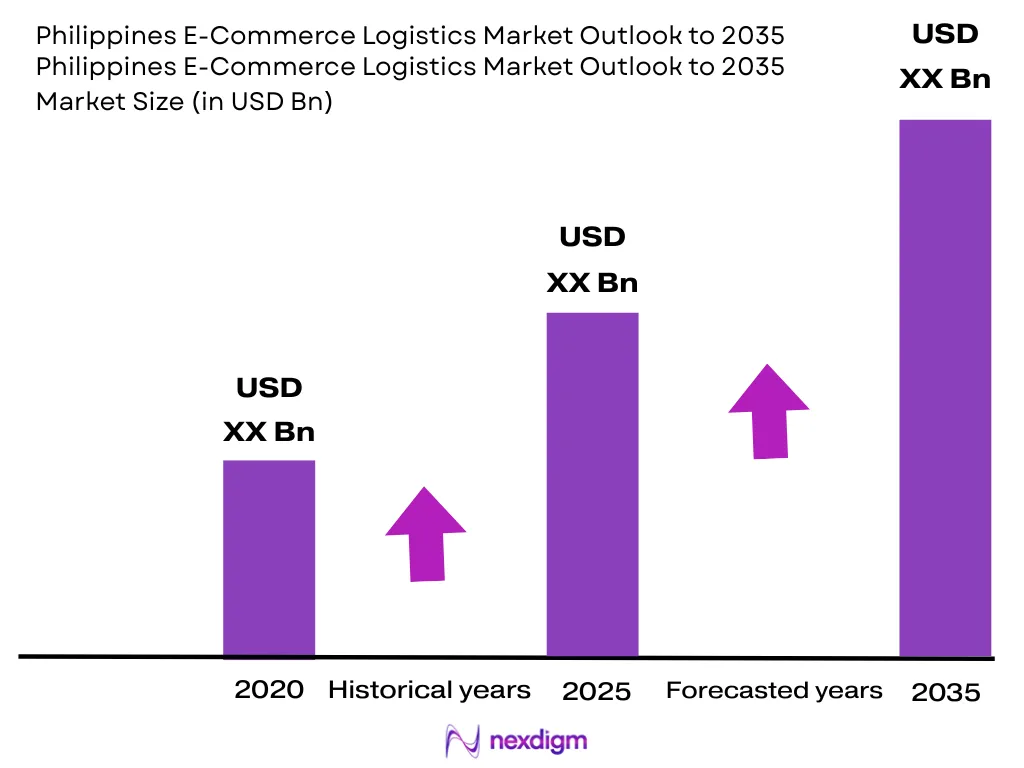
The Philippines E-Commerce Logistics Market was valued at USD ~ Billion in 2024 and is anticipated to expand at a CAGR of ~% during 2026-2035. The market is primarily driven by the rapid expansion of Shopee, Lazada, and TikTok Shop gross merchandise value, nationwide mobile-wallet penetration that exceeded 65% in 2024, and the rollout of provincial logistics mini-hubs that shorten delivery routes across the country’s 7,641 islands. According to industry estimates, the Philippines E-Commerce Logistics Market was valued at approximately USD ~ million in 2025 and is projected to grow at a CAGR of approximately 10.8%, while the broader Philippines e-commerce market is projected to grow from approximately USD 17.65 billion in 2025 to USD 37.95 billion by 2031 at a CAGR of approximately 13.61%. E-commerce gross merchandise value climbed to approximately USD 21 billion in 2025 as 73% of adult Filipinos shopped online, generating a step-change in last-mile delivery activity and reflecting the market’s rapid maturation across last-mile delivery, warehousing, and fulfillment segments.
Market Segmentation
By Service Type
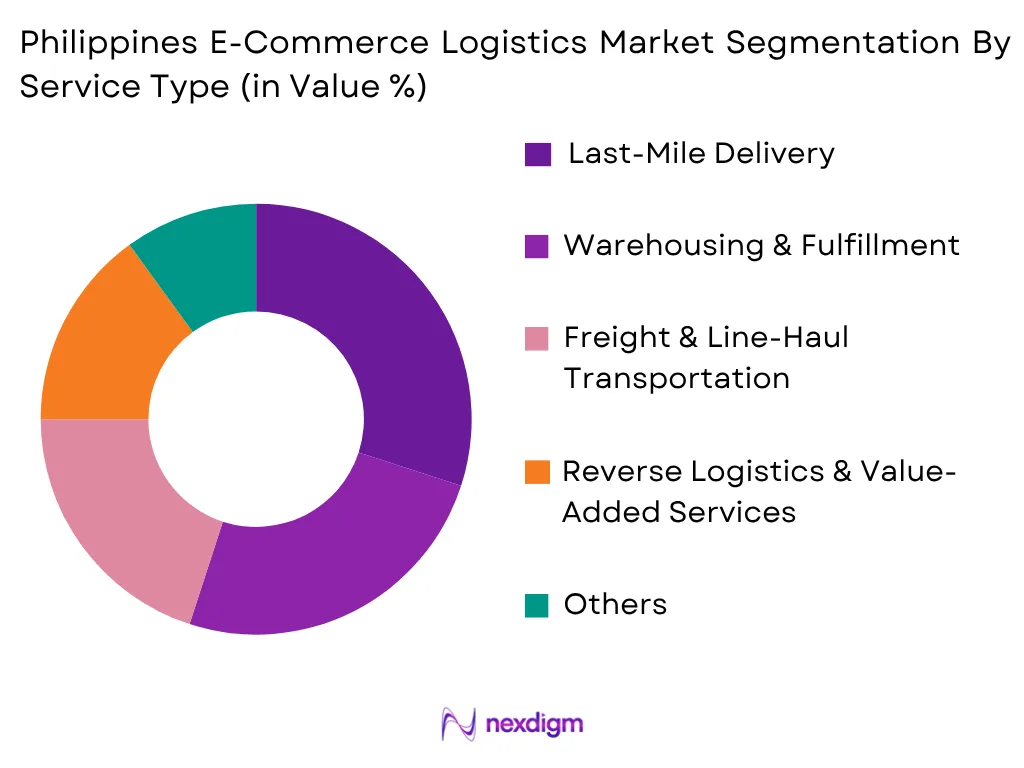
Among these, Last-Mile Delivery continues to dominate the Philippines E-Commerce Logistics Market, with J&T Express processing over 2 million parcels daily nationwide and operating 600+ branches, a fleet of 8,000+ delivery vehicles, and 30,000+ personnel as the preferred logistics partner for Shopee, Lazada, TikTok Shop, and other major platforms. Ninja Van continues to differentiate through its technology-driven approach and API integration capabilities, positioning itself as the preferred partner for high-volume sellers requiring automation and data analytics. Flash Express has carved out significant market share through inclusive logistics services designed for underserved micro, small, and medium enterprises, which comprise approximately 99.5% of Philippine enterprises. Warehousing & Fulfillment services are gaining increasing importance as SM Prime Holdings and other developers expand industrial park capacity in hubs such as Laguna, contributing to approximately 63% growth in industrial warehouse stock between 2015 and 2025, supporting the shift toward embedded fulfillment models.
By Region
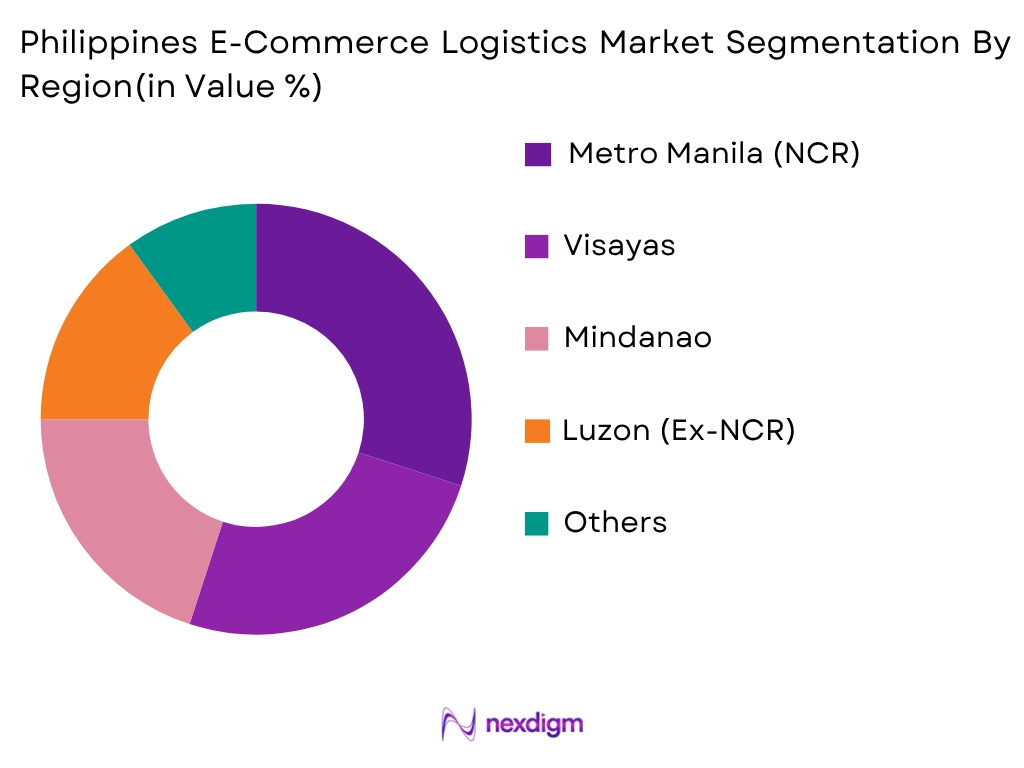
Metro Manila (NCR) remains the largest regional market within the Philippines E-Commerce Logistics Market by parcel volume and revenue, given its concentration of population, warehousing infrastructure, and last-mile delivery density, though chronic traffic congestion continues to constrain delivery speed and cost efficiency in the region. The Visayas and Mindanao regions are witnessing the fastest growth as modern trade and e-commerce penetration expand beyond Luzon, with Ninja Van’s 2025 partnership with Universal Robina embedding scan-to-print fulfillment inside fast-moving consumer goods channels to cut order cycle times in South Luzon and beyond. Global integrators including Maersk continue scaling air-cargo hubs in Clark to capture high-value cargo, while domestic truckers and coastal shippers leverage the government’s Build, Better, More infrastructure corridors to unlock previously underserved provincial lanes across the Visayas and Mindanao.
Competitive Landscape
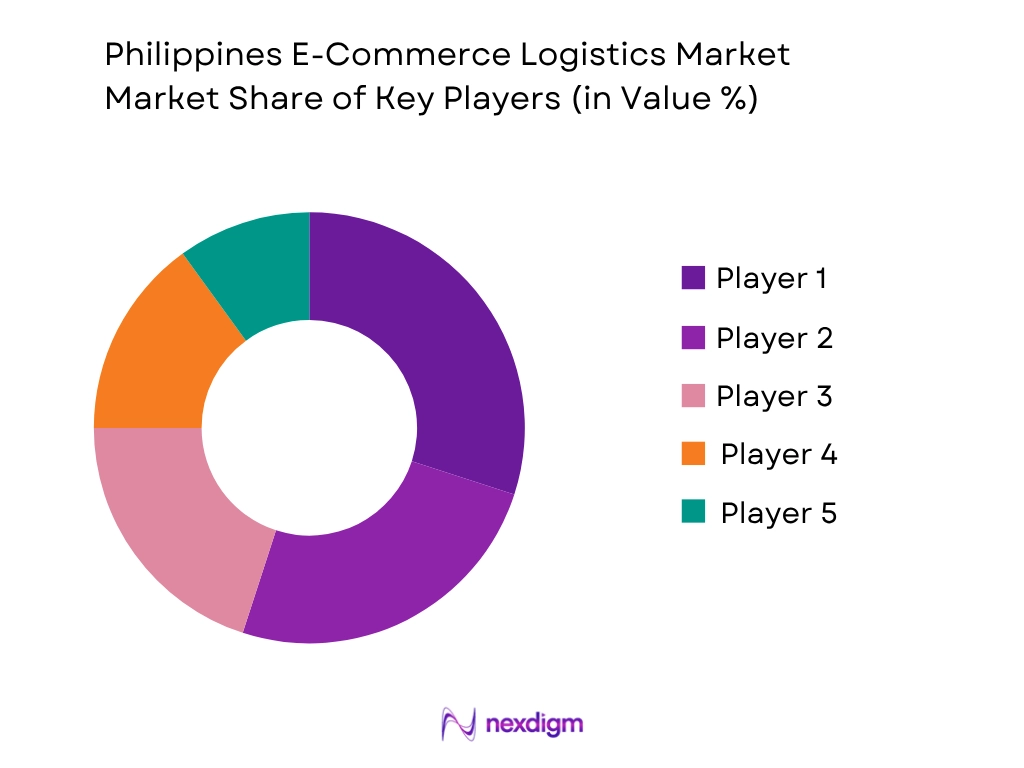
The Philippines E-Commerce Logistics Market is highly competitive and moderately fragmented, with J&T Express, Ninja Van, Flash Express, and LBC Express together handling the substantial majority of e-commerce parcel volume nationwide. Competition is primarily based on nationwide and provincial coverage, delivery speed, cash-on-delivery settlement reliability, platform API integration, and cost competitiveness. J&T Express maintains its position as the undisputed market leader in volume and geographic penetration, serving as the preferred fulfillment partner for Shopee, Lazada, TikTok Shop, and Temu with embedded high-frequency routing capability. Ninja Van continues to compete on technology differentiation and enterprise integration, while Flash Express targets underserved micro and small enterprise sellers with inclusive, cost-effective logistics services. Platform-owned logistics arms including SPX Express (Shopee Xpress) and Lazada Express (LEX) continue to expand their embedded fulfillment networks to reduce reliance on third-party couriers, while on-demand players Lalamove and GrabExpress compete for same-day and instant delivery volume in Metro Manila, Cebu, and Davao. LBC Express and 2GO Group continue to leverage their long-established nationwide networks, including remote and provincial coverage, to serve both e-commerce and traditional cargo and remittance customers across the archipelago.
| Company | Establishment Year | Headquarters | Primary Service Portfolio | Delivery Speed Portfolio
|
Network Presence | Major End-Use Industries | Key Strategic Focus | Certifications & Compliance |
| J&T Express Philippines | 2015 | ~ | ~ | ~ | ~ | ~ | ~ | ~ |
| Ninja Van Philippines | 2015 | ~ | ~ | ~ | ~ | ~ | ~ | ~ |
| Flash Express Philippines | 2018 | ~ | ~ | ~ | ~ | ~ | ~ | ~ |
| LBC Express, Inc. | 1945 | ~ | ~ | ~ | ~ | ~ | ~ | ~ |
| 2GO Group, Inc. | 1949 | ~ | ~ | ~ | ~ | ~ | ~ | ~ |
Philippines E-Commerce Logistics Market Analysis
Growth Drivers
Rapid Growth of Marketplace Platforms and Digital Payment Penetration
The Philippines E-Commerce Logistics Market continues to be shaped decisively by the rapid expansion of Shopee, Lazada, TikTok Shop, and other marketplace platforms, which collectively drove e-commerce gross merchandise value to approximately USD 21 billion in 2025 as 73% of adult Filipinos shopped online. Nationwide mobile-wallet penetration exceeding 65% in 2024, combined with the rapid uptake of Buy-Now-Pay-Later credit and continued reliance on cash-on-delivery convenience, has further expanded the market’s addressable consumer base across both urban and provincial areas. According to industry estimates, the Philippines E-Commerce Logistics Market is projected to grow at a CAGR of approximately 10.8% from its 2025 base of approximately USD 1,280 million, propelled in part by the government’s push to utilize the Regional Comprehensive Economic Partnership (RCEP) for tariff-free cross-border shipments, expanding the addressable base for cross-border e-commerce sellers and their logistics partners.
Provincial Logistics Mini-Hub Rollout and Infrastructure Investment
The rollout of provincial logistics mini-hubs that shorten delivery routes across the Philippines’ 7,641 islands continues to be a critical driver of market expansion, as logistics providers increasingly decentralize sorting and fulfillment capacity beyond Metro Manila to serve growing e-commerce demand in the Visayas and Mindanao. The government’s Build, Better, More infrastructure program, with a PHP 8.8 trillion (approximately USD 158.19 billion) investment commitment, continues to expand port facilities, road networks, and rail systems, positioning the Philippines as a key logistics hub in Southeast Asia. Global integrators are scaling air-cargo hubs in Clark to capture high-value cargo, while domestic truckers and coastal shippers leverage these Build Better More corridors to unlock previously underserved provincial lanes, illustrating the scale of infrastructure investment being deployed to address the archipelago’s persistent logistics fragmentation.
Market Challenges
Archipelagic Geography and Metro Manila Congestion
The Philippines E-Commerce Logistics Market faces significant challenges from the country’s archipelagic geography, which spans 7,641 islands and creates substantial inter-island freight cost complexity for logistics providers seeking to offer uniform nationwide delivery pricing and timelines. Chronic Metro Manila traffic congestion continues to shave cost competitiveness and delay last-mile delivery performance in the country’s highest-volume market, requiring providers to invest in route optimization technology and alternative delivery modes such as motorcycle and bicycle couriers to maintain service levels. Recurring typhoon and natural disaster disruptions add further operational unpredictability, periodically halting inter-island freight and last-mile delivery operations across affected regions and requiring providers to maintain contingency capacity and flexible routing to minimize service disruption.
High Cash-on-Delivery Reliance and Fragmented Provincial Networks
High reliance on cash-on-delivery as a payment method, while critical to serving the Philippines’ large unbanked and underbanked population, continues to increase reverse logistics costs and working capital requirements for both logistics providers and e-commerce sellers, given the need to manage cash collection, remittance timing, and return processing for undelivered or refused parcels. Fragmented last-mile networks outside major urban centers continue to constrain delivery speed and reliability in provincial and remote areas, where smaller regional couriers and informal delivery networks often supplement national providers’ coverage gaps. Rising fuel and labor costs continue to pressure delivery economics across the industry, particularly for last-mile providers operating dense motorcycle and vehicle fleets across congested urban and dispersed provincial territories.
Market Opportunities
Expansion of Provincial Networks and Cross-Border E-Commerce Growth
The continued expansion of provincial and rural delivery networks presents substantial opportunities for logistics providers willing to invest in decentralized sorting hubs and last-mile capacity beyond Metro Manila, as modern trade penetration accelerates across the Visayas and Mindanao. Growth in cross-border e-commerce under RCEP tariff-free shipment provisions is expanding the addressable market for logistics providers capable of offering integrated customs clearance and cross-border fulfillment services alongside domestic last-mile delivery. Companies developing AI-based route optimization and real-time tracking platforms are well positioned to capture growing demand as e-commerce sellers and platforms increasingly prioritize delivery reliability and shipment visibility across the country’s complex multi-island distribution network.
Electric Vehicle Adoption, Quick Commerce, and Fulfillment-as-a-Service Growth
The growing adoption of electric vehicle and motorcycle delivery fleets presents a significant opportunity for logistics providers seeking to reduce fuel cost exposure while addressing rising sustainability expectations from e-commerce platforms and corporate clients. Growth of quick commerce and same-day grocery delivery, led by on-demand players such as Lalamove and GrabExpress, is expanding the addressable market beyond traditional next-day and standard delivery models, particularly in Metro Manila, Cebu, and Davao. Expansion of fulfillment-as-a-service offerings for small and medium enterprises, which comprise approximately 99.5% of Philippine enterprises, presents a significant opportunity for providers such as Flash Express and Entrego that combine last-mile delivery with warehousing and order management capabilities, positioning them to capture growing demand from underserved MSME sellers scaling their online operations.
Future Outlook
The Philippines E-Commerce Logistics Market is expected to witness robust expansion over the forecast period, supported by continued growth in marketplace platform gross merchandise value, nationwide mobile-wallet and digital payment penetration, and the ongoing rollout of provincial logistics mini-hubs across the archipelago. Continued investment in electric vehicle fleets, AI-based route optimization, and fulfillment-as-a-service offerings is expected to further strengthen the market’s competitive landscape. Growing government emphasis on infrastructure investment under the Build, Better, More program and cross-border trade facilitation under RCEP will continue to reshape investment decisions and competitive dynamics across the industry through 2035.
Major Players
- J&T Express Philippines
- Ninja Van Philippines
- Flash Express Philippines
- LBC Express, Inc.
- 2GO Group, Inc.
- Entrego (Entrego Express Logistics)
- GoGo Xpress
- Lalamove Philippines
- GrabExpress (Grab Philippines)
- JRS Express
- SPX Express (Shopee Xpress)
- Lazada Express (LEX)
- DHL eCommerce Philippines
- Air21 Domestic Cargo, Inc.
- YTO Express Philippines
Key Target Audience
- E-Commerce Marketplace Platforms and Social Commerce Sellers
- Last-Mile Delivery and Courier Service Providers
- Warehousing and Fulfillment Center Operators
- Direct-to-Consumer Brands and SMEs
- Investment and Venture Capitalist Firms
- Government and Regulatory Bodies (Department of Trade and Industry, Land Transportation Franchising and Regulatory Board, Bureau of Customs)
- Fleet, Route Optimization, and Tracking Technology Providers
- Port, Airport, and Cross-Dock Facility Operators
Research Methodology
Step 1: Identification of Key Variables
The research process begins with identifying the complete ecosystem of the Philippines E-Commerce Logistics Market, including last-mile delivery providers, warehousing and fulfillment operators, marketplace platforms, and regulatory authorities. Extensive secondary research is conducted using company annual reports, government publications, regulatory agency disclosures, industry journals, and proprietary databases to determine the variables influencing market demand, pricing, parcel volume, and technological developments.
Step 2: Market Analysis and Construction
Historical market information is collected and analyzed to estimate market size, parcel volume, application-wise demand, and pricing trends. A combination of top-down and bottom-up approaches is used to estimate market revenues and validate segment-level performance. Consumption patterns across marketplace platforms, direct-to-consumer brands, and cross-border sellers are evaluated to establish an accurate representation of the industry.
Step 3: Hypothesis Validation and Expert Consultation
The preliminary findings are validated through Computer-Assisted Telephone Interviews (CATIs) and structured discussions with logistics providers, warehousing operators, e-commerce platform procurement managers, regulatory experts, and senior executives operating within the Philippines’ e-commerce logistics industry. These interviews help verify market assumptions, competitive developments, technology adoption trends, pricing dynamics, and future investment opportunities while refining the overall market estimates.
Step 4: Research Synthesis and Final Output
The final stage integrates insights obtained from primary interviews with quantitative information collected through secondary sources. Data triangulation techniques are applied to reconcile differences between supply-side and demand-side estimates, ensuring robust market forecasting. The report is then reviewed through multiple quality assurance checkpoints to deliver a comprehensive analysis covering market size, segmentation, competitive landscape, future outlook, and strategic recommendations for industry stakeholders.

- Executive Summary
- Research Methodology (Market Definitions and Assumptions, Abbreviations, Market Sizing Approach, Top-Down Analysis, Bottom-Up Analysis, Demand-Side Assessment, Supply-Side Assessment, Primary Industry Interviews, Secondary Research Validation, Data Triangulation, Forecasting Framework, Limitations and Future Conclusions)

- Definition and Scope
- Market Evolution and Industry Genesis
- Timeline of Major Industry Developments
- E-Commerce Logistics Industry Value Chain Analysis
- Supply Chain Analysis

- Growth Drivers (Rapid Growth of Shopee, Lazada, and TikTok Shop Gross Merchandise Value, Nationwide Mobile-Wallet and Digital Payment Penetration, Rollout of Provincial Logistics Mini-Hubs Across 7,641 Islands, Government’s Build, Better, More Infrastructure Program, Rise of Buy-Now-Pay-Later Credit and Cash-on-Delivery Convenience, Growth of Live-Selling and Social Commerce on Facebook and TikTok)
- Market Challenges (Archipelagic Geography and Inter-Island Freight Cost Complexity, Metro Manila Traffic Congestion and Last-Mile Delivery Delays, Recurring Typhoon and Natural Disaster Disruptions, High Cash-on-Delivery Reliance and Associated Reverse Logistics Costs, Fragmented Last-Mile Networks Outside Major Urban Centers, Rising Fuel and Labor Costs)
- Market Opportunities (Expansion of Provincial and Rural Delivery Networks, Growth in Cross-Border E-Commerce Under RCEP Tariff-Free Shipments, Adoption of Electric Vehicle and Motorcycle Delivery Fleets, Integration of AI-Based Route Optimization and Real-Time Tracking, Growth of Quick Commerce and Same-Day Grocery Delivery, Expansion of Fulfillment-as-a-Service for SMEs)
- Market Trends (Rise of Embedded Fulfillment Partnerships with Shopee, Lazada, and TikTok Shop, Growth of Scan-to-Print and API-Integrated Fulfillment, Expansion of Micro-Fulfillment and Provincial Sorting Hubs, Consolidation Among Express Delivery Providers, Increasing Use of Data Analytics for Delivery Performance, Growth of Multi-Courier Aggregation Platforms)
- Government Regulations (Philippine E-Commerce Roadmap and Digital Trade Policy, Department of Trade and Industry E-Commerce Guidelines, Land Transportation Franchising and Regulatory Board (LTFRB) Delivery Fleet Regulations, Bureau of Customs Cross-Border E-Commerce and RCEP Tariff Rules, Build, Better, More Infrastructure Program, Data Privacy Act Compliance for E-Commerce Logistics)
- Import and Export Analysis (Trade Volume, Major Import Sources, Export Destinations, HS Code Analysis, Trade Balance)
- Infrastructure Availability Analysis (Warehousing and Fulfillment Center Capacity, Last-Mile Fleet and Delivery Rider Availability, Port and Airport Cargo Handling Infrastructure (Manila, Cebu, Clark), Provincial Logistics Mini-Hub Coverage, Sorting and Cross-Dock Facility Capacity)
- Technology Landscape (Route Optimization and AI-Based Delivery Planning, Real-Time Parcel Tracking Platforms, Warehouse Management and Order Fulfillment Systems, Electric Vehicle and Motorcycle Fleet Technology, Multi-Courier Aggregation and API Integration Platforms)
- Sustainability Assessment (Electrification of Last-Mile Delivery Fleets, Packaging Waste Reduction Initiatives, Route Optimization for Emissions Reduction, Energy-Efficient Warehouse and Fulfillment Center Design, Community-Based Delivery and Micro-Hub Models)
- PESTLE Analysis
- SWOT Analysis
- Porter’s Five Forces Analysis
- Stakeholder Ecosystem
- Competition Ecosystem

- By Market Value (2020-2025)
- By Shipment Volume (2020-2025)
- By Average Pricing (2020-2025)

- By Service Type (In Value %)
Last-Mile Delivery
Warehousing & Fulfillment
Freight & Line-Haul Transportation
Reverse Logistics & Value-Added Services - By Delivery Speed (In Value %)
Same-Day & Instant Delivery
Next-Day Delivery
Standard Delivery (2+ Days) - By Mode of Transport (In Value %)
Road Freight
Air Freight
Sea & Inter-Island Freight - By End User (In Value %)
Marketplace Platforms (Shopee, Lazada, TikTok Shop)
Direct-to-Consumer Brands & SMEs
Food & Grocery Delivery Platforms
Cross-Border E-Commerce Sellers - By Region (In Value %)
Metro Manila (NCR)
Luzon (Ex-NCR)
Visayas
Mindanao

- Market Share of Major Players (By Value, Parcel Volume, Service Type, Delivery Speed, Region Served)
- Cross Comparison Parameters (Service Portfolio Breadth, Fleet and Sorting Hub Capacity, Provincial and Nationwide Coverage, Platform Integration and API Capability, Cash-on-Delivery Settlement Reliability, Customer Base, Innovation & New Service Launch Frequency, Sustainability Initiatives)
- SWOT Analysis of Major Players
- Pricing Analysis by Service Type and Delivery Speed
- Fleet & Sorting Hub Capacity Analysis
- Network Footprint Analysis
- Distribution Network Analysis
- Innovation Benchmarking
- Detailed Profiles of Major Companies
J&T Express Philippines
Ninja Van Philippines
Flash Express Philippines
LBC Express, Inc.
2GO Group, Inc.
Entrego (Entrego Express Logistics)
GoGo Xpress
Lalamove Philippines
GrabExpress (Grab Philippines)
JRS Express
SPX Express (Shopee Xpress)
Lazada Express (LEX)
DHL eCommerce Philippines
Air21 Domestic Cargo, Inc.
YTO Express Philippines

- Consumption Pattern Analysis (Parcel Volume, Order Size Distribution, Product Category Penetration, Seasonal Demand (11.11, 12.12, Payday Sales), Urban vs Provincial Order Activity)
- Purchasing Criteria (Delivery Speed, Cost per Parcel, Cash-on-Delivery Availability, Real-Time Tracking, Delivery Reliability and Damage Rate, Coverage in Provincial and Remote Areas)
- Procurement and Supplier Selection Analysis
- Platform-Embedded vs Third-Party Courier Adoption Assessment
- In-House vs Outsourced Fulfillment Demand
- Product Attribute Preference Analysis (Delivery Turnaround Time, Real-Time Tracking Capability, Cash-on-Delivery Reliability, Provincial Coverage, API Integration Capability, Return and Reverse Logistics Support)
- Consumer Delivery Reliability Expectations
- Pain Point Analysis
- Decision-Making Process

- By Market Value (2026-2035)
- By Shipment Volume (2026-2035)
- By Average Pricing (2026-2035)


 Request a Sample
 Ask for Customization
 Get a Quote
 Enquire Now