

 Download PDF
Market Overview
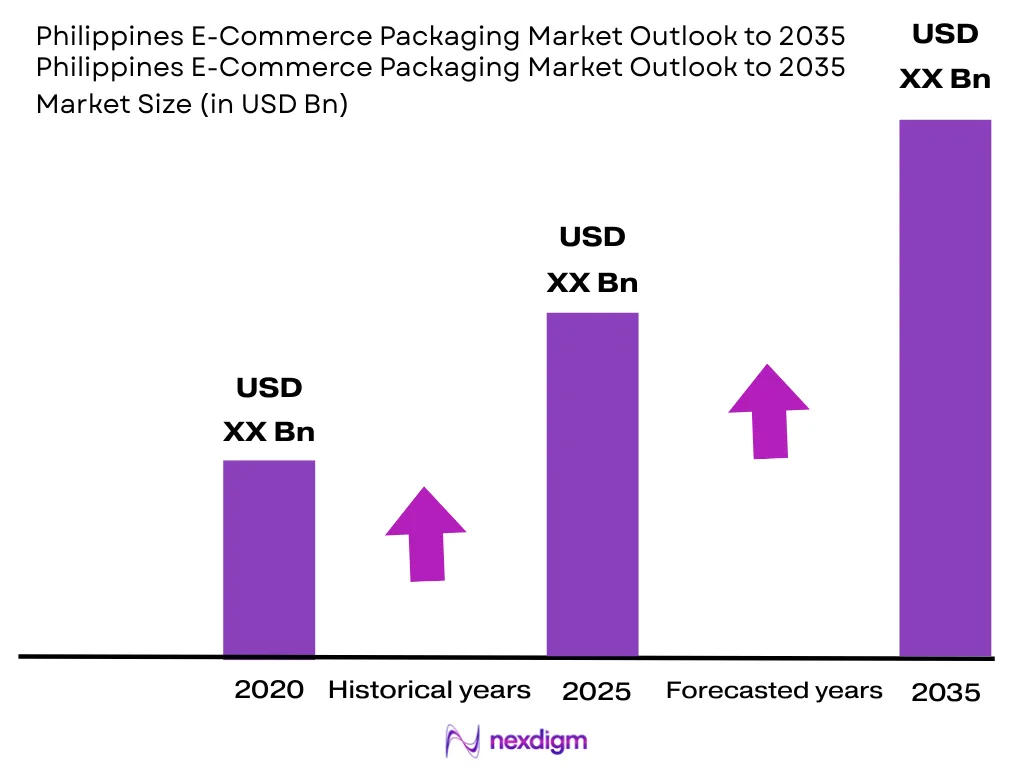
The Philippines E-Commerce Packaging Market was valued at USD ~ Billion in 2024 and is anticipated to expand at a CAGR of ~% during 2026-2035, tracking growth in the Philippines’ digital economy, which is set to reach approximately USD 36 billion in gross merchandise value in 2025, growing 16% year-on-year, with e-commerce accounting for more than 60% of total GMV. E-commerce GMV alone grew to approximately USD 24 billion in 2025, up from approximately USD 20 billion in 2024, with video commerce emerging as a major growth engine, now encompassing approximately 475,000 sellers and stores, a 90% year-on-year increase, generating approximately 1.2 billion transactions. The Asian Packaging Federation has confirmed that e-commerce has surpassed traditional food demand as the primary packaging driver in the Philippines, with the industry expected to grow in line with the country’s approximately 5% GDP expansion. The Philippines corrugated boxes market, the dominant packaging format for e-commerce shipments, reached approximately USD 970.07 million in 2025 and is projected to reach approximately USD 1,315.95 million by 2034.
Market Segmentation
By Material Type
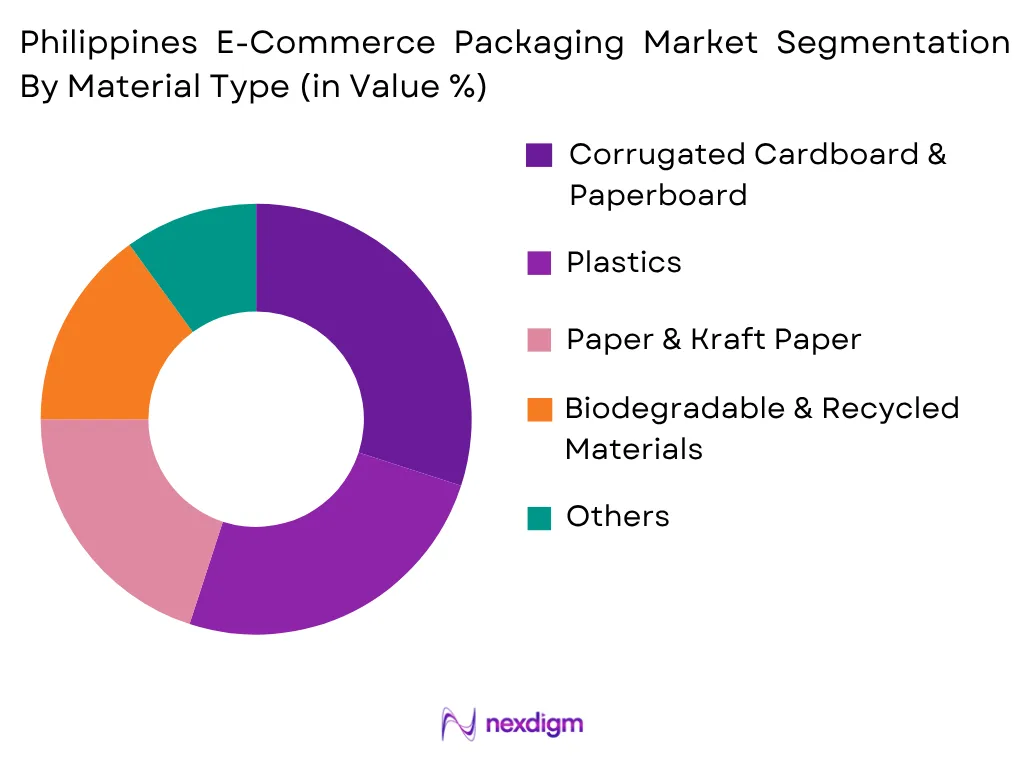
Corrugated Cardboard & Paperboard dominates the Philippines E-Commerce Packaging Market, directly reflecting the scale of parcel volumes generated by Lazada, Shopee, and the country’s rapidly expanding video and social commerce ecosystem. Online platforms such as Lazada and Shopee continue to create unprecedented demand for protective, lightweight, and customizable corrugated boxes, with local manufacturers including Victory Packaging and Golden Package Printing Co. adopting advanced printing technologies to serve this growing demand base. Plastic materials, primarily used in poly mailers and bubble wrap protective packaging, retain an important role for lightweight apparel and soft goods shipments common across the Philippines’ large fashion e-commerce category. Biodegradable and recycled materials represent a fast-growing material category, supported by government initiatives championing green packaging that continue to improve eco-friendly packaging adoption among both businesses and consumers, reinforcing interest in recycled corrugates and biodegradable alternatives across the industry.
By Product Type
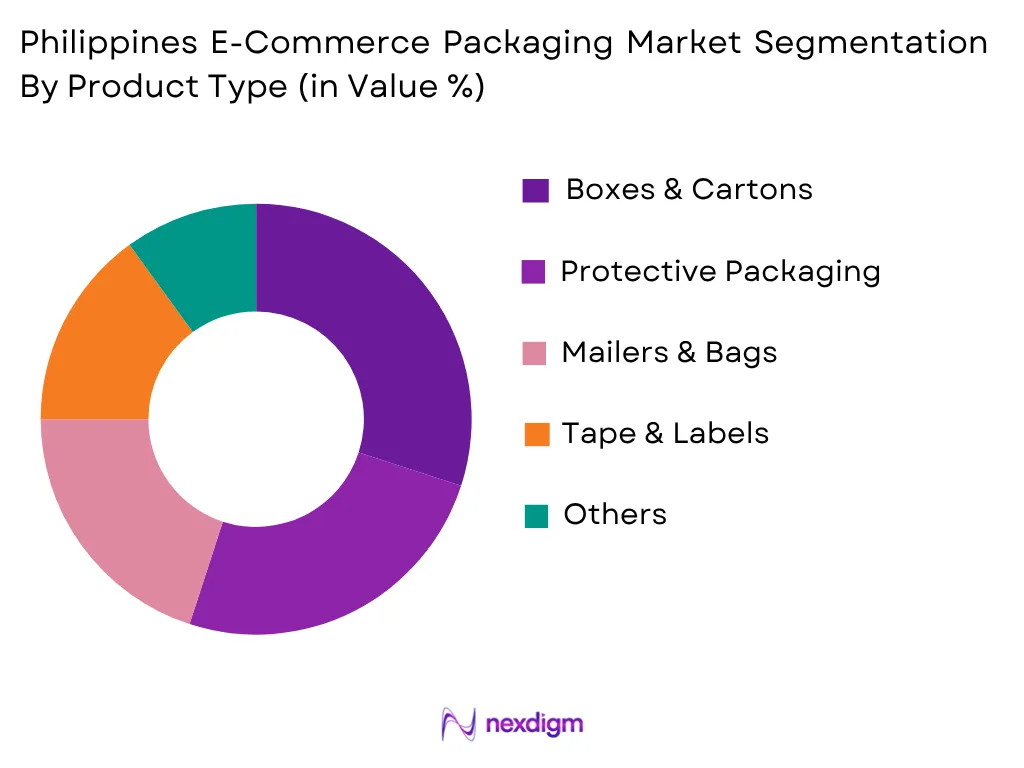
Boxes & Cartons, particularly Regular Slotted Containers (RSC), represent the largest and fastest-growing product-type segment in the Philippines E-Commerce Packaging Market, with RSC formats expanding at approximately 5.43% CAGR through 2032 given their cost efficiency and adaptability across diverse e-commerce shipment sizes. E-Commerce & Retail represents the fastest-growing application segment within the broader Philippines corrugated packaging market, expanding at approximately 6.30% CAGR through 2032, outpacing even the historically dominant Personal Care segment, which held the largest revenue share at approximately USD 2.24 billion in 2024. Cold Chain & Insulated Packaging represents a distinctive and structurally important segment for the Philippines specifically, as the country’s archipelagic geography demands robust packaging solutions capable of protecting fresh produce, frozen seafood, and temperature-sensitive pharmaceuticals across multiple modes of inter-island transport. Mailers & Bags and Protective Packaging continue to expand alongside the growth of video commerce sellers, who increasingly require lightweight, cost-efficient packaging suited to high-frequency, smaller-parcel fulfillment.
Competitive Landscape
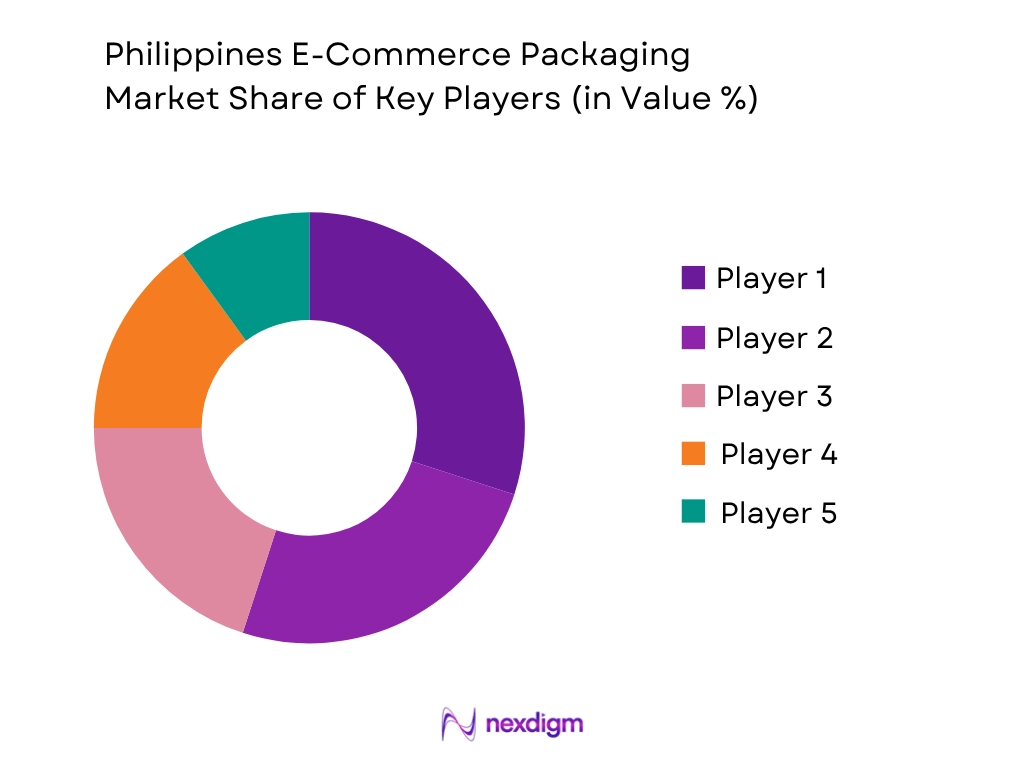
The Philippines E-Commerce Packaging Market features a mix of established domestic converters and multinational packaging specialists serving the country’s rapidly expanding parcel volumes. Victory Packaging and Golden Package Printing Co. represent significant domestic players that have invested in advanced printing technologies to serve Lazada, Shopee, and the broader e-commerce ecosystem, indicating a broader industry shift toward higher value-added, customized products. San Miguel Yamamura Packaging Corporation maintains a diversified domestic footprint spanning corrugated and other packaging formats, while global majors including International Paper, Smurfit Westrock, Mondi, and DS Smith continue to expand distribution capability to serve the Philippines’ growing base of multinational e-commerce sellers and fulfillment partners. Competition is primarily based on lead time, minimum order quantity flexibility, digital printing capability for short-run branded packaging, and the ability to serve the logistical complexity of the Philippines’ archipelagic geography, spanning dense urban centers such as Metro Manila to remote rural municipalities requiring more resilient protective packaging specifications.
| Company | Established | Headquarters | Primary Product Portfolio | Natural Color Portfolio | Manufacturing Presence | Major End-Use Industries | Key Strategic Focus | Certifications & Compliance |
| Victory Packaging Philippines | 1985 | ~ | ~ | ~ | ~ | ~ | ~ | ~ |
| Golden Package Printing Co. | 1978 | ~ | ~ | ~ | ~ | ~ | ~ | ~ |
| San Miguel Yamamura Packaging Corporation | 1998 | ~ | ~ | ~ | ~ | ~ | ~ | ~ |
| International Paper Company | 1898 | ~ | ~ | ~ | ~ | ~ | ~ | ~ |
| Smurfit Westrock plc | 2024 | ~ | ~ | ~ | ~ | ~ | ~ | ~ |
Philippines E-Commerce Packaging Market Analysis
Growth Drivers
Explosive Digital Economy and Video Commerce Growth
The Philippines e-commerce packaging market is experiencing sustained growth due to the rapid expansion of the country’s digital economy, which is set to reach approximately USD 36 billion in gross merchandise value in 2025, growing 16% year-on-year, with e-commerce representing the largest sector at more than 60% of total GMV. E-commerce GMV alone grew to approximately USD 24 billion in 2025, up from approximately USD 20 billion in 2024, reflecting sustained acceleration in online shopping penetration across the country. Video commerce has emerged as a particularly significant growth engine, now encompassing approximately 475,000 sellers and stores, a 90% year-on-year increase, and generating approximately 1.2 billion transactions, creating substantial new demand for lightweight, cost-efficient packaging suited to high-frequency, smaller-parcel fulfillment associated with livestream and short-video-driven sales. As SMEs and individual online sellers increasingly participate in this expanding digital economy, demand for accessible, appropriately sized e-commerce packaging continues to grow correspondingly across the Philippines’ online retail ecosystem.
Packaging Demand Overtaking Traditional Food and Beverage Drivers
The Asian Packaging Federation has confirmed that e-commerce has surpassed traditional food demand as the primary packaging driver in the Philippines, with the packaging industry expected to grow in line with the country’s approximately 5% GDP expansion. This structural shift reflects the scale of transformation underway across the Philippines’ packaging industry, as online platforms such as Lazada and Shopee continue to create unprecedented demand for protective, lightweight, and customizable corrugated boxes that increasingly rival or exceed the packaging volumes historically associated with food and beverage manufacturing. The Philippines packaging market overall, measured by unit volume, is projected to grow from approximately 78.4 billion units in 2025 to approximately 112.0 billion units by 2034, with the rise of digital marketplaces and online shopping platforms specifically cited as a significant contributor to demand for protective and durable packaging, including shipping boxes, flexible packaging, and courier-friendly materials essential to supporting the logistics requirements of e-commerce deliveries.
Market Challenges
Archipelago Geography and Inter-Island Logistics Complexity
The Philippines E-Commerce Packaging Market faces distinctive structural challenges stemming from the country’s archipelagic geography, which demands robust packaging solutions capable of protecting goods across multiple modes of transport spanning sea, air, and land logistics. Fresh produce, frozen seafood, and temperature-sensitive pharmaceuticals require specialized cold chain and protective packaging capable of maintaining product integrity across variable transit conditions and extended delivery timelines uncommon in more geographically compact e-commerce markets. This expansion is creating new challenges for protective and customizable corrugated packaging designed to meet the varying logistical requirements of both dense urban centers, such as Metro Manila, Cebu, and Davao, and remote rural municipalities with less developed distribution infrastructure. Packaging suppliers and e-commerce sellers alike must navigate this geographic complexity, often requiring more resilient, higher-specification packaging formats for shipments destined beyond the country’s primary urban logistics corridors.
Raw Material Price Volatility and Supply Chain Inefficiencies
The Philippines E-Commerce Packaging Market continues to navigate raw material price fluctuations affecting kraft paper, recovered fiber, and polymer inputs used across corrugated and flexible packaging formats. Key challenges identified across the industry include fluctuations in raw material prices, competition from alternative packaging materials, and inefficiencies in the supply chain that collectively complicate long-term cost planning for packaging converters and their e-commerce customers. These cost pressures particularly affect smaller domestic converters and SME e-commerce sellers, who often lack the purchasing power and long-term supply agreements available to larger multinational packaging suppliers and major marketplace-affiliated fulfillment operations. As the Philippines’ e-commerce sector continues its rapid expansion, packaging suppliers must balance rising input costs against increasing pressure from cost-conscious SME sellers and marketplace platforms seeking to minimize per-shipment packaging expenses without compromising protective performance.
Market Opportunities
Growth in Digital Printing for Social Commerce Sellers
As SMEs and online sellers increasingly seek distinct brand presentation without committing to bulk ordering, digital printing technologies are enabling manufacturers to offer high-resolution, customized boxes in small batches, creating substantial opportunity for converters serving the Philippines’ fast-growing social and video commerce seller base. This trend is particularly valuable for e-commerce sellers on platforms such as Shopee and Lazada, where unboxing experience directly influences customer reviews and repeat purchase behavior. Suppliers offering low minimum order quantities and rapid turnaround times are well positioned to capture the fast-growing segment of micro-businesses and social commerce sellers, a segment that expanded to approximately 475,000 active sellers and stores in the video commerce category alone, an increase of approximately 90% year-on-year. As video and livestream commerce continues to mature as a distinct retail channel within the Philippines, packaging converters that can profitably serve small-batch, rapid-turnaround orders are increasingly well positioned to capture this expanding customer segment.
Cold Chain and Protective Packaging for Inter-Island Shipping
The Philippines’ archipelagic geography, while creating logistical complexity, simultaneously creates substantial opportunity for packaging suppliers capable of providing specialized cold chain and protective packaging solutions suited to inter-island shipping requirements. Fresh produce, frozen seafood, and temperature-sensitive pharmaceuticals require specialized packaging capable of protecting goods across multiple modes of transport, creating a distinct and technically demanding market segment relative to conventional urban last-mile e-commerce packaging. As e-commerce penetration continues expanding beyond Metro Manila into secondary cities and provincial markets, demand for packaging capable of reliably protecting temperature-sensitive and fragile goods across longer, more variable transit routes is expected to grow correspondingly. Packaging suppliers that can combine validated cold chain performance with cost-efficient, scalable production are well positioned to capture premium contract positioning from food, grocery, and pharmaceutical e-commerce sellers seeking to expand delivery coverage across the Philippines’ full geographic footprint.
Future Outlook
The Philippines E-Commerce Packaging Market is expected to witness robust expansion over the forecast period, supported by continued digital economy growth toward an estimated USD 36 billion in gross merchandise value in 2025, sustained expansion of video and social commerce channels, and growing government support for green packaging initiatives. Continued investment in digital printing capability, recycled and biodegradable materials, and specialized cold chain packaging for inter-island logistics will further shape competitive positioning across the industry. The market is also likely to benefit from the Asian Packaging Federation’s confirmation that e-commerce has surpassed traditional food demand as the primary packaging driver in the Philippines, reinforcing the sector’s central role in shaping the country’s broader packaging industry investment priorities through 2034 and beyond.
Major Players
- Victory Packaging Philippines
- Golden Package Printing Co.
- San Miguel Yamamura Packaging Corporation
- International Paper Company
- Smurfit Westrock plc
- Mondi Group
- DS Smith plc
- Sonoco Products Company
- Amcor plc
- Berry Global, Inc.
- Nefab Group
- Sealed Air Corporation
- Uline Inc.
- PakWorks Philippines
- Solid Group Inc.
Key Target Audience
- E-Commerce Packaging Manufacturers
- E-Commerce Marketplaces & Online Retailers
- Social & Video Commerce Sellers
- Direct-to-Consumer Retail Brands & SMEs
- Third-Party Logistics Providers
- Investment and Venture Capitalist Firms
- Government and Regulatory Bodies (Department of Environment and Natural Resources (DENR), Department of Trade and Industry (DTI), Bureau of Product Standards)
- Raw Material Suppliers and Paper Producers
Research Methodology
Step 1: Identification of Key Variables
The research process begins with identifying the complete ecosystem of the Philippines E-Commerce Packaging Market, including raw material suppliers, packaging converters, printing technology providers, e-commerce marketplaces, logistics providers, and regulatory authorities. Extensive secondary research is conducted using company annual reports, government publications, trade associations, customs statistics, industry journals, and proprietary databases to determine the variables influencing market demand, pricing, production, consumption, and technological developments.
Step 2: Market Analysis and Construction
Historical market information is collected and analyzed to estimate market size, production volumes, import-export activity, application-wise demand, and pricing trends. A combination of top-down and bottom-up approaches is used to estimate market revenues and validate segment-level performance. Consumption patterns across fashion, electronics, food and beverage, and personal care e-commerce packaging are evaluated to establish an accurate representation of the industry.
Step 3: Hypothesis Validation and Expert Consultation
The preliminary findings are validated through Computer-Assisted Telephone Interviews (CATIs) and structured discussions with e-commerce packaging converters, procurement managers, distributors, packaging engineers, logistics executives, and senior executives operating within the Philippine e-commerce and packaging industries. These interviews help verify market assumptions, competitive developments, technology adoption trends, pricing dynamics, and future investment opportunities while refining the overall market estimates.
Step 4: Research Synthesis and Final Output
The final stage integrates insights obtained from primary interviews with quantitative information collected through secondary sources. Data triangulation techniques are applied to reconcile differences between supply-side and demand-side estimates, ensuring robust market forecasting. The report is then reviewed through multiple quality assurance checkpoints to deliver a comprehensive analysis covering market size, segmentation, competitive landscape, future outlook, and strategic recommendations for industry stakeholders.

- Executive Summary
- Research Methodology (Market Definitions and Assumptions, Abbreviations, Market Sizing Approach, Top-Down Analysis, Bottom-Up Analysis, Demand-Side Assessment, Supply-Side Assessment, Primary Industry Interviews, Secondary Research Validation, Data Triangulation, Forecasting Framework, Limitations and Future Conclusions)

- Definition and Scope
- Market Evolution and Industry Genesis
- Timeline of Major Industry Developments
- E-Commerce Packaging Industry Value Chain Analysis
- Supply Chain Analysis

- Growth Drivers (Explosive Digital Economy & Video Commerce Growth, Packaging Demand Overtaking Traditional Food Drivers, Rising Mobile Payment & Digital Adoption, Growth in Micro-Business & Social Commerce Sellers, Government-Backed Green Packaging Initiatives, Urbanization-Driven Parcel Volume Growth)
- Market Challenges (Archipelago Geography & Inter-Island Logistics Complexity, Raw Material Price Volatility, Supply Chain Inefficiencies, Competition from Alternative Packaging Materials, SME Access to Affordable Packaging, Rural Municipality Distribution Gaps)
- Market Opportunities (Growth in Digital Printing for Social Commerce Sellers, Cold Chain & Protective Packaging for Inter-Island Shipping, Sustainable & Recycled Corrugate Adoption, Low-MOQ Customized Branded Packaging, Smart Packaging & QR Traceability Integration, Regional Fulfillment Hub Expansion)
- Market Trends (Growth in Regular Slotted Container Adoption, Rise of Video & Livestream Commerce Packaging Demand, Digital Printing for Mass Customization, Recycled Corrugate & Biodegradable Material Adoption, Smart Packaging with QR Codes, Automated Filling & Labeling Systems)
- Government Regulations (Extended Producer Responsibility Act – Republic Act No. 11898, DENR EPR Program Registration Requirements, Green Packaging Promotion Initiatives, Local Government Single-Use Plastic Ordinances, Bureau of Product Standards Compliance, Import Compliance)
- Import and Export Analysis (Trade Volume, Major Import Sources, Export Destinations, HS Code Analysis, Trade Balance)
- Raw Material Availability Analysis (Domestic & Imported Kraft Linerboard, Recovered Paper & Recycled Fiber, Polyethylene Film for Mailers, Adhesives & Tape Substrates, Bio-Based & Compostable Materials)
- Technology Landscape (Automated Box-Making & Corrugation Technologies, Digital Printing Systems, Automated Filling & Labeling Systems, Insulated & Cold Chain Packaging Technologies, QR Code & Traceability Platforms)
- Sustainability Assessment (Recycled Corrugate & PCR Content Adoption, Biodegradable Material Substitution, Lightweighting & Material Reduction, Government Green Packaging Program Participation, Circular Economy Partnerships)
- PESTLE Analysis
- SWOT Analysis
- Porter’s Five Forces Analysis
- Stakeholder Ecosystem
- Competition Ecosystem

- By Market Value (2020-2025)
- By Volume Consumption (2020-2025)
- By Average Selling Price (2020-2025)

- By Material Type (In Value %)
Corrugated Cardboard & Paperboard
Plastic (Poly Mailers & Bubble Wrap)
Paper & Kraft Paper
Protective & Void-Fill Materials
Biodegradable & Recycled Materials - By Product Type (In Value %)
Boxes & Cartons (Regular Slotted Containers)
Mailers & Bags
Protective Packaging (Bubble Wrap & Air Pillows)
Tape & Labels
Cold Chain & Insulated Packaging - By Application (In Value %)
Fashion & Apparel
Electronics & Electricals
Food & Beverage
Personal Care & Beauty
Home & Furniture
Others - By End User (In Value %)
E-Commerce Marketplaces
Direct-to-Consumer Retail Brands & SMEs
Social & Video Commerce Sellers
Third-Party Logistics Providers
Food & Grocery Delivery Platforms - By Region (In Value %)
Metro Manila (National Capital Region)
Calabarzon
Central Luzon
Cebu & Central Visayas
Davao & Mindanao

- Market Share of Major Players (By Value, Volume, Material Type, Application, Product Category)
- Cross Comparison Parameters (Product Portfolio Breadth, Recycled-Content Capability, Digital Printing & Low-MOQ Capacity, Application Technical Support, Manufacturing Capacity, Regulatory Compliance & Certifications, Marketplace Customer Base, Innovation & New Product Launch Frequency)
- SWOT Analysis of Major Players
- Pricing Analysis by Product Category and Format
- Production Capacity Analysis
- Manufacturing Footprint Analysis
- Distribution Network Analysis
- Innovation Benchmarking
- Detailed Profiles of Major Companies
Victory Packaging Philippines
Golden Package Printing Co.
San Miguel Yamamura Packaging Corporation
International Paper Company
Smurfit Westrock plc
Mondi Group
DS Smith plc
Sonoco Products Company
Amcor plc
Berry Global, Inc.
Nefab Group
Sealed Air Corporation
Uline Inc.
PakWorks Philippines
Solid Group Inc.

- Consumption Pattern Analysis (Order Volume, Batch Size, Product Category Penetration, Peak Season Demand, Fulfillment Model Activity)
- Purchasing Criteria (Cost per Shipment, Protective Performance, Recyclability, Minimum Order Quantity Flexibility, Lead Time, Brand Presentation)
- Procurement and Supplier Selection Analysis
- Recycled-Content Adoption Assessment
- Marketplace-Fulfilled vs Social Commerce Packaging Demand
- Product Attribute Preference Analysis (Damage Protection, Tamper-Evidence, Print & Branding Quality, Recyclability, Weight Efficiency, Unboxing Experience)
- Sustainability & Cost Efficiency Influence on Packaging Investment
- Pain Point Analysis
- Decision-Making Process

- By Market Value (2026-2035)
- By Volume Consumption (2026-2035)
- By Average Selling Price (2026-2035)


 Request a Sample
 Ask for Customization
 Get a Quote
 Enquire Now