
 Download PDF
Market Overview
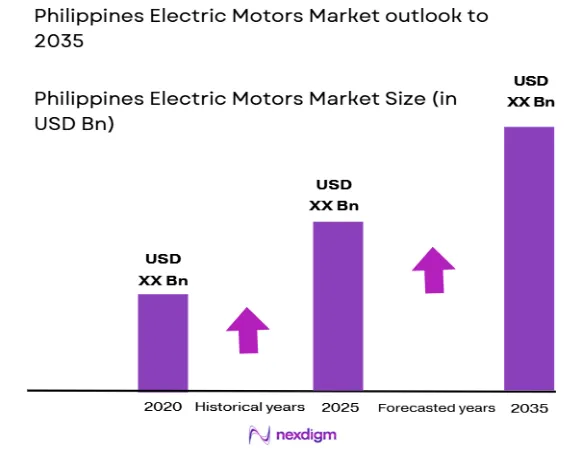
The Philippines Electric Motors Market is valued at approximately USD ~ billion based on a recent historical assessment, supported by data from industrial production statistics and trade records. The market is driven by increasing industrial automation, expansion of manufacturing sectors, and rising demand for energy-efficient equipment. Growth in HVAC systems, electric mobility components, and infrastructure projects further strengthens demand, while government-led electrification and efficiency initiatives continue to accelerate adoption of electric motor technologies across multiple applications.
Metro Manila, Cebu, and Davao emerge as dominant regional hubs due to concentrated industrial activity, infrastructure development, and strong commercial demand for motor-driven systems. These cities benefit from better logistics, industrial clusters, and energy infrastructure, enabling higher adoption of electric motors across manufacturing, construction, and utilities. Additionally, proximity to ports and industrial zones facilitates imports and assembly operations, strengthening their position as key centers for electric motor deployment and distribution within the country.
Market Segmentation
By Product Type
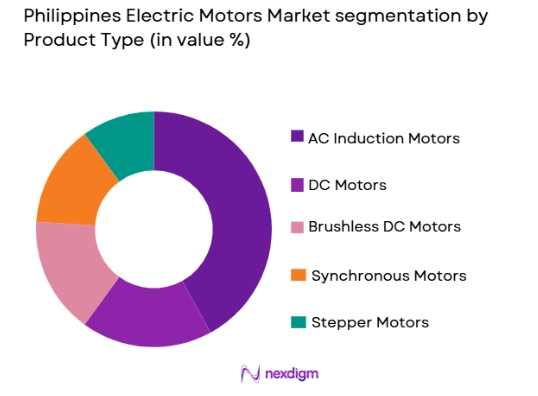
Philippines Electric Motors market is segmented by product type into AC induction motors, DC motors, brushless DC motors, synchronous motors, and stepper motors. Recently, AC induction motors has a dominant market share due to factors such as widespread industrial usage, cost efficiency, and robust performance in heavy-duty applications. These motors are extensively used in manufacturing plants, HVAC systems, and water treatment facilities, making them the preferred choice for large-scale operations. Their durability, lower maintenance requirements, and compatibility with existing industrial infrastructure further enhance adoption. Additionally, availability of standardized designs and ease of integration into automation systems make AC induction motors the most commercially viable option across multiple sectors in the Philippines industrial ecosystem.
By End-User
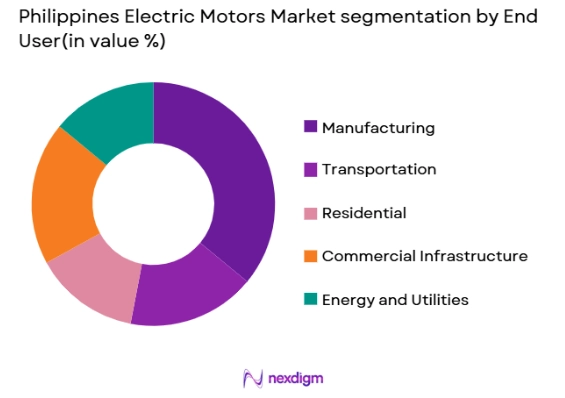
Philippines Electric Motors market is segmented by end-user industry into manufacturing, transportation, residential, commercial infrastructure, and energy and utilities. Recently, manufacturing has a dominant market share due to factors such as rapid industrialization, increasing automation, and expansion of production facilities. Manufacturing units heavily rely on electric motors for machinery, conveyors, and processing equipment, making them the largest consumers. Growth in electronics, food processing, and automotive assembly sectors further drives demand. Continuous upgrades in industrial equipment and energy efficiency mandates also contribute to higher motor replacements and installations, reinforcing manufacturing as the leading end-user segment in the market landscape.
Competitive Landscape
The Philippines Electric Motors Market is moderately consolidated, with global manufacturers maintaining strong influence through technological expertise and established distribution networks. International companies dominate high-efficiency motor segments, while regional distributors and local assemblers support mid-range demand. Strategic partnerships, after-sales service capabilities, and energy-efficient product portfolios are key competitive differentiators. Market participants are increasingly focusing on localized production and digital motor technologies to strengthen their presence and respond to evolving industrial requirements.
| Company Name | Establishment Year | Headquarters | Technology Focus | Market Reach | Key Products | Revenue | Efficiency Standard Focus |
| ABB Ltd | 1988 | Zurich, Switzerland | ~ | ~ | ~ | ~ | ~ |
| Siemens AG | 1847 | Munich, Germany | ~ | ~ | ~ | ~ | ~ |
| Nidec Corporation | 1973 | Kyoto, Japan | ~ | ~ | ~ | ~ | ~ |
| WEG Industries | 1961 | Brazil | ~ | ~ | ~ | ~ | ~ |
| Mitsubishi Electric | 1921 | Tokyo, Japan | ~ | ~ | ~ | ~ | ~ |
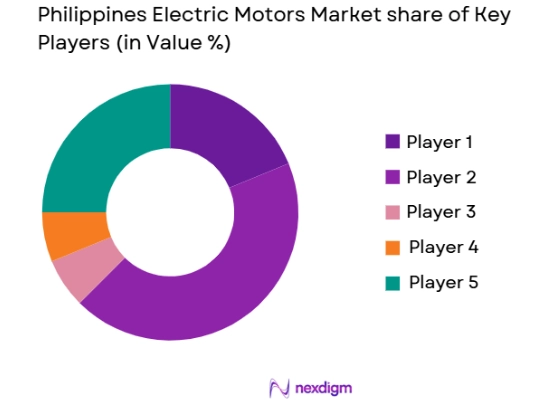
Philippines Electric Motors Market Analysis
Growth Drivers
Industrial Automation Expansion Across Manufacturing Sector
The rapid expansion of industrial automation across manufacturing facilities is significantly driving demand for electric motors in the Philippines. Industries are increasingly adopting automated systems to improve productivity, reduce labor costs, and enhance operational efficiency. Electric motors are integral components of automated machinery such as conveyors, robotics, and processing equipment, making them indispensable in modern manufacturing setups. As industries move toward Industry 4.0 practices, the need for high-performance and energy-efficient motors continues to rise. Additionally, government initiatives promoting industrialization and infrastructure development further support this trend. Investments in electronics, automotive assembly, and food processing sectors have accelerated the deployment of advanced motor-driven systems. The shift toward precision manufacturing also requires motors with higher reliability and performance consistency. Furthermore, automation reduces downtime and improves product quality, encouraging industries to upgrade legacy motor systems. As a result, electric motors are witnessing increased demand across both new installations and replacement cycles.
Rising Demand for Energy-Efficient Systems and Electrification
The growing emphasis on energy efficiency and electrification is another key factor propelling the electric motors market. Regulatory bodies are encouraging the adoption of energy-efficient appliances and industrial systems to reduce overall power consumption. Electric motors account for a significant portion of electricity usage in industrial and commercial applications, making efficiency improvements a priority. High-efficiency motors such as IE3 and IE4 are gaining traction due to their ability to lower operational costs and meet regulatory requirements. Additionally, the expansion of electrification projects in transportation and infrastructure sectors is increasing the use of electric motor systems. The shift toward electric vehicles and renewable energy installations further contributes to market growth. Consumers and businesses are also becoming more conscious of long-term energy savings, leading to higher adoption of efficient motor technologies. Technological advancements in motor design and materials have enhanced performance while reducing energy losses. These developments are collectively strengthening the demand for electric motors in the country.
Market Challenges
Dependence on Imported Components and Supply Chain Constraints
The Philippines electric motors market faces significant challenges due to its reliance on imported components and finished products. Limited domestic manufacturing capabilities result in high dependency on international suppliers for critical motor parts such as copper windings, magnets, and electronic components. This dependency exposes the market to supply chain disruptions caused by global trade fluctuations, geopolitical tensions, and logistical constraints. Delays in component availability can impact production schedules and increase lead times for industrial projects. Additionally, fluctuations in foreign exchange rates influence import costs, making pricing less stable for end-users. Local distributors often face inventory challenges due to unpredictable supply conditions. The lack of a strong domestic manufacturing base also limits innovation and customization capabilities within the country. Small and medium enterprises struggle to compete with global players due to cost disadvantages. These factors collectively hinder the growth potential of the market and create operational inefficiencies.
High Initial Costs and Limited Adoption of Advanced Motor Technologies
The adoption of advanced electric motor technologies is often constrained by high initial investment costs, particularly for small and medium-sized enterprises. High-efficiency motors and digitally integrated systems require substantial upfront capital, which may not be feasible for all businesses. Many industries continue to rely on conventional motor systems due to cost considerations, despite the long-term benefits of energy-efficient alternatives. Additionally, lack of awareness regarding lifecycle cost savings and energy efficiency benefits further slows adoption. Technical expertise required for installation and maintenance of advanced motor systems is also limited in certain regions. This creates hesitation among end-users when transitioning to newer technologies. Financial constraints, coupled with limited access to incentives or subsidies, restrict market penetration of high-performance motors. As a result, the market experiences slower adoption rates for advanced solutions compared to more developed regions.
Opportunities
Development of Local Manufacturing and Assembly Capabilities
The establishment of local manufacturing and assembly facilities presents a significant opportunity for the Philippines electric motors market. Developing domestic production capabilities can reduce dependency on imports and improve supply chain resilience. Local manufacturing enables cost optimization through reduced transportation expenses and import duties. It also allows companies to customize products according to regional requirements and industry needs. Government support for industrial development and investment incentives can encourage global players to set up production units in the country. This would create employment opportunities and enhance technological expertise within the local workforce. Additionally, local manufacturing can strengthen the competitiveness of domestic suppliers in both regional and international markets. Partnerships between international manufacturers and local firms can accelerate knowledge transfer and innovation. Over time, this can lead to the development of a robust ecosystem for electric motor production, supporting sustained market growth.
Integration of Smart and IoT-Enabled Motor Systems
The integration of smart technologies and IoT-enabled motor systems offers substantial growth opportunities in the market. Smart motors equipped with sensors and connectivity features enable real-time monitoring, predictive maintenance, and performance optimization. These capabilities help reduce downtime, improve efficiency, and extend equipment lifespan. Industries are increasingly adopting digital solutions to enhance operational visibility and control. The growing adoption of Industry 4.0 practices further supports the demand for intelligent motor systems. Smart motors can be integrated with automation platforms and cloud-based analytics tools, enabling data-driven decision-making. This trend is particularly relevant in manufacturing, energy, and infrastructure sectors. Additionally, advancements in communication technologies facilitate seamless integration of motor systems into broader industrial networks. As businesses prioritize efficiency and cost optimization, the adoption of smart motor solutions is expected to increase significantly.
Future Outlook
The Philippines Electric Motors Market is expected to experience steady growth over the next five years, driven by industrial expansion, electrification initiatives, and increasing adoption of energy-efficient technologies. Technological advancements in smart motors and digital monitoring systems will further enhance market potential. Government policies promoting energy efficiency and infrastructure development are likely to support demand. Additionally, rising investments in manufacturing and renewable energy sectors will continue to create new opportunities for electric motor applications.
Major Players
- ABB Ltd
- Siemens AG
- Nidec Corporation
- WEG Industries
- Mitsubishi Electric Corporation
- Toshiba Corporation
- Hitachi Industrial Equipment Systems
- Regal Rexnord Corporation
- Johnson Electric Holdings
- TECO Electric and Machinery
- CG Power and Industrial Solutions
- Brook Crompton
- Leroy Somer
- Rockwell Automation
- Baldor Electric Company
Key Target Audience
- Manufacturing companies
- Automotive OEMs
- Energy and utility providers
- Infrastructure development firms
- Industrial equipment distributors
- Government and regulatory bodies
- Investments and venture capitalist firms
- Renewable energy developers
Research Methodology
Step 1: Identification of Key Variables
The study begins with identifying critical variables influencing the electric motors market, including demand drivers, industrial output, energy consumption trends, and technological advancements. Key performance indicators and market boundaries are defined to ensure focused analysis.
Step 2: Market Analysis and Construction
Comprehensive data collection is conducted through secondary sources such as trade statistics and industry reports. The market structure is developed by segmenting data across product types, applications, and end-user industries.
Step 3: Hypothesis Validation and Expert Consultation
Initial findings are validated through consultations with industry experts, manufacturers, and distributors. Feedback is incorporated to refine assumptions and ensure accuracy in market representation and forecasting.
Step 4: Research Synthesis and Final Output
All validated data is synthesized into structured insights, combining quantitative analysis with qualitative evaluation. The final output is prepared to provide actionable intelligence and a comprehensive understanding of the market.

- Executive Summary
- Research Methodology (Definitions, Scope, Industry Assumptions, Market Sizing Approach, Primary & Secondary Research Framework, Data Collection & Verification Protocol, Analytic Models & Forecast Methodology, Limitations & Research Validity Checks)

- Market Definition and Scope
- Value Chain & Stakeholder Ecosystem
- Regulatory / Certification Landscape
- Sector Dynamics Affecting Demand
- Strategic Initiatives & Infrastructure Growth

- Growth Drivers
Rising industrial automation across manufacturing sectors
Expansion of HVAC and building infrastructure projects
Increasing adoption of electric mobility solutions
Government support for energy efficiency standards
Growth in renewable energy installations requiring motor systems - Market Challenges
High dependency on imported motor components
Fluctuating raw material prices affecting production cost
Limited domestic manufacturing capabilities
Energy efficiency compliance complexities
Supply chain disruptions in electronic components - Market Opportunities
Development of local motor manufacturing facilities
Integration of smart and IoT enabled motor systems
Expansion in electric vehicle component supply chains - Trends
Shift toward energy efficient IE3 and IE4 motor standards
Increasing demand for compact and lightweight motor designs
Integration of digital monitoring and predictive maintenance
Growth in brushless motor applications across industries
Adoption of motors in renewable energy systems - Government Regulations & Defense Policy
Implementation of minimum energy performance standards
Import regulations and tariff adjustments for motor components
Government incentives for industrial energy efficiency programs - SWOT Analysis
- Stakeholder and Ecosystem Analysis
- Porter’s Five Forces Analysis
- Competition Intensity and Ecosystem Mapping

- By Market Value, 2020-2025
- By Installed Units, 2020-2025
- By Average System Price, 2020-2025
- By System Complexity Tier, 2020-2025

- By System Type (In Value%)
AC Induction Motors
DC Motors
Brushless DC Motors
Stepper Motors
Synchronous Motors - By Platform Type (In Value%)
Industrial Machinery Applications
Automotive Systems
Consumer Appliances
HVAC Systems
Renewable Energy Installations - By Fitment Type (In Value%)
OEM Installed Motors
Aftermarket Replacement Motors
Retrofit Installations
Integrated System Motors
Modular Motor Units - By EndUser Segment (In Value%)
Manufacturing Sector
Transportation Sector
Residential Applications
Commercial Infrastructure
Energy and Utilities Sector - By Procurement Channel (In Value%)
Direct Industrial Procurement
Distributor and Dealer Networks
Online Industrial Marketplaces
Government and Public Tenders
Third Party Integrators - By Material / Technology (in Value %)
Copper Wound Motors
Aluminum Wound Motors
Rare Earth Magnet Motors
Ferrite Magnet Motors
High Efficiency IE3 and IE4 Motors

- Market structure and competitive positioning
- Market share snapshot of major players
- Cross Comparison Parameters (Product Portfolio, Power Rating Range, Efficiency Standards, Pricing Strategy, Distribution Network, End User Coverage, Technological Innovation, After Sales Service, Localization Strategy, Production Capacity)
- SWOT Analysis of Key Players
- Pricing & Procurement Analysis
- Key Players
ABB Ltd
Siemens AG
WEG Industries
Nidec Corporation
Toshiba Corporation
Mitsubishi Electric Corporation
Rockwell Automation
Johnson Electric Holdings
Regal Rexnord Corporation
Baldor Electric Company
Hitachi Industrial Equipment Systems
Brook Crompton
TECO Electric and Machinery
CG Power and Industrial Solutions
Leroy Somer

- Manufacturing sector increasing reliance on automation driven motor systems
- Transport sector adopting electric motors for vehicle electrification
- Commercial buildings integrating motors in HVAC and vertical mobility systems
- Energy sector deploying motors in renewable and grid infrastructure

- Forecast Market Value, 2026-2035
- Forecast Installed Units, 2026-2035
- Price Forecast by System Tier, 2026-2035
- Future Demand by Platform, 2026-2035


 Request a Sample
 Ask for Customization
 Get a Quote
 Enquire Now