
 Download PDF
Market Overview
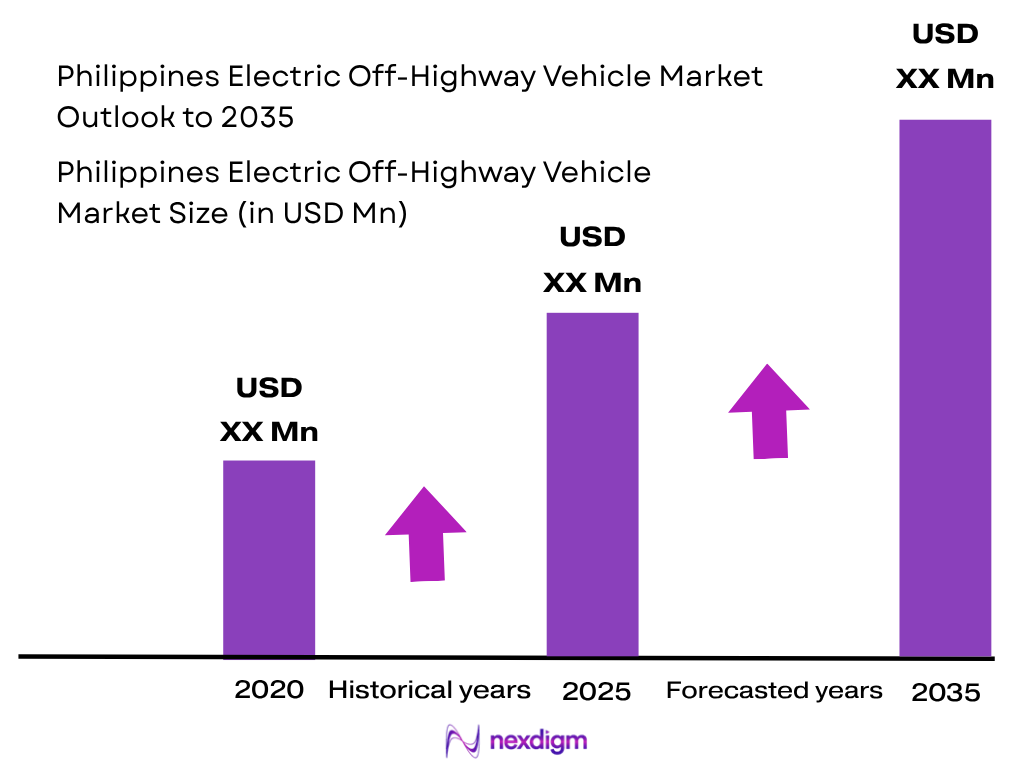
The Philippines Electric Off-Highway Vehicle Market is valued at approximately USD ~[XX] million, with adoption supported by construction, logistics, manufacturing, mining, agriculture and material-handling applications. Official indicators show national GDP growth accelerating from 5.5 to 5.7, while construction expanded 10.2 and gross capital formation increased 7.7, strengthening the equipment-utilization environment. Construction establishments generated PHP 713.19 billion in revenue, while industry GVA reached PHP 6.47 trillion, creating a broad industrial base for electric forklifts, loaders, excavators and specialized equipment.
The Philippines Electric Off-Highway Vehicle Market is concentrated around Metro Manila, CALABARZON, Central Luzon, Cebu and Davao, reflecting the country’s major logistics, manufacturing, construction and industrial clusters. NCR accounted for 1,535 transportation and storage establishments, while CALABARZON provinces such as Laguna, Cavite and Batangas were among the country’s leading contributors to industrial GVA. Manila’s major terminals also processed 2.95 million TEUs at MICT and 1.29 million TEUs at Manila South Harbor, reinforcing demand for electric material-handling and port equipment.
Market Segmentation
By Vehicle Type
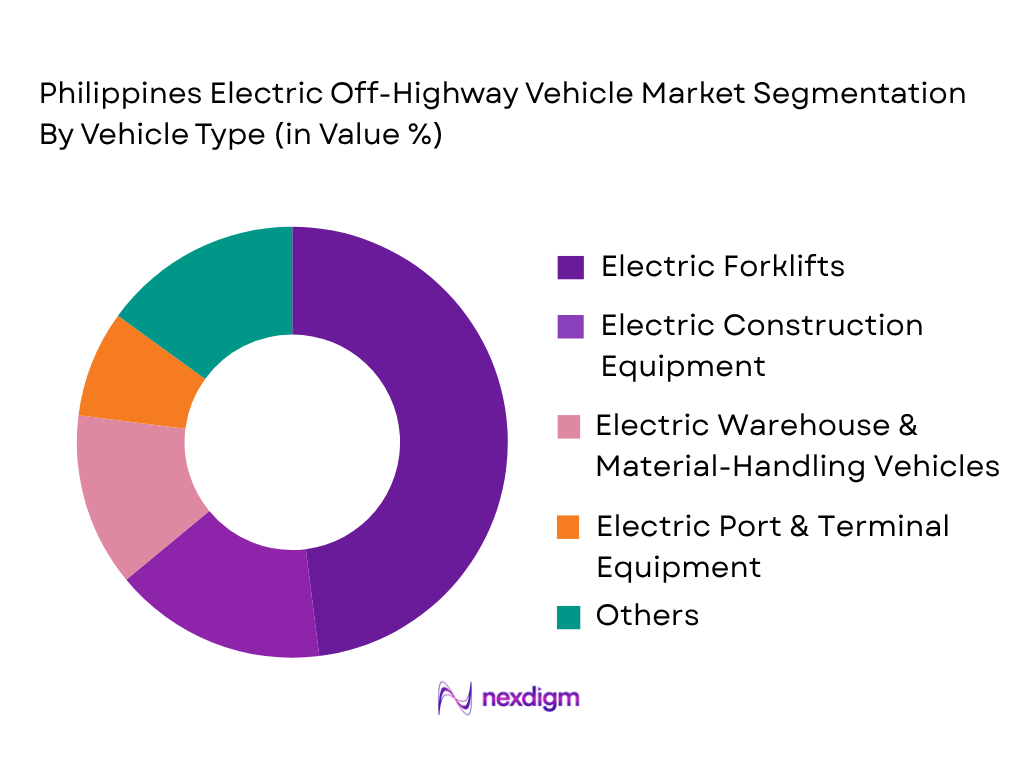
The Philippines Electric Off-Highway Vehicle Market is segmented by vehicle type into electric forklifts, electric construction equipment, electric mining equipment, electric agricultural equipment, electric warehouse and material-handling vehicles, electric port and terminal equipment, and other specialized electric off-highway vehicles. Electric forklifts are expected to hold the dominant share at approximately [~XX%] in the 2024 market because they are suitable for controlled indoor and semi-controlled operating environments where charging can be centralized and local emissions are operationally undesirable. Warehousing, manufacturing, food processing, retail distribution and port-related logistics create recurring material-handling requirements. The segment also benefits from established electric drivetrain architectures and comparatively straightforward charging deployment. Electric forklifts can be integrated with fleet telematics, battery-management systems and automated warehouse workflows, making them a practical initial electrification pathway. The country’s growing transportation and storage ecosystem, together with expanding industrial activity, supports recurring demand for productive, low-emission material-handling equipment.
By Application
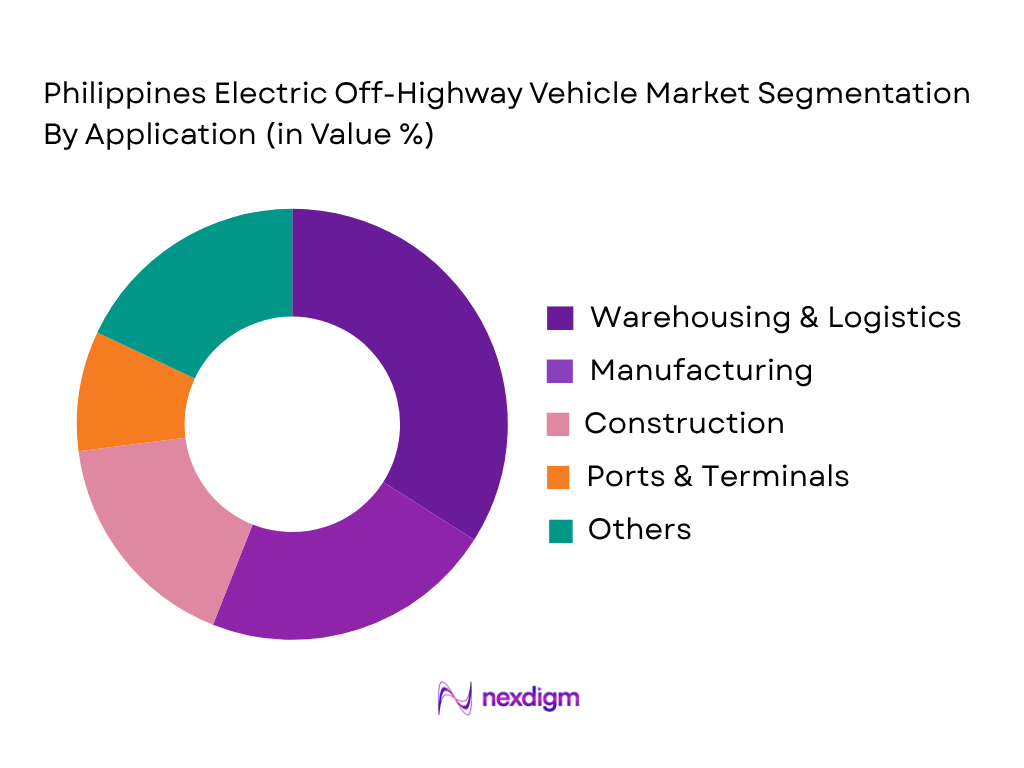
The Philippines Electric Off-Highway Vehicle Market is segmented by application into construction, warehousing and logistics, manufacturing, mining and quarrying, agriculture, ports and terminals, airports, waste management, and other industrial applications. Warehousing and logistics is expected to represent the leading application at approximately [~XX%] of the 2024 market because electric equipment is particularly compatible with repetitive material movement, fixed operating routes, indoor environments and centralized charging. The transportation and storage sector contained 3,309 formal establishments, including 1,515 support-activity establishments and 1,029 other land-transport establishments. Port activity provides an additional demand base, with national container traffic reaching 7.82 million TEUs and cargo throughput reaching 289.52 million metric tons. These operating characteristics make logistics one of the most commercially accessible pathways for electric off-highway deployment.
Competitive Landscape
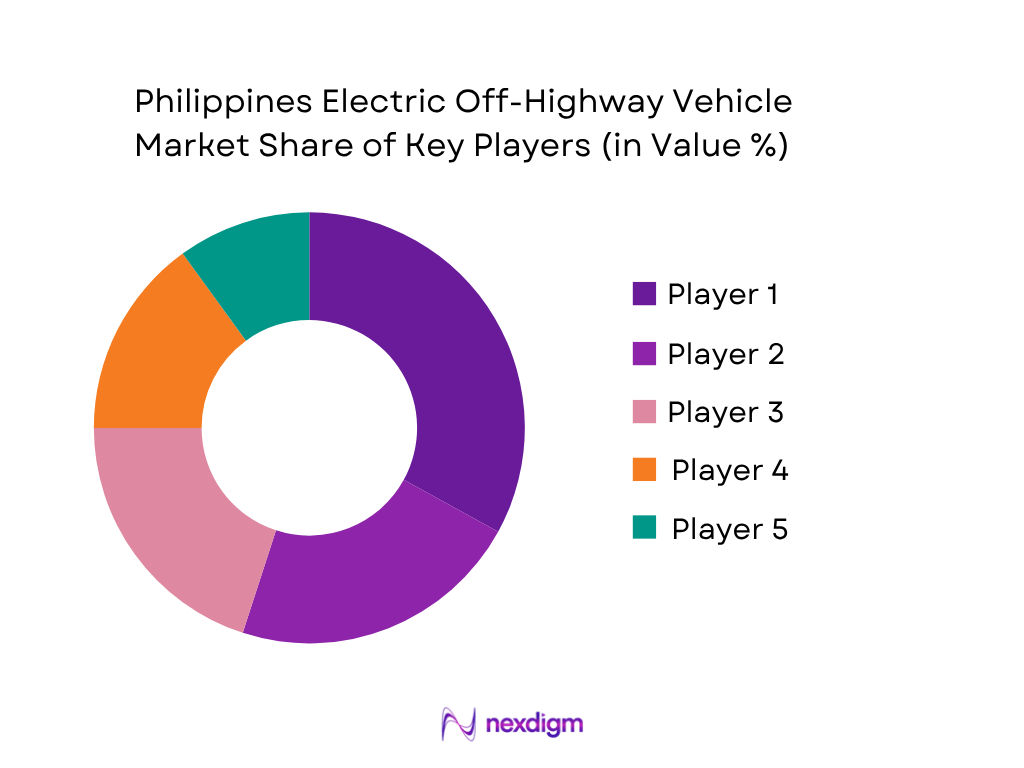
The Philippines Electric Off-Highway Vehicle Market comprises global construction-equipment manufacturers, material-handling specialists, industrial-equipment suppliers and diversified machinery companies. Competition is shaped by equipment reliability, battery technology, charging compatibility, dealer coverage, aftermarket support, financing, telematics capability and the ability to adapt electric platforms to tropical operating conditions. Established international manufacturers such as Toyota Industries, Komatsu, Caterpillar, Volvo Construction Equipment and BYD have strong technology or equipment portfolios relevant to different electric off-highway applications.
| Company | Establishment | Headquarters | Electric Equipment Focus | Key Vehicle/Application | Battery/Powertrain Capability | Telematics/Digital Capability | Dealer & Aftermarket Strength |
| Toyota Industries Corporation | 1926 | Kariya, Japan | ~ | ~ | ~ | ~ | ~ |
| Komatsu | 1921 | Tokyo, Japan | ~ | ~ | ~ | ~ | ~ |
| Caterpillar | 1925 | Irving, USA | ~ | ~ | ~ | ~ | ~ |
| Volvo Construction Equipment | 1832 | Gothenburg, Sweden | ~ | ~ | ~ | ~ | ~ |
| BYD Company | 1995 | Shenzhen, China | ~ | ~ | ~ | ~ | ~ |
Philippines Electric Off-Highway Vehicle Market Analysis
Growth Drivers
Port & Logistics Expansion
The Philippines’ expanding trade, infrastructure and industrial base is creating a broader operating environment for electric off-highway vehicles, particularly forklifts, warehouse vehicles, terminal equipment and specialized electric machinery. The International Monetary Fund reported that real GDP grew 5.7% in 2024, with public consumption increasing 7.3% and gross fixed capital formation increasing 6.3%, indicating continued investment activity that supports material-handling and construction-equipment utilization. Philippine Ports Authority data recorded 7.82 million TEUs of container traffic and 289.52 million metric tons of cargo throughput in 2024, compared with 7.51 million TEUs and 272.46 million metric tons in 2023. This expanding cargo base supports demand for electric forklifts, terminal tractors, container-handling equipment and warehouse vehicles around major gateways. Construction provides another demand channel. Philippine Statistics Authority data shows that the value of approved construction reached PHP563.89 billion in 2024, compared with PHP515.30 billion in 2023, while approved construction floor area reached 42.84 million square meters. Manufacturing also remains strategically relevant: the manufacturing production index increased 0.2% in 2024, while volume of production increased 0.9%, according to PSA. Meanwhile, the digital economy reached PHP2.25 trillion in 2024, with e-commerce representing one of its components, supporting increasingly structured fulfilment and warehouse operations. These indicators collectively strengthen the addressable operating base for electrified material-handling equipment.
Industrial & Fleet Modernization
The logistics ecosystem is particularly important because the Philippines’ geography makes ports, distribution centers and intermodal facilities critical nodes for moving goods between islands and economic regions. Philippine Ports Authority statistics recorded 621,807 domestic and foreign vessel calls in 2024, compared with 562,888 in 2023, alongside 78.74 million passenger movements. The combination of rising vessel activity and containerized cargo creates repeated operating cycles for forklifts, reach trucks, terminal tractors, yard equipment and other electric off-highway vehicles. Industrial concentration further supports adoption. PSA reported that national industry gross value added reached PHP6.47 trillion in 2024, up from PHP6.13 trillion in 2023; Laguna, Cavite and Batangas were among the leading provincial contributors, establishing a strong industrial cluster across CALABARZON. Investment commitments also indicate continued capacity creation. The Board of Investments approved PHP1.62 trillion of investments in 2024, including PHP31.67 billion in manufacturing and PHP121.20 billion in air and water transport. These investments can translate into new factories, warehouses, logistics facilities and transport infrastructure requiring material-handling fleets. Agricultural modernization adds another equipment pathway. The Department of Agriculture has explicitly prioritized mechanization, post-harvest infrastructure, storage, processing and improved transport logistics, while PhilMech’s mechanization programs delivered thousands of machines through government-supported initiatives. For electric equipment suppliers, these conditions create multiple entry points: indoor warehouse fleets, port handling, manufacturing plants, cold-chain facilities, food-processing sites and controlled agricultural applications. The resulting opportunity is not dependent on a single industry; rather, it emerges from simultaneous development of trade infrastructure, industrial capacity, logistics networks and mechanization.
Market Challenges
Acquisition & Charging Constraints
The economics of electric off-highway equipment remain challenging where users operate assets continuously, carry high loads or have limited access to charging infrastructure. This issue is particularly relevant in the Philippines because many prospective users operate in ports, warehouses, manufacturing plants, construction sites and distribution facilities where equipment availability directly affects throughput. Imported-equipment dependence adds another layer of complexity. Philippine Statistics Authority data shows that total imports reached USD127.60 billion in 2024, including USD35.73 billion of capital goods and USD11.36 billion of transport equipment. China supplied USD32.83 billion of Philippine imports, while Japan supplied USD10.11 billion, demonstrating the importance of international manufacturing and component supply chains. Electric off-highway vehicles depend on imported battery cells, power electronics, motors, controllers, charging systems and specialized components, making equipment availability sensitive to international logistics. Battery runtime can also be problematic for high-utilization operations because equipment may require opportunity charging, battery swapping or additional units to maintain uninterrupted workflows. Grid conditions become particularly important when several high-capacity electric vehicles charge simultaneously. Financing is another constraint for smaller logistics operators and warehouses. The Bangko Sentral ng Pilipinas maintained a relatively restrictive monetary environment through much of 2024, with the target reverse repurchase rate reaching 5.75% in December, although monetary easing subsequently progressed. The combination of capital intensity, imported components, charging requirements and financing conditions can lengthen purchasing decisions. Consequently, adoption is likely to be strongest where utilization is predictable, charging can be centralized and the operational value of lower emissions and reduced local exhaust exposure can be incorporated into fleet decisions.
Service & Duty-Cycle Constraints
Infrastructure limitations can become more pronounced outside highly developed industrial clusters, particularly when electric equipment is deployed for demanding duty cycles rather than predictable indoor operations. The Philippines’ industrial ecosystem is geographically dispersed, while inter-island logistics creates additional requirements for equipment movement and service support. PSA data recorded PHP6.47 trillion in industry gross value added in 2024, with major contributions coming from CALABARZON and other industrial regions, but equipment suppliers must still support customers across a geographically fragmented market. This creates a challenge for specialist maintenance because electric forklifts and other off-highway vehicles require technicians familiar with lithium-ion battery systems, high-voltage components, power electronics, regenerative braking and electronic controls. Heavy-duty construction and port applications can further expose equipment to dust, humidity, uneven surfaces and high utilization, increasing the importance of thermal management and battery protection. The electricity system also requires consideration when charging depots are scaled. Electric equipment can create concentrated loads at warehouses, factories and terminals, requiring appropriate connection capacity and charging management rather than simply installing individual chargers. The Philippine government’s infrastructure program remains substantial: the Department of Public Works and Highways transparency portal records PHP6.4 trillion of cumulative infrastructure investment across 258,645 contracts in its published project database through 2026. While this represents a significant addressable environment for equipment, it also means that many projects occur under demanding field conditions where diesel equipment remains operationally familiar. The challenge for electric equipment suppliers is therefore not only vehicle technology but also deployment readiness: charging availability, battery logistics, technician coverage, spare parts, financing and duty-cycle matching must be solved simultaneously.
Market Opportunities
Electric Material Handling
The strongest near-term opportunity is concentrated in applications where operating routes are predictable and equipment returns repeatedly to a defined depot, particularly warehouses, factories, ports, airports and distribution centers. Philippine Ports Authority data recorded 7.82 million TEUs of container traffic and 289.52 million metric tons of cargo throughput in 2024, establishing a substantial operating base for terminal tractors, forklifts, yard equipment and other cargo-handling machinery. This environment is well suited to electrification because vehicles can be scheduled around known loading cycles and charging locations. Manufacturing provides another important pathway. The Board of Investments approved PHP31.67 billion in manufacturing investments in 2024, while the broader BOI portfolio reached PHP1.62 trillion across approved investments. New and expanded manufacturing facilities can create greenfield opportunities in which electric forklifts and warehouse equipment are incorporated during facility design rather than retrofitted later. Construction is also relevant: PSA recorded 180,341 approved construction projects in 2024, covering 42.84 million square meters of floor area and PHP563.89 billion in construction value. Although construction remains more difficult to electrify than indoor logistics, compact electric equipment can serve enclosed sites, urban projects and applications where local emissions and noise are important. The opportunity extends beyond vehicle sales toward integrated solutions. Battery leasing can reduce upfront capital requirements, while equipment-as-a-service can combine vehicles, batteries, charging infrastructure, maintenance and telematics into an operating contract. Warehouse automation further increases the potential value of electric equipment because automated guided vehicles, electric forklifts and charging systems can be coordinated through a common fleet-management platform.
Automated & Zero-Emission Equipment
The Philippines’ expanding digital economy, industrial investment and logistics infrastructure create a foundation for more integrated electrified equipment ecosystems. PSA reported that the digital economy reached PHP2.25 trillion in 2024, up from PHP2.09 trillion in 2023, and supported 11.30 million workers. Although digital-economy activity does not directly equal warehouse-equipment demand, its expansion supports increasingly technology-enabled commerce, distribution and fulfilment operations. PSA also reported that 36.7% of internet users aged 10 and above purchased goods or services online in 2024, strengthening the operational case for organized fulfilment infrastructure and material-handling automation. Airport electrification represents another targeted opportunity because baggage handling, ground-support and cargo operations involve repetitive movements within controlled facilities. The wider transport ecosystem is also attracting investment: BOI recorded PHP121.20 billion of approved investments in air and water transport in 2024. Ports offer an especially attractive electrification pathway because the equipment operates within defined boundaries and can return regularly to charging points. Electric terminal tractors, yard tractors, container handlers and forklifts can therefore be deployed without immediately solving the longer-distance range problem associated with road transport. Battery leasing and equipment-as-a-service can further address adoption barriers by shifting customers away from large upfront purchases toward predictable operating arrangements. This model is particularly relevant for warehouses, third-party logistics providers, ports and manufacturing companies that need equipment uptime but may not want to own charging infrastructure or maintain high-voltage systems internally. The opportunity therefore extends from individual electric vehicles toward complete electrified material-handling systems incorporating charging, batteries, telematics, preventive maintenance and fleet optimization.
Future Outlook
The Philippines Electric Off-Highway Vehicle Market is expected to transition progressively from pilot deployments toward broader fleet adoption as industrial operators evaluate electrification through total cost of ownership, operating-hour utilization and emissions requirements. Construction, logistics, manufacturing, ports, mining and agriculture will provide different adoption pathways, with controlled-duty applications likely to move faster than high-load, remote or continuous-duty operations.The country’s EV policy environment, industrial expansion and development of charging infrastructure should improve the operating ecosystem for electric equipment. Longer-term opportunities will increasingly involve battery-electric machinery, connected equipment, autonomous material handling, predictive maintenance and integrated charging-and-fleet-management solutions.
Major Players
- Toyota Industries Corporation
- Komatsu Ltd.
- Caterpillar Inc.
- Volvo Construction Equipment
- BYD Company Limited
- Mitsubishi Logisnext Co., Ltd.
- KION Group AG
- Jungheinrich AG
- Hyster-Yale Materials Handling, Inc.
- Doosan Bobcat Inc.
- SANY Heavy Industry Co., Ltd.
- Xuzhou Construction Machinery Group (XCMG)
- Hitachi Construction Machinery Co., Ltd.
- Liebherr Group
- Hyundai Construction Equipment Co., Ltd.
Key Target Audience
- Construction Equipment Fleet Operators
- Warehousing and Third-Party Logistics Operators
- Mining and Quarrying Companies
- Agricultural Equipment Fleets and Agribusinesses
- Port, Terminal and Airport Operators
- Investments and Venture Capitalist Firms (Infrastructure Funds, Clean-Technology Investors, Mobility Investors)
- Government and Regulatory Bodies (Department of Energy, Department of Trade and Industry, Department of Transportation, Department of Environment and Natural Resources, Board of Investments)
- Equipment Dealers, Distributors and Fleet-Financing Providers
Research Methodology
Step 1: Identification of Key Variables
The research begins by mapping the Philippines Electric Off-Highway Vehicle ecosystem across OEMs, importers, dealers, fleet operators, construction companies, warehouses, ports, mines, agricultural users, battery suppliers and charging-infrastructure providers. Secondary research incorporates government statistics, trade data, industrial indicators, regulatory publications and company-level information to identify the variables influencing equipment adoption.
Step 2: Market Analysis and Construction
Historical market information is compiled by vehicle category, application, powertrain, equipment utilization and end-user industry. The analysis evaluates equipment deployments, replacement requirements, import activity, fleet electrification potential, charging requirements and operating-duty characteristics. Bottom-up calculations are reconciled with top-down industry indicators from construction, mining, agriculture, manufacturing, logistics and port activity.
Step 3: Hypothesis Validation and Expert Consultation
Market hypotheses are tested through structured discussions with equipment manufacturers, authorized distributors, fleet operators, industrial procurement teams, charging providers and technical specialists. Interviews focus on purchase cycles, utilization patterns, electric-equipment suitability, battery runtime, charging constraints, service requirements, financing and customer decision criteria.
Step 4: Research Synthesis and Final Output
The final analysis triangulates demand-side estimates with supply-side information, import patterns, industry activity and company-level evidence. Segment forecasts are then constructed using application-specific adoption assumptions, fleet replacement dynamics and electrification readiness. The resulting framework is designed to distinguish addressable electric-equipment demand from the broader off-highway machinery population.

- Executive Summary
- Research Methodology (Market Definition and Scope, Electric Off-Highway Vehicle Taxonomy, Equipment-Level Classification, Top-Down Market Assessment, Bottom-Up Unit Validation, Fleet-Level Demand Mapping, OEM and Distributor Assessment, End-User Analysis, Secondary Research, Primary Industry Validation, Data Triangulation, Adoption-Curve Analysis, Forecasting Framework, Scenario Modelling, Assumptions and Limitations)

- Definition and Scope
- Evolution of Electric Off-Highway Vehicles in the Philippines
- Philippines Off-Highway Equipment Ecosystem
- Electric Off-Highway Vehicle Value Chain
- Philippine Construction and Infrastructure Equipment Landscape
- Port and Container-Terminal Electrification Landscape

- Growth Drivers (Port Modernization, Logistics and Warehousing Expansion, Infrastructure Construction, Manufacturing Growth, E-Commerce Fulfilment, Agricultural Mechanization, Fleet Modernization, Industrial Decarbonization)
- Market Challenges (High Acquisition Requirements, Charging Infrastructure Gaps, Battery Runtime, Grid Reliability, Imported Equipment Dependence, Limited Specialist Service Capability, Financing Constraints, Heavy-Duty Duty Cycles)
- Market Opportunities (Electric Forklifts, Electric Terminal Tractors, Port Equipment Electrification, Electric Construction Equipment, Warehouse Automation, Airport Electrification, Battery Leasing, Equipment-as-a-Service)
- Emerging Technology Trends (LFP Batteries, High-Voltage Platforms, Fast Charging, Electric Hydraulics, Regenerative Braking, Battery Swapping, Thermal Management, Modular Battery Packs)
- Government and Regulatory Framework Electric Vehicle Industry Development Act, CREVI, EV Charging Standards, Importation Rules, Manufacturing Incentives, Energy Regulations, Environmental Compliance)
- Porter’s Five Forces Analysis
- PESTLE Analysis
- SWOT Analysis

- By Market Value (2020-2025)
- By Unit Sales (2020-2025)
- By Average Selling Value (2020-2025)
- By Equipment Type (2020-2025)
- By Application (2020-2025)

- By Equipment Type (in value %)
Electric Forklifts
Electric Reach Trucks
Electric Pallet Trucks
Electric Stackers
Electric Tow Tractors
Electric Automated Guided Vehicles
Electric Terminal Tractors
Electric Yard Trucks
Electric Yard Cranes
Electric Excavators - By Application (in value %)
Ports and Container Terminals
Warehousing and Distribution
Manufacturing and Industrial Facilities
Construction and Infrastructure
Airports and Aviation Ground Operations
Agriculture and Agro-Processing - By Propulsion Technology (in value %)
Battery Electric
Hybrid Electric
Plug-in Hybrid Electric
Hydrogen Fuel Cell
Hydrogen Internal Combustion
Other Alternative Powertrains - By Battery Capacity (in value %)
Below 20 kWh
20–50 kWh
51–100 kWh
101–250 kWh
251–500 kWh
Above 500 kWh - By Power Output (in value %)
Below 20 kW
20–50 kW
51–100 kW
101–200 kW
201–400 kW
Above 400 kW - By Operating Weight (in value %)
Below 2 Tons
2–5 Tons
5–10 Tons
10–20 Tons
20–40 Tons
Above 40 Tons

- Market Share of Major Players (By Revenue, Unit Sales, Equipment Type, Application, Propulsion Technology, Battery Capacity, End User and Operating Environment)
- Cross Comparison Parameters (Electric Equipment Portfolio Breadth, Electric Model Count, Battery Capacity Range, Maximum Operating Power, Operating Runtime, Charging Technology Capability, Philippine Dealer and Service Network Coverage, Telematics and Autonomous Technology Capability)
- SWOT Analysis of Major Players
- Detailed Profiles of Major Companies
Toyota Material Handling Philippines
Mitsubishi Logisnext
Jungheinrich
Crown Equipment
Hyster-Yale Materials Handling
Komatsu
Doosan Industrial Vehicle
Clark Material Handling
Hangcha
EP Equipment
KION Group
Hyundai Construction Equipment
Caterpillar
Volvo Construction Equipment
SANY

- Buyer Profile and Fleet Characteristics
- Equipment Purchase Behavior
- Application-Specific Demand Behavior
- Electrification Adoption Behavior
- Total Cost of Ownership Priorities
- Performance Attribute Preferences

- By Market Value (2026-2035)
- By Unit Sales (2026-2035)
- By Average Selling Value (2026-2035)
- By Equipment Type (2026-2035)
- By Application (2026-2035)


 Request a Sample
 Ask for Customization
 Get a Quote
 Enquire Now