
 Download PDF
Market Overview
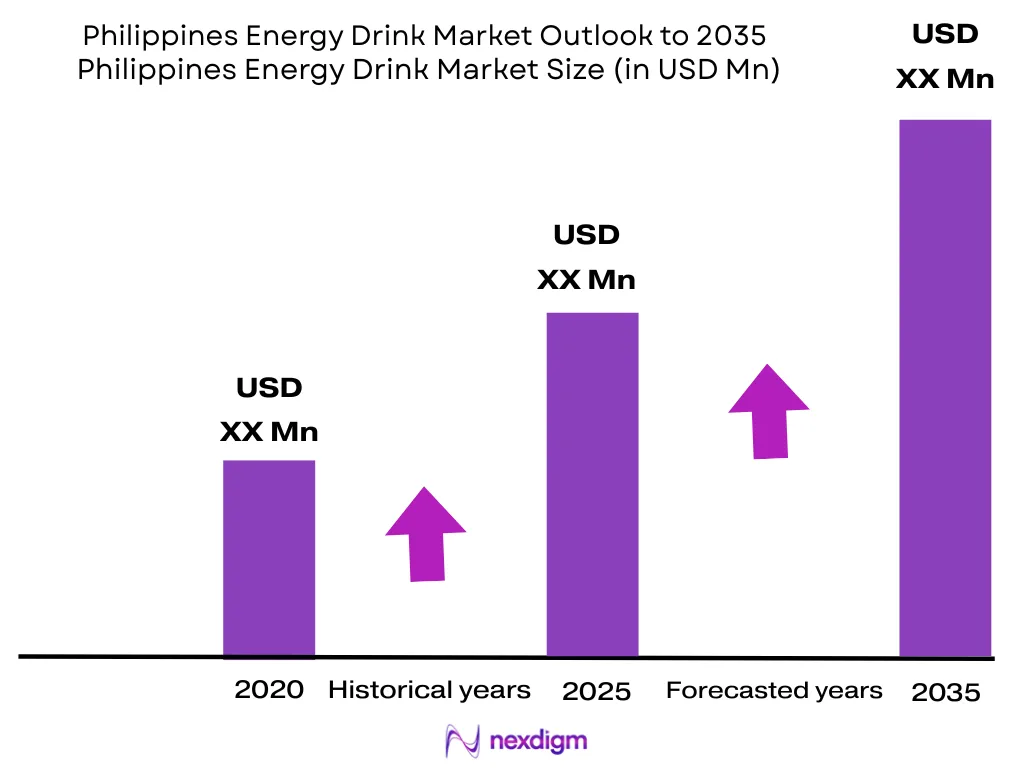
The Philippines Energy Drink Market is valued at USD ~ million, based on a five-year historical analysis. Demand is driven by mass-market PET energy drinks, high-frequency single-serve purchases, night-shift employment, student consumption, transport workers, and impulse buying across sari-sari stores and convenience chains. The country recorded 48.84 million employed persons out of a 50.79 million labor force, while IT-BPM employment reached 1.82 million and revenue reached USD 38 billion, strengthening work-linked energy drink demand. Metro Manila, CALABARZON, Central Luzon, Cebu, Davao, and other high-density urban corridors dominate the Philippines Energy Drink Market due to dense labor clusters, modern retail concentration, BPO hubs, university zones, transport nodes, and stronger cold-shelf availability. Sari-sari stores remain central to market penetration, with Packworks monitoring more than 270,000 stores and reporting PHP 8 billion sari-sari sales, followed by 175,000 active stores on its app versus 133,000 earlier.
Market Segmentation
By Product Type
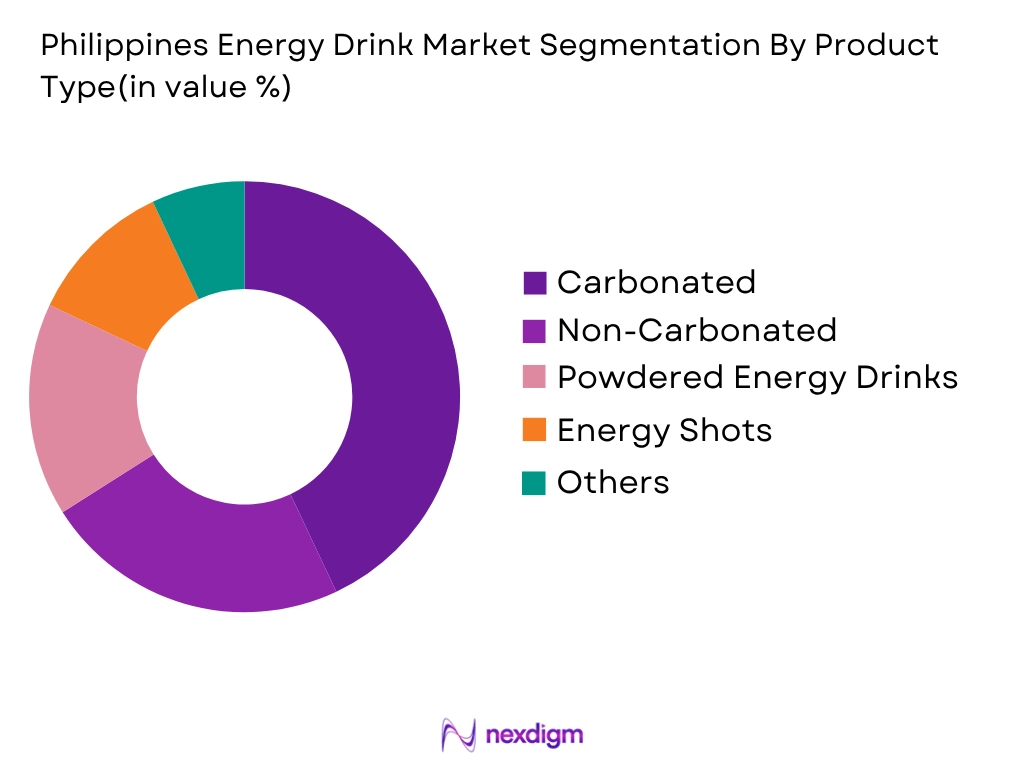
The Philippines Energy Drink Market is segmented by product format into carbonated ready-to-drink energy drinks, non-carbonated ready-to-drink energy drinks, energy shots, powdered energy drinks, sugar-free energy drinks, and low-calorie functional energy drinks. Carbonated ready-to-drink energy drinks hold the dominant market share because they fit the country’s high-frequency, low-ticket beverage culture and are widely available through sari-sari stores, convenience stores, petrol stations, and traditional groceries. Brands such as Cobra and Sting have built strong mass-market recall through PET bottle formats, bright flavor profiles, affordable pricing, and distribution depth. This segment also benefits from impulse consumption during commuting, work breaks, school hours, and late-night shifts. Imported cans and sugar-free variants are gaining attention, but the market remains anchored in chilled, sweet, carbonated, single-serve energy beverages sold through traditional retail.
By Distribution Channel
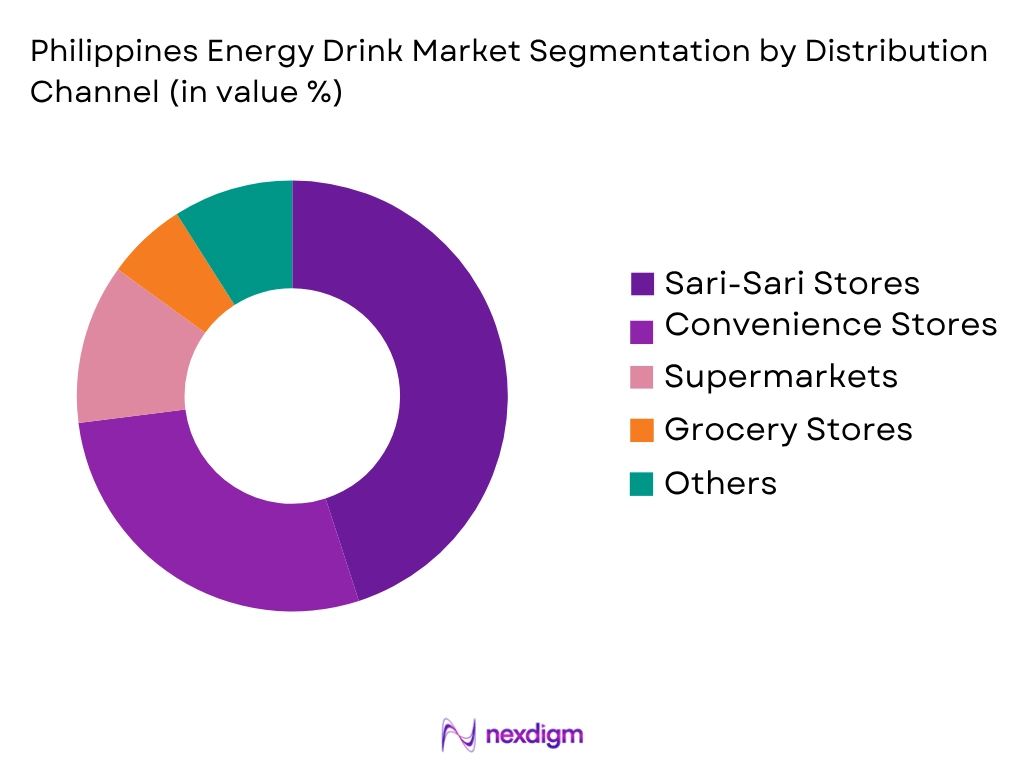
The Philippines Energy Drink Market is segmented by distribution channel into sari-sari stores, convenience stores, supermarkets and hypermarkets, traditional grocery stores, petrol stations, online marketplaces, gyms and sports venues, and foodservice or institutional channels. Sari-sari stores dominate the market because energy drinks are frequently bought as single units near homes, workplaces, transport stops, and community routes. The channel supports the “tingi” economy, allowing consumers to buy affordable single-serve beverages without travelling to supermarkets. Traditional retail also gives mass brands broader reach into lower-income and regional households. Convenience stores are important in urban areas due to cold-shelf visibility and BPO worker traffic, while supermarkets and online marketplaces support multipack buying, imported premium brands, and planned purchases.
Competitive Landscape
The Philippines Energy Drink Market is moderately consolidated at the mass-market level, with Cobra Energy Drink and Sting Energy Drink holding strong visibility across traditional trade, modern retail, and convenience channels. Premium and imported brands such as Red Bull and Monster compete through cans, lifestyle positioning, sports associations, and higher price points. The competitive structure is shaped by local manufacturing scale, distributor reach, PET bottle affordability, cold-shelf control, flavor innovation, and regulatory exposure to sugar-sweetened beverage rules.
| Major Player | Establishment Year | Headquarters | Core Energy Drink Brand | Product Format Strength | Dominant Channel Presence | Key Consumer Base | Pricing Positioning | Market-Specific Advantage |
| Asia Brewery, Inc. | 1982 | Makati, Philippines | ~ | ~ | ~ | ~ | ~ | ~ |
| Pepsi-Cola Products Philippines / PepsiCo | 1989 local bottling structure | Muntinlupa, Philippines / Purchase, USA | ~ | ~ | ~ | ~ | ~ | ~ |
| Red Bull GmbH / TCP Group | 1984 | Fuschl am See, Austria / Bangkok, Thailand | ~ | ~ | ~ | ~ | ~ | ~ |
| Monster Beverage Corporation | 1935 corporate roots; Monster launched 2002 | Corona, California, USA | ~ | ~ | ~ | ~ | ~ | ~ |
| Taisho Pharmaceutical | 1912 | Tokyo, Japan | ~ | ~ | ~ | ~ | ~ | ~ |
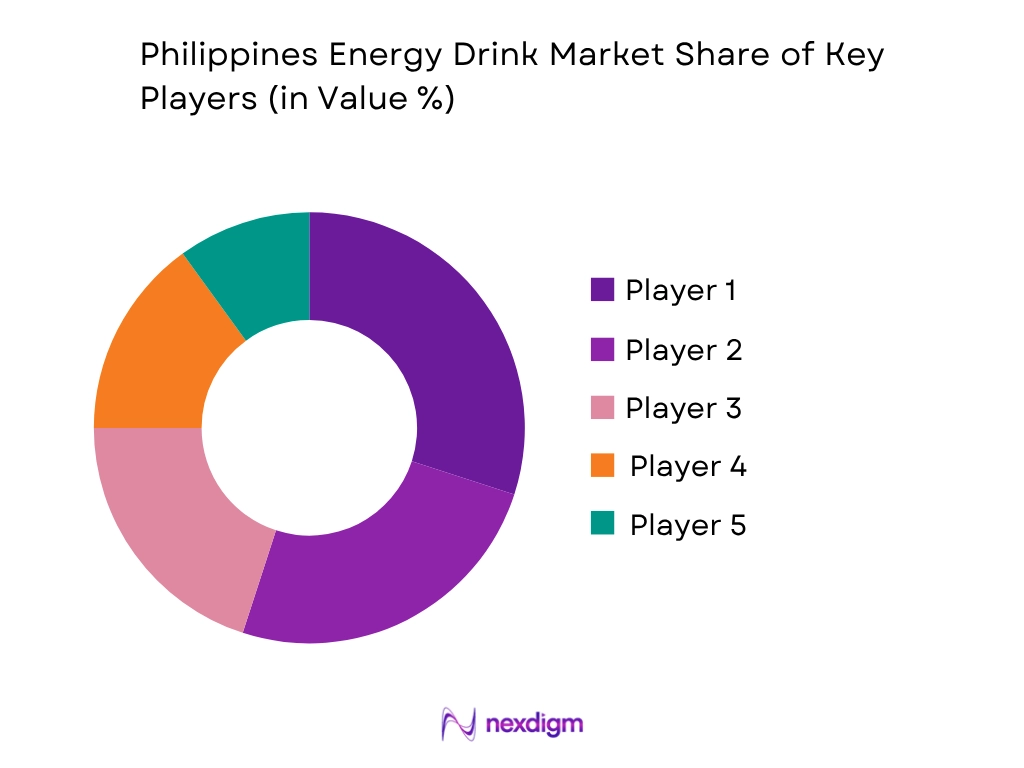
Philippines Energy Drink Market Analysis
Growth Drivers
Urbanization
Urbanization is a key growth driver for the Philippines Energy Drink Market because energy drink consumption is concentrated in cities where commuting, shift-based work, campus activity, convenience retail, and impulse beverage purchases are stronger. World Bank data records the Philippines’ urban population at 64,237.75 thousand people and total population at 115,843,670, creating a large city-based consumer base for ready-to-drink energy beverages. The same source records GDP at USD 470.06 billion and GDP per capita at USD 4,057.40, supporting packaged beverage spending across modern trade, sari-sari stores, convenience stores, and online channels. Urban beverage demand is also supported by household consumption capacity, with World Bank-reported household final consumption expenditure at USD 351.50 billion. For energy drink brands, dense cities such as Metro Manila, Cebu, Davao, and CALABARZON create stronger cold-chain availability, retail visibility, BPO-worker demand, student consumption, motorcycle-delivery activity, and late-night purchasing occasions. This makes urban density directly relevant to volume movement, single-serve PET bottle demand, premium imported can visibility, and convenience-led category expansion.
Workforce and Night-Shift Consumption Base
The Philippines Energy Drink Market is driven by a large active workforce, especially consumers who require alertness during long working hours, night shifts, commuting, logistics work, field work, and study routines. The Philippine Statistics Authority reported 48.84 million employed Filipinos out of a 50.79 million labor force, compared with a 95.6 employment-rate level in the previous annual reference, creating a broad base of wage earners and informal workers who purchase affordable single-serve beverages. The IT-BPM sector is especially relevant because IBPAP reported 1.82 million jobs and USD 38 billion in revenue, reinforcing demand from call centers, shared-services offices, and night-shift workers who frequently consume energy drinks for alertness. This workforce base is supported by World Bank macro indicators showing GDP of USD 470.06 billion and population of 115,843,670. Energy drink brands benefit from this employment structure because products are sold in low-ticket, ready-to-drink formats through convenience stores, sari-sari stores, petrol stations, office-adjacent outlets, and transport corridors.
Market Challenges
Health, Sugar and Regulatory Scrutiny
Health and regulatory scrutiny restrain the Philippines Energy Drink Market because energy drinks are positioned around caffeine, sugar, stimulant ingredients, and youth-oriented consumption occasions. The Philippines has a large consumer base, with World Bank population data at 115,843,670 and urban population at 64,237.75 thousand people, making public-health communication and product-label compliance highly visible for beverage regulators. The Food and Drug Administration Philippines oversees processed food registration and labeling, while energy drink brands must manage ingredient declarations, nutrition facts, caffeine communication, and claim substantiation. Demand remains strong, but brands face pressure to balance “energy boost” messaging with responsible consumption and clearer nutrition disclosure. Household final consumption expenditure of USD 351.50 billion shows a large packaged goods consumption base, but health-conscious consumers may shift toward lower-sugar, low-calorie, hydration-based, or coffee alternatives. For manufacturers, the challenge is not only compliance, but also reformulating without losing taste, affordability, carbonation intensity, and repeat-purchase appeal among students, drivers, BPO workers, manual workers, and convenience-store shoppers.
Distribution Fragmentation and Retail Execution Complexity
Distribution fragmentation is a major challenge for the Philippines Energy Drink Market because the category depends heavily on neighborhood-level retail, sari-sari stores, convenience stores, petrol stations, independent groceries, wholesalers, and small distributors. World Bank data records the Philippines as a large consumption economy, with household final consumption expenditure at USD 351.50 billion, total population at 115,843,670, and urban population at 64,237.75 thousand people. These numbers support demand, but they also show the scale of outlets and consumer locations that beverage firms must reach consistently. The Philippine Statistics Authority reported 48.84 million employed persons, creating many purchase occasions across workplaces, transport stops, construction sites, campuses, and late-night service hubs. However, ensuring chilled availability, shelf visibility, stock replenishment, regional distributor coverage, promo execution, and route-to-market discipline is difficult across an archipelagic market. Energy drinks are highly impulse-led, so out-of-stock events, warm products, weak cooler presence, and inconsistent regional coverage can directly reduce sales momentum even where consumer demand exists.
Market Opportunities
Low-Sugar, Functional and Premium Energy Drink Innovation
Low-sugar, functional, and premium product innovation creates a future growth opportunity for the Philippines Energy Drink Market because the country has a large young workforce and expanding urban consumer base that can support differentiated energy products. World Bank data records a total population of 115,843,670 and an urban population of 64,237.75 thousand people, while PSA records 48.84 million employed persons, giving brands a broad base of consumers who use energy drinks for work, commuting, study, delivery work, and fitness routines. IBPAP’s 1.82 million IT-BPM jobs create a concentrated night-shift audience where zero-sugar, vitamin-fortified, higher-caffeine, and functional formulations can gain relevance. GDP of USD 470.06 billion and household final consumption expenditure of USD 351.50 billion also support packaged beverage experimentation in modern retail, online marketplaces, and convenience chains. The opportunity is market specific because brands can move beyond traditional sweet PET bottles into sugar-free cans, electrolyte-energy hybrids, functional shots, tropical flavors, esports-linked products, and premium imported-style formats without abandoning mass-market affordability.
Regional Expansion Through Sari-Sari, Convenience and Online Channels
Regional expansion through sari-sari stores, convenience retail, and online platforms is a key opportunity because the Philippines Energy Drink Market is still highly dependent on accessibility, single-serve purchase behavior, and chilled product availability. World Bank data shows 64,237.75 thousand urban residents and 115,843,670 total population, indicating demand potential beyond Metro Manila into CALABARZON, Central Luzon, Cebu, Davao, Iloilo, Cagayan de Oro, and other regional consumption centers. The Philippine labor base of 48.84 million employed persons supports weekday and work-linked consumption across factories, offices, transport routes, service jobs, campuses, and small businesses. Household final consumption expenditure of USD 351.50 billion demonstrates the scale of consumer spending that beverage companies can address through affordable SKUs, multipacks, online bundles, and localized flavors. This opportunity is strengthened by modern retail and e-commerce because imported brands, sugar-free variants, and performance energy drinks can use digital channels for discovery, while mass brands can deepen penetration through wholesalers, small-format retailers, coolers, and route-to-market partnerships in secondary cities and provincial hubs.
Future Outlook
The Philippines Energy Drink Market is expected to grow at a forecasted CAGR of ~% during the forecast period. Growth will be supported by rising urban employment, continued expansion of convenience retail, BPO and night-shift consumption, student demand, e-commerce access to imported brands, and increasing awareness of functional beverages. Sugar-free and lower-calorie products are expected to gain traction as health concerns around sugar and caffeine become more visible. The market will remain price-sensitive, but premium cans, esports-linked brands, and performance energy formats will expand in urban centers.
Future growth will also depend on distribution depth outside Metro Manila. Regional expansion into Visayas, Mindanao, and tier-2 cities will create opportunities for brands with strong wholesale partnerships and traditional retail execution. Sari-sari stores will remain critical for volume, while convenience stores and online marketplaces will drive premiumization. Companies that balance affordable PET SKUs with functional, sugar-free, and flavor-localized innovation will be best positioned.
Regulatory pressure will influence product formulation and pricing. Energy drink companies will need stronger label transparency, ingredient compliance, caffeine communication, and sugar-tax management. Brands are expected to invest in pack-size optimization, affordable trial packs, and low-sugar formulas to defend consumption frequency. Competitive advantage will increasingly come from cold availability, retail visibility, regional distributor coverage, and consumer trust in product safety.
Major Players
- Cobra Energy Drink
- Sting Energy Drink
- Red Bull
- Monster Energy
- Lipovitan
- Bacchus
- Extra Joss
- Rockstar Energy
- Predator Energy
- Celsius
- Bang Energy
- G Fuel
- C4 Energy
- Prime Energy
- V Energy
Key Target Audience
- Energy Drink Manufacturers
- Functional Beverage Companies
- Bottled Beverage Distributors
- Modern Trade Retail Chains
- Convenience Store Operators
- Online Grocery and Quick Commerce Platforms
- Investments and Venture Capitalist Firms
- Government and Regulatory Bodies (Food and Drug Administration Philippines, Department of Health, Department of Trade and Industry, Bureau of Internal Revenue)
Research Methodology
Step 1: Identification of Key Variables
The initial phase involves constructing an ecosystem map covering manufacturers, importers, distributors, sari-sari store networks, modern retailers, convenience chains, online platforms, and regulatory authorities within the Philippines Energy Drink Market. This step is supported by secondary research, trade channel mapping, SKU identification, and category-level assessment of RTD, shot, powdered, and sugar-free energy drink formats.
Step 2: Market Analysis and Construction
In this phase, historical data is compiled and analyzed for the Philippines Energy Drink Market, including retail value, volume consumption, average selling price, SKU mix, channel contribution, and regional availability. Bottom-up inputs include product pricing, retail audits, distributor checks, and channel-level sales indicators, while top-down validation uses beverage industry data, employment statistics, and macro-consumption indicators.
Step 3: Hypothesis Validation and Expert Consultation
Market hypotheses are validated through interviews with beverage distributors, modern trade buyers, convenience store category managers, wholesalers, importers, and selected manufacturers. These consultations help assess category penetration, pricing structures, margins, retail execution, cold-chain availability, and promotional intensity. The objective is to refine channel assumptions and validate competitive positioning across mass and premium segments.
Step 4: Research Synthesis and Final Output
The final phase integrates desk research, primary interviews, retail checks, pricing analysis, and triangulated estimates into a validated market model. Manufacturer and distributor inputs are compared with observed shelf presence, online availability, and regional channel coverage. The output provides a consolidated view of market size, segmentation, competition, growth outlook, and strategic recommendations for the Philippines Energy Drink Market.

- Executive Summary
- Research Methodology (Market Definitions and Assumptions, Abbreviations, Product Inclusion and Exclusion Criteria, Energy Drink Category Mapping, Carbonated and Non-Carbonated Energy Drink Classification, Energy Shot Classification, Powdered Energy Mix Classification, Market Sizing Approach, Top-Down Analysis, Bottom-Up Analysis, Demand-Side Assessment, Supply-Side Assessment, Channel Checks Across Sari-Sari Stores and Modern Trade, Distributor Interviews, Retail Price Audits, SKU Benchmarking, Import and Local Manufacturing Assessment, Data Triangulation, Forecasting Framework, Limitations and Future Conclusions)

- Definition and Scope
- Market Evolution and Industry Genesis
- Timeline of Major Industry Developments
- Business Cycle and Seasonality
- Value Chain Analysis
- Supply Chain Analysis
- Route-to-Market Structure
- Local Manufacturing vs Imported Brand Ecosystem
- Category Role in Functional Beverage Industry

- Growth Drivers (BPO Workforce Expansion, High Youth Population, Rising Convenience Store Penetration, Sari-Sari Store Accessibility, Demand for Affordable Single-Serve Beverages, Urban Commuting Patterns, Fitness and Esports Culture, Heat-Driven Beverage Consumption)
- Market Challenges (Sugar Tax Exposure, Price Sensitivity, Health Concerns Around Caffeine and Sugar, Counterfeit and Parallel Imports, Shelf-Space Competition, Distribution Fragmentation, Rural Cold-Chain Limitations, Premium Brand Affordability Constraints)
- Market Opportunities (Sugar-Free Energy Drink Adoption, Sachet and Trial-Pack Innovation, Functional Energy and Hydration Convergence, Esports Partnerships, Workplace Energy Solutions, BPO-Focused Consumption Campaigns, Regional Distributor Expansion, Quick Commerce Energy Drink Bundles)
- Market Trends (Low-Sugar Formulations, Imported Premium Cans, PET Bottle Dominance in Mass Market, Flavor Localization, Multi-Buy Promotions, Functional Ingredient Claims, Influencer-Led Beverage Discovery, Night-Economy Consumption)
- SWOT Analysis
- Porter’s Five Forces Analysis
- PESTLE Analysis

- By Market Value (2020-2025)
- By Volume Consumption (2020-2025)
- By Average Selling Price (2020-2025)

- By Product Format (In Value %)
Carbonated Ready-to-Drink Energy Drinks
Non-Carbonated Ready-to-Drink Energy Drinks
Energy Shots
Powdered Energy Drinks
Sugar-Free Energy Drinks
Low-Calorie Functional Energy Drinks - By Packaging Type (In Value %)
PET Bottles
Aluminum Cans
Glass Bottles
Sachets and Powder Sticks
Multipack Packaging
Single-Serve On-the-Go Packs - By Distribution Channel (In Value %)
Sari-Sari Stores
Convenience Stores
Supermarkets and Hypermarkets
Traditional Grocery Stores
Petrol Stations and Forecourt Retail
Drugstores and Pharmacies - By Region (In Value %)
National Capital Region
Central Luzon
CALABARZON
North Luzon

- Market Share of Major Players (By Value, Volume, Product Format, Packaging Type, Distribution Channel, Region)
- Competitive Positioning Matrix (Mass Affordability, Premium Positioning, Functional Claims, Flavor Range, Channel Reach, Brand Equity)
- Cross Comparison Parameters (Energy Drink SKU Count, Average Caffeine Content per Serving, Sugar-Free Portfolio Strength, PET Bottle vs Can Mix, Sari-Sari Store Penetration, Convenience Store Cooler Visibility, Imported Premium Brand Availability, Esports and Fitness Marketing Intensity)
- SWOT Analysis of Major Players
- Detailed Profiles of Major Companies
Cobra Energy Drink
Sting Energy Drink
Red Bull
Monster Energy
Lipovitan
Bacchus
Extra Joss
Rockstar Energy
Predator Energy
Celsius
Bang Energy
G Fuel
C4 Energy
Prime Energy
V Energy

- Consumption Behavior Assessment
- Demographic Consumption Trends
- Purchasing Power Analysis
- Consumer Need-State Analysis
- Brand Loyalty Assessment
- Health and Wellness Influence on Purchase Decisions
- Product Attribute Preference Analysis

- By Market Value (2026-2035)
- By Volume Consumption (2026-2035)
- By Average Selling Price(2026-2035)


 Request a Sample
 Ask for Customization
 Get a Quote
 Enquire Now