
 Download PDF
Market Overview
The Philippines Epoxy Flooring Market is valued at approximately USD ~XX million, supported by construction activity increasing from 171,268 approved projects covering 41,472,200 square metres in the preceding annual observation to 180,341 projects covering 42,837,581 square metres in the latest observation. Non-residential construction remained substantial at 39,238 projects and 22,380,982 square metres, creating a broad installation base for industrial, warehouse, institutional and commercial epoxy flooring systems.
CALABARZON, Central Luzon, Metro Manila and Central Visayas dominate demand because they combine manufacturing plants, logistics facilities, electronics operations, industrial estates and continuing economic-zone investment. PEZA approved 255 new and expansion projects, including 122 export-manufacturing projects, 18 facilities projects and 9 logistics projects, while investment activity was concentrated across Laguna, Cavite, Batangas, Pampanga, Tarlac, Cebu and Metro Manila, supporting epoxy-floor installations in high-traffic industrial facilities.
Market Segmentation
By Flooring System Type
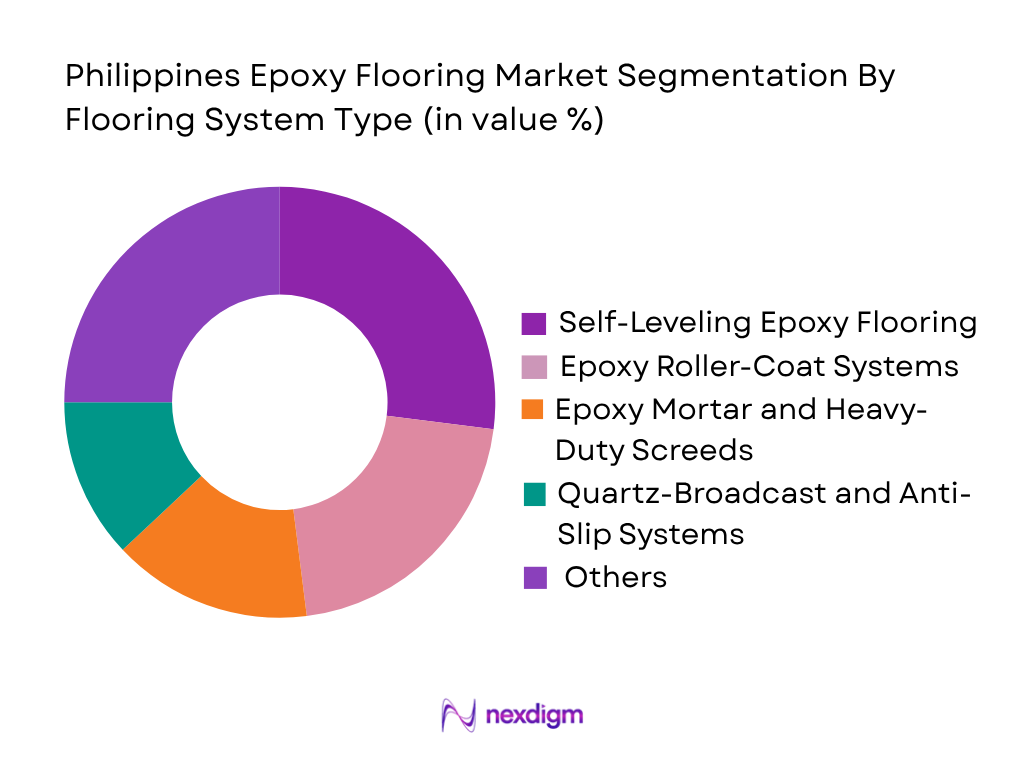
The Philippines Epoxy Flooring Market is segmented into roller-coat systems, self-leveling epoxy flooring, epoxy mortar floors, quartz-broadcast systems, anti-slip floors, decorative epoxy, conductive and ESD systems, chemical-resistant flooring and moisture-barrier systems. Self-leveling epoxy flooring holds the dominant market share because it provides a seamless, dense and smooth surface suitable for factories, laboratories, pharmaceutical production, electronics facilities and controlled industrial environments. These systems can be applied at greater thickness than conventional roller coatings and provide strong resistance to abrasion, liquids and routine industrial cleaning. Growing manufacturing and economic-zone activity also supports this segment: PEZA reported 122 export-manufacturing projects approved during 2024, while manufacturing accounted for PHP149.3 billion of approved economic-zone investments. This expansion increases the requirement for production-floor systems capable of supporting carts, equipment, pedestrian traffic and cleaning operations. Roller coatings remain important for lighter-duty areas because of simpler installation, while epoxy mortars and broadcast systems serve higher mechanical-load and slip-resistance requirements.
By End-Use Industry
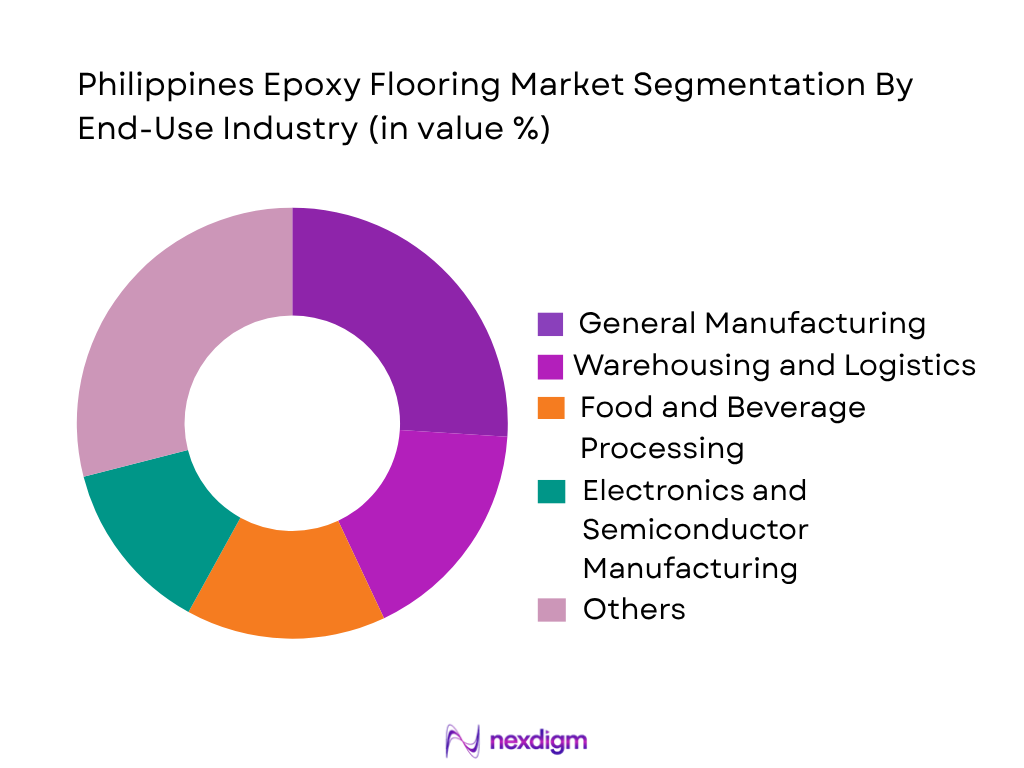
The Philippines Epoxy Flooring Market is segmented into manufacturing, warehousing and logistics, food and beverage processing, electronics and semiconductors, pharmaceuticals and cleanrooms, healthcare, commercial buildings, car parks and other specialized facilities. General manufacturing holds the dominant market share because epoxy floors are widely specified where concrete surfaces require dust control, abrasion resistance, oil resistance, easy cleaning and improved durability. Philippine Statistics Authority data show manufacturing gross value added increasing from PHP3.946 trillion to PHP4.146 trillion, including PHP2.229 trillion from food manufacturing and PHP204.657 billion from beverage manufacturing, illustrating the scale of sectors that frequently use seamless resin floors. Electronics operations create further specialized demand for conductive and ESD systems, while logistics facilities require abrasion-resistant finishes suitable for forklifts and pallet movement. Pharmaceutical and food-processing users typically require smooth, cleanable surfaces with coved transitions and chemical resistance, supporting higher-specification epoxy systems.
Competitive Landscape
The Philippines Epoxy Flooring Market is characterized by multinational construction-chemical manufacturers, industrial coatings companies and domestic paint and specialty-material suppliers. Sika and MAPEI compete with broad system-based flooring portfolios, while Jotun and Nippon Paint bring strong industrial-coatings capabilities. Pacific Paint / BOYSEN provides a large domestic manufacturing and distribution presence. Competition increasingly centers on self-leveling technology, abrasion and chemical resistance, ESD capability, moisture tolerance, approved applicators, surface-preparation expertise and on-site technical service.
| Major Player | Establishment Year | Headquarters | Self-Leveling Epoxy | Heavy-Duty / Mortar Systems | Chemical-Resistant Systems | ESD / Conductive Capability | Industrial & Warehouse Exposure | Technical / Applicator Support |
| Sika | 1910 | Baar, Switzerland | ~ | ~ | ~ | ~ | ~ | ~ |
| Jotun | 1926 | Sandefjord, Norway | ~ | ~ | ~ | ~ | ~ | ~ |
| MAPEI | 1937 | Milan, Italy | ~ | ~ | ~ | ~ | ~ | ~ |
| Pacific Paint / BOYSEN | 1953 | Philippines | ~ | ~ | ~ | ~ | ~ | ~ |
| Nippon Paint | 1881 | Japan | ~ | ~ | ~ | ~ | ~ | ~ |
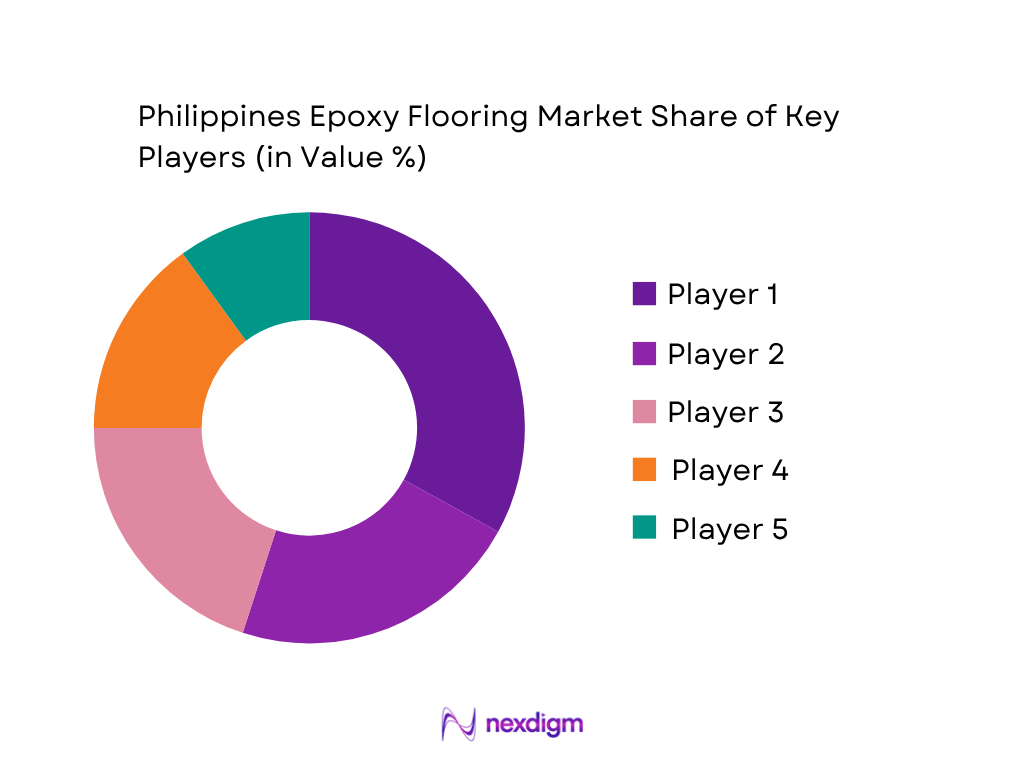
Philippines Epoxy Flooring Market Analysis
Growth Drivers
Expansion of Export Manufacturing and Economic-Zone Facilities Driving Industrial Flooring Demand
The Philippines Epoxy Flooring Market is being supported by continued expansion of export manufacturing, industrial facilities and economic-zone activity, all of which require durable floors for production areas, assembly lines, clean operational zones, warehouses and utility spaces. During 2024, 255 new and expansion projects were approved within economic zones, including 122 export-manufacturing projects, 18 facilities-development projects and 9 logistics projects. The industrial pipeline strengthened further during 2025, when 314 new and expansion projects were approved, including 146 manufacturing projects, 25 facilities projects and 13 logistics projects. These facilities create direct demand for self-leveling epoxy systems, roller coatings, heavy-duty epoxy mortar and anti-slip broadcast floors because manufacturing environments require dust control, abrasion resistance, easy cleaning and protection of concrete substrates. Electronics, automotive components, fabricated metals and other production activities also create specialized requirements around machinery and processing areas. The economic backdrop remains substantial, with World Bank data recording Philippine GDP of US$461.62 billion in 2024, GDP per capita of US$3,984.8, and a population of approximately 115.8 million people. This combination of industrial project formation and national economic scale supports sustained installation of epoxy flooring systems.
Expanding Non-Residential Floor Area Creating a Larger Addressable Installation Base
Growth in non-residential construction is increasing the physical floor area available for epoxy flooring installation across factories, warehouses, hospitals, commercial buildings, institutional facilities and industrial support structures. Philippine construction statistics recorded 39,238 non-residential projects covering 22,380,982 square metres in 2024. During 2025, the country recorded 38,991 non-residential projects covering 24,847,366 square metres, adding approximately 2.47 million square metres of non-residential floor area even though the number of individual projects remained broadly stable. Total approved construction floor area increased from 42,837,581 square metres to 45,236,312 square metres during the same period. For epoxy flooring suppliers, larger floor plates are particularly relevant because warehouses, factories and institutional facilities can require thousands of square metres of continuous self-leveling, broadcast or roller-applied flooring. The same construction base also generates future maintenance and recoating requirements once facilities enter service. World Bank indicators place Philippine GDP at US$461.62 billion in 2024, GDP per capita at US$3,984.8, and the national population at approximately 115.8 million, demonstrating the macroeconomic scale supporting continued expansion of built industrial and commercial assets.
Market Challenges
Diverse Industrial Applications Increasing Flooring Specification and Application Complexity
The Philippines Epoxy Flooring Market faces technical complexity because the industrial investment pipeline spans manufacturing, logistics, facilities, information technology and other operational environments with materially different flooring requirements. Economic-zone approvals in 2025 included 146 manufacturing projects, 67 IT-BPM projects, 26 economic-zone developments, 25 facilities projects, 25 domestic-market enterprises, 13 logistics projects and 5 utilities projects. A standard roller-coated epoxy may be adequate for a low-traffic service room, whereas production areas can require heavy-duty mortar systems, wet-processing facilities require slip-resistant finishes, and electronics operations may require conductive or ESD-controlled floors. Incorrect system selection can result in premature wear, delamination or inadequate resistance to chemicals and mechanical loading. Contractors therefore need to evaluate concrete strength, moisture, traffic, cleaning regimes, chemical exposure and required system thickness before installation. This broad mix of facility types also increases inventory and technical-support requirements for manufacturers and distributors. The challenge exists within a sizeable national economy: World Bank data record Philippine GDP of US$461.62 billion in 2024, GDP per capita of US$3,984.8, and population of around 115.8 million, supporting large industrial activity but also increasing the diversity of project specifications suppliers must serve.
Geographic Dispersion of Industrial Projects Increasing Applicator and Quality-Control Requirements
Geographic dispersion represents another challenge because epoxy flooring performance depends heavily on trained applicators, mechanical surface preparation, moisture assessment, mixing accuracy and controlled installation at individual project sites. In 2024, approved economic-zone projects were distributed across Metro Manila, CALABARZON, Central Luzon, Central Visayas, Bicol, Northern Mindanao and other regions, while one November approval batch alone included projects in 4 locations in Batangas, 4 in Laguna, 4 in Cebu, 2 in Cavite and individual projects in Rizal, Pampanga and Negros Oriental. The network has continued to broaden: PEZA reported 441 operating economic zones in 2026, including more than 200 zones within the Luzon Economic Corridor. Flooring suppliers therefore need dependable product warehousing, trained applicators and field technical support across multiple islands and industrial corridors. Variation in contractor capability can affect grinding, crack repair, primer application, resin mixing and final coating thickness, making project-site control essential for achieving consistent performance. World Bank data show Philippine GDP of US$461.62 billion in 2024, GDP per capita of US$3,984.8, and a population of approximately 115.8 million, underscoring the national scale across which suppliers must maintain execution quality.
Market Opportunities
Electronics Manufacturing Expansion Creating Future Demand for ESD and Conductive Epoxy Flooring
The continuing expansion of electronics manufacturing creates a high-value opportunity for the Philippines Epoxy Flooring Market because semiconductor, electronics-assembly and precision-manufacturing facilities often require seamless floors capable of controlling electrostatic discharge, supporting clean operating conditions and resisting repetitive equipment traffic. During the first half of 2026, electronics manufacturing was the leading sector among economic-zone investment approvals, while 21 big-ticket projects accounted for PHP122.841 billion of approved investment. In June alone, authorities approved 22 new and expansion projects, including 12 export-manufacturing projects, alongside facilities and logistics developments supporting industrial activity. Projects were distributed across Metro Manila, CALABARZON, Central Luzon, Central Visayas, Davao and Caraga, widening the geographic opportunity for specialized flooring contractors. Conductive primers, ESD epoxy layers and grounding-compatible flooring systems can therefore become increasingly important compared with conventional industrial coatings as advanced manufacturing expands. These current investments establish the operational facility base from which future floor installation, maintenance and recoating demand can develop. The macroeconomic environment provides additional support, with World Bank data showing Philippine GDP at US$461.62 billion in 2024, GDP per capita at US$3,984.8, and population at approximately 115.8 million.
Facility Renovation and Recoating Creating a Recurring Epoxy Flooring Opportunity
The expanding stock of existing Philippine buildings creates a future opportunity for epoxy flooring suppliers beyond initial installation because industrial and commercial floors require resurfacing when coatings wear, concrete deteriorates or operational requirements change. Construction statistics recorded 13,997 alteration and repair projects in 2024, increasing to 14,372 projects in 2025. At the same time, existing non-residential construction activity represented 39,238 projects and 22,380,982 square metres of floor area in 2024, followed by 38,991 projects and 24,847,366 square metres in 2025. These figures indicate an expanding installed base of production, commercial and institutional floor surfaces that can subsequently require crack repair, grinding, moisture barriers, epoxy primers, self-leveling resurfacing or replacement topcoats. Facility owners can also upgrade conventional concrete floors when operations shift toward food processing, pharmaceutical production, electronics assembly or higher warehouse traffic. This makes maintenance and refurbishment an important recurring opportunity rather than a demand stream tied only to new buildings. World Bank data record Philippine GDP of US$461.62 billion in 2024, GDP per capita of US$3,984.8, and population of approximately 115.8 million, providing a substantial economic and building-user base supporting ongoing facility modernization.
Future Outlook
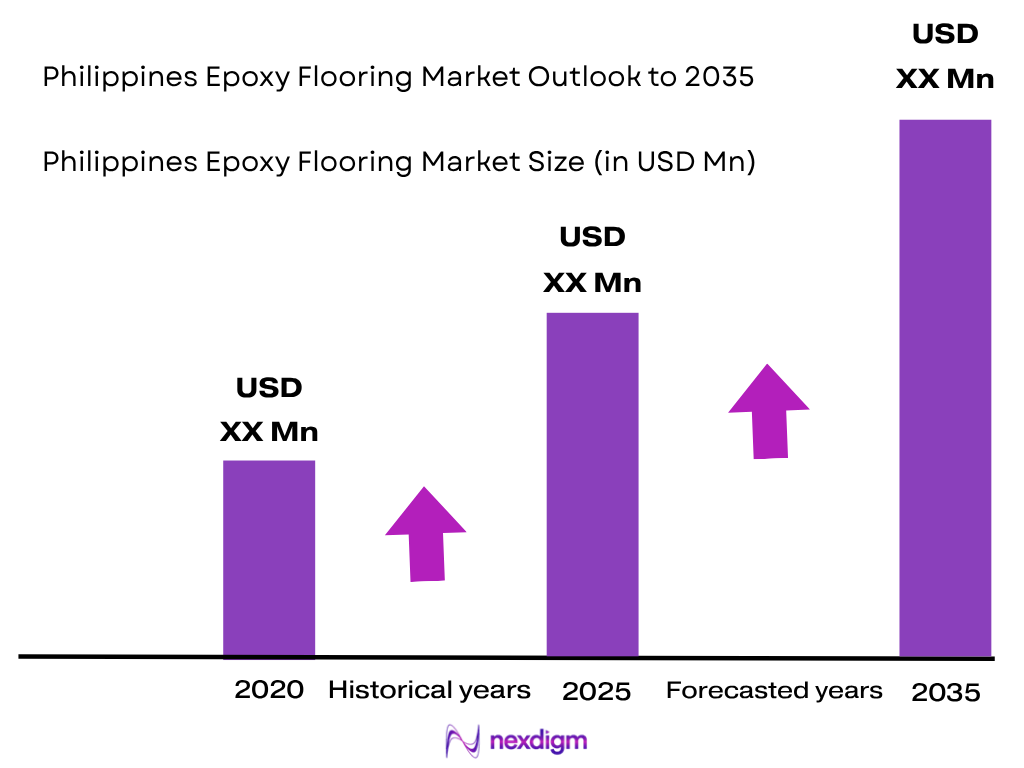
The Philippines Epoxy Flooring Market is expected to expand at approximately ~XX% CAGR during 2026-2035, supported by manufacturing investment, economic-zone development, logistics facilities, electronics production and industrial refurbishment. Demand should increasingly move toward technically differentiated systems rather than basic floor paints. Self-leveling and heavy-duty floors are expected to remain important in manufacturing plants and warehouses, while ESD systems should gain relevance in electronics and semiconductor facilities. PEZA approved 146 manufacturing projects in 2025, compared with a large manufacturing project base in the preceding period, reinforcing the industrial pipeline.
Moisture-tolerant primers and vapor-barrier technologies will become more important because substrate moisture is a major cause of blistering and coating failure in tropical conditions. Suppliers capable of combining substrate assessment, mechanical preparation, repair, priming and flooring installation will have an advantage. Low-VOC, seamless and hygienic flooring systems should also gain significance in pharmaceutical, healthcare and food-processing environments where cleanability and controlled operating conditions are critical.
Major Players
- Sika Philippines, Inc.
- Buildrite Construction Chemicals / Magna Prime Chemical
- Technologies, Inc.
- Jotun Philippines Inc.
- Pacific Paint (BOYSEN) Philippines, Inc.
- MAPEI Philippines Inc.
- Fosroc
- Master Builders Solutions
- Nippon Paint Philippines
- Davies Paints Philippines, Inc.
- PPG Philippines
- Sherwin-Williams Philippines
- Allgemeine Bau-Chemie Phil., Inc.
- Terraco Philippines
- Canchem, Inc.
- Pioneer Adhesives, Inc.
Key Target Audience
- Epoxy Flooring and Construction Chemical Manufacturers
- Industrial Flooring Applicators and Contractors
- Manufacturing and Electronics Facility Owners
- Warehouse, Logistics and Cold-Storage Operators
- Food, Beverage and Pharmaceutical Manufacturers
- Construction Chemical and Industrial Coating Distributors
- Investments and Venture Capitalist Firms
- Government and Regulatory Bodies (Philippine Economic Zone Authority, Department of Trade and Industry, Board of Investments, Department of Labor and Employment, Food and Drug Administration Philippines)
Research Methodology
Step 1: Identification of Key Variables
The initial phase involves creating an ecosystem map covering epoxy resin suppliers, flooring manufacturers, local formulators, distributors, applicators, industrial developers, manufacturers and facility managers. Critical variables include installed floor area, system thickness, resin consumption, substrate condition, end-use requirements, surface preparation, recoating cycles, industrial construction activity and regional manufacturing concentration.
Step 2: Market Analysis and Construction
Historical data for the Philippines Epoxy Flooring Market is compiled using approved non-residential construction, manufacturing activity, economic-zone investments, industrial-facility additions and warehouse development. Bottom-up analysis estimates installed flooring area and epoxy consumption by system thickness, while top-down analysis evaluates industrial construction and flooring intensity to derive market estimates.
Step 3: Hypothesis Validation and Expert Consultation
Market hypotheses are validated through computer-assisted telephone interviews with flooring manufacturers, applicators, industrial coating distributors, general contractors and facility-maintenance professionals. Discussions focus on self-leveling versus roller-coat usage, average system build-up, ESD demand, chemical resistance, moisture-related failures, surface preparation methods, contractor productivity and specification requirements.
Step 4: Research Synthesis and Final Output
Primary findings are triangulated with Philippine Statistics Authority manufacturing and construction data, PEZA investment records, manufacturer technical documentation and application-level evidence. Top-down and bottom-up models are reconciled to establish market estimates, while the forecasting framework incorporates manufacturing expansion, logistics development, facility refurbishment, electronics investment and increasing adoption of higher-performance flooring technologies.

- Executive Summary
- Research Methodology (Market Definitions and Assumptions, Philippines Epoxy Flooring Market Classification, Epoxy Primer Assessment, Roller-Coat Epoxy Assessment, Self-Leveling Epoxy Assessment, Epoxy Mortar Assessment, Quartz-Broadcast Epoxy Assessment, Anti-Slip Epoxy Assessment, Conductive Flooring Assessment, ESD Flooring Assessment, Decorative Epoxy Assessment, Metallic Epoxy Assessment, Flake Epoxy Assessment, Chemical-Resistant Epoxy Assessment, Food-Grade Flooring Assessment, Pharmaceutical Flooring Assessment, Cleanroom Flooring Assessment, Car Park Flooring Assessment, Moisture-Barrier Assessment, Concrete Substrate Assessment, Surface Preparation Assessment, Concrete Moisture Assessment, Pull-Off Adhesion Assessment, Abrasion Resistance Assessment, Chemical Resistance Assessment, Compressive Strength Assessment, Flexural Strength Assessment, Impact Resistance Assessment, Slip Resistance Assessment, VOC Assessment, System Thickness Assessment, Cure-Time Assessment, Application Temperature Assessment)

- Definition and Scope
- Philippines Epoxy Flooring Industry Evolution and Development of Conventional Epoxy Floor Paints, Solvent-Based Epoxy Coatings, Water-Based Epoxy Coatings, High-Solids Epoxy Systems, Solvent-Free Epoxy Systems, Self-Leveling Epoxy Screeds, Epoxy Mortar Floors, Quartz-Broadcast Systems, Anti-Slip Epoxy Floors, Decorative Epoxy Floors, Flake Flooring Systems, Metallic Epoxy Floors, Conductive Epoxy Floors, ESD Flooring Systems, Chemical-Resistant Epoxy Floors, Food Processing Flooring Systems, Pharmaceutical Flooring Systems, Cleanroom Flooring Systems, Moisture-Tolerant Epoxy Systems and Heavy-Duty Industrial Resin Flooring Systems
- Epoxy Flooring Value Chain Analysis
- Epoxy Flooring Supply Chain Analysis
- Epoxy Resin Suppliers, Amine and Polyamide Hardener Suppliers, Reactive Diluent Suppliers, Quartz Aggregate Suppliers, Silica Filler Suppliers, Pigment Suppliers, Conductive Additive Suppliers, Anti-Slip Aggregate Suppliers, Decorative Flake Suppliers, Epoxy Flooring Manufacturers, Local Formulators, Private-Label Producers, Importers, Industrial Coating Distributors, Construction Chemical Distributors, Flooring Applicators, Surface Preparation Contractors, General Contractors, Industrial Facility Owners and Facility Managers

- Growth Drivers (Manufacturing Facility Expansion, Warehouse and Logistics Development, Food Processing Capacity, Pharmaceutical Production, Electronics Manufacturing, Semiconductor Facility Development, Commercial Facility Modernization, Industrial Floor Rehabilitation, Car Park Development, Cleanroom Construction, Dust-Control Requirements, Hygiene and Washability Requirements, Chemical and Abrasion Resistance Demand, Facility Maintenance and Recoating)
- Market Challenges (Concrete Moisture Content, Rising Moisture Vapor, Inadequate Surface Preparation, Osmotic Blistering, Pot-Life Constraints, High Ambient Temperature, Humidity During Application, Substrate Cracking, Poor Concrete Profile, Incorrect Mixing Ratios, Skilled Applicator Availability, Installation Downtime, UV Yellowing of Epoxy, Chemical Compatibility Selection, Imported Epoxy Resin Dependence)
- Market Opportunities (Self-Leveling Epoxy Systems, ESD and Conductive Flooring, Semiconductor Facility Flooring, Pharmaceutical Cleanroom Flooring, Food-Safe Industrial Flooring, Low-VOC Epoxy Systems, Moisture-Tolerant Primers, High-Chemical-Resistance Floors, Heavy-Duty Warehouse Flooring, Decorative Commercial Epoxy, Car Park Systems, Rapid Facility Refurbishment, Antimicrobial Flooring, Local Epoxy Formulation, Applicator Certification Networks)
- Market Trends (Solvent-Free Epoxy Adoption, High-Solids Systems, Self-Leveling Flooring, Quartz-Broadcast Systems, Conductive Flooring, ESD-Control Systems, Moisture-Barrier Technology, Low-VOC Formulations, Decorative Flake Floors, High-Gloss Seamless Finishes, Anti-Slip Aggregates, Integrated Primer-Screed-Topcoat Systems, Mechanized Surface Preparation, Digital Color Selection, System-Based Flooring Specifications)
- Government Regulations and Standards (National Building Code of the Philippines, Philippine Green Building Code, Occupational Safety and Health Standards, Fire Code of the Philippines, Food Manufacturing GMP Requirements, Pharmaceutical GMP Requirements, ASTM D4060 Abrasion Resistance, ASTM D4541 Pull-Off Adhesion, ASTM D7234 Pull-Off Strength of Coatings on Concrete, ASTM D2794 Impact Resistance, ASTM D543 Chemical Resistance, ASTM C579 Compressive Strength, ASTM C307 Tensile Strength, ASTM C580 Flexural Strength, ISO 4624 Adhesion Testing, ISO 14644 Cleanroom Requirements, VOC and Chemical Safety Requirements)
- SWOT Analysis
- Porter’s Five Forces Analysis
- PESTLE Analysis
- Stakeholder Ecosystem
- Epoxy Flooring Manufacturing Applicator and Industrial Project Ecosystem

- By Market Value (2020-2025)
- By Installed Epoxy Flooring Area (2020-2025)
- By Epoxy Resin Consumption Volume (2020-2025)
- By Primer Consumption (2020-2025)
- By Roller-Coat Flooring Consumption (2020-2025)
- By Self-Leveling Epoxy Consumption (2020-2025)
- By Epoxy Mortar Flooring Consumption (2020-2025)
- By Broadcast Flooring Consumption (2020-2025)
- By Conductive and ESD Flooring Consumption (2020-2025)
- By Chemical-Resistant Flooring Consumption (2020-2025)
- By Industrial Flooring Consumption (2020-2025)
- By Warehouse and Logistics Flooring Consumption (2020-2025)
- By Food and Beverage Flooring Consumption (2020-2025)
- By Pharmaceutical and Cleanroom Flooring Consumption (2020-2025)

- By Flooring System Type (In Value %)
Epoxy Roller-Coat Systems
Self-Leveling Epoxy Flooring
Epoxy Mortar Flooring
Quartz-Broadcast Epoxy Systems
Anti-Slip Epoxy Flooring
Decorative Epoxy Flooring
Metallic Epoxy Flooring
Flake Epoxy Flooring
Conductive Epoxy Flooring
ESD Epoxy Flooring
Chemical-Resistant Epoxy Flooring
Moisture-Barrier Epoxy Systems
Epoxy-Cementitious Hybrid Flooring
Heavy-Duty Epoxy Screeds
Other Specialty Epoxy Flooring Systems - By Resin and Formulation Type (In Value %)
Bisphenol-A Epoxy Systems
Bisphenol-F Epoxy Systems
Polyamide-Cured Epoxy Systems
Amine-Cured Epoxy Systems
Water-Based Epoxy Systems
Solvent-Based Epoxy Systems
Solvent-Free Epoxy Systems
High-Solids Epoxy Systems
Quartz-Filled Epoxy Systems
Conductive Epoxy Systems
Epoxy-Cementitious Hybrid Systems
Moisture-Tolerant Epoxy Systems - By Application (In Value %)
Production Floors
Assembly Areas
Warehouses
Loading Bays
Cold Rooms
Cleanrooms
Laboratories
Commercial Kitchens
Food Processing Areas
Packaging Areas
Plant Rooms
Maintenance Workshops
Car Parks
Garages
Showrooms
Hospital Service Areas
Aircraft Hangars
Data Center Technical Areas - By Performance Requirement (In Value %)
High Abrasion Resistance
High Chemical Resistance
High Impact Resistance
Anti-Slip Performance
Dust-Proof Performance
Liquid Impermeability
Oil Resistance
Acid and Alkali Resistance
Conductive Performance
ESD-Control Performance
Antimicrobial Performance
Low-VOC Performance
High Compressive Strength
High Adhesion Strength
Decorative High-Gloss Finish
Moisture Resistance
Easy-Clean and Hygienic Performance - By Region (In Value %)
National Capital Region
CALABARZON
Central Luzon
Central Visayas
Western Visayas
Davao Region
Northern Mindanao
Ilocos Region
Cagayan Valley
Bicol Region
Eastern Visayas
SOCCSKSARGEN
Caraga
Cordillera Administrative Region
Other Philippine Regions

- Market Share of Major Players (By Philippines Revenue, Installed Epoxy Flooring Area, Epoxy Resin Flooring Volume, Self-Leveling Portfolio, Roller-Coat Portfolio, Heavy-Duty Flooring Exposure, Conductive and ESD Flooring Portfolio, Food and Pharmaceutical Flooring Exposure, Warehouse and Logistics Exposure, Chemical-Resistant Flooring Portfolio, Local Manufacturing Capacity, Distributor Network, Authorized Applicator Network, Technical Laboratory Capability, Project Specification Support)
- Cross Comparison Parameters (Industrial Self-Leveling and Heavy-Duty Epoxy Portfolio Breadth, Chemical Abrasion and Impact Resistance Capability, Conductive and ESD Flooring System Capability, Food Pharmaceutical and Cleanroom Flooring Exposure, Moisture-Barrier and High-Moisture Substrate Technology Capability, Philippines Manufacturing Formulation and Product Availability, Authorized Applicator and Nationwide Distribution Network Reach, Technical Testing Specification and Project-Site Support Capability)
- SWOT Analysis of Major Players
- Competitive Positioning Matrix
- Major Companies
Sika Philippines, Inc.
Buildrite Construction Chemicals / Magna Prime Chemical Technologies, Inc.
Jotun Philippines Inc.
Pacific Paint (BOYSEN) Philippines, Inc.
MAPEI Philippines Inc.
Fosroc
Master Builders Solutions
Nippon Paint Philippines
Davies Paints Philippines, Inc.
PPG Philippines
Sherwin-Williams Philippines
Allgemeine Bau-Chemie Phil., Inc.
Terraco Philippines
Canchem, Inc.
Pioneer Adhesives, Inc.

- Manufacturing Facility Requirement Assessment
- Food Processing Facility Requirement Assessment
- Pharmaceutical Facility Requirement Assessment
- Electronics Manufacturer Requirement Assessment
- Semiconductor Facility Requirement Assessment
- Warehouse Operator Requirement Assessment
- Commercial Property Developer Requirement Assessment
- Hospital and Healthcare Facility Requirement Assessment
- Car Park Operator Requirement Assessment
- General Contractor Procurement Assessment
- Facility Manager Maintenance Requirement Assessment
- Industrial Flooring Applicator Requirement Assessment
- Technical Testing and Site-Support Requirement Assessment

- By Market Value (2026-2035)
- By Installed Epoxy Flooring Area (2026-2035)
- By Epoxy Resin Consumption Volume (2026-2035)
- By Primer Consumption (2026-2035)
- By Roller-Coat Flooring Consumption (2026-2035)
- By Self-Leveling Epoxy Consumption (2026-2035)
- By Epoxy Mortar Flooring Consumption (2026-2035)
- By Broadcast Flooring Consumption (2026-2035)
- By Conductive and ESD Flooring Consumption (2026-2035)
- By Chemical-Resistant Flooring Consumption (2026-2035)
- By Industrial Flooring Consumption (2026-2035)
- By Warehouse and Logistics Flooring Consumption (2026-2035)
- By Food and Beverage Flooring Consumption (2026-2035)
- By Pharmaceutical and Cleanroom Flooring Consumption (2026-2035)


 Request a Sample
 Ask for Customization
 Get a Quote
 Enquire Now
