

 Download PDF
Market Overview
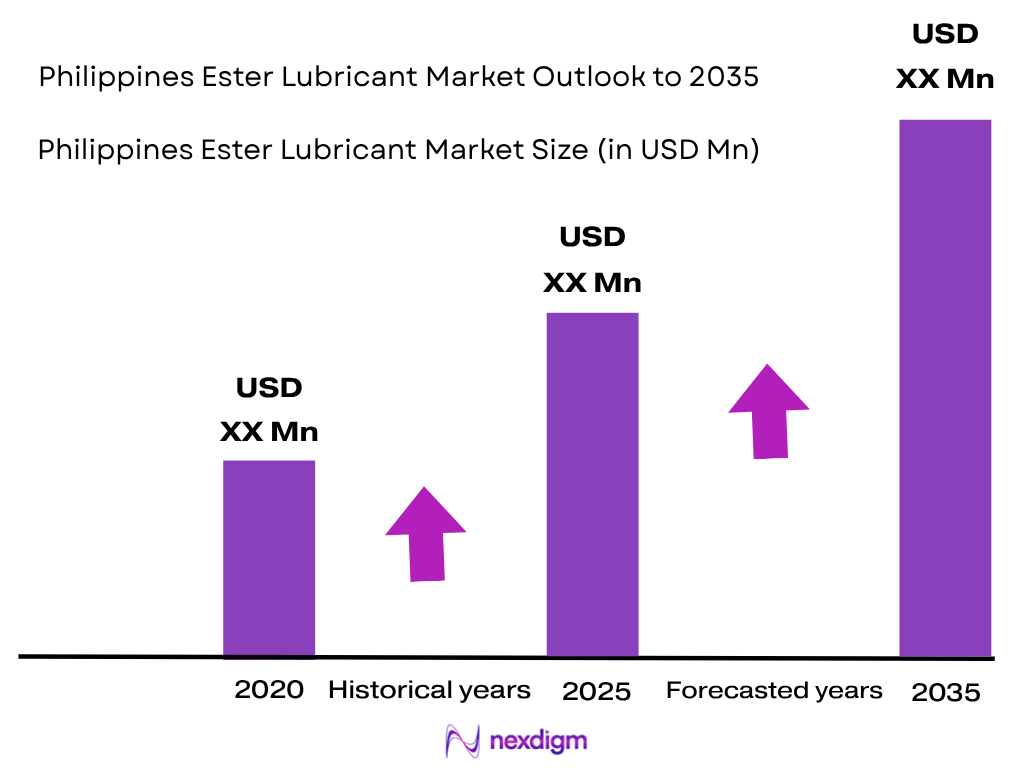
The Philippines Ester Lubricant Market is valued at ~USD XX million in 2024 and is supported by increasing demand for synthetic lubricants across automotive, industrial, marine, and manufacturing applications. The market growth is driven by rising industrial activity, expanding transportation infrastructure, and the requirement for high-performance lubricants offering improved thermal stability, oxidation resistance, and equipment protection. The Philippines recorded GDP of approximately USD 461 billion in 2024, reflecting continued economic activity across manufacturing, construction, logistics, and energy sectors that require advanced lubrication solutions.
The Philippines Ester Lubricant Market is concentrated around major industrial and economic centers, including Metro Manila, Calabarzon, Central Luzon, and Cebu, due to their strong manufacturing presence, automotive activity, port infrastructure, and industrial equipment demand. Metro Manila remains a key commercial hub, while Calabarzon hosts automotive manufacturing facilities and industrial parks. The country’s manufacturing sector contributed significantly to economic activity, with industrial clusters supporting demand for specialty lubricants used in machinery, production equipment, and transportation systems. Coastal regions also contribute through marine and shipping applications.
Market Segmentation
By Ester Type
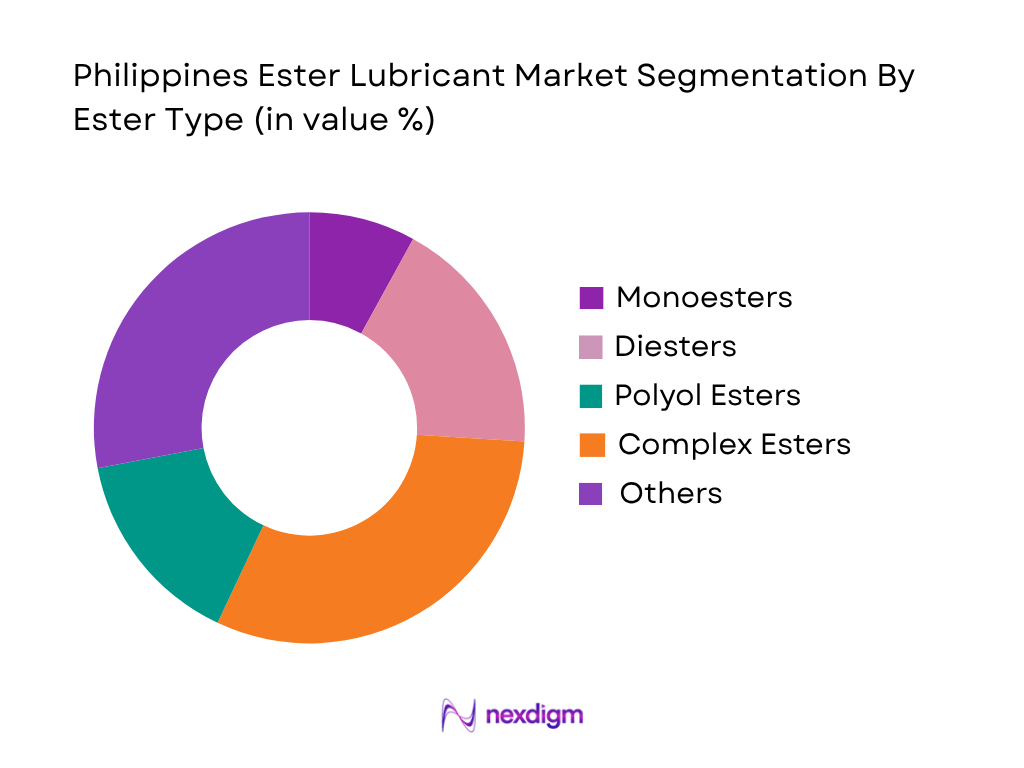
The Philippines Ester Lubricant Market is segmented by ester type into monoesters, diesters, polyol esters, complex esters, trimellitate esters, phosphate esters, neopolyol esters, and other specialty esters. Polyol esters represent the dominant sub-segment due to their superior thermal stability, oxidation resistance, and performance under severe operating conditions. These properties make polyol esters suitable for aerospace, compressors, turbines, refrigeration systems, and industrial machinery requiring extended lubricant life. The increasing adoption of advanced equipment in manufacturing and power generation supports demand for high-performance ester formulations. Diesters maintain significant usage due to their excellent low-temperature properties and solvency characteristics, making them suitable for automotive and industrial applications. Complex esters are increasingly preferred for customized lubricant formulations where specific viscosity, temperature resistance, and additive compatibility requirements exist. The expansion of industrial operations and modernization of machinery continues to support demand for specialized ester chemistries.
By End-Use Industry
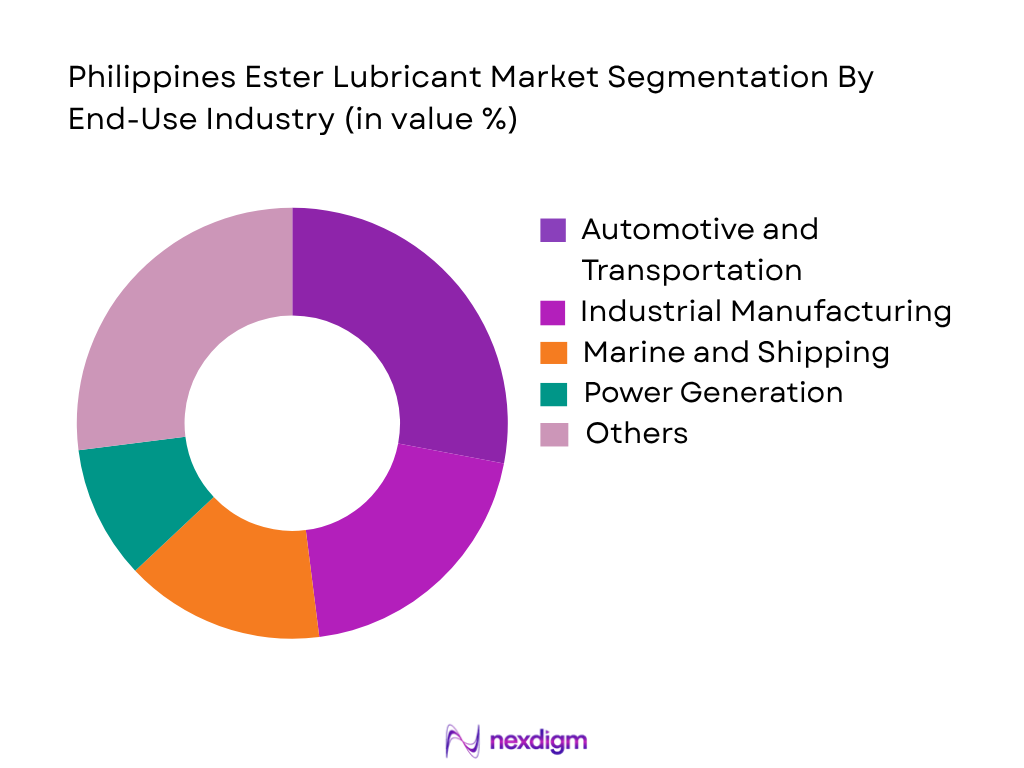
The Philippines Ester Lubricant Market is segmented by end-use industry into automotive and transportation, industrial manufacturing, marine and shipping, power generation, oil and gas, food and beverage processing, chemical manufacturing, mining and construction, aerospace and defense, and metal processing. Automotive and transportation represent the dominant sub-segment due to the country’s expanding vehicle population, logistics activity, and requirement for efficient lubrication solutions. Ester lubricants are increasingly utilized in high-performance automotive applications because they provide improved lubrication efficiency, thermal stability, and reduced volatility compared with conventional lubricants. Industrial manufacturing also represents a major demand area due to the presence of electronics, semiconductor, machinery, and processing industries requiring advanced lubricants for operational reliability. Marine and shipping applications contribute significantly because of the Philippines’ extensive maritime network and dependence on marine transportation. Power generation and construction sectors further support adoption as equipment operators seek lubricants that improve machinery performance and reduce maintenance requirements.
Competitive Landscape
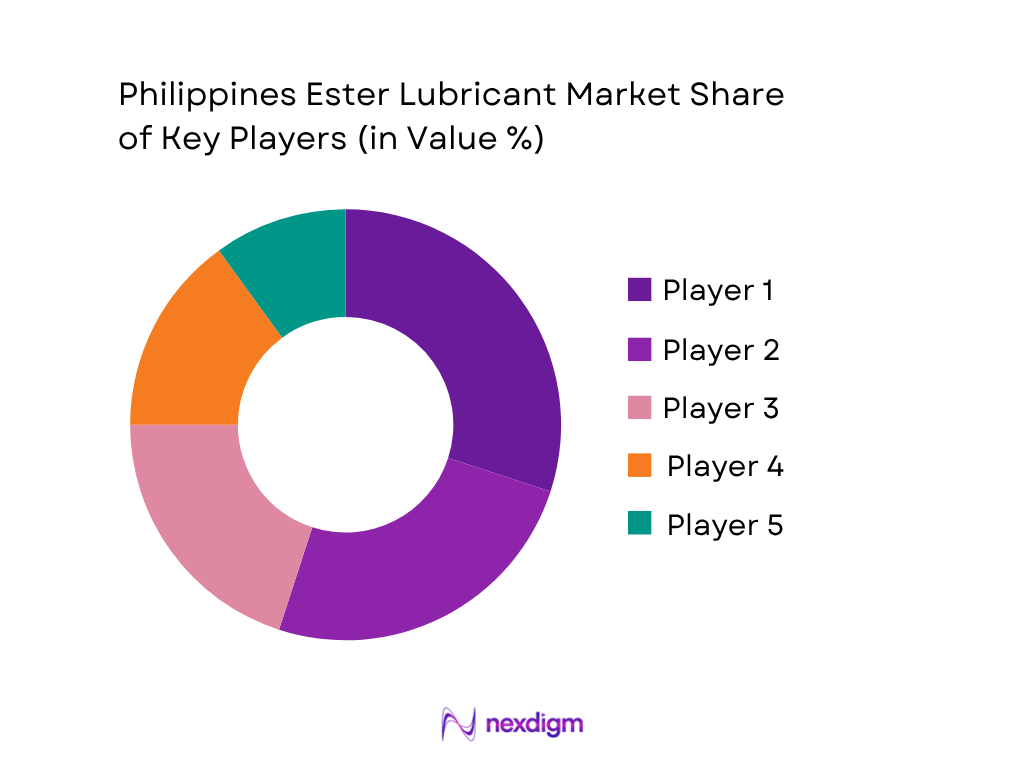
The Philippines Ester Lubricant Market is characterized by the presence of multinational lubricant manufacturers, specialty chemical companies, and regional lubricant suppliers. The competitive environment includes global players with established synthetic lubricant portfolios and local distributors supporting industrial and automotive applications. Companies compete based on ester chemistry capabilities, product performance, application expertise, distribution reach, and technical support services. Major participants focus on expanding specialty lubricant offerings for automotive, industrial machinery, marine, and environmentally acceptable applications.
| Company | Establishment Year | Headquarters | Ester Product Portfolio | Major Applications | Distribution Presence | Technology Capability | Key Market Focus |
| ExxonMobil Corporation | 1999 | USA | ~ | ~ | ~ | ~ | ~ |
| BASF Corporation | 1865 | Germany | ~ | ~ | ~ | ~ | ~ |
| Shell Pilipinas Corporation | 1907 | Philippines/UK | ~ | ~ | ~ | ~ | ~ |
| Petron Corporation | 1973 | Philippines | ~ | ~ | ~ | ~ | ~ |
| Fuchs Lubricants | 1931 | Germany | ~ | ~ | ~ | ~ | ~ |
Philippines Ester Lubricant Market Analysis
Growth Drivers
Increasing Industrial Manufacturing and Machinery Lubrication Requirements
The Philippines Ester Lubricant Market is supported by the expansion of industrial manufacturing activities requiring advanced lubrication solutions for machinery, compressors, hydraulic systems, and production equipment. The country’s manufacturing sector remains a key contributor to industrial demand, supported by electronics, semiconductor assembly, food processing, automotive components, and chemical production industries. The Philippines recorded a GDP of approximately USD 461 billion in 2024, according to the World Bank, reflecting continued economic activity across industrial and commercial sectors. Manufacturing value addition reached around USD 76 billion in 2024, highlighting the scale of equipment-intensive operations requiring reliable lubrication systems. Ester lubricants are increasingly utilized in applications where conventional mineral lubricants face limitations related to thermal degradation, oxidation stability, and equipment efficiency. The Philippine industrial sector also benefits from government-supported manufacturing expansion initiatives, increasing the requirement for high-performance synthetic lubricants. The presence of industrial hubs including Calabarzon, Central Luzon, and Cebu supports demand for specialty lubricants used in machinery maintenance, processing equipment, and automated manufacturing systems. The growing adoption of advanced machinery creates opportunities for ester lubricant suppliers offering improved equipment protection and longer operational performance.
Expansion of Automotive and Transportation Sector Supporting Ester Lubricant Demand
The Philippines Ester Lubricant Market benefits from increasing automotive activity, transportation infrastructure development, and demand for efficient lubrication technologies. The country’s expanding vehicle population and logistics network create significant requirements for engine oils, transmission fluids, gear lubricants, and specialty automotive formulations. According to government transportation data, the Philippines recorded more than 13 million registered motor vehicles in 2024, creating a broad demand base for advanced lubrication products. The country’s economic growth supported transportation activity, with GDP growth recorded at 5.6 billion constant local currency growth in 2024 according to international economic databases. Ester lubricants provide advantages in automotive applications through improved lubricity, oxidation resistance, and temperature performance, particularly in high-performance engines and transmission systems. The development of electric and hybrid vehicle ecosystems also encourages lubricant manufacturers to explore advanced thermal management fluids and specialty formulations. Major urban centers including Metro Manila, Cebu, and Davao continue to generate transportation demand due to commercial mobility, logistics operations, and industrial distribution activities. The increasing focus on vehicle efficiency and maintenance reliability supports the adoption of synthetic ester-based lubricant solutions.
Market Challenges
High Dependence on Imported Raw Materials and Specialty Lubricant Technologies
The Philippines Ester Lubricant Market faces challenges due to dependence on imported ester base stocks, specialty chemical feedstocks, and advanced lubricant technologies. Domestic production of specialty ester chemicals remains limited, requiring suppliers and formulators to rely on international supply chains for raw materials such as fatty acids, polyols, and synthetic intermediates. The Philippines imported more than USD 132 billion worth of goods in 2024, according to national trade statistics, reflecting the country’s significant dependence on imported industrial inputs. Exchange rate fluctuations, shipping disruptions, and international chemical supply conditions can influence availability and procurement stability for specialty lubricant manufacturers. Ester lubricant production requires precise chemical processing capabilities and specialized formulation expertise, limiting the number of domestic producers capable of manufacturing advanced products. Additionally, industries adopting ester lubricants often require technical validation, equipment compatibility testing, and application-specific performance assessments before switching from conventional lubricants. These factors can increase adoption timelines among smaller industrial operators. The requirement for imported technology and specialized knowledge remains a key challenge for wider ester lubricant penetration across Philippine industrial applications.
Higher Product Costs Compared with Conventional Mineral Lubricants
The Philippines Ester Lubricant Market experiences adoption challenges due to the higher production complexity and formulation requirements associated with synthetic ester lubricants compared with conventional mineral-based lubricants. Ester lubricants require advanced chemical synthesis, performance testing, and specialized additive packages to achieve characteristics such as thermal stability, oxidation resistance, and biodegradability. Many small and medium-sized industrial users in the Philippines remain cost-sensitive and prioritize initial lubricant purchase costs over long-term equipment efficiency benefits. According to the Philippine Statistics Authority, the country had more than 1.1 million registered business establishments in 2024, with a large proportion classified as micro, small, and medium enterprises that often operate under tighter capital constraints. Industrial users may require additional technical education regarding lifecycle benefits, reduced maintenance frequency, and improved equipment reliability associated with ester-based formulations. Furthermore, competition from conventional lubricants with established supply networks creates pricing pressure for specialty lubricant suppliers. Increasing awareness of environmental regulations and operational efficiency requirements can support adoption, but cost considerations remain a barrier for broader market acceptance among price-sensitive end users.
Market Opportunities
Growing Adoption of Environmentally Acceptable and Bio-Based Lubricants
The Philippines Ester Lubricant Market presents opportunities through increasing demand for environmentally acceptable lubricant solutions across marine, industrial, and hydraulic applications. Ester lubricants derived from renewable feedstocks offer improved biodegradability and reduced environmental impact compared with conventional petroleum-based products, making them suitable for applications where environmental performance is important. The Philippines has extensive maritime activity, with more than 7,600 islands and a significant dependence on shipping and marine transportation, creating demand for environmentally responsible lubricants in ports, vessels, and offshore operations. The country’s environmental policies increasingly emphasize sustainable industrial practices and pollution reduction, encouraging industries to evaluate cleaner lubricant technologies. The marine sector, construction equipment sector, and industrial hydraulic applications represent potential areas where biodegradable ester formulations can gain adoption. The increasing presence of multinational manufacturing companies operating in Philippine industrial zones also creates demand for globally compliant lubricant solutions. Ester lubricant suppliers can capture future opportunities by developing renewable ester formulations, environmentally acceptable hydraulic fluids, and specialty lubricants designed for industries seeking improved sustainability performance.
Expansion of Advanced Industrial Equipment and Specialty Applications
The Philippines Ester Lubricant Market has opportunities from increasing adoption of advanced machinery requiring high-performance lubrication solutions. Industrial sectors including semiconductor manufacturing, electronics assembly, food processing, power generation, and automated production facilities require lubricants capable of operating under demanding temperature, pressure, and load conditions. The Philippines electronics industry generated approximately USD 40 billion in exports in 2024, according to trade-related government data, demonstrating the scale of precision manufacturing operations requiring reliable equipment performance. Ester lubricants are suitable for specialty applications including compressors, turbines, refrigeration systems, metalworking fluids, and high-temperature machinery due to their strong thermal and oxidation characteristics. Growth in industrial parks located in regions such as Calabarzon and Central Luzon creates additional demand for advanced maintenance products. Power generation capacity expansion and infrastructure development further support the requirement for efficient lubrication systems. Suppliers focusing on customized ester formulations, technical support services, and application-specific solutions can address the needs of industries transitioning toward higher-performance equipment maintenance strategies.
Future Outlook
Over the next decade, the Philippines Ester Lubricant Market is expected to witness steady development driven by industrial modernization, increasing demand for synthetic lubrication technologies, and growing sustainability requirements. Expansion of manufacturing activities, automotive development, marine operations, and advanced machinery adoption will create additional opportunities for ester lubricant suppliers. The transition toward environmentally acceptable lubricants and high-performance formulations will further support market development.
Major Players
- ExxonMobil Corporation
- Shell Pilipinas Corporation
- Chevron Corporation
- BP Castrol
- TotalEnergies Philippines
- Fuchs Lubricants
- Idemitsu Kosan Co., Ltd.
- BASF Corporation
- Croda International Plc
- The Lubrizol Corporation
- LANXESS Corporation
- Emery Oleochemicals
- Afton Chemical Corporation
- Quaker Houghton
- Valvoline Inc.
Key Target Audience
- Ester lubricant manufacturers
- Synthetic lubricant producers
- Automotive OEMs and component manufacturers
- Industrial machinery manufacturers
- Marine and shipping companies
- Chemical and specialty additive suppliers
- Investments and venture capitalist firms
- Government and regulatory bodies (Department of Environment and Natural Resources, Department of Trade and Industry, Department of Energy)
Research Methodology
Step 1: Identification of Key Variables
The initial phase involves developing an ecosystem map covering ester lubricant manufacturers, raw material suppliers, distributors, industrial users, and regulatory stakeholders within the Philippines Ester Lubricant Market. This step includes extensive secondary research to identify critical variables such as product categories, application areas, demand drivers, supply structures, and market dynamics.
Step 2: Market Analysis and Construction
This phase involves analyzing historical market information related to ester lubricant consumption, industrial applications, import dependency, distribution channels, and end-user industries. Demand assessment is conducted across automotive, manufacturing, marine, and industrial sectors to evaluate adoption patterns and market opportunities.
Step 3: Hypothesis Validation and Expert Consultation
Market assumptions are validated through discussions with lubricant manufacturers, distributors, industrial operators, and technical specialists. These consultations provide insights into product requirements, purchasing behavior, competitive positioning, and future technology adoption.
Step 4: Research Synthesis and Final Output
The final stage integrates primary and secondary findings to create a comprehensive assessment of the Philippines Ester Lubricant Market. Data triangulation is performed using industry information, trade data, regulatory developments, and application-level analysis to ensure accuracy.

- Executive Summary
- Research Methodology (Market Definition and Scope, Philippines Ester Lubricant Market Classification, Ester Base Stock Mapping, Ester Chemistry Assessment, Ester Molecular Structure Assessment, Monoester and Diester Evaluation, Polyol Ester Assessment, Complex Ester Assessment, Trimellitate Ester Assessment, Synthetic and Bio-Based Ester Assessment, Viscosity Grade Mapping, Performance Property Assessment, Application-Level Demand Analysis, End-Use Industry Assessment, Lubricant Formulation Mapping, Base Oil Supply Assessment, Domestic Production Assessment, Import and Export Trade Analysis, Raw Material Supply Assessment, Demand-Side Assessment, Supply-Side Assessment, Top-Down Market Sizing, Bottom-Up Market Sizing, Primary Industry Interviews, Data Triangulation, Forecasting Framework, Market Share Validation, Limitations and Future Conclusions)

- Definition and Scope
- Philippines Ester Lubricant Industry Evolution and Development of Synthetic Base Oil Technology, High-Performance Lubricant Formulation, Automotive Lubrication, Marine Lubrication, Industrial Fluid Applications and Bio-Based Lubricant Technologies
- Ester Lubricant Value Chain Analysis
- Ester Lubricant Supply Chain Analysis
- Fatty Acid and Alcohol Feedstock Suppliers, Petrochemical Feedstock Suppliers, Ester Base Stock Manufacturers, Specialty Ester Producers, Lubricant Additive Manufacturers, Lubricant Blenders, Industrial Lubricant Manufacturers, Automotive Lubricant Suppliers, Marine Lubricant Suppliers, Distributors, Industrial OEMs and End-Use Industries
- Ester Lubricant Integration Across Automotive Engine Oils, Transmission Fluids, Gear Lubricants, Hydraulic Fluids, Compressor Oils, Turbine Lubricants, Metalworking Fluids, Greases, Marine Lubricants, Refrigeration Lubricants and Environmentally Acceptable Lubricants

- Growth Drivers (Demand for High-Performance Synthetic Lubricants, Automotive Fleet Expansion, Marine Transportation Growth, Industrial Manufacturing Development, Power Generation Expansion, High-Temperature Lubrication Requirements, Growth of Environmentally Acceptable Lubricants, Industrial Equipment Modernization, Increasing Requirement for Longer Drain Lubricant Solutions)
- Market Challenges (Dependence on Imported Ester Base Stocks, Specialty Ester Feedstock Availability, Higher Cost Compared with Conventional Lubricants, Limited Domestic Ester Manufacturing, Formulation Compatibility Constraints, Low End-User Awareness, Supply Chain Disruptions, Product Qualification Requirements)
- Market Opportunities (Bio-Based Ester Expansion, Sustainable Marine Lubricants, Electric Vehicle Lubrication Applications, Environmentally Acceptable Hydraulic Fluids, High-Temperature Industrial Lubricants, Advanced Metalworking Fluids, Food-Grade Lubricants, Renewable Feedstock-Based Esters, Specialty Automotive Lubricant Applications)
- Market Trends (Shift Toward Synthetic Base Stocks, Bio-Based Lubricant Development, Low-Volatility Ester Formulations, Sustainable Lubricant Adoption, Advanced Industrial Fluids, Specialty Marine Lubricants, High-Performance Automotive Lubricants, Longer Drain Intervals, Ester-Based Hydraulic Fluids, Premium Lubricant Formulations)
- Government Regulations and Standards (Philippine Environmental Management Bureau Requirements, Department of Environment and Natural Resources Regulations, Department of Energy Lubricant Standards, Philippine National Standards for Lubricants, Occupational Safety and Health Standards, Chemical Management Regulations, Marine Environmental Protection Requirements, Industrial Waste Management Standards)
- SWOT Analysis
- Porter’s Five Forces Analysis
- PESTLE Analysis
- Stakeholder Ecosystem
- Competition Ecosystem

- By Market Value (2020-2025)
- By Market Volume (2020-2025)
- By Ester Base Stock Consumption Volume (2020-2025)
- By Synthetic Ester Consumption Volume (2020-2025)
- By Bio-Based Ester Consumption Volume (2020-2025)
- By Monoester Consumption Volume (2020-2025)
- By Diester Consumption Volume (2020-2025)
- By Polyol Ester Consumption Volume (2020-2025)

- By Ester Type (In Value %)
Monoesters
Diesters
Polyol Esters
Complex Esters
Trimellitate Esters
Phosphate Esters
Neopolyol Esters
Other Specialty Esters - By Base Stock Origin (In Value %)
Petrochemical-Based Esters
Oleochemical-Based Esters
Bio-Based Esters
Renewable Feedstock-Based Esters
Blended Ester Base Stocks - By Lubricant Application (In Value %)
Engine Oils
Transmission and Gear Lubricants
Hydraulic Fluids
Compressor Lubricants
Turbine Lubricants
Metalworking Fluids
Greases
Marine Lubricants
Refrigeration Lubricants
Aerospace Lubricants - By End-Use Industry (In Value %)
Automotive and Transportation
Industrial Manufacturing
Marine and Shipping
Power Generation
Oil and Gas
Food and Beverage Processing
Chemical Manufacturing
Mining and Construction
Aerospace and Defense
Metal Processing - By Distribution Channel (In Value %)
Direct Industrial Sales
Automotive Lubricant Distributors
Specialty Chemical Distributors
Industrial Supply Networks
OEM Lubricant Supply Channels
Marine Lubricant Suppliers
Online Industrial Platforms
Retail Lubricant Outlets - By Region (In Value %)
National Capital Region
Central Luzon
Calabarzon
Visayas
Mindanao

- Market Share of Major Players (By Philippines Revenue, Ester Base Stock Sales Volume, Ester Chemistry Portfolio, Production Capacity, Synthetic Ester Portfolio, Bio-Based Ester Portfolio, Automotive Application Exposure, Marine Lubricant Coverage, Industrial Application Coverage, Distribution Network Coverage, Regional Presence, OEM Customer Coverage, Technical Service Capability)
- Cross Comparison Parameters (Ester Lubricant Revenue, Ester Chemistry Portfolio Breadth, Polyol Ester Technology Coverage, Diester and Monoester Capability, Automotive Lubricant Application Coverage, Marine Lubricant Capability, Bio-Based Ester Portfolio Breadth, Philippines Distribution Network Reach)
- SWOT Analysis of Major Players
- Competitive Positioning Matrix
- Ester Base Stock Product Portfolio and Application Benchmarking
- Bio-Based and Renewable Ester Technology Assessment
- Detailed Profiles of Major Companies
ExxonMobil Corporation
BASF Corporation
Croda Inc.
Emery Oleochemicals
LANXESS Corporation
The Lubrizol Corporation
Cargill, Incorporated
Afton Chemical Corporation
Shell Pilipinas Corporation
Petron Corporation
Caltex Philippines
Fuchs Lubricants Philippines
TotalEnergies Marketing Philippines
Castrol Philippines
Idemitsu Philippines Corporation

- Automotive OEM Ester Lubricant Requirement Assessment
- Automotive Service and Maintenance Lubricant Demand Analysis
- Industrial Machinery Lubricant Requirement Analysis
- Power Generation Lubricant Procurement Assessment
- Marine and Shipping Lubricant Requirement Analysis
- Manufacturing Plant Lubricant Consumption Assessment
- Food Processing Lubricant Procurement Assessment
- Chemical Industry Lubricant Requirement Analysis
- Mining Equipment Lubricant Requirement Assessment
- Construction Equipment Lubricant Analysis
- Compressor and Turbine Lubricant Requirement Assessment
- Industrial OEM Ester Lubricant Qualification Assessment

- By Market Value (2026-2035)
- By Market Volume (2026-2035)
- By Ester Base Stock Consumption Volume (2026-2035)
- By Synthetic Ester Consumption Volume (2026-2035)
- By Bio-Based Ester Consumption Volume (2026-2035)
- By Monoester Consumption Volume (2026-2035)
- By Diester Consumption Volume (2026-2035)
- By Polyol Ester Consumption Volume (2026-2035)


 Request a Sample
 Ask for Customization
 Get a Quote
 Enquire Now