
 Download PDF
 Download PDF
Market Overview
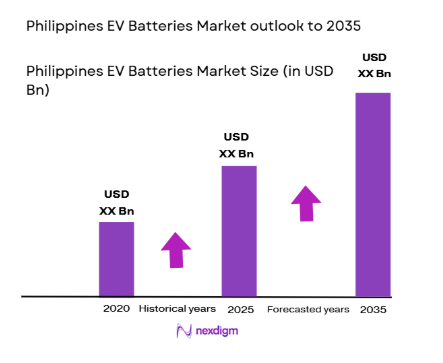
The Philippines EV Batteries market reached approximately USD ~ billion based on a recent historical assessment, driven by rapid electrification in transportation and increasing adoption of electric two-wheelers and public utility vehicles. Government-backed incentives, import duty adjustments, and infrastructure expansion have accelerated demand for lithium-ion batteries. Growth is further supported by rising fuel costs and environmental concerns, encouraging fleet operators and consumers to transition toward electric mobility solutions across urban centers.
Metro Manila, Cebu, and Davao emerge as dominant regions due to high vehicle density, urban congestion, and strong infrastructure readiness supporting EV deployment. These cities benefit from concentrated charging networks, logistics demand, and government pilot programs for electrification. Additionally, proximity to ports and industrial hubs facilitates battery imports and assembly activities, while policy-driven urban transport modernization initiatives further reinforce adoption patterns across these metropolitan areas.
Market Segmentation
By Product Type
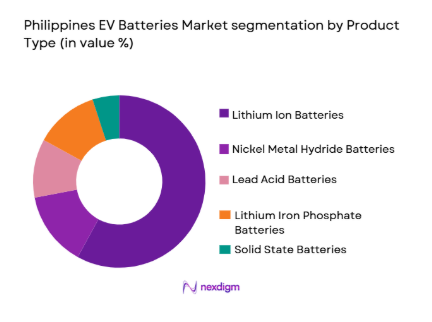
Philippines EV Batteries market is segmented by product type into lithium ion batteries, nickel metal hydride batteries, lead acid batteries, solid state batteries, and lithium iron phosphate batteries. Recently, lithium ion batteries have a dominant market share due to factors such as higher energy density, longer lifecycle, and compatibility with modern EV platforms. Strong global supply chains, declining production costs, and widespread OEM adoption further reinforce their leadership. Additionally, infrastructure for lithium ion battery charging and replacement is more developed, making it the preferred choice among fleet operators and private consumers.
By Vehicle Type
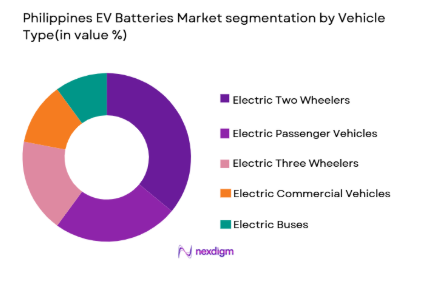
Philippines EV Batteries market is segmented by vehicle type into electric passenger vehicles, electric two wheelers, electric three wheelers, electric buses, and electric commercial vehicles. Recently, electric two wheelers have a dominant market share due to affordability, ease of adoption, and suitability for dense urban environments. Strong demand from delivery services and ride-hailing operators has accelerated adoption. Additionally, lower battery capacity requirements reduce upfront costs, while government incentives targeting small mobility solutions further strengthen their dominance in urban transportation ecosystems.
Competitive Landscape
The Philippines EV Batteries market exhibits moderate consolidation with a mix of global battery manufacturers and regional energy companies competing for market presence. Large multinational players dominate technology and supply chains, while local firms focus on distribution, assembly, and partnerships. Strategic collaborations between automakers and battery suppliers are shaping competitive dynamics, with increasing investments in localized battery ecosystems and aftersales services strengthening long-term positioning.
| Company Name | Establishment Year | Headquarters | Technology Focus | Market Reach | Key Products | Revenue | Battery Chemistry Focus |
| Panasonic Energy | 1918 | Japan | ~ | ~ | ~ | ~ | ~ |
| LG Energy Solution | 2020 | South Korea | ~ | ~ | ~ | ~ | ~ |
| Samsung SDI | 1970 | South Korea | ~ | ~ | ~ | ~ | ~ |
| BYD Energy | 1995 | China | ~ | ~ | ~ | ~ | ~ |
| CATL | 2011 | China | ~ | ~ | ~ | ~ | ~ |
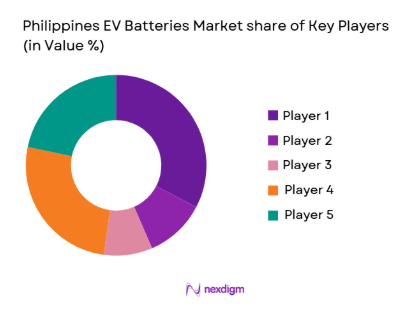
Philippines EV Batteries Market Analysis
Growth Drivers
Rapid Electrification of Public and Commercial Transport Systems
The Philippines EV Batteries market is significantly driven by the electrification of public transportation fleets and commercial vehicles across major cities. Government-led initiatives to modernize jeepneys and buses are encouraging fleet operators to shift toward electric alternatives, creating substantial demand for battery systems. Urban congestion and rising fuel costs are pushing operators to adopt cost-efficient electric mobility solutions that rely heavily on advanced battery technologies. Additionally, logistics and delivery sectors are transitioning toward electric fleets to improve operational efficiency and meet sustainability goals. The integration of electric two-wheelers in last-mile delivery services is further amplifying battery demand. Financial incentives and subsidies are reducing initial investment barriers for fleet operators. Public-private partnerships are accelerating the deployment of charging infrastructure. Growing environmental awareness among operators is influencing procurement decisions toward electric solutions. Continuous advancements in battery performance and durability are enhancing adoption rates across commercial applications.
Declining Battery Costs and Advancements in Lithium Ion Technology
Technological advancements in lithium ion batteries are significantly lowering production costs and improving energy efficiency, driving widespread adoption in the Philippines EV Batteries market. Economies of scale in global battery manufacturing have reduced cost per kilowatt-hour, making EVs more affordable for consumers. Enhanced battery chemistries are improving range and lifespan, addressing key concerns around electric mobility. Increased research and development investments are accelerating innovation in battery safety and performance. The availability of modular battery systems is supporting flexible vehicle integration across segments. Improved charging speeds are reducing downtime and enhancing usability for daily commuters. Battery management systems are optimizing performance and extending lifecycle, increasing consumer confidence. Integration with renewable energy sources is further strengthening the value proposition of EV batteries. These developments collectively contribute to sustained market growth and technological adoption.
Market Challenges
Dependence on Imported Raw Materials and Battery Components
The Philippines EV Batteries market faces significant challenges due to its reliance on imported lithium, cobalt, and other critical battery materials. This dependency exposes the market to supply chain disruptions and price volatility, affecting overall cost structures. Limited domestic mining and processing capabilities restrict local value addition in battery production. Fluctuations in global commodity prices create uncertainty for manufacturers and investors. Import tariffs and logistics costs further increase the final price of battery systems. The absence of a robust domestic supply chain reduces competitiveness against established manufacturing hubs. Currency fluctuations also impact procurement costs for imported components. Lack of long-term supply agreements can lead to inconsistent availability of materials. These factors collectively hinder the development of a stable and cost-efficient battery ecosystem within the country.
Underdeveloped Battery Recycling and Disposal Infrastructure
The absence of a well-established recycling ecosystem poses a major challenge for the Philippines EV Batteries market. Improper disposal of used batteries raises environmental and safety concerns, potentially slowing adoption rates. Limited investment in recycling technologies restricts the ability to recover valuable materials from end-of-life batteries. Regulatory frameworks for battery disposal are still evolving, creating uncertainty for stakeholders. High costs associated with recycling infrastructure development discourage private sector participation. Lack of consumer awareness about battery disposal practices contributes to environmental risks. Inefficient collection systems further complicate recycling processes. The absence of standardized recycling protocols limits scalability. Addressing these challenges is critical for ensuring sustainable growth and environmental compliance in the EV battery sector.
Opportunities
Expansion of Local Battery Assembly and Manufacturing Capabilities
The Philippines EV Batteries market presents strong opportunities for developing local assembly and manufacturing facilities to reduce dependence on imports. Establishing domestic production units can enhance supply chain resilience and reduce costs associated with logistics and tariffs. Government incentives and industrial policies are encouraging investments in local battery ecosystems. Partnerships with global battery manufacturers can facilitate technology transfer and skill development. Local manufacturing can create employment opportunities and stimulate economic growth. Integration with renewable energy initiatives can further strengthen the value chain. Development of industrial clusters dedicated to EV components can enhance operational efficiency. Domestic production can also improve responsiveness to local market demand. These factors collectively position local manufacturing as a key growth opportunity.
Growth of Battery Swapping and Energy-as-a-Service Models
Innovative business models such as battery swapping and energy-as-a-service are creating new growth avenues in the Philippines EV Batteries market. These models reduce upfront costs for consumers by separating battery ownership from vehicle ownership. Rapid battery swapping infrastructure improves convenience and reduces charging downtime. Fleet operators benefit from predictable operational costs and improved efficiency. Integration of digital platforms enables real-time monitoring and management of battery usage. Expansion of swapping networks in urban areas supports widespread adoption of electric two-wheelers and three-wheelers. Partnerships between technology providers and mobility companies are accelerating deployment. These models also facilitate better battery lifecycle management and recycling. Overall, they offer scalable and sustainable solutions for expanding EV adoption.
Future Outlook
The Philippines EV Batteries market is expected to witness steady growth driven by increasing electrification across transport segments and supportive regulatory frameworks. Advancements in battery technology and cost reductions will enhance accessibility and adoption. Expansion of charging and swapping infrastructure will further strengthen market penetration. Government initiatives promoting sustainable mobility and investments in local manufacturing are likely to accelerate industry development. Demand from urban mobility and logistics sectors will remain a key growth driver.
Major Players
- Panasonic Energy Philippines
- LG Energy Solution Philippines
- Samsung SDI Philippines
- BYD Energy Philippines
- CATL Philippines
- Mitsubishi Electric Philippines
- Hitachi Energy Philippines
- Toshiba Energy Systems Philippines
- Amita Technology Philippines
- Bosch Philippines Battery Division
- GS Yuasa Philippines
- EVE Energy Philippines
- Aboitiz Power Battery Solutions
- AC Energy EV Solutions
- Varta Philippines
Key Target Audience
- Electric vehicle manufacturers
- Battery technology providers
- Automotive OEM suppliers
- Logistics and fleet operators
- Ride hailing companies
- Government and regulatory bodies
- Investments and venture capitalist firms
- Energy infrastructure developers
Research Methodology
Step 1: Identification of Key Variables
Key variables such as battery demand, vehicle electrification rates, pricing trends, and supply chain factors are identified. These variables form the foundation for understanding market dynamics and segmentation.
Step 2: Market Analysis and Construction
Data is collected from industry sources and analyzed to construct market size and segmentation. Analytical models are used to ensure consistency and reliability of findings.
Step 3: Hypothesis Validation and Expert Consultation
Initial findings are validated through consultations with industry experts and stakeholders. Feedback is incorporated to refine assumptions and improve accuracy.
Step 4: Research Synthesis and Final Output
All data points are synthesized into a structured report. Insights are finalized to ensure alignment with market realities and strategic relevance.

- Executive Summary
- Research Methodology (Definitions, Scope, Industry Assumptions, Market Sizing Approach, Primary & Secondary Research Framework, Data Collection & Verification Protocol, Analytic Models & Forecast Methodology, Limitations & Research Validity Checks)

- Market Definition and Scope
- Value Chain & Stakeholder Ecosystem
- Regulatory / Certification Landscape
- Sector Dynamics Affecting Demand
- Strategic Initiatives & Infrastructure Growth

- Growth Drivers
Rising adoption of electric mobility solutions across urban centers
Government incentives supporting EV adoption and battery localization
Expansion of charging infrastructure and battery swapping networks
Declining lithium ion battery costs improving affordability
Increasing environmental regulations promoting low emission transport - Market Challenges
High dependency on imported battery materials and components
Limited domestic manufacturing capacity for advanced batteries
Infrastructure gaps in rural and semi urban regions
Battery recycling and disposal ecosystem still underdeveloped
Volatility in raw material prices affecting cost structures - Market Opportunities
Development of local battery assembly and manufacturing plants
Expansion of battery recycling and second life applications
Partnerships between global battery firms and local EV companies - Trends
Shift toward lithium iron phosphate batteries for cost efficiency
Adoption of battery swapping models in urban mobility
Integration of smart battery management systems
Growing focus on sustainable and recyclable battery materials
Emergence of solid state battery research initiatives - Government Regulations & Defense Policy
National policies promoting EV adoption and infrastructure expansion
Import duty adjustments on EV components and battery systems
Standards for battery safety, recycling, and environmental compliance - SWOT Analysis
- Stakeholder and Ecosystem Analysis
- Porter’s Five Forces Analysis
- Competition Intensity and Ecosystem Mapping

- By Market Value, 2020-2025
- By Installed Units, 2020-2025
- By Average System Price, 2020-2025
- By System Complexity Tier, 2020-2025

- By System Type (In Value%)
Lithium Ion Battery Packs
Nickel Metal Hydride Batteries
Solid State Batteries
Lead Acid EV Batteries
Lithium Iron Phosphate Batteries - By Platform Type (In Value%)
Electric Passenger Vehicles
Electric Two Wheelers
Electric Commercial Vehicles
Electric Buses
Electric Three Wheelers - By Fitment Type (In Value%)
OEM Installed Batteries
Aftermarket Replacement Batteries
Swappable Battery Systems
Integrated Battery Modules
Retrofit Battery Systems - By EndUser Segment (In Value%)
Private Vehicle Owners
Commercial Fleet Operators
Public Transportation Authorities
Logistics and Delivery Companies
Ride Sharing Service Providers - By Procurement Channel (In Value%)
Direct OEM Procurement
Government Tender Procurement
Distributor and Dealer Networks
Online Procurement Platforms
Third Party Integrators - By Material / Technology (in Value %)
Nickel Cobalt Aluminum Chemistry
Nickel Manganese Cobalt Chemistry
Lithium Iron Phosphate Chemistry
Solid State Electrolyte Technology
Advanced Thermal Management Systems

- Market structure and competitive positioning
- Market share snapshot of major players
- CrossComparison Parameters (Battery Capacity, Energy Density, Charging Time, Lifecycle Performance, Cost per kWh, Safety Standards, Thermal Management, Supply Chain Integration, Recycling Capability, Technology Type)
- SWOT Analysis of Key Players
- Pricing & Procurement Analysis
- Key Players
Panasonic Energy Philippines Corporation
LG Energy Solution Philippines
Samsung SDI Philippines Inc
BYD Philippines Energy Systems
Contemporary Amperex Technology Philippines
Aboitiz Power Battery Solutions
AC Energy EV Solutions
Mitsubishi Electric Philippines Battery Division
Hitachi Energy Philippines
Toyota Battery Manufacturing Philippines
Amita Technology Philippines
Varta Microbattery Philippines
Bosch Philippines Battery Systems
GS Yuasa Philippines Inc
EVE Energy Philippines Corporation

- Increasing demand from ride hailing and delivery fleets for EV adoption
- Public transportation electrification initiatives driving bulk procurement
- Rising consumer preference for cost efficient and eco friendly vehicles
- Logistics sector transitioning toward electric fleets for operational savings

- Forecast Market Value, 2026-2035
- Forecast Installed Units, 2026-2035
- Price Forecast by System Tier, 2026-2035
- Future Demand by Platform, 2026-2035


 Request a Sample
 Ask for Customization
 Get a Quote
 Enquire Now