
 Download PDF
Market Overview
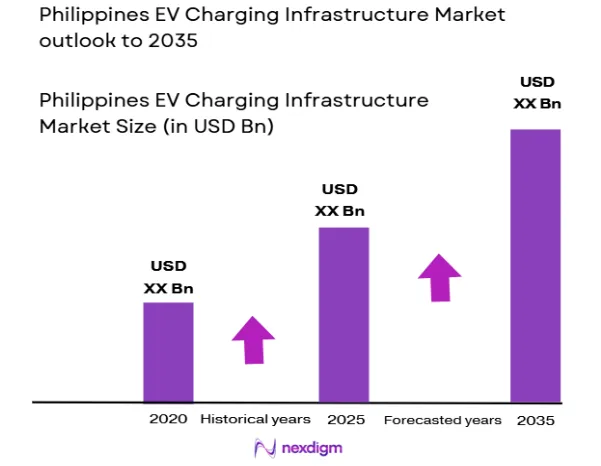
The Philippines EV Charging Infrastructure Market is valued at approximately USD ~ billion based on a recent historical assessment, driven by rapid electrification initiatives, supportive policy frameworks, and increasing adoption of electric vehicles across urban centers. The market expansion is supported by investments from utilities, oil companies, and private developers focusing on public charging networks, fleet electrification, and integration with renewable energy systems, enhancing accessibility and operational efficiency across multiple user segments.
Metro Manila, Cebu, and Davao dominate the Philippines EV Charging Infrastructure Market due to higher vehicle density, advanced grid connectivity, and strong presence of commercial establishments. These cities benefit from government-backed infrastructure programs and private sector investments in charging networks. Additionally, economic activity concentration, logistics demand, and urban mobility initiatives encourage deployment of fast-charging stations, making these regions focal points for infrastructure expansion and technological integration within the national EV ecosystem.
Market Segmentation
By Charger Type
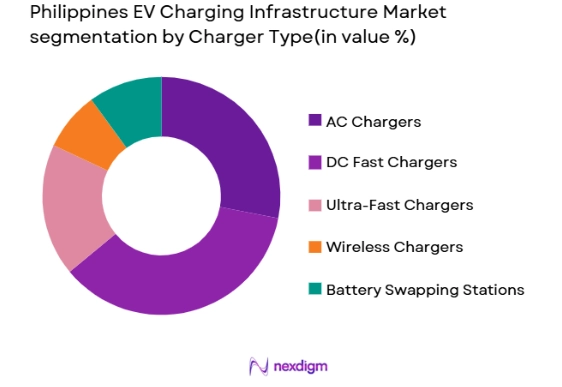
Philippines EV Charging Infrastructure Market is segmented by product type into AC Chargers, DC Fast Chargers, Ultra-Fast Chargers, Wireless Chargers, and Battery Swapping Stations. Recently, DC Fast Chargers has a dominant market share due to factors such as higher charging efficiency, increasing demand from commercial fleets, and growing deployment along highways and urban corridors. Infrastructure providers prioritize DC fast charging to support reduced downtime and improved vehicle turnaround, especially in logistics and public transport segments. Additionally, investments from energy companies and partnerships with automotive OEMs have strengthened the availability of high-capacity charging stations, further reinforcing their leading position.
By Application
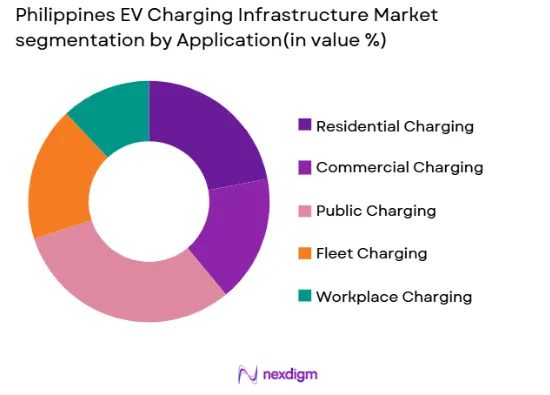
Philippines EV Charging Infrastructure Market is segmented by product type into Residential Charging, Commercial Charging, Public Charging, Fleet Charging, and Workplace Charging. Recently, Public Charging has a dominant market share due to factors such as increasing urban EV adoption, expansion of public infrastructure, and accessibility across key transportation corridors. Public charging networks are strategically deployed in malls, highways, and commercial hubs, ensuring convenience for EV users. Government support for infrastructure development and collaborations with private companies have accelerated installation of public charging stations, making them critical for reducing range anxiety and supporting long-distance travel requirements.
Competitive Landscape
The Philippines EV Charging Infrastructure Market is moderately consolidated, with a mix of domestic energy companies, multinational technology providers, and emerging EV infrastructure startups. Major players leverage strong distribution networks, technological expertise, and partnerships with government agencies to expand their footprint. Strategic collaborations, investments in smart charging technologies, and integration with renewable energy systems are key competitive strategies, enabling companies to strengthen market positioning and capture growing demand.
| Company Name | Establishment Year | Headquarters | Technology Focus | Market Reach | Key Products | Revenue | Charging Network Capacity |
| Meralco PowerGen Corporation | 2013 | Philippines | ~ | ~ | ~ | ~ | ~ |
| Shell Pilipinas Corporation | 1914 | Philippines | ~ | ~ | ~ | ~ | ~ |
| Petron Corporation | 1933 | Philippines | ~ | ~ | ~ | ~ | ~ |
| ABB Ltd | 1988 | Switzerland | ~ | ~ | ~ | ~ | ~ |
| Siemens AG | 1847 | Germany | ~ | ~ | ~ | ~ | ~ |
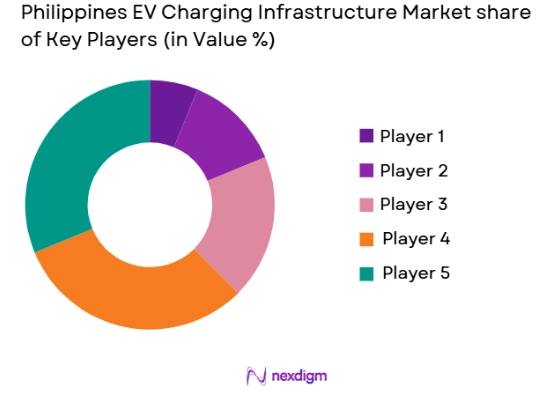
Philippines EV Charging Infrastructure Market Analysis
Growth Drivers
Increasing Electric Vehicle Adoption and Government Incentives
The rapid increase in electric vehicle adoption across the Philippines is a major driver of EV charging infrastructure development, supported by strong government incentives and policy frameworks. National electrification programs and tax incentives for EV purchases are encouraging consumers and businesses to transition toward electric mobility. This shift is generating a parallel demand for reliable and accessible charging infrastructure across urban and semi-urban regions. Automotive manufacturers are also introducing a wider range of EV models, further stimulating infrastructure needs. Government initiatives promoting clean energy and reduced carbon emissions are influencing both private and public investments in charging networks. Additionally, the growing awareness of environmental sustainability among consumers is accelerating EV adoption. Infrastructure developers are responding by expanding charging station installations in strategic locations. The integration of renewable energy with EV charging further strengthens the ecosystem. Public-private partnerships are playing a significant role in scaling infrastructure deployment. As a result, the market continues to expand with strong policy-backed momentum.
Expansion of Smart City Projects and Urban Mobility Solutions
The development of smart city initiatives across the Philippines is significantly driving the demand for EV charging infrastructure. Urban planning strategies increasingly emphasize sustainable transportation systems, including electric mobility solutions. Smart city projects integrate advanced technologies such as IoT-enabled charging stations, real-time monitoring, and digital payment systems. These initiatives enhance efficiency and user convenience, encouraging wider EV adoption. Urban mobility programs are also focusing on electrifying public transportation systems, including buses and taxis, which require dedicated charging infrastructure. The rise of shared mobility services further contributes to infrastructure demand. Investments from both public and private sectors are supporting large-scale deployment of charging stations in metropolitan areas. Additionally, advancements in grid modernization enable efficient energy distribution for charging networks. Infrastructure scalability and integration with renewable sources further strengthen market growth. Overall, smart city developments are creating a favorable environment for sustained infrastructure expansion.
Market Challenges
High Capital Investment and Infrastructure Deployment Costs
The significant capital required for establishing EV charging infrastructure remains a major challenge in the Philippines market. Installation of charging stations involves high costs related to equipment, grid upgrades, land acquisition, and maintenance. Infrastructure developers must invest heavily in advanced technologies such as fast-charging systems and smart grid integration. These costs can limit participation from smaller players and slow down market expansion. Additionally, return on investment may take longer due to relatively lower EV adoption rates in certain regions. Financing challenges further complicate infrastructure deployment. Government subsidies and incentives help mitigate costs but may not fully offset the financial burden. Operational expenses, including electricity costs and maintenance, add to overall expenditure. Infrastructure planning must also consider scalability and future demand, increasing initial investments. As a result, cost barriers remain a critical constraint for widespread infrastructure development.
Limited Grid Capacity and Standardization Issues
The existing power grid infrastructure in the Philippines poses limitations for supporting large-scale EV charging deployment. Many regions experience grid constraints that hinder installation of high-capacity charging stations. Upgrading grid infrastructure requires significant investments and coordination among stakeholders. Additionally, lack of standardized charging protocols creates compatibility issues among different EV models and charging systems. This inconsistency affects user experience and slows adoption rates. Infrastructure providers must address interoperability challenges to ensure seamless operations. Regulatory frameworks for standardization are still evolving, adding uncertainty for investors. Technical challenges related to energy distribution and peak load management further complicate infrastructure deployment. Integration of renewable energy sources requires additional technological advancements. Addressing these issues is essential for enabling efficient and scalable charging infrastructure development across the country.
Opportunities
Development of Fast-Charging Highway Corridors
The expansion of fast-charging corridors along major highways presents a significant opportunity for the Philippines EV charging infrastructure market. Increasing long-distance travel demand among EV users necessitates reliable and accessible charging networks across transportation routes. Infrastructure providers are focusing on deploying high-capacity fast chargers to reduce charging time and improve travel convenience. Government initiatives supporting nationwide EV infrastructure development further enhance opportunities in this segment. Collaboration between energy companies, automotive manufacturers, and infrastructure developers is driving corridor expansion. Strategic placement of charging stations along highways ensures efficient coverage and accessibility. These developments also support logistics and commercial transportation sectors transitioning to electric mobility. Investments in advanced technologies such as ultra-fast chargers enhance operational efficiency. Integration with renewable energy sources further strengthens sustainability. As a result, highway charging corridors are expected to play a crucial role in market expansion.
Integration of Renewable Energy with Charging Infrastructure
The integration of renewable energy sources such as solar and wind with EV charging infrastructure offers substantial growth opportunities in the Philippines market. This approach supports sustainability goals while reducing operational costs associated with electricity consumption. Infrastructure providers are increasingly adopting solar-powered charging stations to enhance energy efficiency. Government policies promoting renewable energy adoption further encourage integration efforts. Hybrid charging systems combining grid and renewable sources ensure reliable power supply. This integration also reduces carbon emissions, aligning with environmental objectives. Technological advancements in energy storage systems enhance the feasibility of renewable-powered charging stations. Investments in green infrastructure attract both public and private sector participation. Additionally, renewable integration improves long-term cost efficiency and resilience. This opportunity is expected to drive innovation and expansion in the EV charging ecosystem.
Future Outlook
The Philippines EV Charging Infrastructure Market is expected to witness steady growth over the next five years driven by increasing EV adoption and infrastructure investments. Technological advancements in fast charging and smart systems will enhance efficiency and accessibility. Government support through policies and incentives will continue to accelerate deployment. Integration with renewable energy and smart grid systems will strengthen sustainability. Rising demand from urban mobility and logistics sectors will further support market expansion.
Major Players
- Meralco PowerGen Corporation
- Shell Pilipinas Corporation
- Petron Corporation
- AC Energy Corporation
- ABB Ltd
- Siemens AG
- Schneider Electric
- Delta Electronics
- ChargePoint
- EVRO Philippines
- TotalEnergies
- First Gen Corporation
- SMC Global Power Holdings
- Enel X
- Tesla Inc
Key Target Audience
- Automotive manufacturers
- Energy and utility companies
- Infrastructure developers
- Fleet operators
- Real estate developers
- Oil and gas companies
- Investments and venture capitalist firms
- Government and regulatory bodies
Research Methodology
Step 1: Identification of Key Variables
The research begins with identifying critical variables influencing the market, including demand drivers, infrastructure deployment patterns, regulatory policies, and technological advancements impacting EV charging systems.
Step 2: Market Analysis and Construction
Data is analyzed using primary and secondary research sources to construct market models, evaluate segmentation, and assess competitive positioning across various infrastructure segments.
Step 3: Hypothesis Validation and Expert Consultation
Industry experts, stakeholders, and professionals validate assumptions and findings to ensure accuracy and reliability of the data and insights derived during the research process.
Step 4: Research Synthesis and Final Output
All validated data is synthesized into structured insights, providing a comprehensive view of market trends, growth opportunities, and strategic recommendations.

- Executive Summary
- Research Methodology (Definitions, Scope, Industry Assumptions, Market Sizing Approach, Primary & Secondary Research Framework, Data Collection & Verification Protocol, Analytic Models & Forecast Methodology, Limitations & Research Validity Checks)

- Market Definition and Scope
- Value Chain & Stakeholder Ecosystem
- Regulatory / Certification Landscape
- Sector Dynamics Affecting Demand
- Strategic Initiatives & Infrastructure Growth

- Growth Drivers
Rising electric vehicle adoption supported by government incentives
Expansion of urban mobility and smart city initiatives
Increasing investments from utilities and private sector players
Growing demand for sustainable transportation infrastructure
Integration of renewable energy with EV charging networks - Market Challenges
High initial infrastructure deployment costs
Limited grid capacity in rural and semi-urban areas
Lack of standardized charging protocols
Slow adoption due to range anxiety among consumers
Regulatory uncertainties and permitting delays - Market Opportunities
Expansion of fast-charging corridors across major highways
Public-private partnerships for nationwide charging networks
Integration of solar-powered EV charging stations - Trends
Shift toward ultra-fast and high-capacity charging systems
Increasing deployment of smart and connected charging infrastructure
Growth in battery swapping solutions for commercial fleets
Rising adoption of mobile app-based charging platforms
Integration of EV charging with renewable energy sources - Government Regulations & Defense Policy
Implementation of national EV roadmap and infrastructure guidelines
Incentives for EV infrastructure investments and tax benefits
Standards development for interoperability and safety compliance - SWOT Analysis
- Stakeholder and Ecosystem Analysis
- Porter’s Five Forces Analysis
- Competition Intensity and Ecosystem Mapping

- By Market Value, 2020-2025
- By Installed Units, 2020-2025
- By Average System Price, 2020-2025
- By System Complexity Tier, 2020-2025

- By System Type (In Value%)
AC Charging Stations
DC Fast Charging Stations
Ultra-Fast Charging Stations
Wireless Charging Systems
Battery Swapping Stations - By Platform Type (In Value%)
Public Charging Networks
Private Residential Charging
Commercial Fleet Charging
Highway Corridor Charging
Workplace Charging Solutions - By Fitment Type (In Value%)
Standalone Chargers
Wall-mounted Chargers
Integrated Charging Systems
Portable Charging Units
Smart Networked Chargers - By EndUser Segment (In Value%)
Passenger Vehicle Owners
Commercial Fleet Operators
Public Transport Operators
Real Estate Developers
Government and Municipal Bodies - By Procurement Channel (In Value%)
Direct OEM Supply
Government Tenders
Private Infrastructure Developers
Utility Partnerships
Third-party Distributors - By Material / Technology (in Value %)
Lithium-ion Battery Integration Systems
Solid-state Charging Modules
Smart Grid Integration Technology
IoT-enabled Charging Systems
Renewable Energy Integrated Chargers

- Market structure and competitive positioning
- Market share snapshot of major players
- Cross Comparison Parameters (Charging Speed, Network Coverage, Technology Integration, Pricing Models, Installation Cost, Energy Efficiency, Smart Features, Scalability, Service Support, Grid Compatibility)
- SWOT Analysis of Key Players
- Pricing & Procurement Analysis
- Key Players
Meralco PowerGen Corporation
Shell Pilipinas Corporation
Petron Corporation
AC Energy Corporation
ABB Philippines
Siemens Philippines
Schneider Electric Philippines
Delta Electronics Philippines
ChargePoint Philippines
EVRO Philippines
Cleanfuel Infrastructure Services
First Gen Corporation
Leighton Asia Philippines
TotalEnergies Philippines
SMC Global Power Holdings

- Passenger vehicle users increasingly demand accessible urban charging solutions
- Fleet operators prioritize fast charging for operational efficiency
- Real estate developers integrate EV charging as a value-added amenity
- Government agencies focus on electrification of public transport systems

- Forecast Market Value, 2026-2035
- Forecast Installed Units, 2026-2035
- Price Forecast by System Tier, 2026-2035
- Future Demand by Platform, 2026-2035


 Request a Sample
 Ask for Customization
 Get a Quote
 Enquire Now