
 Download PDF
Market Overview
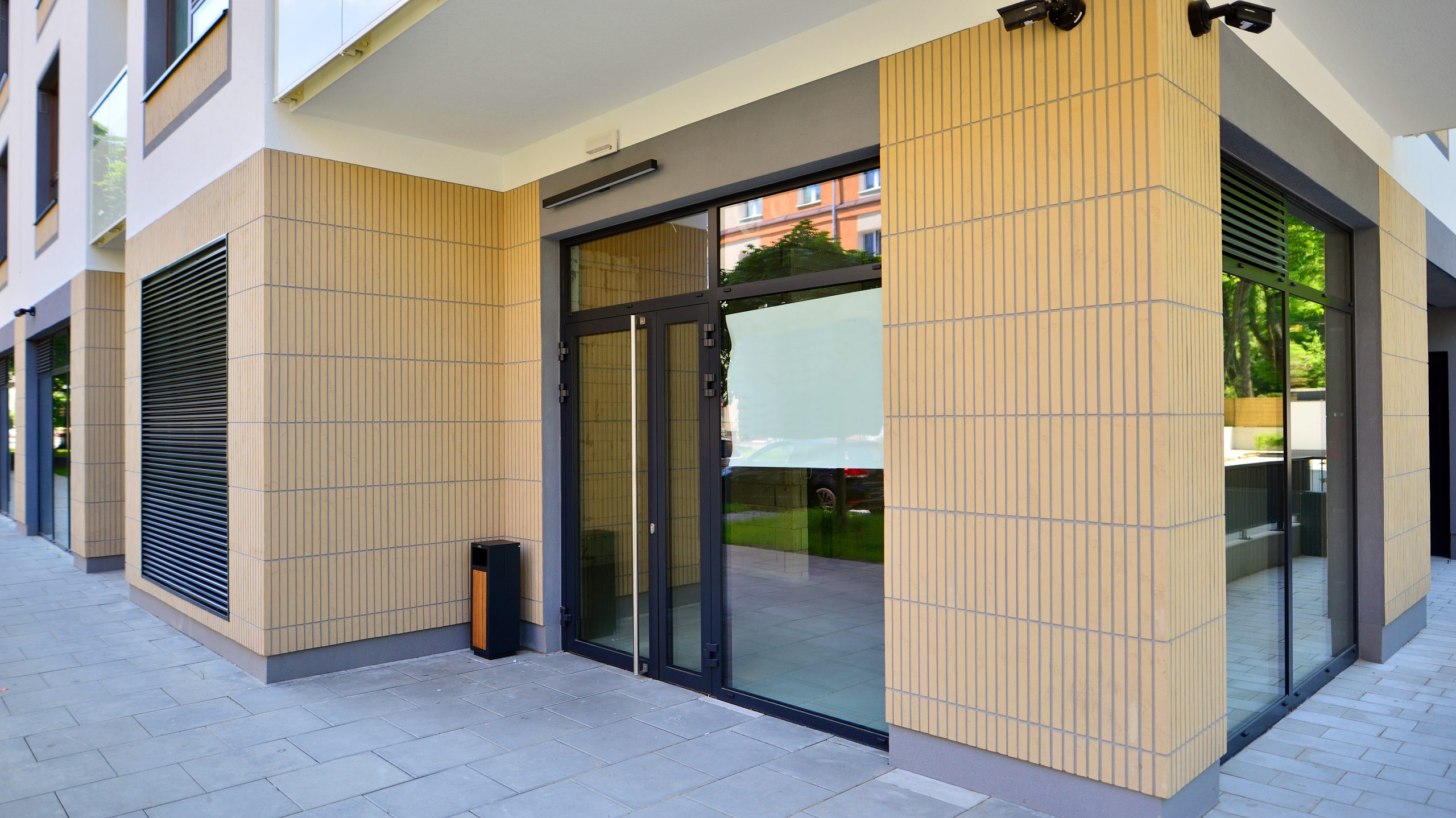
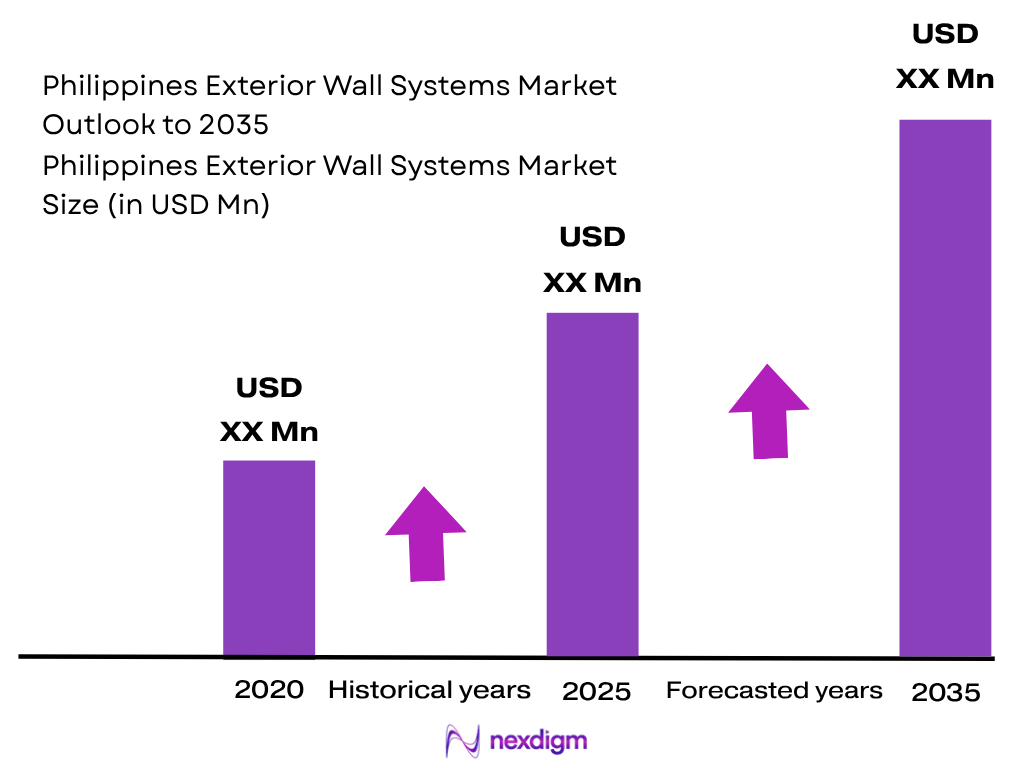
The Philippines Exterior Wall Systems Market is valued at approximately USD ~ billion in 2024, with the figure retained as a placeholder as requested. The underlying construction base expanded from 166,972 private building constructions and 41.47 million square meters of floor area in 2023 to 175,356 constructions and 42.84 million square meters in 2024. Residential construction alone accounted for 19.75 million square meters, sustaining demand for masonry walls, glazing, fiber-cement boards, precast systems and exterior cladding. PSA OpenSTAT
CALABARZON, Metro Manila/National Capital Region, Central Luzon and Central Visayas form the principal demand centers for Philippines exterior wall systems. CALABARZON recorded 41,471 construction projects, Central Luzon 22,824, and Central Visayas 19,585 in the latest full-year construction statistics. Metro Manila remains particularly important for high-rise curtain walls, architectural glazing and engineered façades, while CALABARZON and Central Luzon combine residential development with industrial, logistics and manufacturing facilities requiring masonry, metal cladding and insulated envelope systems.
Market Segmentation
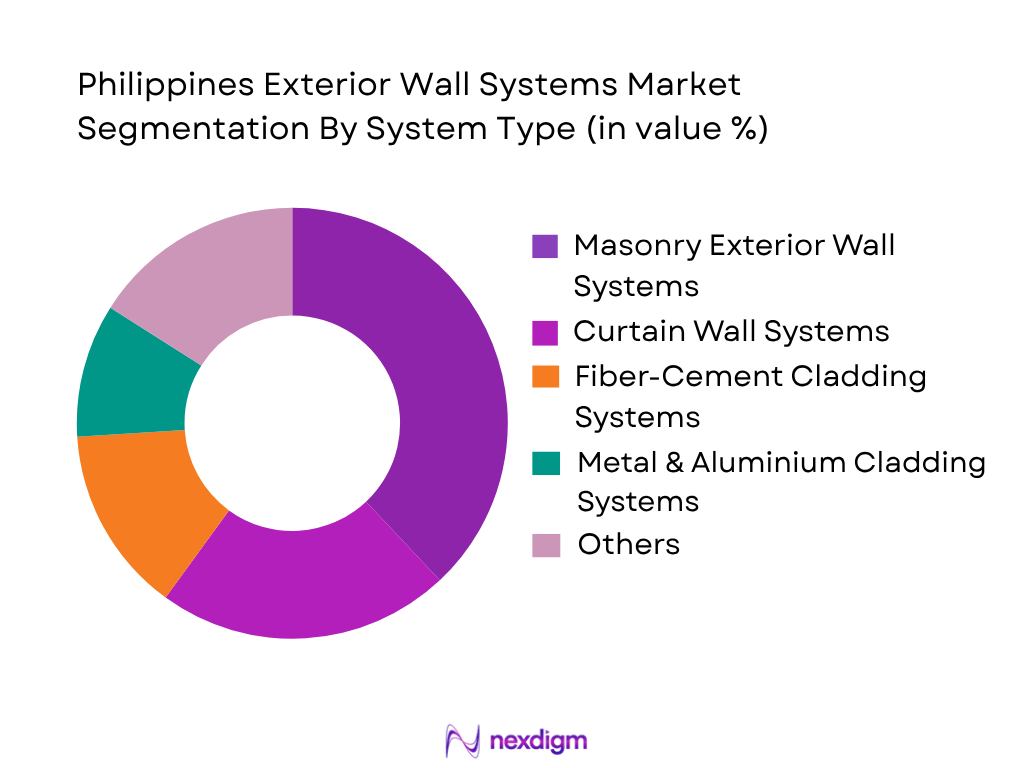
By System Type
The Philippines Exterior Wall Systems Market is segmented by system type into masonry exterior walls, curtain wall systems, fiber-cement cladding, metal and aluminium cladding, precast concrete exterior walls, insulated wall panels and rainscreen or ventilated façades. Masonry exterior wall systems are assigned the dominant 2024 share of ~38% in the placeholder segmentation. Their position reflects the prevalence of reinforced-concrete-frame construction combined with concrete hollow-block or masonry infill across residential and conventional commercial construction. Curtain walls have stronger relevance in Metro Manila’s office towers, condominiums, hotels and mixed-use projects because these developments place greater emphasis on architectural glazing and modern building envelopes. Fiber-cement systems are also strategically important because lightweight, moisture-resistant materials suit the Philippines’ humid and high-rainfall environment. Insulated and metal wall panels have greater relevance in manufacturing, warehousing and logistics buildings, where installation speed, large wall coverage and thermal performance influence system specification. These shares are analytical placeholders rather than published official statistics.
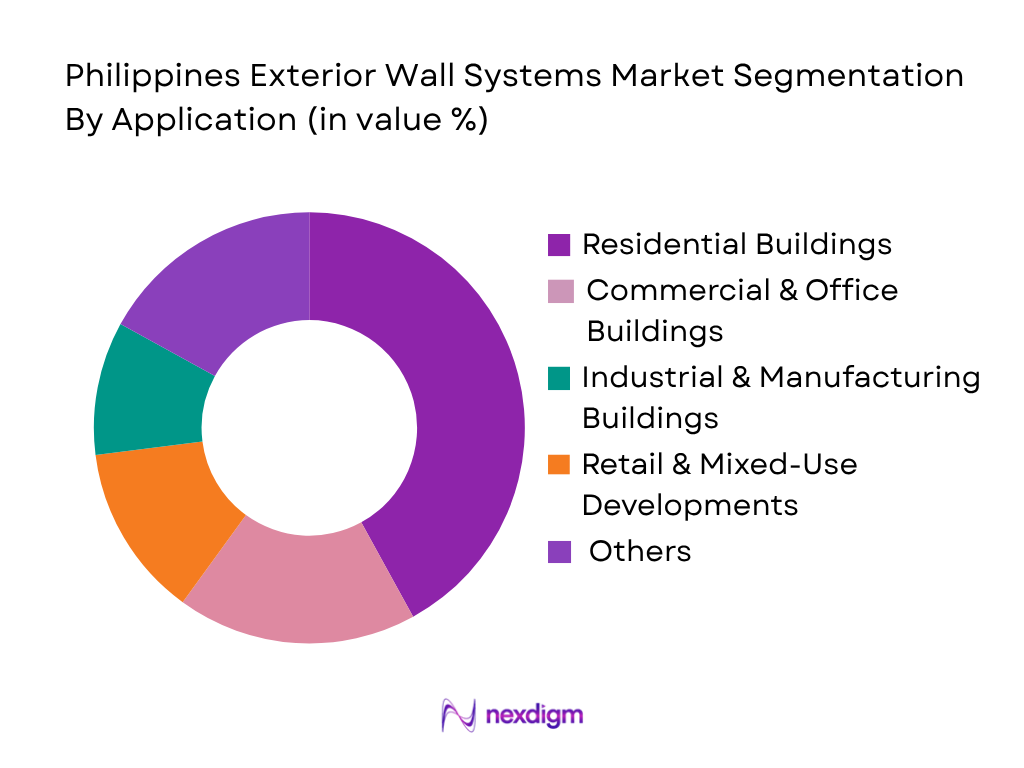
By Application
The Philippines Exterior Wall Systems Market is segmented by application into residential buildings, commercial and office buildings, industrial and manufacturing buildings, retail and mixed-use developments, hospitality buildings, logistics and warehousing facilities, and institutional and infrastructure buildings. Residential buildings are assigned the dominant share at ~42% in the placeholder 2024 segmentation, reflecting the country’s extensive housing construction and continuing condominium and residential development. The official construction dataset shows residential construction reached 116,427 projects covering 19.75 million square meters, illustrating the large addressable building-envelope base. Commercial buildings create comparatively specification-intensive demand for curtain walls, aluminium framing, structural glazing and architectural cladding. Industrial and logistics projects increasingly require metal wall systems, insulated panels and prefabricated envelope solutions because large building footprints favor rapid installation. Hospitality and mixed-use developments create opportunities for premium façade materials, while institutional applications emphasize durability, fire performance and weather resistance.
Competitive Landscape
The Philippines Exterior Wall Systems Market combines domestic façade fabricators and contractors with international building-material, glass, cement-board, fastening and envelope-technology suppliers. Competition differs substantially by project category: high-rise projects require façade engineering, curtain-wall fabrication and glazing capabilities, whereas residential, industrial and logistics projects create stronger demand for cementitious boards, masonry, lightweight wall systems, fastening solutions and prefabricated envelopes. Supplier qualification increasingly depends on weather resistance, structural performance, installation capabilities, technical support and compliance with building and fire requirements.
| Company | Established | Headquarters | Key Exterior-Wall Offering | Core Material/Technology | Target Buildings | Technical Capability | Local Market Route | Key Strength |
| AGC | 1907 | Tokyo, Japan | ~ | ~ | ~ | ~ | ~ | ~ |
| James Hardie | 1888 | Dublin, Ireland | ~ | ~ | ~ | ~ | ~ | ~ |
| Knauf Philippines | 1932* | Iphofen, Germany* | ~ | ~ | ~ | ~ | ~ | ~ |
| Saint-Gobain | 1665 | Courbevoie, France | ~ | ~ | ~ | ~ | ~ | ~ |
| Hilti Philippines | 1941 | Schaan, Liechtenstein | ~ | ~ | ~ | ~ | ~ | ~ |
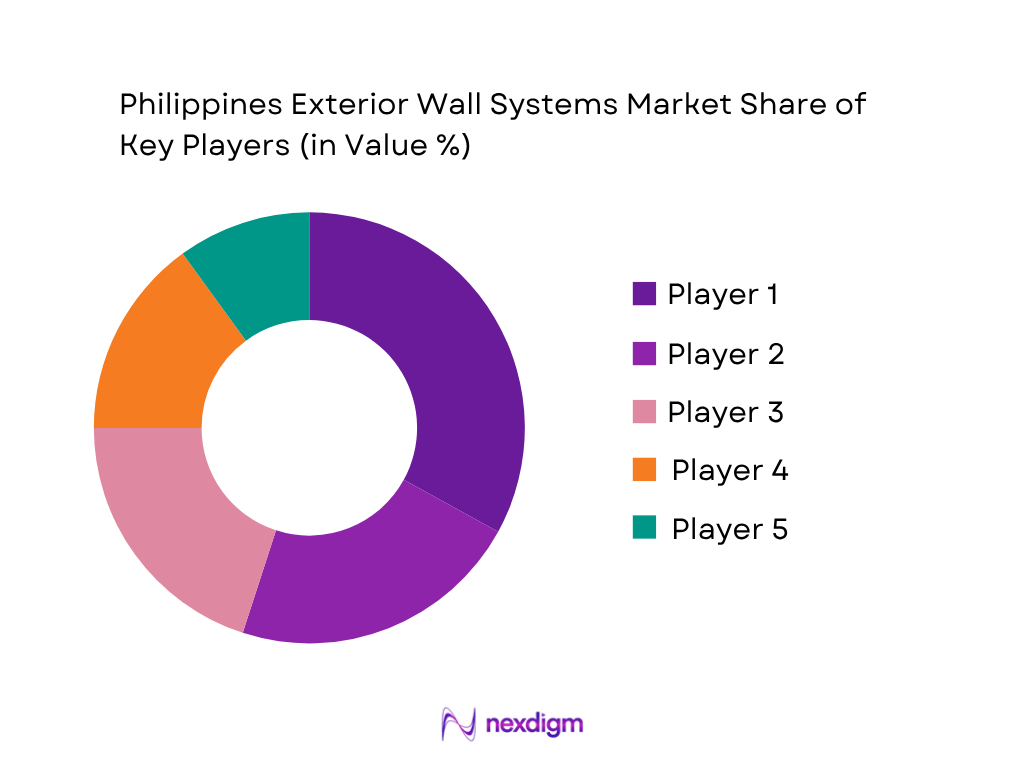
Philippines Exterior Wall Systems Market Analysis
Growth Drivers
Expanding Building Construction and Residential Floor-Area Pipeline
The Philippines Exterior Wall Systems Market is being supported by a large construction pipeline that directly expands the addressable area for masonry façades, curtain walls, fiber-cement boards, architectural glazing, aluminium cladding and other exterior-envelope solutions. Philippine Statistics Authority data show 180,341 approved constructions in 2024, compared with 171,268 in 2023, while associated floor area reached 42,837,581 square meters. Residential construction accounted for 116,427 projects and 19,748,190 square meters, creating a substantial installation base for exterior walls in houses, condominiums, apartments and residential developments. Non-residential projects added another 39,238 constructions covering 22,380,982 square meters, supporting demand for engineered façade systems across offices, factories, retail buildings, hotels and institutional properties. The Philippine population also reached 112.73 million people in 2024, including 16.93 million in CALABARZON, 14.00 million in NCR and 12.99 million in Central Luzon, reinforcing building-envelope demand around the country’s largest metropolitan and development corridors. These construction and demographic fundamentals support continued specification of durable, weather-resistant exterior wall assemblies.
Government Infrastructure Expenditure Supporting the Construction Ecosystem
Public-sector expenditure is strengthening the broader construction ecosystem that supports the Philippines Exterior Wall Systems Market, particularly through transportation facilities, institutional buildings, urban redevelopment and associated private property development. Department of Budget and Management records show National Government disbursements reached PHP 5,925.4 billion in 2024, an increase of PHP 589.2 billion from PHP 5,336.2 billion in 2023. The expenditure environment included higher infrastructure and other capital outlays, sustaining activity across contractors, engineering firms and building-material supply chains. The connection to exterior wall systems is particularly relevant where transport infrastructure, government buildings and adjoining commercial development require architectural glass, metal façades, masonry, precast walls and high-durability cladding. Philippine Statistics Authority construction records reinforce this demand environment, showing 42,837,581 square meters of permitted construction floor area across 180,341 projects during 2024. Furthermore, the construction industry employed 296,144 workers, including 103,894 workers specifically engaged in construction of buildings. This combination of government expenditure, project activity and established construction labor capacity supports façade installation and building-envelope procurement throughout the country.
Market Challenges
High Exposure to Construction Cyclicality and Uneven Project Execution
The Philippines Exterior Wall Systems Market remains exposed to fluctuations in project commencement and construction execution because façade materials are typically procured after structural work progresses. This vulnerability was visible within 2024 monthly construction statistics. Philippine Statistics Authority data show that December recorded only 10,809 approved constructions covering 2,626,755 square meters, compared with 13,534 projects covering 3,712,401 square meters in November. December residential construction represented 6,728 projects and 1,149,423 square meters, while non-residential activity totaled 2,589 projects and 1,441,969 square meters. July similarly demonstrated volatility, with 14,343 projects covering 3,062,216 square meters, including 1,566,767 square meters of non-residential construction. Such month-to-month variation affects production scheduling and inventory requirements for architectural glass, aluminium profiles, fiber-cement boards, insulation, sealants and façade accessories. The challenge is particularly important for engineered curtain-wall and unitized-façade suppliers because manufacturing, fabrication and installation must correspond closely with construction milestones. Suppliers therefore require flexible production planning, geographically distributed inventories and strong contractor coordination to manage irregular project timing without accumulating excessive material inventories or creating installation bottlenecks.
Geographic Concentration Creates Complex Nationwide Distribution Requirements
Exterior-wall demand in the Philippines is geographically concentrated around several major economic and construction corridors, creating logistics and distribution challenges for manufacturers and façade contractors serving the wider archipelago. Philippine Statistics Authority data show that the National Capital Region contained 935 construction establishments in 2024, compared with 372 in CALABARZON and 229 in Central Luzon. NCR construction establishments employed 155,266 workers, while CALABARZON employed 32,271 and Central Visayas 22,881. This concentration corresponds with major demand for curtain walls, architectural glass, aluminium systems, masonry products and engineered cladding, but suppliers must simultaneously serve projects across numerous islands and secondary cities. The challenge becomes particularly significant for large-format glass, aluminium framing, prefabricated façade panels and insulation systems that require controlled handling and coordinated transportation. National construction activity encompassed 180,341 approved projects and 42,837,581 square meters of floor area in 2024, meaning suppliers cannot depend solely on Metro Manila. Building-envelope companies therefore need regional warehousing, distributor relationships, fabrication capabilities and contractor networks capable of supporting projects across Luzon, Visayas and Mindanao while maintaining consistent technical and installation standards.
Market Opportunities
Industrial and Economic-Zone Expansion Supporting Engineered Wall Systems
Industrial expansion provides a substantial future opportunity for the Philippines Exterior Wall Systems Market because manufacturing facilities, warehouses, logistics properties and economic-zone buildings require large exterior surfaces suited to metal cladding, insulated panels, precast systems and lightweight envelope solutions. Philippine Economic Zone Authority records show 255 new and expansion projects were approved in 2024, involving PHP 214.176 billion in investment commitments. Manufacturing accounted for PHP 149.3 billion of approved investment activity, directly strengthening the development pipeline for production facilities and supporting buildings. PEZA economic zones generated USD 58.7 billion in actual locator exports and supported approximately 1.7 million direct jobs, demonstrating the physical scale of the industrial ecosystem requiring factories, warehouses and auxiliary facilities. The agency also reported 17 additional economic zones with associated investments of PHP 6.65 billion, spanning NCR, Central Luzon, CALABARZON, Western Visayas, Central Visayas and SOCCSKSARGEN. For exterior-wall suppliers, this industrial footprint creates opportunities for insulated metal panels, coated-steel walls, fiber-cement systems, weather-resistant façades and prefabricated building envelopes designed for rapid construction, large installation areas and demanding operating environments.
Building Renovation and Exterior-Envelope Upgrade Opportunity
Renovation represents an increasingly relevant opportunity for the Philippines Exterior Wall Systems Market because the addressable market extends beyond new construction into façade rehabilitation, additions, weatherproofing, recladding and building-envelope upgrades. Philippine Statistics Authority data show 13,997 alteration and repair projects in 2024, while approved additions numbered another 5,694 projects covering 708,409 square meters. This creates an established project base for replacement glazing, fiber-cement cladding, façade coatings, waterproofing layers, sealants, aluminium components and other exterior-envelope materials. The opportunity is strengthened by the scale of the existing construction sector: 2,515 formal construction establishments operated nationally in 2024 and employed 296,144 workers, while building-construction activities alone employed 103,894 workers. Construction establishments generated PHP 713.19 billion in revenue, with building construction contributing PHP 240.84 billion, illustrating substantial contractor capacity capable of undertaking façade rehabilitation alongside new projects. For suppliers, the renovation channel can expand demand beyond major new developments into commercial buildings, residential properties, hotels and institutional facilities requiring improved moisture protection, façade durability, structural rehabilitation and replacement of aging exterior components.
Future Outlook
The Philippines Exterior Wall Systems Market is expected to expand at a placeholder CAGR of ~% during 2026-2035. Growth is expected to be supported by continuing residential construction, high-rise condominium development, industrial expansion, logistics facilities, commercial redevelopment and infrastructure investment. Building-envelope specifications are also likely to place greater emphasis on typhoon resistance, water tightness, thermal performance, corrosion resistance and fire safety.
Curtain-wall and architectural-glass demand should remain concentrated in high-rise commercial, condominium, hospitality and mixed-use developments, particularly around Metro Manila. At the same time, industrial corridors in CALABARZON and Central Luzon should create opportunities for insulated panels, metal cladding and prefabricated wall assemblies. Lightweight exterior systems are positioned to benefit where contractors seek faster installation and lower structural loading.
Major Players
- Fasclad Inc.
- Loxon Wandset Incorporated
- Jangho Curtainwall Philippines Inc.
- Knauf Gypsum Philippines Inc.
- James Hardie Philippines
- LOTTE EcoWall Philippines Inc.
- Lakshmi BEMT Inc.
- SEAPAC Philippines Inc.
- Dalkia Incorporated
- JL Aluglass Contractor Inc.
- 3A Composites / ALUCOBOND
- Saint-Gobain / Weber
- Alucobond Philippines Inc.
- Multiple Options Incorporated
- CCSUI / façade-system operations
Key Target Audience
- Exterior Wall System Manufacturers and Suppliers
- Façade, Curtain Wall and Architectural Glazing Contractors
- Real Estate Developers and Property Development Groups
- Main Construction Contractors and EPC Companies
- Building Material Manufacturers and Distributors
- Industrial, Logistics and Commercial Property Developers
- Investments and Venture Capitalist Firms
- Government and Regulatory Bodies (Department of Public Works and Highways, Department of Energy, Department of Human Settlements and Urban Development, Bureau of Fire Protection, Philippine Economic Zone Authority)
Research Methodology
Step 1: Identification of Key Variables
The initial phase develops an ecosystem map covering exterior wall manufacturers, façade contractors, glass processors, aluminium fabricators, fiber-cement suppliers, developers, architects and construction contractors. Variables include installed façade area, building type, wall-system adoption, construction floor area, material penetration, project pipeline, building height and regional construction activity.
Step 2: Market Analysis and Construction
Historical construction and building-permit information is analyzed alongside residential, commercial, industrial and institutional project activity. Top-down analysis assesses national construction indicators, while bottom-up analysis evaluates wall-system requirements by building category, façade area, system type and major project activity to construct the Philippines Exterior Wall Systems Market framework.
Step 3: Hypothesis Validation and Expert Consultation
Market hypotheses are validated through CATIs and structured discussions with façade contractors, building-material suppliers, fabricators, developers and project professionals. Interviews assess system preferences, procurement practices, material substitution, curtain-wall adoption, fiber-cement usage, technical specifications, installation constraints and regional demand differences.
Step 4: Research Synthesis and Final Output
Findings from primary and secondary research are triangulated across system types, materials, applications and regions. Particular attention is given to residential construction, Metro Manila high-rise projects, CALABARZON and Central Luzon industrial development, façade engineering requirements and climate-related specifications before finalizing historical analysis and the forecast framework.

- Executive Summary
- Research Methodology (Market Definitions and Assumptions, Philippines Exterior Wall Systems Market Classification, Building-Envelope Scope, Facade System Mapping, Curtain Wall Assessment, Structural Glazing Assessment, Cladding System Assessment, Masonry Exterior Wall Assessment, Insulated Wall System Assessment, Fiber-Cement Facade Assessment, Rainscreen Facade Assessment, Ventilated Facade Assessment, Aluminium Profile Assessment, Architectural Glass Assessment, ACP and Metal Composite Panel Assessment, Precast Concrete Wall Assessment, GRC and GFRC Facade Assessment, Thermal Performance Assessment, Typhoon and Wind-Load Assessment, Water-Tightness Assessment, Fire Performance Assessment, Corrosion Resistance Assessment, Supply-Side Assessment, Demand-Side Assessment, Top-Down Market Sizing, Bottom-Up Market Sizing, Primary Industry Interviews, Construction Project Pipeline Assessment, Data Triangulation, Forecasting Framework)

- Definition and Scope
- Philippines Building-Envelope Industry Evolution and Development of Masonry Exterior Walls, Curtain Wall Systems, Structural Glazing, Unitized Facades, Stick Curtain Walls, Aluminium Cladding, Fiber-Cement Cladding, ACP Cladding, Precast Concrete Walls, Glass Facades, GRC and GFRC Facades, Rainscreen Systems, Insulated Wall Systems, Ventilated Facades, Lightweight Exterior Walls, Prefabricated Facade Systems, Typhoon-Resistant Building Envelopes, Sustainable Exterior Wall Technologies
- Exterior Wall Systems Value Chain Analysis
- Exterior Wall Systems Supply Chain Analysis
- Cement and Concrete Suppliers, Architectural Glass Manufacturers, Aluminium Extrusion Suppliers, Fiber-Cement Board Manufacturers, ACP Manufacturers, Precast Concrete Manufacturers, GRC and GFRC Manufacturers, Insulation Material Suppliers, Sealant and Adhesive Suppliers, Steel and Structural Component Suppliers, Facade System Providers, Facade Engineering Companies, Facade Contractors, Fabrication Facilities, Installation Contractors, Main Contractors, Real Estate Developers, Architects, Building Material Distributors, Building Testing and Certification Providers

- Growth Drivers (Residential and Condominium Construction, Metro Manila High-Rise Development, Commercial Real Estate Construction, Industrial and Manufacturing Expansion, Logistics and Warehousing Development, Infrastructure Construction, Hospitality Development, Mixed-Use Development, Urban Redevelopment, Demand for Weather-Resistant Building Envelopes, Building Energy-Efficiency Requirements, Expansion of Economic Zones)
- Market Challenges (Typhoon and Extreme Wind Exposure, Heavy Rainfall and Water Penetration, High Humidity Exposure, Coastal Corrosion Risk, Skilled Facade Installer Requirements, Imported High-Performance Component Dependency, High-Rise Installation Complexity, Fire-Safety Compliance Requirements, Project Execution Delays, Facade Maintenance Requirements, Material and Component Supply Constraints)
- Market Opportunities (Typhoon-Resistant Facade Systems, High-Performance Curtain Walls, Fiber-Cement Exterior Cladding, Energy-Efficient Glazing, Insulated Wall Panels, Building Retrofit and Facade Rehabilitation, Industrial Building Envelopes, Logistics Facility Wall Systems, Prefabricated Facade Systems, Sustainable Cladding Materials, Rainscreen and Ventilated Facades, High-Performance Weather-Sealing Systems)
- Market Trends (Unitized Curtain Wall Adoption, Fiber-Cement Cladding Adoption, High-Performance Architectural Glass, Lightweight Exterior Wall Systems, Rainscreen Facades, Prefabricated Facade Components, BIM-Based Facade Coordination, Low-E Glazing, Weather-Resistant Coatings, Modular Exterior Wall Construction, Energy-Efficient Building Envelopes, Sustainable Facade Materials)
- Government Regulations and Standards (National Building Code of the Philippines, Revised Implementing Rules and Regulations of PD 1096, Philippine Green Building Code, Fire Code of the Philippines, National Structural Code of the Philippines, Energy Efficiency and Conservation Act, Guidelines on Energy Conserving Design of Buildings, Wind-Load Requirements, Fire-Resistance Requirements, Building Permit Requirements)
- SWOT Analysis
- Porter’s Five Forces Analysis
- PESTLE Analysis
- Stakeholder Ecosystem
- Construction and Facade Project Ecosystem

- By Market Value (2020-2025)
- By Exterior Wall Systems Installation Area (2020-2025)
- By Curtain Wall Installation Area (2020-2025)
- By Cladding Installation Area (2020-2025)
- By Architectural Glass Installation Area (2020-2025)
- By Aluminium Facade Installation Volume (2020-2025)
- By Fiber-Cement Facade Installation Area (2020-2025)
- By Precast Exterior Wall Installation Area (2020-2025)

- By System Type (In Value %)
Masonry Exterior Wall Systems
Curtain Wall Systems
Unitized Curtain Walls
Stick Curtain Walls
Structural Glazing Systems
Semi-Unitized Facade Systems
Aluminium Cladding Systems
Fiber-Cement Cladding Systems
Aluminium Composite Panel Cladding
Metal Cladding Systems
Rainscreen and Ventilated Facade Systems
Insulated Exterior Wall Systems
Precast and GRC Exterior Wall Systems - By Material Type (In Value %)
Concrete and Masonry
Architectural Glass
Aluminium
Fiber Cement
Aluminium Composite Panels
Steel and Metal
Precast Concrete
GRC and GFRC
Insulation Materials
Stone and Ceramic
Other Facade Materials - By Application (In Value %)
Residential Buildings
Residential Condominiums
Commercial Buildings
Office Buildings
Retail and Shopping Centres
Hospitality and Hotels
Healthcare Facilities
Educational Buildings
Industrial and Manufacturing Buildings
Logistics and Warehousing Buildings
Transportation Infrastructure
Government and Institutional Buildings
Mixed-Use Developments - By Building Height (In Value %)
Low-Rise Buildings
Mid-Rise Buildings
High-Rise Buildings
High-Rise Residential Condominiums
Tall Commercial Buildings - By Region (In Value %)
National Capital Region
CALABARZON
Central Luzon
Central Visayas
Western Visayas
Davao Region
Northern Mindanao
Other Philippines Regions

- Market Share of Major Players (By Philippines Revenue, Facade Project Value, Curtain Wall Installation Capacity, Aluminium Fabrication Capacity, Architectural Glass Processing Capacity, Fiber-Cement Product Portfolio, Cladding Portfolio, Unitized Facade Capability, High-Rise Project Portfolio, Regional Project Coverage, Weather-Resistance Capability, Facade Engineering Capability, Installation Capacity, Aftermarket and Maintenance Support)
- Cross Comparison Parameters (Curtain Wall System Portfolio Breadth, Unitized Facade Manufacturing Capability, Architectural Glass Processing Capability, Aluminium Fabrication Capacity, Typhoon and Wind-Load Engineering Capability, Fiber-Cement and Exterior Cladding Portfolio, High-Rise Project Execution Capability, Facade Engineering and Installation Capability)
- SWOT Analysis of Major Players
- Competitive Positioning Matrix
- Exterior Wall Systems Technology and Performance Benchmarking
- Major Companies
Fasclad Inc.
Wil-An Aluminum Center, Inc.
JL Aluglass Contractor Inc.
Kenneth & Mock Designs, Inc.
AGC Flat Glass Philippines
Republic Glass Holdings Corporation
Alutech Aluminum Industries, Inc.
Glass Solutions, Inc.
Aluminum Power Marketing Corporation
Pacific Glass Corporation
James Hardie Philippines
Knauf Philippines
Saint-Gobain Philippines
Hilti Philippines
SteelAsia Manufacturing Corporation

- Real Estate Developer Facade Requirement Assessment
- Main Contractor Procurement Assessment
- Facade Contractor Project Requirement Analysis
- Architect and Design Specification Assessment
- Residential Condominium Facade Requirement Assessment
- Commercial Building Envelope Requirement Assessment
- High-Rise Building Facade Requirement Assessment
- Industrial and Manufacturing Building Envelope Assessment
- Logistics and Warehousing Exterior Wall Assessment

- By Market Value (2026-2035)
- By Exterior Wall Systems Installation Area (2026-2035)
- By Curtain Wall Installation Area (2026-2035)
- By Cladding Installation Area (2026-2035)
- By Architectural Glass Installation Area (2026-2035)
- By Aluminium Facade Installation Volume (2026-2035)
- By Fiber-Cement Facade Installation Area (2026-2035)
- By Precast Exterior Wall Installation Area (2026-2035)


 Request a Sample
 Ask for Customization
 Get a Quote
 Enquire Now