
 Download PDF
Market Overview
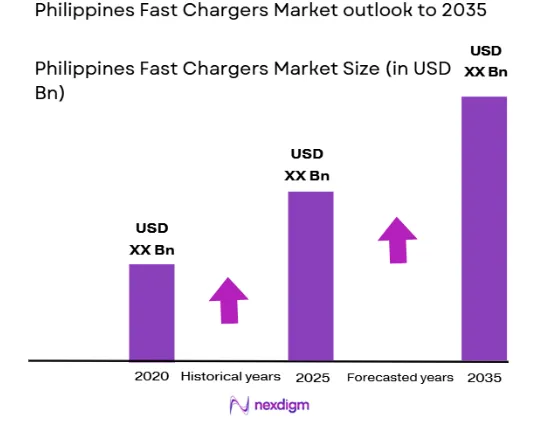
The Philippines Fast Chargers market is valued at approximately USD ~ billion based on a recent historical assessment, supported by rapid electric vehicle adoption and government-backed electrification initiatives. Increasing investments in charging infrastructure, particularly high-power DC fast charging systems, are driving deployment across urban corridors. Expansion of commercial fleets and ride-hailing electrification programs further accelerates demand. Infrastructure modernization and rising private sector participation continue to enhance accessibility and technological integration within the market ecosystem.
Metro Manila, Cebu, and Davao dominate the Philippines Fast Chargers market due to higher electric vehicle concentration, infrastructure readiness, and supportive local policies. These cities benefit from strong commercial activity, dense population clusters, and early adoption of smart mobility initiatives. Strategic location advantages such as port access and logistics hubs also contribute to charger deployment. Additionally, government pilot programs and partnerships with private developers reinforce urban dominance, creating scalable frameworks for nationwide infrastructure expansion.
Market Segmentation
By Product Type
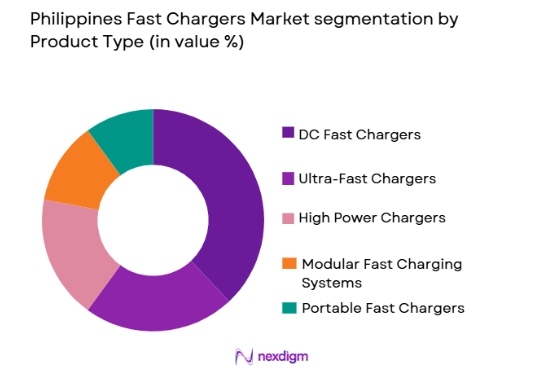
Philippines Fast Chargers market is segmented by product type into DC Fast Chargers, Ultra-Fast Chargers, High Power Chargers, Modular Fast Charging Systems, and Portable Fast Chargers. Recently, DC Fast Chargers have a dominant market share due to factors such as widespread compatibility with existing EVs, cost efficiency, and easier deployment across public and commercial charging networks. Their reliability and established infrastructure presence make them the preferred choice for operators and fleet managers. Government-supported projects also prioritize DC systems due to their scalability and integration with grid infrastructure. Additionally, the availability of standardized connectors and strong OEM support further strengthens their dominance. As urban charging demand grows, DC Fast Chargers continue to serve as the backbone of fast charging infrastructure across major Philippine cities.
By End User
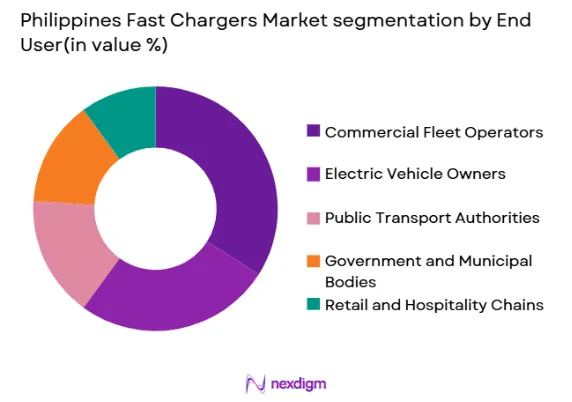
Philippines Fast Chargers market is segmented by end-user into Electric Vehicle Owners, Commercial Fleet Operators, Public Transport Authorities, Retail and Hospitality Chains, and Government and Municipal Bodies. Recently, Commercial Fleet Operators have a dominant market share due to increasing electrification of logistics and ride-hailing services. Fleet operators prioritize fast charging infrastructure to minimize downtime and maximize operational efficiency, making them key drivers of demand. The need for centralized charging depots and predictable charging cycles further supports this segment’s growth. Additionally, partnerships between logistics firms and charging providers accelerate deployment of dedicated fast charging hubs. As fleet electrification expands across urban and intercity routes, commercial operators continue to lead adoption due to their scale and operational requirements.
Competitive Landscape
The Philippines Fast Chargers market exhibits moderate consolidation, with global technology providers and regional players competing for infrastructure contracts and partnerships. Major companies leverage advanced charging technologies, grid integration capabilities, and strategic alliances with utilities and government agencies to strengthen their market presence. The competitive environment is shaped by innovation in power electronics, expansion of service networks, and customization for local infrastructure conditions.
| Company Name | Establishment Year | Headquarters | Technology Focus | Market Reach | Key Products | Revenue | Charging Capacity Range |
| ABB Ltd | 1988 | Switzerland | ~ | ~ | ~ | ~ | ~ |
| Siemens AG | 1847 | Germany | ~ | ~ | ~ | ~ | ~ |
| Schneider Electric SE | 1836 | France | ~ | ~ | ~ | ~ | ~ |
| Delta Electronics Inc | 1971 | Taiwan | ~ | ~ | ~ | ~ | ~ |
| ChargePoint Holdings Inc | 2007 | USA | ~ | ~ | ~ | ~ | ~ |
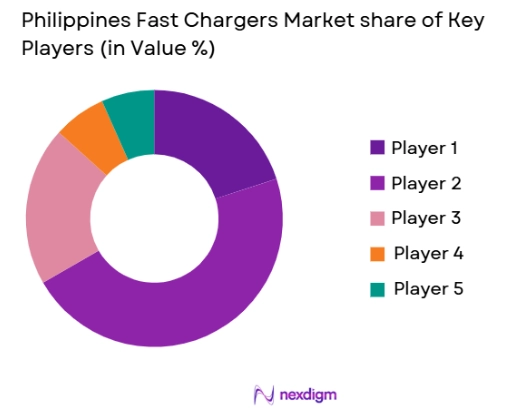
Philippines Fast Chargers Market Analysis
Growth Drivers
Expansion of Electric Vehicle Adoption Across Urban Centers
The rapid increase in electric vehicle adoption across metropolitan regions is significantly driving demand for fast charging infrastructure in the Philippines. Urban consumers are increasingly shifting toward electric mobility due to rising fuel costs and environmental awareness. Government incentives and tax benefits further encourage EV purchases, creating a parallel need for efficient charging solutions. Charging infrastructure providers are responding by deploying fast chargers in commercial and residential zones. Ride-hailing and delivery services are also transitioning to electric fleets, intensifying charging requirements. Public awareness campaigns and sustainability goals reinforce adoption trends. Technological advancements in battery systems are enabling compatibility with fast chargers, enhancing user convenience. Increasing vehicle range expectations further necessitate reliable fast charging access. As urban density grows, fast chargers become critical to maintaining mobility efficiency.
Government Policies and Infrastructure Development Initiatives
Strong policy support and infrastructure development initiatives are accelerating the deployment of fast chargers across the Philippines. Government programs aimed at reducing carbon emissions promote the installation of EV charging networks nationwide. Incentives for private sector participation encourage investments in charging infrastructure projects. Public-private partnerships facilitate faster deployment of charging stations in key urban and highway locations. Regulatory frameworks supporting standardization and interoperability improve system integration. Infrastructure funding and subsidies lower entry barriers for new market participants. Smart city initiatives integrate EV charging into broader urban planning strategies. Grid modernization efforts enhance capacity to support high-power charging systems. Continuous policy evolution ensures alignment with global sustainability goals. These factors collectively strengthen the growth trajectory of the fast chargers market.
Market Challenges
High Capital Investment and Infrastructure Costs
The deployment of fast charging infrastructure requires substantial capital investment, posing a significant challenge for market expansion in the Philippines. High costs associated with equipment, installation, and grid upgrades create barriers for new entrants and smaller operators. Infrastructure development in less urbanized areas further increases costs due to limited grid capacity and logistical complexities. Maintenance and operational expenses add to the financial burden, impacting profitability. Limited access to financing options restricts large-scale deployment. The need for advanced cooling systems and high-power components further elevates costs. Return on investment remains uncertain due to evolving EV adoption rates. Regulatory approvals and land acquisition processes can delay projects. Market players must balance cost efficiency with performance standards. These financial constraints slow the pace of infrastructure development.
Grid Capacity Limitations and Energy Supply Constraints
The existing power grid infrastructure in the Philippines faces limitations in supporting widespread fast charger deployment, creating a major operational challenge. High-power charging systems demand significant electricity capacity, which may not be available in all regions. Grid stability concerns arise due to sudden load increases from fast charging stations. Upgrading grid infrastructure requires additional investments and coordination with utility providers. Renewable energy integration remains limited, affecting sustainability goals. Power outages and inconsistencies in supply impact charger reliability and user confidence. Remote and rural areas face greater challenges due to weaker grid connectivity. Demand management systems are still developing, limiting efficiency. Coordination between stakeholders is necessary to address infrastructure gaps. These constraints hinder seamless expansion of fast charging networks.
Opportunities
Development of Nationwide Highway Charging Networks
The expansion of highway-based fast charging networks presents a significant opportunity for the Philippines Fast Chargers market. Intercity travel demand is increasing, necessitating reliable charging infrastructure along major transportation corridors. Government infrastructure programs support the development of charging stations on highways and expressways. Strategic placement of fast chargers enables long-distance EV travel, enhancing adoption rates. Collaboration between private companies and public agencies accelerates project implementation. Tourism and logistics sectors benefit from improved charging accessibility. Charging networks along highways reduce range anxiety among EV users. Integration with rest stops and commercial centers enhances convenience. Advanced technologies enable high-speed charging, reducing downtime. This opportunity supports nationwide EV ecosystem growth.
Integration of Renewable Energy with Charging Infrastructure
The integration of renewable energy sources with fast charging systems offers a transformative opportunity for the market. Solar and wind energy can power charging stations, reducing dependence on conventional energy sources. Sustainable charging solutions align with environmental policies and global climate goals. Energy storage systems enhance efficiency and reliability of renewable-powered chargers. Government incentives promote renewable energy adoption in infrastructure projects. Hybrid charging models combine grid and renewable energy sources for optimized performance. Reduced operational costs improve long-term profitability for operators. Green energy branding attracts environmentally conscious consumers. Technological advancements support seamless integration of renewables with charging systems. This opportunity strengthens sustainability and resilience in the charging ecosystem.
Future Outlook
The Philippines Fast Chargers market is expected to experience steady growth driven by expanding electric vehicle adoption and infrastructure investments. Technological advancements in high-power charging systems will enhance efficiency and reduce charging time. Government support and regulatory frameworks will continue to encourage private sector participation. Increasing integration with renewable energy and smart grid systems will improve sustainability. Demand from commercial fleets and urban mobility solutions will remain a key growth driver.
Major Players
- ABB Ltd
- Siemens AG
- Schneider Electric SE
- Delta Electronics Inc
- ChargePoint Holdings Inc
- EVBox Group
- Tritium DCFC Limited
- Blink Charging Co
- Wallbox N.V.
- Alpitronic GmbH
- Enel X Way
- Legrand SA
- Phihong Technology Co Ltd
- StarCharge
- Exicom Tele-Systems Limited
Key Target Audience
- Electric vehicle manufacturers
- Charging infrastructure developers
- Commercial fleet operators
- Automotive OEM suppliers
- Energy utilities and grid operators
- Retail and hospitality chains
- Investments and venture capitalist firms
- Government and regulatory bodies
Research Methodology
Step 1: Identification of Key Variables
Key variables including charging technology types, infrastructure deployment patterns, and end-user demand trends are identified. Data points are collected from industry databases and validated through cross-referencing.
Step 2: Market Analysis and Construction
Market size and segmentation are constructed using bottom-up and top-down approaches. Data is analyzed across multiple dimensions to ensure consistency and accuracy.
Step 3: Hypothesis Validation and Expert Consultation
Industry experts and stakeholders validate assumptions and projections. Feedback is incorporated to refine market models and ensure realistic outcomes.
Step 4: Research Synthesis and Final Output
All findings are consolidated into structured insights. Data is synthesized into actionable intelligence, ensuring clarity, accuracy, and relevance for stakeholders.

- Executive Summary
- Research Methodology
(Definitions, Scope, Industry Assumptions, Market Sizing Approach, Primary & Secondary Research Framework, Data Collection & Verification Protocol, Analytic Models & Forecast Methodology, Limitations & Research Validity Checks)

- Market Definition and Scope
- Value Chain & Stakeholder Ecosystem
- Regulatory / Certification Landscape
- Sector Dynamics Affecting Demand
- Strategic Initiatives & Infrastructure Growth

- Growth Drivers
Rising adoption of electric vehicles across urban regions
Government incentives promoting EV infrastructure deployment
Expansion of commercial fleet electrification initiatives
Growing investments in smart city infrastructure
Increasing demand for high-speed charging solutions - Market Challenges
High capital investment requirements for fast charging infrastructure
Grid capacity limitations in certain regions
Standardization issues across charging connectors
Maintenance and operational cost complexities
Limited rural infrastructure development - Market Opportunities
Development of nationwide highway fast charging networks
Integration with renewable energy-powered charging systems
Partnerships between private firms and government agencies - Trends
Adoption of ultra-fast charging technologies
Integration of digital payment and smart connectivity features
Shift towards modular and scalable charging systems
Growth of fleet-based fast charging hubs
Increased use of advanced semiconductor materials - Government Regulations & Defense Policy
Implementation of EV infrastructure development policies
Standards for charging interoperability and safety compliance
Incentive schemes for private sector participation - SWOT Analysis
- Stakeholder and Ecosystem Analysis
- Porter’s Five Forces Analysis
- Competition Intensity and Ecosystem Mapping

- By Market Value, 2020-2025
- By Installed Units, 2020-2025
- By Average System Price, 2020-2025
- By System Complexity Tier, 2020-2025

- By System Type (In Value%)
DC Fast Chargers
Ultra-Fast Chargers
High Power Chargers
Modular Fast Charging Systems
Portable Fast Chargers - By Platform Type (In Value%)
Public Charging Infrastructure
Private Commercial Installations
Residential Fast Charging Units
Fleet Charging Depots
Highway Charging Corridors - By Fitment Type (In Value%)
Standalone Chargers
Integrated Charging Stations
Retrofitted Charging Systems
Modular Installations
Mobile Charging Units - By EndUser Segment (In Value%)
Electric Vehicle Owners
Commercial Fleet Operators
Public Transport Authorities
Retail and Hospitality Chains
Government and Municipal Bodies - By Procurement Channel (In Value%)
Direct Procurement from OEMs
Government Tenders
Private Infrastructure Developers
Public-Private Partnerships
Third-Party Distributors - By Material / Technology (in Value %)
Silicon-Based Power Electronics
Silicon Carbide Components
Gallium Nitride Systems
Liquid Cooling Technology
Smart Grid Integrated Systems

- Market structure and competitive positioning
- Market share snapshot of major players
- Cross Comparison Parameters (Charging Speed, Power Output, Installation Cost, Technology Type, Cooling Mechanism, Connectivity Features, Compatibility Standards, Service Network, Scalability, Energy Efficiency)
- SWOT Analysis of Key Players
- Pricing & Procurement Analysis
- Key Players
ABB Ltd
Siemens AG
Schneider Electric SE
Delta Electronics Inc
Tritium DCFC Limited
EVBox Group
ChargePoint Holdings Inc
Blink Charging Co
Wallbox N.V.
Alpitronic GmbH
Enel X Way
Legrand SA
Phihong Technology Co Ltd
StarCharge
Exicom Tele-Systems Limited

- Increasing demand from urban EV owners for faster charging solutions
- Commercial fleets prioritizing high-efficiency charging infrastructure
- Government bodies supporting public charging expansion projects
- Retail and hospitality sectors leveraging chargers to attract customers

- Forecast Market Value, 2026-2035
- Forecast Installed Units, 2026-2035
- Price Forecast by System Tier, 2026-2035
- Future Demand by Platform, 2026-2035


 Request a Sample
 Ask for Customization
 Get a Quote
 Enquire Now