
 Download PDF
Market Overview
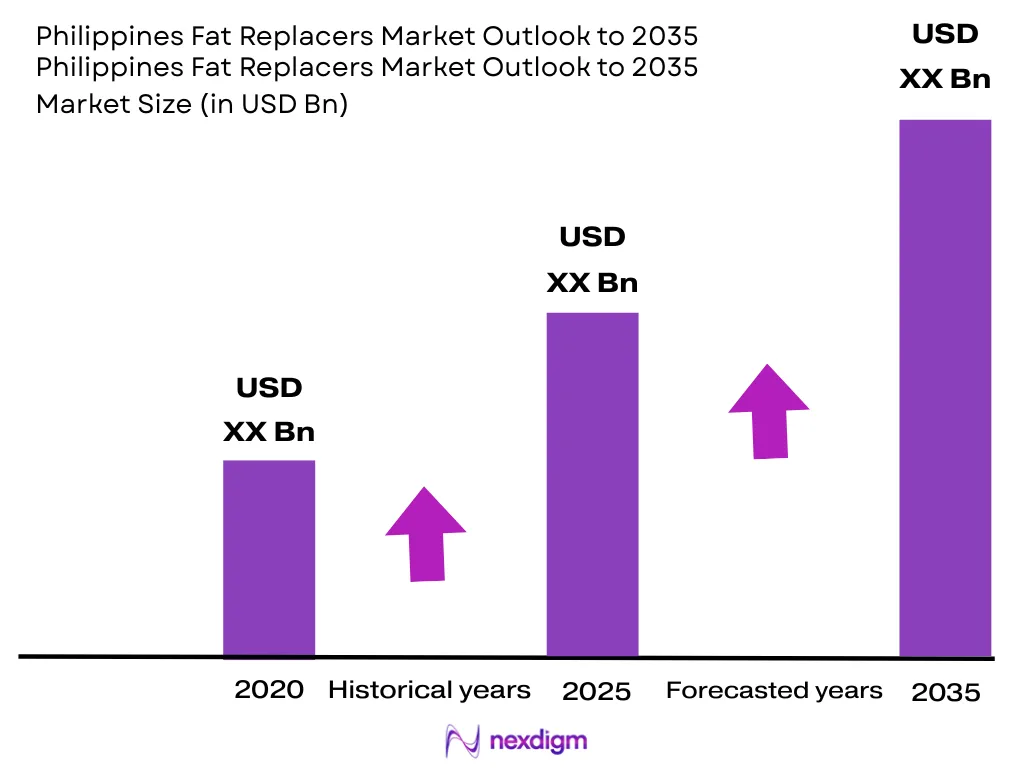
The Philippines Fat Replacers Market was valued at USD ~ million in 2024 and is projected to expand at a CAGR of ~% during the 2026–2035 forecast period. According to data published by the Food and Drug Administration Philippines (FDA Philippines), the Food and Nutrition Research Institute (FNRI) of the Department of Science and Technology (DOST), and the Department of Health (DOH), the Philippines continues to experience a rising burden of diet-related non-communicable diseases including obesity, type 2 diabetes, and cardiovascular disease, reinforcing the government’s commitment to nutrition improvement through food reformulation, mandatory nutritional labelling, and reduced-fat product development. The Philippines is one of Southeast Asia’s largest and most dynamic food manufacturing economies, with a population exceeding 115 million people and a well-established processed food industry supplying both the domestic market and export channels across ASEAN, the Middle East, North America, and Japan. Fat replacers, encompassing carbohydrate-based, protein-based, lipid-based, and novel functional ingredients used to partially or fully substitute fat content in food formulations while maintaining acceptable sensory and textural characteristics, are experiencing growing demand from the country’s food manufacturers as they respond to nutritional labelling regulations, health-conscious consumer trends, and the growing preference for lower-fat and cleaner-label packaged food products. The Philippines also possesses unique local ingredient development opportunities rooted in its abundant coconut production, native starch resources, and agricultural diversity, providing a distinctive foundation for locally-derived fat replacer innovation alongside imported specialty ingredient systems.
Market Segmentation
By Source
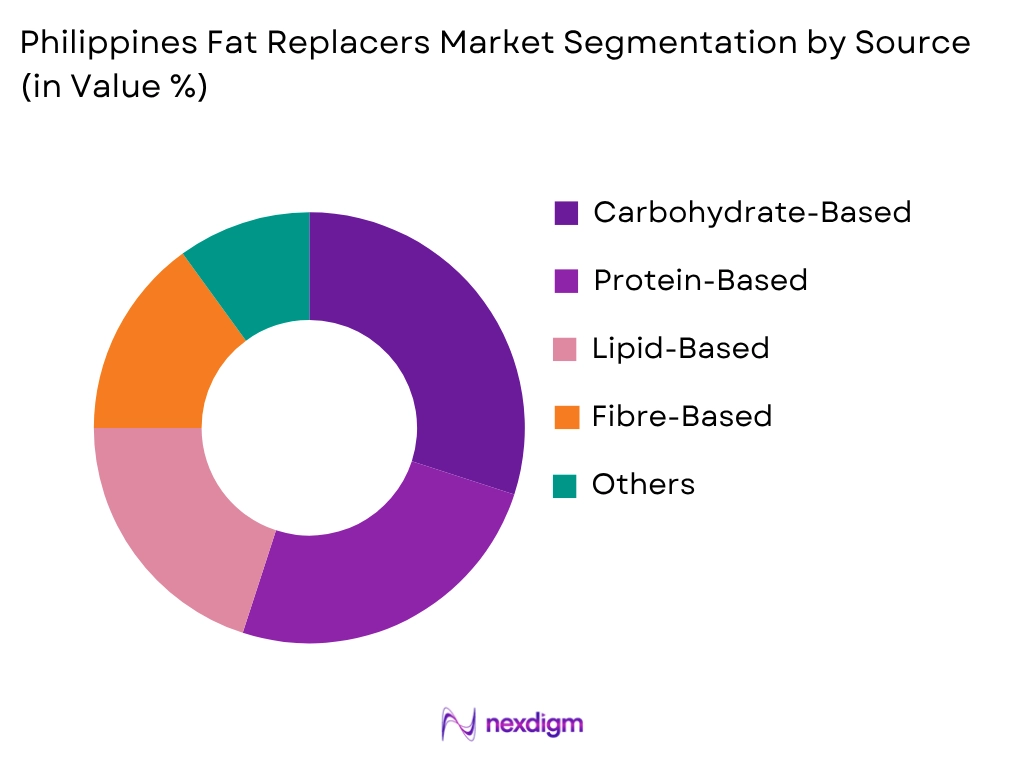
Carbohydrate-based fat replacers represent the largest and most widely adopted segment of the Philippines Fat Replacers Market owing to their broad application versatility across the country’s dominant food manufacturing categories, established regulatory acceptance under FDA Philippines food additive standards, cost competitiveness relative to protein and novel lipid-based alternatives, and ready availability through both multinational ingredient suppliers and local distributors. Carbohydrate-based fat replacers, including modified starches derived from corn, cassava, and potato, inulin, pectin, carrageenan, guar gum, xanthan gum, cellulose derivatives, and resistant starch systems, are widely used across bakery, processed meat, dairy, sauces, and snack food reformulation applications in the Philippines. The country’s large processed meat sector, encompassing products such as longganisa, tocino, hotdog, corned beef, and Vienna sausage manufactured by companies including San Miguel Pure Foods, Universal Robina Corporation, and CDO Foodsphere, represents a particularly active application segment for fat replacer adoption as producers seek to reformulate traditional high-fat Filipino processed meat products to achieve reduced-fat and lower-calorie nutritional profiles. Modified starch-based fat replacers are also extensively used in the country’s large sauces, dressings, and condiments manufacturing sector, where products such as banana ketchup, mayonnaise, and various Filipino-specific condiments have been primary targets of fat reduction reformulation activity. Continuous investments by multinational ingredient suppliers in Philippines-based technical sales capabilities, application support, and distributor network development have further strengthened the adoption of carbohydrate-based fat replacers across the country’s food manufacturing base.
By Distribution Channel
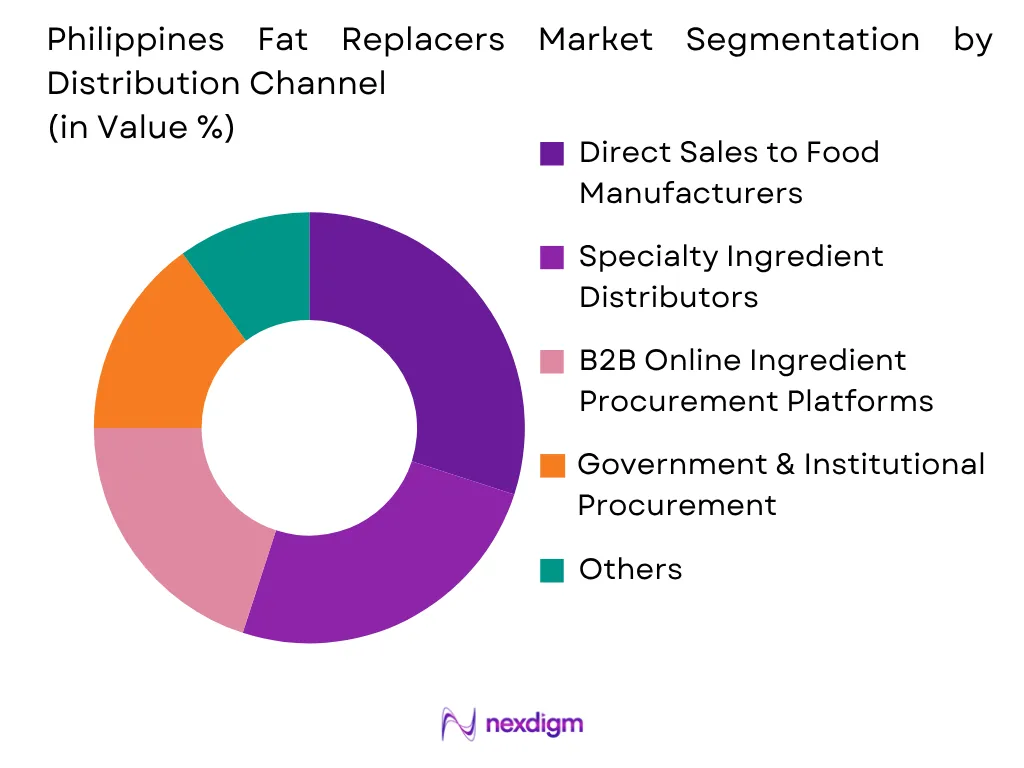
Direct sales to food manufacturers represent the dominant distribution channel for fat replacers in the Philippines, as multinational ingredient companies including Ingredion, Kerry, and Cargill maintain dedicated Philippines-based commercial and technical sales teams that engage directly with large and medium-sized food manufacturers through long-term ingredient supply agreements, reformulation project support, and regulatory compliance assistance. The Philippines food manufacturing sector is anchored in Metro Manila, CALABARZON, and Central Luzon, where the concentration of major food processing facilities operated by conglomerates including San Miguel Corporation, Universal Robina Corporation, Monde Nissin, Jollibee Foods Corporation, and their subsidiaries creates a geographically concentrated and commercially accessible customer base for direct ingredient sales engagement. Specialty ingredient distributors play a critical role in reaching smaller and medium-sized food manufacturers, regional food companies, bakery operators, and foodservice suppliers across the archipelago, providing flexible order quantities, blended ingredient solutions, local logistics coordination, and distributor-managed regulatory documentation. The geographic fragmentation of the Philippine archipelago, comprising over 7,600 islands, presents a unique distribution challenge that makes a strong regional distributor network an essential component of ingredient market coverage beyond Metro Manila. B2B online ingredient procurement platforms are gaining traction among larger food manufacturers seeking competitive pricing, technical specification comparison, and streamlined procurement for repeat commodity-grade fat replacer ingredient orders. Government and institutional procurement through channels such as the PhilGEPS (Philippine Government Electronic Procurement System) represents a growing segment for clinical nutrition ingredient supply to DOH and Department of Social Welfare and Development (DSWD) food assistance programmes.
Competitive Landscape
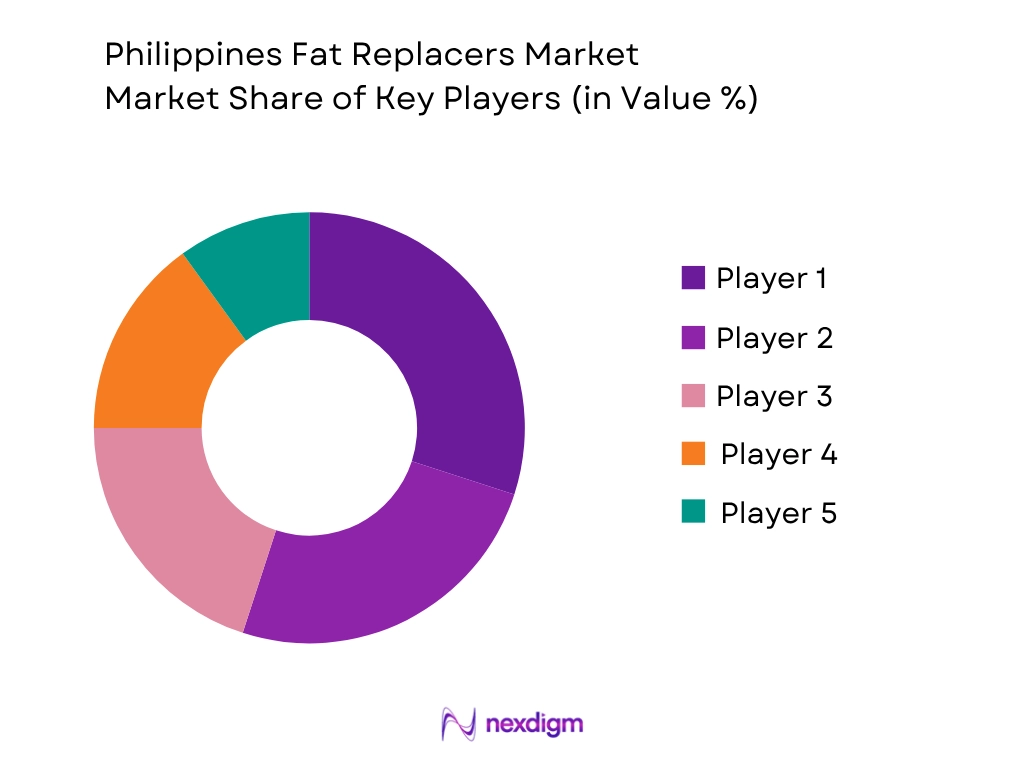
The Philippines Fat Replacers Market is served by a combination of multinational specialty food ingredient companies with direct Philippines commercial operations or established local distributor partnerships, domestic food conglomerates with in-house ingredient development capabilities, and a growing number of specialty ingredient distributors serving the country’s diverse food manufacturing base. Multinational ingredient leaders including Ingredion, Kerry Group, Cargill, Roquette, Beneo, Tate & Lyle, DSM-Firmenich, and IFF serve the Philippines market through direct sales teams, APAC regional distribution arrangements, and authorised local distributors, competing on product portfolio breadth, application development support, Halal certification credentials, FDA Philippines regulatory compliance expertise, and price competitiveness. Domestic food conglomerates including Universal Robina Corporation and San Miguel Pure Foods maintain in-house ingredient sourcing and applied development capabilities that give them a degree of integration in fat replacer adoption for their own product lines. Competition is intensifying as FDA Philippines nutritional labelling enforcement strengthens and health-conscious consumer demand for reduced-fat and cleaner-label products accelerates reformulation activity across the Philippine food manufacturing sector.
| Company | Establishment Year | Headquarters | Primary Fat Replacer Portfolio | Key Application Industries
|
Manufacturing Presence | R&D Capability | Distribution Network | Clean Label Solutions |
| Ingredion Philippines | 1906 | ~ | ~ | ~ | ~ | ~ | ~ | ~ |
| Kerry Group Philippines | 1972 | ~ | ~ | ~ | ~ | ~ | ~ | ~ |
| Cargill Philippines | 1865 | ~ | ~ | ~ | ~ | ~ | ~ | ~ |
| Roquette Philippines | 1933 | ~ | ~ | ~ | ~ | ~ | ~ | ~ |
| Beneo Philippines (via Distributors) | 1899 | ~ | ~ | ~ | ~ | ~ | ~ | ~ |
Philippines Confectionary Market Analysis
Growth Drivers
Rising Non-Communicable Disease Burden and Government Nutrition Policy Mandates
The Philippines’ escalating burden of diet-related non-communicable diseases and the government’s progressive strengthening of food nutrition policy continue to be among the most significant structural growth drivers for the Philippines Fat Replacers Market. According to the Food and Nutrition Research Institute (FNRI) of the Department of Science and Technology (DOST), the 2019 Expanded National Nutrition Survey revealed that overweight and obesity rates among Filipino adults had been increasing steadily, with over 37 percent of adults aged 20 years and above classified as overweight or obese, a trend that has continued to concern the Department of Health (DOH) and the Philippine Health Insurance Corporation (PhilHealth). The World Bank estimated the Philippines’ GDP at approximately USD 435 billion in 2024, reflecting a growing economy with an expanding middle class that is increasingly exposed to processed and packaged food products with high fat, sugar, and sodium content. The Republic Act 11239 and associated FDA Philippines regulations governing mandatory nutritional labelling on pre-packaged food products have progressively strengthened requirements for front-of-pack nutrient disclosure, compelling food manufacturers to examine the fat content profiles of their existing product portfolios and initiate reformulation projects targeting reduced total fat, reduced saturated fat, and zero trans fat claims. The International Monetary Fund (IMF) projected the Philippines as one of Southeast Asia’s fastest-growing economies, with GDP growth of approximately 6 percent in 2024-25, supporting rising household income and expanding consumer spending on packaged food products, increasing the commercial relevance of health-oriented reformulated foods. The Department of Health’s Philippine Plan of Action for Nutrition (PPAN) and the Kalusugan at Nutrisyon ng Mag-Nanay Act (Republic Act 11148) further reinforce national commitment to dietary improvement and nutritional enhancement of the Philippine food supply, creating a sustained policy environment that incentivises fat reduction and food reformulation investment across the food manufacturing sector.
Expanding Food Manufacturing Base and Export-Oriented Processed Food Production
The Philippines’ well-established and growing food manufacturing sector, combined with the country’s increasing participation in ASEAN regional food export markets and global ethnic food demand, continues to generate sustained commercial demand for fat replacer ingredients across a wide range of food categories. According to the Philippine Statistics Authority (PSA), food and beverage manufacturing remains one of the largest contributors to Philippines manufacturing value added, with major conglomerates including San Miguel Corporation, Universal Robina Corporation, Monde Nissin, Jollibee Foods Corporation, and CDO Foodsphere operating large-scale manufacturing facilities across Metro Manila, CALABARZON, Central Luzon, and Central Visayas. The Philippines’ processed meat sector, encompassing high-consumption categories such as hotdog, longganisa, corned beef, tocino, and canned meat products, is one of the most active segments for fat replacer adoption due to the high baseline fat content of traditional formulations, strong consumer demand for products with improved nutritional profiles, and the commercial imperative to achieve reduced-fat label claims that support premium positioning and retail shelf placement. Philippine food exporters targeting the United States, Middle East, Japan, and ASEAN markets face increasing buyer requirements for reduced-fat, low-saturated-fat, and clean-label formulations in export-destined products, creating additional commercial incentives for reformulation investment that drives fat replacer ingredient demand. The Overseas Filipino Worker (OFW) remittance economy, with the Bangko Sentral ng Pilipinas (BSP) reporting annual remittances exceeding USD 36 billion in recent years, continues to sustain household purchasing power across the archipelago, supporting growing retail demand for premium and health-oriented packaged food products that represent primary targets for fat replacer-based reformulation.
Market Challenges
High Import Dependency for Specialty Ingredients and Price Sensitivity Among Manufacturers
The Philippines Fat Replacers Market faces a significant structural challenge arising from the country’s near-total reliance on imported specialty fat replacer ingredients, as local manufacturing of advanced carbohydrate, protein, and lipid-based fat replacer systems remains extremely limited, exposing the market to global supply chain disruptions, foreign exchange volatility, and import cost inflation. According to the Bureau of Customs Philippines and the Philippine Statistics Authority (PSA), the Philippines imports the large majority of its specialty food ingredient requirements, including modified starches from Europe and North America, hydrocolloids from China, Indonesia, and Europe, protein concentrates and isolates from Europe, North America, and Australia, and emulsifier systems primarily from European manufacturers. The peso exchange rate against the US dollar and Euro is a key cost determinant for imported fat replacer ingredients, and peso depreciation episodes, such as those experienced during periods of global monetary tightening, directly increase the landed cost of imported ingredients for Philippine food manufacturers. Price sensitivity among small and medium-sized food manufacturers, which constitute the majority of enterprises in the Philippine food processing sector according to PSA data, represents a persistent barrier to the adoption of premium and novel fat replacer systems, as these companies frequently prioritise lowest-cost reformulation options over technically superior but more expensive specialty ingredients. The limited availability of locally developed and commercially scalable fat replacer alternatives based on Philippine agricultural resources, including cassava starch, coconut derivatives, and carrageenan, constrains the ability of domestic manufacturers to reduce import dependency through local sourcing, though ongoing DOST-FNRI research programmes are progressively developing such local ingredient options.
Archipelagic Distribution Challenges and Limited Local Application Development Infrastructure
The Philippines’ unique geographic structure as an archipelago of over 7,600 islands presents substantial logistics and distribution challenges for fat replacer ingredient suppliers seeking to serve food manufacturers and foodservice operators across regional markets outside Metro Manila and the major Luzon industrial corridors. According to the National Economic and Development Authority (NEDA), inter-island freight transportation costs in the Philippines are among the highest in Southeast Asia relative to distance, reflecting the high cost of sea freight, limited roll-on roll-off (RoRo) connectivity between island groups, and inadequate cold chain and warehousing infrastructure outside major urban centres. Specialty fat replacer ingredients requiring temperature-controlled storage and handling during transit face additional logistics complexity and cost when distributed across Visayas and Mindanao, where regional food manufacturers are growing in scale and sophistication but remain underserved by ingredient supplier technical sales and distribution networks. The Philippines also lacks the depth of food application laboratory infrastructure, food science talent pools, and dedicated ingredient innovation ecosystems found in more developed ASEAN food technology hubs such as Singapore and Thailand, making it more difficult for food manufacturers, particularly SMEs, to execute technically complex fat reformulation projects without significant support from multinational ingredient supplier application teams. The Department of Science and Technology (DOST) and its Food and Nutrition Research Institute (FNRI) provide some applied research and formulation development support to the Philippine food industry, but the scale and scope of available technical infrastructure remain limited relative to the size and diversity of the country’s food manufacturing sector. Strengthening inter-island logistics networks, expanding regional food ingredient distribution hubs, and developing localised food application development centres outside Metro Manila are essential steps toward realising the full geographic growth potential of the Philippine fat replacers market.
Market Opportunities
Coconut-Derived Fat Replacer Innovation and Local Agricultural Ingredient Development
The Philippines’ position as one of the world’s largest coconut producers presents a distinctive and strategically significant opportunity for the development of locally-derived fat replacer ingredients that leverage the country’s abundant coconut agricultural resources and established coconut processing industry. According to the Philippine Coconut Authority (PCA), the Philippines is consistently ranked among the top two coconut producing nations globally, with coconut cultivation covering approximately 3.5 million hectares across the archipelago and supporting the livelihoods of millions of farming households. The coconut processing industry, encompassing coconut oil, coconut milk, desiccated coconut, coconut flour, coconut water, and medium-chain triglyceride (MCT) oil production, provides a well-established industrial foundation for the development of coconut-based fat mimetics, coconut flour-based fat extenders, MCT-based structured lipid systems, and coconut fibre dietary fibre ingredients with demonstrable fat replacement functionality in bakery, dairy, and processed meat applications. The Department of Science and Technology (DOST), through its Philippine Coconut Authority research partnerships and FNRI applied food research programmes, has been actively exploring value-added applications of coconut derivatives in food reformulation, including the use of coconut flour as a fat replacer and fibre enricher in bakery products and the application of coconut milk solids as a fat mimetic in reduced-fat dairy analogues. Growing global and regional demand for plant-based, tropical-origin, and clean-label food ingredients, combined with increasing consumer and manufacturer interest in sustainably sourced and traceable ingredient systems, creates a compelling market opportunity for Philippines-developed coconut-derived fat replacers targeting both domestic food manufacturers and export-oriented premium ingredient buyers across ASEAN, Japan, Europe, and North America. Companies and research institutions investing in the commercial development, standardisation, and market validation of coconut-based fat replacer systems are well positioned to establish a differentiated and sustainable competitive advantage in the Philippines fat replacers market while contributing to the broader agricultural value-add development objectives of the Philippine coconut industry.
Processed Meat Reformulation Demand and ASEAN Export-Oriented Product Development
The Philippines’ large and deeply embedded processed meat consumption culture, combined with growing export market requirements for healthier formulations, creates a substantial near-term commercial opportunity for fat replacer ingredient suppliers targeting the country’s processed meat manufacturing sector. According to the Philippine Statistics Authority (PSA) and the Meat Industry Association of the Philippines (MIAP), processed meat products including hotdog, longganisa, corned beef, tocino, ham, and canned meat products are among the most widely consumed packaged food categories across Filipino households at all income levels, with total processed meat production representing a major segment of Philippine food manufacturing output. Traditional Filipino processed meat formulations typically incorporate high levels of animal fat, pork back fat, or vegetable shortening to achieve desired texture, juiciness, flavour delivery, and mouthfeel characteristics, making this category one of the most technically feasible and commercially impactful applications for carbohydrate-based, protein-based, and lipid structuring fat replacer systems. Major processed meat manufacturers including San Miguel Pure Foods, CDO Foodsphere, Virginia Food, and Purefoods-Hormel have been progressively investing in reduced-fat product line extensions and reformulated mainstream products targeting health-conscious Filipino consumers and export buyers who require compliant nutritional profiles for market entry. Philippine food exporters targeting ASEAN, Middle Eastern, North American, and Japanese ethnic food markets face increasing buyer-side requirements for reduced-saturated-fat formulations, clean-label ingredient declarations, and Halal-certified processing standards that further incentivise fat replacer adoption in export-oriented processed meat product lines. Ingredient companies offering technically validated, cost-effective, and Halal-certified fat replacer systems specifically optimised for Filipino processed meat application requirements are well positioned to capture significant commercial growth as this high-volume reformulation opportunity continues to develop through 2035.
Future Outlook
The Philippines Fat Replacers Market is expected to witness sustained growth throughout the forecast period, supported by rising non-communicable disease awareness, progressive strengthening of FDA Philippines nutritional labelling requirements, the country’s expanding processed food manufacturing sector, growing health-conscious consumer demand, and increasing investment in food reformulation across major food categories including processed meat, bakery, dairy, and snacks. Local ingredient innovation opportunities rooted in the Philippines’ coconut, cassava, and carrageenan agricultural resources are expected to gradually diversify the fat replacer supply base and reduce import dependency over time. Growing export market requirements for healthier formulations, expanding ASEAN regional trade, and the development of the Philippine food manufacturing sector as a contract production hub for health-oriented products will further stimulate fat replacer adoption. Continued investments in local application development infrastructure, distributor network expansion across the archipelago, Halal certification coverage, and DOST-FNRI research collaborations will strengthen the long-term growth trajectory of the Philippines Fat Replacers Market through 2035.
Major Players
- Ingredion Philippines
- Kerry Philippines
- Cargill Philippines
- Roquette Philippines
- Beneo Philippines (via Distributors)
- Tate & Lyle Philippines (via Distributors)
- DSM-Firmenich Philippines
- IFF (International Flavors & Fragrances) Philippines
- Universal Robina Corporation (UFC) Ingredient Division
- San Miguel Pure Foods Ingredient Division
- Glanbia Nutritionals Philippines (via Distributors)
- CP Kelco Philippines (via Distributors)
- Farbest Philippines (Specialty Ingredient Distributor)
- Philippine Starch Industries
- DOST-FNRI (Applied Research & Local Ingredient Development)
Key Target Audience
- Food & Beverage Manufacturers and Product Developers
- Processed Meat and Meat Analogue Producers
- Nutraceutical and Functional Food Producers
- Contract Food Manufacturers and Co-Packers
- Foodservice Operators, QSR Chains and HoReCa
- Investments and Venture Capitalist Firms
- Government and Regulatory Bodies (Food and Drug Administration Philippines (FDA Philippines), Food and Nutrition Research Institute (FNRI-DOST), Department of Health (DOH), Philippine Coconut Authority (PCA), Bureau of Agriculture and Fisheries Standards (BAFS))
- Food Ingredient Distributors and Specialty Chemical Traders
- Export-Oriented Food Manufacturers Targeting ASEAN, Middle East and Global Markets
Research Methodology
Step 1: Identification of Key Variables
The research begins by identifying the major stakeholders across the Philippines Fat Replacers value chain, including ingredient manufacturers, importers, specialty distributors, food manufacturers, nutraceutical producers, foodservice operators, research institutions including DOST-FNRI, and regulatory bodies including FDA Philippines and DOH. Extensive secondary research is conducted using FDA Philippines publications, FNRI nutrition survey data, PSA food manufacturing statistics, DOST research outputs, company product catalogues, and proprietary ingredient market databases to establish the key variables influencing market performance.
Step 2: Market Analysis and Construction
Historical market information is compiled and evaluated to estimate overall market size, ingredient consumption volumes by category, pricing dynamics, application penetration by food manufacturing segment, and revenue generation across major fat replacer types. Both demand-side indicators, including food manufacturer reformulation activity, FDA Philippines compliance investment, and processed meat and bakery production volumes, and supply-side indicators, including ingredient import volumes, distributor network depth, and local production capacity, are analysed using bottom-up and top-down approaches to construct a comprehensive market model.
Step 3: Hypothesis Validation and Expert Consultation
Preliminary market estimates and assumptions are validated through Computer Assisted Telephone Interviews (CATIs) and structured discussions with food ingredient company commercial and technical directors, food manufacturer R&D and procurement managers, processed meat industry executives, specialty ingredient distributors, food scientist consultants, and regulatory affairs specialists with FDA Philippines expertise. These consultations provide critical insights into reformulation trends, ingredient adoption barriers, pricing dynamics, Halal certification requirements, and emerging application development priorities specific to the Philippine food manufacturing context.
Step 4: Research Synthesis and Final Output
The final stage integrates primary research findings with secondary data to develop a comprehensive market assessment covering ingredient type segments, application categories, regional distribution patterns, end-user profiles, competitive landscape, and future growth opportunities. Multiple validation techniques, including cross-verification with Bureau of Customs import data, PSA food manufacturing output statistics, and FDA Philippines product registration records, are employed to ensure the consistency and credibility of the final market report.

- Executive Summary
- Research Methodology (Market Definitions and Assumptions, Abbreviations, Market Taxonomy, Market Sizing Approach, Top-Down Analysis, Bottom-Up Analysis, Demand-Side Assessment, Supply-Side Assessment, Primary Industry Interviews, Secondary Research Validation, Data Triangulation, Forecasting Framework, Limitations and Future Conclusions)

- Definition and Scope
- Market Evolution and Industry Genesis
- Timeline of Major Industry Developments
- Fat Replacer Industry Value Chain Analysis
- Supply Chain Analysis

- Growth Drivers (Rising Non-Communicable Disease Burden and Government Health Nutrition Initiatives, Expanding Food Manufacturing Sector and Export-Oriented Production, Growing Middle-Class Health and Wellness Awareness, Republic Act 11239 Mandatory Nutrition Labelling, Expanding Processed and Packaged Food Demand, Growth of Plant-Based and Alternative Protein Foods, Foodservice and QSR Chain Reformulation Demand, OFW Remittance-Driven Household Spending Growth)
- Market Challenges (High Import Dependency for Specialty Fat Replacer Ingredients, Price Sensitivity Among Small and Medium Food Manufacturers, Limited Local R&D and Application Development Infrastructure, Consumer Acceptance of Reduced-Fat Products in Traditional Filipino Cuisine, Regulatory Complexity Across FDA Philippines Novel Ingredient Approvals, Competition from Low-Cost Imported Finished Products, Logistics and Distribution Challenges Across the Archipelago)
- Market Opportunities (FDA Philippines Nutrition Labelling Compliance-Driven Reformulation, Expanded Processed Meat Reformulation Demand, Plant-Based Food Sector Development, Functional Fibre and Prebiotic Fat Replacers, Export-Oriented Reformulated Product Development for ASEAN and Global Markets, Clinical and Medical Nutrition Fat Replacer Applications, Coconut-Derived Fat Replacer Innovation, Contract Manufacturing Hub Development)
- Market Trends (Clean-Label Ingredient Adoption, Plant-Based Reformulation, Reduced-Fat Processed Meat Development, High-Fibre Functional Fat Replacers, Coconut-Based Ingredient Innovation, Localised Starch and Hydrocolloid Application Development, Reduced-Saturated Fat Snack and Bakery Products, Healthier QSR and Foodservice Menu Development)
- Government Regulations and Policies (Food and Drug Administration Philippines (FDA Philippines) Food Regulations, Republic Act 11239 – Philippine Food Fortification Act Amendments, Republic Act 11148 – Kalusugan at Nutrisyon ng Mag-Nanay Act, Department of Health (DOH) Dietary Guidelines, Bureau of Food and Drugs Standards, Permitted Food Additives and Functional Ingredient Regulations, Import Permits and SPS Requirements, Philippine National Standards (PNS) for Food)
- Nutritional Policy and Public Health Analysis (Non-Communicable Disease Prevalence, Dietary Fat and Saturated Fat Intake Trends, National Nutrition Survey Findings by FNRI, Department of Health Nutrition Programmes, PhilPEN Integrated NCD Prevention Framework)
- Raw Material and Import Supply Analysis (Key Ingredient Import Sources, Coconut-Derived Ingredient Availability, Modified Starch Supply, Hydrocolloid and Gum Supply Chains, Protein Ingredient Import Trends)
- Food Reformulation Landscape Analysis (Categories Undergoing Active Reformulation, Reduced-Fat Product Launch Trends, Clean-Label Transition Pace, Reformulation Investment by Company Size)
- Local Ingredient Innovation Analysis (Coconut-Based Fat Replacers, Native Starch Applications, Cacao-Derived Ingredient Potential, DOST-FNRI Research Programmes)
- SWOT Analysis
- Porter’s Five Forces Analysis
- PESTLE Analysis
- Stakeholder Ecosystem
- Competition Ecosystem

- By Market Value (2020-2025)
- By Volume Consumption (2020-2025)
- By Average Selling Price (2020-2025)

- By Source (In Value %)
Carbohydrate-Based Fat Replacers
Protein-Based Fat Replacers
Lipid-Based Fat Replacers
Combination / Hybrid Fat Replacers
Novel & Functional Fat Replacers - By Application (In Value %)
Bakery & Confectionery
Dairy & Frozen Desserts
Processed Meat & Meat Analogues
Sauces, Dressings & Condiments
Snacks & Savoury Products
Beverages & Functional Drinks
Infant & Clinical Nutrition
Foodservice & HoReCa Formulations - By End User (In Value %)
Food & Beverage Manufacturers
Foodservice Operators & HoReCa
Nutraceutical & Functional Food Producers
Clinical & Medical Nutrition Companies
Food Technology Startups & Agri-Food Innovators
Contract Food Manufacturers & Co-Packers - By Distribution Channel (In Value %)
Direct Sales to Food Manufacturers
Specialty Ingredient Distributors
B2B Online Ingredient Procurement Platforms
Government & Institutional Procurement
Trade Shows, Demos & Technical Sales - By Region (In Value %)
Metro Manila & National Capital Region (NCR)
Central Luzon (Region III)
CALABARZON (Region IV-A)
Central Visayas (Region VII)
Davao Region (Region XI)
Other Regions (Ilocos, Bicol, Western Visayas, Northern Mindanao)

- Market Share Analysis (By Value, Product Type, Application Segment, End-User Category, Region)
- Cross Comparison Parameters (Product Portfolio Breadth Across Fat Replacer Types, Application Coverage, Philippines and ASEAN Regional Distribution Capability, Local Technical Sales and Food Scientist Support, Clean-Label and Halal-Certified Portfolio Strength, Novel and Functional Ingredient Depth, FDA Philippines Regulatory Compliance Track Record, Coconut-Derived and Local Ingredient Integration)
- SWOT Analysis of Major Players
- Pricing Analysis (By Ingredient Type, Source, Application, Functionality Level, Volume Tier)
- Detailed Profiles of Major Companies
Ingredion Philippines
Kerry Philippines
Cargill Philippines
Roquette Philippines
Beneo Philippines (via Distributors)
Tate & Lyle Philippines (via Distributors)
DSM-Firmenich Philippines
IFF (International Flavors & Fragrances) Philippines
Universal Robina Corporation (UFC) Ingredient Division
San Miguel Pure Foods Ingredient Division
Glanbia Nutritionals Philippines (via Distributors)
CP Kelco Philippines (via Distributors)
Farbest Philippines (Specialty Ingredient Distributor)
Philippine Starch Industries
DOST-FNRI (Applied Research & Local Ingredient Development)

- Procurement Pattern Analysis (B2B Ingredient Procurement Frequency, Direct vs Distributor Sourcing, Reformulation Project-Based vs Ongoing Purchasing, Tender vs Negotiated Contracts)
- End-User Demand Analysis (Food Manufacturer Requirements, Foodservice Reformulation Needs, Nutraceutical Producer Preferences, Clinical Nutrition Specifications)
- Budget and Expenditure Analysis by Application Segment
- Premium vs Economy Ingredient Preference Analysis
- Clean-Label and Sustainability Certification Preference
- Technical Support and Application Development Service Preference
- Product Attribute Preference Analysis (Functionality, Taste and Texture Neutrality, Clean Label Status, FDA Philippines Compliance, Price, Solubility and Processing Compatibility, Halal Certification)
- Technology Adoption in Food Reformulation
- Online vs Traditional Ingredient Sourcing Behaviour
- Buyer Pain Point Analysis
- Supplier Switching and Loyalty Behaviour

- By Market Value (2026-2035)
- By Volume Consumption (2026-2035)
- By Average Selling Price (2026-2035)


 Request a Sample
 Ask for Customization
 Get a Quote
 Enquire Now