
 Download PDF
Market Overview
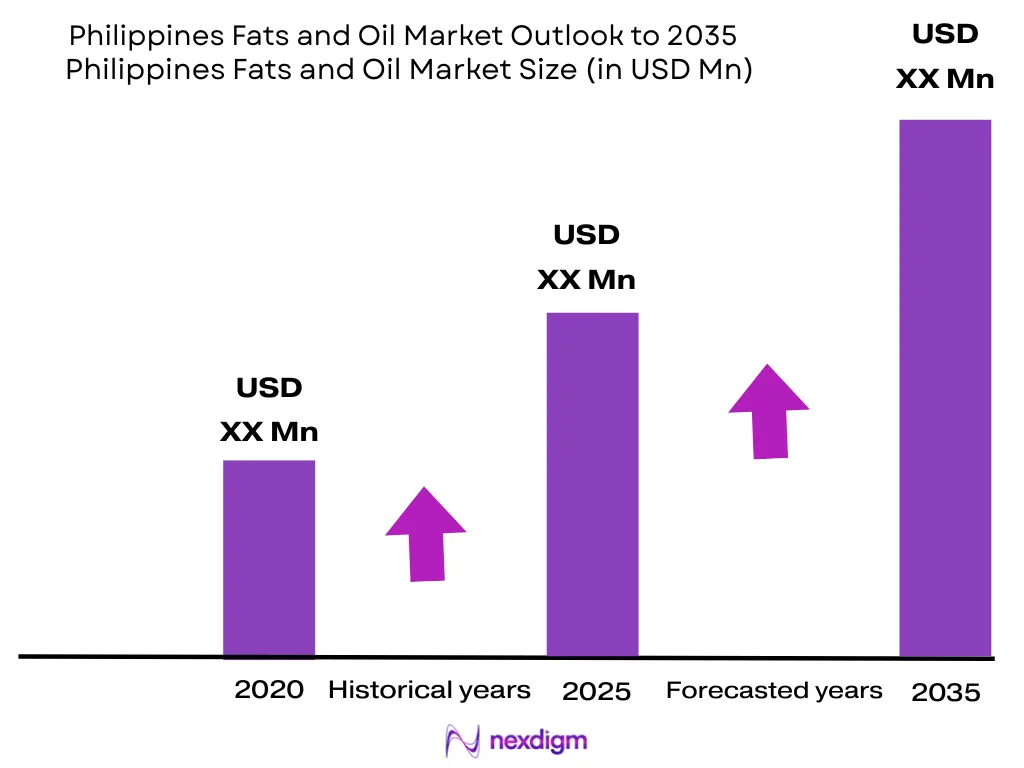
The Philippines Fats and Oil Market is valued at USD ~ million, based on a five-year historical analysis, and is forecast to grow at ~ % CAGR during the forecast period. Demand is driven by household cooking oil consumption, coconut oil exports, palm oil imports, foodservice frying, bakery fats, oleochemicals and processed food manufacturing. The country’s total external goods trade reached USD 200.87 billion, compared with USD 199.83 billion previously, supporting oilseed, edible oil and coconut-product trade flows. The Philippines Fats and Oil Market is dominated by Davao Region, Northern Mindanao, Zamboanga Peninsula, CALABARZON, National Capital Region and Central Luzon. Davao, Northern Mindanao and Zamboanga Peninsula dominate coconut supply because coconut production reached 14.5 million MT, with Davao at 1.9 million MT, Northern Mindanao at 1.8 million MT and Zamboanga Peninsula at 1.7 million MT. NCR, CALABARZON and Central Luzon dominate demand because of food manufacturing, ports, modern retail and HoReCa density.
Market Segmentation
By Product Type
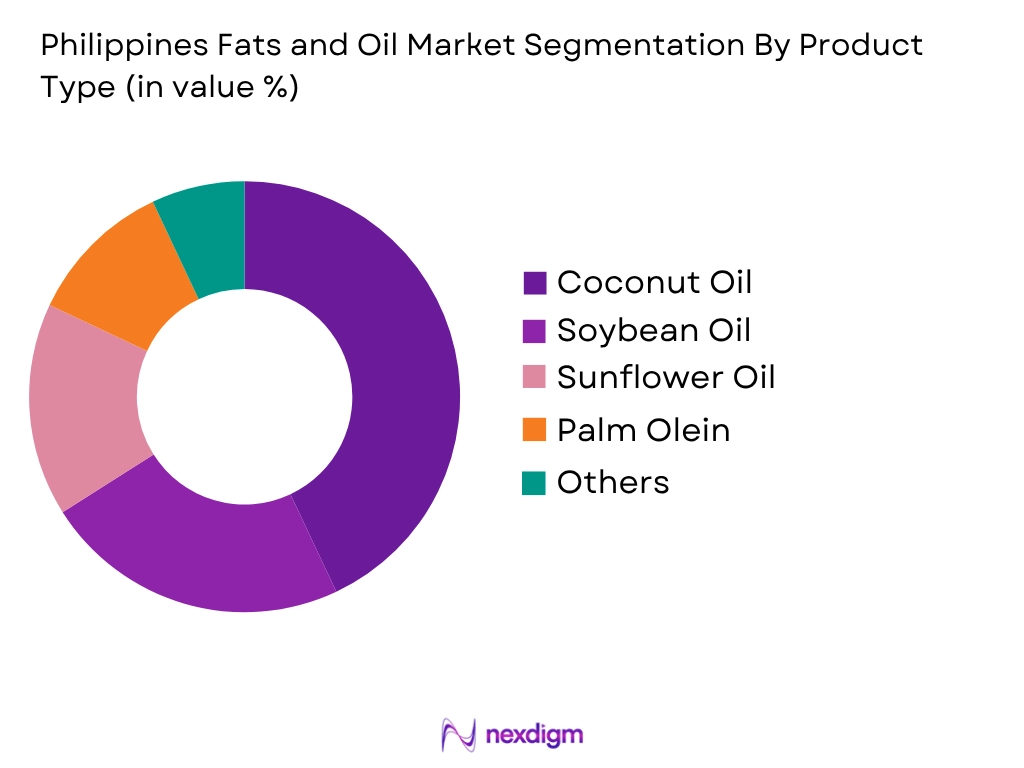
The Philippines Fats and Oil Market is segmented by product type into coconut oil, palm oil and palm olein, soybean oil, canola oil, sunflower oil, corn oil, margarine, shortening, specialty fats and other edible oils. Coconut oil holds the dominant position because the Philippines has a large domestic coconut base and a mature copra crushing, crude coconut oil, refined coconut oil, virgin coconut oil and oleochemical ecosystem. Coconut oil is used in household cooking, exports, food processing, soaps, personal care, lauric chemicals and industrial applications. The country’s coconut export profile also reinforces the segment’s importance, with coconut oil reported as the leading coconut export item and coconut-product export earnings expanding strongly. This gives coconut oil a structural advantage over imported soft oils, even though palm oil remains important in foodservice frying and mass-market blended oil applications.
By Application
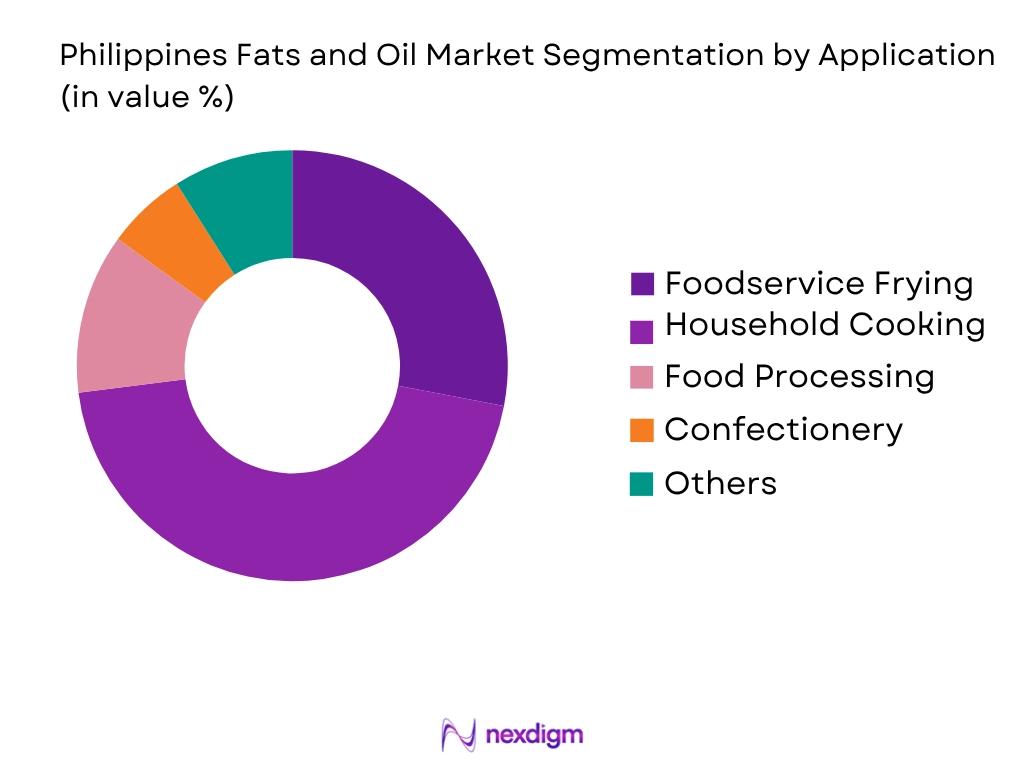
The Philippines Fats and Oil Market is segmented by application into household cooking, foodservice frying, food processing, bakery and confectionery, oleochemicals, personal care, export-oriented coconut oil processing, biodiesel and industrial uses. Household cooking dominates the application mix because edible oils are staple kitchen inputs across urban and provincial households, while sari-sari stores, supermarkets, wet markets and grocery chains support frequent replenishment of small and family-sized packs. Coconut oil, palm olein and blended vegetable oils remain widely used because they fit local cooking patterns, frying requirements and price-sensitive purchasing behavior. Foodservice frying is also significant due to fast-food chains, carinderias, restaurants, bakeries and catering businesses, but household demand remains broader and more dispersed nationwide. The country’s population scale, food expenditure base and strong coconut supply chain sustain recurring demand for cooking oils across retail formats. World Bank data places Philippine GDP at USD 461.62 billion and GDP per capita at USD 3,984.8, indicating a broad consumer economy for packaged food and household staples.
Competitive Landscape
The Philippines Fats and Oil Market is moderately consolidated among coconut oil millers, branded cooking oil companies, palm oil processors, oleochemical manufacturers and food conglomerates. Local players dominate coconut-based products because of procurement networks, copra access and mill capacity, while palm oil and soft oils depend more heavily on imports and refining relationships. Competition is shaped by feedstock access, retail brand strength, sari-sari distribution, foodservice bulk supply, export certifications, FDA compliance, halal documentation and specialty fat capability.
| Company | Establishment Year | Headquarters | Core Product Focus | Market Role | Key Channels | Feedstock Strength | Export/Industrial Linkage | Market-Specific Capability |
| San Miguel Corporation | 1890 | Mandaluyong, Philippines | ~ | ~ | ~ | ~ | ~ | ~ |
| Minola Refining Corporation | 1980s | Philippines | ~ | ~ | ~ | ~ | ~ | ~ |
| NutriAsia Inc. | 1991 | Taguig, Philippines | ~ | ~ | ~ | ~ | ~ | ~ |
| Oleo-Fats Incorporated | 1987 | Quezon City, Philippines | ~ | ~ | ~ | ~ | ~ | ~ |
| CIIF Oil Mills Group | 1970s | Makati, Philippines | ~ | ~ | ~ | ~ | ~ | ~ |
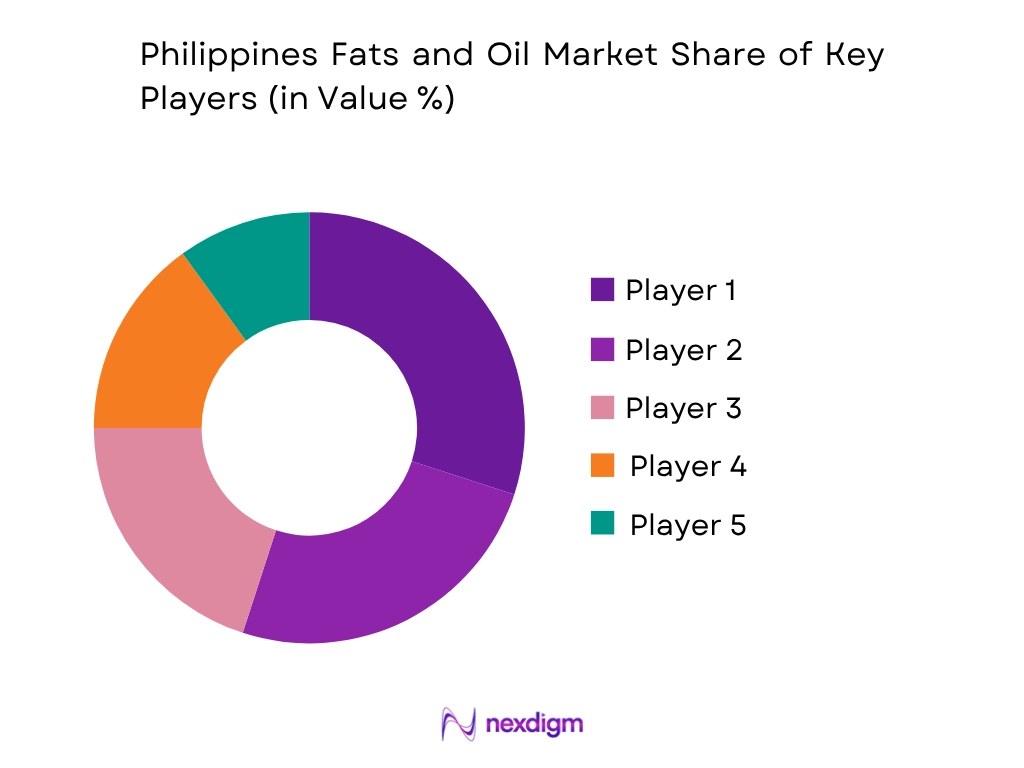
Philippines Fats and Oil Market Analysis
Growth Drivers
Urbanization and packaged-food consumption density
The Philippines Fats and Oil Market is supported by an expanding urban consumer base that drives recurring purchases of cooking oil, coconut oil, palm olein, blended vegetable oils, margarine and bakery fats through supermarkets, sari-sari stores, foodservice outlets and online grocery channels. World Bank country data reports GDP at USD 487.09 billion and GDP per capita at USD 4,170.7 in 2025, while PSA reported household population at 112.33 million persons in 2024. These macro indicators matter for fats and oils because edible oil is a staple input across household cooking, fried foods, sauces, bakery products and convenience meals. Urban concentration also strengthens distributor economics, allowing cooking oil companies to serve dense demand clusters in NCR, CALABARZON, Central Luzon, Cebu and Davao through bottled packs, pouch packs, foodservice jerry cans and institutional drums. Rising urban food consumption benefits coconut oil in traditional cooking and palm olein in high-volume frying because both formats fit local cooking behaviour and price-sensitive household replenishment.
Industrialization and food-processing demand
Industrialization is a direct driver for the Philippines Fats and Oil Market because oils and fats are functional ingredients in snacks, instant noodles, breads, confectionery, biscuits, canned foods, sauces, margarine, shortening, personal care and oleochemical products. World Bank data reports Philippines manufacturing value added at USD 72,368,483,741 in 2024, while PSA recorded total external trade in goods at USD 200.87 billion, imports at USD 127.60 billion, and imports of raw materials and intermediate goods at USD 46.47 billion in 2024. These indicators support a large industrial base requiring consistent supply of coconut oil, palm oil, soybean oil and specialty fats. Coconut oil remains important because PCAARRD, citing PSA preliminary data, reports coconut production at 14.5 million MT, with Davao Region producing 1.9 million MT, Northern Mindanao 1.8 million MT, and Zamboanga Peninsula 1.7 million MT. This production base gives industrial processors local access to lauric oil feedstock for refined oils, oleochemicals, soaps, personal care inputs and export-oriented coconut derivatives.
Market Challenges
Coconut feedstock volatility and regional supply concentration
The Philippines Fats and Oil Market faces a structural challenge from the concentration of coconut feedstock in selected regions and the exposure of farm output to weather, crop age and copra quality variation. PCAARRD, citing PSA preliminary data, reports coconut production at 14.5 million MT, led by Davao Region with 1.9 million MT, Northern Mindanao with 1.8 million MT, and Zamboanga Peninsula with 1.7 million MT. This regional concentration supports milling scale, but it also creates supply-chain exposure when typhoons, droughts, pest pressure or inter-island logistics affect major producing areas. World Bank reporting on the Philippines noted that adverse weather disrupted agricultural output in 2024, while IMF Article IV reporting stated that inflation declined after a restrictive monetary stance and government efforts to reduce food prices. For oils and fats suppliers, this means coconut oil procurement depends not only on national crop output, but also on copra collection efficiency, drying quality, farmgate aggregation, port movement and the ability of mills to maintain consistent crude coconut oil feedstock.
Import dependence for palm oil and soft oils
Import dependence remains a core challenge because the Philippines relies on imported palm oil, palm olein, soybean oil and other soft oils to supplement domestic coconut oil supply and serve foodservice, bakery and packaged-food demand. WITS/World Bank trade data shows Philippines palm oil and fractions imports at 898,453,000 kg in 2023, with Indonesia supplying 469,328,000 kg and Malaysia supplying 428,763,000 kg. PSA also reports total imports of USD 127.60 billion in 2024 and imports from ASEAN member countries at USD 36.04 billion, with Indonesia alone contributing USD 10.64 billion in import value. This external dependence exposes edible oil packers, foodservice distributors and industrial users to shipping schedules, port congestion, supplier allocation, documentation requirements and foreign exchange movements. The challenge is market-specific because palm olein is a direct substitute for coconut oil in household cooking and frying applications; therefore, availability constraints in imported oils can affect blending strategies, retail pack continuity, foodservice supply contracts and industrial formulations.
Market Opportunities
Value-added coconut oil exports and lauric oil processing
The Philippines Fats and Oil Market has a strong opportunity in value-added coconut oil, refined coconut oil, virgin coconut oil and lauric oil derivatives because the country already has a large coconut production base and established export channels. PCAARRD, citing PSA preliminary data, reports coconut production at 14.5 million MT, while BSP external trade data records coconut products exports at USD 482 million and coconut oil exports at USD 387 million in 2024. WITS/World Bank data also reports crude coconut oil exports under HS 151311 at 986,301,000 kg and USD 1,239,973.06 thousand in 2024. These figures indicate that the country has both feedstock depth and global customer access for crude coconut oil, refined oil, desiccated coconut-linked derivatives, oleochemicals and personal care inputs. Future growth opportunities are strongest for processors that can move beyond commodity crude oil toward certified, traceable, food-grade and industrial-grade coconut oil products suited for nutraceutical, personal care, bakery, confectionery and premium edible oil applications.
Specialty fats and B2B ingredient solutions for food manufacturing
Specialty fats present a growth opportunity because the Philippines has a sizeable food manufacturing and packaged-food ecosystem requiring application-specific oils rather than only generic cooking oil. World Bank data reports manufacturing value added at USD 72,368,483,741 in 2024, while PSA reports manufactured goods exports at USD 58.39 billion and agro-based exports at USD 5.96 billion in 2024. These indicators support demand for shortening, margarine, filling fats, frying blends, bakery fats, confectionery fats and non-hydrogenated oil systems. The opportunity is reinforced by the country’s domestic coconut base, with PCAARRD reporting 14.5 million MT of coconut production, and by palm oil import availability, with WITS/World Bank reporting 898,453,000 kg of palm oil and fractions imported in 2023. Suppliers that combine coconut oil, palm oil and soft oils into customized fat systems can serve bakeries, snack producers, instant noodle manufacturers, quick-service restaurants, institutional kitchens and personal care manufacturers. Competitive advantage will depend on formulation support, FDA-compliant documentation, halal certification, consistency of melting profile and bulk delivery reliability.
Future Outlook
Over the forecast period, the Philippines Fats and Oil Market is expected to grow steadily, supported by household cooking demand, foodservice recovery, coconut oil exports, bakery fat consumption and processed food manufacturing. The market will remain shaped by the interaction between domestic coconut oil supply and imported palm oil, soybean oil and other soft oils. Coconut oil will remain structurally important because the Philippines is a major coconut producer with a long-established milling and export base. However, the market’s growth path will depend on coconut productivity, copra availability, weather conditions, replanting efforts and export buyer demand for traceable and higher-value coconut derivatives.
Palm oil and palm olein will gain relevance in foodservice frying and cost-sensitive food manufacturing because they offer high heat stability and broad availability through regional imports. Bakeries, snack manufacturers and confectionery producers will continue to demand shortening, margarine and specialty fats with predictable melting profiles and clean-label reformulation potential. Premium and health-oriented oils such as virgin coconut oil, canola oil, sunflower oil and olive oil will remain smaller but important urban categories. These products are expected to benefit from modern retail, e-commerce and higher-income urban households in NCR, CALABARZON and Central Luzon.
Major Players
- San Miguel Corporation
- Minola Refining Corporation
- NutriAsia Inc.
- Oleo-Fats Incorporated
- CIIF Oil Mills Group
- United Coconut Chemicals Inc.
- Century Pacific Food Inc.
- JNJ Oleochemicals Inc.
- Asian Plantations Philippines Inc.
- Agumil Philippines Inc.
- Univanich Carmen Palm Oil Corporation
- A Brown Company Inc.
- Philippine Global Coconut Oil Mill Inc.
- Franklin Baker Company of the Philippines
- Cardinal Agri Products Inc.
Key Target Audience
- Edible oil manufacturers and refiners
- Coconut oil millers and copra aggregators
- Palm oil processors and importers
- Foodservice distributors and HoReCa procurement teams
- Packaged food, bakery and confectionery manufacturers
- Oleochemical and personal care ingredient manufacturers
- Investments and venture capitalist firms
- Government and regulatory bodies (Philippine Coconut Authority, Food and Drug Administration Philippines, Department of Agriculture, Department of Trade and Industry, Bureau of Customs, National Biofuels Board)
Research Methodology
Step 1: Identification of Key Variables
The initial phase involves constructing an ecosystem map covering coconut farmers, copra traders, oil mills, refiners, palm oil processors, importers, foodservice distributors, retail chains and industrial buyers in the Philippines Fats and Oil Market. This step uses desk research, trade data, company information, government publications and regulatory references to identify key variables such as product type, feedstock source, application, region, pack size and certification.
Step 2: Market Analysis and Construction
In this phase, historical data is compiled across coconut production, palm oil imports, coconut oil exports, retail edible oil movement, foodservice demand and industrial consumption. The top-down approach evaluates trade, macroeconomic and food manufacturing indicators, while the bottom-up approach assesses SKU-level retail packs, bulk oil distribution, mill capacities and processor-level activity. This helps construct value, volume and segmentation estimates.
Step 3: Hypothesis Validation and Expert Consultation
Market hypotheses are validated through computer-assisted telephone interviews with edible oil manufacturers, coconut oil millers, palm oil importers, foodservice distributors, bakery ingredient suppliers, retailers and industrial fat users. These discussions validate category dominance, channel structure, product substitution, bulk procurement behavior, quality requirements and regional demand concentration. Expert inputs are used to refine the assumptions built from secondary research.
Step 4: Research Synthesis and Final Output
The final phase integrates trade statistics, production data, regulatory information, company benchmarking, channel checks and expert interviews into a consolidated market model. Data triangulation is applied across coconut production, oil exports, palm oil imports, retail demand and food manufacturing consumption. The final output includes market size, segmentation, competitive landscape, future outlook and strategic recommendations for business decision-makers.

- Executive Summary
- Research Methodology (Market Definitions and Assumptions, Abbreviations, HS Code Mapping, Top-Down Market Sizing, Bottom-Up Market Sizing, Demand-Side Assessment, Supply-Side Assessment, Import-Export Data Validation, Retail SKU Benchmarking, Foodservice Distributor Checks, Coconut Oil Mill and Palm Oil Processor Interviews, Primary Industry Interviews, Data Triangulation, Forecasting Framework, Limitations and Future Conclusions)

- Definition and Scope
- Market Evolution and Industry Genesis
- Timeline of Major Industry Developments
- Role of Coconut Oil in the National Oils and Fats Ecosystem
- Palm Oil Import and Domestic Processing Landscape

- Growth Drivers (Coconut Production Base, Rising Urban Food Consumption, Expansion of Food Manufacturing, HoReCa and Quick-Service Restaurant Demand, Sari-Sari Store Penetration, Growing Bakery and Snack Processing, Palm Oil Availability, Export Demand for Coconut Oil and Lauric Oils)
- Market Challenges (Copra Supply Volatility, Aging Coconut Trees, Typhoon and Climate Exposure, Crude Palm Oil Price Volatility, Import Dependence for Palm and Soft Oils, Informal Retail Price Sensitivity, Quality Adulteration Risk, Regulatory Compliance for Food-Grade Oils)
- Market Opportunities (Virgin Coconut Oil Premiumization, Organic Coconut Oil Exports, Specialty Fats for Bakery and Confectionery, Non-Hydrogenated Fat Reformulation, Foodservice Bulk Oil Contracts, Fortified Cooking Oils, Sustainable Palm Oil Procurement, E-Commerce and Modern Retail Expansion)
- Market Trends (Shift Toward Blended Vegetable Oils, Premium Coconut Oil Demand, Palm Olein Use in Frying Applications, Smaller Pack Sizes for Price-Sensitive Consumers, Growth of Halal-Certified Oils, Clean Label and Cholesterol-Free Claims, Traceable Coconut Oil Supply, Bakery Fat Customization)
- SWOT Analysis
- Porter’s Five Forces Analysis
- PESTLE Analysis

- By Market Value (2020-2025)
- By Consumption Volume (2020-2025)
- By Domestic Production Volume (2020-2025)

- By Product Type (In Value %)
Coconut Oil
Palm Oil and Palm Olein
Soybean Oil
Canola Oil
Sunflower Oil - By Source (In Value %)
Coconut-Based Oils
Palm-Based Oils
Oilseed-Based Oils
Corn-Based Oils
Animal-Based Fats - By Distribution Channel (In Value %)
Sari-Sari Stores
Wet Markets
Supermarkets and Hypermarkets
Convenience Stores
Online Grocery Platform - By Region (In Value %)
National Capital Region
CALABARZON
Central Luzon
Bicol Region
Western Visayas
Central Visayas

- Market Share of Major Playersn(By Value, Volume, Product Type, Application, Distribution Channel, Regional Coverage, Retail SKU Presence, B2B Bulk Supply)
- Cross Comparison Parameters (Copra Crushing Capacity, Coconut Oil Refining Capacity, Palm Oil Processing Capability, Retail Brand Portfolio, Sari-Sari Store Distribution Reach, Foodservice Bulk Pack Coverage, Export Certification Strength, Specialty Fats and Oleochemical Integration)
- SWOT Analysis of Major Players
- Detailed Profiles of Major Companies
San Miguel Corporation
Minola Refining Corporation
NutriAsia Inc.
Oleo-Fats Incorporated
CIIF Oil Mills Group
United Coconut Chemicals Inc.
Century Pacific Food Inc.
JNJ Oleochemicals Inc.
Asian Plantations Philippines Inc.
Agumil Philippines Inc.
Univanich Carmen Palm Oil Corporation
A Brown Company Inc.
Philippine Global Coconut Oil Mill Inc.
Franklin Baker Company of the Philippines
Cardinal Agri Products Inc.

- Household Consumer Analysis
- Sari-Sari Store and Traditional Retail Analysis
- Modern Retail Buyer Analysis
- Foodservice Buyer Analysis
- Food Processing Buyer Analysis
- Bakery and Confectionery Buyer Analysis

- By Market Value (2026-2035)
- By Consumption Volume (2026-2035)
- By Domestic Production Volume (2026-2035)


 Request a Sample
 Ask for Customization
 Get a Quote
 Enquire Now