
 Download PDF
Market Overview
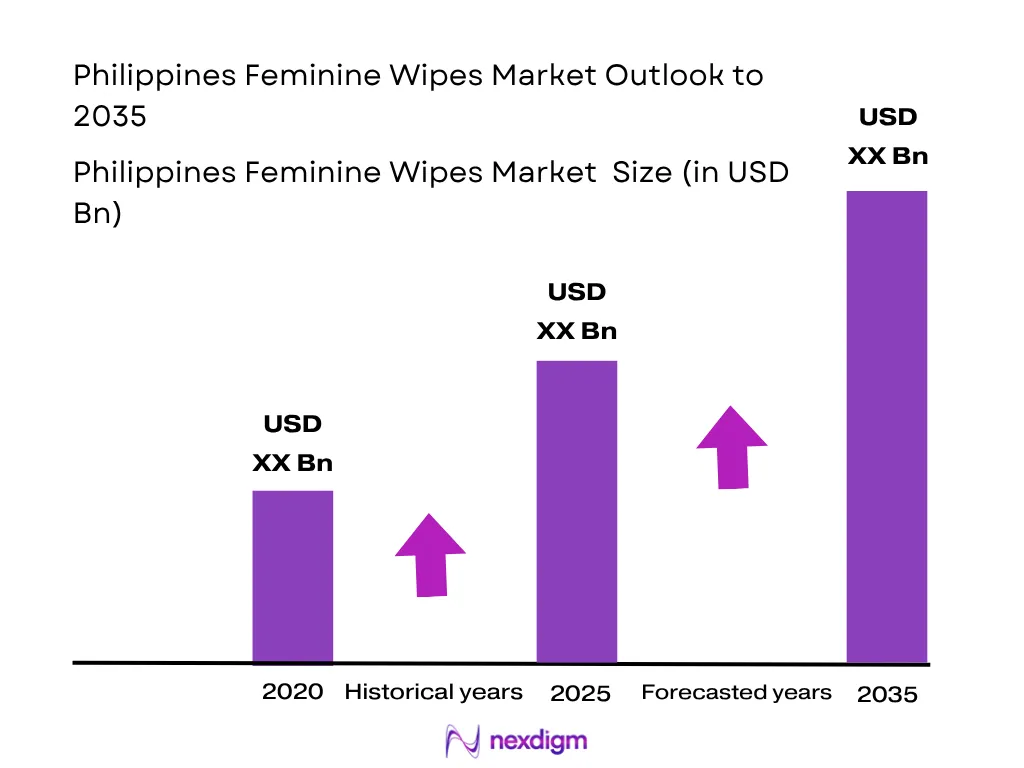
The Philippines feminine wipes market is valued at USD ~ billion in 2025, while the global retail market size was approximately USD ~ billion in 2024, with expectations of continued growth at a CAGR of 6.7% from 2024 to 2034. In the Philippines personal care wipes market context (which includes feminine wipes), import data and retail growth metrics indicate strong year‑over‑year expansion, with the overall personal care wipes sector posting double‑digit growth in retail value from 2023 to 2024, reflecting rising consumer adoption of disposable hygiene products including feminine wipes.
Regional dominance within the Philippines feminine wipes market is shaped by urban centers such as Metro Manila, Cebu, and Davao, where higher disposable incomes, greater health and hygiene awareness, and a denser modern retail presence drive stronger consumption. These metropolitan areas benefit from robust distribution networks that ensure product availability across drugstores, supermarkets, and online marketplaces; they also see higher marketing penetration and consumer exposure to international and premium brands compared with provincial regions where purchase frequency and product variety are comparatively limited.
Market Segmentation
By Product Type
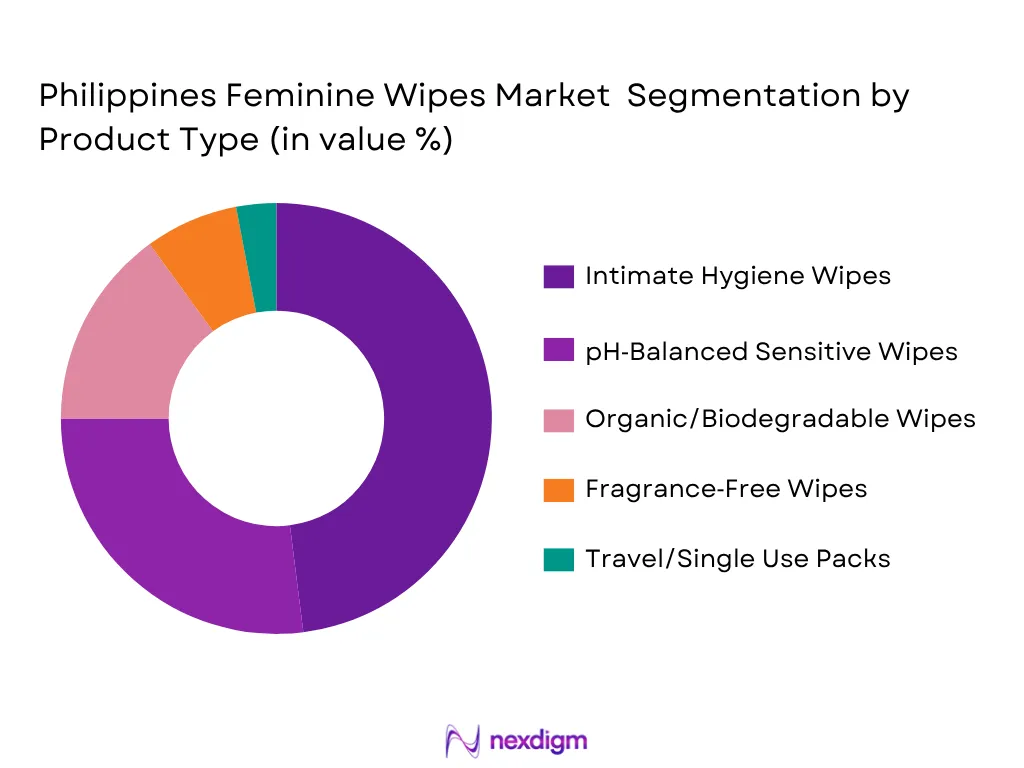
Intimate Hygiene Wipes dominate the Philippines feminine wipes market. This sub‑segment’s leadership reflects ingrained consumer preference for products specifically positioned for intimate cleansing and freshness, often supported by strong brand marketing in pharmacies, supermarkets, and online channels. Urban consumers particularly seek formulations that promise gentle care, pH balancing, and dermatological safety given heightened hygiene expectations. Leading modern retail and pharmacy distribution ensures that intimate hygiene wipes are widely available, reinforcing their penetration relative to other variants. Specialized formulations such as fragrance‑free and biodegradable wipes are growing, but they remain niche relative to mainstream intimate wipe offerings. Global research shows intimate wipes as the largest sub‑segment globally, and Philippines consumption patterns align with this trend.
By Distribution Channel
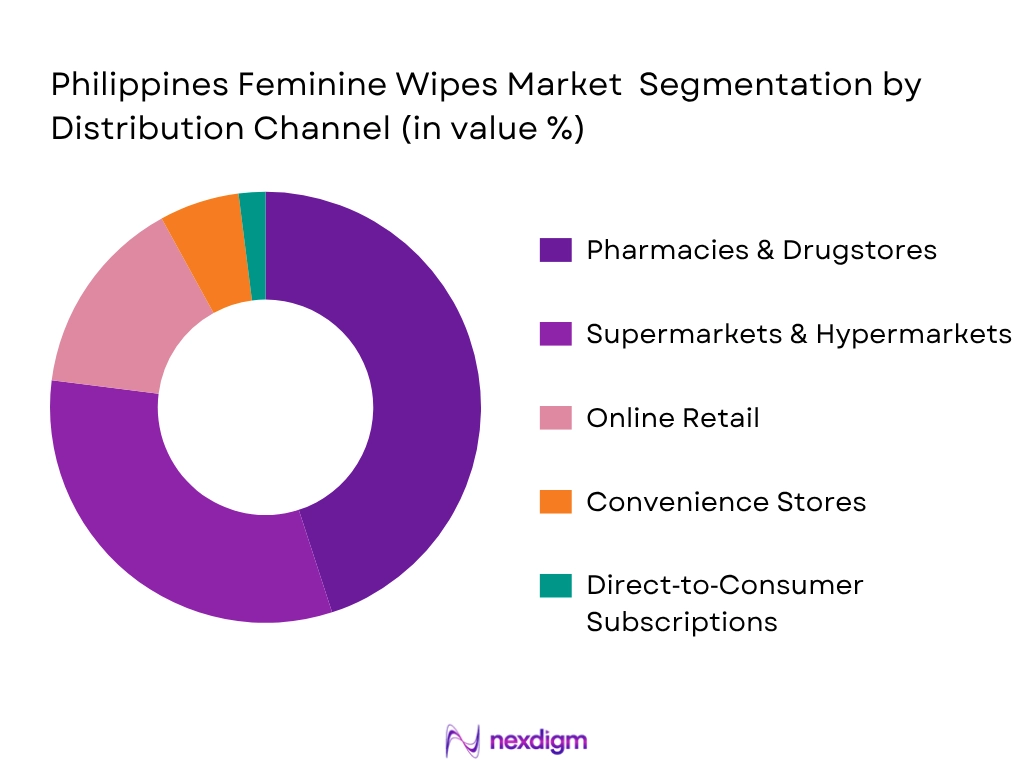
Pharmacies & Drugstores lead retail distribution in the Philippines feminine wipes market. These channels are preferred because consumers often associate pharmacy availability with product safety and quality, especially for intimate hygiene products. Physical retail footprint in urban and peri‑urban areas ensures high visibility and impulse purchase potential. Supermarkets and hypermarkets also capture significant share by offering convenient one‑stop shopping and loyalty programs that incentivize purchases across hygiene categories. E‑commerce continues to grow rapidly, driven by increased online shopping adoption for personal care items, but it remains secondary to traditional retail formats. Convenience stores and direct subscription channels are emerging options, particularly among younger consumers seeking on‑the‑go or recurring supply solutions, but they currently represent smaller portions of the market.
Competitive Landscape
The Philippines feminine wipes market competitive environment includes both local and multinational personal care brands. While comprehensive market share data by company is proprietary, the competitive structure is shaped by established personal care firms with strong distribution networks and branding, and emerging niche players focusing on sensitive and eco‑friendly formats. The competitive landscape reflects consolidation around a core group of players that leverage deep distribution in pharmacies, supermarkets, and online platforms. These brands differentiate through product innovation (such as pH‑balanced formulations, fragrance‑free lines) and marketing campaigns tailored to Filipino consumers. Domestic distribution partners and localized marketing also play a critical role in ensuring visibility and availability. Retailers with private label offerings are emerging, though their impact remains modest compared with global and regional brand portfolios.
| Company | Est. Year | Headquarters | Product Breadth | Distribution Footprint | E‑commerce Presence | Brand Recognition | Innovation Focus |
| Uni‑Care Inc. | 1990 | Philippines | ~ | ~ | ~ | ~ | ~ |
| Kimberly‑Clark Philippines | 1872 | Philippines | ~ | ~ | ~ | ~ | ~ |
| Procter & Gamble Philippines | 1837 | Philippines | ~ | ~ | ~ | ~ | ~ |
| Johnson & Johnson (Femcare) | 1886 | USA/Philippines operations | ~ | ~ | ~ | ~ | ~ |
| Unicharm Corporation | 1961 | Japan | ~ | ~ | ~ | ~ | ~ |
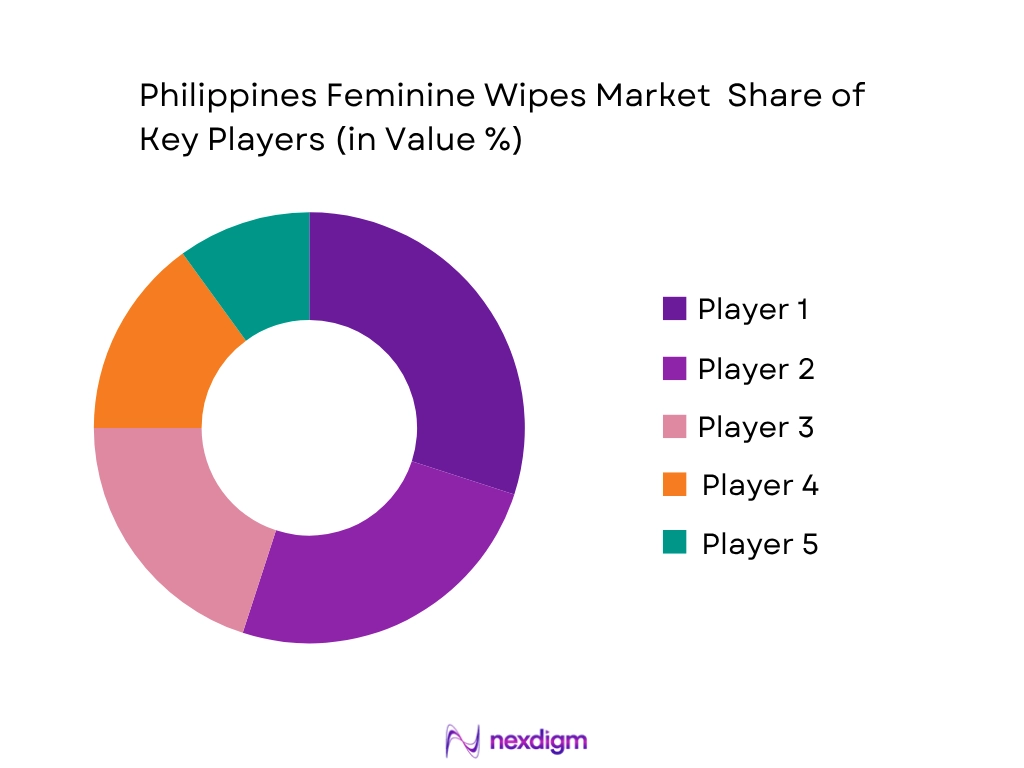
Philippines Feminine Wipes Market Analysis
Growth Drivers
Rising hygiene awareness
Consumer focus on hygiene and personal care in the Philippines is supported by macro and retail indicators for 2024–2026. The population of the Philippines is estimated at 115,843,670 people, providing a large potential user base for quality hygiene products that includes intimate wipes. Household access to safely managed sanitation services stands at 62 percent of the population, indicating ongoing improvements in hygiene infrastructure and public health interest, which correlates with demand for personal and feminine care products. Retail category performance for wipes across baby, personal and adult segments grew in current value in 2024 driven by enhanced consumer mobility and sustained post‑pandemic hygiene behaviour, illustrating consumers’ continued prioritization of hygiene formats including intimate wipes. Indonesia and Vietnam trends in tissue and hygiene also reflect broader regional hygiene adoption, with Philippine retail demonstrating similar expansion. Online use of internet services is at 67 percent of the population, enabling digital education and awareness campaigns for hygiene practices. These factors collectively anchor rising consumption of intimate wipes as part of daily hygiene routines.
Retail & pharmacy expansion
Retail access is a fundamental driver for feminine wipes distribution in the Philippines. By the end of 2024, Watsons Philippines operated 1,166 stores nationwide, including more than 400 dedicated community pharmacy outlets, reflecting strong retail and pharmacy expansion into both urban centers and provincial towns. This illustrates significant points of sale for personal and hygiene products across broad geographic coverage. Expansion included 80 new stores opened in 2024 alone, with upwards of 50 stores located outside Metro Manila, indicating strategic nationwide network growth. Retail trade sales in the Philippines increased by 8.4 percent year‑on‑year in 2024, with consumer spending comprising approximately 73 percent of GDP, underscoring the resilience and purchasing power within the retail ecosystem that supports hygiene product consumption. Additionally, the Philippine retail industry was valued at USD 145.20 billion in 2024, with modern trade channels such as pharmacy chains and supermarkets playing a major role in driving accessibility. These retail expansion dynamics, particularly in pharmacy and health & beauty store formats, enhance points of availability for feminine wipes, facilitating wider consumer reach and enabling category growth through visibility and convenience.
Market Challenges
Price sensitivity
Economic indicators for Filipino households highlight persistent price sensitivity, which directly impacts demand elasticity for personal care products including feminine wipes. The Philippines’ GDP per capita is approximately USD 3,984.8 in 2024, reflecting a middle‑income economy where discretionary spending on non‑essential personal care items may be conditioned by overall living costs. Retail inflation, as measured by consumer prices, was at 3.2 percent in 2024, indicating moderate but sustained price pressures on consumer goods, which can constrain demand for higher‑priced hygiene formats when alternatives exist. Consumer remittances, which account for 8.7 percent of GDP, support household spending but also reflect reliance on external income to meet expenses, indicating that price sensitivity remains a meaningful market constraint for discretionary categories. Hygiene categories such as wipes also compete within broader personal care budgets, and high retail markup structures in pharmaceuticals and FMCG may further accentuate sensitivity consistent with reported healthcare retail pricing concerns, where cumulative markups inflate end prices. As a result, feminine wipes products must be priced competitively relative to alternative personal hygiene options to secure repeat purchase behaviour, especially among lower to middle‑income consumer segments.
FDA labeling & safety compliance
Regulatory compliance with the Philippines Food and Drug Administration (FDA) presents systematic requirements for personal hygiene products, including feminine wipes, that must meet safety, labeling, and quality standards before retail distribution. The FDA mandates detailed product information and quality credentials for regulated goods, requiring manufacturers and importers to supply comprehensive details including ingredients, manufacturing identifiers, and safety data during registration and distribution. While specific published numbers for compliance workload are not publicly consolidated, the FDA’s stringent administrative process is publicly documented, involving multiple documentation layers for health‑related products to ensure consumer safety. This regulatory environment ensures product integrity but also introduces complexity and cost into market entry and shelfing, particularly for smaller brands and importers that must allocate resources for compliance documentation, stability testing, and approval workflows. Consumer confidence in regulated products may be high, yet the administrative burden can delay product launch timelines and create resource barriers for new entrants. Moreover, enforcement intensity may vary across regions, with rural distribution points experiencing inconsistent regulatory oversight, affecting both product compliance and consumer safety perceptions. These dynamics underscore the importance of regulatory navigation in the feminine wipes market, balancing consumer protection with operational efficiency.
Opportunities
Eco‑friendly product expansion
Demand for environmentally sustainable products is emerging in the Philippines, providing an opportunity within the feminine wipes segment to differentiate offerings. Consumer awareness of sustainable hygiene behaviours correlates with improving sanitation services 62 percent of the Philippine population has access to safely managed sanitation services, suggesting growing expectations for comprehensive personal care standards that include environmental considerations. Internet penetration reaching 67 percent of the population facilitates information exchange about product sustainability and ecological impact, enhancing consumer exposure to eco‑friendly solutions. Retail tissue and hygiene data indicate a diversification trend within the wipes category, with adult and specialty wipes gaining traction beyond traditional baby wipes, reflecting consumer interest in differentiated product formats that may include biodegradable and low‑impact materials. Furthermore, high availability of modern retail channels with pharmacy networks expanding to over 1,000 locations nationwide creates a broad platform for introducing premium, eco‑friendly feminine wipes alongside standard formats. These structural conditions — sanitation awareness, digital information access, and retail reach provide fertile ground for brands that can position eco‑friendly formulations as value‑adding alternatives that appeal to environmentally conscious Filipino consumers without compromising hygiene performance.
Private label growth
The Philippine retail landscape, underpinned by robust consumer spending and expanding modern trade channels, supports private label development within essential personal care categories, including feminine wipes. Retail trade representing USD 145.20 billion in revenue in 2024 highlights a substantial market footprint where private label strategies can be deployed by supermarkets and pharmacy retailers to address price‑sensitive consumers. Retail trade sales increased by 8.4 percent year‑on‑year in 2024, reflecting consumer demand resilience in personal care categories that can be served by retailer brands. Pharmacy chain expansion, such as Watsons’ network of 1,166 stores, provides extensive shelf space and visibility for private label hygiene products that can be priced more competitively than national brands while meeting quality expectations. Additionally, organized retail penetration into provincial markets evidenced by over 50 new pharmacy openings outside Metro Manila in 2024, enables local brand variants to reach diverse consumer segments where branded products may command premium pricing. These structural retail developments create opportunity for private labels to carve meaningful presence in intimate wipes through value positioning that aligns with Filipino consumers’ price sensitivity and channel convenience dynamics.
Future Outlook
The Philippines feminine wipes market is expected to continue its growth trajectory over the next decade, driven by sustained hygiene awareness, expanding retail infrastructure, and the increasing preference for convenient personal care formats. E‑commerce will play an increasingly important role, particularly among younger and urban consumers, supported by improved online payment systems and delivery logistics. Continued innovation in formulation including eco‑friendly, biodegradable, and sensitive skin variants will expand the market’s appeal beyond mainstream consumers to niche segments seeking premium or specialized products. Retailers and brands that can align product offerings with Filipino consumer values safety, convenience, and quality are likely to secure stronger positions as the category evolves.
Major Market Players
- Uni‑Care Inc.
- Kimberly‑Clark Philippines
- Procter & Gamble Philippines
- Johnson & Johnson (Femcare Division)
- Unicharm Corporation
- Reckitt Benckiser (Personal Care)
- Kao Corporation (Intimate Care)
- Local private label wipe manufacturers
- Regional brands from Indonesia & Malaysia
- E‑commerce native brands
- Eco‑friendly wipe start‑ups
- Franchise distributorship brands
- Retailer private labels (major pharmacy chains)
- International niche boutique brands
- Emerging dermatological intimate care brands
Key Target Audience
- FMCG and Personal Care Brand Managers
- Retail Chain Category Buyers
- E‑commerce Marketplace Strategists
- Investments and Venture Capitalist Firms (consumer health & hygiene focus)
- Health & Beauty Retail Operators
- Government and Regulatory Bodies (e.g., Philippines Food and Drug Administration (FDA), Department of Trade and Industry (DTI))
- Supply Chain & Distribution Partners
- Private Equity Firms Focused on Consumer Goods
Research Methodology
Step 1: Identification of Key Variables
The initial phase involved constructing an ecosystem map of the Philippines feminine wipes market, including consumer segments, product types, and distribution channels. This was underpinned by desk research using secondary databases, industry reports, trade data, and retail analytics to define critical market drivers and boundaries.
Step 2: Market Analysis and Construction
Historical sales data and retail performance indicators were analyzed to map market penetration and growth. This included segmentation by product type and distribution channel to derive revenue contributions. Price trends, channel dynamics, and consumer purchasing patterns were evaluated to validate revenue estimates.
Step 3: Hypothesis Validation and Expert Consultation
Market hypotheses about growth drivers, barriers, and adoption trends were tested through consultations with industry experts including retail category managers, distribution executives, and personal care product specialists. These insights provided operational context and refined market assumptions.
Step 4: Research Synthesis and Final Output
The final phase synthesized insights from secondary research and expert input to build a comprehensive market model. This included cross‑verification of data points, alignment with regional trends, and preparation of forecast scenarios ensuring accuracy and relevance for stakeholders.

- Executive Summary
- Research Methodology (Market Definitions & Domain Scope, Abbreviations, Research Design Framework, Market Sizing & Forecasting Approach, Data Collection Matrix, Primary & Secondary Sources, Validation Protocols, Limitations of Study)

- Definition and Product Classification
- Category Genesis & Adoption Curve
- Macro‑environment Analysis
- Product Life Cycle in Philippines Context
- Feminine Wipes Supply Chain & Value Delivery Ecosystem
- Retail & E‑commerce Channel Structures

- Growth Drivers (Rising hygiene awareness, Retail & pharmacy expansion, Urban lifestyle adoption, E‑commerce growth, pH‑balanced & sensitive skin innovations)
- Market Restraints (Price sensitivity, FDA labeling & safety compliance, Limited eco-friendly options, Raw material cost pressures)
- Opportunities (Eco-friendly product expansion, Private label growth, Institutional hygiene partnerships, Provincial urban market growth)
- Emerging Trends (Omnichannel retail adoption, Influencer-led campaigns, Personalized packs, Sustainability certifications)
- Regulatory Environment (FDA hygiene standards, Import & customs compliance, Advertising & product claim rules)
- Porter’s Five Forces Analysis (New entrants, Supplier power, Buyer power, Substitutes, Competitive rivalry)
- SWOT Analysis (Strengths, Weaknesses, Opportunities, Threats)
- Value Chain and Supply Chain Analysis (Raw materials – nonwoven & cleansers, Local vs imported sourcing, Manufacturing & contract packaging, Logistics hubs, Retail & online distribution, QA & testing)
- Pricing Dynamics and Margin Stack (ASP by segment, Channel pricing, Promotions, Manufacturer vs retailer margins, Cost pass-through)
- Consumer Purchase Behavior & Retail Analytics (Purchase frequency, Basket mix & cross-sell, Urban vs provincial patterns, Channel conversion insights)

- By Market Value (22020-2025)
- By Market Volume (2020-2025)
- By Average Selling Price (2020-2025)
- By Distribution Value Chain Share (2020-2025)

- By Product Type (In Value%)
Regular Freshening Wipes
pH‑Balanced Feminine Wipes
Extra‑Sensitive/ Dermatologically Tested Wipes
Organic/Biodegradable Wipes
Multipurpose - By Distribution Channel (In Value%)
Pharmacies/Drug Stores
Supermarkets/Hypermarkets
Traditional Retail (Mom‑and‑Pop)
E‑commerce & Digital Marketplaces
Direct‑to‑Consumer (Brand Webstores, Subscriptions) - By Consumer Demographic (In Value%)
Age Cohorts (Teen, Young Adult, Mature)
Urban vs Rural Penetration
Income‑Based Segmentation (Low, Mid, High) - By Packaging Format (In Value%)
Sachets
Pop‑Top Pack
Refill Packs
Travel/Single‑Use Packs - By Price Tier (In Value%)
Value Segment
Mid‑Tier
Premium/Doctor‑Recommended Tier

- Market Share Assessment (Value & Volume)
- Cross‑Company Benchmarking Parameters (Product Assortment Breadth (Variants/Functional Attributes), Brand Equity & Awareness Index, Pricing Architecture & Tier Positioning, Channel Penetration (Pharmacy, Modern Retail, Online), Distribution Network Strength, Customer Loyalty/Repeat Purchase Rates, Marketing Spend & Campaign Footprint, Sustainability & Eco‑Certifications)
- Brand Positioning (Value vs quality vs innovation, Target segment alignment, Price positioning)
- Price & SKU Analysis (Average selling price by segment, Online vs offline pricing, Promotional discounts, SKU-level comparison)
- SWOT Analysis – Key Players (Strengths, Weaknesses, Opportunities, Threats specific to Philippines market)
- Retail Shelf and Digital Shelf Analysis (Search rank, product title optimisation, claim visibility, review count, rating quality, image pack hierarchy, subscription availability, out-of-stock frequency)
- Market Competitive Intelligence
Uni‑Care Inc.
Kimberly‑Clark Philippines
Procter & Gamble Philippines
Johnson & Johnson (Femcare Division)
Unicharm Corporation
Reckitt Benckiser (Vanish/Wipes SKU)
Kao Corporation (Laurier)
Hengan International Group
Kimberly‑Clark (Cottonelle/Everyday)
Nivea (Beiersdorf) – Wipes Variants
Human Nature Philippines
Happy Skin Cosmetics (Intimate Care Extensions)
Belo Essentials/Monde Nissin Portfolio
Local Private Label Wipes Players
Emerging Direct‑to‑Consumer Brands

- Usage Patterns & Frequency (Daily/weekly usage, Seasonal or travel-driven spikes, Urban vs provincial differences)
- Demographic Insights (Age cohorts, Income tiers, Urban vs rural penetration, Lifestyle & occupation patterns)
- Purchase Drivers (Product safety & pH balance, Fragrance & comfort preferences, Packaging convenience, Brand trust & recommendation)
- Pain Points & Barriers (Price sensitivity, Skin irritation concerns, Limited eco-friendly choices, Availability in smaller towns)
- Brand Loyalty & Switching Behavior (Repeat purchase rates, Multi-brand usage, Influencer/peer influence, Promotional impact)
- Channel Preference Analysis (Pharmacies, Supermarkets, Traditional retail, E-commerce, Direct-to-consumer subscriptions)
- Basket Affinity & Cross-Sell (Purchase alongside sanitary pads, Personal care, Feminine washes, Skincare products)
- Decision-Making Process (Research & online reviews, Influencer guidance, Family/peer recommendations, Trial & sampling behavior)

- By Value (2026-2035)
- By Volume (2026-2035)
- By ASP (2025-2035)
- By Channel Forecasting (2026-2035)


 Request a Sample
 Ask for Customization
 Get a Quote
 Enquire Now