
 Download PDF
Market Overview
The Philippines fertilizer market is one of the most significant agricultural input markets in Southeast Asia, underpinned by the country’s extensive cultivation of rice, corn, sugarcane, coconut, banana, and a wide range of high-value fruits and vegetables across approximately 12 million hectares of agricultural land. Agriculture is a foundational sector of the Philippine economy, contributing approximately 10% of GDP in 2024 and employing more than 25% of the total labor force across predominantly smallholder farming households. Fertilizer consumption is driven by the need to sustain productivity on millions of small farm holdings, government subsidy and distribution programs targeting rice and corn farmers, rising commercial agriculture investment in Mindanao and Visayas, and growing demand for high-value crop production to serve domestic food markets and agricultural export industries. The Philippines imports the overwhelming majority of its fertilizer requirements, making global commodity price dynamics, foreign exchange rates, and international shipping costs critical determinants of fertilizer availability and affordability for the country’s farming population.
Market Segmentation
By Nutrient Type
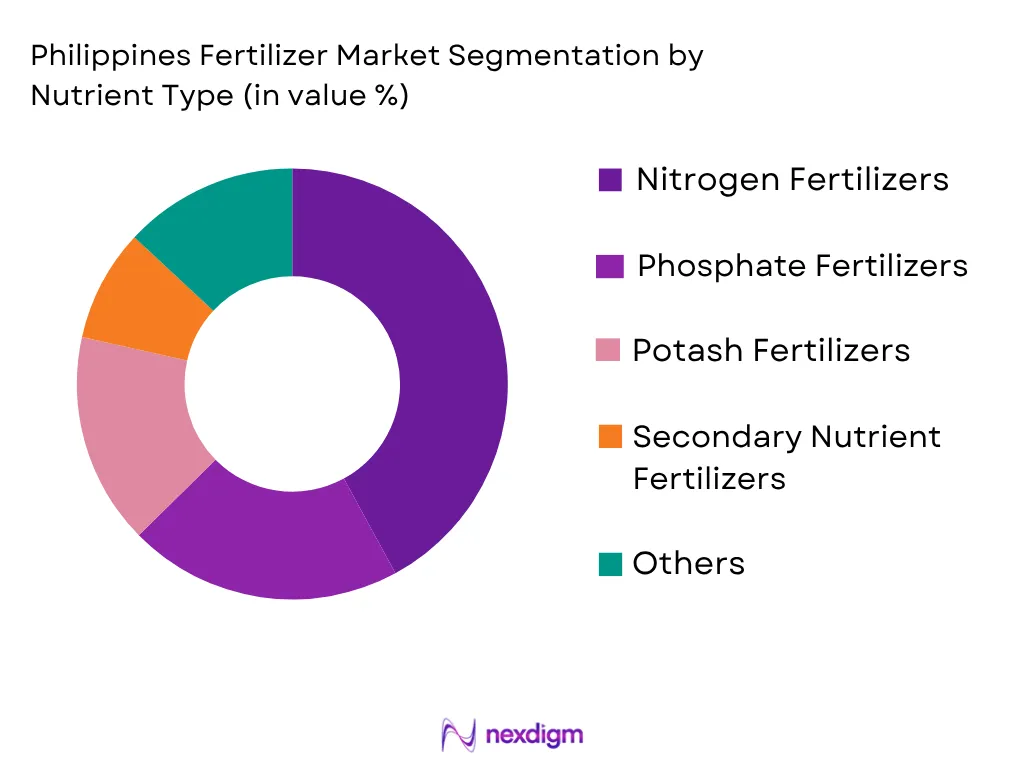
Nitrogen fertilizers dominate the Philippines fertilizer market due to the country’s extensive cultivation of rice and corn, which together account for the largest share of total fertilizer consumption and require consistent nitrogen applications to sustain productivity across the country’s diverse tropical soil types. Urea and ammonium sulfate are the most widely consumed nitrogen fertilizer products, with ammonium sulfate particularly favored by sugarcane farmers for its combined nitrogen and sulfur content. Philippine soils across Luzon, Visayas, and Mindanao are widely characterized by low nitrogen availability, particularly on intensively cropped lowland rice paddies and upland corn fields where organic matter content has been depleted by continuous cultivation without adequate nutrient replenishment. Government subsidy programs administered by the Department of Agriculture have historically channeled urea and complete fertilizers as the primary subsidized products for rice farmers, reinforcing nitrogen fertilizer dominance. Growing adoption of complete NPK fertilizers and foliar micronutrient products is gradually increasing demand for phosphate, potassium, and secondary nutrient components, but nitrogen remains the cornerstone of fertilizer use across the country.
By Crop Type
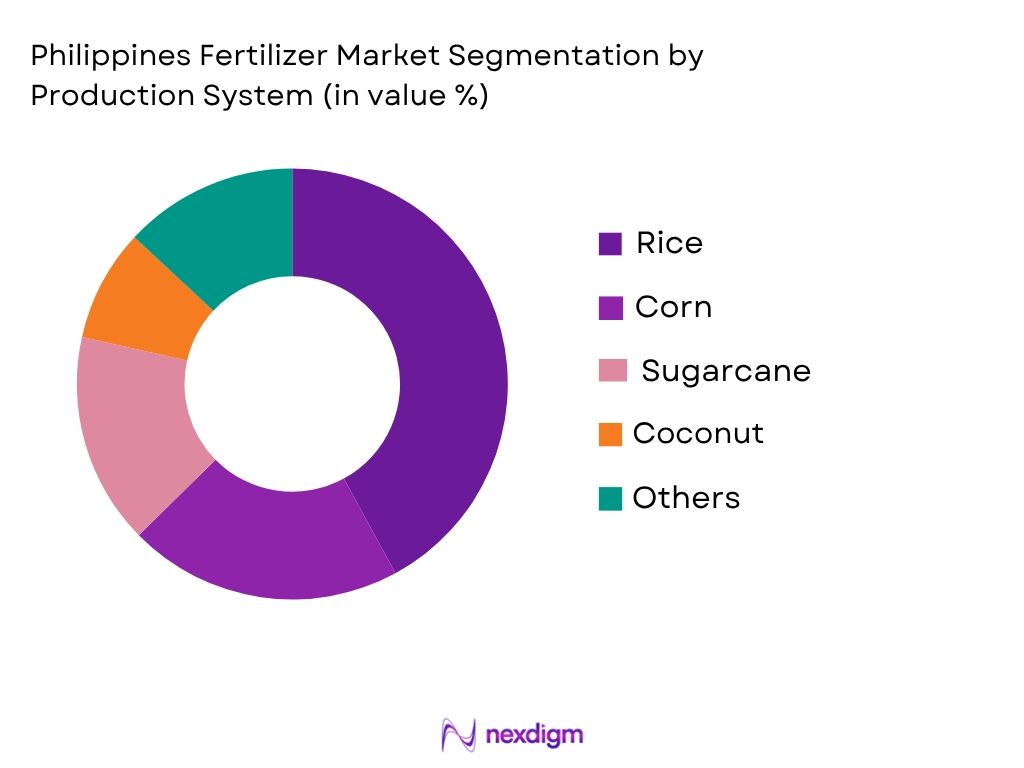
Rice represents the dominant crop segment within the Philippines fertilizer market as it is the country’s most important staple food crop, cultivated across approximately 4.7 million hectares of irrigated and rainfed lowland and upland areas by millions of smallholder farming households. The Philippines produced approximately 20 million metric tons of palay (rough rice) in 2024, with Central Luzon, Cagayan Valley, Ilocos Region, Western Visayas, and key Mindanao provinces accounting for the largest production volumes. Rice cultivation requires substantial applications of nitrogen, phosphorus, and potassium fertilizers across two cropping seasons annually, and it is the primary crop targeted by government fertilizer subsidy and distribution programs administered through the Department of Agriculture and the Philippine Rice Research Institute (PhilRice). Rising domestic demand for rice driven by population growth, and the government’s goal to achieve rice self-sufficiency, has encouraged expansion of irrigated rice area and intensification of production practices. Consequently, rice farming remains the single largest contributor to fertilizer consumption throughout the Philippines.
Competitive Landscape
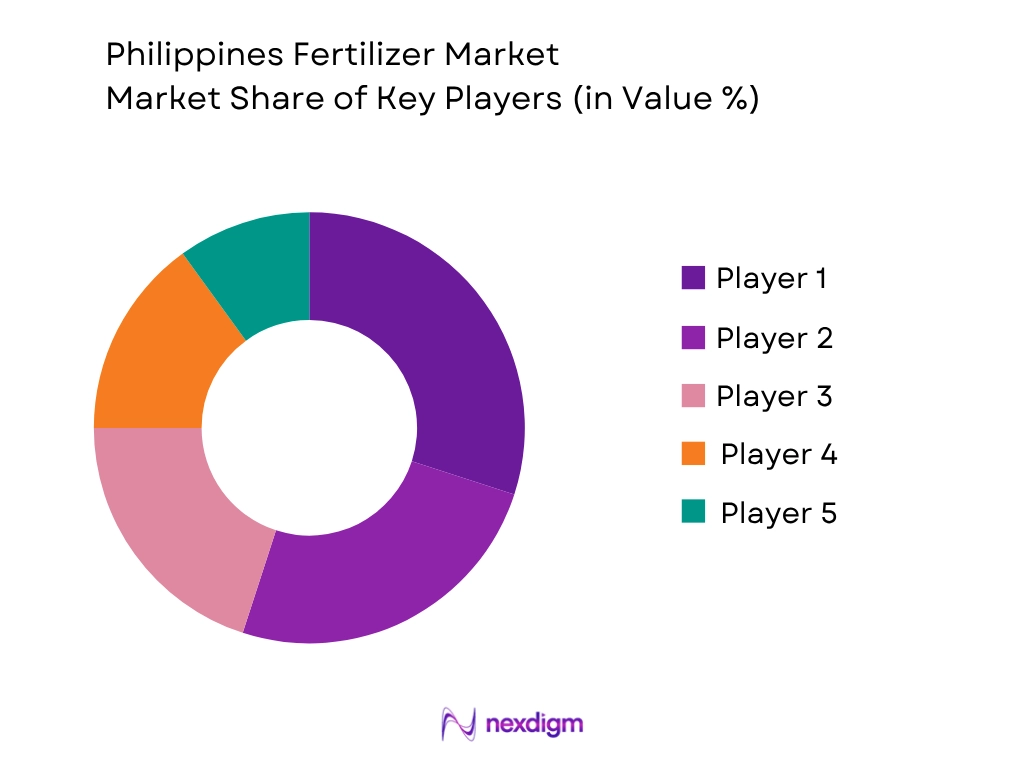
The Philippines fertilizer market is moderately concentrated, with a small number of established domestic blending companies and importers alongside multinational crop nutrition companies competing across the value chain. Fertiphil Corporation and Planters Products Incorporated are the dominant domestic players with long-established production, blending, and distribution networks. International companies including Yara, Haifa Group, OCP, and ICL serve the growing specialty and high-value crop segment. Government distribution programs significantly influence market dynamics by directing subsidized fertilizer volumes to rice and corn farmers through Department of Agriculture channels and accredited agri-dealers. Companies compete through blending and import capacity, distribution network reach across the archipelago’s island geography, government program participation, product quality assurance, and increasingly through digital agri-advisory platforms that are improving last-mile access in remote farming communities.
| Company | Establishment Year | Headquarters | Product Portfolio | Production & Blending Facilities
|
Import Infrastructure | Distribution Reach | Specialty Fertilizer Portfolio | Agronomic Support Network |
| Yara Philippines | 1905 | ~ | ~ | ~ | ~ | ~ | ~ | ~ |
| ICL Specialty Fertilizers Philippines | 1968 | ~ | ~ | ~ | ~ | ~ | ~ | ~ |
| Fertiphil Corporation | 1960 | ~ | ~ | ~ | ~ | ~ | ~ | ~ |
| Planters Products Inc. | 1961 | ~ | ~ | ~ | ~ | ~ | ~ | ~ |
| OCP Philippines | 1920 | ~ | ~ | ~ | ~ | ~ | ~ | ~ |
Philippines Fertilizer Market Analysis
Growth Drivers
Rising Population and Growing Domestic Food Demand
The Philippines fertilizer market is fundamentally driven by the country’s robust population growth and the resulting surge in domestic food demand. According to the Philippine Statistics Authority (PSA), the Philippines’ population surpassed 115 million in 2024, making it the thirteenth most populous country in the world and the second most populous in Southeast Asia after Indonesia. Population growth is expected to continue at approximately 1.5% annually, adding roughly 1.7 million new consumers each year and placing sustained upward pressure on the agricultural sector to increase domestic food production. The PSA reported that the Philippines’ agricultural sector employed approximately 26% of the total labor force in 2024, with rice, corn, and coconut as the three largest commodity contributors to agricultural output value. Demand for rice, the country’s primary staple food, continues to grow in line with population expansion, with the government targeting rice self-sufficiency under the Rice Competitiveness Enhancement Fund (RCEF) and related productivity improvement programs. Rising incomes and urbanization are also driving increased consumption of higher-value agricultural products including vegetables, fruits, poultry, and processed foods, encouraging commercial farm investment and fertilizer adoption in high-value crop production. The Philippines’ GDP exceeded USD 440 billion in 2024 according to the World Bank, with agricultural productivity improvement identified as a national development priority. These population and food demand dynamics are expected to remain among the most powerful structural drivers of fertilizer consumption growth throughout the country over the forecast period.
Government Fertilizer Subsidy Programs and Rice Competitiveness Enhancement Fund
Government-led fertilizer subsidy and distribution programs represent a major driver of fertilizer consumption in the Philippines, with the Department of Agriculture (DA) historically allocating significant annual budgets toward inorganic fertilizer subsidies, distribution programs, and soil fertility improvement initiatives targeting smallholder rice and corn farmers. The Rice Competitiveness Enhancement Fund (RCEF), established under Republic Act 11203 or the Rice Tariffication Law of 2019, redirected a portion of rice import tariff revenues toward farm inputs including certified seeds, fertilizers, and irrigation support for rice farmers registered under the Registry System for Basic Sectors in Agriculture (RSBSA). According to the DA, the RCEF distributed subsidized fertilizers to hundreds of thousands of rice farmers across major production provinces annually, providing meaningful cost relief and supporting fertilizer adoption among resource-constrained smallholders. Additional programs under the Philippine Rural Development Program (PRDP) and local government unit-level agricultural assistance schemes further channel subsidized or discounted fertilizers to farmers across Luzon, Visayas, and Mindanao. The Philippine government has also engaged international organizations including the Food and Agriculture Organization (FAO) and development finance institutions to support soil health and fertilizer use efficiency programs in priority rice and corn producing regions. While subsidy program efficiency and targeting remain areas for improvement, government fertilizer distribution continues to underpin a substantial share of annual fertilizer demand, particularly among the country’s approximately 5.5 million smallholder rice farming households.
Market Challenges
Heavy Import Dependence and Global Price Volatility
A fundamental and persistent challenge facing the Philippines fertilizer market is the country’s almost total dependence on imported fertilizer products and raw materials, which exposes the market to significant price volatility, supply chain disruptions, and foreign exchange risks. According to the Fertilizer and Pesticide Authority (FPA) of the Philippines, the country imports more than 90% of its total fertilizer requirements, with urea, complete fertilizer (14-14-14), ammonium sulfate, DAP, and MOP sourced from China, Indonesia, Malaysia, Russia, Belarus, Morocco, and other international suppliers. The Philippine peso’s sensitivity to US dollar movements amplifies the impact of global commodity price fluctuations on domestic fertilizer costs, as international fertilizer prices are denominated in US dollars while most Filipino farmers earn income in pesos. The global fertilizer price spikes of 2021 and 2022, driven by natural gas shortages, China’s export restrictions, and geopolitical disruptions following the Russia-Ukraine conflict, caused domestic urea prices in the Philippines to increase by more than 100% within a single year, severely straining smallholder farm budgets and suppressing fertilizer application rates across major rice and corn producing regions. The absence of significant domestic fertilizer production capacity — no major ammonia-urea plant has operated at commercial scale in the Philippines in recent years — means the country has limited ability to buffer against global supply shocks. Strengthening domestic production capability and diversifying import supplier relationships are widely recognized as strategic priorities for improving the resilience and affordability of the Philippine fertilizer market.
Typhoon Risk, Climate Vulnerability, and Fragmented Island Distribution Logistics
The Philippines fertilizer market faces severe and recurring operational challenges stemming from the country’s extreme vulnerability to typhoons, flooding, drought, and other climate-related disruptions that regularly damage agricultural production, destroy stored fertilizer inventories, and disrupt supply chain logistics. According to the Philippine Atmospheric, Geophysical and Astronomical Services Administration (PAGASA), the Philippines is struck by an average of 20 typhoons per year, with a significant number making landfall in major agricultural production areas including Central Luzon, Cagayan Valley, Eastern Visayas, and Mindanao. Typhoon damage to roads, bridges, port facilities, and farm infrastructure creates severe disruptions to fertilizer delivery and farm operations during the critical planting and top-dressing periods of the wet season cropping calendar. Additionally, the Philippines’ archipelagic geography — comprising over 7,100 islands spread across more than 300,000 square kilometers of sea area — creates one of the world’s most complex agricultural input distribution logistics challenges. Delivering fertilizers from major import terminals in Manila, Cebu, and Davao to the thousands of municipalities and farming communities across remote islands requires extensive inter-island shipping, overland trucking over poorly maintained rural roads, and last-mile distribution through agri-dealer networks that are frequently under-resourced and geographically stretched. These logistics challenges increase transportation costs, extend delivery lead times, and raise farm-gate fertilizer prices for farmers located in remote production areas, suppressing adoption and increasing the risk of product shortages during peak demand periods across the planting season.
Market Opportunities
Development of Domestic Fertilizer Blending and Production Capacity
The Philippines’ heavy import dependence and recurring fertilizer price crises have created strong policy and commercial incentives to develop greater domestic fertilizer blending and production capacity. According to the FPA, the Philippines has a network of registered fertilizer blending plants that mix imported raw materials into formulated NPK and specialty products for the domestic market, but overall blending capacity is insufficient to cover national demand during peak season periods. Investment in additional blending facilities, particularly in major agricultural regions in Mindanao, Visayas, and Luzon, could reduce distribution costs, improve product availability, and enable more locally tailored nutrient formulations suited to Philippine soil and crop conditions. The country’s natural gas resources in the Malampaya field in Palawan, though declining, and potential future offshore gas developments represent a foundation for domestic ammonia and urea production if economically developed. The Board of Investments and the Department of Trade and Industry have identified fertilizer manufacturing as a priority investment area under the Philippine Development Plan, with incentives available for qualifying domestic production projects. Regional blending hubs positioned near major ports and agricultural production zones could significantly reduce logistics costs and improve fertilizer availability across the archipelago. These investments would reduce the Philippines’ vulnerability to global commodity price shocks, strengthen food security, and create industrial employment across the manufacturing and logistics value chain.
Expansion of High-Value Crop Fertilizer Demand in Mindanao and Visayas
The rapid expansion of commercial high-value crop production across Mindanao and Visayas represents a significant growth opportunity for specialty and premium fertilizer products in the Philippines. According to the DA’s Bureau of Plant Industry, the Philippines is one of the world’s largest exporters of banana, pineapple, and coconut products, with Mindanao accounting for the majority of banana and pineapple plantation acreage. Export-oriented plantation crops including Cavendish banana, Del Monte and Dole pineapple operations, and oil palm cultivation require intensive and scientifically managed fertilizer programs using high-quality NPK blends, foliar micronutrient formulations, and precision soil nutrition management. Rising investment in cacao, coffee, rubber, and tropical fruit production across Davao, Soccsksargen, Northern Mindanao, and Zamboanga Peninsula is creating growing demand for specialty fertilizer solutions tailored to perennial and high-value tree crop nutrition requirements. Domestic vegetable production for the urban consumer market in Metro Manila, Cebu, and Davao is also intensifying, with commercial vegetable farms in Benguet, Bukidnon, and Nueva Ecija adopting improved nutrient management practices. International agribusiness companies and domestic conglomerates investing in commercial agriculture across Mindanao represent a growing customer segment for technically sophisticated fertilizer products and crop nutrition advisory services, positioning the high-value crop segment as one of the strongest opportunities for premium fertilizer market development in the Philippines.
Future Outlook
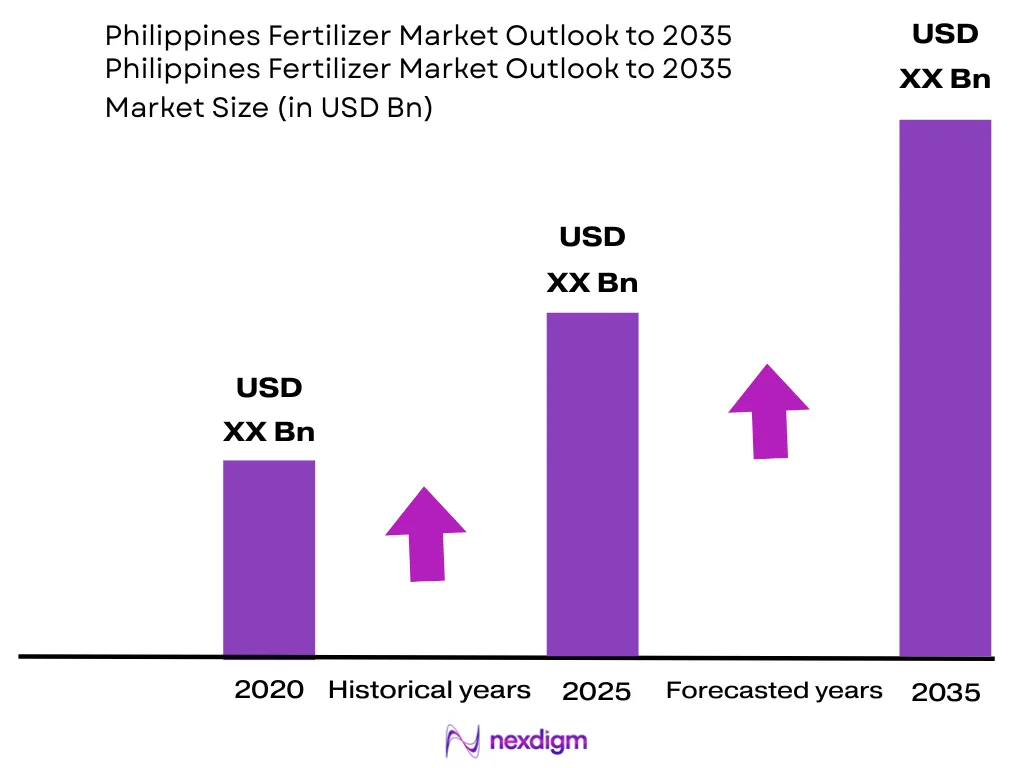
The Philippines fertilizer market is expected to witness sustained growth over the forecast period driven by continuing population expansion, rising food demand, government investment in agricultural productivity programs, and growing commercial agriculture development across Mindanao and Visayas. The Rice Competitiveness Enhancement Fund and related DA programs are expected to continue supporting fertilizer access for smallholder rice farmers, while private sector investment in high-value crop production will drive demand for specialty and premium fertilizer products. Improvements in domestic blending capacity, digital agri-input distribution platforms, and precision agriculture adoption are anticipated to improve fertilizer accessibility and use efficiency across the archipelago. Rising awareness of soil health management, organic farming, and sustainable crop nutrition will further diversify the product mix toward specialty and biological inputs. The Philippines’ young and growing population, vast agricultural land resources, and significant untapped crop yield potential position the fertilizer market for sustained long-term expansion through 2035.
Major Players
- Fertiphil Corporation
- Planters Products Incorporated
- Yara Philippines
- Haifa Group Philippines
- OCP Philippines
- ICL Specialty Fertilizers Philippines
- Bayer CropScience Philippines
- Syngenta Philippines
- East-West Seed Philippines
- Agri-Stores Inc.
- Cielo Farms and AgriTech
- Filchem Industrial Corporation
- Agventure Inc.
- SL Agritech Corporation
- Unahco Inc. (Univet Agriculture)
Key Target Audience
- Fertilizer Manufacturers, Blenders, and Importers
- Agricultural Input Distributors, Agri-Dealers, and Retailers
- Commercial Farming Enterprises and Agribusiness Plantations
- Smallholder Farmer Cooperatives and Associations
- Investments and Venture Capitalist Firms
- Government and Regulatory Bodies (Department of Agriculture, Fertilizer and Pesticide Authority, Bureau of Plant Industry, Philippine Rice Research Institute, Philippine Coconut Authority)
- Fertilizer Importers and Exporters
- Agri-Fintech and Digital Agriculture Platform Providers
Research Methodology
Step 1: Identification of Key Variables
The initial phase involves constructing an ecosystem map encompassing all major stakeholders within the Philippines Fertilizer Market. Extensive secondary research is conducted through industry publications, government databases, company annual reports, trade associations, and agricultural statistics. The objective is to identify critical variables influencing fertilizer demand, supply, pricing, imports, and crop production.
Step 2: Market Analysis and Construction
This phase focuses on gathering and analyzing historical information regarding fertilizer imports, blending output, nutrient consumption, crop acreage, and agricultural production. Market revenues are estimated through analysis of fertilizer volumes, average selling prices, and nutrient demand trends. Both supply-side and demand-side assessments are incorporated to develop comprehensive market estimates.
Step 3: Hypothesis Validation and Expert Consultation
Preliminary findings and market assumptions are validated through structured interviews with fertilizer importers, blenders, distributors, agricultural cooperatives, agronomists, and industry specialists. These consultations provide valuable insights into purchasing patterns, nutrient application trends, production economics, and future market developments.
Step 4: Research Synthesis and Final Output
The final stage integrates findings obtained from primary and secondary research. Data triangulation techniques are applied to ensure consistency and reliability across all market estimates. The resulting report provides a comprehensive assessment of market structure, competitive dynamics, growth opportunities, and long-term industry outlook for the Philippines Fertilizer Market.

- Executive Summary
- Research Methodology (Market Definitions and Assumptions, Abbreviations, Market Sizing Approach, Top-Down Analysis, Bottom-Up Analysis, Fertilizer Demand Assessment by Crop Area, Nutrient Consumption Analysis, Import-Export Assessment, Primary Industry Interviews, Data Triangulation, Forecasting Framework, Limitations and Future Conclusions)

- Definition and Scope
- Market Evolution and Industry Genesis
- Timeline of Major Industry Developments
- Philippines Agricultural Production Ecosystem
- Fertilizer Industry Value Chain Analysis

- Growth Drivers (Expansion of Rice and Corn Cultivation, Rising Population and Food Demand, Government Fertilizer Subsidy Programs, Increasing Commercial Agriculture Investment, Growth in High-Value Crop Production, Rising Adoption of Modern Farming Practices)
- Market Challenges (Heavy Dependence on Imported Fertilizers, Typhoon and Climate-Related Disruptions, Poor Rural Infrastructure and Last-Mile Distribution, Currency Volatility and Rising Input Costs, Fragmented Smallholder Farm Structure)
- Market Opportunities (Domestic Fertilizer Production Development, Specialty Fertilizer Growth for High-Value Crops, Biofertilizer and Organic Fertilizer Adoption, Digital Agri-Input Platforms, Expansion of Precision Agriculture Technologies)
- Market Trends (Increased Use of Blended NPK Fertilizers, Growing Adoption of Foliar and Liquid Fertilizers, Expansion of Organic and Biofertilizer Products, Digital Agriculture Platform Integration, Customized Nutrient Solutions for Tropical Crops)
- Government Regulations (Fertilizer and Pesticide Authority Regulatory Framework, Bureau of Plant Industry Standards, Philippine National Standards for Fertilizers, Import and Trade Policies, Environmental Compliance Requirements)
- Import Dependency Assessment (Urea Import Ratio, Phosphate Import Ratio, Potash Import Ratio, Supplier Country Concentration)
- Raw Material Analysis (No Significant Domestic Raw Material Production, Import Origin Analysis, Price Sensitivity to Global Commodity Markets, Logistics and Storage Constraints)
- Fertilizer Consumption Intensity Analysis (Kg per Hectare, Nutrient Use Efficiency, Crop-Wise Consumption, Regional Application Rates)
- Price Trend Analysis (Urea Prices, Complete Fertilizer Prices, Ammonium Sulfate Prices, DAP Prices, MOP Prices)
- Supply-Demand Gap Analysis (Import Volumes, Domestic Blending Capacity, Inventory Levels, Demand Forecasting)
- SWOT Analysis
- Porter’s Five Forces Analysis
- PESTLE Analysis
- Stakeholder Ecosystem
- Competition Ecosystem

- By Market Value (2020-2025)
- By Production Volume (2020-2025)
- By Average Selling Price (2020-2025)

- By Nutrient Type (In Value %)
Nitrogen Fertilizers
Phosphate Fertilizers
Potash Fertilizers
Secondary Nutrient Fertilizers
Micronutrient Fertilizers
Specialty and Customized Fertilizers - By Application Method (In Value %)
Soil Application
Fertigation
Foliar Application
Seed Treatment
Precision Agriculture Application - By Crop Type (In Value %)
Rice
Corn
Sugarcane
Coconut
Banana
Vegetables
Pineapple
Rubber
Others - By Region (In Value %)
Central Luzon
Calabarzon
Cagayan Valley
Ilocos Region
Western Visayas
Northern Mindanao
Davao Region
Soccsksargen
Other Regions - By Distribution Channel (In Value %)
Government Programs (PhilFoodEx, DA Fertilizer Distribution)
Agricultural Cooperatives
Agricultural Retailers and Agri-Dealers
Direct Sales by Manufacturers and Importers
Distributors and Wholesalers

- Market Share Analysis of Major Players (By Value, By Volume, Nutrient Segment, Crop Segment, By Region)
- Market Concentration Analysis
- Cross Comparison Parameters (Product Portfolio Diversity, Annual Fertilizer Import and Blending Capacity, Distribution Network Reach, Government Program Participation, Agronomic Technical Service Coverage, Specialty Fertilizer Portfolio Strength, Crop-Specific Nutrient Solution Capability, Island Logistics Infrastructure)
- SWOT Analysis of Major Players
- Pricing Analysis by Product Type and Nutrient Grade
- Detailed Profiles of Major Companies
Fertiphil Corporation
Planters Products Incorporated
Yara Philippines
Haifa Group Philippines
OCP Philippines
ICL Specialty Fertilizers Philippines
Bayer CropScience Philippines
Syngenta Philippines
East-West Seed Philippines
Agri-Stores Inc.
Cielo Farms and AgriTech
Filchem Industrial Corporation
Agventure Inc.
SL Agritech Corporation
Unahco Inc. (Univet Agriculture)

- Crop Nutrient Consumption Assessment (Crop Area, Yield Targets, Nutrient Removal Rates, Fertilizer Intensity)
- Farm Size Analysis (Smallholder Subsistence Farms, Medium Commercial Farms, Large Agribusiness Plantations)
- Purchasing Power Analysis (Farm Income Levels, Subsidy Access, Credit Availability, Fertilizer Budget Allocation)
- Seasonal Demand Assessment (Wet and Dry Season Planting Cycles, Crop Calendar, Procurement Patterns)
- Farmer Purchasing Behavior (Brand Preference, Nutrient Preference, Price Sensitivity)
- Precision Agriculture Adoption Analysis (Mobile Advisory Platforms, Variable Rate Technology, Digital Farm Management)
- Sustainability Adoption Analysis (Organic Farming Practices, Soil Health Management, Conservation Agriculture)
- Pain Point Analysis (Input Costs, Fertilizer Availability, Typhoon Risk, Last-Mile Access, Counterfeiting, Agronomic Support)
- Purchase Decision-Making Process

- By Market Value (2026-2035)
- By Production Volume (2026-2035)
- By Average Selling Price (2026-2035)


 Request a Sample
 Ask for Customization
 Get a Quote
 Enquire Now