

 Download PDF
Market Overview
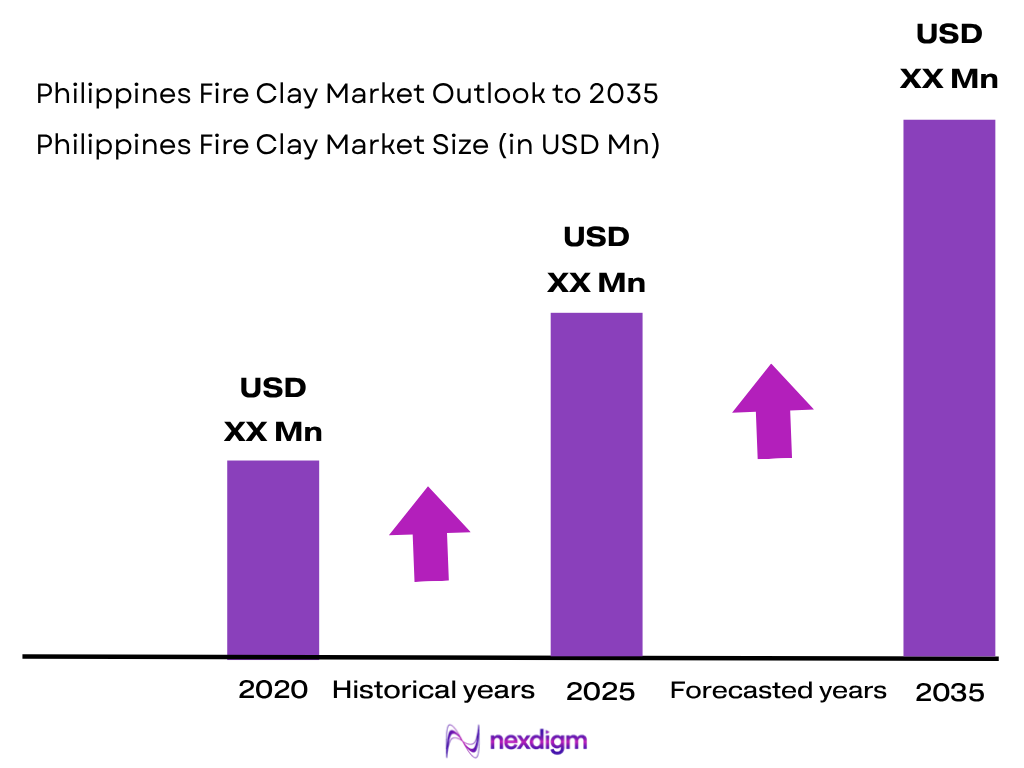
The Philippines Fire Clay Market is valued at approximately USD ~ million, based on the report’s bottom-up assessment of refractory-grade clay consumption, imports, domestic mineral processing and downstream refractory applications. For external validation, Philippine imports under HS 250830 declined from 567,885 kg valued at USD 288,200 to 264,727 kg valued at USD 147,540 across the two latest annual observations. China supplied 194,920 kg and Japan 69,807 kg in the latest period, demonstrating the market’s reliance on imported refractory-grade feedstock.
CALABARZON, Central Luzon, Metro Manila and the major industrial areas of Mindanao form important demand centers for the Philippines Fire Clay Market because refractory consumption follows cement, metals, boilers, kilns and manufacturing activity. Philippine construction value increased from PHP 515.30 billion to PHP 563.89 billion, while non-residential construction reached PHP 250.86 billion. CALABARZON recorded PHP 118.37 billion of construction, NCR PHP 112.84 billion, and Central Luzon PHP 76.50 billion, reinforcing their industrial-material demand base.
Market Segmentation
By Product Type
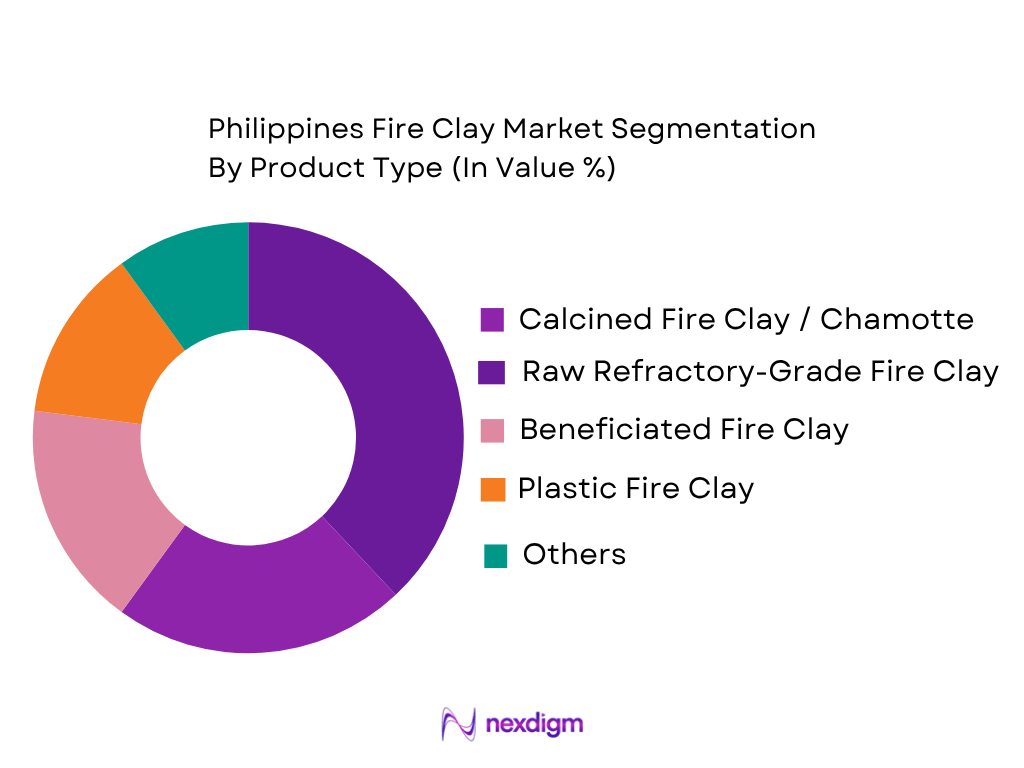
The Philippines Fire Clay Market is segmented by product type into raw fire clay, beneficiated fire clay, calcined fire clay, chamotte/refractory grog and refractory-grade blended fire clay. Calcined fire clay and chamotte represent the dominant modeled segment because thermal treatment provides greater dimensional stability and makes the material particularly suitable as aggregate and feedstock for firebricks, castables, mortars and other refractory products. Philippine industrial users require refractory materials for cement kilns, metal-processing facilities, boilers and other thermal equipment, creating demand for material with controlled refractory characteristics. Import data provide a useful indicator of the underlying feedstock ecosystem: the country imported 264,727 kg of HS 250830 fire clay, of which 194,920 kg originated in China and 69,807 kg in Japan. World Integrated Trade Solution Because official Philippine statistics do not publish product-level market shares for these refractory grades, the percentages below are analytical allocations for market-model construction rather than government-reported statistics.
By End-Use Industry
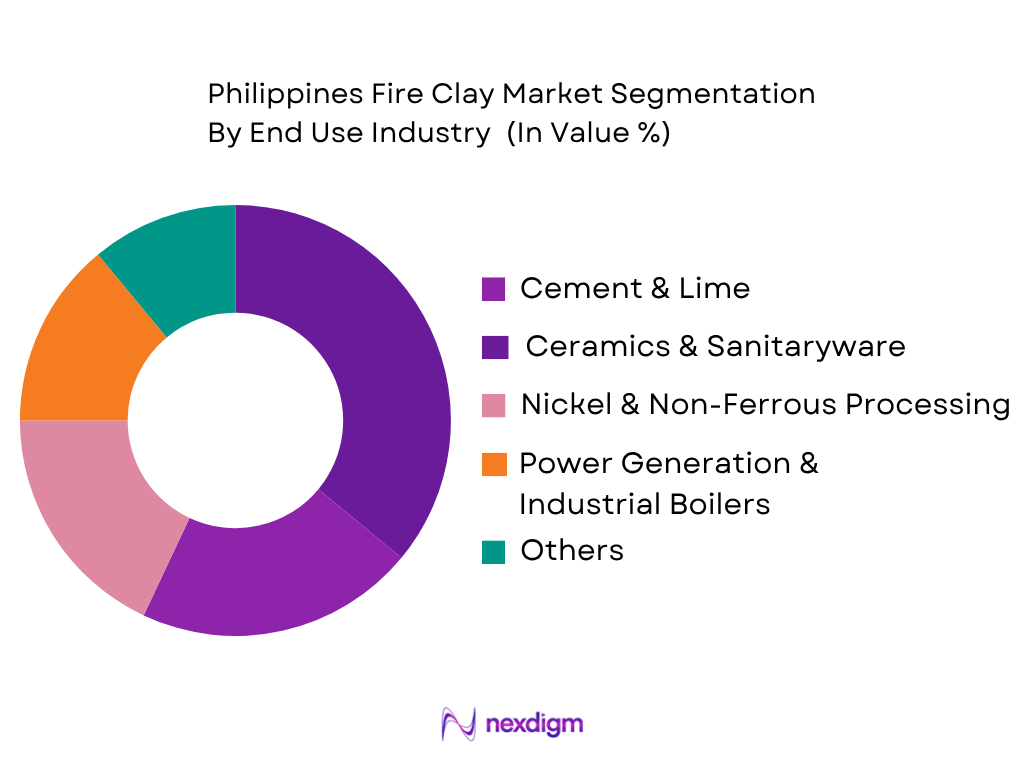
The Philippines Fire Clay Market is segmented by end-use industry into cement manufacturing, iron and steel, nickel and non-ferrous processing, power and industrial boilers, and glass, ceramics and other high-temperature manufacturing. Cement manufacturing represents the dominant modeled segment because cement production requires extensive refractory linings across rotary kilns, transition zones, preheaters, calciners and associated thermal equipment. Metals provide another significant refractory demand pool. The Mines and Geosciences Bureau recorded 33,431,483 dry metric tons of nickel direct-shipping ore, 71,801 dry metric tons of mixed nickel-cobalt sulfide, 256,769 dry metric tons of copper concentrate, 127,613 dry metric tons of chromite, and 130,161 dry metric tons of iron ore in its latest annual metallic-mineral statistics. MGB These processing-intensive industries create recurring refractory maintenance requirements. The shares below are modeled allocations because no official dataset divides Philippine fire-clay consumption by end-use industry.
Competitive Landscape
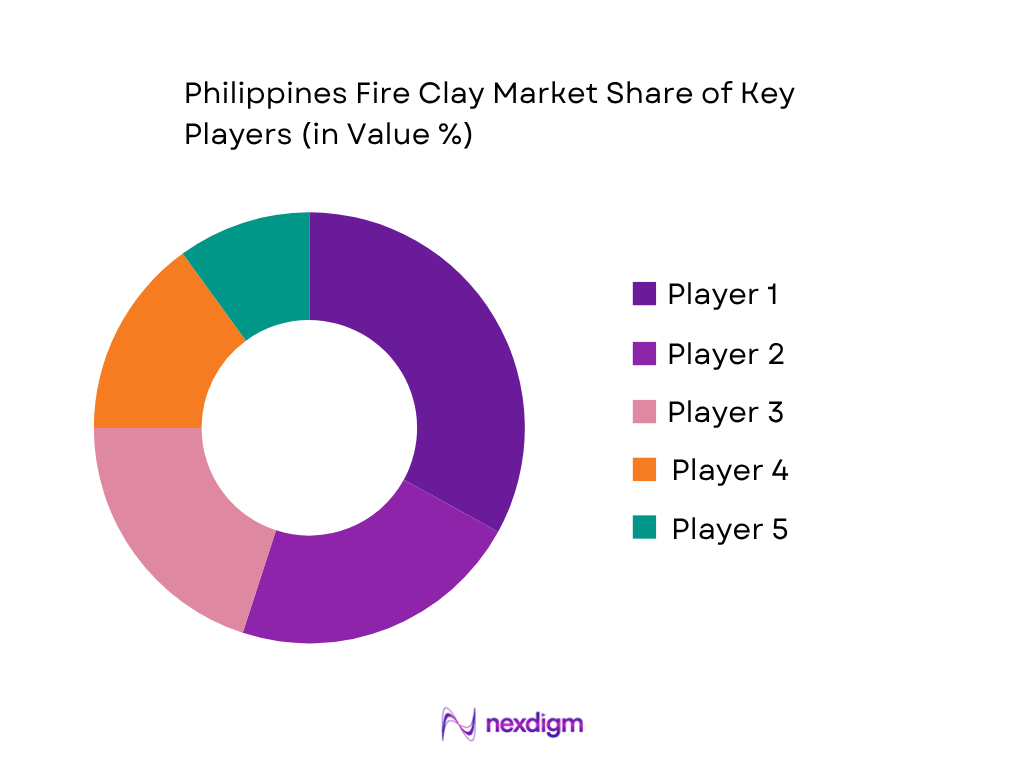
The Philippines Fire Clay Market has a fragmented competitive structure combining international refractory manufacturers, specialized material suppliers, importers, distributors and domestic refractory installation companies. International manufacturers primarily compete through advanced bricks, castables, monolithics and application engineering, while local companies provide inventory, installation, demolition, relining and maintenance support. For example, Red-C Trading & Installation Services lists monolithics, bricks and ceramic fiber and documents refractory work on rotary kilns and industrial boilers in the Philippines.
| Major Player | Establishment Year | Headquarters | Fire Clay/Aluminosilicate Relevance | Shaped Refractories | Monolithic Capability | Petrochemical/Industrial Coverage | Marine/Boiler Relevance |
| RHI Magnesita | 2017* | Vienna, Austria | ~ | ~ | ~ | ~ | ~ |
| Calderys / HWI | 2005* | Paris, France | ~ | ~ | ~ | ~ | ~ |
| Vesuvius | 1704** | London, UK | ~ | ~ | ~ | ~ | ~ |
| Morgan Advanced Materials | 1875 | Tokyo, Japan | ~ | ~ | ~ | ~ | ~ |
| PE-TECH Pte. Ltd. | ~ | Iligan City, Philippines | ~ | ~ | ~ | ~ | ~ |
Philippines Fire Clay Market Analysis
Growth Drivers
Cement Kiln Refractory Consumption and Infrastructure-Led Cement Demand
The Philippines’ expanding construction base supports recurring demand for fire-clay bricks, aluminosilicate linings, refractory castables and kiln-maintenance materials used by cement producers. Philippine Statistics Authority data show 180,341 construction projects covering 42,837,581 square meters of floor area in 2024, while non-residential construction alone accounted for 39,238 projects and 22,380,982 square meters. In 2025, total approved constructions reached 181,832 projects with 45,236,312 square meters of floor area, expanding the physical infrastructure base requiring cement. Cement production involves rotary kilns, preheaters, calciners and coolers operating under severe thermal conditions, making refractory replacement an operational necessity. The World Bank recorded Philippine GDP at USD 461.62 billion in 2024 and GDP per capita at USD 3,984.8, supporting continued infrastructure and industrial activity. These indicators provide a direct demand pathway for the Philippines Fire Clay Market: greater construction activity supports cement consumption, while sustained cement manufacturing increases kiln operating hours and consequently the requirement for fire-clay and aluminosilicate refractory products used during scheduled maintenance and relining.
Nickel Processing, Metals Production and High-Temperature Industrial Operations
The Philippines’ large mineral-processing ecosystem creates a substantial installed base of furnaces, dryers, kilns, boilers and other thermal equipment requiring refractory protection. Mines and Geosciences Bureau data show that the country produced 33,431,483 dry metric tons of nickel direct-shipping ore, 71,801 dry metric tons of mixed nickel-cobalt sulfide, 256,769 dry metric tons of copper concentrate, 127,613 dry metric tons of chromite and 130,161 dry metric tons of iron ore in 2024. Nickel alone therefore provides a significant industrial foundation for refractory consumption, particularly around processing facilities where thermal, chemical and abrasion resistance are required. The country also produced 354,132 metric tons of contained nickel in ore and 53,182 metric tons of copper metal equivalent, demonstrating the scale of metals handled within the domestic mineral economy. Fire-clay bricks and aluminosilicate refractory systems are relevant for lower- and intermediate-duty thermal zones, ancillary furnaces, boilers and supporting process equipment. Regular shutdowns and furnace relining create replacement-driven demand rather than purely new-capacity demand.
Market Challenges
Dependence on Imported Refractory-Grade Fire Clay and Concentrated Supply Sources
Import dependence remains a structural challenge for the Philippines Fire Clay Market because domestic users require controlled alumina-silica chemistry, thermal stability and impurity levels that cannot automatically be obtained from ordinary domestic clay deposits. World Bank WITS/UN Comtrade data show that the Philippines imported 264,727 kilograms of fire clay under HS 250830 in 2024. The sourcing structure was highly concentrated: 194,920 kilograms originated from China and another 69,807 kilograms came from Japan. These two origins therefore accounted for the entire reported import quantity during the period. Such concentration exposes refractory manufacturers and industrial users to international logistics, shipping availability and supplier qualification constraints. The challenge becomes more important when considered alongside the country’s industrial scale: Philippine GDP reached USD 461.62 billion in 2024, while 39,238 non-residential construction projects were approved nationally. Refractory buyers serving cement, metals, boilers and manufacturing therefore need dependable specifications and continuity of material supply. Developing alternative qualified sources requires mineralogical testing, beneficiation assessment, firing trials and industrial validation before domestic clay can reliably substitute imported refractory-grade material.
Mineralogical Consistency, Beneficiation Requirements and Competition from Advanced Refractories
Philippine fire-clay development faces a technical challenge because refractory applications require repeatable alumina-silica composition and tight control of iron oxide, alkalis and other fluxing impurities. Material inconsistency can affect refractoriness, dimensional stability, thermal cycling performance and service life, requiring beneficiation, blending, calcination and quality-control infrastructure before local clay becomes commercially reliable. The scale of competing high-temperature industries raises the performance threshold. In 2024, the Philippines produced 256,769 dry metric tons of copper concentrate, 127,613 dry metric tons of chromite, 130,161 dry metric tons of iron ore and 71,801 dry metric tons of mixed nickel-cobalt sulfide, according to the Mines and Geosciences Bureau. These operations can involve aggressive thermal and chemical environments where conventional fire-clay refractories compete against high-alumina, magnesia-based and other specialized refractory systems. The country simultaneously had 58 operating metallic mines and 61 operating non-metallic mines at the end of 2024, including 30 limestone operations. Local fire-clay suppliers consequently need reliable mineral characterization and application-specific processing rather than relying on basic clay availability alone.
Market Opportunities
Domestic Fire Clay Beneficiation, Calcination, Chamotte and Import Substitution
Local processing represents a significant development opportunity because the Philippines currently imports commercially classified fire clay while maintaining a sizeable domestic mineral and industrial base. World Bank WITS records 264,727 kilograms of fire-clay imports in 2024, consisting of 194,920 kilograms from China and 69,807 kilograms from Japan. This creates room for domestic mineral developers to evaluate suitable clay resources and establish beneficiation, washing, classification, blending, calcination and grog-production capabilities. The supporting mineral-processing ecosystem is substantial: the Mines and Geosciences Bureau recorded 61 operating non-metallic mines at the end of 2024, including 30 limestone mines, 4 silica quarries, 2 shale quarries, 2 perlite operations, and individual dolomite and zeolite-bentonite operations. Philippine GDP of USD 461.62 billion in 2024 further demonstrates the broader economic base supporting industrial investment. Commercialization would nevertheless require laboratory mineralogy, alumina-silica characterization, impurity control and high-temperature performance validation. Successfully qualified domestic material could support firebrick, refractory mortar, castable and chamotte production while reducing dependence on a narrow set of overseas suppliers.
Domestic Refractory Manufacturing, Nickel-Sector Applications and Refractory Recyclin
Expansion downstream from raw clay into firebricks, monolithic refractories, calcined grog and recycled refractory aggregates provides another opportunity for the Philippines Fire Clay Market. The domestic industrial base is sufficiently large to support application-specific refractory development. Mines and Geosciences Bureau figures show 33,431,483 dry metric tons of nickel direct-shipping ore and 71,801 dry metric tons of mixed nickel-cobalt sulfide production in 2024. The country also recorded 256,769 dry metric tons of copper concentrate and 127,613 dry metric tons of chromite, creating multiple high-temperature industrial applications requiring periodic refractory maintenance. Construction activity strengthens the downstream environment: PSA recorded 39,238 non-residential projects, representing 22,380,982 square meters of floor area in 2024, followed by a national construction floor area of 45,236,312 square meters in 2025. Domestic producers can therefore target refractory bricks, castables, mortars and precast shapes while developing recovery systems for spent kiln and furnace linings. Sorting, crushing and qualifying suitable spent aluminosilicate material as secondary grog could reduce virgin raw-material requirements and create a localized refractory-material loop serving cement, metals and industrial-boiler customers.
Future Outlook
The Philippines Fire Clay Market is forecast to expand at a placeholder CAGR of approximately ~% during 2026–2035. Demand is expected to remain closely linked to cement production, nickel processing, metals, industrial boilers, ceramics and other high-temperature processes. Opportunities should increasingly move beyond raw fire clay toward beneficiated material, calcined fire clay, chamotte, engineered refractory aggregates and application-specific refractory formulations. Localization is likely to become particularly important because the country remains dependent on external refractory-grade feedstock. China and Japan supplied the entire importer-reported HS 250830 volume in the latest World Bank WITS dataset, while earlier sourcing also included the United States and other Asian origins. World Integrated Trade Solution Supplier diversification, therefore, can become an important procurement strategy for Philippine refractory producers and distributors.
Major Players
- RHI Magnesita
- Calderys
- Vesuvius
- Shinagawa Refractories
- Krosaki Harima Corporation
- Refratechnik Group
- Morgan Advanced Materials
- HarbisonWalker International
- Puyang Refractories Group
- INTOCAST Group
- Saint-Gobain
- Chosun Refractories
- Resco Products
- Specialized Products & Services Inc. (SPSI)
- Red-C Trading & Installation Services, Inc.
Key Target Audience
- Fire Clay and Refractory Raw Material Producers
- Firebrick and Monolithic Refractory Manufacturers
- Cement, Steel, Nickel and Non-Ferrous Metal Producers
- Refractory Importers, Distributors and Installation Contractors
- Mining and Mineral Beneficiation Companies
- Industrial Furnace, Kiln and Boiler Operators
- Investments and Venture Capitalist Firms
- Government and Regulatory Bodies (Department of Environment and Natural Resources, Mines and Geosciences Bureau, Department of Trade and Industry, Board of Investments, Bureau of Philippine Standards)
Research Methodology
Step 1: Identification of Key Variables
The research begins by mapping the Philippines Fire Clay Market across mineral extraction, imports, beneficiation, calcination, refractory manufacturing, distribution and industrial consumption. Key variables include fire-clay tonnage, alumina-silica characteristics, calcined-clay consumption, chamotte availability, refractory output, import dependence and consumption across cement, metals, boilers, glass and ceramics.
Step 2: Market Analysis and Construction
Historical market construction combines HS 250830 trade flows with domestic refractory-material availability and end-use industrial activity. Top-down analysis assesses cement, metals and high-temperature manufacturing activity, while bottom-up analysis evaluates refractory manufacturers, distributors, firebrick consumption, monolithic refractory use, maintenance cycles and estimated fire-clay intensity.
Step 3: Hypothesis Validation and Expert Consultation
Initial hypotheses are validated through interviews with refractory manufacturers, raw-material importers, distributors, refractory contractors, cement-plant procurement teams and metallurgical-industry participants. Interviews focus on grade requirements, sourcing origins, firebrick versus monolithic consumption, shutdown frequency, material substitution, domestic processing capability and imported refractory competition.
Step 4: Research Synthesis and Final Output
Supply-side and demand-side findings are triangulated against official trade and industrial datasets. The final model reconciles fire-clay imports, domestic availability, refractory conversion, industrial demand and competitive positioning while separating directly reported statistics from modeled market allocations. Forecast assumptions incorporate industrial capacity additions, localization, material substitution and refractory recycling.

- Executive Summary
- Research Methodology (Market Definition and Scope, Fire Clay Classification Framework, Refractory-Grade Clay Identification, Alumina and Silica Content Assessment, Refractoriness Evaluation, Plasticity and Particle Size Analysis, Iron Oxide and Alkali Impurity Assessment, Raw Fire Clay versus Calcined Fire Clay Mapping, Chamotte and Grog Assessment, Domestic Clay Resource Mapping, Imported Fire Clay Assessment, Refractory Manufacturing Ecosystem Mapping, Firebrick Production Assessment, Monolithic Refractory Demand Assessment, Cement Kiln Application Mapping, Iron and Steel Furnace Application Assessment, Nickel and Non-Ferrous Processing Demand Assessment, Boiler and Power Plant Refractory Assessment, Glass and Ceramic Kiln Application Mapping, Import Dependency Analysis, Supplier-Origin Mapping, Supply-Side Assessment, Demand-Side Assessment, Top-Down Market Sizing, Bottom-Up Market Sizing, Primary Industry Interviews, Trade Flow Analysis, Data Triangulation, Forecasting Framework)

- Definition and Scope
- Philippines Fire Clay Industry Evolution
- Fire Clay Industry Value Chain Analysis
- Fire Clay Supply Chain Analysis

- Growth Drivers (Cement Kiln Refractory Consumption, Expansion of Domestic Infrastructure and Cement Demand, Steel Furnace Refractory Requirements, Nickel Processing Industry Demand, Industrial Boiler Maintenance, Furnace and Kiln Relining Cycles, Growth of Domestic Manufacturing, Refractory Localization, Demand for Aluminosilicate Linings)
- Market Challenges (Dependence on Imported Refractory-Grade Fire Clay, Variability in Domestic Clay Mineralogy, Alumina-Silica Consistency Requirements, Iron Oxide and Alkali Impurity Control, Beneficiation Requirements, Competition from High-Alumina and Basic Refractories, Imported Firebrick Competition, Calcination Energy Requirements, Limited Commercialization of High-Grade Deposits)
- Market Opportunities (Domestic Refractory-Grade Clay Resource Development, Fire Clay Beneficiation, Calcined Fire Clay Localization, Chamotte and Grog Manufacturing, Domestic Firebrick Production, Monolithic Refractory Manufacturing, Cement Kiln Refractory Localization, Nickel Smelter Refractory Applications, Refractory Recycling, Import Substitution, Regional Refractory Distribution)
- Market Trends (Shift toward Processed and Beneficiated Fire Clay, Increasing Use of Calcined Feedstock, Growth of Monolithic Refractories, Application-Specific Refractory Formulations, Increased Raw Material Quality Testing, Growth of Precast Refractory Components, Refractory Recycling and Circular Raw Materials, Supplier Diversification)
- Government Regulations and Standards (Mines and Geosciences Bureau Mineral Resource Regulation, Department of Environment and Natural Resources Mining and Environmental Compliance Requirements, Philippine Mining Act Requirements, Environmental Compliance Certificate Requirements, Bureau of Philippine Standards Product Standards, Occupational Safety Requirements for Mining and Mineral Processing, Import and Customs Requirements for Mineral Raw Materials)
- SWOT Analysis
- Porter’s Five Forces Analysis
- PESTLE Analysis
- Stakeholder Ecosystem
- Competition Ecosystem

- By Market Value
- By Fire Clay Consumption Volume
- By Domestic Production Volume
- By Import Volume
- By Calcined Fire Clay and Chamotte Consumption Volume
- By Refractory-Grade Fire Clay Consumption Volume

- By Product Type (In Value %)
Raw Fire Clay
Washed and Beneficiated Fire Clay
Calcined Fire Clay
Chamotte and Refractory Grog
Fire Clay Powder
Refractory-Grade Blended Fire Clay
Processed Aluminosilicate Clay - By Grade and Alumina Content (In Value %)
Low-Alumina Fire Clay
Standard Refractory Fire Clay
Medium-Alumina Fire Clay
High-Alumina Fire Clay
Low-Iron Fire Clay
Low-Alkali Refractory Clay
Specialty Refractory-Grade Clay - By Refractory Product Application (In Value %)
Dense Fire Clay Bricks
Insulating Firebricks
Refractory Mortars
Conventional Castables
Low-Cement and Specialty Castables
Ramming and Gunning Mixes
Refractory Shapes and Precast Components
Kiln and Furnace Repair Materials - By End-Use Industry (In Value %)
Cement Manufacturing
Iron and Steel
Nickel and Non-Ferrous Metal Processing
Power Generation and Industrial Boilers
Glass Manufacturing
Ceramics and Sanitaryware
Foundries and Metal Casting
Petrochemical and Process Industries
Waste Incineration and Thermal Treatment
Sugar and Food-Processing Boilers
Other High-Temperature Industrial Applications - By Supply Source (In Value %)
Domestic Mined Fire Clay
Domestic Beneficiated Fire Clay
Imported Raw Fire Clay
Imported Calcined Fire Clay
Imported Refractory Blends
Secondary and Recycled Refractory Raw Materials - By Refractory Form (In Value %)
Shaped Refractories
Unshaped Refractories
Precast Refractory Shapes
Refractory Mortars
Insulating Refractories
Repair and Maintenance Refractories - By Distribution Channel (In Value %)
Direct Supply to Refractory Manufacturers
Direct Supply to Industrial Plants
Specialty Refractory Distributors
Industrial Material Importers
Refractory Installation Contractors
Engineering and Maintenance Service Providers
Dealer and Stockist Network - By Region (In Value %)
National Capital Region
CALABARZON
Central Luzon
Central Visayas
Northern Mindanao
Davao Region
SOCCSKSARGEN
Caraga
Other Philippines

- Market Share of Major Players (By Philippines Revenue, Fire Clay and Aluminosilicate Product Portfolio, Firebrick Portfolio, Monolithic Refractory Portfolio, Cement Industry Coverage, Steel Industry Coverage, Nickel Processing Coverage, Import and Distribution Network, Installation Capability, Technical Support, Local Inventory, Application Engineering Capability)
- Cross Comparison Parameters (Refractory-Grade Fire Clay and Aluminosilicate Portfolio, Al₂O₃-SiO₂ Grade Range, Firebrick and Monolithic Refractory Capability, Cement-Steel-Nickel End-Use Coverage, Philippines Distribution and Inventory Presence, Refractory Installation and Relining Capability, Application Engineering and Technical Support, Import Supply Reliability and Lead-Time Capability)
- SWOT Analysis of Major Players
- Competitive Positioning Matrix
- Detailed Profiles of Major Companies
RHI Magnesita
Calderys
Vesuvius
Shinagawa Refractories
Krosaki Harima Corporation
Refratechnik Group
Morgan Advanced Materials
HarbisonWalker International
Puyang Refractories Group
INTOCAST Group
Saint-Gobain
Chosun Refractories
Resco Products
Specialized Products & Services (SPSI), Inc.
Red-C Trading & Installation Services, Inc.

- Cement Industry Demand Assessment
- Iron and Steel Industry Demand Assessment
- Nickel and Non-Ferrous Processing Demand Assessment
- Power Generation Demand Assessment
- Glass and Ceramic Industry Demand Assessment
- Industrial Boiler Demand Assessment
- Fire Clay Procurement Criteria Assessment
- Domestic versus Imported Fire Clay Procurement Assessment

- By Market Value (2026-2035)
- By Fire Clay Consumption Volume (2026-2035)
- By Domestic Production Volume (2026-2035)
- By Import Volume (2026-2035)
- By Calcined Fire Clay and Chamotte Consumption Volume (2026-2035)
- By Refractory-Grade Fire Clay Consumption Volume (2026-2035)


 Request a Sample
 Ask for Customization
 Get a Quote
 Enquire Now