
 Download PDF
 Download PDF
Market Overview
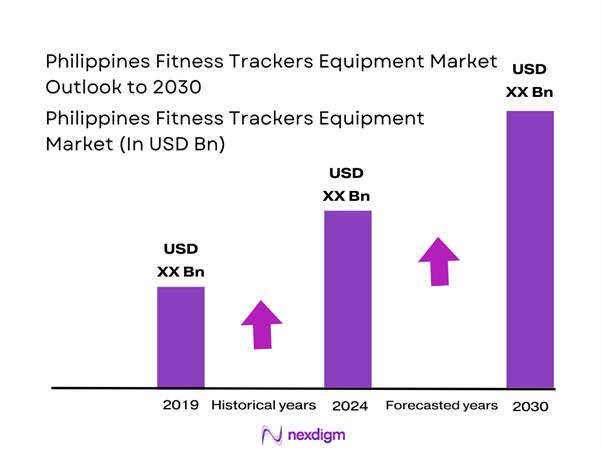
The Philippines fitness trackers equipment market (wrist-worn wearables such as smartwatches and fitness trackers, plus adjacent AI-enabled wearables) is valued at USD ~ billion on the latest base-year assessment. Demand is structurally supported by the country’s large digital addressable base: internet users increased from ~ million to ~ million, while AI-enabled fitness tracking benefits from always-connected lifestyles built around smartphones and app ecosystems. This “device + app + connectivity” stack keeps wearables sticky through subscriptions, coaching features, and health dashboards.
Within the Philippines, Metro Manila, Cebu, and Davao are the dominant demand centers because they combine higher density of tech-forward consumers, stronger modern retail and e-commerce logistics, and more concentrated corporate employers that run wellness programs. From the supply side, the category is shaped by global device ecosystems—especially brands headquartered in the US, South Korea, and China—because their platforms control operating systems, sensor roadmaps, and companion apps, which directly influence consumer switching costs and upgrade cycles.
Market Segmentation
By Device Type
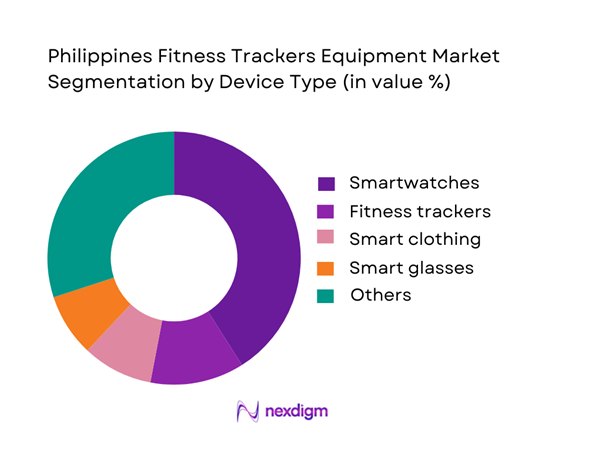
The Philippines fitness trackers equipment market is segmented by device type into smartwatches, fitness trackers, smart clothing, smart glasses, wearable medical devices, smart earwear (hearables), head-mounted displays, and others. Recently, smartwatches dominate because they function as the “all-in-one” wrist device: notifications, payments (where enabled), activity tracking, GPS variants for sports, and deeper app integrations than band-style trackers. This matters in the Philippines because wearables are bought not only for fitness but also for daily convenience—messaging, calls, and smartphone extension features—making smartwatch upgrades easier to justify than single-purpose trackers. Fitness trackers still scale strongly through affordability and gifting, but the center of gravity is shifting to multi-function wristwear that can replace multiple devices and lock users into an ecosystem (iOS/Android plus brand apps).
By End-User
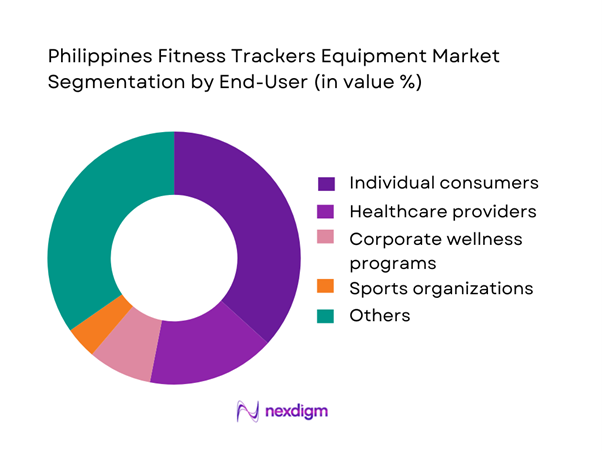
The market is segmented into individual consumers, healthcare providers, corporate wellness programs, sports organizations, industrial & manufacturing sector, and others. Individual consumers dominate because adoption is led by lifestyle tracking (steps, sleep, heart rate, workouts) and habit-forming app nudges rather than institution-led procurement. Consumers also buy wearables as “status + utility” devices, which increases repeat purchase behavior when new features appear (better sensors, longer battery life, newer OS features). Healthcare providers are a meaningful secondary segment where remote monitoring pilots and clinician workflows exist, but scaling is slower due to integration requirements and regulatory diligence. Corporate wellness grows where employers subsidize or reimburse devices to reduce absenteeism and improve engagement.
Competitive Landscape
The Philippines fitness trackers equipment market is characterized by intense ecosystem competition, where a few global brands shape category expectations (sensor accuracy, battery life, OS features, and app ecosystems), while value brands expand the user base through aggressive online distribution and feature-per-peso positioning. This landscape reflects a mix of international leaders and fast-moving challengers active in the Philippines wearable space.
| Company | Est. Year | HQ | Core Fitness-Tracker Portfolio | Primary Price Positioning in PH | Key Sales Channels in PH | Ecosystem / OS Strategy | Differentiating Health/Fitness Features | After-Sales / Warranty Model | Typical Buyer Archetype |
| Apple | 1976 | USA | ~ | ~ | ~ | ~ | ~ | ~ | ~ |
| Samsung | 1969 | South Korea | ~ | ~ | ~ | ~ | ~ | ~ | ~ |
| Huawei | 1987 | China | ~ | ~ | ~ | ~ | ~ | ~ | ~ |
| Garmin | 1989 | USA | ~ | ~ | ~ | ~ | ~ | ~ | ~ |
| Fitbit (Google) | 2007 | USA | ~ | ~ | ~ | ~ | ~ | ~ | ~ |
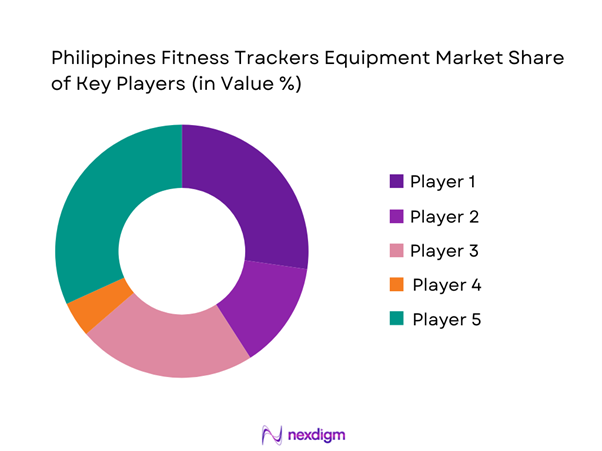
Philippines Fitness Trackers Equipment Market Analysis
Growth Drivers
Increasing Smartphone Penetration
Fitness trackers scale fastest when they “ride” on a large, always-connected mobile base—because setup, sync, coaching, and habit nudges are app-led. The Philippines’ macro backdrop supports this: the economy is recorded at USD ~ billion and GNI per capita at USD ~, enabling broader discretionary device adoption in urban households. On connectivity, the Philippines is logged at ~ mobile-cellular subscriptions and ~ active mobile-broadband subscriptions, which directly expands the addressable base for Bluetooth/4G-tethered wearables and their companion apps. For workforce users, the Labor Force Survey shows ~ employed persons, which matters because steady employment supports repeat upgrade cycles (battery life, sensors, OS features) and employer-related wellness adoption. These structural numbers collectively reinforce a large, app-ready environment where fitness trackers convert from “nice-to-have” to daily utility (notifications, step goals, sleep tracking, workout logging), accelerating adoption beyond early enthusiasts into mainstream buyers.
Urban Health Awareness
Urban health awareness pushes wearable demand when chronic-disease risk and lifestyle-management needs are visible and personal. The Philippines’ population is recorded at ~, creating a large base where daily “self-monitoring” behaviors can scale through affordable wrist devices. At the same time, official statistics show the country’s health burden is heavily shaped by noncommunicable diseases, underscoring the national shift toward lifestyle-linked mortality patterns. This environment favors fitness trackers because they operationalize awareness into routines—step counts, active minutes, sleep regularity, and heart-rate trend visibility—especially among office workers and commuters in dense metros. On the macro side, reporting places GNI per capita at USD ~, supporting rising spend on consumer health tech in urban corridors where modern retail and e-commerce logistics are strongest. The mechanism is straightforward: the more visible the chronic-risk conversation becomes (work stress, inactivity, sleep deficits), the more consumers look for “always-on” tools that quantify habits without clinic dependency, expanding demand for entry and mid-tier trackers that bundle app dashboards and reminders.
Challenges
Price Sensitivity
Price sensitivity remains a binding constraint because a large share of wearable demand sits in entry and mid tiers, where buyers trade off features (display, sensors, battery, app quality) against affordability. Even with positive macro momentum—records place the Philippines at USD ~ billion GDP and USD ~ GNI per capita—income distribution and household budget prioritization still make “nice-to-have” electronics harder to justify versus essentials. The labor market scale provides context: ~ employed persons, but not all employment is formal or high-income; this creates a wide band of consumers who delay upgrades or choose unbranded or gray devices. At the same time, the Philippines runs at ~ mobile subscriptions and ~ active mobile-broadband subscriptions, which means the addressable audience is huge—but conversion into branded wearables is uneven because many consumers already spend on connectivity and smartphones first. This is why market momentum often concentrates around promotional events and installment-led affordability programs: when financing or bundling lowers upfront burden, adoption rises; when promotions fade, replacement cycles slow. The challenge for wearable brands is to maintain perceived value (accuracy, battery, warranty credibility, app insights) at price points acceptable to mass consumers—without relying on claims that require premium sensors or subscription ecosystems.
Accuracy Perception Issues
Accuracy skepticism can suppress repeat purchases and institutional adoption because users compare wearable readings (heart rate, SpO₂, sleep, stress proxies) against personal expectations or clinical devices. In a country with a large population recorded at ~, perception spreads quickly through families, workplaces, and social networks, especially in dense metros. The broader health context matters: policy analysis compiling registered deaths by cause highlights the seriousness of lifestyle-linked health risks, which raises the bar for credibility—consumers increasingly want devices that feel “trustworthy,” not just stylish. Macro conditions—GNI per capita at USD ~—also cut both ways: higher ability to spend increases demand, but it also increases expectations for quality and reliability, making low-accuracy devices more likely to disappoint and churn. Connectivity scale with ~ active mobile-broadband subscriptions enables constant syncing and app feedback loops, but it also amplifies negative experiences when dashboards show inconsistent trends. For brands, the challenge is to communicate limitations honestly (fitness vs medical), align app coaching with plausible interpretations, and strengthen warranty and service assurance so consumers don’t equate a single bad reading with total device failure.
Opportunities
Insurance-Linked Wellness Programs
Insurance-linked wellness programs can accelerate device adoption by converting wearables into a measurable benefits tool—rewarding activity adherence, sleep consistency, and preventive behaviors rather than episodic care usage. The Philippines’ workforce and household economics support this opportunity: reports show ~ employed persons, creating a large pool for employer-sponsored and insurer-administered wellness structures. Macro indicators reinforce capacity to scale programs: GNI per capita at USD ~ and the national economy at USD ~ billion are consistent with expanding formal benefits ecosystems in key urban centers. The health context strengthens the logic: policy analysis using registered deaths data highlights how lifestyle-linked conditions dominate mortality patterns, making prevention-focused incentives strategically relevant for payers. For fitness trackers, this means higher conversion (devices subsidized or reimbursed), stronger engagement (program rules create daily wear habits), and faster refresh cycles (participants upgrade to maintain compatibility and accuracy). The opportunity is grounded in today’s workforce scale, national income levels, and the preventive-care imperative visible in official cause-of-death data.
Preventive Healthcare Integration
Preventive healthcare integration is a high-leverage opportunity because fitness trackers can extend care from clinics into daily life—capturing activity, sleep, and basic cardio signals that support coaching, adherence, and risk-flagging. The Philippines’ scale makes this meaningful: population is recorded at ~, and digital infrastructure is large enough to support app-led monitoring with ~ active mobile-broadband subscriptions and ~ mobile subscriptions. On the macro side, reporting places GNI per capita at USD ~, supporting wider adoption of consumer health tech that can complement preventive care behaviors. The urgency is reinforced by official mortality patterns summarized in policy work using registered deaths data, where noncommunicable-disease burden is prominent—creating a clear rationale for systems that encourage activity and healthier routines at scale. For device vendors, the integration pathway is practical: build interoperability with health apps, strengthen privacy-by-design, and partner with employer clinics, HMOs, and wellness administrators. Growth comes from current infrastructure and health needs—not from speculative future statistics.
Future Outlook
The Philippines fitness trackers equipment market is expected to expand as wearables become more software-defined and AI-assisted—shifting from step counting to continuous, personalized coaching and risk-flagging. Growth will be supported by broader smartphone-led adoption, improving sensor quality at lower price points, and more partnerships spanning telcos, retailers, insurers, and employer wellness programs. As global wearables demand grows, industry benchmarks indicate strong momentum for smart wearable devices.
Major Players
- Fitbit
- Garmin
- Apple
- Samsung
- Huawei
- Xiaomi
- Zepp Health
- Withings
- Fossil
- Sony
- Polar
- Misfit
- Whoop
- Oura
Key Target Audience
- Investments and venture capitalist firms
- Government and regulatory bodies
- Consumer electronics & mobile device OEM country teams / regional HQ strategy units
- Telecom operators and device bundling teams
- E-commerce marketplaces and omni-channel retailers
- Health insurers / HMOs and benefit administrators
- Corporate HR & Total Rewards leaders
- Sports & fitness chains / gym networks
Research Methodology
Step 1: Identification of Key Variables
We construct an ecosystem map of the Philippines fitness trackers equipment market covering OEMs, app ecosystems, retail/e-commerce, telcos, and institutional buyers. We define variables such as device ASP bands, attachment drivers, and channel intensity through structured desk research and database screening.
Step 2: Market Analysis and Construction
We compile historical demand indicators and map device cycles (launch cadence, feature jumps, and channel promotions). We build bottom-up logic around device category mix and channel contribution, and validate internal consistency against published market commentary and segmentation frameworks.
Step 3: Hypothesis Validation and Expert Consultation
We validate hypotheses via computer-assisted interviews with distributors, modern retail category leads, e-commerce sellers, and wellness program managers. Inputs focus on sell-through dynamics, promotion depth, return rates, and feature-led consumer preferences.
Step 4: Research Synthesis and Final Output
We triangulate findings across OEM and retail feedback, channel checks, and secondary publications. We finalize the narrative on segment dominance, competitive positioning, and adoption barriers, ensuring market definitions and assumptions are internally consistent and audit-ready.

- Executive Summary
- Research Methodology (Market Definitions and Assumptions, Abbreviations, Market Boundary and Scope Delineation, Bottom-Up Device Shipment Modeling, Top-Down Consumer Electronics Spend Mapping, Primary Interviews with Retailers, Telco Bundling Partners and Fitness Chains, Secondary Source Validation, Demand-Side and Supply-Side Triangulation, Data Normalization, Limitations and Assumptions)

- Definition and Scope
- Market Genesis and Evolution
- Timeline of Fitness Wearables Adoption in the Philippines
- Consumer Electronics and Wearables Business Cycle
- End-to-End Value Chain and Supply Chain Analysis

- Growth Drivers
Increasing Smartphone Penetration
Urban Health Awareness
Gym and Boutique Fitness Expansion
Telco Device Bundling
Employer Wellness Programs - Challenges
Price Sensitivity
Accuracy Perception Issues
Battery Life Constraints
Data Privacy Concerns
Grey Market and Counterfeit Devices - Opportunities
Insurance-Linked Wellness Programs
Preventive Healthcare Integration
Corporate Wellness Adoption
Subscription-Based Health Platforms - Trends
SpO₂ and Stress Tracking Adoption
AI-Driven Health Insights
App Ecosystem Lock-In
Wearable-to-Smartphone Platform Integration - Regulatory & Policy Landscape
- SWOT Analysis
- Stakeholder & Ecosystem Analysis
- Porter’s Five Forces Analysis
- Competitive Intensity & Ecosystem Mapping

- By Value, 2019–2024
- By Volume, 2019–2024
- By Average Selling Price, 2019–2024

- By Technology Architecture (in Value %)
Basic Fitness Bands
Advanced Fitness Trackers
Hybrid Fitness Watches
Medical-grade Activity Trackers
Kids and Youth Fitness Trackers - By Connectivity Type (in Value %)
Bluetooth-Only Devices
Bluetooth + NFC Enabled Devices
Smartphone-Dependent Trackers
Cloud-Synced Standalone Trackers - By Application (in Value %)
Activity and Step Tracking
Heart Rate and SpO₂ Monitoring
Sleep and Stress Monitoring
Sports and Performance Tracking
Preventive Health and Wellness Monitoring - By End-Use Industry (in Value %)
Online Marketplaces and Brand Stores
Consumer Electronics Retail Chains
Telco-Bundled Sales Channels
Fitness Centers and Wellness Clinics
Corporate and Insurance-Led Procurement - By Fleet Type (in Value %)
Urban Youth and Students
Working Professionals
Fitness Enthusiasts and Athletes
Health-Conscious Middle-Aged Users
Senior and Assisted-Care Users - By Region (in Value %)
Metro Manila
CALABARZON
Central Luzon
Visayas
Mindanao

- Market Share of Major Players on the Basis of Value and Volume
- Cross Comparison Parameters (Device Portfolio Breadth, Sensor Accuracy, Battery Life per Charge Cycle, App Ecosystem Maturity, Local Retail Presence, Telco Partnerships, Pricing Tier Coverage, After-Sales and Warranty Network)
- SWOT Analysis of Major Players
- Pricing Analysis by Key SKUs and Feature Sets
- Detailed Profiles of Major Companies
Xiaomi Corporation
Huawei Technologies Co., Ltd.
Samsung Electronics
Apple Inc.
Fitbit
Garmin Ltd.
Amazfit
Realme
Oppo
Honor
OnePlus
Polar Electro
Withings
Suunto

- Usage Frequency and Engagement Levels
- Purchasing Power and Budget Allocation Patterns
- Feature Prioritization and Buying Criteria
- Pain Points and Adoption Barriers
- Decision-Making Journey and Replacement Cycles

- By Value, 2025–2030
- By Volume, 2025–2030
- By Average Selling Price, 2025–2030


 Request a Sample
 Ask for Customization
 Get a Quote
 Enquire Now