

 Download PDF
Market Overview
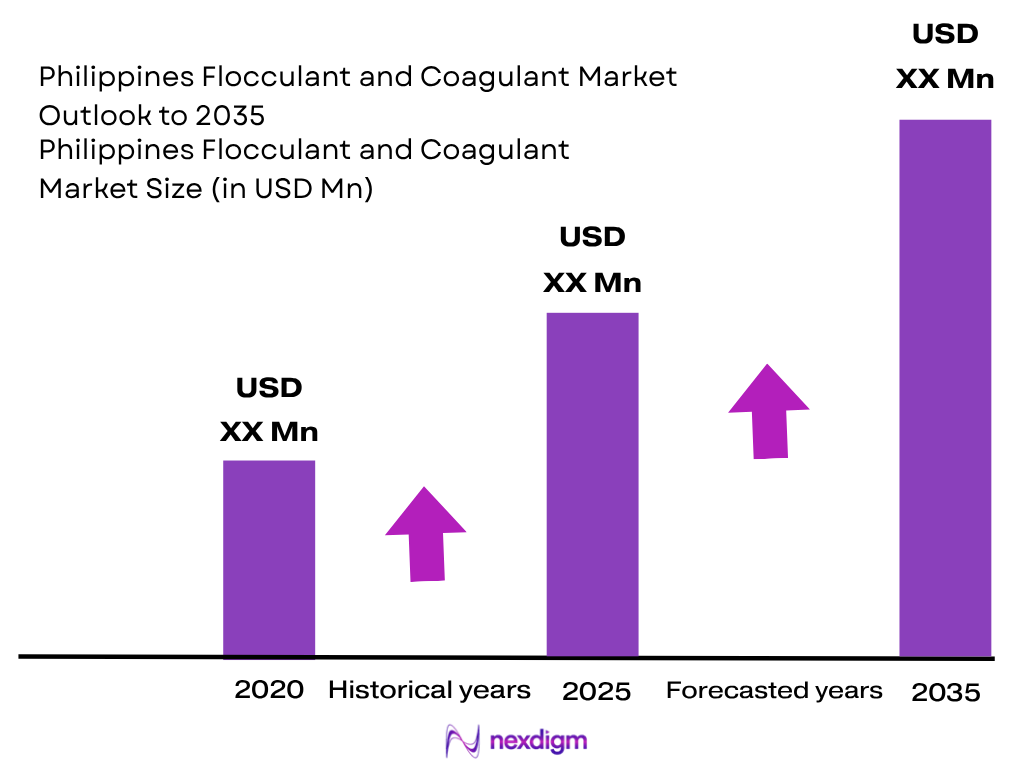
The Philippines Flocculant and Coagulant Market is valued at ~USD XX million in 2024, supported by expanding water-treatment requirements, industrial wastewater management and rising demand for efficient solid-liquid separation. The Philippines recorded GDP of approximately USD 461.7 billion and GDP growth of 5.7 in the latest World Bank data, strengthening the industrial and infrastructure base that consumes treatment chemicals. Official water accounts also recorded freshwater withdrawals of 93.08 billion cubic meters, compared with 91.20 billion cubic meters in the preceding period, reinforcing the importance of treatment, reuse and resource-efficiency systems.
The market is concentrated around major economic and industrial clusters where municipal utilities, manufacturing facilities and water-intensive industries create recurring treatment demand. Official statistics identify 1,259 formal establishments operating across water supply, sewerage, waste management and remediation activities, with 1,066 belonging to water collection, treatment and supply. CALABARZON accounted for 217 establishments, Central Luzon for 199, and Central Visayas for 124, highlighting the importance of these industrial and population centers. NCR generated PHP 108.84 billion in sector revenue, reflecting its concentration of water-related economic activity.
Market Segmentation
By Product Type
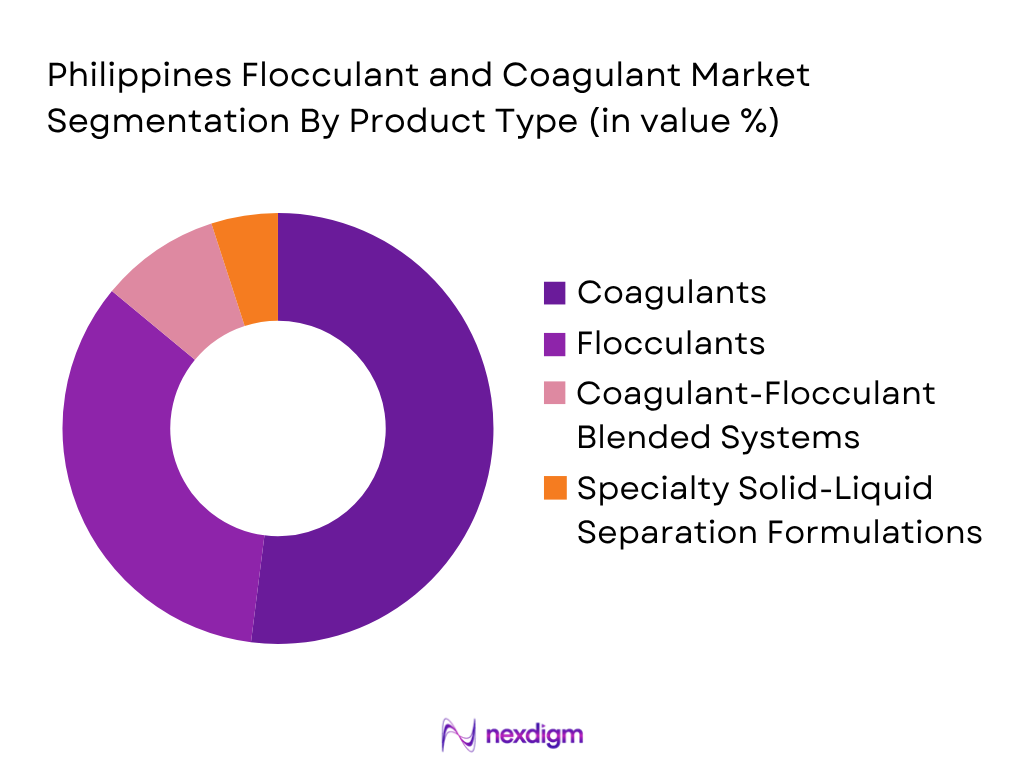
The Philippines Flocculant and Coagulant Market is segmented by product type into coagulants, flocculants, coagulant-flocculant blended systems and specialty solid-liquid separation formulations. Coagulants are expected to represent the dominant sub-segment because they are widely used at the initial clarification stage to destabilize suspended and colloidal particles. Aluminum sulfate, ferric chloride and polyaluminum chloride are applicable across drinking-water treatment, municipal wastewater treatment and industrial effluent clarification. Their role in reducing turbidity and improving downstream separation makes them an important component of conventional treatment trains. Flocculants subsequently promote particle aggregation and improve settling, sludge thickening and dewatering performance. Blended systems can simplify chemical programs for operators, while specialty formulations address difficult industrial streams. The broad Philippine water-treatment ecosystem provides recurring demand from utilities and industrial facilities. The country’s formal water-supply and treatment sector includes 1,066 establishments, creating a broad customer base for coagulation and flocculation chemicals.
By End-Use Industry
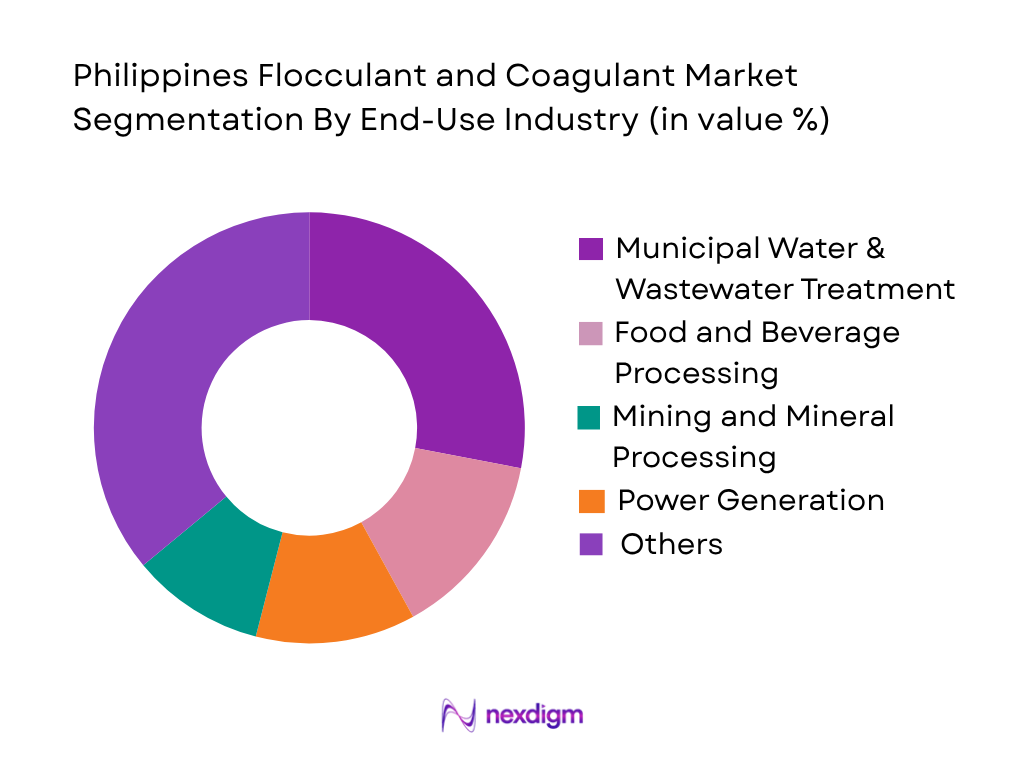
The Philippines Flocculant and Coagulant Market is segmented by end-use industry into municipal water and wastewater treatment, food and beverage processing, mining and mineral processing, power generation, chemical manufacturing, pulp and paper, textiles and dyeing, pharmaceutical manufacturing, oil and gas, electronics and semiconductor manufacturing and other industrial applications. Municipal water and wastewater treatment is expected to represent the dominant sub-segment because coagulation and flocculation are fundamental to clarification, suspended-solids removal and sludge treatment. The importance of water infrastructure is reinforced by the country’s 28.01 million households, of which 27.31 million had access to an improved water supply according to the Philippine Statistics Authority. Industrial demand is also significant as the Philippines recorded 227.37 billion cubic meters of total abstracted water, with industry forming part of the country’s regulated water-use ecosystem.
Competitive Landscape
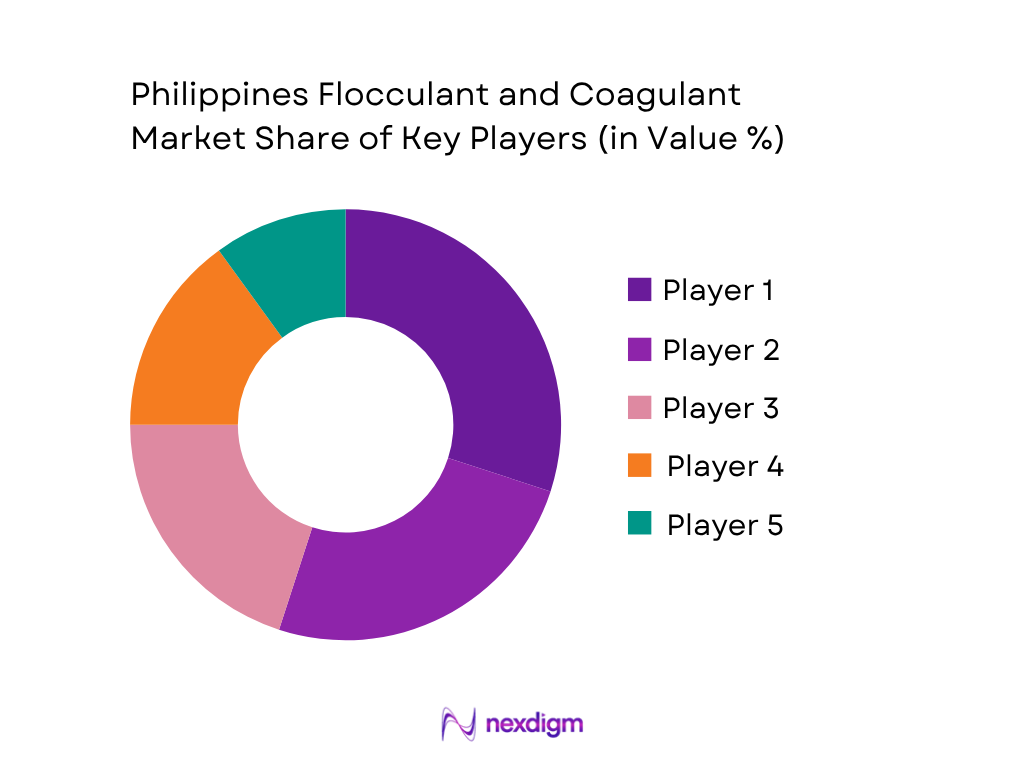
The Philippines Flocculant and Coagulant Market comprises global water-treatment chemical manufacturers, specialty polymer suppliers, integrated water-treatment companies and regional distributors. Competition is shaped by product chemistry, treatment performance, technical service, chemical supply reliability and relationships with municipal and industrial customers. Companies serving the market compete across polyacrylamide formulations, inorganic coagulants, specialty treatment chemicals, sludge-management solutions and integrated water-treatment services. The competitive environment also reflects the country’s geographically dispersed customer base, making distribution capability and local technical support important competitive considerations.
| Company | Establishment Year | Headquarters | Product Chemistry Portfolio | Municipal Water Capability | Industrial Wastewater Capability | Technical Service Capability | Distribution Reach | Key Application Exposure |
| SNF | 1978 | France | ~ | ~ | ~ | ~ | ~ | ~ |
| Kemira | 1920 | Finland | ~ | ~ | ~ | ~ | ~ | ~ |
| Ecolab | 1923 | USA | ~ | ~ | ~ | ~ | ~ | ~ |
| Solenis | 1907 | USA | ~ | ~ | ~ | ~ | ~ | ~ |
| Kurita Water Industries | 1949 | Japan | ~ | ~ | ~ | ~ | ~ | ~ |
Philippines Flocculant and Coagulant Market Analysis
Growth Drivers
Expansion of Municipal Water Treatment Infrastructure
The Philippines Flocculant and Coagulant Market is supported by continued development of municipal water collection, treatment and wastewater-management infrastructure, creating recurring requirements for aluminum-based coagulants, iron-based coagulants, polyacrylamide flocculants and sludge-treatment chemicals. The Philippine Statistics Authority recorded 1,259 establishments across water supply, sewerage, waste management and remediation activities, including 1,066 establishments specifically engaged in water collection, treatment and supply. The sector employed 45,082 workers, while water collection, treatment and supply activities accounted for 38,407 workers, demonstrating the scale of operational activity supporting water-treatment demand. Regional concentration also creates identifiable demand centers, with 217 establishments in CALABARZON, 199 in Central Luzon and 124 in Central Visayas. The country’s population reached 112,729,484, increasing the underlying requirement for reliable drinking-water and wastewater services. Government expenditure also supports infrastructure development, with PHP 364 million allocated to the Water Supply and Sanitation Program of the Local Water Utilities Administration. These conditions create recurring applications for coagulation, flocculation, clarification, sludge thickening and dewatering. Increasing treatment requirements across municipal facilities therefore provide a broad demand base for chemical suppliers offering both conventional and higher-performance treatment formulations.
Expansion of Industrial Manufacturing and Water-Intensive Activities
Industrial expansion is strengthening the demand base for flocculants and coagulants because manufacturing, mining, food processing, chemicals, power generation and other industrial activities generate wastewater streams requiring clarification, suspended-solids removal and sludge management. Philippine Statistics Authority data indicate that national industry gross value added reached PHP 6.47 trillion at constant 2018 prices, while manufacturing generated PHP 3.92 trillion. Mining and quarrying generated PHP 157.09 billion, creating additional requirements for mineral-processing water clarification, tailings treatment and solid-liquid separation. The country’s water-resource requirements further reinforce this demand: freshwater withdrawals reached 93.08 billion cubic meters, while total abstracted water reached 227.37 billion cubic meters. Manufacturing facilities require treatment systems capable of handling different wastewater characteristics, including suspended solids, colloidal particles, process residues and sludge. This creates demand for differentiated coagulant and flocculant chemistries rather than a single standardized formulation. Food-processing facilities can require rapid clarification, while mining operations require high-performance flocculation for mineral slurries and tailings. Chemical and manufacturing facilities can require application-specific polymers selected according to wastewater chemistry. As industrial production expands, chemical-treatment suppliers can therefore address a wider range of applications through customized formulations, technical dosing services and integrated wastewater-treatment programs.
Market Challenges
Uneven Water Infrastructure and Regional Treatment Capacity
The Philippines Flocculant and Coagulant Market faces infrastructure and geographic challenges because treatment facilities and industrial customers are distributed across a large archipelagic economy, creating differences in treatment capacity, procurement volumes and technical-service requirements. The Philippine Statistics Authority recorded 1,259 establishments across water supply, sewerage, waste management and remediation, but their distribution remained uneven. CALABARZON recorded 217 establishments, Central Luzon 199, Central Visayas 124, while BARMM recorded only 5. Employment showed a similar concentration, with NCR accounting for 7,123 workers and CALABARZON accounting for 6,916 workers within the broader sector. The national water-stress indicator stood at 28.5, while freshwater withdrawals reached 93.08 billion cubic meters. These conditions create different chemical-treatment requirements between densely industrialized regions and less-developed areas. Suppliers may need to maintain inventories across multiple locations while managing transportation, storage and technical support requirements. Smaller treatment facilities can also have limited chemical-handling infrastructure and fewer specialized operators. Consequently, market participants need distribution models capable of serving both large metropolitan utilities and geographically dispersed municipal and industrial customers. These logistical and operational differences can increase complexity in procurement, inventory planning, technical servicing and application support.
Water-Quality Compliance and Treatment Complexity
Increasing treatment requirements create technical and operational challenges for the Philippines Flocculant and Coagulant Market because chemical selection must respond to changing influent characteristics, discharge requirements, sludge properties and water-reuse objectives. Freshwater withdrawals reached 93.08 billion cubic meters, while total abstracted water reached 227.37 billion cubic meters, demonstrating the scale of water resources managed across municipal and economic activities. National water-use efficiency reached PHP 231.36 per cubic meter, while industrial water-use efficiency reached PHP 392.89 per cubic meter, increasing the importance of efficient water management within industrial operations. The national water-stress indicator of 28.5 further emphasizes the importance of effective treatment and resource utilization. These conditions increase the need for precise chemical dosing, appropriate polymer selection and reliable clarification performance. Municipal facilities may require consistent turbidity removal, while industrial facilities can face substantially more variable wastewater chemistry. Mining operations may require high-molecular-weight polymers for tailings separation, whereas food-processing facilities may require different charge characteristics for organic wastewater streams. Treatment operators may consequently require jar testing, dosage optimization and application-specific technical support. Suppliers that cannot provide consistent formulation performance and technical assistance may face qualification barriers, particularly where customers prioritize treated-water quality, sludge performance and operational reliability.
Market Opportunities
Advanced Water-Reuse and High-Efficiency Treatment Solutions
The Philippines Flocculant and Coagulant Market presents opportunities for higher-performance formulations designed for water reuse, efficient clarification, sludge dewatering and reduced chemical consumption. Freshwater withdrawals reached 93.08 billion cubic meters, while total abstracted water reached 227.37 billion cubic meters, creating a substantial operating base for technologies that improve separation efficiency and enable treated water to be reused. Water-use efficiency reached PHP 231.36 per cubic meter, while industrial water-use efficiency reached PHP 392.89 per cubic meter, demonstrating the economic relevance of improving water productivity. The country’s treatment ecosystem includes 1,066 establishments engaged in water collection, treatment and supply, providing an established customer base for upgrades to chemical-treatment programs. This creates opportunities for high-charge polyacrylamide flocculants, low-residual coagulants, application-specific blends, automated dosing systems and formulations optimized for sludge dewatering. Advanced products can be designed around specific influent conditions, allowing operators to improve particle aggregation and reduce variability in clarification performance. Automated dosing can further improve chemical-feed consistency by responding to changing flow and water-quality conditions. Suppliers combining treatment chemicals with jar testing, dosage optimization and technical monitoring can address increasingly sophisticated treatment requirements across municipal and industrial facilities.
Industrial Wastewater and Specialized Solid-Liquid Separation Applications
Industrial diversification creates opportunities for application-specific flocculant and coagulant formulations across manufacturing, mining, food processing, chemical production, power generation and other water-intensive activities. Philippine industry gross value added reached PHP 6.47 trillion at constant 2018 prices, while manufacturing generated PHP 3.92 trillion and mining and quarrying generated PHP 157.09 billion. Manufacturing activity is particularly significant in major industrial centers, with manufacturing gross value added in NCR reaching PHP 806.48 billion. These industrial activities generate diverse wastewater streams requiring different treatment chemistries, including suspended-solids removal, colloidal destabilization, sludge thickening and solid-liquid separation. Mining operations can require selective flocculation for mineral slurries and tailings, while food-processing facilities can require rapid clarification of wastewater containing organic and suspended materials. Chemical manufacturing can involve variable pH and complex dissolved and suspended contaminants, increasing the importance of formulation customization. The presence of 1,259 establishments across water supply, sewerage, waste management and remediation further supports an established treatment ecosystem. Opportunities therefore extend beyond conventional municipal clarification toward industrial wastewater treatment, mineral-processing applications, sludge dewatering, tailings management and water recycling. Suppliers with application-specific polymer chemistry, technical dosing expertise and customized treatment programs can address these increasingly differentiated requirements.
Future Outlook
Over the coming years, the Philippines Flocculant and Coagulant Market is expected to benefit from continued development of municipal water infrastructure, industrial wastewater treatment and water-reuse systems. Demand should increasingly move toward higher-performance polymers, application-specific formulations and automated chemical-dosing systems. Expansion of manufacturing, food processing, mining and other water-intensive activities should create additional treatment requirements. The country’s water accounts already show substantial resource utilization, while official statistics identify continuing activity across water collection, treatment and supply establishments.
The Philippines’ water-use efficiency reached PHP 231.36 per cubic meter in the latest official assessment, compared with PHP 222.75 per cubic meter previously, demonstrating increasing economic relevance of water productivity. Industry recorded water-use efficiency of PHP 392.89 per cubic meter, providing an additional basis for investment in improved industrial water management and chemical-treatment systems.
Major Players
- SNF
- Kemira Oyj
- Ecolab Inc.
- Solenis LLC
- Kurita Water Industries Ltd.
- Veolia Water Technologies
- SUEZ Water Technologies & Solutions
- BASF SE
- Chemtrade Logistics Inc.
- Feralco Group
- USALCO LLC
- Kronos Worldwide, Inc.
- Kuraray Co., Ltd.
- Aries Chemical, Inc.
- Avista Technologies, Inc.
Key Target Audience
- Water Utilities and Water Districts
- Industrial Wastewater Treatment Operators
- Food and Beverage Manufacturing Companies
- Mining and Mineral Processing Companies
- Power Generation Companies
- Investments and Venture Capitalist Firms
- Government and Regulatory Bodies (Department of Environment and Natural Resources, Environmental Management Bureau, Metropolitan Waterworks and Sewerage System)
- Engineering, Procurement and Construction Companies
Research Methodology
Step 1: Identification of Key Variables
The initial phase involves constructing an ecosystem map covering chemical manufacturers, polymer suppliers, distributors, water utilities, industrial wastewater operators and treatment-service providers within the Philippines Flocculant and Coagulant Market. Product chemistry, charge type, formulation, treatment application, end-use industry and regional demand are identified as core variables. Public-sector water, environmental and industrial statistics are incorporated to establish the market framework.
Step 2: Market Analysis and Construction
This phase involves compiling historical information on flocculant and coagulant consumption, domestic supply, imports, exports, treatment applications and end-use demand. Municipal water treatment, industrial wastewater, sludge dewatering, mining and food-processing requirements are assessed separately. Top-down market sizing is compared with bottom-up consumption estimates derived from treatment capacity, facility activity and chemical application requirements.
Step 3: Hypothesis Validation and Expert Consultation
Market hypotheses are developed around product adoption, treatment chemistry, customer procurement patterns, distribution structures and application-specific consumption. These hypotheses are validated through discussions with water-treatment specialists, chemical suppliers, industrial users, utility operators and technical personnel. Feedback is used to refine product segmentation, competitive assessments and demand assumptions.
Step 4: Research Synthesis and Final Output
The final phase integrates primary findings with government statistics, company information, trade data, industrial indicators and water-sector information. Market estimates are cross-checked through top-down and bottom-up methodologies to identify inconsistencies. The resulting analysis provides a structured assessment of market size, segmentation, competitive positioning, customer requirements and future demand.

- Executive Summary
- Research Methodology (Market Definition and Scope, Philippines Flocculant and Coagulant Market Classification, Flocculant and Coagulant Product Mapping, Coagulant Chemistry Assessment, Flocculant Polymer Assessment, Charge-Type Analysis, Product Form Assessment, Water Treatment Process Mapping, Municipal Demand Assessment, Industrial Demand Assessment, Desalination and Water-Reuse Assessment, Production Capacity Mapping, Domestic Supply Assessment, Import and Export Trade Analysis, Raw Material Supply Assessment, Distribution Channel Mapping, Demand-Side Assessment, Supply-Side Assessment, Top-Down Market Sizing, Bottom-Up Market Sizing, Primary Industry Interviews, Data Triangulation, Forecasting Framework, Market Share Validation, Limitations and Future Conclusions)

- Definition and Scope
- Philippines Flocculant and Coagulant Industry Evolution and Development of Municipal Water Treatment, Industrial Wastewater Treatment, Water-Supply Infrastructure, Solid-Liquid Separation Technologies and Specialty Water-Treatment Chemical Applications
- Flocculant and Coagulant Value Chain Analysis
- Flocculant and Coagulant Supply Chain Analysis
- Chemical Feedstock Suppliers, Polymer Manufacturers, Coagulant Manufacturers, Flocculant Formulators, Water Treatment Chemical Suppliers, Chemical Distributors, Water Utilities, Wastewater Treatment Operators, Engineering and EPC Companies, Industrial End Users, Mining Companies, Food and Beverage Manufacturers, Pulp and Paper Producers, Power Generation Companies
- Flocculant Integration Across Drinking Water Treatment, Municipal Wastewater Treatment, Industrial Effluent Treatment, Mining and Mineral Processing, Food and Beverage Processing, Pulp and Paper, Textile Processing, Chemical Manufacturing, Power Generation and Oil and Gas Applications

- Growth Drivers (Expansion of Municipal Water and Wastewater Treatment, Increasing Industrial Water Consumption, Food and Beverage Processing Expansion, Mining and Mineral Processing Development, Growth of Manufacturing Activity, Expansion of Water Supply Infrastructure, Rising Wastewater Treatment Requirements, Increasing Demand for Sludge Dewatering, Water Recycling and Reuse Adoption)
- Market Challenges (Fragmented Water Infrastructure, Limited Wastewater Treatment Coverage, Dependence on Imported Specialty Chemicals, Raw Material Price Volatility, Logistics Across Island-Based Geography, Municipal Budget Constraints, Chemical Storage and Handling Requirements, Variable Industrial Wastewater Composition, Technical Qualification Requirements)
- Market Opportunities (Municipal Wastewater Treatment Expansion, Industrial Water Recycling, Advanced Polyacrylamide Formulations, Bio-Based Flocculants, Low-Residual Coagulants, Mining Tailings Treatment, Food and Beverage Wastewater Solutions, Sludge Dewatering Technologies, Automated Chemical Dosing, Specialty Treatment Solutions for Industrial Effluents)
- Market Trends (Advanced Polymer Flocculants, Shift Toward High-Efficiency Coagulants, Water Reuse and Recycling, Automated Chemical Dosing, Digital Water Quality Monitoring, Sludge Dewatering Optimization, Low-Residual Treatment Chemistry, Sustainable Flocculant Development, Specialty Industrial Wastewater Formulations, Integrated Chemical and Treatment-Service Models)
- Government Regulations and Standards (Philippine Clean Water Act Requirements, Department of Environment and Natural Resources Effluent Standards, Water Quality Guidelines, Environmental Compliance Certificate Requirements, Philippine National Standards for Drinking Water, Environmental Management Bureau Requirements, Local Water District Regulations, Hazardous Chemical Management Requirements, Industrial Wastewater Discharge Requirements, Chemical Product Registration and Safety Requirements)
- SWOT Analysis
- Porter’s Five Forces Analysis
- PESTLE Analysis
- Stakeholder Ecosystem
- Competition Ecosystem

- By Market Value (2020-2025)
- By Market Volume (2020-2025)
- By Flocculant Consumption Volume (2020-2025)
- By Coagulant Consumption Volume (2020-2025)
- By Organic Flocculant Consumption Volume (2020-2025)
- By Inorganic Coagulant Consumption Volume (2020-2025)
- By Domestic Production Volume (2020-2025)
- By Import Volume (2020-2025)
- By Export Volume (2020-2025)
- By Average Selling Price (2020-2025)

- By Product Type (In Value %)
Coagulants
Flocculants
Coagulant-Flocculant Blended Systems
Specialty Solid-Liquid Separation Formulations - By Flocculant Type (In Value %)
Polyacrylamide Flocculants
Cationic Flocculants
Anionic Flocculants
Nonionic Flocculants
Amphoteric Flocculants
Natural Flocculants
Biopolymer-Based Flocculants
Specialty High-Molecular-Weight Flocculants - By Application Type (In Value %)
Coagulation
Flocculation
Clarification
Sedimentation
Sludge Thickening
Sludge Dewatering
Dissolved Air Flotation
Tailings Treatment
Solid-Liquid Separation
Water Recycling and Reuse - By End-Use Industry (In Value %)
Municipal Water and Wastewater Treatment
Food and Beverage Processing
Mining and Mineral Processing
Power Generation
Chemical Manufacturing
Pulp and Paper
Textiles and Dyeing
Pharmaceutical Manufacturing
Oil and Gas
Electronics and Semiconductor Manufacturing
Other Industrial Applications - By Water Treatment Application (In Value %)
Drinking Water Treatment
Municipal Wastewater Treatment
Industrial Wastewater Treatment
Process Water Treatment
Surface Water Treatment
Cooling Water Treatment
Boiler Water Treatment
Water Reuse and Recycling
Sludge Treatment - By Region (In Value %)
National Capital Region
CALABARZON
Central Luzon
Central Visayas
Western Visayas
Davao Region
Northern Mindanao
Other Philippine Regions

- Market Share of Major Players (By Philippines Revenue, Flocculant Sales Volume, Coagulant Sales Volume, Product Chemistry Portfolio, Polymer Production Capacity, Municipal Customer Coverage, Industrial Customer Coverage, End-Use Industry Exposure, Distribution Network Coverage, Regional Presence, Water Treatment Application Coverage, Technical Service Capability, R&D and Application-Laboratory Capability)
- Cross Comparison Parameters (Flocculant and Coagulant Revenue, Organic and Inorganic Product Portfolio Breadth, Polyacrylamide Technology Coverage, Municipal Water Treatment Capability, Industrial Wastewater Treatment Coverage, Sludge Dewatering Technology Capability, Mining and Food Processing Application Coverage, Philippines Distribution Network Reach)
- SWOT Analysis of Major Players
- Competitive Positioning Matrix
- Detailed Profiles of Major Companies
SNF Floerger Philippines Inc.
Kemira Oyj
Solenis LLC
Ecolab Inc.
Kurita Water Industries Ltd.
Veolia Water Technologies
SUEZ Water Technologies & Solutions
BASF SE
Chemtrade Logistics Inc.
Feralco Group
USALCO LLC
Kronos Worldwide, Inc.
Kuraray Co., Ltd.
Aries Chemical, Inc.
Avista Technologies, Inc.

- Municipal Drinking Water Utility Procurement Assessment
- Water District Chemical Procurement Analysis
- Municipal Wastewater Treatment Plant Chemical Requirement Analysis
- Industrial Wastewater Treatment Operator Assessment
- Food and Beverage Wastewater Treatment Requirement Analysis
- Mining and Mineral Processing Flocculant Requirement Assessment
- Power Generation Water Treatment Chemical Procurement Analysis
- Pulp and Paper Mill Coagulant Requirement Assessment
- Textile and Dyeing Effluent Treatment Analysis
- Chemical Manufacturing Effluent Treatment Analysis
- Pharmaceutical Wastewater Treatment Assessment
- Sludge Dewatering Chemical Procurement Assessment

- By Market Value (2026-2035)
- By Market Volume (2026-2035)
- By Flocculant Consumption Volume (2026-2035)
- By Coagulant Consumption Volume (2026-2035)
- By Organic Flocculant Consumption Volume (2026-2035)
- By Inorganic Coagulant Consumption Volume (2026-2035)
- By Domestic Production Volume (2026-2035)
- By Import Volume (2026-2035)
- By Export Volume (2026-2035)
- By Average Selling Price (2026-2035)


 Request a Sample
 Ask for Customization
 Get a Quote
 Enquire Now