

 Download PDF
Market Overview
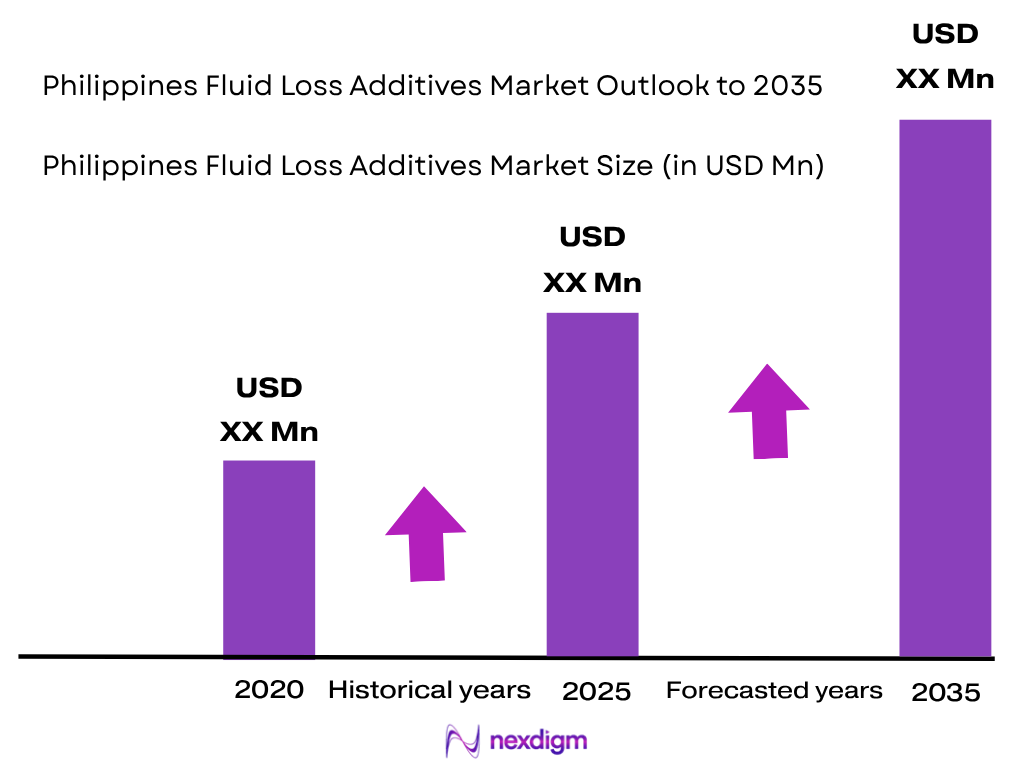
The Philippines Fluid Loss Additives Market is valued at approximately ~USD XX million, supported primarily by geothermal well construction, petroleum exploration and cementing operations. Geothermal installed capacity remained at 1,952 MW across the latest two comparable annual observations, while geothermal electricity generation increased from 10,730 GWh to 10,789 GWh. Continued drilling, workovers and high-temperature well maintenance sustain demand for PAC, CMC, modified starches and synthetic filtration-control polymers.
Leyte, Laguna-Batangas, Bicol, Negros, North Cotabato and Northwest Palawan are the principal demand centres for fluid loss additives because they concentrate geothermal fields and upstream petroleum activity. Leyte’s Tongonan geothermal production field alone has 610.18 MW of installed capacity, while the wider Visayas geothermal portfolio carries 975.055 MW of installed capacity. Northwest Palawan remains important because production and exploration service contracts are concentrated around Malampaya and Galoc.
Market Segmentation
By Application Type
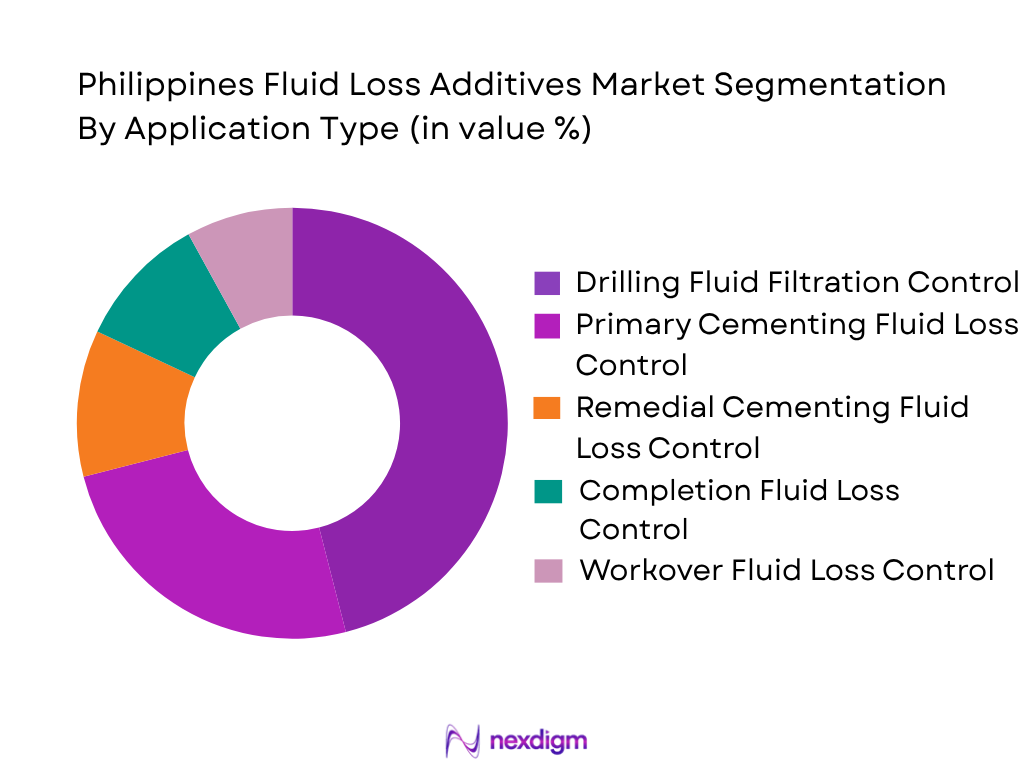
The Philippines Fluid Loss Additives Market is segmented by application type into drilling-fluid filtration control, primary cementing, remedial cementing, completion-fluid control and workover-fluid control. Drilling-fluid filtration control represents the dominant application because the Philippines has an established geothermal drilling base where fluid-loss management is critical in fractured volcanic formations and high-temperature wells. Geothermal drilling typically uses water-based mud systems containing PAC, CMC, starch derivatives and thermally stable synthetic polymers to limit filtrate invasion while maintaining rheology. The country’s geothermal installed capacity is 1,952 MW, with major producing fields in Leyte, Laguna-Batangas, Bicol and North Cotabato, creating recurring demand from replacement wells, make-up wells and field maintenance. Petroleum drilling also contributes to filtration-control demand as operators conduct exploration and development activity under active service contracts. Cementing additives form another important segment because uncontrolled fluid loss during primary or remedial cementing can compromise slurry stability, zonal isolation and long-term well integrity in both geothermal and petroleum wells.
By End-Use Sector
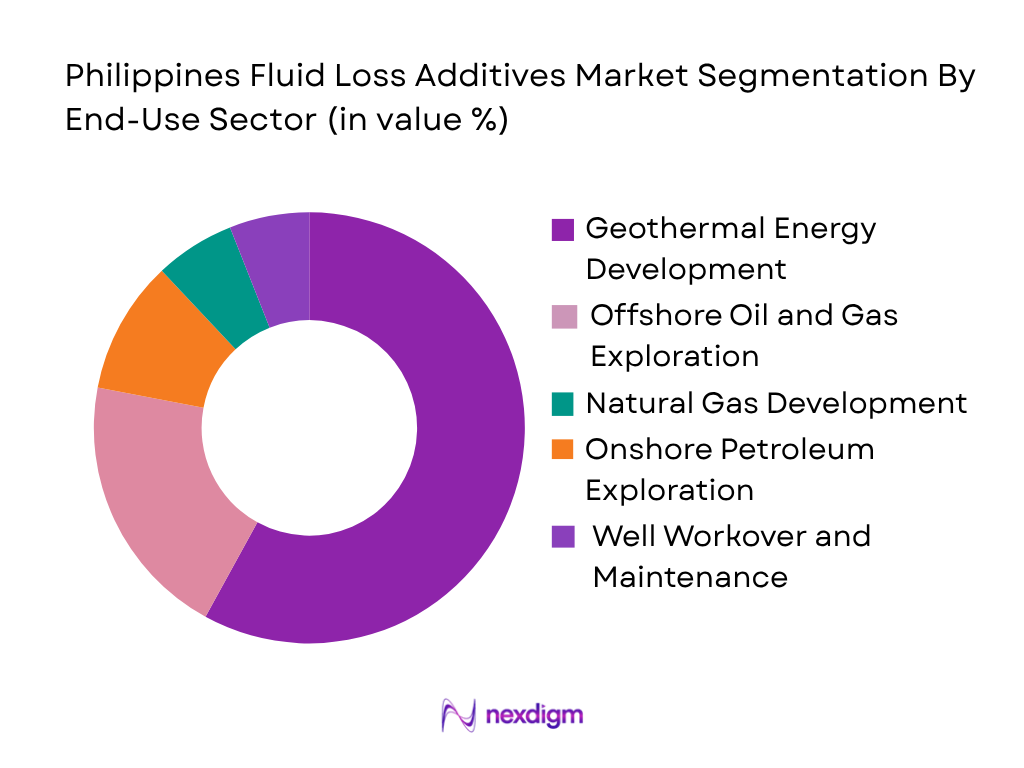
The Philippines Fluid Loss Additives Market is segmented by end-use sector into geothermal energy development, offshore oil and gas exploration, onshore petroleum exploration, natural gas development and well workover and maintenance. Geothermal energy development dominates this segmentation because the Philippines maintains one of Southeast Asia’s largest operational geothermal systems and requires continuous drilling and well-intervention activity to sustain steam availability. The Department of Energy records 1,952 MW of geothermal installed generating capacity and 1,708 MW of dependable capacity, while output reached 10,789 GWh in the latest reported period. Geothermal wells expose drilling fluids and cement systems to elevated temperatures, fractured volcanic formations and lost-circulation zones, increasing demand for thermally stable fluid-loss control additives. Petroleum remains strategically important, particularly Northwest Palawan, where Malampaya and Galoc activity sustains drilling-fluid and cementing demand. Offshore operations also require fluid-loss materials compatible with seawater, brine and HPHT conditions while providing reliable filter-cake performance and formation protection.
Competitive Landscape
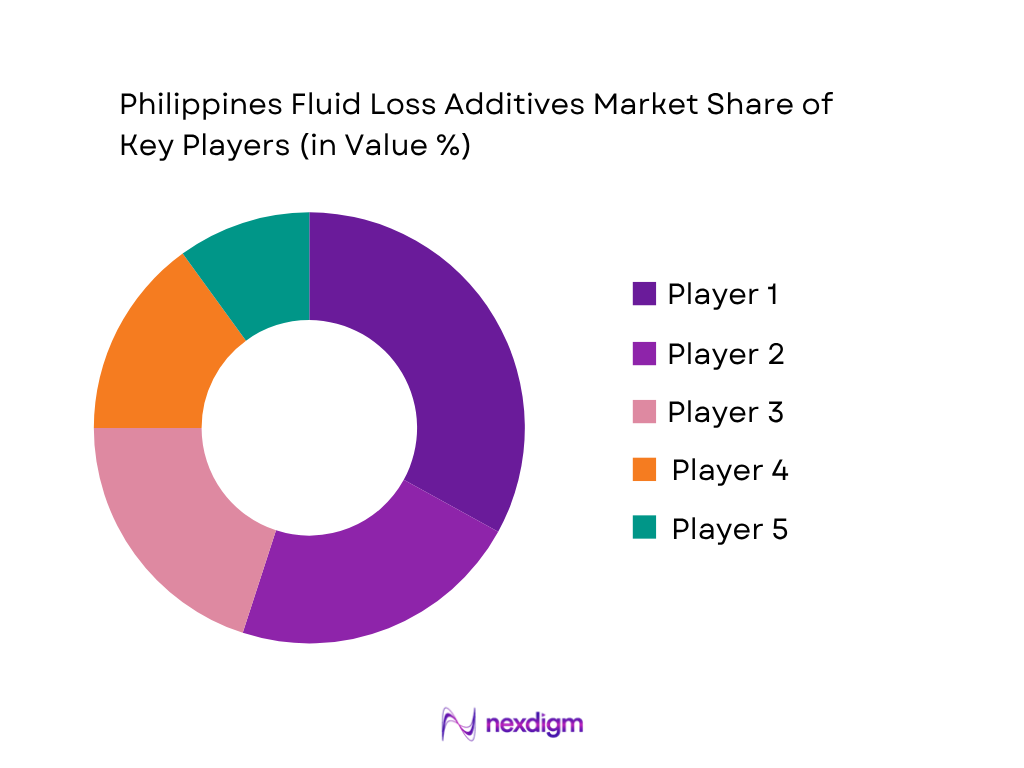
The Philippines Fluid Loss Additives Market is shaped by global oilfield-service companies and specialty-chemical suppliers that compete on high-temperature performance, filtration reduction, cement compatibility, fluid-system versatility and field technical support. SLB, Halliburton, Baker Hughes, Weatherford and Newpark Resources represent the most relevant integrated well-construction participants, while specialty polymer suppliers support the wider formulation chain. Competitive advantage in the Philippines depends heavily on geothermal experience, offshore logistics, HPHT capability and the ability to provide locally available product inventory.
| Company | Establishment Year | Headquarters | Drilling-Fluid Capability | Cement Fluid-Loss Capability | High-Temperature Capability | WBM / OBM Compatibility | Geothermal Relevance | Technical Service Capability |
| SLB | 1926 | ~ | ~ | ~ | ~ | ~ | ~ | ~ |
| Halliburton | 1919 | ~ | ~ | ~ | ~ | ~ | ~ | ~ |
| Baker Hughes | 1907 | ~ | ~ | ~ | ~ | ~ | ~ | ~ |
| Weatherford | 1941 | ~ | ~ | ~ | ~ | ~ | ~ | ~ |
| Newpark Resources | 1932 | ~ | ~ | ~ | ~ | ~ | ~ | ~ |
Philippines Fluid Loss Additives Market Analysis
Growth Drivers
Large Geothermal Well Base and Continuing High-Temperature Drilling Activity
The Philippines’ established geothermal sector is a major structural driver for fluid loss additives because steam-field productivity requires development wells, replacement wells, workovers and periodic intervention in high-temperature volcanic formations. Department of Energy records show approximately 1,951.665 MW of installed geothermal capacity in 2024, including 610.18 MW at the Tongonan Geothermal Production Field, 112.08 MW at Mt. Apo and 975.055 MW across the Visayas geothermal portfolio. These operating assets require drilling fluids capable of controlling filtrate invasion in fractured formations while retaining rheology under elevated temperatures. Fluid-loss reducers such as PAC, CMC, modified starch and thermally stable synthetic polymers therefore remain integral to geothermal mud programs, while cementing operations require specialized additives for reliable zonal isolation. The wider economic environment also supports sustained energy development, with Philippine GDP at approximately USD 461.67 billion in 2024 and GDP per capita at about USD 3,984.8. For fluid-loss suppliers, the combination of a large operating geothermal base and continuing well maintenance creates recurring demand beyond one-time greenfield drilling activity.
Renewed Petroleum Exploration and Deepwater Well Construction
Philippine upstream petroleum activity is strengthening demand for filtration-control chemicals used in drilling, cementing and completion fluids. Active petroleum operations extend across Northwest Palawan, Cagayan, Cebu and other basins, while 8 new petroleum service contracts were awarded in October 2025 across the Sulu Sea, Cagayan, Cebu, Northwest Palawan, East Palawan and Central Luzon. In April 2026, another 2 petroleum service contracts were signed, bringing the number awarded under the current administration to 12. The Malampaya development is particularly relevant because the 2026 drilling program covers 3 wells—Malampaya East-1, Camago-3 and Bagong Pagasa-1—requiring drilling fluids and cement systems that can operate under demanding offshore temperature, pressure and salinity conditions. These activities support demand for synthetic polymer fluid-loss reducers, seawater-compatible filtration-control additives and cementing agents with stable HPHT performance. Philippine GDP stood at approximately USD 461.67 billion in 2024, providing a macroeconomic base for domestic energy-security investment and upstream project execution.
Market Challenges
High-Temperature and Fractured Geothermal Formation Complexity
The Philippines Fluid Loss Additives Market faces a significant technical challenge because many geothermal wells are drilled through high-temperature, fractured volcanic formations where conventional fluid-loss polymers can lose viscosity, thermally degrade or provide insufficient filter-cake integrity. Major geothermal operations include 610.18 MW at the Tongonan production field and 112.08 MW at Mt. Apo. Development-stage and pre-development projects also include 50 MW of identified capacity at Biliran, 40 MW in Southern Leyte, 40 MW at Maragusan and 20 MW at Mt. Zion. These geological environments can expose mud systems to high temperatures, fractured intervals and changing concentrations of dissolved salts and formation contaminants. Fluid-loss additives must therefore maintain filtration control without causing excessive viscosity or interfering with lost-circulation materials and cement systems. Product qualification requires thermal-aging, HPHT filtration and contamination testing before field deployment. Philippine GDP stood at approximately USD 461.67 billion in 2024, yet the technical difficulty of geothermal wells means market participation depends more on specialized formulation performance than broad economic scale.
Dispersed Offshore and Remote-Well Supply Requirements
The geographic dispersion of Philippine drilling activity creates a logistics and inventory challenge for fluid-loss additive suppliers. Petroleum service-contract areas are located across Northwest Palawan, Cagayan, Cebu and other offshore or geographically separated basins, while the 8 petroleum service contracts awarded in 2025 added acreage in the Sulu Sea, Cagayan, Cebu, Northwest Palawan, East Palawan and Central Luzon. A further 2 contracts signed in April 2026 expanded current upstream activity into southern Cebu and Leyte. Fluid-loss reducers are specialty chemicals that often need to be matched to actual mud salinity, bottom-hole temperature, cement formulation and drilling conditions, which makes unplanned product substitution difficult. Offshore campaigns additionally require inventory planning around supply vessels, port access, packaging, storage and emergency replenishment. Geothermal projects face similar challenges because producing fields in Leyte, Bicol, Negros and Mindanao can be distant from major chemical warehousing centres. The Philippines generated approximately USD 461.67 billion of GDP in 2024, but national archipelagic geography makes reliable local inventory and technical support especially important for well-chemical suppliers.
Market Opportunities
Thermally Stable Geothermal Fluid-Loss Polymer Systems
The Philippines presents a substantial future opportunity for suppliers of thermally stable filtration-control additives because its current geothermal operating base and active development portfolio require products capable of maintaining performance in severe downhole conditions. The country had approximately 1,951.665 MW of installed geothermal capacity in the 2024 project inventory, including extensive production assets in Leyte and Mindanao. Current project records also identify 50 MW of geothermal potential at Biliran, 40 MW in Southern Leyte, 40 MW at Maragusan and 20 MW at Mt. Zion. These existing projects provide a current demand foundation for future adoption of synthetic copolymers, thermally enhanced PAC systems, modified starch formulations and high-temperature cement fluid-loss additives. Suppliers can differentiate through lower dosage requirements, stronger thermal-aging performance, improved calcium and salinity tolerance and compatibility with lost-circulation materials. Opportunities also exist for geothermal-specific pre-blended chemical packages that simplify treatment at remote well sites. Philippine GDP of approximately USD 461.67 billion in 2024 indicates an economy large enough to sustain continuing energy infrastructure investment.
Deepwater Gas, Petroleum Cementing and HPHT Fluid Systems
Current Philippine upstream activity provides a strong platform for future growth in advanced drilling-fluid and cementing additives designed for offshore and HPHT environments. Malampaya East-1 was the first well in a 3-well drilling campaign that also includes Camago-3 and Bagong Pagasa-1. The government also reported 12 petroleum service contracts awarded under the current administration by April 2026, including areas in Northwest Palawan, the Sulu Sea, Cebu, Cagayan and other prospective basins. These present-day activities create an addressable base for future demand for fluid-loss reducers that can withstand high pressure, elevated temperature, seawater contamination and extended circulation periods. Cementing additives are also positioned to benefit because offshore wells require controlled slurry filtration to support placement efficiency, prevent premature dehydration and maintain zonal isolation. Product opportunities include synthetic copolymers, latex-based cement additives, salt-tolerant filtration reducers and multi-functional polymers combining fluid-loss control with rheology management. Philippine GDP stood at approximately USD 461.67 billion in 2024, supporting continued domestic energy-development capability.
Future Outlook
The Philippines Fluid Loss Additives Market is expected to expand at approximately ~XX.X% CAGR during 2026–2035, supported by geothermal field development, replacement drilling, petroleum exploration, deepwater gas activity and increasing requirements for high-temperature well integrity. Growth will remain technically driven rather than volume driven, with thermally stable synthetic polymers and advanced cementing additives gaining importance.
The geothermal sector will remain the central demand base. The Department of Energy has maintained an installed geothermal capacity of approximately 1,952 MW, while awarded geothermal areas include producing fields and additional projects under development and pre-development. Biliran carries 50 MW of identified potential, Southern Leyte 40 MW, Maragusan 40 MW and Mt. Zion 20 MW, supporting continued drilling-related chemical requirements.
Major Players
- SLB
- Halliburton
- Baker Hughes
- Weatherford
- Newpark Resources
- BASF
- Clariant
- Nouryon
- Syensqo
- Dow
- Ashland
- Lubrizol
- TETRA Technologies
- Chevron Phillips Chemical
- Filtron Envirotech
Key Target Audience
- Oilfield and Geothermal Specialty Chemical Manufacturers
- Drilling Fluid and Mud Engineering Service Providers
- Geothermal Energy Developers and Well Operators
- Petroleum Exploration and Production Companies
- Drilling, Cementing and Well Construction Contractors
- Oilfield Chemical Importers and Distributors
- Investments and Venture Capitalist Firms
- Government and Regulatory Bodies (Philippines Department of Energy, Department of Environment and Natural Resources, Environmental Management Bureau, Energy Regulatory Commission)
Research Methodology
Step 1: Identification of Key Variables
The initial phase involves constructing an ecosystem map encompassing fluid-loss additive manufacturers, drilling-fluid service companies, cementing providers, geothermal developers, petroleum operators, drilling contractors, chemical importers and distributors. Key variables include well count, well depth, bottom-hole temperature, drilling-fluid system, additive dosage, filtration requirement, cementing activity, geothermal capacity and petroleum service-contract activity.
Step 2: Market Analysis and Construction
Historical market development is analysed through both top-down and bottom-up approaches. The top-down model evaluates geothermal development, petroleum exploration, active service contracts, drilling campaigns and well-construction activity. The bottom-up model estimates additive demand by well type, mud system, drilling stage, fluid-loss dosage, cement volume, thermal specification and expected consumption per drilling or cementing operation.
Step 3: Hypothesis Validation and Expert Consultation
Market hypotheses are validated through structured interviews with drilling-fluid specialists, mud engineers, geothermal operators, petroleum contractors, cementing companies, chemical distributors and technical-service providers. Interviews are used to validate PAC, CMC, starch and synthetic-polymer usage, temperature limitations, field dosage practices, import lead times, product qualification procedures and operator procurement behaviour.
Step 4: Research Synthesis and Final Output
The final phase triangulates primary insights with Department of Energy project data, petroleum service contracts, geothermal operating information, drilling programs and supplier technology specifications. Top-down drilling and energy indicators are reconciled with bottom-up additive-consumption models to develop the final segmentation, competitive positioning, demand outlook and strategic assessment for the Philippines Fluid Loss Additives Market.

- Executive Summary
- Research Methodology (Market Definitions and Assumptions, Philippines Fluid Loss Additives Market Classification, Drilling Fluid Additive Scope, Cement Slurry Additive Scope, Completion Fluid Loss Control Scope, Water-Based Mud Assessment, Oil-Based Mud Assessment, Synthetic-Based Mud Assessment, Geothermal Well Assessment, Petroleum Well Assessment, HPHT Well Assessment, Polymer Chemistry Assessment, PAC Assessment, CMC Assessment, Starch Derivative Assessment, Polyacrylamide Assessment, Synthetic Copolymer Assessment, Lignite and Resin-Based Additive Assessment, Latex Cement Additive Assessment, API Fluid Loss Performance Assessment, HPHT Filtration Assessment, Thermal Stability Assessment, Salinity Tolerance Assessment, Calcium Contamination Tolerance Assessment, Rheology Interaction Assessment, Well Depth Assessment, Formation Permeability Assessment, Import Dependency Assessment, Top-Down Market Sizing, Bottom-Up Market Sizing, Demand-Side Assessment, Supply-Side Assessment, Primary Industry Interviews, Geothermal Drilling Pipeline Assessment, Petroleum Service Contract Pipeline Assessment, Data Triangulation, Forecasting Framework)

- Definition and Scope
- Evolution of Fluid Loss Control Chemicals in the Philippines, Development of Bentonite-Based Drilling Fluids, Transition toward Polymer-Enhanced Water-Based Mud Systems, Expansion of High-Temperature Geothermal Drilling Fluids, Development of Oil-Based and Synthetic-Based Mud Systems, Adoption of PAC, CMC, Modified Starch, Polyacrylamide, Synthetic Copolymers, Resinated Lignite and Latex-Based Cement Additives, Fluid Loss Additives Industry Value Chain, Oilfield Chemical Supply Chain, Well Construction Chemical Ecosystem Mapping
- Cellulose Feedstock Suppliers, Starch Feedstock Suppliers, Polymer Raw Material Suppliers, Specialty Chemical Manufacturers, Fluid Loss Additive Formulators, Oilfield Chemical Manufacturers, Drilling Fluid Service Companies, Cementing Service Companies, Chemical Importers, Philippine Distributors, Bulk Chemical Warehouses, Offshore Logistics Providers, Geothermal Drilling Contractors, Petroleum Drilling Contractors, Geothermal Developers, Petroleum Operators, Testing Laboratories, Environmental Compliance Providers

- Growth Drivers (Geothermal Exploration and Development, New Geothermal Power Projects, Geothermal Replacement Well Drilling, Petroleum Exploration Activity, Offshore Drilling Programs, Domestic Energy Security Initiatives, Mature Field Workovers, Deep and High-Temperature Wells, Increasing Wellbore Stability Requirements, Growing Use of Engineered Polymer Mud Systems)
- Market Challenges (Limited Domestic Specialty Chemical Manufacturing, Import Dependence, Long Offshore Supply Lead Times, Volatile Well-Drilling Programs, High-Temperature Polymer Degradation, Salt and Calcium Contamination, Complex Volcanic Geology, Lost Circulation Interaction, Environmental Compliance Requirements, Limited Local Laboratory Formulation Capability, Chemical Storage and Handling Constraints)
- Market Opportunities (High-Temperature Geothermal Fluid Loss Additives, Thermally Stable Synthetic Polymers, Locally Stocked Specialty Additives, Geothermal-Specific Mud Packages, High-Salinity Fluid Loss Control, Environmentally Improved Polymer Systems, Cementing Additives for Geothermal Wells, Offshore Petroleum Exploration Chemicals, Workover Fluid Loss Control, Local Blending and Formulation, Technical Service and Mud Engineering Support)
- Market Trends (Thermally Stable Synthetic Polymer Adoption, PAC and Modified Starch Optimization, Lower-Toxicity Water-Based Systems, Multi-Functional Polymer Additives, Higher Salinity Tolerance, High-Temperature Filtration Control, Customized Geothermal Mud Formulation, Reduced Formation Damage, Pre-Blended Chemical Packages, Local Inventory Holding, Performance-Based Chemical Selection)
- Government Regulations and Standards (Department of Energy Petroleum Service Contract Requirements, Geothermal Renewable Energy Service Contract Requirements, Philippine Conventional Energy Contracting Program, Environmental Compliance Certificate Requirements, DENR Chemical Management Requirements, Philippine Inventory of Chemicals and Chemical Substances Requirements, Toxic Substances and Hazardous and Nuclear Wastes Control Act, Maritime Transport Requirements, Offshore Chemical Handling Requirements, Occupational Safety and Health Requirements)
- SWOT Analysis
- Porter’s Five Forces Analysis
- PESTLE Analysis
- Stakeholder Ecosystem
- Well Construction and Oilfield Chemical Project Ecosystem

- By Market Value (2020-2025)
- By Consumption Volume (2020-2025)
- By Drilling Fluid Loss Additive Consumption (2020-2025)
- By Cementing Fluid Loss Additive Consumption (2020-2025)
- By Completion and Workover Fluid Loss Additive Consumption (2020-2025)
- By Geothermal Well Consumption (2020-2025)
- By Petroleum Well Consumption (2020-2025)
- By Offshore Well Consumption (2020-2025)
- By Onshore Well Consumption (2020-2025)
- By High-Temperature Fluid Loss Additive Consumption (2020-2025)
- By Imported Fluid Loss Additive Value (2020-2025)
- By Domestic Formulation and Distribution Value (2020-2025)

- By Application Type (In Value %)
Drilling Fluid Filtration Control
Primary Cementing Fluid Loss Control
Remedial Cementing Fluid Loss Control
Completion Fluid Loss Control
Workover Fluid Loss Control
Wellbore Strengthening and Seepage Control - By Fluid System (In Value %)
Water-Based Mud Systems
Freshwater Polymer Mud Systems
Saltwater and Seawater Mud Systems
Oil-Based Mud Systems
Synthetic-Based Mud Systems
High-Temperature Geothermal Mud Systems
Completion and Brine Systems
Cement Slurry Systems - By Additive Chemistry (In Value %)
Polyanionic Cellulose
Carboxymethyl Cellulose
Modified Starch
Polyacrylamide
Acrylamide-Based Synthetic Copolymers
Vinyl-Based Synthetic Polymers
Lignite and Resinated Lignite
Latex-Based Cement Additives
Cellulosic Filtration Control Additives
Specialty High-Temperature Polymers - By Well Construction Stage (In Value %)
Surface Hole Drilling
Intermediate Hole Drilling
Production Hole Drilling
Primary Cementing
Liner Cementing
Remedial Cementing
Completion
Workover and Intervention - By Formation Condition (In Value %)
Highly Permeable Formations
Fractured Formations
Depleted Formations
Reactive Shale Formations
High-Temperature Volcanic Formations
Carbonate Formations
Sandstone Formations - By Region (In Value %)
Leyte
Albay and Bicol Geothermal Belt
Laguna-Batangas Geothermal Belt
Negros
North Cotabato and Mindanao Geothermal Areas
Northwest Palawan
Cebu
Cagayan
Other Petroleum and Geothermal Contract Areas

- Market Share of Major Players (By Philippines Revenue, Fluid Loss Additive Volume, Drilling Fluid Portfolio, Cementing Additive Portfolio, Geothermal Well Exposure, Petroleum Well Exposure, Water-Based Mud Capability, Oil-Based and Synthetic-Based Mud Capability, High-Temperature Product Capability, Synthetic Polymer Portfolio, Local Distributor Network, Technical Service Capability, Laboratory Support, Offshore Supply Capability)
- Cross Comparison Parameters (Fluid Loss Additive Chemistry Portfolio Breadth, High-Temperature and HPHT Performance Capability, Geothermal Drilling Application Experience, Water-Based Oil-Based and Cement System Compatibility, API and HPHT Fluid Loss Performance Range, Philippines Inventory and Distribution Capability, Field Mud Engineering and Laboratory Technical Support, Offshore Petroleum and Geothermal Well Project Execution Capability)
- SWOT Analysis of Major Players
- Competitive Positioning Matrix
- Major Companies
SLB
Halliburton
Baker Hughes
Weatherford
Newpark Resources
BASF
Clariant
Nouryon
Syensqo
Dow
Ashland
Lubrizol
TETRA Technologies
Chevron Phillips Chemical
Filtron Envirotech

- Geothermal Developer Requirement Assessment
- Petroleum Operator Requirement Assessment
- Drilling Contractor Requirement Assessment
- Drilling Fluid Service Company Requirement Assessment
- Cementing Service Provider Requirement Assessment
- Completion and Workover Contractor Requirement Assessment
- High-Temperature Polymer Requirement Assessment
- HPHT Fluid Loss Performance Requirement Assessment
- Salinity and Calcium Tolerance Requirement Assessment
- Local Inventory Requirement Assessment
- Offshore Logistics Requirement Assessment
- Laboratory and Technical Support Requirement Assessment
- Environmental Compliance Requirement Assessment
- Product Qualification and Field Trial Requirement Assessment

- By Market Value (2026-2035)
- By Consumption Volume (2026-2035)
- By Drilling Fluid Loss Additive Consumption (2026-2035)
- By Cementing Fluid Loss Additive Consumption (2026-2035)
- By Completion and Workover Fluid Loss Additive Consumption (2026-2035)
- By Geothermal Well Consumption (2026-2035)
- By Petroleum Well Consumption (2026-2035)
- By Offshore Well Consumption (2026-2035)
- By Onshore Well Consumption (2026-2035)
- By High-Temperature Fluid Loss Additive Consumption (2026-2035)
- By Imported Fluid Loss Additive Value (2026-2035)
- By Domestic Formulation and Distribution Value (2026-2035)


 Request a Sample
 Ask for Customization
 Get a Quote
 Enquire Now