
 Download PDF
Market Overview
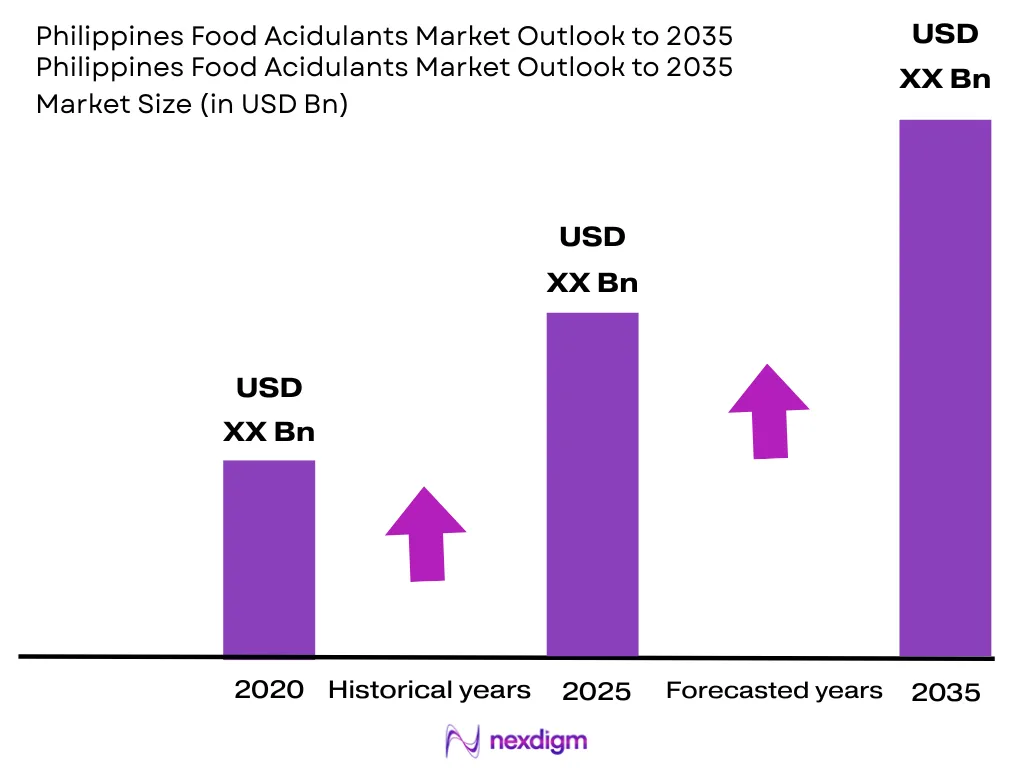
The Philippines food acidulants market was valued at approximately USD ~ Billion in 2024 and is projected to reach USD ~ Billion by 2032, growing at a CAGR of 7.54% during the forecast period — one of the highest growth rates among Southeast Asian food acidulant markets. The market is underpinned by the Philippines’ large and youthful population of more than 115 million people, a fast-growing processed food and beverage manufacturing industry, an expanding quick-service restaurant (QSR) and foodservice sector, and rising consumer demand for packaged, shelf-stable, and convenience food products across Metro Manila and secondary urban centres. According to the Philippine Statistics Authority (PSA), the food manufacturing industry is one of the country’s most significant manufacturing sectors, contributing substantially to industrial output and employment. The Philippines Food and Drug Administration (FDA), operating under the Department of Health (DOH) and Republic Act 9711, regulates the use of food additives including acidulants through its food additive guidelines and the Codex General Standard for Food Additives (GSFA) alignment framework, governing the approval, registration, and permissible usage of acidulants across domestic food manufacturing and import activities. Growth is driven by urbanization, a large young consumer demographic, rapidly expanding QSR and packaged food consumption, strong demand for sauces, condiments, and snack foods, and increasing food ingredient imports from Singapore, Indonesia, Malaysia, and China.
Market Segmentation
By Acidulant Type
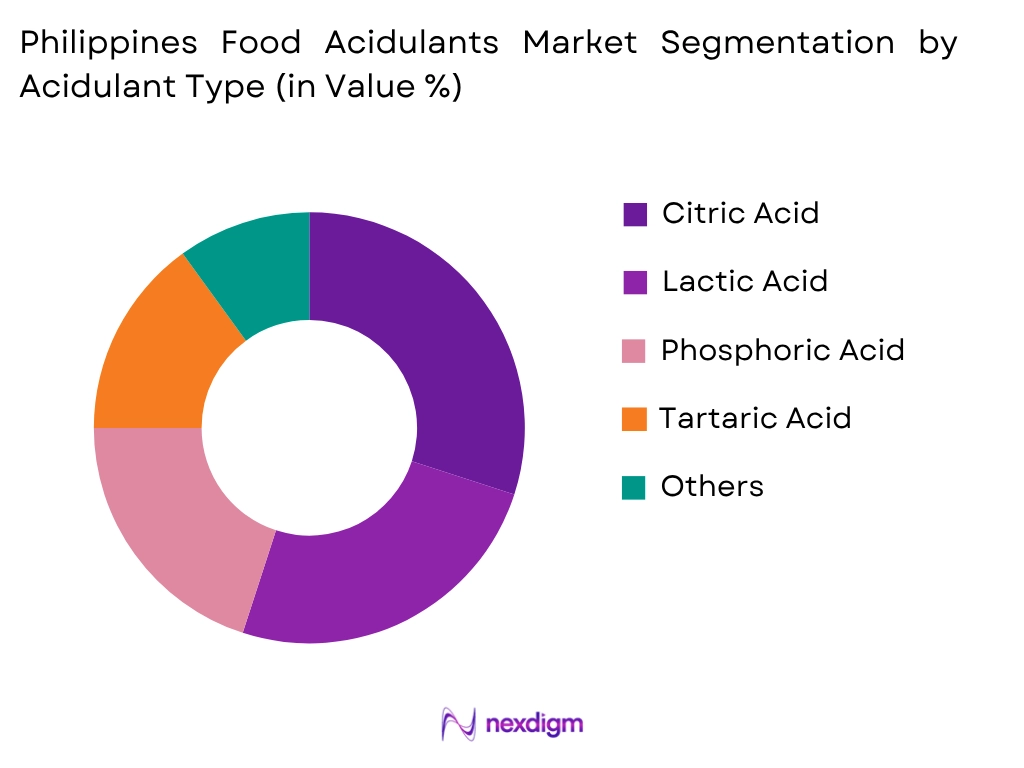
Citric acid dominates the Philippines food acidulants market, representing the largest segment with a market value of approximately USD 19.60 million in 2024, and is projected to grow at the fastest CAGR of 8.08% among all acidulant types through 2032. Citric acid’s dominance reflects its widespread application across the Philippines’ extensive beverage manufacturing sector, which includes carbonated soft drinks, fruit juices, energy drinks, powdered drink mixes, and ready-to-drink functional beverages that together represent the country’s largest food processing subsector. Its role as a natural pH regulator, flavor enhancer, preservative, and antioxidant synergist makes it the primary acidulant of choice for the Philippines’ large-scale producers of sauces, vinegars, condiments, canned and processed seafood, and confectionery products. All major food and beverage companies operating in the Philippines, including San Miguel Corporation, Universal Robina Corporation, and Monde Nissin, rely on citric acid across multiple product categories. The Philippines continues to import citric acid predominantly from China and ASEAN trading partners, with Singapore, Indonesia, and Malaysia identified among the country’s top food ingredient import sources. Lactic acid serves important roles in the dairy, processed meat, and bakery segments, while acetic acid is extensively used in vinegar production, a deeply embedded component of Filipino culinary culture. Phosphoric acid maintains demand within the carbonated beverage segment, while malic acid is gaining traction in flavored snack and functional beverage innovation.
By Application
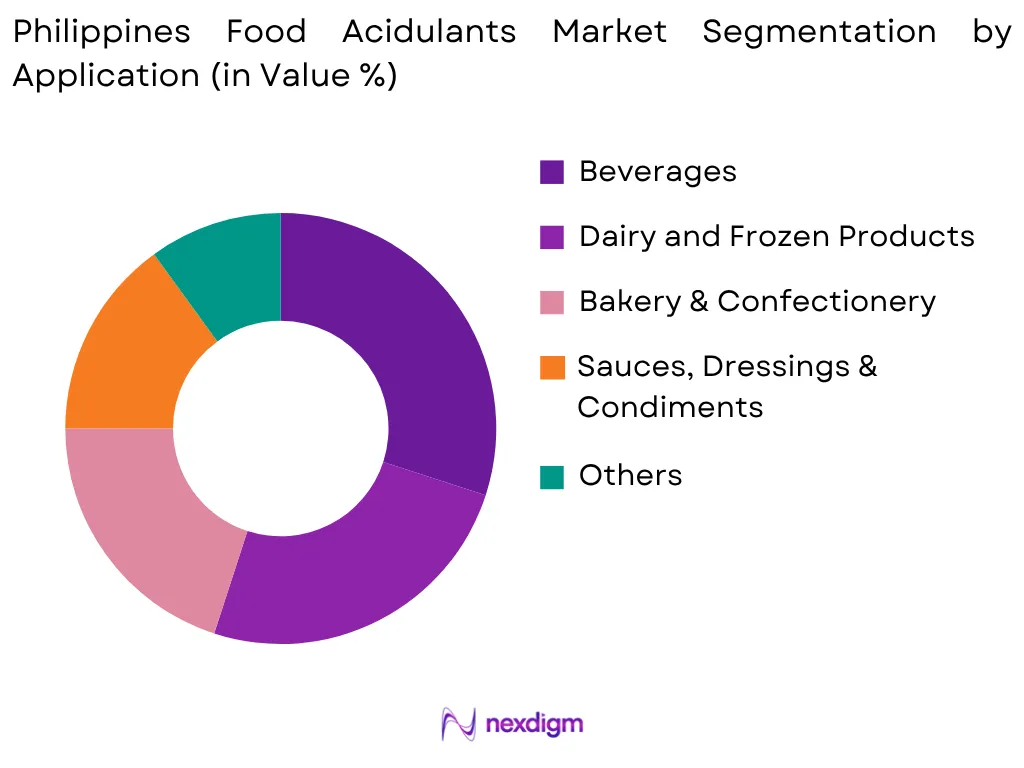
Beverages represent the dominant application segment in the Philippines food acidulants market, driven by one of Southeast Asia’s most active soft drink, juice, and flavored drink markets supported by a population with a strong preference for sweet, fruity, and tangy beverage profiles. The Philippines’ tropical climate sustains year-round high demand for hydration beverages, carbonated drinks, and powdered juice mixes, all of which rely extensively on citric acid and phosphoric acid for flavor enhancement, pH control, and preservation. According to the Philippine Statistics Authority, beverage manufacturing is among the top revenue-generating food processing subsectors in the country, with companies including San Miguel Brewery, Coca-Cola Philippines, and Universal Robina Corporation maintaining large-scale production operations requiring consistent industrial acidulant supply. Sauces, dressings, and condiments represent a further major application segment, reflecting the importance of vinegar, soy sauce, fish sauce, banana ketchup, and proprietary condiments in Filipino cuisine and the country’s significant condiment export trade. Acidulants play critical functional roles in condiment production, including pH control for microbial safety, preservation, flavor balance, and shelf-life extension in products distributed across the Philippines’ extensive general trade network of sari-sari stores, wet markets, and supermarkets. The bakery segment also relies significantly on acidulants for leavening, mold inhibition, and shelf-life extension, while the processed meat and seafood sector uses acidulants for pH management and safety compliance in chorizo, tocino, longganisa, and canned seafood products.
Competitive Landscape
The Philippines food acidulants market is dominated by specialty ingredient distributors and trading companies, as the country maintains no significant domestic acidulant manufacturing capacity and relies on imported product sourced primarily from China, Singapore, Malaysia, and Europe. International ingredient distribution companies including Brenntag, Univar Solutions, Hawkins Watts, DKSH, and Foodchem International serve as the primary commercial intermediaries, supplying food-grade acidulants to the Philippines’ food processing, foodservice, pharmaceutical, and household retail sectors. These companies compete on the depth and breadth of their acidulant portfolios, Philippines FDA compliance capabilities, License to Operate (LTO) standing, warehousing and distribution infrastructure across Metro Manila and the provinces, and technical application support for food and beverage formulation. Multinational ingredient producers including Cargill, Kerry, Ingredion, ADM, and Corbion maintain commercial presences in the Philippines through direct sales teams and distribution partnerships, serving major food and beverage manufacturing accounts in the National Capital Region and key provincial food processing hubs.
| Company | Establishment Year | Headquarters | Primary Acidulant Portfolio | Key Application Industries
|
Manufacturing Presence | R&D Capability | Distribution Network | Clean Label Solutions |
| Univar Solutions Philippines | 1924 | ~ | ~ | ~ | ~ | ~ | ~ | ~ |
| Hawkins Watts Philippines | 1945 | ~ | ~ | ~ | ~ | ~ | ~ | ~ |
| Foodchem International Philippines | 2006 | ~ | ~ | ~ | ~ | ~ | ~ | ~ |
| DKSH Philippines | 1865 | ~ | ~ | ~ | ~ | ~ | ~ | ~ |
| Brenntag Philippines | 1874 | ~ | ~ | ~ | ~ | ~ | ~ | ~ |
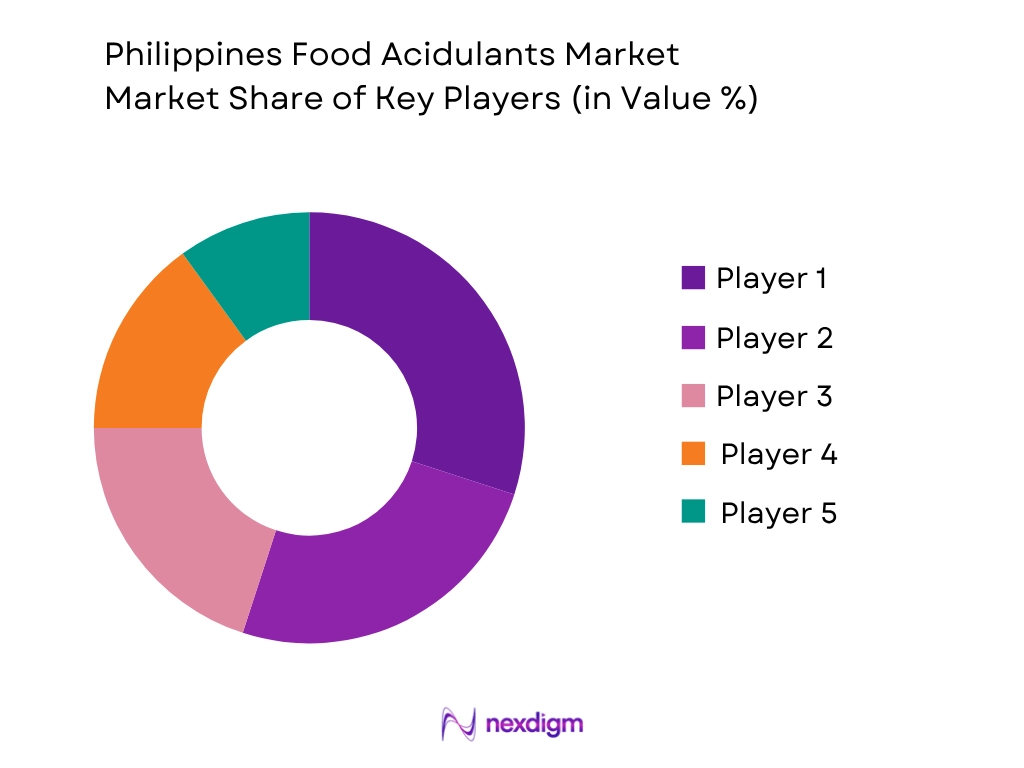
Philippines Food Acidulants Market Analysis
Growth Drivers
Rapid Expansion of the Processed Food, Beverage, and Snack Food Sectors
The Philippines’ rapidly expanding processed food, beverage, and snack food manufacturing sectors represent the primary structural growth drivers for the food acidulants market. According to the Philippine Statistics Authority (PSA), the food and beverage manufacturing industry is one of the country’s largest manufacturing subsectors, generating substantial industrial output and employment across Metro Manila, Cavite, Laguna, Batangas, and Cebu. The Philippines’ population exceeded 115 million in 2024, with the World Bank estimating that more than 50% of the population lives in urban areas, driving consistent growth in packaged, processed, and convenience food consumption. The International Monetary Fund (IMF) projects the Philippine economy to maintain GDP growth of approximately 6% annually through the mid-2030s, supported by a young, consumption-oriented demographic profile and rising middle-class spending power, particularly in Metro Manila and secondary urban centres. Major food and beverage companies including Universal Robina Corporation, San Miguel Corporation, Monde Nissin Corporation, Jollibee Foods Corporation, and Del Monte Philippines operate large-scale manufacturing facilities that require consistent supply of food-grade acidulants for pH regulation, flavor enhancement, preservation, and shelf-life management across their product portfolios. The food ingredient import market of the Philippines recorded a CAGR of 13.15% between 2020 and 2024, with a 35.87% growth rate in 2024 alone, reflecting the pace at which domestic food manufacturing is scaling and increasingly demanding food ingredient inputs including acidulants. This strong industrial demand trajectory, combined with expanding retail distribution of packaged food products across the Philippines’ approximately 1.1 million sari-sari stores and modern supermarket chains, creates a robust and growing addressable market for food acidulant suppliers.
Growing QSR and Foodservice Sector and Filipino Culinary Profile
The Philippines’ fast-growing quick-service restaurant (QSR) and broader foodservice sector creates substantial and expanding demand for food-grade acidulants used across food preparation, sauce production, beverage formulation, and processed ingredient manufacturing. According to market data, the Philippines foodservice market was valued at approximately USD 23.09 billion in 2024 and is projected to grow to USD 35.75 billion by 2035, reflecting a CAGR of 4.05% during the forecast period. Major QSR chains including Jollibee Foods Corporation — which operates globally and across thousands of domestic locations — McDonald’s Philippines, KFC Philippines, and Max’s Group collectively drive large-scale institutional demand for standardized food ingredients including acidulants used in marinades, sauces, beverages, and condiment applications. The deep integration of sour and acidic flavor profiles in Filipino cuisine, including the use of calamansi, vinegar, tamarind, and kamias as culinary acidulants in dishes such as sinigang, adobo, kinilaw, and paksiw, reflects a strong cultural predisposition toward acidic flavor enhancement that extends into the commercial food processing and foodservice sectors. Food processors manufacturing commercially packaged versions of traditional Filipino sauces and condiment products depend on industrial-grade citric acid and acetic acid to replicate and standardize the acidic profiles of these culturally significant foods. The continued expansion of QSR chains into secondary cities and provincial markets beyond Metro Manila, combined with strong growth in cloud kitchens, food delivery platforms, and catering services, is expected to sustain growing institutional demand for food-grade acidulants throughout the forecast period.
Market Challenges
Heavy Import Dependency and Archipelagic Logistics Complexity
The Philippines’ near-complete reliance on imported food acidulants, combined with the inherent logistical complexity of distributing food ingredients across an archipelago of more than 7,600 islands, represents a fundamental structural challenge for market participants. The Philippines imports citric acid, lactic acid, phosphoric acid, malic acid, and virtually all other food-grade acidulant types from overseas sources, with Singapore, China, Indonesia, Malaysia, and the United States identified as the country’s principal food ingredient import partners. According to Philippine trade data, food ingredient imports have grown substantially in recent years, reflecting the accelerating expansion of domestic food processing capacity. However, this import dependency exposes food manufacturers and ingredient distributors to global supply chain disruptions, international commodity price volatility, and foreign exchange risk arising from the Philippine Peso’s fluctuation relative to the US Dollar and other major currencies. The Bureau of Customs and the Philippines FDA’s import permit requirements add documentation and administrative burden to the procurement process, with import permits required to be applied for a minimum of 14 days before shipment arrival. Beyond Metro Manila and major provincial hubs, the distribution of food ingredients across the Philippines’ dispersed island geography requires multi-modal logistics combining sea freight, air cargo, and road transport, substantially increasing last-mile distribution costs and transit times for food manufacturers located in Visayas, Mindanao, and remote provincial areas. These logistics constraints can result in supply inconsistencies, higher carrying costs for regional distributors, and limited market access for premium or specialty acidulant grades that may not justify the cost of extended distribution.
Philippines FDA Regulatory Compliance Complexity
The Philippines Food and Drug Administration’s food additive regulatory framework, administered under Republic Act 9711 and the Food Safety Act of 2013, creates ongoing compliance obligations for acidulant importers, distributors, and food manufacturing companies operating in the domestic market. The Philippines FDA requires all food establishments involved in the importation, distribution, and manufacture of food products to obtain a License to Operate (LTO), while processed food products must secure a Certificate of Product Registration (CPR) demonstrating compliance with applicable food safety standards, Philippine National Standards, and Codex General Standard for Food Additives (GSFA) requirements. In January 2023, the Philippines FDA unveiled a draft of Revised Guidelines on Food Additives and Processing Aids to replace the existing Administrative Order 88-A from 1984, signaling the country’s intention to comprehensively update its food additive regulatory framework in alignment with current Codex Alimentarius standards. For food additives without a specific national standard, the maximum usage levels and application restrictions must comply with the Codex GSFA, requiring food manufacturers and ingredient importers to maintain current knowledge of international regulatory developments. In May 2024, the Philippines FDA also formalized new regulations requiring advance declaration for food ingredient samples, with import permits required at least 14 days before product arrival at port. Companies must invest in dedicated regulatory affairs expertise, comprehensive compliance documentation systems, and proactive monitoring of Philippines FDA regulatory updates to navigate these evolving requirements effectively and maintain uninterrupted market access.
Market Opportunities
Sauces, Condiments, and Processed Food Export Growth
The Philippines’ deep culinary tradition of acidic flavor profiles and its large overseas Filipino worker (OFW) diaspora create significant export growth opportunities for Philippine-manufactured sauces, condiments, and processed foods that rely on food-grade acidulants for flavor, preservation, and shelf-life management. According to the Bangko Sentral ng Pilipinas (BSP), OFW remittances exceeded USD 37 billion in 2024, reflecting the scale of the Philippine diaspora and creating cultural demand for authentic Filipino food products in markets across the United States, Canada, Europe, the Middle East, and East Asia. Philippine-made banana ketchup, vinegar, soy sauce, fish sauce, canned goods, and processed meat products — all of which utilize acidulants for preservation and flavor — are exported to overseas Filipino communities, generating consistent and growing export revenue for domestic food manufacturers. The Philippine Export Promotion Board (DTI-Export Marketing Bureau) actively supports the expansion of Philippine processed food exports as part of the country’s broader diversification agenda. The growth of Filipino cuisine’s international profile, driven by OFW communities and rising global interest in Southeast Asian food culture, creates expanding commercial opportunities for Philippine food manufacturers to develop export-oriented product lines that require reliable, consistently supplied, and food-safe acidulant ingredients. Companies that develop strong supply relationships with domestic food exporters and provide application-specific technical support for export-grade formulation are well positioned to capture this growing segment of the Philippine food processing industry.
Functional Beverage and Fortified Food Innovation
The Philippines’ large young population, growing health awareness, and expanding modern retail infrastructure create significant opportunities for functional beverage and fortified food innovation that drives new acidulant demand. According to the Philippine Statistics Authority, more than 60% of the Philippine population is under 35 years of age, creating a substantial and health-conscious consumer base increasingly receptive to functional beverages, energy drinks, vitamin-fortified juices, and electrolyte replenishment products that rely on citric acid, malic acid, and lactic acid for flavor balance, pH optimization, and nutritional stability. The Philippine Food Fortification Act (Republic Act 8976) mandates the fortification of staple foods including rice, flour, cooking oil, and sugar with essential micronutrients, and has established a regulatory culture and manufacturing infrastructure supportive of fortified and functional food product development. Market data indicates that health-oriented beverage categories including vitamin water, probiotic drinks, sports hydration beverages, and reduced-sugar fruit juice products are among the fastest-growing segments of the Philippine beverage market. These product categories require specialized acidulant formulation expertise, including malic acid for enhanced tartness in reduced-sugar beverages, lactic acid for probiotic and fermented drink applications, and citric acid for vitamin C stability and flavor enhancement. Companies investing in functional food application expertise, collaborative product development with Philippine beverage manufacturers, and innovative acidulant system solutions for health-oriented food categories are well positioned to capture premium growth opportunities across the Philippines’ rapidly evolving functional food and beverage market.
Future Outlook
The Philippines food acidulants market is expected to maintain one of Southeast Asia’s strongest growth trajectories through the forecast period, supported by a large and young population, rapid urbanization, expanding food processing capacity, and the continued growth of the QSR, foodservice, and packaged food sectors. Market expansion will be further driven by increasing export of Philippine processed foods to OFW diaspora markets, rising demand for functional and health-oriented food and beverage products, and the Philippines FDA’s ongoing regulatory modernization efforts aligning domestic food additive standards with international Codex frameworks. Infrastructure investments in provincial logistics, cold chain development, and digital procurement platforms will progressively improve acidulant distribution efficiency beyond Metro Manila into secondary cities across Luzon, Visayas, and Mindanao. Companies that invest in Philippines FDA regulatory compliance capabilities, broadened acidulant portfolios, provincial distribution reach, and close commercial partnerships with major Filipino food manufacturers will be best positioned to capture the market’s substantial long-term growth opportunities.
Major Players
- Brenntag Philippines
- Univar Solutions Philippines
- Hawkins Watts Philippines
- Foodchem International Philippines
- DKSH Philippines
- Cargill Philippines
- Kerry Philippines
- Ingredion Philippines
- ADM Philippines
- Corbion Philippines
- Chemvera Specialty Chemicals Philippines
- Richest Group Philippines
- Jungbunzlauer Philippines
- Pacific Ingredients Philippines
- Interphil Laboratories
Key Target Audience
- Food and Beverage Manufacturers and Industrial Processors
- Specialty Food Ingredient Distributors and Specialty Chemical Trading Companies
- Sauce, Condiment, and Processed Food Exporters
- Quick-Service Restaurant (QSR) Chains and Foodservice Operators
- Pharmaceutical and Nutraceutical Manufacturers
- Investments and Venture Capitalist Firms
- Government and Regulatory Bodies (Philippines Food and Drug Administration (FDA), Department of Health (DOH), Philippine Statistics Authority (PSA), Department of Trade and Industry (DTI), Bureau of Customs, Department of Agriculture (DA))
- Food Industry Associations (Philippine Food Processors and Exporters Organization (PHILFOODEX), Cebu Food Manufacturers Association, Philippine Chamber of Food Manufacturers (PCFM))
Research Methodology
Step 1: Identification of Key Variables
The research begins by identifying the major stakeholders across the Philippines food acidulants value chain, including international acidulant producers, specialty ingredient distributors, food and beverage manufacturers, QSR chains, sauce and condiment producers, export-oriented food processors, and regulatory authorities including the Philippines FDA and the Department of Health. Extensive secondary research is conducted using PSA industry data, Philippines FDA regulatory publications, DTI trade statistics, Bureau of Customs import data, industry association reports, and proprietary databases to establish the key variables influencing market performance.
Step 2: Market Analysis and Construction
Historical market information is compiled and evaluated to estimate the overall market size, acidulant type penetration, application volumes, import volumes, consumption trends, pricing dynamics, and revenue generation across major categories. Both demand-side and supply-side indicators are analyzed using bottom-up and top-down market sizing approaches, with particular attention to the Philippines’ archipelagic distribution structure, the dominance of Metro Manila as the primary consumption and distribution hub, and the growing importance of provincial food processing centres.
Step 3: Hypothesis Validation and Expert Consultation
Preliminary market estimates and analytical assumptions are validated through Computer Assisted Telephone Interviews (CATIs) and structured discussions with acidulant distributors, food and beverage manufacturers, condiment producers, QSR procurement specialists, Philippines FDA regulatory compliance experts, and food industry consultants operating across the Philippines’ major food manufacturing regions. These interviews provide valuable commercial and regulatory insights that strengthen the reliability and accuracy of market estimates.
Step 4: Research Synthesis and Final Output
The final stage integrates primary research findings with secondary information to develop a comprehensive assessment of market size, segmentation, competitive landscape, end-user behaviour, and future opportunities specific to the Philippines food acidulants market. Multiple validation techniques, including data triangulation and cross-verification against Bureau of Customs import records, PSA manufacturing data, and Philippines FDA licensing information, are employed to ensure the consistency, accuracy, and credibility of the final market report.

- Executive Summary
- Research Methodology (Market Definitions and Assumptions, Abbreviations, Market Taxonomy, Market Sizing Approach, Top-Down Analysis, Bottom-Up Analysis, Demand-Side Assessment, Supply-Side Assessment, Primary Industry Interviews, Secondary Research Validation, Data Triangulation, Forecasting Framework, Limitations and Future Conclusions)

- Definition and Scope
- Market Evolution and Industry Genesis
- Timeline of Major Industry Developments
- Industry Value Chain Analysis
- Supply Chain Analysis

- Growth Drivers (Rapid Expansion of Processed and Packaged Food Sector, Strong Beverage Industry Demand Driven by Young Population, Urbanization and Rising Middle-Class Consumption, Growth of Sauces, Condiments, and Snack Food Categories, Large and Fast-Growing Foodservice and QSR Sector, Increasing Demand for Shelf-Stable and Preserved Foods, Expansion of Food Export-Oriented Manufacturing, Rising Consumer Awareness of Food Safety and Labeling)
- Market Challenges (Heavy Import Dependency for All Acidulant Types, Philippines FDA Regulatory Compliance Complexity and License to Operate Requirements, Price Sensitivity Among Local Food Processors, Infrastructure and Logistics Constraints Across the Archipelago, Foreign Exchange Volatility Affecting Import Costs, Competition from Informal and Unregulated Ingredient Supply Channels)
- Market Opportunities (Processed Food Export Growth Driven by OFW Remittance-Linked Consumer Demand, Sauces and Condiments Expansion for Regional Export, Functional Beverage and Health Drink Innovation, Clean-Label and Natural Acidulant Adoption, Fortified Food Manufacturing Growth Under RA 8976, Foodservice and QSR Chain Expansion Beyond Metro Manila, Digital Procurement Platform Development)
- Market Trends (Shift Toward Natural and Fermentation-Derived Acidulants, Clean-Label Formulation in Beverages and Snacks, Reduced Sugar Product Reformulation Using Acidulant Rebalancing, Growth of Functional and Fortified Foods, Sour Flavor Profiles in Snack Innovation, Shelf-Life Extension in Processed Meats and Sauces, Increased QSR Ingredient Standardization)
- Government Regulations (Philippines FDA Food Additive Regulations under RA 9711 and Administrative Order 88-A, Revised Guidelines on Food Additives and Processing Aids (Draft 2023), Codex General Standard for Food Additives (GSFA) Alignment, Certificate of Product Registration (CPR) Requirements, License to Operate (LTO) for Food Establishments, Philippines Food Safety Act of 2013, Philippine Food Fortification Act RA 8976, Import Permit Requirements under FDA Circular No. 2024-004)
- Raw Material Supply Analysis (Import-Dependent Citric Acid from China and ASEAN, Regional Feedstock Availability, Pricing Dynamics for Imported Grades, Logistics Costs Across the Philippine Archipelago, Currency and Trade Policy Impacts on Import Pricing)
- Application Demand Analysis (Beverage Industry Demand, Food Processing Sector Usage, Sauces and Condiments Production, Bakery and Confectionery Demand, Meat and Seafood Processing Volumes, Snack Food Manufacturing)
- Innovation Landscape (Sour Snack and Flavored Beverage Innovation, Functional and Health Drink Formulations, Clean-Label Sauce and Condiment Development, Fortified Food Ingredient Systems, Acidulant Blends for Ready-to-Eat Meal Preservation)
- Sustainability Analysis (Sustainable Import Sourcing, Responsible Distribution Practices, Waste Reduction in Food Manufacturing, Clean-Label and Minimal Processing Trends, Eco-Friendly Packaging for Ingredient Products)
- SWOT Analysis
- Porter’s Five Forces Analysis
- PESTLE Analysis
- Stakeholder Ecosystem
- Competition Ecosystem

- By Market Value (2020-2025)
- By Volume Consumption (2020-2025)
- By Average Selling Price (2020-2025)

- By Acidulant Type (In Value %)
Citric Acid
Lactic Acid
Phosphoric Acid
Acetic Acid
Malic Acid
Tartaric Acid
Fumaric Acid
Other Acidulant Types - By Application (In Value %)
Beverages
Dairy and Frozen Products
Bakery
Meat Industry
Confectionery
Sauces, Dressings & Condiments
Snacks & Convenience Foods
Other Applications - By End User (In Value %)
Food Processing Sector
Foodservice & HoReCa Sector
Pharmaceutical & Nutraceutical Companies
Household / Retail
Export-Oriented Processors - By Distribution Channel (In Value %)
B2B Specialty Ingredient Distributors
Direct Sales from Manufacturers
Traditional Trade & Wholesale
B2C Retail
Online & Digital Procurement Platforms - By Region (In Value %)
National Capital Region (NCR) / Metro Manila
Luzon (excluding NCR)
Visayas
Mindanao

- Market Share Analysis (By Value, Volume, Acidulant Type, Application Sector, Price Segment)
- Cross Comparison Parameters (Acidulant Portfolio Breadth, Bio-Based Product Range, Annual New Product Launches, Philippines FDA Compliance Track Record, Distribution Reach Across Luzon, Visayas, and Mindanao, Application-Specific Portfolio Strength, Premium Product Mix, Warehousing and Logistics Capability)
- SWOT Analysis of Major Players
- Pricing Analysis (By Acidulant Type, Purity Grade, Source, Application, Pack Size)
- Detailed Profiles of Major Companies
Brenntag Philippines
Univar Solutions Philippines
Hawkins Watts Philippines
Foodchem International Philippines
DKSH Philippines
Cargill Philippines
Kerry Philippines
Ingredion Philippines
ADM Philippines
Corbion Philippines
Chemvera Specialty Chemicals Philippines
Richest Group Philippines
Jungbunzlauer Philippines
Pacific Ingredients Philippines
Interphil Laboratories

- End-User Demand Pattern Analysis (Application Frequency, Formulation Preference, Functional Requirement, Seasonal Usage, Price Sensitivity)
- Demographic End-User Analysis (Company Size, Industry Sector, Geographic Concentration, Processing Scale)
- Procurement Expenditure Analysis
- Premium vs Standard Acidulant Preference
- Brand Loyalty and Supplier Relationship Analysis
- Clean-Label and Natural Ingredient Purchase Behaviour
- Product Attribute Preference Analysis (Purity, Solubility, pH Range, Source, Regulatory Compliance, Price, Consistency)
- Bulk vs Packaged Procurement Behaviour
- Online vs Offline Procurement Behaviour
- Procurement Pain Point Analysis
- Supplier Selection Decision-Making Process

- By Market Value (2026-2035)
- By Volume Consumption (2026-2035)
- By Average Selling Price (2026-2035)


 Request a Sample
 Ask for Customization
 Get a Quote
 Enquire Now