
 Download PDF
Market Overview
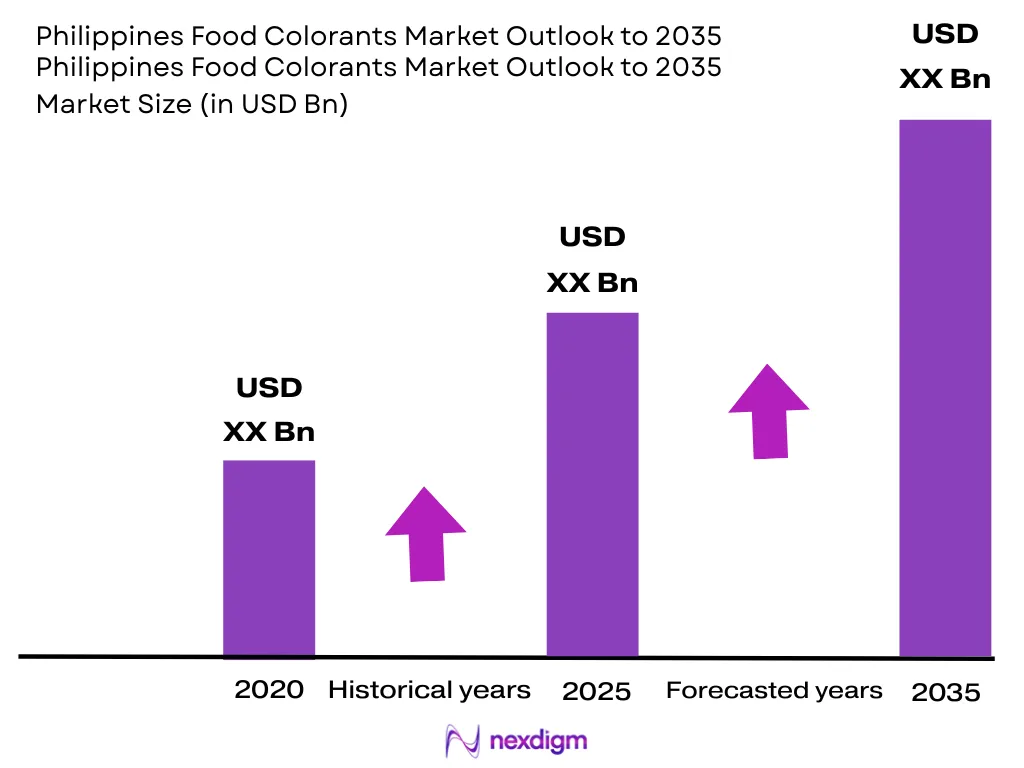
The Philippines Food Colorants Market was valued at USD ~ Billion in 2024 and is anticipated to expand at a CAGR of ~% during 2026–2035. The market is primarily driven by the country’s large processed food and beverage manufacturing base, rapid urbanisation, and growing consumer demand for visually appealing bakery, confectionery, and beverage products. According to EMIS Insights, the food and beverage sector accounted for 9.2% of Philippine GDP in 2024, with the country holding leading global positions in the production of rice, pork, coconuts, and bananas. Statista estimates the Philippines’ food market will reach approximately USD 146.41 billion in revenue in 2025, growing annually at 7.8% through 2030, reflecting sustained demand for functional ingredients such as food colorants across bakery, dairy, confectionery, beverages, snacks, and processed meat applications.
Market Segmentation
By Source Type
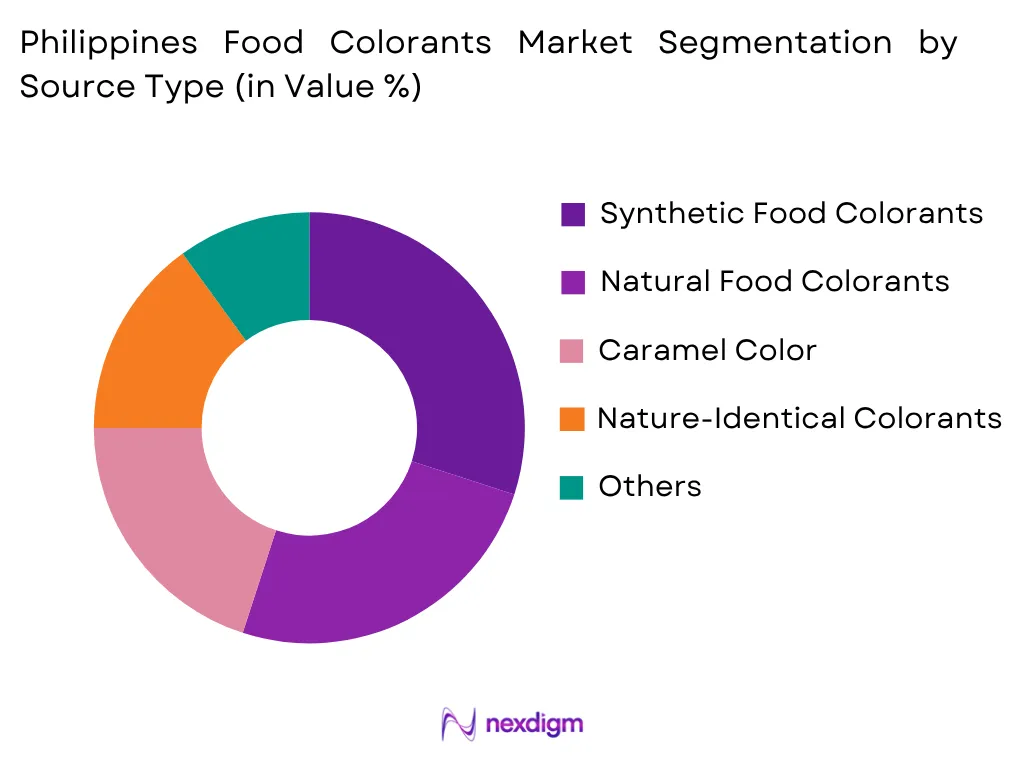
Among these, Synthetic Food Colourants continue to hold a significant share of the Philippines Food Colorants Market owing to their low cost, consistent hue, and strong stability under the country’s hot and humid climate, which makes them attractive for mass-market bakery, confectionery, and beverage products. However, Natural Food Colourants are the fastest-growing segment as multinational food manufacturers and increasingly health-conscious urban consumers push for clean-label reformulation using pigments derived from turmeric, annatto, spirulina, and other botanical sources. The Philippines’ strong agricultural base, including domestic cultivation of annatto and coconut-derived ingredients, provides local suppliers with a cost advantage in sourcing certain natural pigment inputs. Multinational ingredient companies and domestic distributors alike are expanding their natural colour portfolios to serve both premium urban retail channels and the country’s large export-oriented confectionery and bakery industry, further strengthening demand across both source-type segments.
By Application
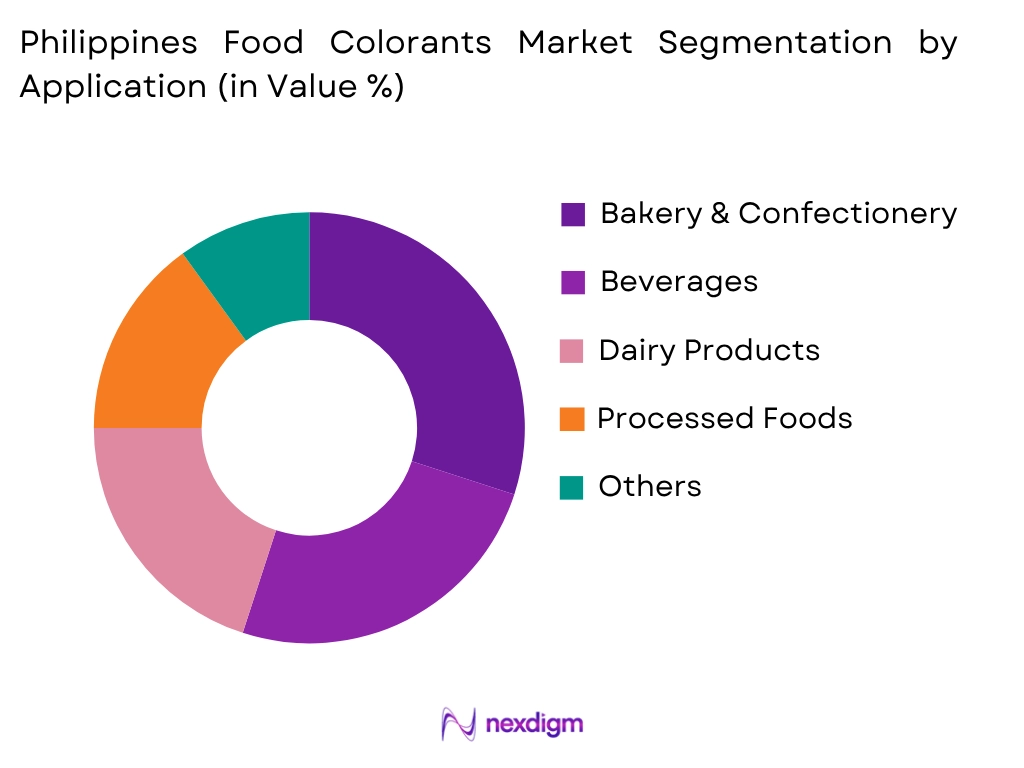
The Bakery & Confectionery segment holds the largest share owing to the extensive use of food colorants in the Philippines’ large bakery industry, which produces everything from everyday pandesal and local delicacies to festive and holiday-season baked goods. Manufacturers increasingly rely on stable colorants to enhance cakes, biscuits, candies, and traditional Filipino delicacies such as puto, kutsinta, and sapin-sapin, many of which are defined by distinctive, vivid colours. The colourful nature of Filipino desserts and street food, combined with the popularity of ube (purple yam) flavoured products across bakery and beverage categories, has created particularly strong demand for stable violet and purple colorants. The continued growth of large domestic bakery and confectionery conglomerates, together with the expansion of modern retail and convenience store bakery sections, further reinforces this segment’s dominance in overall market value.
Competitive Landscape
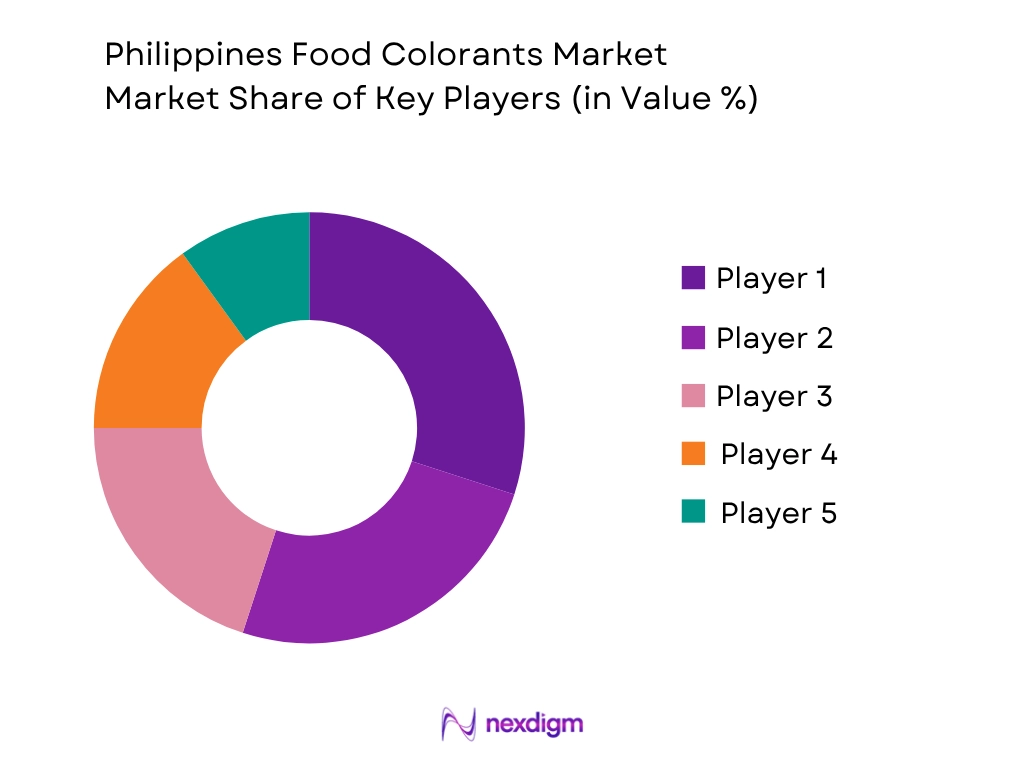
The Philippines Food Colorants Market is moderately fragmented, with a mix of multinational ingredient suppliers, established domestic chemical distributors, and specialised local food ingredient manufacturers. Competition is primarily based on pricing, import logistics efficiency, regulatory compliance, product stability under tropical storage conditions, and the ability to serve both large industrial manufacturers and smaller bakery and confectionery businesses. Many domestic players operate as authorised distributors of global colour brands, combining imported specialty colorants with locally sourced or locally formulated products. Companies are increasingly investing in warehousing, cold-chain logistics, and technical support services to serve the archipelago’s dispersed island geography, while local raw material sourcing of annatto and other domestic botanicals continues to be a key competitive differentiator for natural colour suppliers.
| Company | Establishment Year | Headquarters | Primary Product Portfolio | Natural Color Portfolio
|
Manufacturing Presence | Major End-Use Industries | Key Strategic Focus | Certifications & Compliance |
| TNC Chemicals Philippines Inc. | 1978 | ~ | ~ | ~ | ~ | ~ | ~ | ~ |
| Peotraco Food Inc. | 1924 | ~ | ~ | ~ | ~ | ~ | ~ | ~ |
| SBS Philippines Corporation | 1970 | ~ | ~ | ~ | ~ | ~ | ~ | ~ |
| MSCS PrimeGoods, Inc. | 2015 | ~ | ~ | ~ | ~ | ~ | ~ | ~ |
| Sensient Technologies | 1882 | ~ | ~ | ~ | ~ | ~ | ~ | ~ |
Philippines Confectionary Market Analysis
Growth Drivers
Rapid Expansion of the Food and Beverage Manufacturing Sector
The Philippines food colorants market is experiencing sustained growth due to the rapid expansion of the country’s food and beverage manufacturing sector. According to EMIS Insights, the food and beverage sector accounted for 9.2% of Philippine GDP in 2024, with the country holding leading global positions in the production of rice, pork, coconuts, and bananas. The sector’s firms rely heavily on the robust demand of the domestic market, supported by a population of more than 117 million people and one of the youngest median ages in Asia. Statista projects the Philippines’ food market will generate approximately USD 146.41 billion in revenue in 2025, growing at an annual rate of 7.8% through 2030. Food and non-alcoholic beverages represented 32.6% of household consumption as of the first quarter of 2025, according to industry data, underscoring the centrality of food spending to the Filipino economy. This continued expansion of processed food production directly increases consumption of food additives, including both synthetic and natural colorants used across bakery, confectionery, dairy, and beverage applications.
Growing Demand for Natural and Distinctively Coloured Food Products
Consumer preference for distinctively coloured food products, combined with rising demand for natural and clean-label ingredients, continues to drive the Philippines food colorants market. The Philippines has a deeply rooted culinary tradition of vividly coloured desserts and delicacies, from purple ube-flavoured cakes and pastries to green buko pandan drinks, creating sustained structural demand for both natural and nature-identical pigments capable of achieving these signature hues. According to 6Wresearch, the Philippines food and beverages market is expected to grow at a CAGR of 5.9% from 2025 to 2031, driven by rapid urbanisation, rising disposable incomes, and an expanding middle class that is increasingly willing to pay a premium for natural and clean-label products. Modern retail expansion, including the rapid growth of supermarket chains, warehouse clubs, and convenience stores across Metro Manila and secondary cities such as Cebu and Davao, has further increased shelf space for premium and naturally coloured packaged food products, encouraging manufacturers to reformulate with natural pigments derived from turmeric, annatto, and spirulina.
Market Challenges
High Dependence on Imported Raw Materials and Specialty Colorants
The Philippines food colorants market faces a significant challenge from its heavy dependence on imported raw materials and specialty colour ingredients. The country continued to see a significant volume of food and beverage imports in 2024, with top exporting countries including China, Thailand, Vietnam, Malaysia, and Singapore, and a compound annual growth rate of 11.2% for food and beverage imports between 2020 and 2024. As an archipelago with more than 7,000 islands, the Philippines also faces elevated logistics and distribution costs, weak inland supply chain infrastructure, and inter-island shipping constraints that increase the landed cost of imported colorant ingredients. Currency fluctuations in the Philippine peso against the US dollar further affect the cost of imported specialty pigments, dyes, and encapsulation materials, creating pricing volatility for local food and beverage manufacturers that rely on consistent, cost-effective colour supply.
Raw Material Price Volatility and Food Security Pressures
Volatility in domestic agricultural raw material prices presents a further challenge for the Philippines food colorants market, particularly for natural pigment producers relying on locally grown botanical inputs. In March 2024, rice prices surged by 24.4% year-on-year, prompting the Philippine government to declare a food security emergency and release buffer stocks to stabilise prices, while food and beverage operators more broadly reported ingredient costs doubling in some categories during the same period. Such inflationary pressures directly affect the cost of natural colour feedstocks including annatto, turmeric, and coconut-derived ingredients, complicating long-term procurement planning for ingredient manufacturers. In addition, manufacturers must navigate compliance with the Food and Drug Administration (FDA) of the Philippines and the Department of Health (DOH), which regulate the approval, labelling, and permitted usage levels of both synthetic and natural food colorants under the Food Safety Act, adding further complexity to product development and market entry for new colour formulations.
Market Opportunities
Expansion of Modern Retail and Premium Food Categories
The rapid expansion of modern retail formats across the Philippines presents a substantial opportunity for food colorant manufacturers and distributors. The Philippine food retail market grew by 8% in 2023, with continued 5% growth forecast for 2024, while warehouse clubs and membership retailers such as S&R and Landers continue to open new stores across Metro Manila and provincial cities. As of 2025, roughly 30% of Filipinos dine out at least once every day, and the country’s culinary tourism market, valued at USD 5.4 billion in 2024, is forecast to reach USD 16.7 billion by 2032. This growing foodservice and retail landscape creates expanding opportunities for ingredient suppliers to introduce premium, naturally coloured products tailored to both traditional Filipino delicacies and increasingly popular international food formats being introduced across the archipelago’s cities.
Growth in Domestic Natural Pigment Sourcing and Export-Oriented Manufacturing
The Philippines’ established position as a leading global producer of coconuts, bananas, and other tropical crops provides a substantial opportunity for the development of domestically sourced natural food colorants. The country’s strong performance in the export of bananas and coconut oil, combined with existing annatto cultivation, gives local ingredient manufacturers a cost and traceability advantage over imported natural pigment alternatives. As multinational food companies operating in the Philippines continue to prioritise clean-label reformulation, domestic suppliers such as TNC Chemicals Philippines Inc., Peotraco Food Inc., and SBS Philippines Corporation are well positioned to expand into value-added natural colour manufacturing, supplying both the domestic market and the country’s growing food and beverage export industry across Southeast Asia.
Future Outlook
The Philippines Food Colorants Market is expected to witness steady expansion over the forecast period, supported by continued growth in food and beverage manufacturing, rising urbanisation, and increasing consumer demand for both vividly coloured traditional Filipino products and clean-label natural alternatives. Growing investment in modern retail infrastructure, premium bakery and confectionery products, and export-oriented food manufacturing will further accelerate demand for innovative colouring solutions. The market is also likely to benefit from the country’s strong domestic agricultural base for natural pigment sourcing, even as manufacturers continue to navigate import dependency, logistics complexity across the archipelago, and evolving regulatory requirements set by the Food and Drug Administration (FDA) and the Department of Health (DOH).
Major Players
- Sensient Technologies
- Döhler
- Chr. Hansen
- Givaudan (Naturex)
- IFF (International Flavors & Fragrances)
- Kalsec
- ADM
- Kerry Group
- Symrise
- GNT Group (EXBERRY)
- DDW, The Colour House
- TNC Chemicals Philippines Inc.
- Peotraco Food Inc.
- SBS Philippines Corporation
- MSCS PrimeGoods, Inc.
Key Target Audience
- Food Colorant Manufacturers
- Food & Beverage Processing Companies
- Bakery and Confectionery Manufacturers
- Dairy Product Manufacturers
- Nutraceutical and Functional Food Manufacturers
- Investment and Venture Capitalist Firms
- Government and Regulatory Bodies (Food and Drug Administration (FDA), Department of Health (DOH), Department of Agriculture (DA))
- Food Ingredient Distributors and Industrial Raw Material Suppliers
Research Methodology
Step 1: Identification of Key Variables
The research process begins with identifying the complete ecosystem of the Philippines Food Colorants Market, including raw material suppliers, pigment manufacturers, ingredient distributors, food processors, retailers, and regulatory authorities. Extensive secondary research is conducted using company annual reports, government publications, trade associations, customs statistics, industry journals, and proprietary databases to determine the variables influencing market demand, pricing, production, consumption, and technological developments.
Step 2: Market Analysis and Construction
Historical market information is collected and analysed to estimate market size, production volumes, import-export activity, application-wise demand, and pricing trends. A combination of top-down and bottom-up approaches is used to estimate market revenues and validate segment-level performance. Consumption patterns across bakery, dairy, beverages, confectionery, processed foods, and nutraceuticals are evaluated to establish an accurate representation of the industry.
Step 3: Hypothesis Validation and Expert Consultation
The preliminary findings are validated through Computer-Assisted Telephone Interviews (CATIs) and structured discussions with food ingredient manufacturers, procurement managers, distributors, food technologists, regulatory experts, and senior executives operating within the Philippine food industry. These interviews help verify market assumptions, competitive developments, technology adoption trends, pricing dynamics, and future investment opportunities while refining the overall market estimates.
Step 4: Research Synthesis and Final Output
The final stage integrates insights obtained from primary interviews with quantitative information collected through secondary sources. Data triangulation techniques are applied to reconcile differences between supply-side and demand-side estimates, ensuring robust market forecasting. The report is then reviewed through multiple quality assurance checkpoints to deliver a comprehensive analysis covering market size, segmentation, competitive landscape, future outlook, and strategic recommendations for industry stakeholders.

- Executive Summary
- Research Methodology (Market Definitions and Assumptions, Abbreviations, Market Sizing Approach, Top-Down Analysis, Bottom-Up Analysis, Demand-Side Assessment, Supply-Side Assessment, Primary Industry Interviews, Secondary Research Validation, Data Triangulation, Forecasting Framework, Limitations and Future Conclusions)

- Definition and Scope
- Market Evolution and Industry Genesis
- Timeline of Major Industry Developments
- Food Colorants Industry Value Chain Analysis
- Supply Chain Analysis

- Growth Drivers (Growing Clean Label Food Demand, Rising Consumption of Processed Foods, Expansion of Beverage Manufacturing, Increasing Demand for Natural Pigments, Premiumisation of Food Products, Growth in Plant-Based Foods)
- Market Challenges (High Cost of Natural Colourants, Colour Stability Issues, Raw Material Price Volatility, Regulatory Compliance Complexity, Limited Shelf Stability of Natural Pigments, Import Dependency for Specialty Ingredients)
- Market Opportunities (Microencapsulation Technologies, Fermentation-Based Natural Pigments, Organic Food Expansion, Functional Food Innovation, Export-Oriented Ingredient Manufacturing, Clean Label Reformulation Projects)
- Market Trends (Replacement of Synthetic Colours, Blue Spirulina Adoption, Botanical Extract Innovation, Sustainable Pigment Sourcing, Heat-Stable Natural Colour Development, Multi-Functional Ingredients)
- Government Regulations (FDA Food Additive Regulations, Food Labelling Requirements, Maximum Permitted Usage Levels, Natural Colour Approval Standards, Import Compliance, Food Safety Standards)
- Import and Export Analysis (Trade Volume, Major Import Sources, Export Destinations, HS Code Analysis, Trade Balance)
- Raw Material Availability Analysis (Turmeric, Annatto, Paprika, Spirulina, Coconut-Based Pigments, Caramel Feedstocks)
- Technology Landscape (Extraction Technologies, Encapsulation Technologies, Spray Drying, Fermentation Technologies, Stability Enhancement Technologies)
- Sustainability Assessment (Renewable Raw Materials, Carbon Footprint Reduction, Sustainable Farming Practices, Waste Valorisation, Eco-Friendly Processing)
- PESTLE Analysis
- SWOT Analysis
- Porter’s Five Forces Analysis
- Stakeholder Ecosystem
- Competition Ecosystem

- By Market Value (2020-2025)
- By Volume Consumption (2020-2025)
- By Average Selling Price (2020-2025)

- By Source Type (In Value %)
Natural Food Colourants
Synthetic Food Colourants
Nature-Identical Colourants
Caramel Colour
Mineral-Based Colourants
Fermentation-Derived Colourants - By Application (In Value %)
Bakery & Confectionery
Beverages
Dairy Products
Processed Foods
Snacks & Savoury Products
Meat, Poultry & Seafood Products
Frozen Foods
Plant-Based Foods
Nutraceuticals & Functional Foods
Infant Nutrition - By Distribution Channel (In Value %)
Direct Sales to Food Manufacturers
Ingredient Distributors
Industrial Ingredient Suppliers
Online B2B Ingredient Platforms
Specialty Ingredient Suppliers - By End User (In Value %)
Food Processing Companies
Beverage Manufacturers
Bakery Manufacturers
Confectionery Manufacturers
Dairy Processors
Nutraceutical Manufacturers
Foodservice Manufacturers - By Region (In Value %)
Metro Manila (National Capital Region)
Central Luzon
Calabarzon
Visayas
Mindanao

- Market Share of Major Players (By Value, Volume, Source Type, Application Industry, Product Category)
- Cross Comparison Parameters (Natural Colourant Portfolio Breadth, Synthetic Colourant Portfolio, Colour Stability Performance, Application Technical Support Capability, Manufacturing Capacity, Regulatory Compliance & Certifications, Food & Beverage Customer Base, Innovation & New Product Launch Frequency)
- SWOT Analysis of Major Players
- Pricing Analysis by Product Category and SKU
- Production Capacity Analysis
- Manufacturing Footprint Analysis
- Distribution Network Analysis
- Innovation Benchmarking
- Detailed Profiles of Major Companies
Sensient Technologies
Döhler
Chr. Hansen
Givaudan (Naturex)
IFF (International Flavors & Fragrances)
Kalsec
ADM
Kerry Group
Symrise
GNT Group (EXBERRY)
DDW, The Colour House
TNC Chemicals Philippines Inc.
Peotraco Food Inc.
SBS Philippines Corporation
MSCS PrimeGoods, Inc.

- Consumption Pattern Analysis (Industrial Usage, Batch Size, Product Category Penetration, Seasonal Demand, Reformulation Activity)
- Purchasing Criteria (Colour Stability, Regulatory Compliance, Cost Efficiency, Heat Stability, Light Stability, Shelf Life)
- Procurement and Supplier Selection Analysis
- Clean Label Adoption Assessment
- Premium vs Conventional Product Demand
- Product Attribute Preference Analysis (Hue Consistency, Dispersion Performance, pH Stability, Solubility, Natural Origin, Label Friendliness)
- Consumer Health & Wellness Influence on Product Development
- Pain Point Analysis
- Decision-Making Process

- By Market Value (2026-2035)
- By Volume Consumption (2026-2035)
- By Average Selling Price (2026-2035)


 Request a Sample
 Ask for Customization
 Get a Quote
 Enquire Now