
 Download PDF
Market Overview
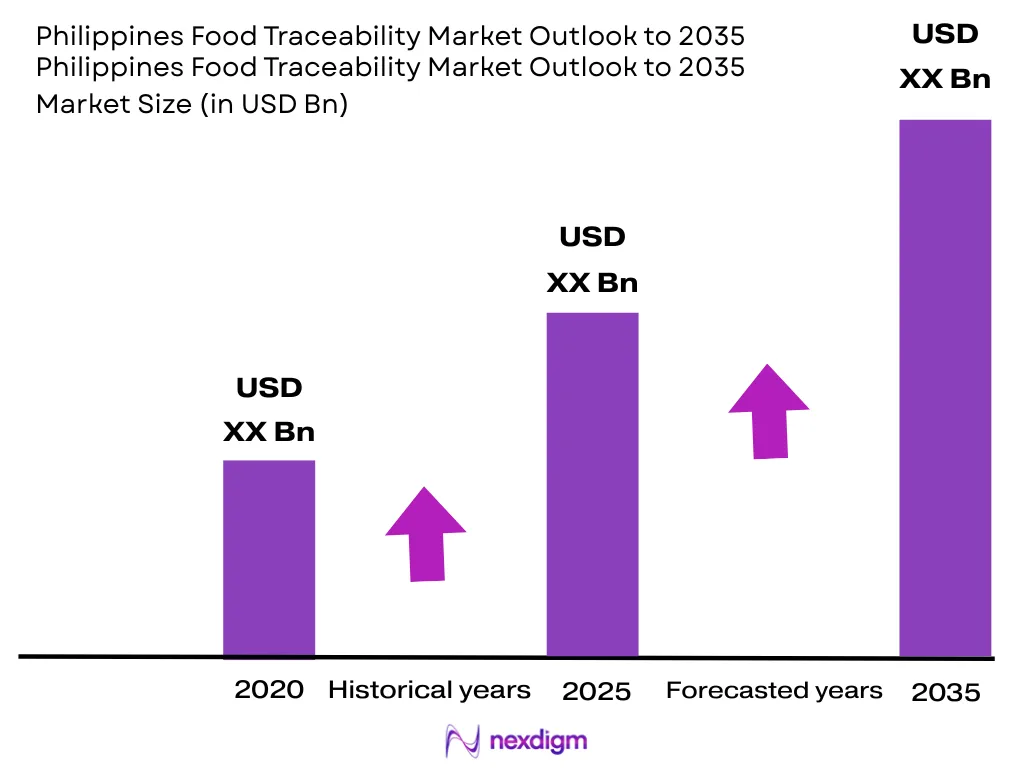
The Philippines Food Traceability Market was valued at USD ~ Billion in 2024 and is anticipated to expand at a CAGR of ~% during 2026–2035. The market is primarily driven by escalating international compliance requirements for the country’s major food exports, including tuna, bananas, pineapple, coconut products, and cacao, alongside a broader national push toward blockchain-enabled supply chain digitization. The Philippines’ wider blockchain-in-supply-chain market, of which food traceability forms a significant part, reached approximately USD 32.06 million in 2025 and is projected to reach USD 588.47 million by 2034, growing at a CAGR of 38.17%, reflecting the government’s assertive digital transformation agenda and mounting demand for verifiable food provenance. The Bureau of Fisheries and Aquatic Resources (BFAR), under Fisheries Administrative Order No. 275, is required to digitize its traceability system for seafood verification and monitoring within one year of the order’s implementation, while the Department of Science and Technology’s Philippine Council for Agriculture, Aquatic and Natural Resources Research and Development (DOST-PCAARRD) has already demonstrated blockchain traceability viability through its Traco cacao project in Southern Philippines.
Market Segmentation
By Technology Type
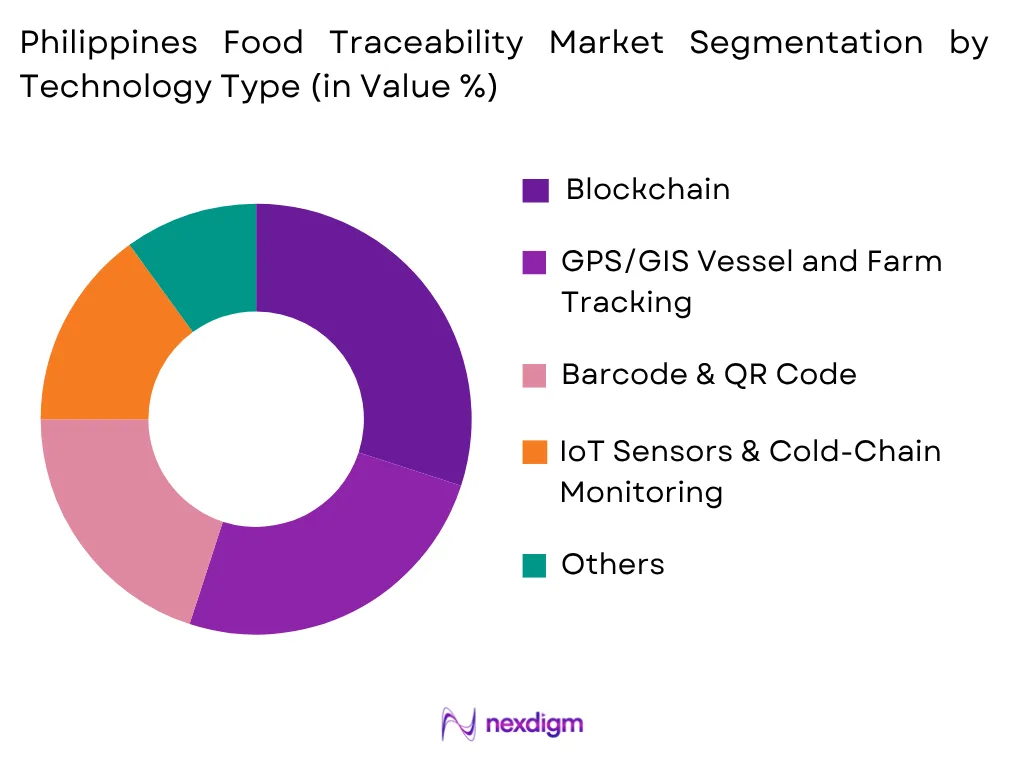
Blockchain holds a rapidly growing share of the Philippines Food Traceability Market, propelled by high-profile government-funded pilot projects that have proven commercial viability. The Traco mobile application, developed under a DOST-PCAARRD-funded project running from March 2023 to May 2025 in partnership with the University of Southeastern Philippines, features blockchain-backed data storage that enables cacao producers and traders to maintain permanent, verifiable transaction records, including price tracking and quality monitoring. A separate academic initiative known as the Tracy project applied Ethereum and Hyperledger Fabric blockchain frameworks to support small-scale Filipino fishermen in recording verified catch and trade data for international seafood buyers. GPS/GIS Vessel and Farm Tracking is particularly important given the Philippines’ archipelagic geography and BFAR’s mandate under FAO 275 to conduct risk-based pre-border audits and accredit foreign fishery establishments, while IoT Sensors & Cold-Chain Monitoring address the logistical challenge of maintaining product integrity across the country’s more than 7,000 islands.
By Application
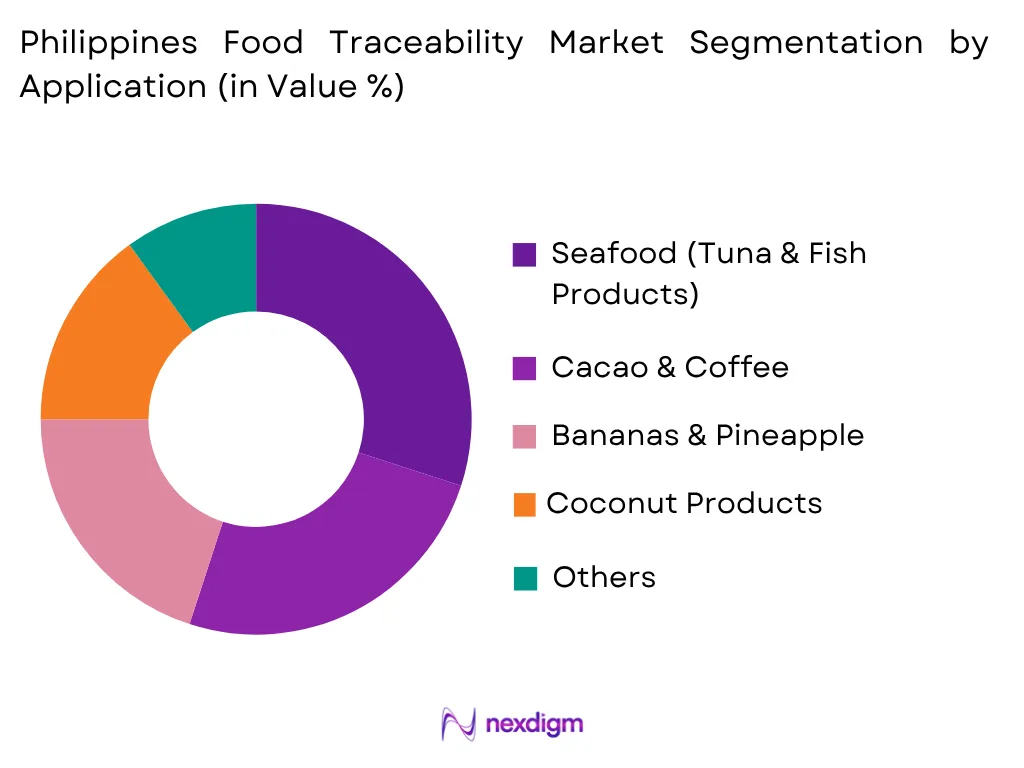
Seafood (Tuna & Fish Products) represents a leading application segment in the Philippines Food Traceability Market, reflecting the country’s position as a major tuna exporter and the regulatory weight of FAO 275, which requires foreign fishery establishments exporting to the Philippines to be accredited and subjects them to risk-based pre-border audits, while domestically pushing BFAR toward full digitization of its own traceability systems. Cacao & Coffee has emerged as a high-visibility proving ground for blockchain traceability, anchored by the Traco project’s partnership with the Biao Agrarian Reform Beneficiaries Cooperative (BARBCO), the country’s second-largest cacao exporter by volume, which secured exclusive commercialization rights to the technology for three years after 102 farmers and consolidators were trained on the system. Bananas & Pineapple and Coconut Products, long-standing pillars of Philippine agricultural exports, represent significant additional opportunity, with industry analysis specifically identifying these commodities as well-suited to replicate the blockchain traceability model first proven in cacao.
Competitive Landscape
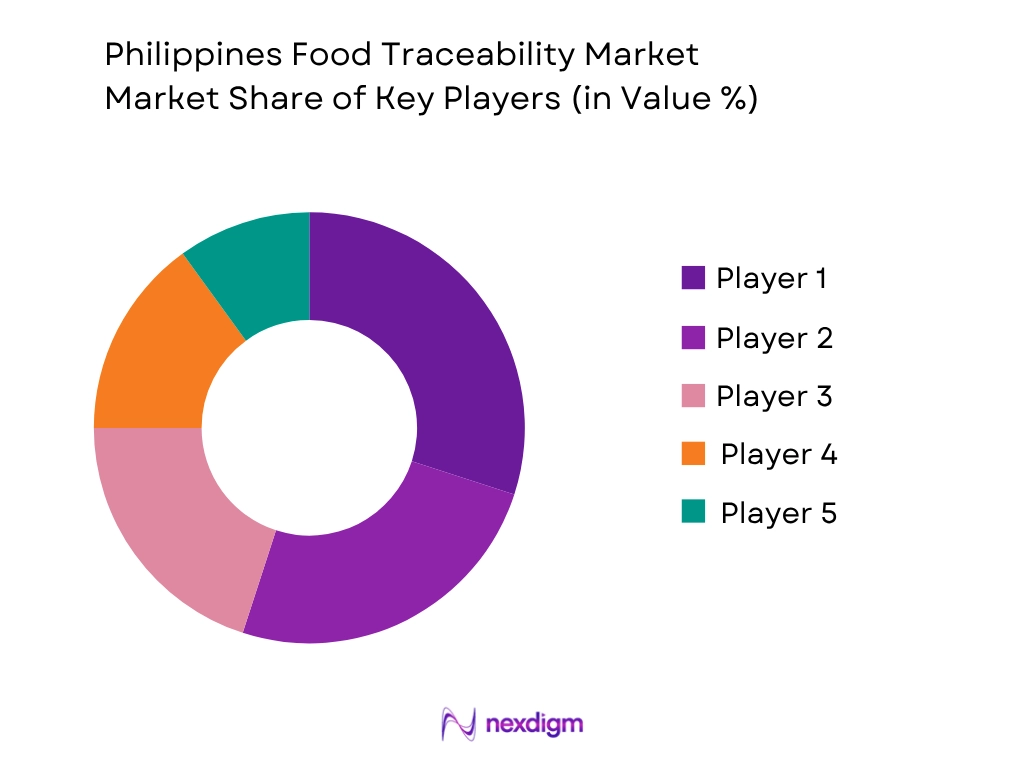
The Philippines Food Traceability Market is fragmented and at a relatively early commercial stage, shaped by a distinctive mix of government-funded research pilots, cooperative-led commercialization models, and global certification and technology majors. DOST-PCAARRD, the Philippine government’s agriculture and aquatic resources research council, has emerged as a central driver of blockchain traceability adoption through its Traco cacao project, developed with the University of Southeastern Philippines and now under exclusive three-year commercialization rights held by BARBCO, the country’s second-largest cacao exporter. Global agri-traceability platforms such as TraceX Technologies, which has supported cocoa exporters in other emerging markets, represent a natural fit for extending blockchain traceability to Philippine coffee and cacao smallholders, while international certification and inspection bodies including SGS and Bureau Veritas play a central role in verifying compliance with BFAR, FDA, and export-market requirements for Philippine seafood and agricultural exports. IBM’s Food Trust platform, deployed globally across banana, pineapple, and other agricultural supply chains, is a natural fit for multinational exporters such as Dole Philippines and Del Monte Philippines seeking end-to-end blockchain verification. Competitive dynamics are increasingly shaped by the ability to replicate the Traco model’s success, referenced by industry analysts as a template deployable through hubs such as the Digital Agriculture Hub in Western Visayas, across additional high-value export commodities.
| Company | Establishment Year | Headquarters | Primary Product Portfolio | Traceability Solution Portfolio
|
Deployment Presence | Major End-Use Industries | Key Strategic Focus | Certifications & Compliance |
| DOST-PCAARRD (Traco) | 1972 | ~ | ~ | ~ | ~ | ~ | ~ | ~ |
| TraceX Technologies | 2019 | ~ | ~ | ~ | ~ | ~ | ~ | ~ |
| SGS | 1878 | ~ | ~ | ~ | ~ | ~ | ~ | ~ |
| IBM | 1911 | ~ | ~ | ~ | ~ | ~ | ~ | ~ |
| Bureau Veritas | 1828 | ~ | ~ | ~ | ~ | ~ | ~ | ~ |
Philippines Food Traceability Market Analysis
Growth Drivers
Mandatory BFAR Digitization and Seafood Export Compliance Under FAO 275
The Philippines food traceability market is being reshaped by Fisheries Administrative Order No. 275, which introduces pre-border control measures requiring foreign fishery establishments exporting to the Philippines to be accredited by their country of origin’s competent authority and subjected to risk-based audits by BFAR, while separately mandating that BFAR itself digitize its own traceability system for verification and monitoring purposes within one year of the order’s implementation. The Philippines’ seafood sector, anchored by its position as a major tuna exporter with tuna and other frozen products serving as staple export commodities, must navigate an increasingly complex web of international requirements, and the country’s history of heightened scrutiny over illegal, unreported, and unregulated (IUU) fishing has sustained regulatory vigilance around catch documentation. Compliance with these requirements, combined with export-market demands from destinations including the EU and US for verifiable fish product traceability and catch certification, is driving structural, regulation-backed demand for digital verification systems across the Philippines’ fishing and seafood processing sector.
Rising Blockchain Adoption Across High-Value Agricultural Exports
The Philippines’ wider blockchain-in-supply-chain market reached approximately USD 32.06 million in 2025 and is projected to grow at a CAGR of 38.17% to reach USD 588.47 million by 2034, reflecting the government’s assertive digital transformation agenda across agriculture, logistics, and public administration. The Traco cacao project, funded by DOST-PCAARRD and developed with the University of Southeastern Philippines between March 2023 and May 2025, has proven the commercial viability of blockchain traceability in Philippine agriculture, training 102 farmers and consolidators and securing a three-year exclusive commercialization partnership with BARBCO, the country’s second-largest cacao exporter. Industry analysts have explicitly identified Philippine coffee, coconut products, bananas, and pineapple as high-value export commodities well-positioned to benefit from similar blockchain traceability models, with the Digital Agriculture Hub in Western Visayas cited as a replicable template for scaling verified-provenance systems that allow smallholders to command premium prices in markets that demand verified origin.
Market Challenges
Archipelagic Geography and Fragmented Smallholder Logistics
The Philippines’ geography, spanning more than 7,000 islands, creates substantial logistical challenges for building consistent, nationwide food traceability infrastructure, particularly for cold-chain integrity and real-time data connectivity in more remote coastal and agricultural areas. Small-scale fishers and farmers, who make up the large majority of the country’s fishing and cacao-producing population, often operate with limited access to fixed digital infrastructure, mirroring the challenges that motivated the Tracy project’s focus on rural Filipino fishermen and the Traco project’s emphasis on training farmers and consolidators directly on mobile-based tools. This fragmentation complicates efforts to build unified, interoperable traceability records across the country’s diverse export supply chains, particularly where produce or catch passes through multiple islands and intermediaries before reaching processing or export facilities.
Early-Stage Commercialization Limits Scale Beyond Pilot Projects
Much of the Philippines’ demonstrated blockchain traceability capability remains at a research or early commercialization stage rather than broad market deployment. The Traco project, while successful, trained only 102 farmers and consolidators and granted exclusive commercialization rights to a single cooperative, BARBCO, for a three-year period, illustrating the limited initial scale of even the country’s flagship agricultural blockchain traceability initiative. Similarly, the Tracy fish traceability system remains an academic case-study concept rather than a broadly deployed commercial platform. Scaling these early successes into nationwide, multi-commodity, multi-exporter traceability infrastructure will require substantial additional funding, technical capacity building, and digital literacy investment among the smallholder farmers and small-scale fishers who form the base of the Philippines’ agricultural and fisheries export sectors.
Market Opportunities
Scaling Blockchain Traceability Beyond Cacao to Coffee, Coconut, Bananas and Pineapple
The proven success of the Traco cacao project creates a clear and explicitly identified opportunity to replicate blockchain traceability models across the Philippines’ other major high-value agricultural exports, including coffee, coconut products, bananas, and pineapple. Industry analysts have highlighted the Digital Agriculture Hub in Western Visayas as a template for replicating blockchain-enabled traceability across multiple regions, suggesting a scalable pathway for technology providers and government agencies to extend verified-provenance systems well beyond their initial cacao proving ground. As global buyers increasingly demand verified origin and sustainability documentation, Philippine exporters and smallholders that adopt blockchain traceability early stand to command premium pricing and strengthen access to high-value international markets, particularly in specialty coffee and premium chocolate segments where provenance verification carries substantial commercial value.
Structural Demand from BFAR’s Mandatory Seafood Digitization
FAO 275’s requirement that BFAR digitize its traceability system for verification and monitoring purposes within one year of implementation creates a clear, regulation-backed demand pathway for technology vendors capable of delivering compliant vessel monitoring, catch documentation, and export certification systems. Given the Philippines’ status as a major tuna exporting nation and its history of navigating international scrutiny over illegal, unreported, and unregulated fishing, technology providers that can offer BFAR-compliant, cost-effective digital traceability tools, whether through blockchain platforms similar to the academic Tracy concept or through more conventional vessel monitoring and certification systems, are well positioned to capture significant deployment volume as the mandate takes effect across the country’s fishing fleet and seafood export infrastructure.
Future Outlook
The Philippines Food Traceability Market is expected to witness sustained expansion over the forecast period, supported by BFAR’s mandatory digitization timeline under FAO 275, continued government funding for blockchain agricultural pilots through DOST-PCAARRD, and rising international buyer demand for verified provenance across the country’s tuna, cacao, coffee, coconut, banana, and pineapple export sectors. Growing replication of the Traco model across additional commodities and regions, alongside the country’s broader blockchain-in-supply-chain market growth of approximately 38% annually through 2034, will further accelerate adoption. The market is also likely to benefit from the Philippines’ integration into regional digital trade frameworks under the ASEAN Digital Economy Framework Agreement, as the country positions its export-oriented agricultural and fisheries sectors to meet increasingly stringent international traceability and sustainability requirements.
Major Players
- DOST-PCAARRD (Traco Cacao Traceability System)
- TraceX Technologies
- SGS
- Bureau Veritas
- IBM
- University of Southeastern Philippines (USeP)
- Biao Agrarian Reform Beneficiaries Cooperative (BARBCO)
- Fishcoin
- Zebra Technologies
- SAP SE
- Dole Philippines
- Del Monte Philippines
- Foodlink Advocacy Cooperative
- Intertek
- TÜV Rheinland
Key Target Audience
- Food Traceability Technology Providers
- Tuna, Cacao, Coffee, Banana, and Pineapple Exporters and Trading Companies
- Food Processors and Manufacturers
- Fishing Cooperatives and Farmer Aggregators
- Retailers and Supermarket Chains
- Investment and Venture Capitalist Firms
- Government and Regulatory Bodies (Bureau of Fisheries and Aquatic Resources – BFAR, Philippine FDA, Department of Agriculture – DA, DOST-PCAARRD)
- Certification and Audit Bodies
Research Methodology
Step 1: Identification of Key Variables
The research process begins with identifying the complete ecosystem of the Philippines Food Traceability Market, including blockchain and mobile technology providers, cooperative aggregators, exporters, food processors, certification bodies, and regulatory authorities. Extensive secondary research is conducted using company reports, government publications, trade associations, customs statistics, industry journals, and proprietary databases to determine the variables influencing market demand, pricing, deployment, adoption, and technological developments.
Step 2: Market Analysis and Construction
Historical market information is collected and analyzed to estimate market size, deployment volumes, application-wise demand, and pricing trends. A combination of top-down and bottom-up approaches is used to estimate market revenues and validate segment-level performance. Adoption patterns across seafood, cacao, coffee, banana, pineapple, and coconut applications are evaluated to establish an accurate representation of the industry.
Step 3: Hypothesis Validation and Expert Consultation
The preliminary findings are validated through Computer-Assisted Telephone Interviews (CATIs) and structured discussions with technology distributors, cooperative managers, compliance officers, regulatory experts, and senior executives operating within the Philippine agrifood and fisheries industry. These interviews help verify market assumptions, competitive developments, technology adoption trends, pricing dynamics, and future investment opportunities while refining the overall market estimates.
Step 4: Research Synthesis and Final Output
The final stage integrates insights obtained from primary interviews with quantitative information collected through secondary sources. Data triangulation techniques are applied to reconcile differences between supply-side and demand-side estimates, ensuring robust market forecasting. The report is then reviewed through multiple quality assurance checkpoints to deliver a comprehensive analysis covering market size, segmentation, competitive landscape, future outlook, and strategic recommendations for industry stakeholders.

- Executive Summary
- Research Methodology (Market Definitions and Assumptions, Abbreviations, Market Sizing Approach, Top-Down Analysis, Bottom-Up Analysis, Demand-Side Assessment, Supply-Side Assessment, Primary Industry Interviews, Secondary Research Validation, Data Triangulation, Forecasting Framework, Limitations and Future Conclusions)

- Definition and Scope
- Market Evolution and Industry Genesis
- Timeline of Major Industry Developments
- Food Traceability Industry Value Chain Analysis
- Supply Chain Analysis

- Growth Drivers (Mandatory BFAR Digitization Under FAO 275, Rising Blockchain Adoption in High-Value Agricultural Exports, Government Digital Transformation Agenda, Growing Demand for Verified Provenance, Post-IUU Fishing Compliance Vigilance, Smallholder Premium Market Access Programs)
- Market Challenges (Archipelagic Geography and Fragmented Logistics, Early-Stage Commercialization Beyond Pilot Projects, Limited Digital Literacy Among Small-Scale Fishers and Farmers, Cold-Chain Infrastructure Gaps, Data Standardization Across Agencies, Funding Constraints for Scale-Up)
- Market Opportunities (Scaling Blockchain Traceability Beyond Cacao to Coffee, Coconut, Bananas and Pineapple, Structural Demand from BFAR’s Mandatory Seafood Digitization, Replicating the Digital Agriculture Hub Model Nationally, Public-Private Traceability Partnerships, Premium Export Certification Services, Cooperative Digitalization Financing)
- Market Trends (Rise of Government-Funded Blockchain Pilot Projects, Cooperative-Led Commercialization Rights Models, Vessel and Farm-to-Plate Digital Tracking, Consolidation of Agri-Export Traceability Platforms, Growing Use of Mobile-First Farmer and Fisher Data Tools, Integration with ASEAN Digital Trade Frameworks)
- Government Regulations (BFAR Fisheries Administrative Order No. 275, Philippine FDA Certificate of Product Registration Requirements, Department of Agriculture Import and Export Orders, Bureau of Agriculture and Fisheries Standards (BAFS), National Meat Inspection Service (NMIS) Requirements, ASEAN Digital Economy Framework Agreement)
- Import and Export Analysis (Trade Volume, Major Export Destinations, EU and US Seafood Import Compliance, HS Code Analysis, Trade Balance)
- Technology Infrastructure Availability Analysis (Blockchain Platform Availability, Mobile Network and Rural Connectivity, Satellite and Vessel Monitoring System Access, Cloud Computing Infrastructure, Cooperative Digitalization Coverage)
- Technology Landscape (Blockchain Platforms, Mobile-Based Farmer and Fisher Data Tools, Vessel Monitoring and GPS Tracking Systems, AI and Machine Learning Analytics, Cloud-Based Traceability Platforms)
- Sustainability Assessment (IUU Fishing Prevention, Smallholder Inclusion Programs, Sustainable Cacao and Coffee Sourcing Verification, Post-Harvest Loss Reduction, Circular Economy Alignment)
- PESTLE Analysis
- SWOT Analysis
- Porter’s Five Forces Analysis
- Stakeholder Ecosystem
- Competition Ecosystem

- By Market Value (2020-2025)
- By Volume of Deployments (2020-2025)
- By Average Selling Price (2020-2025)

- By Technology (In Value %)
Blockchain
RFID (Radio Frequency Identification)
Barcode & QR Code
GPS/GIS Vessel and Farm Tracking
IoT Sensors & Cold-Chain Monitoring - By Component (In Value %)
Hardware
Software
Services - By Application (In Value %)
Seafood (Tuna & Fish Products)
Cacao & Coffee
Bananas & Pineapple
Coconut Products
Rice & Grains
Processed Foods & Beverages - By End User (In Value %)
Exporters and Trading Companies
Food Processors & Manufacturers
Fishing Cooperatives and Aggregators
Retailers and Supermarkets
Government and Regulatory Agencies - By Region (In Value %)
National Capital Region (NCR)
Luzon
Visayas
Mindanao

- Market Share of Major Players (By Value, Deployment Volume, Technology Type, Application Industry, Product Category)
- Cross Comparison Parameters (Blockchain Platform Capability, Mobile/Offline Functionality, Vessel and Farm Monitoring Capability, Application Technical Support, Deployment Scale, Regulatory Compliance & Certifications, Cooperative and Exporter Network Reach, Innovation & New Product Launch Frequency)
- SWOT Analysis of Major Players
- Pricing Analysis by Solution Type and Application
- Deployment Capacity Analysis
- Geographic Footprint Analysis
- Distribution and Partnership Network Analysis
- Innovation Benchmarking
- Detailed Profiles of Major Companies
DOST-PCAARRD (Traco Cacao Traceability System)
TraceX Technologies
SGS
Bureau Veritas
IBM
University of Southeastern Philippines (USeP)
Biao Agrarian Reform Beneficiaries Cooperative (BARBCO)
Fishcoin
Zebra Technologies
SAP SE
Dole Philippines
Del Monte Philippines
Foodlink Advocacy Cooperative
Intertek
TÜV Rheinland

- Consumption Pattern Analysis (Platform Usage Intensity, Deployment Scale, Application Penetration, Seasonal Demand, Cooperative Onboarding Activity)
- Purchasing Criteria (Regulatory Compliance, Data Accuracy, Cost Efficiency, Ease of Fisher/Farmer Onboarding, Offline/Low-Connectivity Functionality, Audit Readiness)
- Procurement and Supplier Selection Analysis
- Blockchain and Mobile Digital Adoption Assessment
- Premium Export-Grade vs Domestic-Grade Traceability Demand
- Product Attribute Preference Analysis (Data Immutability, Real-Time Visibility, Integration Capability, Reporting Accuracy, Certification Compatibility, Fisher/Farmer Accessibility)
- Sustainability & ESG Influence on Procurement Decisions
- Pain Point Analysis
- Decision-Making Process

- By Market Value (2026-2035)
- By Volume of Deployments (2026-2035)
- By Average Selling Price (2026-2035)


 Request a Sample
 Ask for Customization
 Get a Quote
 Enquire Now