
 Download PDF
Market Overview
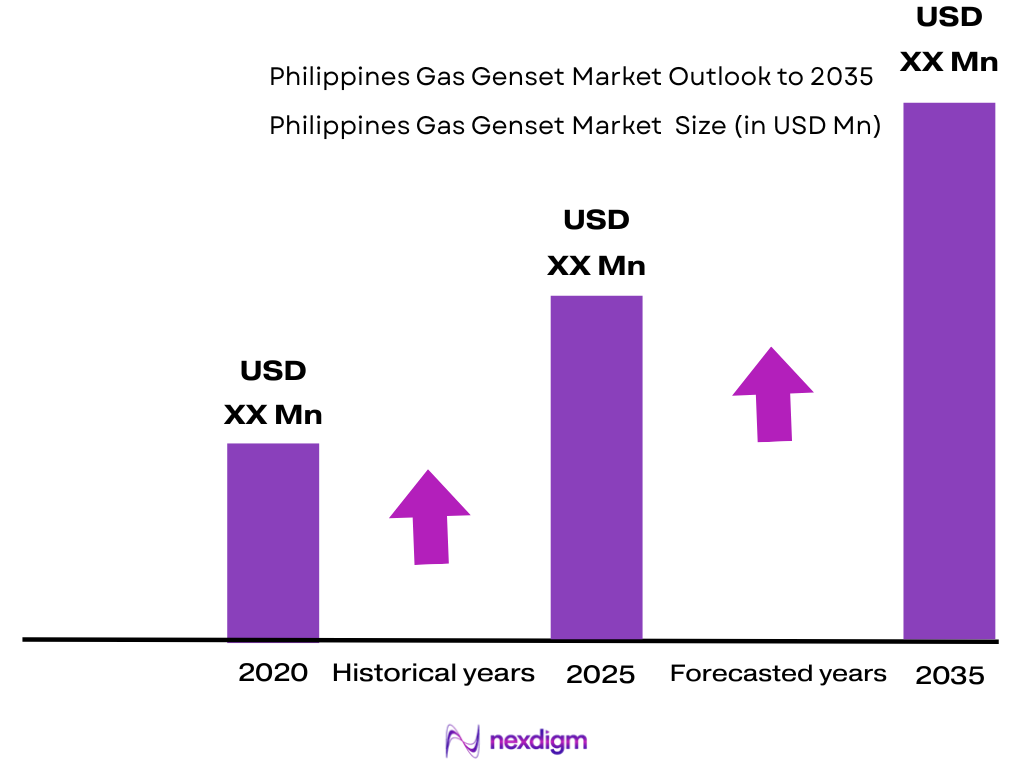
The Philippines Gas Genset Market is valued at approximately ~ million, supported by electricity consumption increasing from 118,004 GWh to 126,941 GWh, while national non-coincidental peak demand increased from 17,331 MW to 19,274 MW. Rising electricity requirements, grid interruptions, construction activity, household backup-power requirements, small enterprises and geographically dispersed island communities sustain demand for compact gasoline generator sets that can provide rapidly deployable power during outages or at locations without dependable grid connections. Metro Manila, CALABARZON and Central Luzon represent important demand centres because they combine dense residential populations, commercial facilities, workshops, construction sites and power-sensitive businesses. Luzon’s system peak demand moved from 12,550 MW to 14,016 MW, while Visayas demand increased from 2,458 MW to 2,681 MW and Mindanao from 2,323 MW to 2,577 MW. CALABARZON also leads Philippine building activity, reinforcing demand for portable power equipment at construction and renovation sites.
Market Segmentation
By Power Rating
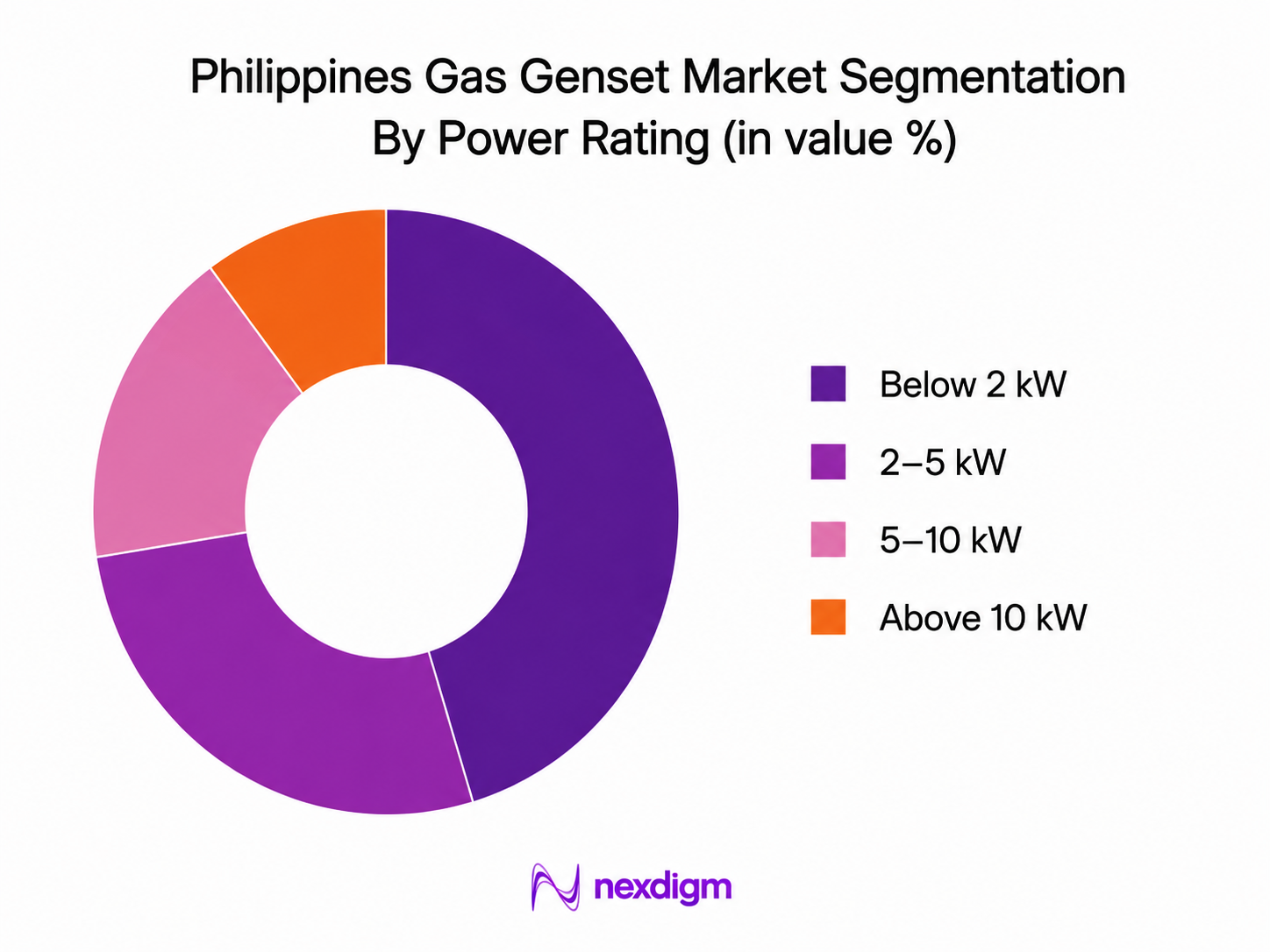
The Philippines Gas Genset Market is segmented into below 2 kW, 2–5 kW, 5–10 kW and above 10 kW gasoline generator sets. The 2–5 kW segment holds the dominant market position because this range provides sufficient output for common Philippine backup-power requirements while remaining relatively portable. These units can support refrigerators, lights, fans, small pumps, telecommunications equipment, workshop tools and selected household appliances during temporary interruptions. The range also suits small retailers, automotive workshops, roadside businesses, provincial residences and construction crews that require mobile electricity without installing a permanently fixed generator. Demand is reinforced by the country’s incomplete household electrification and geographically dispersed islands. Government reporting indicates more than 26 million households are energized from an estimated 27.94 million households, leaving a meaningful population dependent on electrification expansion or alternative power solutions. Compact gasoline gensets consequently occupy a practical middle ground between small recreational units and larger diesel-based commercial generators.
By Application
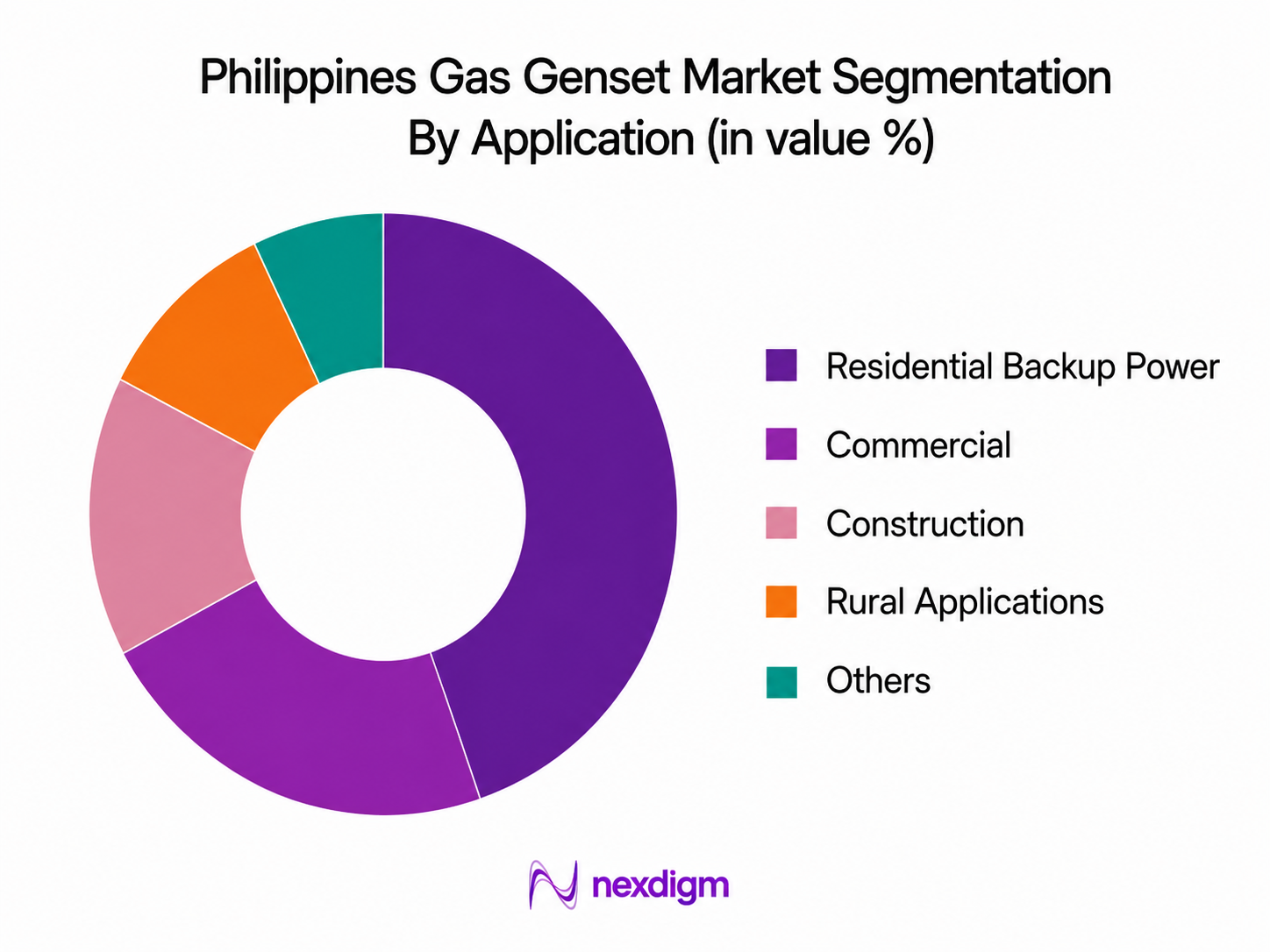
The Philippines Gas Genset Market is segmented into residential backup, commercial and retail establishments, construction and workshops, recreational/mobile applications and agriculture/rural applications. Residential backup represents the dominant application because households require temporary electricity for lighting, refrigeration, communications, fans, water pumps and electronic equipment during power interruptions. Petrol generators are particularly suited to intermittent backup because they can be stored and deployed without permanent installation. Residential demand is also strengthened by rising national power consumption and persistent reliability differences between large urban grids and smaller island or provincial systems. Department of Energy data show total electricity consumption reaching 126,941 GWh, while the government’s missionary-electrification programme continues to address remote and underserved locations. Commercial establishments and construction sites form the next major demand pool because portable gensets can support temporary operations, tools, lighting and emergency business continuity.
Competitive Landscape
The Philippines Gas Genset Market includes globally established engine and power-equipment companies alongside brands distributed through local dealerships, hardware channels and specialist equipment suppliers. Honda and Yamaha have particularly visible Philippine gasoline-generator portfolios. Honda Power Products Philippines markets generator sets built around Honda four-stroke engines, while Yamaha Motor Philippines directly lists conventional and inverter models including the ET-1, EF2600FW, EF7200DE, EF2000iS and EF2200iS. International brands such as Generac, Champion and Briggs & Stratton broaden competition through portable, inverter and residential backup technologies.
| Major Player | Establishment Year | Headquarters | Petrol Generator Portfolio | Inverter Capability | Typical Power Positioning | Key User Groups | Portability Focus | Digital/Safety Features |
| Honda Motor Co. | 1948 | Tokyo, Japan | ~ | ~ | ~ | ~ | ~ | ~ |
| Yamaha Motor Co. | 1955 | Iwata, Japan | ~ | ~ | ~ | ~ | ~ | ~ |
| Generac Power Systems | 1959 | Wisconsin, USA | ~ | ~ | ~ | ~ | ~ | ~ |
| Champion Power Equipment | 2003 | Nevada, USA | ~ | ~ | ~ | ~ | ~ | ~ |
| Briggs & Stratton | 1908 | Wisconsin, USA | ~ | ~ | ~ | ~ | ~ | ~ |
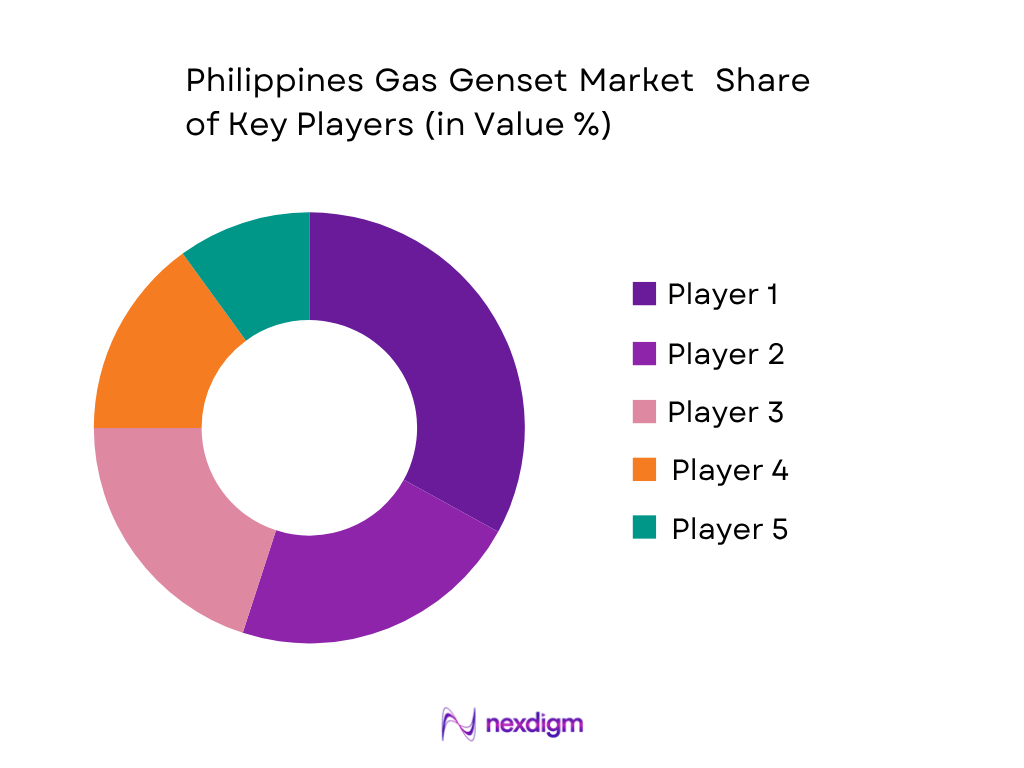
Philippines Gas Genset Market Analysis
Growth Drivers
Grid Reliability Pressure and Rising Electricity Demand Supporting Backup Power Adoption
The Philippines Gas Genset Market is supported by continuing requirements for rapidly deployable backup electricity across households, automotive workshops, roadside businesses, small commercial establishments and temporary operating sites. The National Grid Corporation of the Philippines recorded an actual Luzon peak electricity demand of 14,016 MW on April 24, 2024, while the Department of Energy subsequently established a 14,769 MW Luzon peak-demand reference for 2025. For the Visayas, the DOE’s grid planning framework indicated peak demand of 3,111 MW in 2025 and 3,340 MW in 2026, while Mindanao’s planning framework indicated demand reaching 3,013 MW in 2026. These load levels matter to gasoline gensets because higher system demand increases the operational importance of reserve margins, transmission reliability and distributed emergency power whenever generating units or transmission assets are unavailable. NGCP’s power outlook explicitly evaluates operating margins and loss-of-load probability because electricity demand can temporarily exceed available generation capability. Gasoline gensets are particularly relevant to smaller backup-power applications because portable units can be deployed without permanent fuel infrastructure and can power lighting, small air-conditioning systems, refrigeration, battery chargers, pumps, tools and workshop equipment during interruptions. The Philippines’ archipelagic geography also creates locations where grid restoration can be operationally difficult after storms, equipment faults or transmission disturbances, reinforcing demand for local power resilience. Electricity dependence has simultaneously deepened: Philippine Statistics Authority data indicates that electricity is the country’s most widely used household energy source, making continuity of supply increasingly important for residential and livelihood activities. Broader economic scale supports the installed base of electricity-dependent businesses. World Bank data places Philippine GDP at USD 461.62 billion in 2024 and USD 487.09 billion in 2025, while the population reached 115,843,670 people in 2024. A larger economy means more service businesses, repair shops, communication equipment, food-storage assets and small enterprises whose operations can be interrupted by electricity loss. Portable gasoline generators address this requirement where owners do not need large diesel sets or permanently installed standby systems. They are also relevant to automotive-oriented establishments such as tyre shops, repair garages, car-wash facilities, roadside service centres and mobile maintenance operations that require power for compressors, diagnostic devices, lighting, power tools and charging equipment. The opportunity is therefore directly linked to the gap between growing dependence on electrical equipment and the requirement for decentralized emergency power. Gasoline gensets cannot substitute for grid investments, but their rapid start-up, portability and availability in low-to-medium output ratings make them practical resilience equipment for distributed users. The supporting evidence comes from the National Grid Corporation of the Philippines, Department of Energy, Philippine Statistics Authority and World Bank.
Construction, Small-Business and Temporary Power Activity Expanding Portable Genset Use Cases
Growth in Philippine construction and distributed commercial activity provides another strong demand foundation for portable gasoline gensets because building sites, renovation projects and small enterprises frequently require temporary electricity before permanent utility connections are available or where site mobility makes fixed generation impractical. Philippine Statistics Authority data shows that 180,341 constructions were recorded from approved building permits in 2024, compared with 171,268 constructions in 2023. Residential construction accounted for 116,427 projects, including 97,490 single-type houses, while non-residential developments reached 39,238 projects and included 27,053 commercial buildings. These project volumes create numerous applications for compact gasoline gensets to operate drills, cutters, lighting, small welding equipment, pumps, chargers and other portable tools at sites where grid power is unavailable or inconvenient. Formal-sector construction activity has also expanded. The Philippine Statistics Authority’s 2024 Annual Survey of Philippine Business and Industry identified 2,512 construction establishments, compared with 2,239 establishments in its previous structural benchmark. Gasoline gensets occupy a particular niche within this ecosystem because small contractors and finishing crews often require mobile rather than high-capacity stationary generation. A compact genset can be transported between project sites in a utility vehicle, pickup truck or service van and deployed alongside power tools without the infrastructure requirements associated with larger standby sets. Demand extends beyond formal construction. Automotive garages, tyre-repair businesses, roadside vending facilities, small fabrication shops, event operators and mobile servicing companies also require temporary power for intermittent workloads. The macroeconomic environment provides a large base for such commercial activity. World Bank data records Philippine gross national income per capita at approximately USD 4,470 in 2024, while GDP reached USD 461.62 billion in the same period. The economy expanded further to approximately USD 487.09 billion in 2025, increasing the overall scale of equipment-intensive commercial activity. IMF assessments have also identified domestic demand and public expenditure as important supports for Philippine economic activity, while emphasizing continued infrastructure development and connectivity as priorities for sustaining investment. For genset manufacturers and distributors, this environment favors product portfolios differentiated by portability, starting output, rated wattage, engine displacement, fuel-tank configuration, recoil versus electric start, wheel kits, socket configuration and compatibility with construction equipment. Automotive-oriented distribution is especially relevant because portable generators are frequently transported and used together with service vehicles, construction pickups and mobile workshops. Increasing numbers of residential and commercial construction sites create repeat opportunities for contractors to purchase or replace units subjected to dust, vibration, frequent transport and long operating periods. Suppliers able to support spare parts, carburetor servicing, spark-plug replacement, oil changes and alternator maintenance can consequently build recurring aftermarket relationships rather than relying only on equipment sales. The supporting statistics are drawn from the Philippine Statistics Authority, World Bank and International Monetary Fund.
Market Challenges
Gasoline Supply Dependence, Fuel Storage Constraints and Operating Continuity Risks
The Philippines Gas Genset Market faces an important structural challenge from its dependence on petroleum fuel supply chains. Gasoline gensets require users to maintain accessible fuel inventories, yet the Philippines remains substantially dependent on imported petroleum products and therefore exposed to international supply conditions, shipping logistics, refinery availability and domestic distribution infrastructure. Department of Energy downstream-energy documentation identifies 92 oil depots within the national petroleum distribution system and reports aggregate storage capacity across depots, import terminals and refinery infrastructure of approximately 41.634 million barrels in its established downstream system baseline. The country’s remaining major refinery, Petron’s Bataan facility, accounts for approximately 9.609 million barrels of storage capacity and produces petroleum products including gasoline. These figures demonstrate a significant fuel-supply system, but they also illustrate why gasoline genset operation depends on an extensive logistics chain reaching from ports and terminals through depots, tank trucks and retail fuel outlets to individual generator owners. An automotive gasoline genset that is mechanically operational provides limited resilience if fuel cannot be readily obtained following a severe storm, transportation interruption or concentrated emergency demand. Unlike permanently connected gas systems or battery-storage installations, gasoline sets require users to physically replenish fuel, increasing operational complexity during extended outages. Fuel storage creates additional practical limitations. Users must account for safe containers, ventilation, fire risks, degradation of stored gasoline and carburetor problems caused when fuel remains inside small engines for long periods. Portable generators are often purchased specifically for emergency operation, meaning equipment may remain unused for months and then be expected to start immediately during a grid interruption. This operating pattern can create clogged carburetors, degraded fuel, discharged starting batteries and deteriorated hoses unless preventive maintenance is conducted. The challenge becomes more material as the economy’s dependence on power grows. Philippine GDP reached USD 461.62 billion in 2024 and USD 487.09 billion in 2025, according to the World Bank, while the national population reached 115.84 million people in 2024. Greater economic activity expands backup-power requirements but simultaneously increases fuel demand across transport, industry and other applications during disruptions. Smaller genset owners can be disadvantaged compared with larger facilities holding dedicated fuel inventories. Suppliers therefore need to compete through more than generator output. Extended-run fuel tanks, fuel gauges, efficient engine-control systems, easier draining, fuel shutoff valves and dual- or multi-fuel capability can reduce some limitations of gasoline-only operation. Dealer education on fuel stabilization and periodic test-running also becomes important. From a market perspective, petroleum dependence does not eliminate gasoline genset demand, but it limits the technology’s suitability for very long-duration continuous backup and makes availability of fuel an important purchase consideration. This encourages competition from diesel units, LPG-compatible generators, battery systems and hybrid backup configurations. Market participants therefore need to position gasoline gensets primarily where portability, intermittent use and moderate power requirements outweigh the disadvantages of fuel storage and repeated refueling. Supporting evidence comes from the Department of Energy and World Bank.
Emissions, Noise and Safety Requirements Increasing Product-Engineering Complexity
Gasoline gensets face growing technical and regulatory pressure because small combustion engines produce exhaust gases, carbon monoxide, noise and localized emissions at the exact locations where users often require temporary electricity. This creates a material challenge for manufacturers serving densely populated residential environments, workshops, commercial premises and construction sites. Portable generator operation involves internal-combustion engines located close to workers or households, making correct outdoor placement, exhaust direction, ventilation and electrical protection essential. Philippine environmental regulation operates within the framework of the Philippine Clean Air Act, Republic Act 8749, under which government agencies regulate air-pollution sources and emissions. The broader national energy transition is simultaneously directing investment toward cleaner electricity technologies, creating longer-term competitive pressure on small fossil-fuel generators. The Department of Energy’s planning environment now encompasses grid expansion, renewable-energy development, distributed resources and greater electrification, while grid planners are also incorporating increasing variable renewable generation into operating assumptions. NGCP’s 2025–2027 supply outlook, for example, incorporates solar and wind capacity factors when calculating available capacity and operating margins in Luzon, Visayas and Mindanao. Gasoline gensets therefore need to compete in an energy ecosystem where battery storage, solar-plus-storage packages and cleaner distributed power options are becoming more visible. Technical safety is equally important. Incorrect generator operation can expose users to carbon-monoxide accumulation, electric shock or fire, particularly when equipment is used in enclosed garages, workshops or semi-covered areas. Product differentiation increasingly favors automatic CO detection, low-oil shutdown, overload protection, circuit breakers, ground-fault protection and quieter inverter-based designs. These features add engineering requirements and can increase product complexity for manufacturers and distributors. Noise is another barrier. A conventional open-frame generator operating near homes, commercial premises or automotive workshops can create substantial nuisance, particularly during night-time outages. Enclosed or inverter-based units can reduce acoustic impact but require more sophisticated cooling, electronics and enclosure design. The scale of potential exposure is large because the Philippines had approximately 115,843,670 residents in 2024, while electricity demand on the Luzon grid alone reached 14,016 MW at its actual 2024 peak. The combination of dense settlements and rising electricity dependence increases pressure for generators that can operate safely around people. Regulatory complexity also affects imported equipment because suppliers must ensure product conformity, electrical compatibility and appropriate engine certification while maintaining spare-parts availability. Low-quality units may compete initially through basic specifications, but users increasingly require stable voltage for sensitive electronics, safer exhaust characteristics and automatic protective functions. This creates a challenge for manufacturers that compete solely on engine displacement or maximum output. Long-term competitiveness will increasingly depend on electronic engine control, efficient combustion, acoustic engineering and integrated safety systems. The Philippines Automotive Gas Genset Market therefore faces a transition from basic mechanical generators toward products designed as safer, cleaner and digitally managed portable-power systems. Supporting sources include the Department of Environment and Natural Resources regulatory framework, Department of Energy, National Grid Corporation of the Philippines and World Bank.
Market Opportunities
Inverter Generators, CO Protection and Smart Portable Power Systems
Technological improvement represents one of the strongest opportunities for the Philippines Gas Genset Market because buyers increasingly require portable power that can support electronic devices, automotive diagnostic equipment, chargers and household appliances rather than only basic lighting and mechanical tools. Traditional open-frame generators operate engines at relatively fixed speed and can produce greater noise and fuel use under low-load conditions. Inverter generators electronically condition output and can vary engine speed according to load, enabling quieter operation and more stable electricity for sensitive devices. This is particularly relevant in the Philippines because electricity demand is becoming more digitally intensive. The Philippine Statistics Authority and Department of Information and Communications Technology implemented the 2024 National Information and Communications Technology Household Survey, reflecting the increasing importance of household internet access, connected devices and digital services. Backup power is consequently needed not just for lights and fans but for routers, computers, communications equipment, electronic payment systems, vehicle diagnostic scanners and battery chargers. The national economic base supports this transition. World Bank data places GDP at USD 461.62 billion in 2024, increasing to USD 487.09 billion in 2025, while gross national income per capita reached approximately USD 4,470 in 2024. As equipment ownership and digital dependency expand, buyers have greater reason to select generators offering stable sine-wave output and electronic protections. Carbon-monoxide shutoff technology represents another substantial product opportunity. Because portable gasoline generators may be deployed during storms or outages when users improvise sheltered locations, automatically stopping an engine when CO concentration becomes dangerous can materially improve safety. Additional features including low-oil shutdown, electric start, automatic choke, overload protection, digital load meters and remote monitoring can further differentiate products. Mobile connectivity can extend this concept by enabling operators to view remaining runtime, fuel level, operating hours and maintenance intervals through connected devices. Such capabilities are especially relevant to automotive workshops, field technicians, construction crews and mobile service fleets that use gensets as equipment rather than merely household emergency appliances. The construction market provides a large installed application base: 180,341 approved constructions were recorded in 2024, including 39,238 non-residential developments, while 2,512 formal construction establishments were identified in the 2024 industry survey. These professional users can justify equipment with longer engine life, cleaner electrical output and diagnostic functions because generator failure can interrupt project work. Manufacturers can therefore segment the market into basic emergency generators, premium inverter units, construction-grade open-frame systems and digitally monitored professional products. Dual-fuel compatibility can broaden the proposition further by giving users alternative fuel choices where LPG is available. The opportunity is not based on hypothetical future market statistics; it rests on current construction activity, expanding digital dependence, rising national output and the need for safer distributed electricity. Companies able to combine efficient gasoline engines, inverter electronics, CO protection and service support can shift competition away from commodity wattage comparisons toward reliability and lifecycle functionality. Supporting evidence comes from the Philippine Statistics Authority, Department of Information and Communications Technology and World Bank.
Disaster Resilience, Distributed Backup Power and Provincial Mobility Applications
The Philippines’ exposure to natural hazards creates a durable opportunity for mobile gasoline gensets because power restoration following storms, floods and other disruptive events can require temporary electricity before grid infrastructure is fully restored. Philippine Statistics Authority disaster statistics recorded 225 small-scale natural hazards in 2024, demonstrating the recurring operational exposure of households, enterprises and local communities to disruptive events. Portable gasoline gensets are suited to this environment because units can be transported in pickup trucks, vans or utility vehicles and deployed where electrical infrastructure is unavailable. Applications include powering emergency lighting, communications equipment, water pumps, refrigeration, charging systems, small medical equipment, automotive repair tools and temporary shelters. This mobility differentiates gasoline gensets from permanently installed standby generation, particularly in provincial or geographically dispersed areas. The national grid itself operates across Luzon, Visayas and Mindanao, with interconnected systems carrying very different load profiles. NGCP’s planning framework shows Visayas peak demand of 3,111 MW in 2025 and 3,340 MW in 2026, while Mindanao’s planning framework includes 3,013 MW in 2026. Rising regional electricity requirements increase the value placed on distributed resilience during transmission outages, generating shortages or disaster-related damage. The country’s construction footprint further enlarges this opportunity outside established urban centres. Philippine Statistics Authority records show 180,341 construction projects in 2024, including 116,427 residential developments. Many projects are dispersed across municipalities and provinces where contractors may require power before formal electrical connections are commissioned. Automotive portability is central to this use case: compact gensets can be carried by maintenance teams, contractors, utility crews, telecommunications technicians and emergency-response personnel. The opportunity is reinforced by the country’s macroeconomic scale. The World Bank recorded a population of 115,843,670 in 2024 and GDP of approximately USD 461.62 billion, while output increased to USD 487.09 billion in 2025. More households, small enterprises and infrastructure assets mean more loads requiring emergency electricity when the grid is disrupted. IMF analysis also identifies natural disasters as an important macroeconomic risk for the Philippines, underscoring the strategic importance of infrastructure resilience. Manufacturers can address this opportunity with weather-resistant frames, wheel kits, lifting handles, electric start, extended-runtime tanks, multiple outlets, voltage protection and parallel-operation capability. Distribution through automotive supply stores, hardware chains, equipment dealers and provincial service networks can extend availability beyond metropolitan areas. Rental fleets offer another route because contractors and emergency-response users may require generators only for specific projects or disasters. Service capability is equally important: remote markets need spark plugs, filters, recoil starters, carburetor components and trained technicians to keep units operational. Consequently, future expansion does not depend solely on selling more generators to households. It includes positioning portable gasoline gensets as mobile resilience equipment within contractor fleets, emergency operations, automotive service vehicles, provincial commerce and temporary infrastructure work. Supporting sources are the Philippine Statistics Authority, National Grid Corporation of the Philippines, World Bank and International Monetary Fund.
Future Outlook
The Philippines Gas Genset Market is expected to expand at approximately ~ CAGR during 2026–2035, supported by increasing electricity requirements, construction activity, emergency preparedness and the continuing need for portable electricity across dispersed island communities. Gasoline gensets will remain particularly relevant in low- and medium-output applications where portability, rapid starting and simple operation matter more than continuous multi-day operation. Inverter-based generators are expected to gain prominence because households and businesses increasingly need stable electricity for laptops, communication equipment, point-of-sale terminals and other electronics. The product mix will also move toward quieter engines, improved fuel management, automatic low-oil protection and safer exhaust systems. Honda already combines inverter generator technology with connected functionality on selected international models, demonstrating how traditionally mechanical generator sets are increasingly acquiring digital control features. However, distributed batteries and solar-plus-storage systems will increasingly compete with gasoline generators in some residential applications. Petrol gensets are therefore likely to remain strongest where users value immediate refuelling, relatively compact physical size, high portability and the ability to provide electricity independently of sunlight, battery state-of-charge or permanent infrastructure.
Major Players
- Honda Power Products
- Yamaha Motor
- Generac Power Systems
- Champion Power Equipment
- Briggs & Stratton
- Hyundai Power Products
- FIRMAN Power Equipment
- Westinghouse Outdoor Power Equipment
- DuroMax Power Equipment
- Pramac
- Wacker Neuson
- INGCO Tools
- TOTAL Tools
- Kawasaki Power Products
- PowerSmart
Key Target Audience
- Gasoline generator manufacturers
- Small-engine and alternator manufacturers
- Generator distributors and power-equipment dealers
- Hardware, home-improvement and industrial-equipment retailers
- Construction contractors and automotive workshop operators
- Residential developers, commercial property owners and facility operators
- Investments and venture capitalist firms
- Government and regulatory bodies (Department of Energy, Energy Regulatory Commission, National Electrification Administration, Department of Trade and Industry, Department of Environment and Natural Resources)
Research Methodology
Step 1: Identification of Key Variables
The first stage constructs a complete Philippines Gas Genset Market ecosystem covering generator manufacturers, engine suppliers, alternator manufacturers, importers, equipment distributors, hardware chains, contractors, automotive workshops, households and commercial users. Key variables include generator wattage, engine displacement, fuel-tank capacity, runtime, starting mechanism, inverter architecture, noise characteristics, portability and application environment.
Step 2: Market Analysis and Construction
Historical market demand is constructed through top-down and bottom-up analysis. Electricity consumption, peak power demand, household electrification, construction activity and business density are evaluated alongside product availability across major gasoline-generator power ratings. DOE statistics show total electricity consumption moving from 118,004 GWh to 126,941 GWh and peak demand increasing from 17,331 MW to 19,274 MW, providing important demand-side context.
Step 3: Hypothesis Validation and Expert Consultation
Market hypotheses are validated through CATIs and structured discussions with generator dealers, hardware retailers, contractors, electrical technicians, automotive workshop operators and equipment-rental companies. Primary discussions evaluate typical generator sizing, preferred brands, inverter adoption, seasonal demand, outage-driven purchases, replacement cycles, maintenance requirements, fuel selection and after-sales service expectations.
Step 4: Research Synthesis and Final Output
Demand-side evidence is reconciled with supplier portfolios, dealership presence, generator specifications and regional construction patterns. Honda and Yamaha product ranges provide benchmarks for locally available conventional and inverter configurations, while DOE electrification and electricity-demand data provide the broader power-system framework. The resulting analysis is triangulated to determine market segmentation, competitive positioning and long-term demand scenarios

- Executive Summary
- Research Methodology (Market Definitions and Assumptions, Automotive Gas Genset Definition, Gasoline Generator Classification, Power Output Mapping, Top-Down Market Sizing, Bottom-Up Unit Shipment Assessment, Import and Distribution Analysis, Dealer and Retail Channel Mapping, End-User Demand Assessment, Primary Interviews with Generator Dealers and Contractors, Product Specification Benchmarking, Data Triangulation, Forecasting Framework, Scenario Analysis, Limitations and Future Conclusions)

- Definition and Scope
- Market Evolution and Industry Genesis
- Development of Portable Gasoline Generator Ecosystem
- Generator Industry Business Cycle
- Gasoline Genset Demand Ecosystem

- Growth Drivers (Power Supply Interruptions, Typhoon-Related Outages, Residential Backup Adoption, SME Power Continuity, Construction-Site Electricity Requirements)
- Market Challenges (Gasoline Storage, Runtime Limitations, Emissions, Carbon Monoxide Safety, Noise, Maintenance Requirements)
- Market Opportunities (Inverter Technology, Smart Controls, Low-Noise Products, Fuel Efficiency, Disaster Preparedness, Hybrid Backup Systems)
- Market Trends (Inverter Adoption, AVR Technology, Electronic Fuel Control, Compact Design, Reduced Noise, Smart Monitoring)
- SWOT Analysis
- PESTLE Analysis
- Porter’s Five Forces Analysis

- By Market Value (2020-2025)
- By Unit Sales Volume (2020-2025)
- By Installed Gasoline Genset Base (2020-2025)

- By Power Output (In Value %)
Below 1 kVA
1–2 kVA
Above 2–3 kVA
Above 3–5 kVA
Above 5–7.5 kVA
Above 7.5–10 kVA
Above 10 kVA - By Generator Technology (In Value %)
Conventional Gasoline Generators
Inverter Gasoline Generators
Digital Inverter Generators
AVR-Equipped Conventional Generators
Fuel-Injected Inverter Generators - By Application (In Value %)
Residential Emergency Backup
Small Retail and Commercial Backup
Automotive Workshop and Garage Power
Construction and Contractor Power
Outdoor Events and Mobile Operations - By End User (In Value %)
Households
Automotive Workshops and Repair Garages
Small and Medium Enterprises
Construction Contractors
Retail Stores and Convenience Businesses

- Market Share of Major Players
- Cross Comparison Parameters (Rated Power Range, Maximum Power Output, Continuous Runtime, Fuel Tank Capacity, Inverter/AVR Technology, Noise Level, Starting System, Warranty and After-Sales Network)
- SWOT Analysis of Major Players
- Detailed Profiles of Major Companies
Honda Power Products Philippines
Yamaha Motor Philippines
INGCO Philippines
TOTAL Tools
Hyundai Power Products
FIRMAN Power Equipment
Champion Power Equipment
Westinghouse Outdoor Power Equipment
Generac Power Systems
Briggs & Stratton
Loncin Motor
Lutian Machinery
Atlas Copco
Kipor Power Equipment
Powerhouse Tools and Equipment

- Residential Backup Power Requirement Analysis
- Household Appliance Load Mapping
- Automotive Workshop Power Requirement Analysis
- Small Business Continuity Requirement Analysis
- Contractor and Construction-Site Generator Utilization

- By Market Value (2026-2035)
- By Unit Sales Volume (2026-2035)
- By Installed Gasoline Genset Base (2026-2035)


 Request a Sample
 Ask for Customization
 Get a Quote
 Enquire Now