
 Download PDF
Market Overview
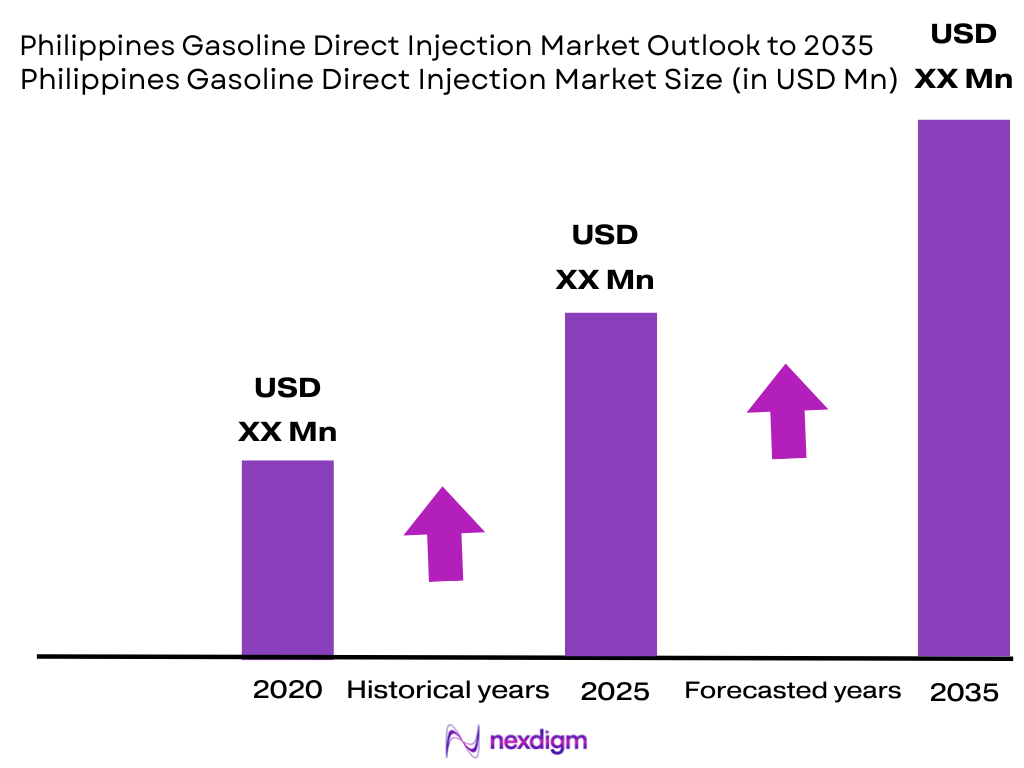
The Philippines Gasoline Direct Injection Market is valued at USD ~ million, supported by expanding new-vehicle demand and a growing installed base of modern gasoline powertrains. Philippine automotive manufacturers recorded 467,252 vehicle sales in the latest annual observation compared with 429,807 units in the preceding observation. Rising adoption of turbocharged gasoline engines, hybrid vehicles and electronically controlled fuel systems strengthens demand for GDI injectors, pumps, rails and engine-management components. Metro Manila/NCR, CALABARZON and Central Luzon constitute the principal demand belt for the Philippines Gasoline Direct Injection Market because of their population scale, economic activity, dealership concentration, automotive manufacturing and large service ecosystems. CALABARZON’s economy expanded from PHP 3.10 trillion to PHP 3.27 trillion across the latest two observations, while NCR’s preceding-period economy was PHP 6.57 trillion. Quezon City alone generated PHP 1.27 trillion, supporting particularly dense automotive demand and aftermarket activity.
Market Segmentation
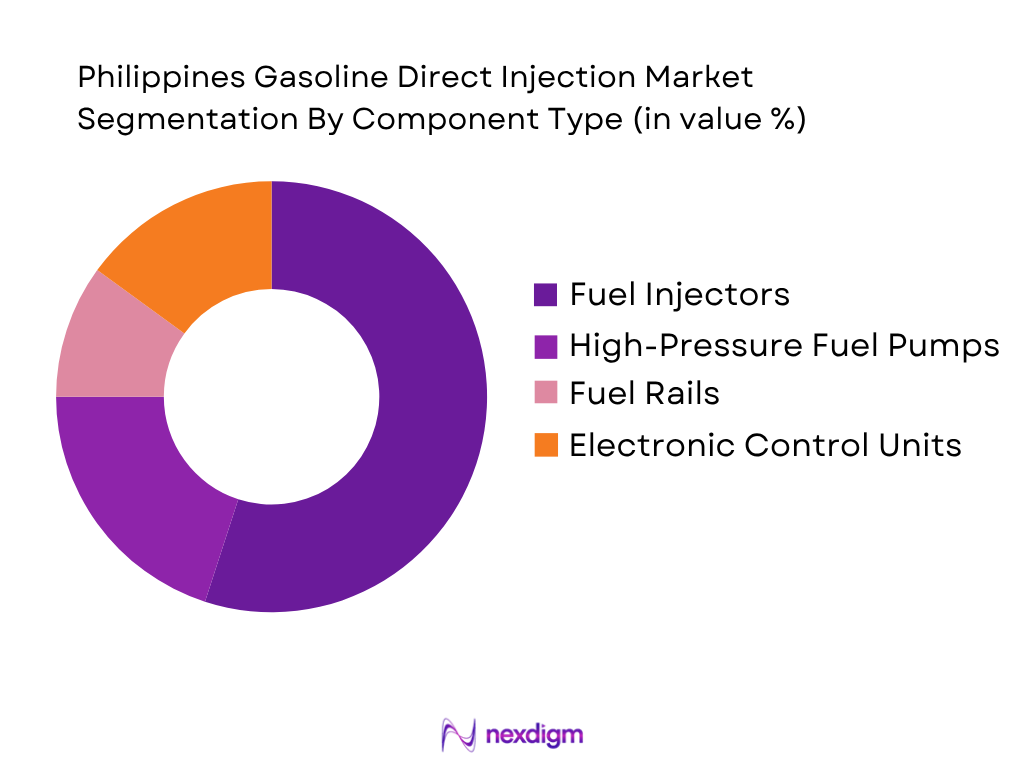
By Component Type
The Philippines Gasoline Direct Injection Market is segmented into high-pressure fuel injectors, high-pressure fuel pumps, fuel rails, electronic control units, and pressure sensors and ancillary components. High-pressure fuel injectors represent the dominant sub-segment in the report model because every GDI cylinder requires individually controlled injection directly into the combustion chamber. Their function combines fuel metering, atomization, spray targeting and rapid response under high pressure, making injectors central to combustion efficiency and emissions control. Bosch describes the injector as the interface between the fuel rail and combustion chamber, while DENSO’s gasoline powertrain portfolio includes direct-injection high-pressure injectors, pumps and ECUs. Injector demand also has an aftermarket dimension because deteriorating spray quality, deposits, electrical faults and sealing problems can require cleaning, testing or component replacement. Higher-cylinder-count engines additionally require multiple injectors per vehicle, strengthening their component-volume contribution relative to pumps and rails.
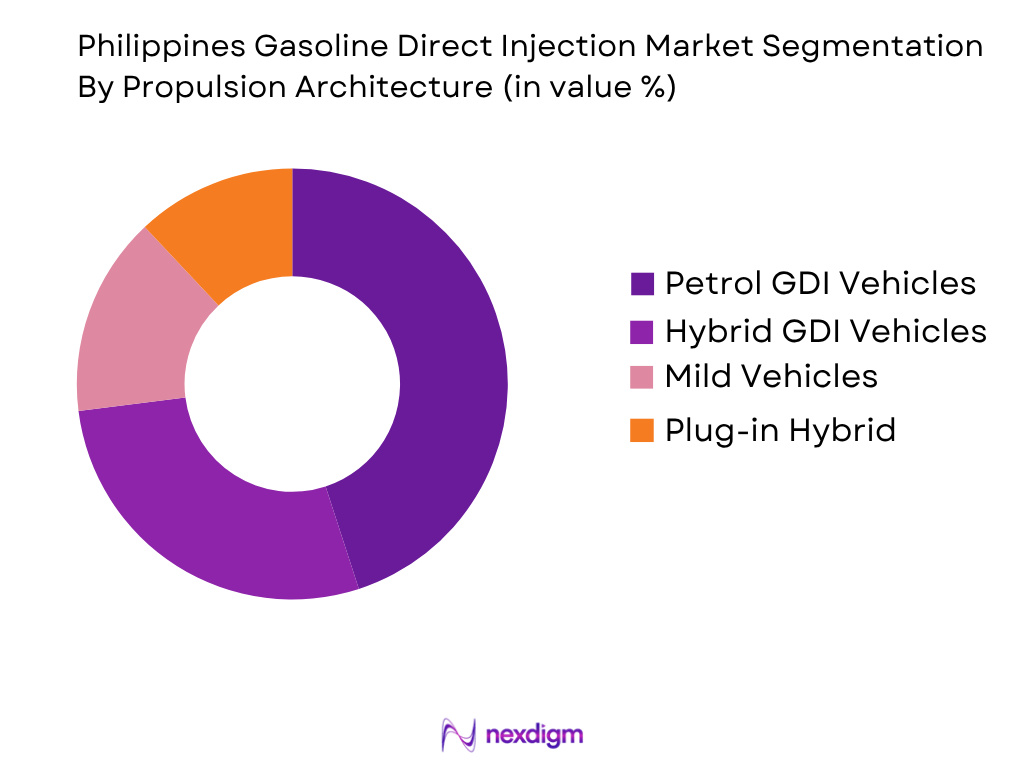
By Propulsion Architecture
The Philippines Gasoline Direct Injection Market is segmented into pure-petrol GDI vehicles, mild-hybrid GDI vehicles, full-hybrid GDI vehicles, and plug-in hybrid GDI vehicles. Pure-petrol GDI vehicles remain the dominant sub-segment in the report model because the country’s installed passenger-vehicle fleet has historically been centered on gasoline-powered Japanese, Korean, American and European models. GDI has particularly strong applicability in turbocharged crossovers, SUVs and downsized gasoline engines where manufacturers use direct injection to improve charge cooling, torque output and combustion control. Hybrid GDI is nevertheless becoming strategically important as Toyota, Honda and other manufacturers expand electrified gasoline offerings in the country. Unlike battery-electric vehicles, hybrids retain an internal-combustion engine and therefore continue to create demand for fuel injectors, pumps, rails and electronic control. This gives hybridized gasoline technology an important bridge role between traditional internal combustion and complete vehicle electrification.
Competitive Landscape
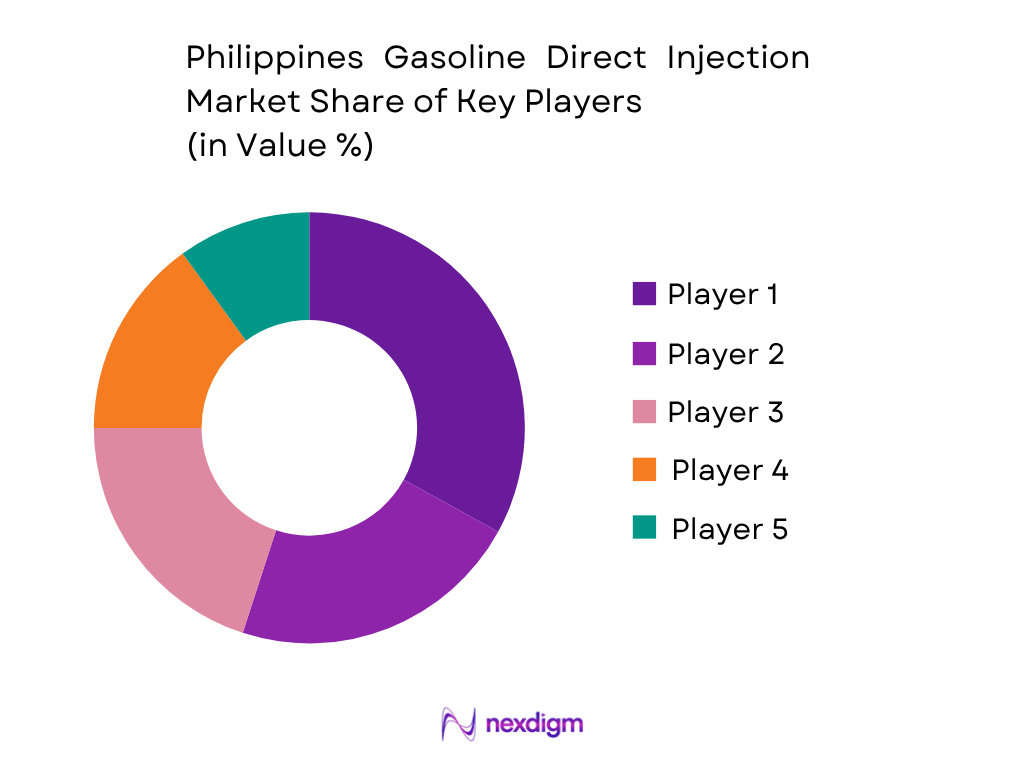
The Philippines Gasoline Direct Injection Market is led primarily by international Tier-1 automotive suppliers rather than domestic GDI-system manufacturers. Bosch, DENSO, Marelli, Astemo and PHINIA/Delphi form a particularly relevant competitive set because they possess established capabilities in high-pressure injectors, pumps, rails, engine-control systems or complete GDI architectures. Their Philippine exposure is largely indirect through OEM vehicle platforms, local vehicle distributors, automotive assemblers and the replacement-parts ecosystem. Competition increasingly centers on injection pressure, spray precision, hybrid compatibility and aftermarket application coverage.
| Major Player | Establishment | Headquarters | GDI Component Portfolio | Injection Pressure Capability | Injector / Control Technology | Pump & Rail Capability | Hybrid / Advanced ICE Relevance | Philippines / APAC Relevance |
| Robert Bosch GmbH | 1886 | Gerlingen/Stuttgart region, Germany | ~ | ~ | ~ | ~ | ~ | ~ |
| DENSO Corporation | 1949 | Kariya, Aichi, Japan | ~ | ~ | ~ | ~ | ~ | ~ |
| Marelli | 2019 as combined entity | Saitama, Japan | ~ | ~ | ~ | ~ | ~ | ~ |
| Astemo, Ltd. | 2021 | Tokyo, Japan | ~ | ~ | ~ | ~ | ~ | ~ |
| PHINIA Inc. / Delphi | 2023 as independent company | Auburn Hills, Michigan, US | ~ | ~ | ~ | ~ | ~ | ~ |
Singapore Gasoline Direct Injection Market Analysis
Growth Drivers
Expansion of Petrol-Electric Hybrid Vehicles and a Large Gasoline-Engine Installed Base
Singapore’s expanding petrol-electric vehicle parc is a major demand driver for the Gasoline Direct Injection Market because electrification through hybrid powertrains does not eliminate the gasoline engine and therefore preserves requirements for fuel injectors, high-pressure pumps, rails, pressure sensors and electronic fuel-management systems. Land Transport Authority data show that Singapore had 99,157 petrol-electric cars and 1,556 plug-in petrol-electric cars in 2024, with the corresponding populations reaching 118,695 and 2,449 vehicles in 2025. At the same time, the country retained 513,943 conventional petrol cars in 2024 and 475,455 in 2025, establishing a very large installed base potentially relevant to gasoline fuel-system servicing and replacement demand. The total car population recorded in the LTA fuel-type series increased from 657,744 vehicles in 2024 to 659,889 vehicles in 2025, showing that the overall addressable passenger-vehicle ecosystem remains substantial even while its powertrain composition changes. The hybrid transition is visible across important vehicle manufacturers. Toyota’s petrol-electric car population increased from 40,948 vehicles in 2024 to 46,418 in 2025, Honda from 18,246 to 20,769, Mercedes-Benz from 10,710 to 14,897, Nissan from 6,337 to 7,399, Mazda from 5,347 to 6,365, Hyundai from 3,118 to 4,189, and Kia from 3,624 to 4,748. These vehicles create continuing opportunities for gasoline fuel-system suppliers wherever their combustion engines use direct injection or other high-pressure injection architectures. The market mechanism is particularly relevant because hybrid engines require accurate control during frequent engine shutdowns and restarts, transient load transitions and efficiency-oriented operating cycles, increasing the importance of precise electronic fuel metering. Singapore’s high-income macroeconomic structure also supports the penetration of sophisticated powertrains: the International Monetary Fund recorded nominal GDP of USD 547.5 billion, GDP per capita of USD 90,689 and a population of 6.0 million in 2024. This economic scale supports a vehicle parc containing a meaningful number of premium and technologically advanced models. BMW alone had 42,997 petrol cars and 2,754 petrol-electric cars in 2024, while Mercedes-Benz had 63,654 petrol cars, 10,710 petrol-electric cars and 601 plug-in petrol-electric cars. The significance for the Singapore GDI market is therefore broader than annual petrol-only vehicle demand. An expanding hybrid parc provides a bridge between conventional internal-combustion vehicles and full battery electrification, allowing GDI suppliers to serve both existing petrol vehicles and newer electrified gasoline platforms. Suppliers offering injectors, high-pressure pumps, fuel rails, pressure sensors and electronic control components compatible with hybrid operating cycles have an opportunity to remain relevant as the powertrain mix evolves. Singapore’s current vehicle data consequently support a market characterized by declining conventional petrol penetration but simultaneous expansion of gasoline-electric architectures, keeping advanced fuel-injection technology commercially relevant during the transition toward cleaner-energy mobility.
Tight Vehicle-Emission Requirements Driving Precision Fuel-Injection and Combustion Control
Singapore’s stringent vehicle-emission framework supports demand for increasingly precise gasoline fuel-injection technology by raising the technical performance required from combustion engines entering and operating in the country. The National Environment Agency implemented the full transition to the Worldwide Harmonised Light-duty Test Procedure for passenger cars and taxis on 1 January 2024, complementing the earlier transition for light commercial vehicles. WLTP evaluates vehicles under a more representative range of operating conditions, increasing the importance of accurate injector timing, fuel quantity, rail pressure, atomization and engine-management calibration. Singapore’s Vehicular Emissions Scheme also evaluates vehicles against 5 emissions parameters: carbon dioxide, hydrocarbons, carbon monoxide, nitrogen oxides and particulate matter. For gasoline direct-injection engines, particulate formation is especially relevant because fuel is injected directly inside the combustion chamber, making spray targeting, droplet size, wall wetting and combustion timing important engineering variables. The VES thresholds applicable from 2024 include specific limits for particulate matter; the A2 band, for example, allows particulate emissions of up to 0.3 milligrams per kilometre, while other emissions parameters are simultaneously considered when determining a vehicle’s overall band. Singapore also continues to require new petrol vehicles to comply with Euro VI-equivalent emission requirements, establishing a high technical threshold for combustion and after-treatment systems. These requirements interact with a substantial gasoline-engine fleet. LTA recorded 513,943 petrol cars, 99,157 petrol-electric cars and 1,556 plug-in petrol-electric cars in 2024, followed by 475,455 petrol cars, 118,695 petrol-electric cars and 2,449 plug-in petrol-electric cars in 2025. This means hundreds of thousands of vehicles continue to operate with gasoline engines for which combustion quality, injection accuracy and emissions performance are relevant. Premium and turbocharged vehicle populations further strengthen the technological requirement: Singapore had 17,332 petrol Audi cars, 42,997 petrol BMW cars, 63,654 petrol Mercedes-Benz cars, 18,664 petrol Volkswagen cars, 8,278 petrol Porsche cars and 7,366 petrol Volvo cars in 2024. These manufacturers have extensively deployed electronically managed turbocharged and direct-injection gasoline architectures across their model ranges, creating a significant service ecosystem for high-pressure fuel systems. Macroeconomic capacity supports this technologically intensive fleet: IMF data place Singapore’s 2024 nominal GDP at USD 547.5 billion and GDP per capita at USD 90,689, with a 6.0 million population. Regulation also became more directionally important in 2025 and 2026. NEA and LTA extended the Vehicular Emissions Scheme from 1 January 2026 through 31 December 2027, while revising the band structure to place greater emphasis on cleaner vehicles. For the GDI market, this creates pressure to deliver rather than merely supply fuel-system components. Injectors must maintain stable flow characteristics, high-pressure pumps must sustain specified rail pressures, sensors must accurately communicate operating conditions and ECU calibration must coordinate injection with ignition and after-treatment systems. Poor spray formation, injector deposits or pressure deviations can increase fuel consumption and pollutant formation, making quality replacement components and accurate diagnostics increasingly important. Singapore’s emission policy therefore drives the GDI ecosystem toward technologically advanced, tightly controlled and emissions-compatible fuel systems, supporting suppliers that can offer reliable high-pressure components for modern petrol and hybrid platforms while progressively marginalizing lower-performance combustion architectures.
Market Challenges
Accelerating Battery-Electric Vehicle Adoption is Shrinking the Addressable GDI Vehicle Pool
Battery-electric vehicle adoption constitutes the most important structural challenge for the Singapore Gasoline Direct Injection Market because every fully electric vehicle entering the fleet eliminates the requirement for gasoline injectors, high-pressure pumps, fuel rails and gasoline-engine control equipment. LTA data show a rapid change in the vehicle population: the number of electric cars increased from 26,225 vehicles in 2024 to 49,110 vehicles in 2025, while conventional petrol cars declined from 513,943 to 475,455 vehicles over the same period. The opposing direction of these two populations directly illustrates the substitution pressure facing GDI suppliers. Individual manufacturer data provide further evidence. Tesla’s Singapore car population increased from 5,163 vehicles in 2024 to 8,635 in 2025, while BYD’s total car population expanded from 8,567 to 19,739 vehicles, primarily through electric models. XPeng grew from 336 cars to 1,276, while Zeekr increased from 99 to 863. At the same time, important conventional petrol vehicle populations declined: Toyota petrol cars fell from 100,281 in 2024 to 91,456 in 2025, Honda from 84,770 to 80,642, Mercedes-Benz from 63,654 to 59,907, Mazda from 31,815 to 28,072, Hyundai from 28,123 to 26,127, Volkswagen from 18,664 to 16,008, Subaru from 13,836 to 12,276, and Kia from 17,996 to 15,873. These changes affect GDI suppliers through both new-vehicle fitment and long-term aftermarket potential. A petrol or hybrid vehicle added to the fleet can create years of demand for injection-system diagnostics, cleaning and replacement, whereas a new battery-electric vehicle permanently removes those gasoline-system opportunities from that vehicle lifecycle. Government policy reinforces the transition. From 1 January 2026, Singapore’s revised Vehicular Emissions Scheme provides rebates only to electric vehicles, while hybrid vehicles no longer receive VES rebates. Electric cars registered in 2026 can also receive an Electric Vehicle Early Adoption Incentive equal to 45 units of ARF relief per 100 units of ARF, capped at SGD 7,500, while combined VES and EEAI benefits can reach SGD 30,000 for qualifying electric cars in 2026. LTA additionally states that new car registrations must move to cleaner-energy models from 2030, while new registrations of diesel and diesel-natural-gas cars have already ceased from 1 January 2025. Although hybrids remain within the cleaner-energy category and therefore preserve some gasoline injection demand, the policy trajectory clearly favors full electrification. The macroeconomic environment can facilitate adoption of new technology because the IMF recorded Singapore’s 2024 GDP at USD 547.5 billion, GDP per capita at USD 90,689 and population at 6.0 million, providing a high-income consumer and corporate fleet base capable of replacing vehicles with newer technologies. For GDI component manufacturers, distributors and workshops, the challenge is consequently one of declining addressable lifetime volume rather than only lower annual sales. Inventory planning must account for petrol engine families gradually leaving the fleet, while investments in tooling and technician training face shorter payback windows for technologies approaching obsolescence. Suppliers with excessive exposure to pure-petrol new-vehicle platforms therefore face greater structural risk, whereas those serving hybrids and the installed aftermarket have a longer transition runway.
Complex Multi-Brand GDI Architectures and Increasing Diagnostic Requirements
Technical complexity represents another major challenge because Singapore’s vehicle parc combines a large number of Japanese, European and Korean engine families with different injection pressures, injector designs, pump architectures, ECU calibrations and hybrid operating strategies. GDI servicing is substantially more application-specific than conventional low-pressure port injection: an injector designed for one engine cannot simply be substituted into another because spray cone, flow capacity, electrical characteristics and operating pressure must match the engine-control strategy. Singapore’s current fleet illustrates the scale of this application fragmentation. In 2024, the country had 100,281 petrol Toyota cars, 84,770 petrol Honda cars, 63,654 petrol Mercedes-Benz cars, 42,997 petrol BMW cars, 31,815 petrol Mazda cars, 28,123 petrol Hyundai cars, 25,609 petrol Nissan cars, 18,664 petrol Volkswagen cars, 17,996 petrol Kia cars, 17,332 petrol Audi cars and 13,836 petrol Subaru cars. Each major brand contains multiple model lines, engine sizes and generations, creating a wide application catalogue for aftermarket distributors. The hybrid population adds further complexity: Toyota had 40,948 petrol-electric cars, Honda 18,246, Mercedes-Benz 10,710, Nissan 6,337, Mazda 5,347, Kia 3,624, Hyundai 3,118 and BMW 2,754 in 2024. By 2025 many of these hybrid fleets had expanded, including Toyota to 46,418, Honda to 20,769, Mercedes-Benz to 14,897, Mazda to 6,365 and Hyundai to 4,189. Hybrid engines can introduce additional requirements around start-stop frequency, transient fuel-pressure control and coordination between the combustion engine and electric drive system. This diversity increases the risk of incorrect part matching, insufficient inventory coverage and repeat repairs if workshops do not possess appropriate technical data and diagnostic equipment. Singapore’s regulatory framework raises the consequences of inaccurate servicing. Passenger cars and taxis have been subject to the WLTP regime since 1 January 2024, while the Vehicular Emissions Scheme assesses 5 separate pollutant or emissions parameters. LTA’s inspection framework also tightened certain high-utilization vehicle requirements: from 1 January 2025, taxis below 3 years old moved to annual periodic inspections, while chauffeured private-hire cars above 10 years old are required to undergo inspections every 6 months. Such requirements increase the importance of maintaining engine and emissions systems in operating condition, especially for vehicles accumulating high mileage. Singapore’s 2024 GDP of USD 547.5 billion, GDP per capita of USD 90,689 and population of 6.0 million, as reported by the IMF, support a high-value and technically diverse automotive fleet where customers expect reliable servicing and component quality. The challenge for the GDI market is therefore capability rather than merely component availability. Workshops must distinguish injector faults from ignition, turbocharging, air-intake, fuel-pressure and sensor issues; diagnose low- and high-pressure circuits; examine long- and short-term fuel corrections; and confirm correct post-repair operation. Distributors must maintain accurate vehicle identification and cross-reference databases across hundreds of potential applications. As Singapore moves toward more hybridized and electronically controlled engines, generalist repair capability becomes progressively less sufficient. The market increasingly favors authorized service centers and technically sophisticated independent specialists, while smaller workshops face barriers in diagnostic equipment, training, software access and component identification.
Market Opportunities
Hybrid-Compatible GDI Components as a Bridge During Singapore’s Powertrain Transition
The expansion of petrol-electric vehicles creates one of the clearest future opportunities for the Singapore Gasoline Direct Injection Market because hybridization allows advanced gasoline-engine technology to remain commercially relevant even while the country progressively electrifies road transport. Current LTA data demonstrate that this is already an established transition rather than a theoretical future scenario. Singapore’s petrol-electric car population increased from 99,157 vehicles in 2024 to 118,695 vehicles in 2025, while plug-in petrol-electric cars increased from 1,556 to 2,449 vehicles. Within individual manufacturers, Toyota’s petrol-electric fleet expanded from 40,948 to 46,418 vehicles, Honda from 18,246 to 20,769, Mercedes-Benz from 10,710 to 14,897, Nissan from 6,337 to 7,399, Mazda from 5,347 to 6,365, Hyundai from 3,118 to 4,189, Kia from 3,624 to 4,748, Volkswagen from 797 to 1,135, Subaru from 621 to 1,296, Suzuki from 962 to 1,313, and Land Rover from 883 to 1,046. These current fleet changes provide a measurable foundation for future GDI opportunities because many hybrid architectures retain advanced gasoline engines requiring injectors, pumps, rails, pressure sensors and electronic fuel control. Hybrid powertrains can create demanding operating conditions for fuel systems: the engine may switch on and off repeatedly, move rapidly between low and high load, and operate according to efficiency-focused Atkinson or Miller-cycle strategies. Accurate fuel atomization and repeatable injector performance therefore remain important even when the electric motor carries part of the propulsion load. The opportunity is further shaped by regulation. Singapore’s policy states that cleaner-energy models include electric, hybrid and hydrogen fuel-cell cars, allowing hybrids to remain part of the transition pathway for new registrations. Although revised VES rules from 1 January 2026 remove rebates for hybrids and reserve rebates for fully electric models, hybrids retain a role as an intermediate technology for motorists and vehicle manufacturers not yet transitioning entirely to BEVs. Suppliers can consequently prioritize GDI products linked to expanding hybrid engine families rather than concentrating only on conventional petrol platforms that are shrinking. Singapore’s economic base strengthens the ability to absorb technologically sophisticated vehicles: IMF data place nominal GDP at USD 547.5 billion, population at 6.0 million, and GDP per capita at USD 90,689 in 2024. This supports demand for Japanese full hybrids, European mild hybrids and premium electrified gasoline architectures, each of which can create specific fuel-system requirements. The strongest opportunity is therefore not generic growth in gasoline injection but portfolio migration toward “electrified combustion.” Component suppliers can expand coverage for high-efficiency hybrid engine families, low-leakage injectors, pressure-stable pumps and electronically integrated fuel systems. Aftermarket distributors can build application databases around Toyota, Honda, Mercedes-Benz, Nissan, Mazda, Hyundai and other hybrid fleets already expanding in Singapore. Workshops can similarly develop expertise at the intersection of hybrid electrical systems and gasoline fuel injection. The current installed-base figures demonstrate that hybridization can extend the commercial life of GDI technology even while fully electric vehicles grow, providing suppliers with a more defensible opportunity than continued reliance on conventional petrol-only powertrains.
Expansion of GDI Aftermarket Diagnostics, Injector Servicing and High-Pressure Component Replacement
The sizeable installed gasoline-engine vehicle parc creates a substantial future opportunity for Singapore’s GDI aftermarket even as battery-electric vehicles gain ground, because existing petrol and hybrid vehicles will continue requiring maintenance throughout their remaining operating lives. LTA recorded 513,943 conventional petrol cars, 99,157 petrol-electric cars and 1,556 plug-in petrol-electric cars in 2024. In 2025, the corresponding populations were 475,455 petrol cars, 118,695 petrol-electric cars and 2,449 plug-in petrol-electric cars. These current figures show that hundreds of thousands of gasoline-engine vehicles remain on Singapore roads, establishing a large service ecosystem from which GDI specialists can capture demand for injectors, high-pressure pumps, fuel rails, pressure sensors, seals, diagnostics and cleaning services. The opportunity becomes more important as the new pure-petrol vehicle pool contracts because aftermarket revenue is tied to the installed fleet rather than only annual vehicle registrations. Vehicle-brand data reveal broad application potential. Singapore’s 2024 fleet contained 63,654 petrol Mercedes-Benz cars, 42,997 petrol BMW cars, 31,815 petrol Mazda cars, 28,123 petrol Hyundai cars, 25,609 petrol Nissan cars, 18,664 petrol Volkswagen cars, 17,996 petrol Kia cars, 17,332 petrol Audi cars, 13,836 petrol Subaru cars and 8,278 petrol Porsche cars, alongside very large Toyota and Honda populations. Many modern gasoline engine families in these fleets use turbocharging, direct injection or sophisticated electronically managed fuel systems. The aftermarket opportunity therefore spans mass-market Japanese vehicles, Korean platforms, European premium automobiles and performance vehicles rather than a single customer category. Singapore’s vehicle ownership framework also gives servicing a defined lifecycle dimension. LTA states that a Certificate of Entitlement allows use of vehicle road space for 10 years, after which owners may deregister the vehicle or renew the COE. From 2026, private-hire vehicles above 10 years of age face inspections every 6 months, illustrating the increased maintenance scrutiny applied to aging high-utilization vehicles. Older gasoline vehicles that remain economically viable through COE renewal can consequently create extended demand for mechanical and electronic fuel-system maintenance. Regulatory conditions add another layer of opportunity. Singapore has applied WLTP to passenger cars and taxis since 1 January 2024, while VES evaluates 5 emissions parameters, making combustion-system condition increasingly relevant. An injector with poor atomization, a high-pressure pump producing unstable rail pressure or a malfunctioning fuel-pressure sensor can cause drivability and emissions problems that require proper diagnosis rather than simple parts replacement. The IMF’s **2024 macroeconomic indicators—USD 547.5 billion nominal GDP, USD 90,689 GDP per capita and 6.0 million residents—**also characterize a high-income market where vehicle owners and fleet operators have strong incentives to protect valuable automotive assets through professional servicing. Future growth opportunities therefore include injector flow testing, ultrasonic or specialized GDI cleaning, high-pressure pump diagnosis, rail-pressure testing, intake-carbon remediation, injector coding where applicable and OEM-equivalent replacement component distribution. Independent specialists that combine diagnostic competence with accurate make-model-engine databases can capture demand that general repair shops may be unable to address. Parts distributors can similarly differentiate through authentic components, technical support and rapid access to lower-volume European or hybrid applications. As electrification progressively weakens factory-fitted pure-petrol GDI demand, the existing fleet makes specialist aftermarket servicing a strategically important route for extending revenue participation in Singapore’s gasoline injection ecosystem.
Future Outlook
The Philippines Gasoline Direct Injection Market is expected to expand at a ~ CAGR during 2026–2035 under the placeholder forecast framework. Demand is expected to become increasingly divided between new-generation hybrid gasoline platforms and replacement requirements from the installed petrol-vehicle parc. Higher-pressure injection, turbocharged downsized engines, precise electronic combustion management and specialist aftermarket services will support opportunities, while battery-electric adoption will progressively limit the addressable market for conventional gasoline injection. Hybridization is likely to represent the most important transition pathway for the Philippine GDI ecosystem. Vehicle manufacturers can reduce fuel consumption and emissions without immediately eliminating the gasoline engine, allowing fuel injectors, high-pressure pumps, rails and engine-management electronics to remain technologically relevant. This is particularly important in the Philippines, where Japanese manufacturers have a substantial automotive presence and are introducing increasingly diverse electrified product portfolios.
Higher-pressure GDI architecture should also become an important competitive differentiator. Bosch currently describes gasoline systems operating at up to 350 bar, PHINIA offers 350-bar and 500+ bar pumps, and Marelli has developed a complete system capable of reaching 1,000 bar. These platforms demonstrate the direction of fuel-system engineering toward finer atomization, more controlled injection events and improved combustion performance. The aftermarket will simultaneously become more significant as earlier generations of GDI-equipped vehicles age. Independent workshops, authorized dealerships, fuel-injection specialists and parts distributors will require more sophisticated diagnostic capability for rail-pressure faults, injector imbalance, pump deterioration and carbon-related combustion issues. The fragmented Philippine vehicle fleet creates opportunities for distributors with accurate make-model-engine application databases and reliable access to OEM-equivalent replacement products.
Major Players
- Robert Bosch GmbH
- DENSO Corporation
- Continental AG
- PHINIA Inc. / Delphi
- Marelli
- Astemo, Ltd.
- BorgWarner Inc.
- Stanadyne LLC
- Schaeffler AG / Vitesco Technologies
- Aisan Industry Co., Ltd.
- TI Automotive / TI Fluid Systems
- Mitsubishi Electric Corporation
- Infineon Technologies AG
- Sensata Technologies, Inc.
- Niterra Co., Ltd.
Key Target Audience
- Gasoline Direct Injection System and Component Manufacturers
- Automotive OEMs and Vehicle Assemblers
- Authorized Vehicle Distributors and Dealership Networks
- Automotive Fuel-System Importers and Aftermarket Parts Distributors
- Automotive Repair, GDI Diagnostic and Fuel-Injection Service Networks
- Fleet, Ride-Hailing and Corporate Mobility Operators
- Investments and Venture Capitalist Firms
- Government and Regulatory Bodies (Department of Transportation, Land Transportation Office, Department of Energy, Department of Environment and Natural Resources, Department of Trade and Industry)
Research Methodology
Step 1: Identification of Key Variables
The research begins by constructing an ecosystem map for the Philippines Gasoline Direct Injection Market covering Tier-1 fuel-system suppliers, OEMs, assemblers, vehicle distributors, component importers, workshops and fleet users. Key variables include vehicle sales, gasoline-engine parc, GDI fitment by engine family, injector count, high-pressure-pump content, hybridization, turbocharging, component replacement and geographic concentration.
Secondary research is conducted using government statistics, automotive-industry data, company disclosures and technical documentation. Each make-model-engine combination is assessed to distinguish GDI from port-injected gasoline platforms and to prevent the entire gasoline vehicle population from being incorrectly treated as directly injected.
Step 2: Market Analysis and Construction
Historical market construction uses both top-down and bottom-up approaches. The top-down model begins with the Philippine vehicle parc, new-vehicle demand and gasoline/hybrid powertrain composition before applying validated GDI fitment assumptions at manufacturer, model and engine-family level.
The bottom-up approach calculates addressable component demand from GDI-equipped vehicles multiplied by component content, including injector count, pumps, rails and relevant sensors. OEM-fitted demand is separated from replacement demand, while distributor and aftermarket channel structures are analyzed independently before the two sizing approaches are reconciled.
Step 3: Hypothesis Validation and Expert Consultation
Initial hypotheses are validated through CATIs and structured discussions with automotive component suppliers, vehicle distributors, parts wholesalers, dealership workshops, independent repair centers and specialist fuel-injection technicians. Interview topics include GDI platform penetration, component sourcing, replacement frequency, injector-cleaning behavior, high-pressure-pump failures and genuine-versus-OES purchasing patterns.
Technical consultations are further used to validate injection-pressure requirements, ethanol compatibility, diagnostic practices and differences between Japanese, Korean, European, American and Chinese powertrain platforms. Findings inconsistent with secondary datasets are rechecked and triangulated before inclusion.
Step 4: Research Synthesis and Final Output
The final stage triangulates vehicle statistics, engine-fitment mapping, supplier disclosures, channel interviews and component-level demand. Top-down and bottom-up estimates are reconciled to build a consistent market structure across component, propulsion architecture, vehicle type and sales channel.
Forecast scenarios incorporate new-vehicle demand, hybrid penetration, turbo-GDI adoption, installed-fleet aging, replacement requirements and battery-electric substitution. The final outlook includes a base case together with accelerated-electrification and hybrid-led transition scenarios to reflect structural uncertainty in Philippine powertrain demand.

- Executive Summary
- Research Methodology (Market Definitions and Assumptions, Abbreviations, GDI System Boundary, Vehicle Make-Model-Engine Mapping, GDI Fitment Identification, Market Sizing Approach, Top-Down Analysis, Bottom-Up Analysis, Demand-Side Assessment, Supply-Side Assessment, OEM Platform Assessment, Registered Vehicle Parc Analysis, New Vehicle Sales Mapping, Import Dependency Mapping, Primary Interviews with OEMs, Distributors, Parts Importers and Workshops, Component Price-Volume Analysis, Data Triangulation, Forecasting Framework, Scenario Analysis, Limitations and Future Conclusions)

- Definition and Scope
- Evolution of Gasoline Fuel Injection in the Philippines
- Transition from Multi-Point/Port Fuel Injection to Gasoline Direct Injection
- GDI System Architecture and Operating Mechanism
- Philippines Passenger Vehicle and Light Commercial Vehicle Powertrain Landscape

- Growth Drivers (Expansion of GDI-Equipped SUVs and Crossovers, Turbocharged Engine Adoption, Growth of Hybrid Gasoline Platforms, Fuel-Efficiency Optimization, Rising Vehicle Ownership, Advanced Engine Technology Introduction, Aging GDI Vehicle Parc)
- Market Challenges (Battery-Electric Vehicle Substitution, Dependence on Imported Tier-1 GDI Components, Fuel Quality Sensitivity, High-Pressure Component Complexity, Fragmented Vehicle Platform Mix, Skilled Technician Requirements, Counterfeit Replacement Parts)
- Market Opportunities (Hybrid-Compatible GDI Systems, High-Pressure 350–500+ Bar Injection, Injector and Pump Replacement, GDI Diagnostics, Specialist Fuel-Injection Workshops, Dual-Injection Technologies, Multi-Fuel GDI Systems, OEM-Equivalent Aftermarket Components)
- Market Trends (Engine Downsizing, Turbo-GDI Adoption, Japanese Hybrid Expansion, Chinese Hybrid Platform Entry, Higher Injection Pressure, Multiple Injection Events, Advanced Spray Control, Digital Diagnostics)
- SWOT Analysis
- Porter’s Five Forces Analysis
- PESTLE Analysis

- By Market Value (2020-2025)
- By GDI System and Component Volume (2020-2025)
- By GDI-Equipped Vehicle Parc (2020-2025)

- By GDI Component Type (In Value %)
High-Pressure Fuel Injectors
High-Pressure Fuel Pumps
Fuel Rails
Electronic Control Units
Fuel Pressure Sensors - By Propulsion Architecture (In Value %)
Pure Petrol GDI Vehicles
Mild-Hybrid GDI Vehicles
Full-Hybrid GDI Vehicles
Plug-in Hybrid GDI Vehicles - By Vehicle Type (In Value %)
Passenger Cars
Sport Utility Vehicles
Multi-Purpose Vehicles
Pickup Trucks
Light Commercial Vehicles - By Geographic Demand Cluster (In Value %)
National Capital Region
CALABARZON
Central Luzon
Central Visayas
Davao Region
Northern Mindanao

- Market Share of Major Players by Value
- Cross Comparison Parameters (GDI Component Portfolio Breadth, Maximum Injection Pressure Capability, High-Pressure Fuel Pump Capability, Injector Spray and Actuation Technology, Hybrid-GDI Platform Compatibility, Philippine OEM and Vehicle-Platform Coverage, Authorized and Independent Aftermarket Distribution Reach, Ethanol-Blended Gasoline Compatibility)
- SWOT Analysis of Major Players
- Detailed Profiles of Major Companies
Robert Bosch GmbH
DENSO Corporation
Continental AG
PHINIA Inc. / Delphi
Marelli Holdings Co., Ltd.
Astemo, Ltd.
BorgWarner Inc.
Stanadyne LLC
Schaeffler AG / Vitesco Technologies
Aisan Industry Co., Ltd.
TI Automotive / TI Fluid Systems
Mitsubishi Electric Corporation
Infineon Technologies AG
Sensata Technologies, Inc.
Niterra Co., Ltd.

- Vehicle Distributor Demand Assessment
- Authorized Workshop Demand Assessment
- Independent Workshop Demand Assessment
- Taxi and Private-Hire Fleet Demand Assessment
- Automotive Parts Distributor Demand Assessment

- By Market Value (2026-2035)
- By GDI System and Component Volume (2026-2035)
- By GDI-Equipped Vehicle Parc (2026-2035)


 Request a Sample
 Ask for Customization
 Get a Quote
 Enquire Now