

 Download PDF
Market Overview
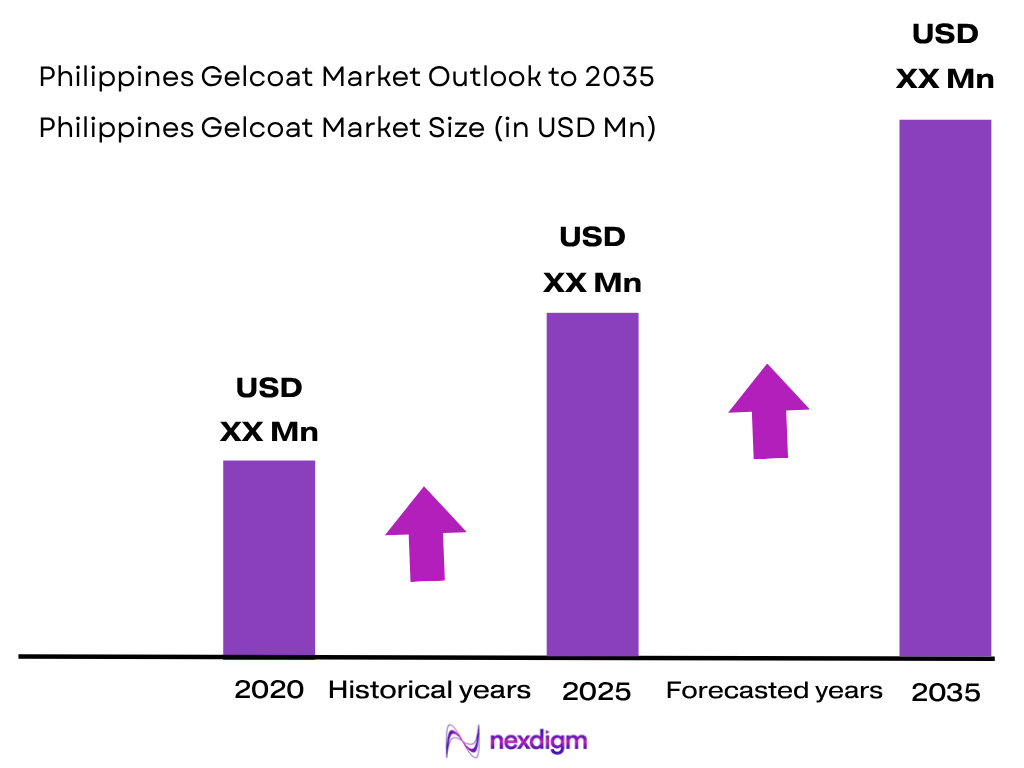
The Philippines Gelcoat Market is estimated at approximately US$~XX million in 2024, with the 2026–2035 CAGR projected at ~X.X%. Demand is closely linked to fiberglass-reinforced plastic (FRP) manufacturing, particularly marine applications, construction components, sanitaryware, transportation and industrial composites. The country’s broader industrial base supports consumption: Philippine GDP expanded by 5.7% in 2024, while construction activity recorded PhP563.89 billion in approved construction value, compared with PhP515.30 billion in 2023. (Philippine Statistics Authority)
The Philippines Gelcoat Market is concentrated around CALABARZON, Central Luzon, Metro Manila and Central Visayas, where composite fabrication, shipbuilding, construction and industrial manufacturing activities are clustered. CALABARZON generated PhP3.27 trillion in GRDP in 2024, with manufacturing representing PhP1.14 trillion, while Laguna, Cavite and Batangas were the country’s leading provincial contributors to industrial GVA. Central Visayas generated PhP1.28 trillion and recorded 6.6% manufacturing growth. The country’s maritime ecosystem further strengthens Cebu’s importance, with Balamban positioned as a major shipbuilding center.
Market Segmentation
By Resin Type
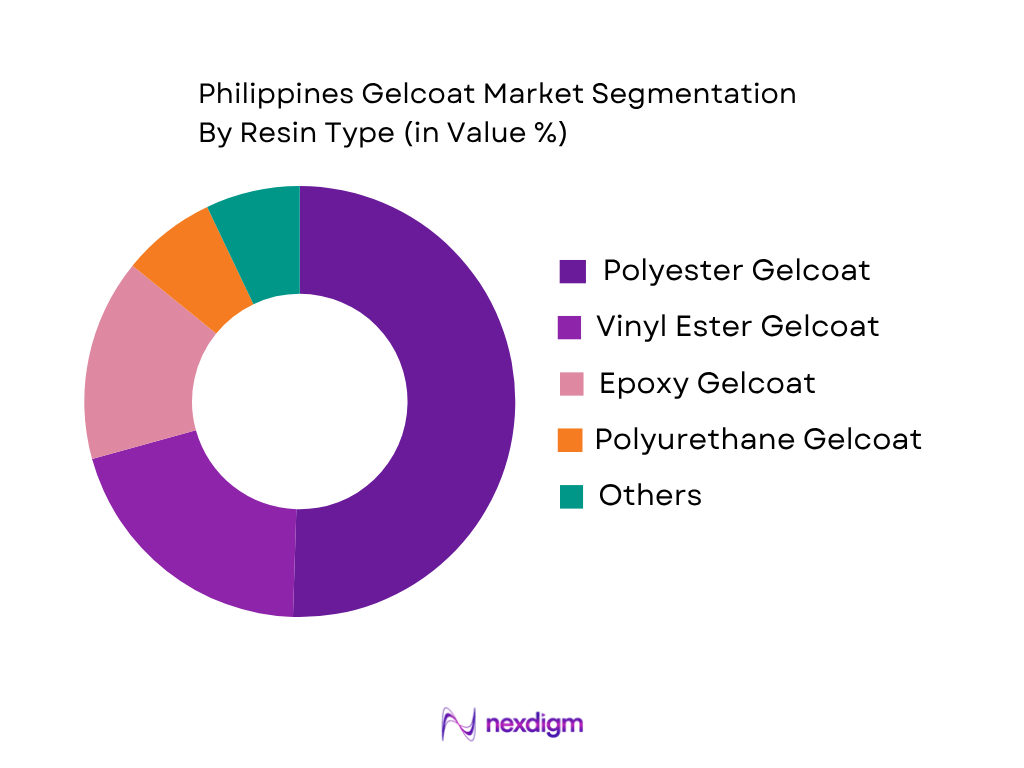
The Philippines Gelcoat Market is segmented by resin type into polyester gelcoat, vinyl ester gelcoat, epoxy gelcoat, polyurethane gelcoat and hybrid/specialty gelcoat. Polyester gelcoat is expected to represent the dominant segment, supported by its established use in fiberglass-reinforced plastic manufacturing, boatbuilding, construction components and general-purpose composite applications. Polyester formulations provide a practical combination of surface finish, weather resistance, process compatibility and suitability for hand lay-up and spray-up production. Their compatibility with conventional unsaturated polyester laminating resins also simplifies procurement and fabrication for smaller composite manufacturers. Marine manufacturing remains particularly important because gelcoat serves as the exposed protective and aesthetic layer over FRP laminates. Scott Bader identifies marine, construction and other composite markets for its gelcoat portfolio, while Polynt describes polyester and vinyl ester gelcoats as essential protective interfaces for high-performance composites.
By End-Use Industry
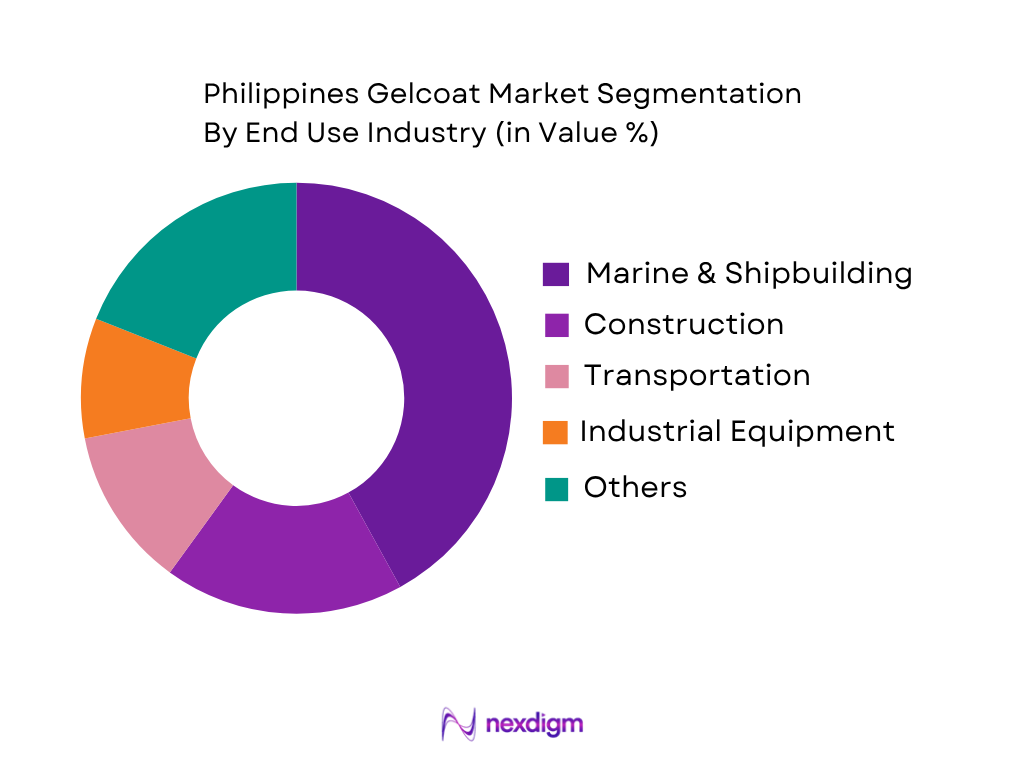
The Philippines Gelcoat Market is segmented by end-use industry into marine and shipbuilding, construction, transportation, industrial equipment, aerospace, renewable energy, electrical and electronics, and sanitaryware/recreational products. Marine and shipbuilding is expected to remain the dominant end-use segment because gelcoat is extensively used on fiberglass boat hulls, decks, superstructures, recreational craft and repair applications. MARINA reported that almost 80 shipyards participated in the country’s 2024 National Shipyards Convention, while government policy continues to prioritize modernization and expansion of shipbuilding and ship repair. The Philippines constructed 484 vessels in 2024, covering fishing boats, passenger vessels and cargo ships. These activities create recurring demand for marine-grade gelcoats with UV resistance, water resistance, gloss retention, colour stability and resistance to blistering and environmental exposure.
Competitive Landscape
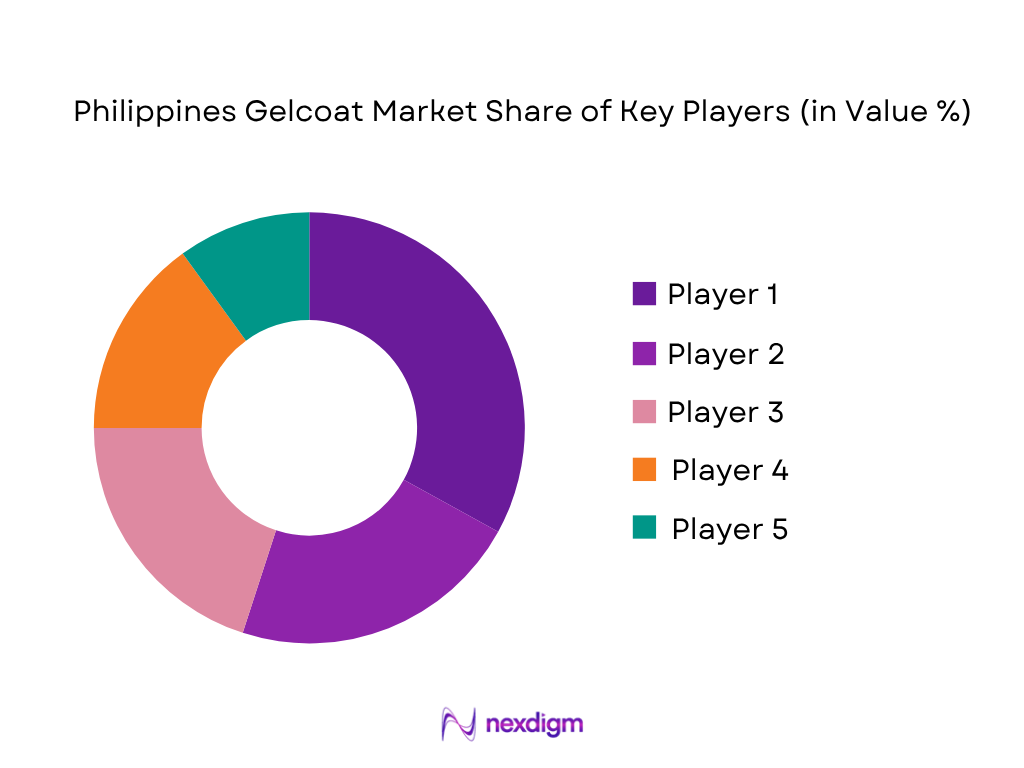
The Philippines Gelcoat Market has a largely international supplier base, with global composite-material manufacturers competing through resin chemistry, marine-grade formulations, tooling systems, application support and distribution relationships. The competitive environment is influenced by the country’s import-oriented supply structure and the need for local technical support. Scott Bader, for example, identifies Behn Meyer Chemicals (Philippines) Inc. as its Philippine composites distributor, while its Asia-Pacific operation covers the Philippines alongside other regional markets. Global suppliers including Polynt, Interplastic, BÜFA and Gurit compete across specialized composite applications, while distributors and composite-material dealers provide market access to shipyards, boatbuilders and smaller fabricators.
| Company | Established | Headquarters | Gelcoat Portfolio | Key Resin Chemistry | Marine Capability | Tooling Capability | Application Coverage |
| Scott Bader | 1921 | Wollaston, UK | ~ | ~ | ~ | ~ | ~ |
| Polynt | 1955* | Scanzorosciate, Italy | ~ | ~ | ~ | ~ | ~ |
| Interplastic Corporation | 1959 | St. Paul, Minnesota, USA | ~ | ~ | ~ | ~ | ~ |
| BÜFA Composites | 1883 | Oldenburg, Germany | ~ | ~ | ~ | ~ | ~ |
| Gurit | 1835** | Wattwil, Switzerland | ~ | ~ | ~ | ~ | ~ |
Philippines Gelcoat Market Analysis
Growth Drivers
Expansion of Marine and Shipbuilding Activity
The expansion of Philippine shipbuilding activity is a direct demand catalyst for gelcoat because marine manufacturers use gelcoat as the protective and aesthetic surface layer on fiberglass-reinforced plastic boats, marine components and composite structures. The Presidential Communications Office reported that the Philippines constructed 484 vessels in 2024, covering fishing boats, passenger ships and cargo ships. The country also had more than 130 registered shipyards as of November 2025, with more than 11,000 workers, including approximately 7,700 skilled professionals such as welders and fitters. The concentration of shipbuilding activity in Cebu, particularly Balamban, strengthens demand for composite materials, coatings and surface-finishing products around shipyard production ecosystems. Marine manufacturing also benefits from the Philippines’ substantial water-based trade infrastructure: Philippine Statistics Authority data recorded PHP 1.31 trillion in commodity flows transported by water in 2024, compared with PHP 1.07 trillion in 2023. This combination of vessel construction, established shipyard capacity and extensive maritime logistics supports recurring requirements for gelcoat in new-build vessels, component fabrication, repair, refurbishment and surface protection applications.
Construction and Infrastructure Applications
Construction activity provides another important demand base for Philippines Gelcoat Market applications because fiberglass-reinforced plastic products are used in architectural, sanitary, recreational and infrastructure-related components where moisture resistance, surface durability and corrosion protection are required. Philippine Statistics Authority data show that the country recorded 180,341 approved construction projects in 2024, compared with 171,268 in 2023. The associated construction value reached PHP 563.89 billion, up from PHP 515.30 billion, while approved construction floor area reached 42.84 million square meters, compared with 41.47 million square meters previously. Construction itself was among the country’s fastest-growing major industries, recording 10.2 growth in 2024 in the revised national accounts. The non-residential segment was particularly relevant for commercial and industrial composite applications, with construction value reaching PHP 250.86 billion. Such activity supports demand for FRP panels, tanks, sanitaryware, molded architectural components and other composite products requiring durable surface finishes. Consequently, continued building activity creates a broader downstream manufacturing base for gelcoat suppliers serving construction-oriented composite fabricators.
Market Challenges
Dependence on Imported Gelcoat and Resin Systems
Dependence on imported specialty chemicals and resin systems remains a structural challenge for the Philippines Gelcoat Market because domestic composite manufacturers require consistent access to polyester, vinyl ester, epoxy systems, pigments, additives and finished gelcoat formulations. The challenge is amplified by the country’s reliance on maritime logistics for international merchandise movement. Philippine Statistics Authority data recorded PHP 1.31 trillion in commodity flows transported by water during 2024, demonstrating the importance of seaborne logistics to national trade. Manufacturing conditions also require close monitoring because the annual average Value of Production Index for Philippine manufacturing increased only 0.2 in 2024, while the Volume of Production Index increased 0.9. These figures indicate relatively modest manufacturing expansion compared with stronger growth in construction and selected service industries. For gelcoat processors and distributors, imported raw-material exposure can therefore create procurement vulnerability when international shipping conditions, supplier availability or customs processes change. Smaller composite manufacturers may face additional difficulties maintaining multiple qualified suppliers because gelcoat formulations require controlled resin chemistry, pigments, fillers and curing characteristics. The resulting supply-chain sensitivity can affect production continuity and increase the importance of local inventory planning.
Environmental, Compliance and Skilled-Application Constraints
Environmental requirements and the availability of technically trained composite workers can constrain the Philippines Gelcoat Market, particularly as manufacturers transition toward lower-emission formulations and more controlled application practices. Gelcoat application requires appropriate surface preparation, mixing, curing and spraying techniques, while improper processing can result in defects such as pinholes, porosity, poor adhesion and uneven surface finish. The Philippines had more than 130 registered shipyards and more than 11,000 shipyard workers as of November 2025, according to the Presidential Communications Office, but only around 70 of those workers were identified as skilled professionals, including welders and fitters. This highlights the importance of maintaining technical capability across the wider composite-processing ecosystem. At the same time, Philippine manufacturing recorded 0.9 growth in its annual average Volume of Production Index in 2024, indicating a relatively measured production environment. Gelcoat suppliers and fabricators therefore need stronger process controls, worker training and material-handling practices rather than relying solely on volume expansion. Environmental management is particularly relevant for formulations containing styrene and other volatile components, increasing the importance of ventilation, workplace controls, responsible chemical handling and compliance with applicable Philippine environmental and occupational requirements.
Market Opportunities
Low-Styrene and Low-Emission Gelcoats
The transition toward lower-styrene and lower-emission gelcoat systems presents an opportunity as Philippine composite manufacturers increasingly need materials compatible with tighter environmental controls while maintaining surface quality and processing performance. The opportunity is particularly relevant to shipyards and FRP manufacturers because marine production represents a sizeable industrial application base. The Presidential Communications Office reported 484 vessels constructed in the Philippines in 2024, while the country had more than 130 registered shipyards as of November 2025. The same government source identified more than 11,000 shipyard workers, demonstrating the scale of the industrial ecosystem in which improved coating technologies can be introduced. Environmental performance is also becoming increasingly relevant to international shipbuilding supply chains, particularly where Philippine manufacturers serve export-oriented customers that operate under environmental specifications. Low-styrene formulations can support improved workplace conditions and help manufacturers align composite-processing operations with increasingly stringent environmental expectations. The opportunity extends beyond shipbuilding into construction, transportation and industrial FRP fabrication. Philippine construction activity reached 180,341 approved projects and PHP 563.89 billion in construction value in 2024, creating a broad downstream base for composite components. Suppliers capable of combining low-emission characteristics with reliable curing, adhesion, pigmentation and weather resistance can therefore address both regulatory and performance requirements.
Composite Repair, Refurbishment and Regional Distribution Opportunities
Composite repair and refurbishment provide an attractive avenue for gelcoat suppliers because the Philippine economy combines extensive maritime activity with geographically distributed industrial and construction demand. The country constructed 484 vessels in 2024, while more than 130 shipyards were registered nationwide as of November 2025. This installed vessel and shipyard base creates recurring requirements for surface restoration, damage repair, cosmetic refurbishment and protective recoating rather than demand being limited to new vessel construction. Maritime logistics further reinforce the opportunity: waterborne commodity flows reached PHP 1.31 trillion in 2024, demonstrating the scale of economic activity connected to marine transport. Regional distribution can help suppliers serve composite fabricators outside the largest manufacturing centers while reducing lead-time exposure for repair businesses that often require materials quickly. Construction provides another demand pool, with 180,341 approved construction projects and 42.84 million square meters of approved construction floor area recorded in 2024. These conditions support potential demand for gelcoat in FRP tanks, panels, sanitaryware, recreational products and infrastructure components requiring maintenance or replacement. Suppliers offering technical support, colour matching, repair-grade formulations and dependable regional inventory can therefore build stronger relationships with shipyards, boatbuilders, repair contractors and independent composite fabricators.
Future Outlook
The Philippines Gelcoat Market is expected to benefit from continued development of shipbuilding, boatbuilding, construction, industrial composites and advanced FRP applications. The country’s maritime development strategy places modernization and expansion of shipbuilding and ship repair among its core priorities. The strongest opportunities are expected to emerge around marine-grade gelcoats, low-emission formulations, fire-retardant surface systems, tooling gelcoats and higher-performance vinyl ester products. Growing composite utilization can also expand demand for gelcoats capable of delivering UV stability, chemical resistance, moisture resistance, abrasion resistance and improved surface quality.
Major Players
- Scott Bader Company Limited
- Polynt Group
- Interplastic Corporation
- BÜFA Composites
- Gurit
- INEOS Composites / ALTA Performance Materials
- AOC
- Allnex
- Mäder Group
- Sika AG
- Ashland
- Reichhold
- Baron Industrial
- Behn Meyer Chemicals (Philippines) Inc.
- SEA Olympus Marketing, Inc.
Key Target Audience
- Composite Resin and Gelcoat Manufacturers
- Shipyards and Shipbuilding Companies
- Fiberglass Boatbuilders and Marine Fabricators
- Industrial FRP Component Manufacturers
- Construction and Architectural Composite Manufacturers
- Investments and Venture Capitalist Firms (Private Equity Funds, Venture Capital Funds, Infrastructure Investors)
- Government and Regulatory Bodies (Maritime Industry Authority, Department of Trade and Industry, Board of Investments, Department of Environment and Natural Resources)
- Chemical and Composite Material Distributors
Research Methodology
Step 1: Identification of Key Variables
The initial stage establishes the Philippines Gelcoat Market ecosystem covering resin manufacturers, gelcoat suppliers, distributors, composite fabricators, shipyards and end-use industries. Key variables include resin chemistry, product grade, application method, composite process, consumption volume, import dependence, end-use demand and regional concentration.
Step 2: Market Analysis and Construction
Historical market information is compiled using industry data, trade statistics, manufacturing indicators, construction activity and maritime-sector information. The bottom-up model evaluates gelcoat consumption across marine, construction, transportation, industrial, sanitaryware and other composite applications, while supplier-side analysis assesses product availability and distribution structures.
Step 3: Hypothesis Validation and Expert Consultation
Market hypotheses are validated through discussions with composite manufacturers, marine fabricators, distributors and industrial users. Interviews focus on product selection, resin compatibility, application techniques, consumption intensity, procurement practices, technical requirements and supplier preferences to validate the quantitative market framework.
Step 4: Research Synthesis and Final Output
The final analysis triangulates demand-side consumption, supplier-side information, trade flows and end-use activity. Market estimates are reconciled across resin types, applications and industries to establish the market size, segmentation structure, competitive landscape and long-term outlook for the Philippines Gelcoat Market.

- Executive Summary
- Research Methodology (Market Definition and Scope, Product Boundary, Market Sizing Framework, Top-Down Market Assessment, Bottom-Up Market Assessment, Demand-Side Analysis, Supply-Side Analysis, Import-Export Reconciliation, Primary Research, Distributor Interviews, Composite Fabricator Interviews, End-User Validation, Data Triangulation, Forecasting Framework, Scenario Analysis, Research Limitations)

- Definition and Scope
- Gelcoat Composition, Functional Characteristics and Role in FRP Manufacturing
- Philippines Gelcoat Industry Evolution and Development Path
Gelcoat Industry Value Chain - Philippines Gelcoat Supply Chain Architecture
- Philippines Composite Materials Ecosystem
- Philippines Marine and Shipbuilding Composite Ecosystem

- Growth Drivers (Expansion of Marine and Shipbuilding Activity, Growth of FRP Boat Manufacturing, Construction and Infrastructure Applications, Expansion of Composite Transportation Components, Growth of Industrial FRP Applications, Increasing Demand for Corrosion-Resistant Surfaces, Aerospace Composite Manufacturing, Expansion of Composite Repair and Refurbishment)
- Market Challenges (Dependence on Imported Gelcoat and Resin Systems, Polyester and Vinyl Ester Feedstock Exposure, Limited Local Formulation Capacity, Raw Material Supply Disruptions, Skilled Composite Application Requirements, Environmental and Styrene Compliance, Product Quality Variability Across Suppliers, Fragmented Distribution Structure)
- Market Opportunities (Low-Styrene and Low-Emission Gelcoats, High-Performance Marine Gelcoats, Fire-Retardant Composite Surfaces, Advanced Tooling Gelcoats, Aerospace-Grade Surface Systems, Sustainable Resin-Based Gelcoats, Local Formulation and Colour-Matching Services, Composite Repair Applications, Regional Distribution and Export Opportunities)
- Market Trends (Low-Emission Formulations, Sustainable Composite Materials, Premium Marine Finishes, Spray Application Adoption, Lightweight FRP Structures, Advanced Marine Composites, Higher UV Resistance, Fire-Retardant Surface Systems, Specialty Gelcoat Formulations)
- SWOT Analysis
- Porter’s Five Forces Analysis
- PESTLE Analysis

- By Market Value (2020-2025)
- By Consumption Volume (2020-2025)
- By Domestic Supply Volume (2020-2025)
- By Imported Gelcoat Volume (2020-2025)
- By Resin Consumption (2020-2025)

- By Resin Type (In Value %)
Polyester Gelcoat
Vinyl Ester Gelcoat
Epoxy Gelcoat
Polyurethane Gelcoat
Hybrid and Specialty Resin Gelcoat - By Product Type (In Value %)
Standard Gelcoat
Marine Gelcoat
Tooling Gelcoat
Fire-Retardant Gelcoat
UV-Resistant Gelcoat
Chemical-Resistant Gelcoat
Low-Styrene Gelcoat
High-Performance Gelcoat - By Application Method (In Value %)
Hand Application
Brush Application
Roller Application
Spray Application
In-Mould Application - By End-Use Industry (In Value %)
Marine and Shipbuilding
Construction
Transportation
Aerospace
Industrial Equipment
Oil & Gas and Offshore
Electrical and Electronics
Renewable Energy
Sanitaryware and Recreational Products - By Application (In Value %)
Boat Hulls and Decks
Passenger and Fishing Boats
Yachts and Recreational Boats
Ship Repair and Refurbishment
Offshore Composite Components
Architectural and Construction Components
Automotive and Transportation Components
Aerospace Composite Components
Industrial Tanks, Pipes and Equipment - By Composite Manufacturing Process (In Value %)
Hand Lay-Up
Spray-Up
Vacuum Infusion
Resin Transfer Molding
Light Resin Transfer Molding
Compression Molding
Filament Winding
Other Composite Processes

- Market Share Analysis of Major Players (By Resin Type, Product Type, Application Method, End-Use Industry, Application, Domestic Supply, Imported Supply)
- Cross Comparison Parameters (Gelcoat Product Portfolio Breadth, Polyester and Vinyl Ester Formulation Capability, Marine-Grade Product Coverage, Low-Styrene Product Availability, Fire-Retardant Gelcoat Capability, Technical Application Support, Colour Customization Capability, Philippines and Southeast Asia Distribution Reach)
- SWOT Analysis of Major Players
- Detailed Profiles of Major Companies
Scott Bader Company Limited
Polynt Group
AOC
Interplastic Corporation
BÜFA Composite Systems
Allnex
Gurit
Mäder Group
Ashland|
Sika AG
INEOS Composites
Benquin Triple 8 Chemicals, Inc.
SEA Olympus Marketing, Inc. / Polyklear Fiberglass + Resin
BFG Philippines
Stoneworks Specialist International Corporation

- End-User Consumption Behavior
- Customer Segmentation by End-Use
- Geographic Consumption Concentration
- Purchase Decision Factors
- Emerging Customer Requirements

- By Market Value (2026-2035)
- By Consumption Volume (2026-2035)
- By Domestic Supply Volume (2026-2035)
- By Imported Gelcoat Volume (2026-2035)
- By Resin Consumption (2026-2035)


 Request a Sample
 Ask for Customization
 Get a Quote
 Enquire Now