
 Download PDF
Market Overview
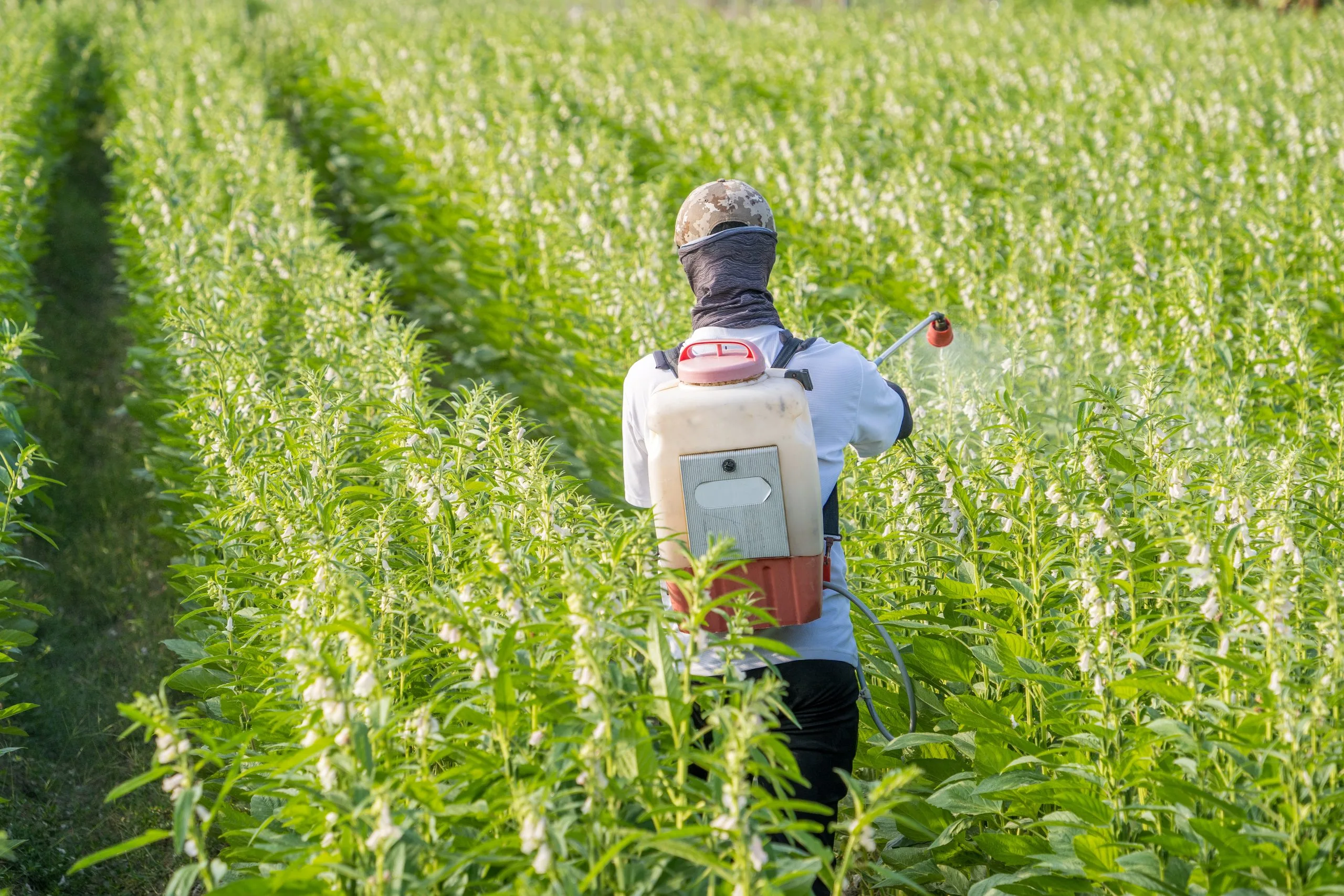
The Philippines Glyphosate Market is supported by increasing herbicide utilization across rice, corn, banana, sugarcane, and coconut cultivation due to rising labor shortages and growing farm mechanization. The market is valued at approximately USD ~ million, supported by more than 13 million hectares of agricultural land according to the Philippine Statistics Authority. Plantation agriculture and export-oriented farming activities continue to strengthen glyphosate demand, particularly in weed management operations. Increasing imports of technical-grade herbicides and formulation products through major ports further support nationwide agrochemical availability across commercial farms and plantation-based agricultural regions.
Mindanao dominates the Philippines Glyphosate Market because of extensive banana, pineapple, oil palm, and rubber plantation operations requiring continuous weed management practices. Davao, Bukidnon, and South Cotabato remain major herbicide consumption centers due to high plantation density and export-oriented crop cultivation. Luzon also represents a strong demand region because of large rice and corn production zones across Central Luzon and Cagayan Valley. Manila and Cebu function as critical agrochemical logistics and import distribution hubs due to strong port infrastructure, importer concentration, and nationwide dealer network connectivity supporting herbicide distribution throughout the Philippines.
Market Segmentation
By Formulation Type
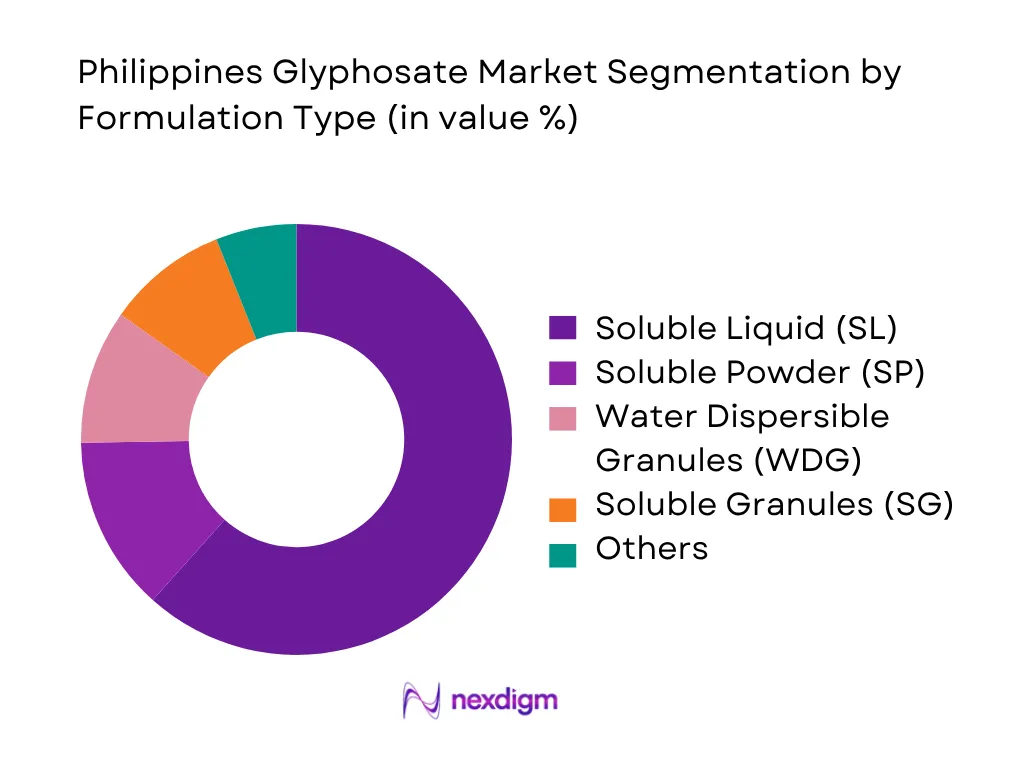
The Philippines Glyphosate Market is segmented by formulation type into soluble liquid (SL), soluble powder (SP), water dispersible granules (WDG), soluble granules (SG), and ready-to-use formulations. Soluble liquid formulations dominate the Philippines Glyphosate Market because of their easy dilution, strong compatibility with mechanized spraying systems, and broader application across rice fields, banana plantations, and sugarcane farms. Commercial plantations prefer soluble liquid glyphosate products because they provide faster weed absorption and operational efficiency across large cultivation areas. Agrochemical distributors also prioritize soluble liquid formulations due to easier transportation, stronger dealer familiarity, and consistent farmer demand across agricultural regions. Increasing imports of liquid glyphosate formulations further strengthen the dominance of this segment in the Philippines market.
By Crop Type
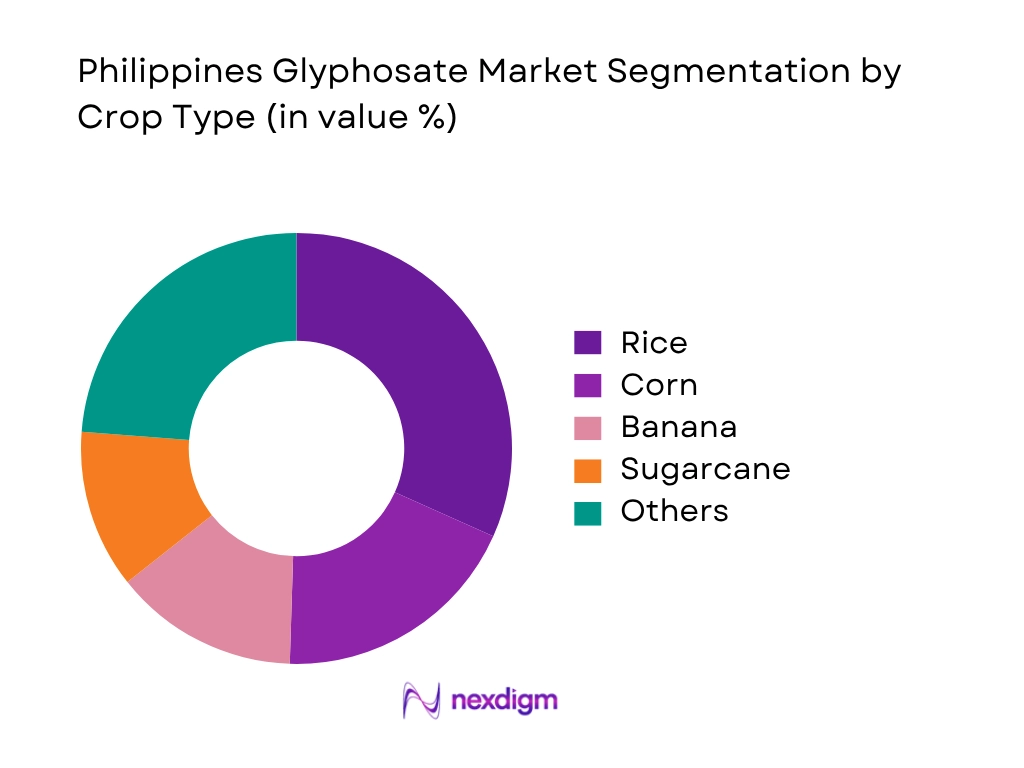
The Philippines Glyphosate Market is segmented by crop type into rice, corn, banana, sugarcane, coconut, pineapple, oil palm, rubber plantation, and vegetables & horticulture. Rice cultivation dominates the Philippines Glyphosate Market because rice remains the country’s largest cultivated crop supported by extensive farming activities in Central Luzon, Western Visayas, and Cagayan Valley. Farmers increasingly depend on glyphosate-based weed management due to labor shortages, rising farm wages, and increasing mechanization adoption. Government support for improving rice productivity and double-cropping activities further increases herbicide utilization intensity across cultivation cycles. Agrochemical retailers also prioritize rice-producing provinces because of recurring seasonal demand and stronger purchase frequency among farming cooperatives and commercial agricultural operators.
Competitive Landscape
The Philippines Glyphosate Market is moderately consolidated with multinational agrochemical manufacturers and regional distributors competing through extensive dealer networks, formulation innovation, plantation partnerships, and crop-specific weed management solutions. Market participants continue focusing on high-concentration formulations, packaging diversification, and agronomy support services to strengthen their regional presence. The market also witnesses increasing competition from imported generic glyphosate products due to strong demand from price-sensitive farming communities and plantation operators.
| Company | Establishment Year | Headquarters | Product Portfolio | Distribution Strength | Plantation Presence | Formulation Capability | Import Dependency | Crop Focus |
| Bayer CropScience Philippines | 1863 | Germany | ~ | ~ | ~ | ~ | ~ | ~ |
| Syngenta Philippines | 2000 | Switzerland | ~ | ~ | ~ | ~ | ~ | ~ |
| Corteva Agriscience | 2019 | United States | ~ | ~ | ~ | ~ | ~ | ~ |
| UPL Philippines | 1969 | India | ~ | ~ | ~ | ~ | ~ | ~ |
| ADAMA Agricultural Solutions | 1945 | Israel | ~ | ~ | ~ | ~ | ~ | ~ |
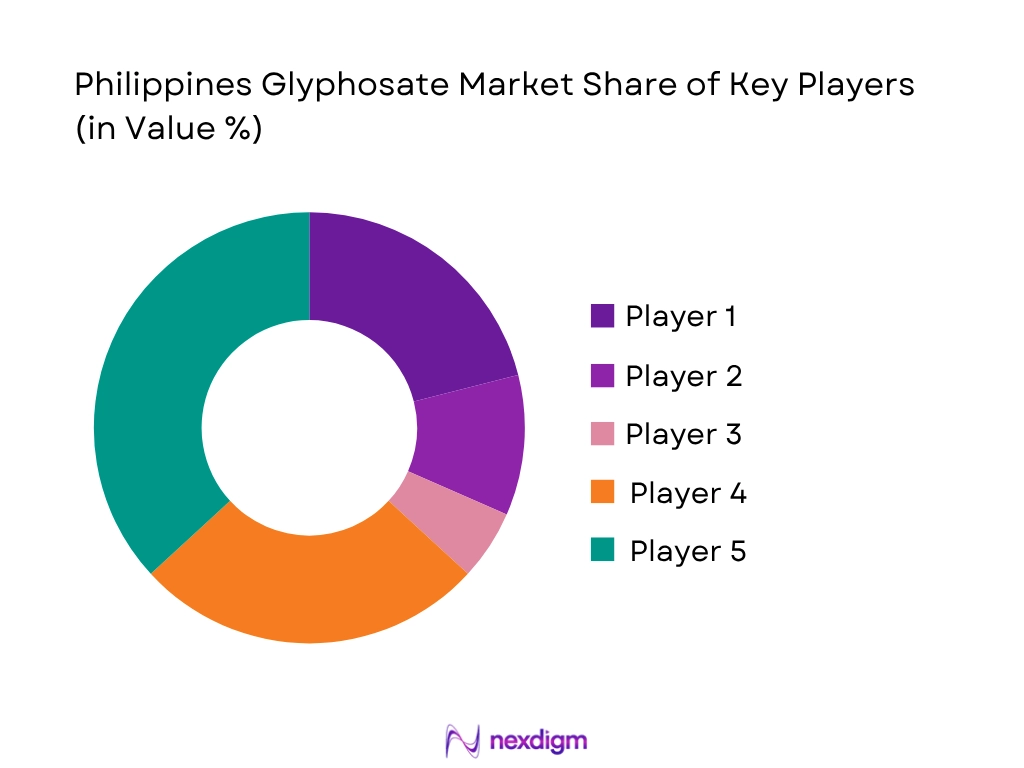
Philippines Glyphosate Market Analysis
Growth Drivers
Expansion of Commercial Agriculture and Plantation Farming
The expansion of commercial agriculture in the Philippines continues to drive glyphosate demand, particularly across rice, banana, pineapple, coconut, and corn cultivation. The Philippine Statistics Authority reported agricultural land exceeding 13 million hectares, while plantation farming activities remain concentrated in Mindanao. Export-oriented banana and pineapple cultivation continues expanding due to international trade demand, increasing herbicide application intensity across plantation zones. Agricultural employment remained above 22% of total employment according to the World Bank, highlighting the importance of large-scale agricultural operations. Increasing cultivation intensity and weed management requirements continue strengthening glyphosate utilization among plantation operators and commercial farming enterprises across major agricultural provinces.
Rising Farm Labor Shortages and Increasing Mechanization
Labor shortages in Philippine agriculture are accelerating herbicide adoption and mechanized weed management practices. Agricultural employment declined gradually as rural workers shifted toward industrial and urban service sectors, increasing dependence on chemical weed control systems. The World Bank reported continued economic expansion with GDP exceeding USD 460 billion, supporting investments in mechanized agriculture and farm modernization. Rice and corn farmers increasingly utilize mechanized spraying systems and tractor-assisted cultivation methods requiring glyphosate-compatible herbicides. Plantation operators across Mindanao are also integrating mechanized weed management technologies to reduce labor dependency and improve operational efficiency across large-scale agricultural plantations.
Market Challenges
Climate Vulnerability and Extreme Weather Disruptions
Climate-related disruptions remain a major challenge for the Philippines Glyphosate Market because agricultural production cycles depend heavily on stable weather conditions. The Philippines experiences frequent typhoons, flooding, and El Niño-related drought conditions that negatively impact crop cultivation and herbicide application schedules. Rice production in several agricultural regions declined due to severe weather disturbances affecting plantation accessibility and field operations. Flooding and irregular rainfall patterns increase operational uncertainty for agrochemical distributors and plantation operators. Climate volatility also disrupts inventory planning and seasonal herbicide demand forecasting, creating challenges across agricultural supply chains and weed management programs.
Dependence on Imported Technical Glyphosate and Supply Chain Risks
The Philippines Glyphosate Market remains highly dependent on imported technical-grade glyphosate and finished herbicide formulations because domestic production capacity remains limited. Agrochemical importers rely heavily on Asian suppliers for technical-grade raw materials, increasing exposure to shipping disruptions, freight volatility, and foreign exchange fluctuations. Major ports including Manila and Davao serve as critical agrochemical import hubs supporting nationwide distribution activities. Delays in shipping schedules and international logistics disruptions can significantly affect herbicide availability during peak planting seasons. Import dependency also creates inventory financing challenges for regional distributors and agrochemical retailers operating across the Philippines.
Market Opportunities
Increasing Government Focus on Agricultural Productivity and Food Security
The Philippines government continues prioritizing agricultural productivity and food security improvement programs, creating long-term opportunities for glyphosate manufacturers and distributors. Rice self-sufficiency challenges continue encouraging investments in crop productivity enhancement and weed management solutions. Government-backed mechanization initiatives and agricultural modernization programs are increasing adoption of efficient weed control systems across rice and corn farming regions. Plantation operators and farming cooperatives increasingly require herbicide-supported crop management systems to reduce operational inefficiencies and improve yield optimization. These developments continue strengthening long-term demand for glyphosate formulations across commercial farming and plantation agriculture sectors.
Expansion of Climate-Resilient and Precision Agriculture Practices
Increasing focus on climate-resilient agriculture and precision farming technologies creates substantial opportunities within the Philippines Glyphosate Market. Agricultural modernization programs continue encouraging adoption of mechanized spraying systems, GPS-assisted farm equipment, and digital crop monitoring technologies. Precision herbicide application improves operational efficiency, reduces chemical wastage, and enhances plantation weed management practices. Commercial farming enterprises and plantation operators increasingly integrate technology-driven crop protection solutions to maintain productivity under changing climate conditions. Expansion of sustainable farming practices and advanced agronomy support systems is expected to strengthen future demand for optimized glyphosate formulations across the Philippines agricultural sector.
Future Outlook
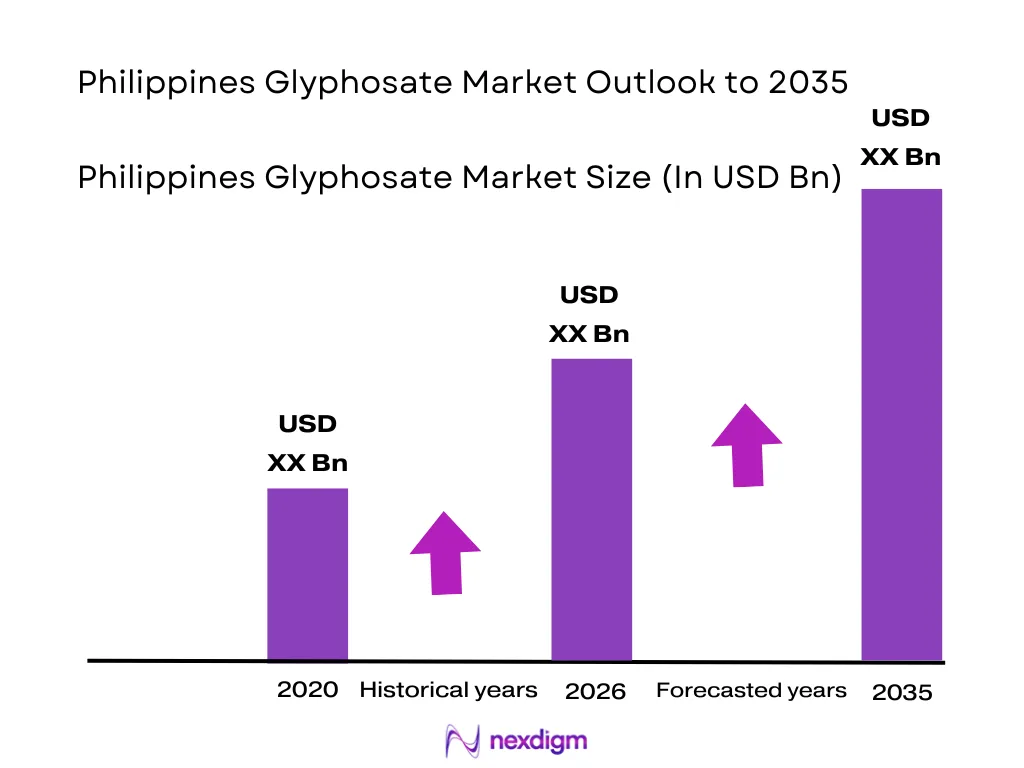
The Philippines Glyphosate Market is expected to witness sustained growth over the coming years due to increasing mechanization across rice, corn, banana, and sugarcane cultivation. Expansion of plantation agriculture and export-oriented farming activities will continue supporting herbicide demand across Mindanao and Luzon. Farmers are increasingly adopting chemical weed management solutions to reduce labor dependency and improve crop productivity. The market is also expected to benefit from precision agriculture technologies, advanced spraying systems, and growing dealer penetration across rural agricultural regions. Rising focus on food security and agricultural modernization programs is expected to strengthen long-term herbicide utilization across the Philippines farming ecosystem.
Major Players
- Bayer CropScience Philippines
- Syngenta Philippines
- Corteva Agriscience Philippines
- UPL Philippines
- ADAMA Agricultural Solutions
- Nufarm Philippines
- BASF Philippines
- FMC Philippines
- Monsanto Philippines
- Rainbow Agro
- Philchema Inc.
- Arysta LifeScience Philippines
- D&L Industries Agro Division
- East-West Seed Agrochemical Division
- Yara Philippines
Key Target Audience
- Agrochemical Manufacturers and Formulators
- Plantation Companies and Commercial Farm Operators
- Agricultural Cooperatives and Dealer Networks
- Crop Protection Chemical Importers and Distributors
- Investments and Venture Capitalist Firms
- Government and Regulatory Bodies
- Precision Agriculture and Farm Mechanization Companies
- Contract Farming and Agribusiness Companies
Research Methodology
Step 1: Identification of Key Variables
The initial phase involved identifying critical variables influencing the Philippines Glyphosate Market including crop cultivation acreage, herbicide penetration rates, technical-grade imports, plantation herbicide utilization, and dealer network expansion. Extensive secondary research was conducted using government publications, agricultural databases, trade reports, and industry disclosures to map the agrochemical ecosystem and establish market dynamics.
Step 2: Market Analysis and Construction
Historical market analysis was conducted using agricultural production statistics, herbicide consumption trends, plantation cultivation data, and agrochemical import information. Market estimations were derived using bottom-up calculations based on crop-wise herbicide utilization, distributor sales performance, plantation procurement activities, and regional agricultural demand analysis across the Philippines.
Step 3: Hypothesis Validation and Expert Consultation
Preliminary market findings were validated through interviews with agrochemical distributors, plantation managers, farming cooperatives, and agricultural input suppliers. These consultations provided operational insights regarding pricing trends, product preferences, dealer penetration strategies, weed management practices, and future demand trends across the glyphosate industry.
Step 4: Research Synthesis and Final Output
The final phase involved consolidating qualitative and quantitative findings to produce a comprehensive market assessment. Cross-validation was conducted using agricultural statistics, trade flow analysis, and industry-level intelligence to ensure consistency and reliability of market sizing, segmentation analysis, competitive benchmarking, and future growth projections for the Philippines Glyphosate Market.

- Executive Summary
- Research Methodology (Market Definitions and Assumptions, Abbreviations, Research Framework, Bottom-Up Market Estimation, Top-Down Validation, Agricultural Consumption Mapping, Agrochemical Trade Flow Assessment, Plantation Herbicide Utilization Analysis, Primary Interviews with Distributors and Plantation Operators, Forecasting Model, Limitations and Assumptions)

- Definition and Scope
- Evolution of Glyphosate Usage in Philippine Agriculture
- Industry Ecosystem and Stakeholder Mapping
- Supply Chain and Value Chain Analysis
- Import Dependency Structure
- Technical Grade Sourcing Landscape

- Growth Drivers
Expansion of Commercial Agriculture and Plantation Farming
Rising Farm Labor Shortages and Increasing Mechanization
Increasing Weed Resistance Management Requirements
Expansion of Export-Oriented Crop Cultivation
Government Support for Agricultural Productivity Improvement - Market Challenges
Climate Vulnerability and Extreme Weather Disruptions
Dependence on Imported Technical Glyphosate and Supply Chain Risks
Counterfeit Agrochemical Circulation
Regulatory Scrutiny on Herbicide Usage
Volatility in International Freight and Logistics - Market Opportunities
Increasing Government Focus on Agricultural Productivity and Food Security
Expansion of Climate-Resilient and Precision Agriculture Practices
Development of Low-Toxicity Herbicide Formulations
Growth in Plantation Weed Management Solutions
Expansion of Digital Agrochemical Distribution Platforms - Market Trends
Transition Toward High-Concentration Formulations
Growth in Mechanized Herbicide Spraying
Rising Adoption of Tank-Mix Herbicide Solutions
Expansion of Plantation-Based Herbicide Procurement
Increasing Dealer-Led Farmer Education Programs - Government Regulations
Fertilizer and Pesticide Authority Registration Standards
Environmental Compliance Requirements
Importation and Customs Procedures
Labeling and Packaging Compliance
Chemical Storage and Transportation Standards - Porter’s Five Forces Analysis
- PESTLE Analysis
- Pricing Analysis
- Competition Ecosystem

- By Value, 2020-2025
- By Volume, 2020-2025
- By Average Selling Price, 2020-2025
- By Technical Grade Imports, 2020-2025

- By Formulation Type (in Value %)
Liquid Formulation
Granular Formulation
Powder Formulation
Others - By Crop Type (in Value %)
Rice
Corn
Sugarcane
Fruits & Vegetables
Plantation Crops
Others - By Application Method (in Value %)
Foliar Spray
Broadcast Application
Spot Treatment
Pre-Plant Application
Post-Emergence Application - By End User (in Value %)
Small & Marginal Farmers
Medium-Sized Farms
Large Commercial Farms
Plantation Owners
Agribusiness Companies - By Distribution Channel (in Value %)
Agrochemical Dealers
Retail Stores
Cooperatives
Online Channels
Direct Sales - By Active Ingredient Concentration (in Value %)
Low Concentration Glyphosate
Medium Concentration Glyphosate
High Concentration Glyphosate - By Packaging Size (in Value %)
Up to 1 Liter
1–5 Liters
5–20 Liters
Above 20 Liters - By Region (in Value %)
Luzon
Visayas
Mindanao
BARMM

- Market Share Analysis of Major Players on the Basis of Revenue and Volume
- Cross Comparison Parameters(Company Overview, Glyphosate Product Portfolio, Technical Grade Sourcing Strategy, Formulation Capacity, Dealer Network Strength, Plantation Penetration, Packaging SKU Diversity, Distribution Reach, Regional Presence, Product Positioning, Inventory Management Efficiency, Regulatory Compliance Status, Import Dependency Ratio, Agronomy Support Services, Strategic Collaborations, Operational Strength)
- Competitive Benchmarking Matrix
- SWOT Analysis of Major Players
- Pricing Analysis by Formulation Type and SKU
- Detailed Profiles of Major Companies
Bayer CropScience Philippines
Syngenta Philippines
Corteva Agriscience Philippines
UPL Philippines
ADAMA Agricultural Solutions
Nufarm Philippines
BASF Philippines
FMC Philippines
Monsanto Philippines
Rainbow Agro
Philchema Inc.
Arysta LifeScience Philippines
D&L Industries Agro Division
East-West Seed Agrochemical Division
Yara Philippines

- Farmer Herbicide Consumption Analysis
- Crop-Wise Utilization Assessment
- Brand Preference and Switching Behavior
- Purchase Decision Parameters
- Dealer Recommendation Influence
- Price Sensitivity Analysis
- Plantation Procurement Behavior
- Mechanized Farming Adoption Trends

- By Value, 2026-2035
- By Volume, 2026-2035
- By Average Selling Price, 2026-2035
- By Technical Grade Imports, 2026-2035


 Request a Sample
 Ask for Customization
 Get a Quote
 Enquire Now