
 Download PDF
Market Overview
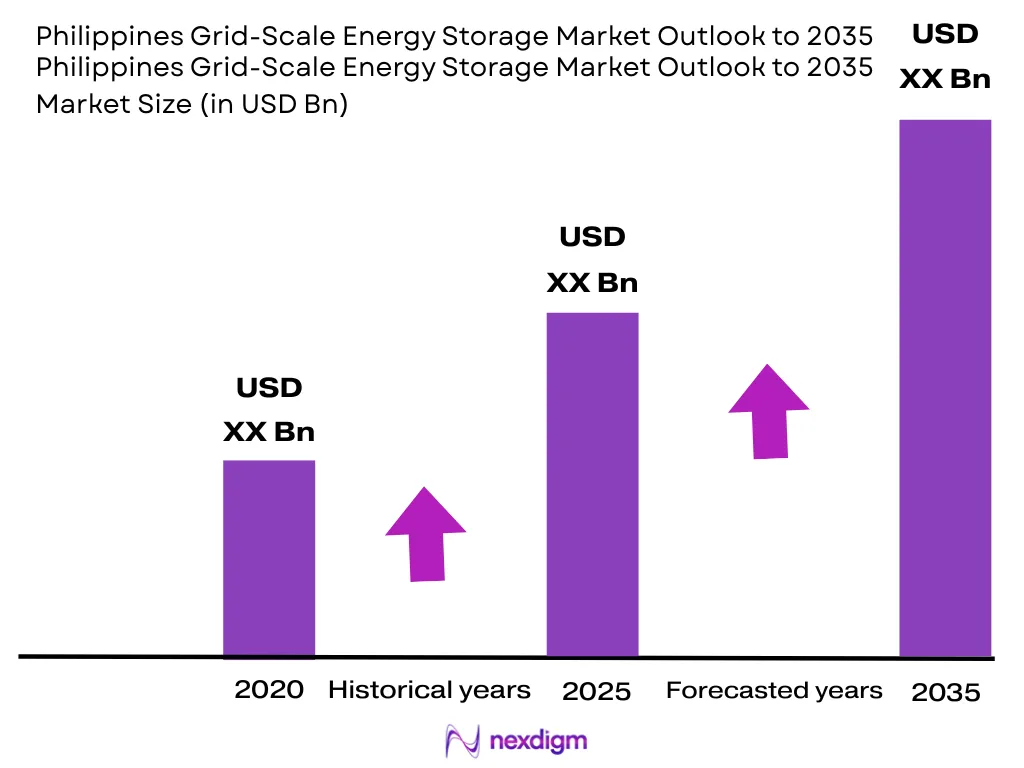
The Philippines Grid-Scale Energy Storage Market was valued at USD ~ Billion in 2024 and is anticipated to expand at a CAGR of ~% during 2026-2035. The market is primarily driven by the country’s decarbonization targets, surging renewable power installations, and rising electricity demand across Luzon, Visayas, and Mindanao. According to industry estimates, the Philippines Battery Energy Storage Systems Market is projected to grow from approximately USD 3.1 billion in 2025 to USD 9.8 billion by 2031, registering a CAGR of approximately 21.5%, with large-scale battery systems increasingly deployed for frequency regulation, peak shaving, and load balancing across the country’s power grid. Within the broader ASEAN region, grid-scale utility storage accounted for approximately 47.2% of the regional energy storage market in 2025, with the Philippines having moved further than most regional peers in turning grid flexibility needs into contracted capacity through its Wholesale Electricity Spot Market ancillary services mechanisms.
Market Segmentation
By Technology
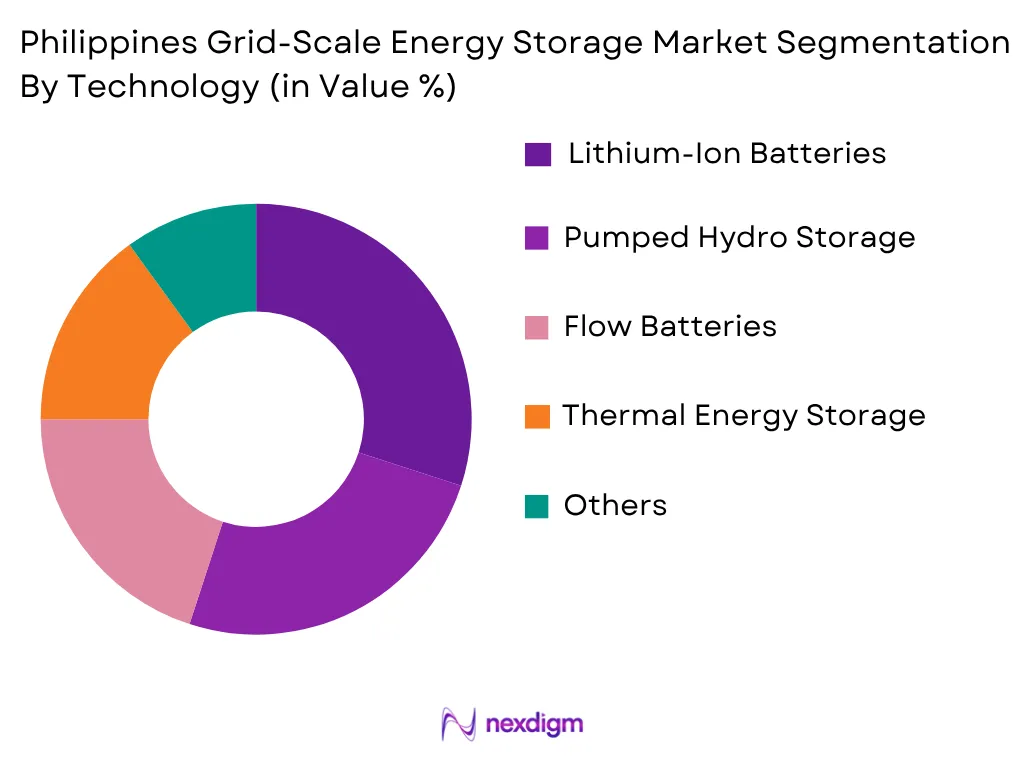
Among these, Lithium-Ion Batteries dominate the Philippines Grid-Scale Energy Storage Market, supported by widespread adoption for frequency regulation, peak shaving, and renewable energy integration applications. Tesla completed deployment of a 200 MWh grid-scale battery project in the Philippines, providing frequency regulation and peak load support to local utilities, while CATL announced plans to establish a local assembly line in the country to support growing demand from utility and industrial segments. Battery is the largest element segment within the market, with the Philippines lithium-ion battery market reaching approximately USD 1,199.21 million in 2025 and projected to grow to approximately USD 2,987.77 million by 2034 at a CAGR of approximately 10.68%. The country’s significant nickel mineral endowments continue to support long-term battery supply chain development ambitions, positioning the Philippines to potentially reduce its reliance on imported battery cells over the forecast period as domestic manufacturing capability expands, including the country’s first advanced battery manufacturing plant established in Luzon.
By Application
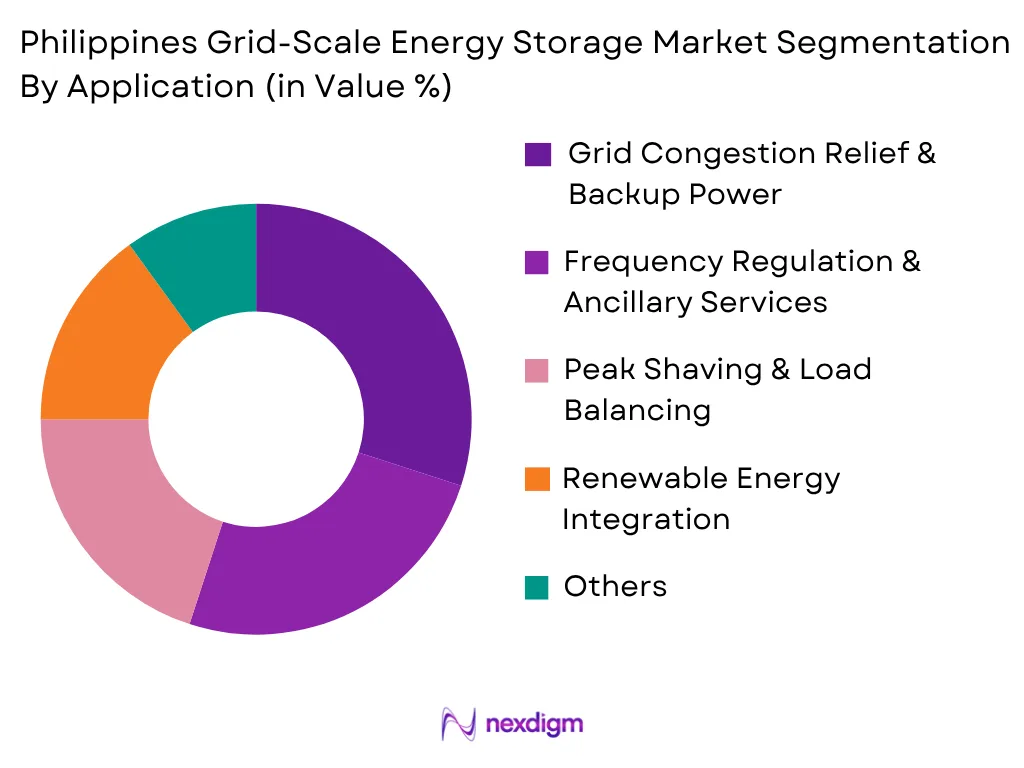
On-Grid (Grid-Tied) Systems represent the largest connection type segment within the Philippines Grid-Scale Energy Storage Market, accounting for approximately USD 0.80 billion in revenue in 2024, as growing concerns around grid congestion, blackout prevention, and carbon neutrality prompt wide-scale adoption of battery energy storage systems across utility, commercial, and residential sectors. Frequency Regulation & Ancillary Services and Peak Shaving & Load Balancing applications continue to dominate grid-scale deployments, as battery systems store electricity during low-demand periods and discharge it when needed, playing a vital role in the country’s energy transition strategy. ABB and SMC Global Power Holdings partnered to install battery energy storage systems specifically designed to enhance grid performance across the Philippines, while Fluence Energy partnered with a regional renewable developer to deliver a co-located solar-plus-storage project within the country’s industrial corridor, illustrating the growing convergence between renewable energy integration and grid-scale storage deployment across the archipelago.
Competitive Landscape
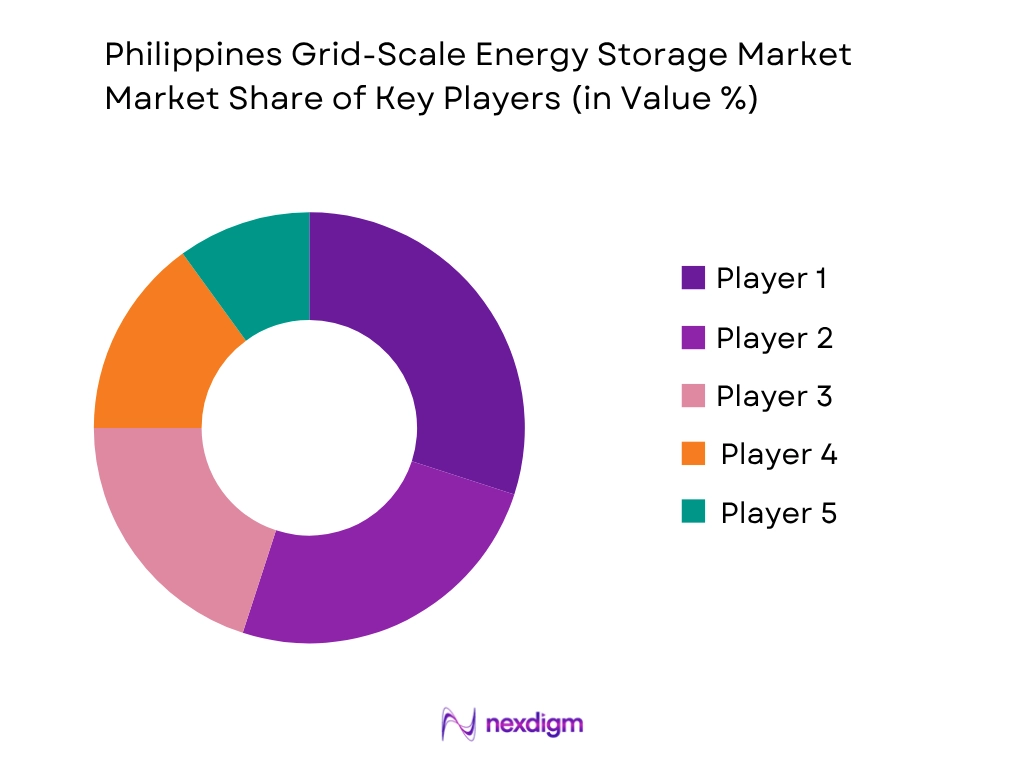
The Philippines Grid-Scale Energy Storage Market is moderately consolidated, led by large domestic power conglomerates alongside multinational technology providers delivering grid-scale battery systems and energy management platforms. Competition is primarily based on installed capacity track record, technology reliability, regulatory compliance, ancillary services market participation capability, and local partnership strength. Domestic power companies such as SMC Global Power Holdings, the power generation arm of San Miguel Corporation, and ACEN Corporation, the renewable energy platform of the Ayala Group, continue to lead large-scale battery storage deployment across the country, while Meralco PowerGen Corporation, affiliated with the country’s largest electric utility, continues to expand its grid-scale storage investments to support distribution network reliability. Multinational players including ABB, which partnered with SMC Global Power Holdings to install battery energy storage systems enhancing grid performance, alongside Tesla, Fluence Energy, LG Energy Solution, and CATL, continue to expand their presence through direct project deployment, partnerships with regional developers, and plans for local assembly capacity to serve the country’s rapidly growing utility and industrial storage demand.
| Company | Establishment Year | Headquarters | Grid-Scale BESS Portfolio | Domestic Manufacturing Portfolio
|
Manufacturing Presence | Major End-Use Industries | Key Strategic Focus | Certifications & Compliance |
| SMC Global Power Holdings Corp. | 2009 | ~ | ~ | ~ | ~ | ~ | ~ | ~ |
| ACEN Corporation | 1997 | ~ | ~ | ~ | ~ | ~ | ~ | ~ |
| Meralco PowerGen Corporation | 2009 | ~ | ~ | ~ | ~ | ~ | ~ | ~ |
| ABB Ltd. | 1988 | ~ | ~ | ~ | ~ | ~ | ~ | ~ |
| Fluence Energy, Inc. | 2018 | ~ | ~ | ~ | ~ | ~ | ~ | ~ |
Philippines Grid-Scale Energy Storage Market Analysis
Growth Drivers
Decarbonization Targets and Surging Renewable Power Installations
The Philippines Grid-Scale Energy Storage Market is experiencing sustained growth driven by the country’s decarbonization targets, surging renewable power installations, and rising electricity demand. According to industry estimates, the Philippines Battery Energy Storage Systems Market is projected to grow from approximately USD 3.1 billion in 2025 to USD 9.8 billion by 2031, registering a CAGR of approximately 21.5%, as battery energy storage systems become key enablers of grid flexibility, energy reliability, and renewable energy integration. Growing concerns around grid congestion, blackout prevention, and carbon neutrality continue to prompt wide-scale adoption of battery energy storage systems across utility, commercial, and residential sectors. Tesla’s completed deployment of a 200 MWh grid-scale battery project, providing frequency regulation and peak load support to local utilities, exemplifies the scale of investment flowing into the market as the Philippines accelerates its integration of solar and wind power generation capacity across Luzon, Visayas, and Mindanao.
Grid Congestion, Reliability Needs, and WESM Ancillary Services Market Participation
The Philippines’ structured Wholesale Electricity Spot Market ancillary services mechanisms continue to be a critical driver of grid-scale storage investment, with the country having moved further than most regional ASEAN peers in turning grid flexibility needs into contracted capacity. Grid-scale utility storage accounted for approximately 47.2% of the ASEAN energy storage market in 2025, with utilities across the region increasingly relying on storage as one of the few technologies capable of simultaneously addressing balancing, reserves, and renewable integration needs. Rising investments in smart grid infrastructure, including automated distribution networks and smart meters, continue to improve energy management and reliability, with the Philippines Grid Modernization Market valued at approximately USD 81.43 million in 2024 and projected to reach approximately USD 286.42 million by 2032, growing at a CAGR of approximately 17.02%. The adoption of solar energy and battery storage technologies in Northern Luzon is expected to further increase, driving future growth in the region’s grid modernization and storage deployment efforts.
Market Challenges
Import Dependency and Absence of Domestic Battery Cell Manufacturing
The Philippines Grid-Scale Energy Storage Market faces significant challenges from the absence of large-scale domestic battery cell manufacturing facilities, which compels the country to rely heavily on imports to satisfy domestic battery demand. This import dependency increases procurement costs, extends supply lead times, and exposes the market to global supply chain disruptions, particularly for grid-scale projects requiring large volumes of battery cells and associated power electronics. While the Philippines possesses significant nickel mineral endowments that could theoretically support long-term battery supply chain development, the country currently lacks the downstream cell manufacturing and refining capacity to convert this natural resource advantage into a fully integrated domestic battery industry. CATL’s announced plans to establish a local assembly line represent an early step toward addressing this gap, though the market remains predominantly dependent on imported lithium-ion cells and modules for the foreseeable future, creating currency exposure and logistical complexity for grid-scale project developers.
Unclear and Evolving Regulatory Frameworks Affecting Investment Decisions
Unclear rules and changing policies continue to make it harder for market participants to make investment decisions within the Philippines Grid-Scale Energy Storage Market. Regulatory frameworks governing ancillary services compensation, interconnection standards, and market participation rules continue to evolve, creating uncertainty for project developers seeking to underwrite long-term investment decisions for grid-scale battery assets. High initial investment costs for deploying energy storage systems may limit adoption, particularly for smaller independent power producers and cooperative utilities operating with constrained capital budgets. Additionally, environmental challenges related to battery disposal and recycling continue to complicate large-scale adoption, as the Philippines currently lacks comprehensive battery end-of-life management infrastructure. These regulatory and environmental uncertainties collectively make it harder for market players to plan multi-year capacity expansion, even as underlying grid reliability and renewable integration needs continue to grow across the country.
Market Opportunities
Growth in Co-Located Solar-Plus-Storage and Industrial Corridor Projects
The growing convergence between renewable energy deployment and grid-scale storage presents substantial opportunities for companies developing co-located solar-plus-storage projects across the Philippines. Fluence Energy’s partnership with a regional renewable developer to deliver a co-located solar-plus-storage project within the country’s industrial corridor illustrates the scale of opportunity available as manufacturers and industrial facilities increasingly seek reliable, renewable-backed power supply. ABB’s introduction of a new battery energy management system tailored for multi-site commercial buildings across the Philippines further reflects growing demand for integrated storage solutions serving distributed industrial and commercial customers. Companies capable of delivering integrated solar-plus-storage solutions with strong grid-services software capability are well positioned to capture growing demand from both utility-scale developers and industrial corridor customers seeking to reduce grid dependency while participating in the country’s ancillary services market.
Expansion of Domestic Battery Assembly and Manufacturing Capacity
The Philippines’ significant nickel resource endowments present substantial long-term opportunities for companies investing in domestic battery assembly and manufacturing capacity. CATL’s announced plans to establish a local assembly line to support growing demand from utility and industrial segments represent an early indicator of broader industry interest in localizing battery production within the country. The establishment of the Philippines’ first advanced battery manufacturing plant in Luzon, which leads the national lithium-ion battery market with approximately 58% share in 2025, further signals growing momentum toward domestic manufacturing capability. Companies developing local assembly, battery management system integration, and eventual cell manufacturing capacity are well positioned to capture growing demand while reducing the import dependency and extended supply lead times that currently constrain the market, particularly as government initiatives increasingly favor projects with domestic value-add and local content components.
Future Outlook
The Philippines Grid-Scale Energy Storage Market is expected to witness robust expansion over the forecast period, supported by continued decarbonization commitments, surging renewable power installations, and growing utilization of the WESM ancillary services market to monetize grid-scale battery assets. Continued investment in domestic battery assembly capacity, co-located solar-plus-storage projects, and grid modernization infrastructure is expected to further strengthen the market’s competitive landscape. Growing regulatory clarity around ancillary services compensation and interconnection standards will be critical to unlocking sustained investment and accelerating the market’s transition from early contracted capacity toward broad-based grid-scale deployment through 2035.
Major Players
- SMC Global Power Holdings Corp.
- ACEN Corporation
- Meralco PowerGen Corporation
- ABB Ltd.
- Fluence Energy, Inc.
- Tesla, Inc.
- LG Energy Solution Ltd.
- Contemporary Amperex Technology Co. Limited (CATL)
- Siemens AG
- Hitachi Energy Ltd.
- General Electric Company
- Schneider Electric SE
- Toshiba Corporation
- Samsung SDI Co., Ltd.
- BYD Company Limited
Key Target Audience
- Battery Storage Manufacturers and System Integrators
- Utilities and Grid Operators
- Independent Power Producers and Renewable Energy Developers
- Commercial & Industrial Facility Operators
- Investment and Venture Capitalist Firms
- Government and Regulatory Bodies (Department of Energy (DOE), Energy Regulatory Commission (ERC), Philippine Electricity Market Corporation (PEMC))
- Battery Cell and Critical Mineral Suppliers
- Grid Modernization and Transmission Infrastructure Providers
Research Methodology
Step 1: Identification of Key Variables
The research process begins with identifying the complete ecosystem of the Philippines Grid-Scale Energy Storage Market, including battery cell suppliers, system integrators, independent power producers, utilities, and regulatory authorities. Extensive secondary research is conducted using company annual reports, government publications, regulatory agency disclosures, industry journals, and proprietary databases to determine the variables influencing market demand, pricing, installed capacity, and technological developments.
Step 2: Market Analysis and Construction
Historical market information is collected and analyzed to estimate market size, installed capacity, application-wise demand, and pricing trends. A combination of top-down and bottom-up approaches is used to estimate market revenues and validate segment-level performance. Consumption patterns across frequency regulation, peak shaving, renewable integration, and grid congestion relief applications are evaluated to establish an accurate representation of the industry.
Step 3: Hypothesis Validation and Expert Consultation
The preliminary findings are validated through Computer-Assisted Telephone Interviews (CATIs) and structured discussions with battery system integrators, utility procurement managers, independent power producer executives, regulatory experts, and senior executives operating within the Philippines’ grid-scale energy storage industry. These interviews help verify market assumptions, competitive developments, technology adoption trends, pricing dynamics, and future investment opportunities while refining the overall market estimates.
Step 4: Research Synthesis and Final Output
The final stage integrates insights obtained from primary interviews with quantitative information collected through secondary sources. Data triangulation techniques are applied to reconcile differences between supply-side and demand-side estimates, ensuring robust market forecasting. The report is then reviewed through multiple quality assurance checkpoints to deliver a comprehensive analysis covering market size, segmentation, competitive landscape, future outlook, and strategic recommendations for industry stakeholders.

- Executive Summary
- Research Methodology (Market Definitions and Assumptions, Abbreviations, Market Sizing Approach, Top-Down Analysis, Bottom-Up Analysis, Demand-Side Assessment, Supply-Side Assessment, Primary Industry Interviews, Secondary Research Validation, Data Triangulation, Forecasting Framework, Limitations and Future Conclusions)

- Definition and Scope
- Market Evolution and Industry Genesis
- Timeline of Major Industry Developments
- Energy Storage Industry Value Chain Analysis
- Supply Chain Analysis

- Growth Drivers (Decarbonization Targets, Surging Renewable Power Installations, Rising Electricity Demand, WESM Ancillary Services Market Participation, Grid Congestion and Blackout Prevention, Government Grid Modernization Initiatives)
- Market Challenges (Absence of Domestic Battery Cell Manufacturing, Import Dependency and Extended Supply Lead Times, Unclear and Evolving Regulatory Frameworks, High Initial Investment Costs, Limited Grid Infrastructure, Battery Recycling and Disposal Challenges)
- Market Opportunities (Growth in Co-Located Solar-Plus-Storage Projects, Expansion of Domestic Battery Assembly Capacity, Nickel Resource-Backed Supply Chain Development, AI-Based Energy Management System Adoption, Rural Electrification Program Integration, Industrial Corridor Storage Deployment)
- Market Trends (Growth in Grid-Scale Frequency Regulation Deployments, Rise of AI-Based Battery Energy Management Systems, Co-Located Solar-Plus-Storage Projects, Modular and Scalable Residential Battery Design, Local Assembly Line Establishment, Hybrid Renewable-Storage Systems)
- Government Regulations (Department of Energy (DOE) Philippine Energy Plan, Energy Regulatory Commission (ERC) Requirements, Wholesale Electricity Spot Market (WESM) Ancillary Services Rules, Renewable Portfolio Standards, Green Energy Auction Program (GEAP), Grid Interconnection Standards)
- Import and Export Analysis (Trade Volume, Major Import Sources, Export Destinations, HS Code Analysis, Trade Balance)
- Raw Material Availability Analysis (Domestic Nickel Resource Endowments, Imported Lithium-Ion Cells, Battery Management System Components, Power Electronics and Inverter Supply, Recycling Feedstock Availability)
- Technology Landscape (Lithium-Ion Battery Technologies, AI-Based Battery Energy Management Systems, Grid-Forming Inverter Technologies, Pumped Hydro Storage Systems, Modular Battery Assembly Technologies)
- Sustainability Assessment (Renewable Energy Integration Support, Carbon Emissions Reduction, Domestic Nickel Value Chain Development, Battery Recycling and Second-Life Applications, Grid Efficiency Improvement)
- PESTLE Analysis
- SWOT Analysis
- Porter’s Five Forces Analysis
- Stakeholder Ecosystem
- Competition Ecosystem

- By Market Value (2020-2025)
- By Installed Capacity (2020-2025)
- By Average Cost Per MWh (2020-2025)

- By Technology (In Value %)
Lithium-Ion Batteries
Flow Batteries
Pumped Hydro Storage
Other Emerging Technologies - By Application (In Value %)
Frequency Regulation & Ancillary Services
Peak Shaving & Load Balancing
Renewable Energy Integration
Grid Congestion Relief & Backup Power - By Ownership Model (In Value %)
Utility-Owned
Independent Power Producer-Owned
Customer-Owned - By End User (In Value %)
Utilities & Grid Operators
Independent Power Producers
Commercial & Industrial Facilities
Residential - By Region (In Value %)
Luzon
Visayas
Mindanao

- Market Share of Major Players (By Value, Installed Capacity, Technology Type, Application Segment, Ownership Model)
- Cross Comparison Parameters (Storage Technology Portfolio Breadth, Local Assembly and Manufacturing Capability, Installed Capacity, Application Technical Support Capability, Regulatory Compliance & Certifications, Utility and IPP Customer Base, Innovation & New Project Launch Frequency, Grid Services Software Capability)
- SWOT Analysis of Major Players
- Pricing Analysis by System Size and Technology
- Installed Capacity Analysis
- Manufacturing Footprint Analysis
- Distribution Network Analysis
- Innovation Benchmarking
- Detailed Profiles of Major Companies
SMC Global Power Holdings Corp.
ACEN Corporation
Meralco PowerGen Corporation
ABB Ltd.
Fluence Energy, Inc.
Tesla, Inc.
LG Energy Solution Ltd.
Contemporary Amperex Technology Co. Limited (CATL)
Siemens AG
Hitachi Energy Ltd.
General Electric Company
Schneider Electric SE
Toshiba Corporation
Samsung SDI Co., Ltd.
BYD Company Limited

- Consumption Pattern Analysis (Installed Capacity, System Size Distribution, Application Category Penetration, Seasonal Demand, Dispatch and Utilization Activity)
- Purchasing Criteria (Usable Capacity, Regulatory Compliance, Cost per kWh, Round-Trip Efficiency, Reliability and Warranty, After-Sales Support)
- Procurement and Supplier Selection Analysis
- Grid-Scale Storage Adoption Assessment
- Standalone vs Co-Located Storage Demand
- Product Attribute Preference Analysis (Usable Energy Capacity, Cycle Life, Response Time, Grid-Forming Capability, Local Assembly Availability, Integration with Renewable Sources)
- Utility and IPP Grid Reliability Expectations
- Pain Point Analysis
- Decision-Making Process

- By Market Value (2026-2035)
- By Installed Capacity (2026-2035)
- By Average Cost Per MWh (2026-2035)


 Request a Sample
 Ask for Customization
 Get a Quote
 Enquire Now