
 Download PDF
Market Overview
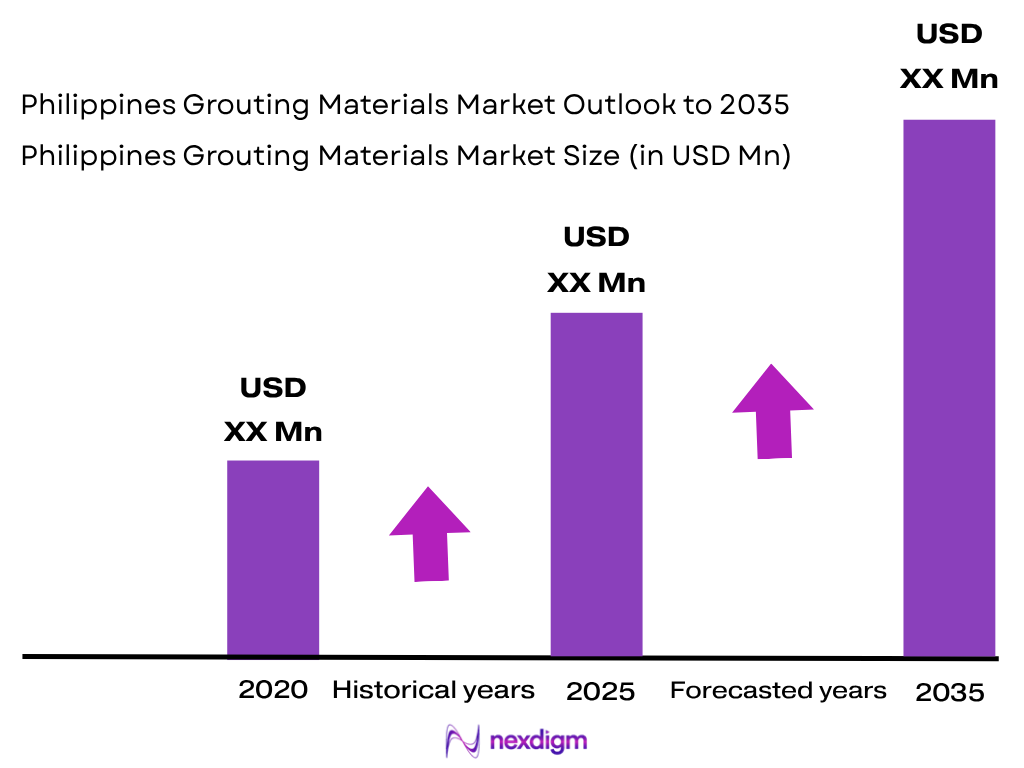
The Philippines Grouting Materials Market is valued at approximately ~USD XX million, supported by building construction, equipment foundations, precast connections and infrastructure works. Approved constructions increased from 171,268 in the preceding period to 180,341 in the latest period, while floor area expanded from 41,472,200 m² to 42,837,581 m². Alteration and repair projects also increased from 12,875 to 13,997, supporting non-shrink, injection and structural grouting demand.
Metro Manila, CALABARZON and Central Luzon are the leading Philippines Grouting Materials demand clusters because they combine high-value building construction, industrial estates and manufacturing expansion. CALABARZON recorded 41,471 constructions, Central Luzon 22,824, and NCR construction value reached ₱112.84 billion in the latest period. PEZA-approved investment simultaneously increased from ₱175.709 billion in the preceding period to ₱214.176 billion, concentrated strongly around Cavite, Laguna, Batangas and Central Luzon.
Market Segmentation
By Material Type
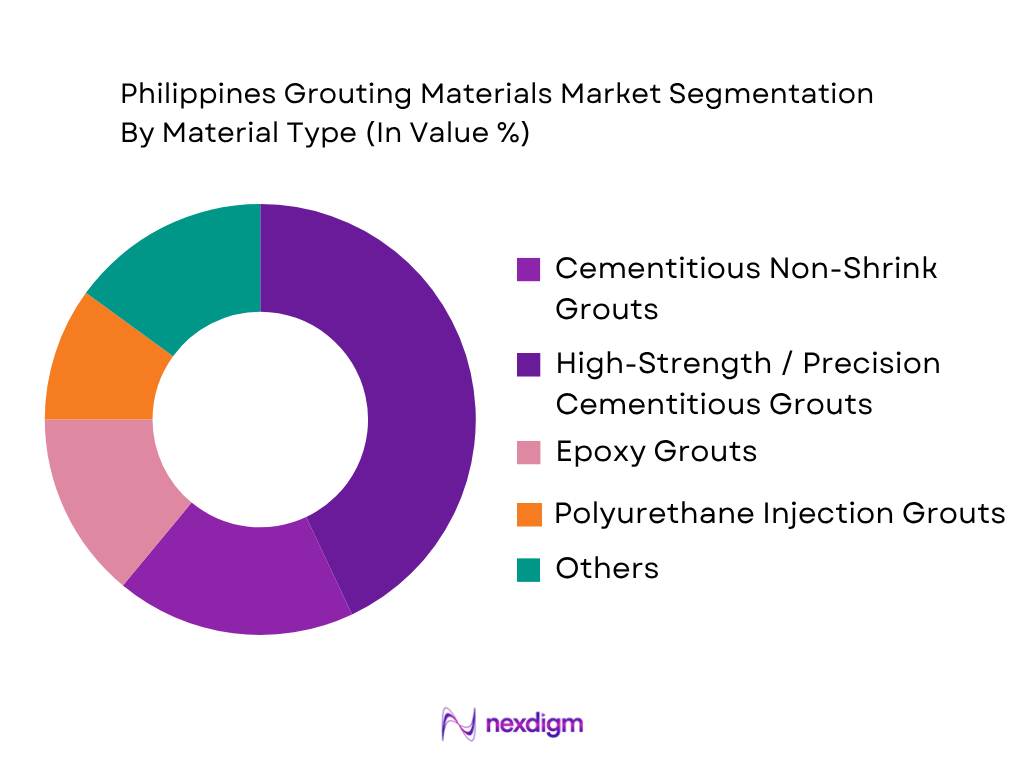
The Philippines Grouting Materials Market is segmented into cementitious non-shrink grouts, high-strength precision grouts, epoxy grouts, polyurethane injection grouts, microfine cement grouts and other specialty chemical grouts. Cementitious non-shrink grouts hold the dominant position because they address the widest range of construction and industrial applications, including machine foundations, baseplates, precast columns, anchors, bridge bearings, rail beds, cavities and structural gaps. Local product portfolios illustrate this breadth: SikaGrout-215 is a pumpable, shrinkage-compensated grout compliant with ASTM C1107 and designed for machine foundations, rail beds, precast columns and bridge bearings, while Bostik Flowfill GP is likewise an ASTM C1107-compliant multipurpose non-shrink cementitious grout. Cementitious systems also offer simpler water-based mixing and broad contractor familiarity compared with specialized resin systems. Epoxy grouts remain more relevant where dynamic loading, chemical resistance, precision alignment and low creep are required, while PU and microfine injection products address water ingress and fine fissures.
By Application
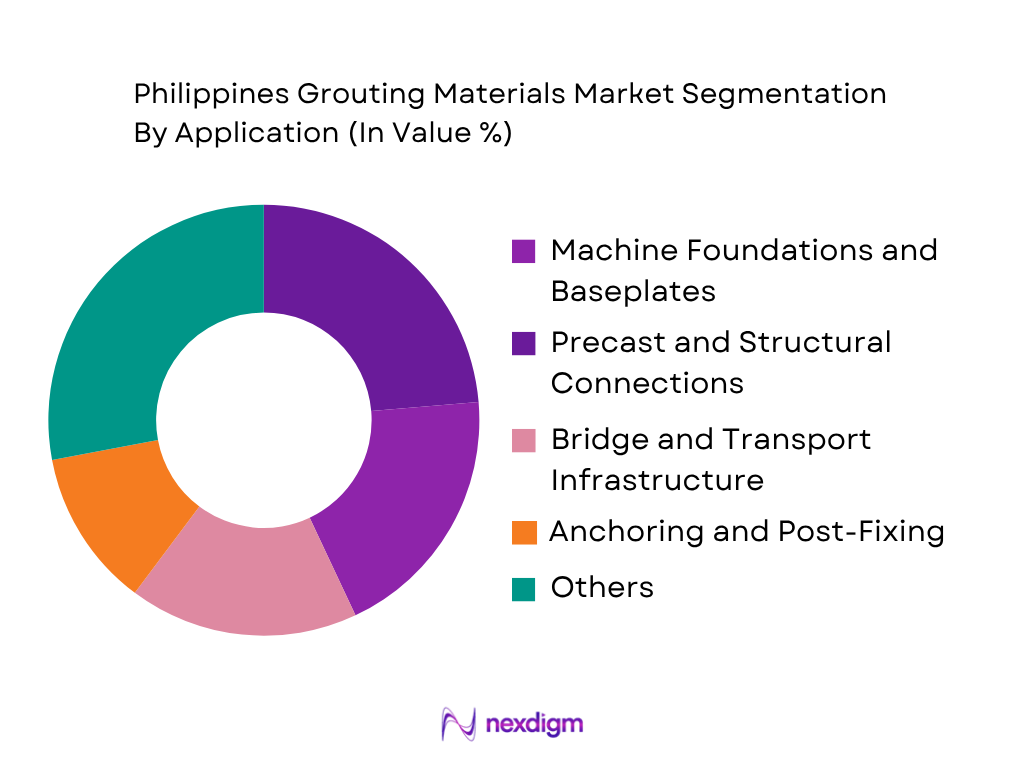
The Philippines Grouting Materials Market is segmented into machine foundations and baseplates, precast structural connections, bridge and infrastructure grouting, anchoring and post-fixing, injection and water cut-off, void filling, and geotechnical applications. Machine foundation and baseplate grouting holds the dominant position because the Philippines is simultaneously expanding manufacturing, logistics and industrial-zone capacity. PEZA approved 255 projects in its latest annual reporting period, including 122 manufacturing projects, 18 facilities-development projects, 9 logistics projects and 2 utility projects. These facilities require non-shrink and precision grout beneath equipment skids, production machinery, pumps, columns and steel baseplates. Industrial applications place premium importance on complete bearing contact, high compressive strength and dimensional stability. Infrastructure adds a second major demand pool through bridge bearings, precast components and anchors. Injection grouts occupy a technically distinct niche in underground works, basements and leakage remediation, where very low viscosity or water-reactive systems are required to penetrate cracks and control active water ingress.
Competitive Landscape
The Philippines Grouting Materials Market combines multinational construction-chemical manufacturers with locally established producers and distributors. Competition is shaped by ASTM C1107-compliant non-shrink grout capability, compressive strength, flow retention, epoxy precision grouting, injection technology, local production, distributor coverage and field technical support. Sika, Bostik and Saint-Gobain currently market dedicated non-shrink cementitious grouts in the Philippines, while LATICRETE operates a Philippine manufacturing plant and Hilti serves specialized anchoring and injectable adhesive applications.
| Major Player | Establishment Year | Headquarters | Non-Shrink Cementitious Grout | Epoxy / Precision Capability | Injection / Anchoring Capability | Infrastructure Applications | Philippines Presence | Technical Support |
| Sika | 1910 | Baar, Switzerland | ||||||
| Fosroc | 1972 | Dubai, UAE | ||||||
| MAPEI | 1937 | Milan, Italy | ||||||
| Saint-Gobain | 1665 | Courbevoie, France | ||||||
| LATICRETE | 1956 | Bethany, Connecticut, USA |
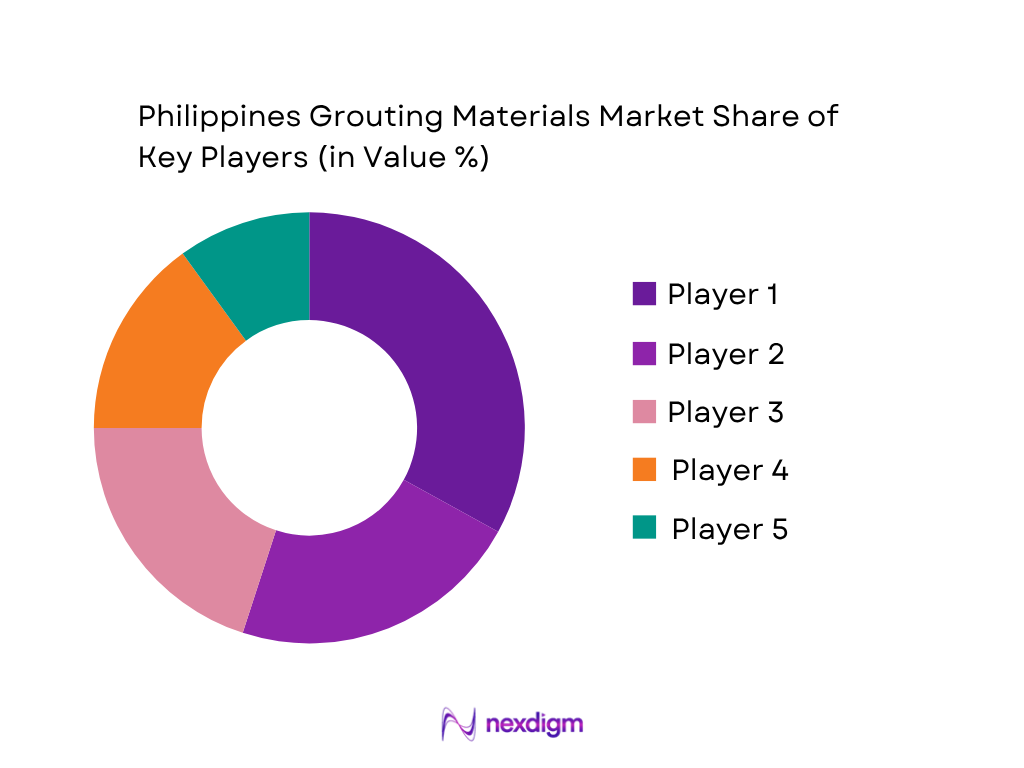
Philippines Grouting Materials Market Analysis
Growth Drivers
Construction and Infrastructure Expansion Is Increasing Structural Grouting Requirements
The Philippines Grouting Materials Market is being supported by sustained building and infrastructure activity that increases demand for non-shrink grout, bridge-bearing grout, anchoring materials and structural void-filling systems. Philippine Statistics Authority data recorded 180,341 approved constructions in 2024, covering 42,837,581 square meters of floor area and ₱563.89 billion in construction value. This included 116,427 residential buildings, 39,238 non-residential buildings and 13,997 alteration and repair projects, providing a diversified base for column-base grouting, precast connections, equipment foundations and rehabilitation applications. Transport infrastructure adds significant engineering demand. The Department of Public Works and Highways identified 509 bridges along primary roads for rehabilitation or strengthening as part of its bridge-resilience program, while the country continues to expand road, flyover and long-span bridge infrastructure. These projects require high-flow grouts capable of complete bearing-area filling and reliable load transfer. World Bank data record Philippine nominal GDP at USD461.67 billion in 2024 and GDP per capita at USD3,984.8. The combination of building activity and infrastructure rehabilitation therefore supports broader adoption of factory-formulated, shrinkage-compensated and high-strength grouting materials.
PEZA Manufacturing Expansion Is Driving Precision Baseplate and Equipment Grouting Demand
Industrial and manufacturing expansion is a particularly important growth driver for the Philippines Grouting Materials Market because factories require machine foundations, steel-column bases, production-line equipment, utility skids and precision-aligned installations. Philippine Economic Zone Authority data show 255 projects were approved in 2024, including 122 export-manufacturing projects, 18 facilities-development projects, 9 logistics projects and 2 utility projects. Approved PEZA investments reached ₱214.2 billion, while registered economic-zone enterprises generated USD58.72 billion in exports and supported 1,720,952 jobs. Industrial momentum continued in 2025, when PEZA approved 307 projects, including 146 manufacturing projects, 25 facilities projects, 13 logistics projects and 5 utilities projects, with approved investments reaching ₱237.10 billion. Every new manufacturing installation creates potential demand for high-strength non-shrink grout and, for dynamic or precision machinery, epoxy grout with low creep and high load-transfer capability. World Bank data record Philippine nominal GDP at USD461.67 billion in 2024 and GDP per capita at USD3,984.8. This industrial base supports continued movement from conventional site-mixed mortar toward engineered grouting systems.
Market Challenges
Imported Raw-Material Dependence Can Affect Specialty Grout Supply and Formulation Consistency
The Philippines Grouting Materials Market remains exposed to imported raw materials and intermediate inputs, particularly for high-performance epoxy, polyurethane, polymer-modified and specialty cementitious systems. Philippine Statistics Authority trade data show total merchandise imports reached USD127.60 billion in 2024, including USD46.47 billion of raw materials and intermediate goods and USD35.73 billion of capital goods. Imports from China alone reached USD32.83 billion, while imports from ASEAN economies totaled USD36.04 billion. The country also imported 23.83 billion kilograms of mineral products in 2024; salt, sulfur, earths, stone, plastering materials, lime and cement formed the largest component of that mineral-import stream. For grout manufacturers, this import exposure matters because epoxy resins, polyurethane components, specialty polymers, microfine binders and high-performance additives must remain chemically consistent to achieve specified flow, strength and shrinkage-control characteristics. Disruptions can complicate inventory planning and product standardization for industrial and infrastructure projects. World Bank data record Philippine nominal GDP at USD461.67 billion in 2024 and GDP per capita at USD3,984.8. Expanding local formulation and diversified sourcing are therefore important strategic requirements for suppliers.
Tropical Weather, Groundwater and Hazard Exposure Increase Grouting Execution Complexity
Application conditions represent another market-specific challenge because grouting performance depends heavily on water control, substrate preparation, mixing accuracy, formwork integrity and curing. PAGASA recorded 18 tropical cyclones entering the Philippine Area of Responsibility in 2024, beginning with Aghon and followed by another 17 systems through December. Repeated rainfall events increase the likelihood of saturated concrete, groundwater inflow, wet foundation pockets and water movement through joints or fissures, complicating cementitious and injection-grout placement. The Department of Public Works and Highways also identified 509 vulnerable bridges along primary roads for rehabilitation or strengthening, underscoring the need for grouts capable of performing under demanding infrastructure and hazard conditions. Underground infrastructure creates additional execution complexity: the Metro Manila Subway comprises a 33.103-kilometer underground alignment with 17 stations, where tunnel construction, groundwater control and structural interfaces increase requirements for controlled injection and void filling. Incorrect water addition or poor substrate preparation can undermine grout strength and bearing contact. World Bank data record Philippine nominal GDP at USD461.67 billion in 2024 and GDP per capita at USD3,984.8, highlighting the economic importance of reliable grouting performance across critical assets.
Market Opportunities
High-Strength Non-Shrink and Precision Grouts Can Capture Expanding Industrial Demand
High-performance cementitious and epoxy grouts represent a strong future opportunity in the Philippines Grouting Materials Market because the current industrial investment pipeline is adding machinery-intensive facilities that require reliable baseplate alignment and structural load transfer. PEZA approved 255 projects in 2024, including 122 export-manufacturing projects, 18 facilities-development projects, 9 logistics projects and 2 utilities projects. The pipeline strengthened further in 2025 to 307 approved projects, including 146 manufacturing projects, 25 facilities-development projects, 13 logistics projects and 5 utility projects. Of total 2025 approvals, 38 large projects accounted for ₱191.48 billion in investment commitments. These projects support future requirements for ASTM C1107-type shrinkage-compensated grouts beneath steel columns, equipment bases, production machinery, electrical equipment and utility skids. Precision epoxy grouts can gain additional relevance where high dynamic loads, vibration, chemical exposure or low creep are critical. World Bank data record Philippine nominal GDP at USD461.67 billion in 2024 and GDP per capita at USD3,984.8. The existing manufacturing investment base therefore provides a concrete platform for suppliers to expand higher-strength, high-flow and application-specific grout portfolios.
Underground, Bridge and Renewable Infrastructure Can Expand Injection and Specialty Grout Applications
Microfine cement grouts, polyurethane water-cut-off systems, bridge-bearing grouts and specialty foundation products have significant future potential as the Philippines expands underground, transport and energy infrastructure. The Metro Manila Subway provides a major current application base with a 33.103-kilometer underground route and 17 stations; Department of Transportation reporting placed physical progress at 40.55 on its project completion scale in February 2024. Underground construction increases requirements for fissure injection, ground consolidation, void filling, construction-joint treatment and groundwater control. Bridge rehabilitation provides another addressable segment, with DPWH identifying 509 bridges for strengthening or rehabilitation in vulnerable primary-road locations. Renewable-energy construction can also broaden foundation-grout demand. Department of Energy statistics recorded 5,252 MW of renewable generating capacity in the relevant 2024 power-statistics series, including 2,382 MW of hydropower, 1,674 MW of solar and 714 MW of geothermal capacity. These assets require foundations, anchor systems and equipment interfaces that can use engineered grouts. World Bank data record Philippine nominal GDP at USD461.67 billion in 2024 and GDP per capita at USD3,984.8, supporting continued infrastructure modernization.
Future Outlook
The Philippines Grouting Materials Market is expected to expand at approximately ~X.X% CAGR during 2026-2035, supported by manufacturing investment, continued building activity and growing requirements for higher-performance structural connections. Future demand should increasingly shift toward high-flow, high-early-strength, shrinkage-compensated and project-specific grouting systems rather than conventional site-mixed mortars.
Major Players
- Sika Philippines, Inc.
- Fosroc Philippines / Saint-Gobain Construction Chemicals
- MAPEI Philippines Inc.
- Bostik Philippines, Inc. / Arkema
- Saint-Gobain Philippines / Weber
- Master Builders Solutions Philippines / Regional Operations
- Hilti Philippines, Inc.
- LATICRETE Philippines, Inc.
- MC-Bauchemie Philippines Inc.
- Allgemeine Bau-Chemie Phil., Inc.
- Pioneer Adhesives, Inc.
- Penetron Philippines Inc.
- Denka / Regional Construction Solutions
- Kryton International / Philippines Distribution
- Weltanchaung Corporation
Key Target Audience
- Grouting Material and Construction Chemical Manufacturers
- Industrial Plant and Equipment Installation Contractors
- Precast Concrete Manufacturers and Structural Contractors
- Bridge, Rail, Airport and Infrastructure Contractors
- Geotechnical, Foundation and Injection Grouting Contractors
- Investments and Venture Capitalist Firms
- Government and Regulatory Bodies (Department of Public Works and Highways, Department of Transportation, Philippine Economic Zone Authority, Department of Trade and Industry–Bureau of Philippine Standards)
- Construction Chemical Distributors and Industrial Supply Companies
Research Methodology
Step 1: Identification of Key Variables
The initial phase develops an ecosystem map covering cement and resin suppliers, grout manufacturers, distributors, EPC companies, industrial contractors, precast manufacturers, infrastructure contractors and geotechnical specialists. Secondary and proprietary sources are used to define grout chemistry, application and specification variables. Core parameters include compressive strength, gap thickness, flowability, expansion, equipment loading, application method and project category.
Step 2: Market Analysis and Construction
Historical demand is assessed through approved construction, industrial investment, infrastructure development and manufacturing expansion. Top-down analysis estimates grouting demand from addressable building, industrial and infrastructure activity, while bottom-up analysis evaluates manufacturer sales, distributor throughput and grout consumption per application. Results are reconciled across cementitious non-shrink, precision, epoxy, injection, anchoring and specialty grouts.
Step 3: Hypothesis Validation and Expert Consultation
Market hypotheses are validated through computer-assisted telephone interviews with grout suppliers, foundation contractors, equipment installers, structural engineers, precast companies and infrastructure contractors. Consultations assess typical grout thickness, strength requirements, ASTM C1107 specification, mixing practices, injection technologies, project approval and contractor preferences. These findings refine category shares and distinguish general-purpose construction grout from precision and specialist engineering applications.
Step 4: Research Synthesis and Final Output
The final stage triangulates PSA construction statistics, PEZA industrial-investment data, technical product specifications and primary research. Demand is validated across material type, application, end-user and geography. Forecasting considers manufacturing expansion, precast penetration, transport infrastructure, machine installations, foundation engineering, rehabilitation requirements and migration toward high-flow, high-strength and mechanized grouting technologies.

- Executive Summary
- Research Methodology (Market Definitions and Assumptions, Philippines Grouting Materials Market Classification, Cementitious Grout Assessment, Non-Shrink Grout Assessment, Precision Grout Assessment, High-Strength Grout Assessment, Rapid-Setting Grout Assessment, Epoxy Grout Assessment, Polyurethane Injection Grout Assessment, Cementitious Injection Grout Assessment, Microfine Cement Grout Assessment, Anchoring Grout Assessment, Precast Connection Grout Assessment, Baseplate Grout Assessment, Machine Foundation Grout Assessment, Bridge Bearing Grout Assessment, Rail and Track Grout Assessment, Void Filling Assessment, Rock and Soil Injection Assessment, Water Cut-Off Grout Assessment, Structural Crack Grouting Assessment, ASTM C1107 Assessment, ASTM C827 Expansion Assessment, ASTM C109 Compressive Strength Assessment, Flowability Assessment, Bleeding Assessment, Shrinkage Compensation Assessment, Early Strength Assessment, Tropical Temperature Workability Assessment, Typhoon and Groundwater Exposure Assessment, Seismic Application Assessment, DPWH Infrastructure Specification Assessment, Top-Down Market Sizing, Bottom-Up Market Sizing, Contractor Interviews, Distributor Mapping, Project Specification Analysis, Data Triangulation, Forecasting Framework)

- Definition and Scope
- Philippines Grouting Materials Industry Evolution and Development of Conventional Cement-Sand Grouting, Prepacked Non-Shrink Cementitious Grouts, High-Strength Precision Grouts, Flowable Baseplate Grouts, Rapid-Setting Grouts, Epoxy Resin Grouts, Chemical Injection Grouts, Polyurethane Water Cut-Off Grouts, Microfine Cement Grouts, Structural Crack Grouting, Anchor Grouts, Precast Connection Grouts, Bridge Bearing Grouts, Rail-Bed Grouts, Machine Foundation Grouts, Void-Filling Systems, Rock and Soil Injection Grouts and High-Flow Tropical-Climate Formulations
- Grouting Materials Value Chain Analysis
- Grouting Materials Supply Chain Analysis
- Portland Cement Suppliers, Specialty Cement Suppliers, Graded Aggregate Suppliers, Silica Fume Suppliers, Mineral Filler Suppliers, Superplasticizer Suppliers, Expansive Additive Suppliers, Shrinkage-Compensating Additive Suppliers, Epoxy Resin Suppliers, Polyurethane Resin Suppliers, Microfine Cement Suppliers, Grout Manufacturers, Local Dry-Mix Blenders, Importers, Construction Chemical Distributors, Industrial Contractors, Precast Contractors, Bridge Contractors, Rail Contractors, Foundation Contractors, Structural Repair Contractors, Geotechnical Contractors, Developers and Infrastructure Agencies

- Growth Drivers (Residential and Non-Residential Construction, PEZA Manufacturing Expansion, Semiconductor and Electronics Investment, Bridge and Expressway Construction, Airport Infrastructure, Precast Construction Adoption, Machine Installation, Industrial Plant Expansion, Foundation Engineering, Structural Rehabilitation, Underground Construction, Water Infrastructure Development)
- Market Challenges (Cement and Specialty Resin Input Dependence, Incorrect Water Addition, Grout Segregation, Bleeding, Inadequate Formwork, Poor Substrate Saturation, Voids Beneath Baseplates, Skilled Applicator Variation, High-Humidity Curing, Tropical Heat, Injection Equipment Requirements, Specification Awareness, Product Substitution, Seismic Performance Requirements)
- Market Opportunities (ASTM C1107 High-Strength Grouts, High-Flow Non-Shrink Grouts, Precision Epoxy Grouts, Rapid-Setting Grouts, Precast Sleeve Grouts, Bridge Bearing Grouts, Microfine Injection Grouts, PU Water Cut-Off Grouts, Semiconductor Facility Grouts, Renewable Energy Foundation Grouts, Tunnel Injection Systems, Low-Carbon Cementitious Grouts)
- Market Trends (Factory-Prepacked Grouts, Shrinkage Compensation, High Early Strength, Pumpable Grouts, Extended Working Time, Precision Epoxy Systems, Microfine Cement Injection, Precast Sleeve Connections, ASTM C1107 Specification, High-Flow Formulations, Project-Specific Grout Design, Mechanized Pump Placement, Integrated Anchoring and Grouting Systems)
- Government Regulations and Standards (National Building Code, DPWH Standard Specifications, ASTM C1107 Non-Shrink Grout Requirements, ASTM C109 Compressive Strength, ASTM C827 Early Volume Change, Structural Code Requirements, Seismic Design Requirements, Occupational Safety Requirements, Chemical SDS Compliance, Government Infrastructure Material Approval)
- SWOT Analysis
- Porter’s Five Forces Analysis
- PESTLE Analysis

- By Market Value (2020-2025)
- By Grouting Material Consumption Volume (2020-2025)
- By Cementitious Grout Consumption (2020-2025)
- By Non-Shrink Grout Consumption (2020-2025)
- By Precision Grout Consumption (2020-2025)
- By High-Strength Grout Consumption (2020-2025)
- By Epoxy Grout Consumption (2020-2025)

- By Material Chemistry (In Value %)
Cementitious Grouts
Polymer-Modified Cementitious Grouts
Epoxy Resin Grouts
Polyurethane Injection Grouts
Microfine Cement Grouts
Acrylic and Chemical Injection Grouts
Hybrid Specialty Grouts - By Product Type (In Value %)
General-Purpose Non-Shrink Grouts
High-Strength Non-Shrink Grouts
Precision Grouts
Rapid-Setting Grouts
High-Flow Cementitious Grouts
Epoxy Precision Grouts
Anchoring Grouts
Precast Connection Grouts
Bridge Bearing Grouts
Rail-Bed Grouts
Injection Grouts
Void-Filling Grouts
Rock and Soil Grouts
Water Cut-Off Grouts - By Application (In Value %)
Machine Foundations
Precast Column Connections
Precast Wall and Beam Connections
Anchor Bolts
Post-Fixed Reinforcement
Bridge Bearings
Bridge Pier and Abutment Grouting
Rail Beds and Track Systems
Structural Voids and Cavities
Concrete Crack Injection
Tunnel and Underground Injection
Rock Fissure Grouting
Soil Consolidation Grouting
Water Cut-Off Grouting
Wind and Energy Equipment Foundations - By Performance Requirement (In Value %)
Shrinkage Compensation
High Early Strength
High Ultimate Strength
High Flowability
Low Bleeding
Zero Segregation
High Dynamic Load Resistance
Water Cut-Off Performance
Microfine Penetration
High Bond Strength
Saturated-Substrate Compatibility
Tropical Temperature Workability
Seismic Load Transfer Capability - By End-Use Sector (In Value %)
Residential Buildings
Commercial Buildings
Manufacturing Facilities
Warehouses and Logistics Facilities
Power Plants
Renewable Energy Facilities
Highway and Bridge Infrastructure
Rail and Metro Infrastructure
Airports
Ports and Marine Facilities
Water and Wastewater Infrastructure
Mining and Geotechnical Projects - By Installation Method (In Value %)
Gravity Pouring
Pump Grouting
Dry-Packing
Flowable Placement
Pressure Injection
Low-Pressure Injection
Preplaced Aggregate Grouting
Tremie Grouting
Vacuum-Assisted Grouting - By Project Type (In Value %)
New Construction
Industrial Expansion
Equipment Installation
Structural Rehabilitation
Infrastructure Upgrading
Precast Construction
Bridge Rehabilitation
Rail Installation
Foundation Remediation
Leakage Remediation
Plant Shutdown Maintenance

- Market Share of Major Players (By Philippines Revenue, Cementitious Grout Volume, Non-Shrink Grout Portfolio, High-Strength Grout Portfolio, Epoxy Grout Portfolio, Injection Grout Portfolio, Anchoring Exposure, Precast Exposure, Industrial Plant Exposure, Bridge and Infrastructure Exposure, Local Manufacturing Capacity, Warehouse Presence, Distributor Network, Specification Support, Contractor Training)
- Cross Comparison Parameters (ASTM C1107 Non-Shrink and High-Strength Cementitious Grout Portfolio Breadth, Precision Epoxy and Dynamic-Load Machinery Grouting Capability, Microfine Cement PU and Water Cut-Off Injection Technology Capability, Precast Sleeve Anchor Bolt and Structural Connection Grouting Capability, Bridge Bearing Rail Industrial and Heavy-Equipment Project Reference Base, Philippines Manufacturing Warehousing and Construction Distribution Network Reach, Tropical Workability High-Flow Early-Strength and Shrinkage-Control Performance, Structural Engineer Contractor Training Field Testing and Technical Site-Support Capability)
- SWOT Analysis of Major Players
- Major Companies
Sika Philippines, Inc.
Fosroc Philippines / Saint-Gobain Construction Chemicals
MAPEI Philippines Inc.
Bostik Philippines, Inc. / Arkema
Saint-Gobain Philippines / Weber
Master Builders Solutions Philippines / Regional Operations
Hilti Philippines, Inc.
LATICRETE Philippines, Inc.
MC-Bauchemie Philippines Inc.
Allgemeine Bau-Chemie Phil., Inc.
Pioneer Adhesives, Inc.
Penetron Philippines Inc.
Denka / Regional Construction Solutions
Kryton International / Philippines Distribution
Weltanchaung Corporation

- Industrial Grouting Contractor Requirement Assessment
- Foundation Contractor Requirement Assessment
- Precast Contractor Requirement Assessment
- Bridge Contractor Requirement Assessment
- Rail and Transport Contractor Requirement Assessment
- Geotechnical Contractor Requirement Assessment
- Structural Repair Contractor Requirement Assessment

- By Market Value (2026-2035)
- By Grouting Material Consumption Volume (2026-2035)
- By Cementitious Grout Consumption (2026-2035)
- By Non-Shrink Grout Consumption (2026-2035)
- By Precision Grout Consumption (2026-2035)
- By High-Strength Grout Consumption (2026-2035)
- By Epoxy Grout Consumption (2026-2035)


 Request a Sample
 Ask for Customization
 Get a Quote
 Enquire Now
