

 Download PDF
Market Overview
The Philippines hand gloves market is valued at approximately USD ~million, based on consolidated trade and healthcare consumption data from Philippine Statistics Authority and Department of Trade and Industry Philippines. The market expanded from nearly USD 440 million, driven by increased imports of nitrile and latex gloves, rising healthcare expenditure, and industrial safety compliance. Growth is supported by strong demand from hospitals, food processing, and manufacturing sectors, with disposable gloves forming a major share of total consumption due to hygiene requirements.
The market is primarily concentrated in urban regions such as Metro Manila, Cebu City, and Davao City due to higher healthcare infrastructure, industrial activity, and retail penetration. Metro Manila dominates due to the presence of major hospitals, import hubs, and distribution centers. Additionally, imports from Malaysia and Thailand lead supply due to cost-efficient manufacturing and large-scale production, making these countries key contributors to market availability.

Market Segmentation
By Product Type
Philippines hand gloves market is segmented by product type into medical and healthcare gloves, industrial safety gloves, household gloves, and fashion & protective gloves. Medical & healthcare gloves dominate the market due to their essential role in infection prevention across hospitals, clinics, and diagnostic centers. Institutions under Department of Health Philippines maintain strict hygiene protocols, leading to continuous procurement cycles. The high patient volume and expansion of healthcare services increase glove consumption significantly. Additionally, disposable gloves are widely used in laboratories and pharmacies, further strengthening this segment’s dominance due to recurring demand and regulatory compliance requirements.

By Material Type
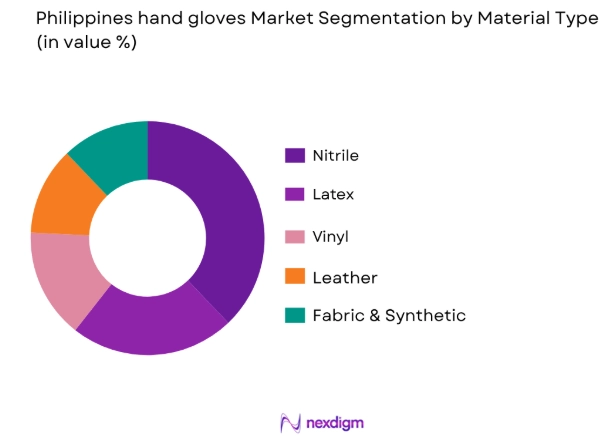
Philippines hand gloves market is segmented by material into nitrile, latex, vinyl, leather, and fabric & synthetic. Nitrile gloves hold the dominant share due to their superior resistance to chemicals, punctures, and allergens. The healthcare sector increasingly prefers nitrile gloves due to reduced risk of latex allergies, while industrial sectors adopt them for durability and versatility. Import availability from major exporting countries ensures consistent supply. Additionally, nitrile gloves are widely used in food handling and laboratory applications, contributing to their widespread adoption. Their performance advantages and regulatory acceptance make them the preferred choice across key industries.
Competitive Landscape
The Philippines hand gloves market is characterized by the presence of global manufacturers and regional distributors, with imports playing a critical role in supply. Major companies dominate through strong distribution networks, healthcare contracts, and product innovation. Firms such as Ansell Limited and Top Glove Corporation maintain strong influence due to large-scale production and global reach.
| Company | Established | Headquarters | Product Range | Distribution Network | Material Expertise | Healthcare Presence | Industrial Reach | Sustainability Initiatives |
| Ansell Limited | 1893 | Australia | ~ | ~ | ~ | ~ | ~ | ~ |
| Top Glove Corporation | 1991 | Malaysia | ~ | ~ | ~ | ~ | ~ | ~ |
| Hartalega Holdings | 1988 | Malaysia | ~ | ~ | ~ | ~ | ~ | ~ |
| Supermax Corporation | 1987 | Malaysia | ~ | ~ | ~ | ~ | ~ | ~ |
| Unigloves | 1989 | UK | ~ | ~ | ~ | ~ | ~ | ~ |

Philippines Hand Gloves Market Analysis
Growth Drivers
Rising Awareness of Workplace Safety and Hygiene Standards
Rising awareness of workplace safety and hygiene standards is supporting demand for hand gloves across construction, manufacturing, logistics, healthcare, and food handling in the Philippines. The country had 48.84 million employed persons out of a 50.79 million labor force in 2024, creating a large base of workers exposed to occupational safety requirements. The Philippine Statistics Authority also reported 27,636 occupational injury cases in its 2021/2022 occupational injuries module, with 11,907 non-fatal cases involving workdays lost and 15,560 cases requiring first-aid or medical treatment only. This strengthens the need for gloves as routine protective equipment in workplaces.
Growth in Healthcare and Medical Disposable Gloves Demand
Growth in healthcare and medical disposable gloves demand is supported by the Philippines’ expanding healthcare expenditure and facility-based care requirements. The Philippine Statistics Authority reported Primary Health Care Expenditure of PhP 748.80 billion in 2024, compared with PhP 628.41 billion in 2023, reflecting stronger activity across primary care, diagnostics, outpatient services, and public health delivery. Medical gloves remain essential in these environments because infection prevention protocols require hand protection during patient handling, sample collection, cleaning, and waste management. The Department of Health’s Health Care Waste Management Manual also identifies disposable gloves for medical staff and heavy-duty gloves for waste workers as obligatory protective items.
Market Challenges
Environmental Concerns Related to Disposable Gloves
Environmental concerns related to disposable gloves are becoming a challenge because gloves add to plastic and medical waste streams after single-use consumption in hospitals, laboratories, food processing units, and households. The Climate Change Commission of the Philippines cited 2.7 million tons of plastics discarded annually in the country, while Department of Environment and Natural Resources data cited 61,000 metric tons of solid waste generated daily, with plastic forming a large part of the waste stream. For glove suppliers, this creates pressure to improve recyclability, reduce non-recyclable packaging, and align with national plastic reduction programs while still meeting hygiene and safety requirements.
Supply Chain Disruptions and Import Dependence
Supply chain disruptions and import dependence remain a major challenge because the Philippines relies heavily on overseas glove supply. World Integrated Trade Solution data shows the Philippines imported 7,356,160 kilograms of surgical gloves in 2024, including 4,107,940 kilograms from China, 1,162,840 kilograms from Malaysia, and 2,016,790 kilograms from Thailand. For other gloves under HS 401519, imports reached 12,732,800 kilograms, with 10,275,300 kilograms from China and 1,899,740 kilograms from Malaysia. This dependence exposes distributors and buyers to shipping delays, customs clearance issues, foreign production disruptions, and limited domestic supply flexibility during demand spikes.
Opportunities
Development of Sustainable and Biodegradable Gloves
Development of sustainable and biodegradable gloves presents a future growth opportunity as the Philippines strengthens waste reduction and single-use plastic management. The National Solid Waste Management Commission’s 2024 roadmap focuses on reducing non-recyclable single-use plastics, while the country’s waste burden remains high at 61,000 metric tons of solid waste daily and 2.7 million tons of plastic discarded annually. This creates room for glove brands to introduce biodegradable, compostable, or lower-plastic-content products for healthcare-adjacent, household, food service, janitorial, and light industrial use. Companies that address disposal concerns without compromising safety, puncture resistance, or hygiene compliance can benefit from institutional procurement shifts.
Expansion of E-Commerce and Retail Channels
Expansion of e-commerce and retail channels creates a growth opportunity for hand gloves because online platforms improve access to disposable, household, industrial, and reusable gloves across urban and provincial markets. The Philippine Statistics Authority reported the digital economy at PhP 2.25 trillion in 2024, compared with PhP 2.09 trillion in 2023, indicating a broader digital commerce base. The 2024 National ICT Household Survey also reported that two in every three individuals aged 10 years and over used the internet, widening the online consumer base for hygiene, cleaning, medical, and workplace safety products. This supports direct-to-consumer and distributor-led online sales.
Future Outlook
Over the next five years, the Philippines hand gloves market is expected to witness steady expansion driven by increasing healthcare demand, industrial safety awareness, and regulatory compliance requirements. Growth in hospitals, laboratories, and food processing industries will continue to generate strong demand for disposable gloves.The market is projected to grow at a CAGR of approximately 7.2% during the 2024-2030 period, supported by rising imports, expansion of e-commerce channels, and increasing adoption of protective equipment in daily use. Additionally, sustainability trends and innovations in biodegradable materials are expected to shape future product development.
Major Players
- Ansell Limited
- Top Glove Corporation
- Hartalega Holdings
- Supermax Corporation
- Semperit AG Holding
- Unigloves
- Shield Scientific
- Globus Group
- SHOWA Group
- 3M Company
- Honeywell Safety Products
- Kimberly-Clark Professional
- Medline Industries
- B. Braun
- Polyco Healthline
Key Target Audience
- Healthcare procurement departments (Department of Health Philippines)
- Industrial safety equipment distributors
- Pharmaceutical and laboratory operators
- Retail chains and supermarket groups
- E-commerce platforms and wholesalers
- Manufacturing and construction companies
- Investments and venture capitalist firms
- Government and regulatory bodies
Research Methodology
Step 1: Identification of Key Variables
The initial phase involves constructing an ecosystem map encompassing all major stakeholders within the Philippines Hand Gloves Market. This step is supported by extensive desk research using government databases, trade reports, and company disclosures to identify key demand and supply variables.
Step 2: Market Analysis and Construction
In this stage, historical consumption and import data are analyzed to estimate market size. The study evaluates sector-wise demand across healthcare, industrial, and household segments, ensuring accurate representation of revenue generation patterns.
Step 3: Hypothesis Validation and Expert Consultation
Market assumptions are validated through interviews with industry experts, distributors, and procurement managers. These insights provide clarity on pricing trends, demand cycles, and operational challenges within the market.
Step 4: Research Synthesis and Final Output
The final phase integrates findings from primary and secondary research to deliver a comprehensive analysis. Data triangulation ensures accuracy and consistency, resulting in a validated and reliable market outlook.

- Executive Summary
- Research Methodology (Market Definitions and Assumptions, Abbreviations, Market Sizing Approach, Consolidated Research Approach, Understanding Market Potential Through In-Depth Industry Interviews, Primary Research Approach, Limitations and Future Conclusions)

- Definition and Scope
- Market Dynamics Overview
- Market Genesis
- Major Players and Market Timeline
- Business Cycle and Trends
- Supply Chain and Value Chain Analysis

- Growth Drivers
Rising Awareness of Workplace Safety and Hygiene Standards
Growth in Healthcare and Medical Disposable Gloves Demand
Increasing Industrialization and Construction Activities - Market Challenges
Fluctuations in Raw Material Prices
Environmental Concerns Related to Disposable Gloves
Supply Chain Disruptions and Import Dependence - Opportunities
Development of Sustainable and Biodegradable Gloves
Expansion of E-Commerce and Retail Channels
Growth in Healthcare and Industrial Safety Sectors - Trends
Shift toward eco-friendly and reusable gloves
Rising demand for powder-free and allergy-safe gloves
Increasing adoption of disposable gloves in daily use - Government Regulations
- SWOT Analysis
- Porter’s Five Forces

- By Value, 2020-2025
- By Volume, 2020-2025
- By Average Price, 2020-2025

- By Product Type (In Value %)
Medical & Healthcare Gloves
Industrial Safety Gloves
Household Gloves
Fashion & Protective Gloves - By Material (In Value %)
Latex
Nitrile
Vinyl
Leather
Fabric & Synthetic - By End User (In Value %)
Healthcare Institutions
Industrial Sector
Households
Retail & Fashion Consumers - By Price Tier (In Value %)
Economy / Entry-Level
Mid-Tier
Premium / High-End - By Region (In Value %)
Metro Manila
Cebu
Davao
Other Regions

- Market Share of Major Players by Value/Volume
- Market Share of Major Players by Product Type
- Cross Comparison Parameters(Company Overview, Business Strategies, Recent Developments, Strength, Weakness, Organizational Structure, Revenues, Revenues by Product Type, Number of Touchpoints, Distribution Channels, Number of Dealers and Distributors, Margins, Production Capacity, Unique Value Offering and Others)
- SWOT Analysis of Major Players
- Pricing Analysis Based on Product Categories for Major Players
- Detailed Profiles of Major Companies
Ansell Limited
Top Glove Corporation
Hartalega Holdings
Supermax Corporation
Semperit AG Holding
Unigloves
Shield Scientific
Globus Group
SHOWA Group
3M Company
Honeywell Safety Products
Kimberly-Clark Professional
Medline Industries
B. Braun
Polyco Healthline

- Market Demand and Utilization
- Purchasing Power and Budget Allocations
- Regulatory and Compliance Requirements
- Needs, Desires, and Pain Point Analysis
- Decision-Making Process

- By Value, 2026-2035
- By Volume, 2026-2035
- By Average Price, 2026-2035


 Request a Sample
 Ask for Customization
 Get a Quote
 Enquire Now