

 Download PDF
Market Overview
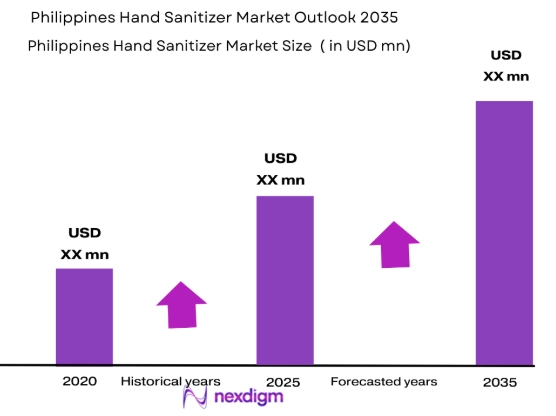
The Philippines Hand Sanitizer Market is assessed at USD ~ million, based on a triangulated five-year historical analysis using Philippines personal hygiene revenue, APAC hand sanitizer growth benchmarks, pharmacy/modern retail distribution intensity, and post-pandemic institutional hygiene demand. The broader Philippines personal hygiene market generated USD ~ million, while APAC hand sanitizer revenue reached USD ~ billion in 2024, supporting sanitizer demand through household, healthcare, office, school, travel, and retail hygiene use cases.
Metro Manila, CALABARZON, Central Luzon, Cebu, and Davao dominate the Philippines Hand Sanitizer Market because they combine high population density, organized retail presence, hospitals, offices, schools, malls, airports, and stronger e-commerce delivery coverage. NCR alone recorded 14,001,751 residents, while the Philippines population increased by ~ million from the previous census cycle. Digital channels also support urban demand, with ~ million internet users and an e-commerce GMV rising from USD ~ billion to USD ~ billion.
Market Segmentation
By Product Type
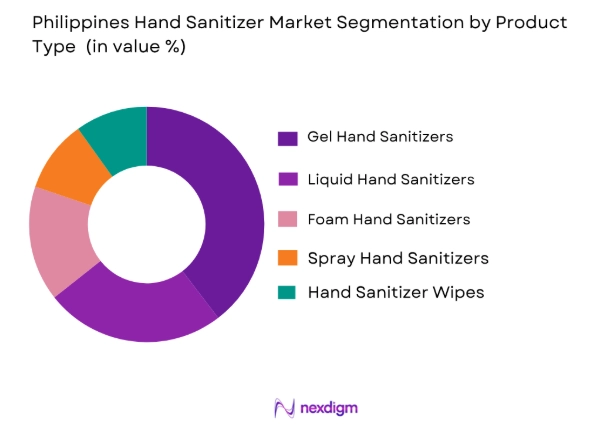
Philippines Hand Sanitizer Market is segmented by product type into gel hand sanitizers, liquid hand sanitizers, spray hand sanitizers, foam hand sanitizers, wipes, and sachet-based sanitizers. Recently, gel hand sanitizers have a dominant market share in the Philippines under the segmentation product type, it is due to their strong availability across pharmacies, supermarkets, convenience stores, offices, schools, and household channels. Gel formats are preferred because they are easy to dispense, reduce spillage, and are familiar to consumers after years of pandemic-led hygiene adoption. They are also convenient for branded and private-label manufacturers because gel bottles can be produced across multiple pack sizes, from pocket packs to pump bottles. Liquid sanitizers remain strong in institutional and refill use, but gels dominate consumer-facing shelf space because of portability, sensory appeal, and wider SKU visibility.
By Distribution Channel
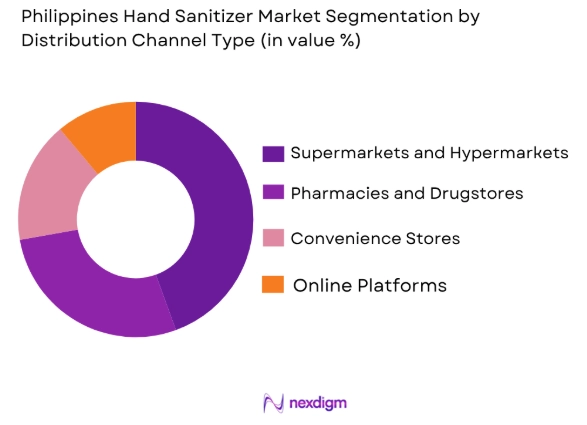
Philippines Hand Sanitizer Market is segmented by distribution channel into pharmacies and drugstores, supermarkets and hypermarkets, convenience stores, online platforms, institutional direct sales, and beauty and personal care stores. Recently, pharmacies and drugstores have a dominant market share in the Philippines under the segmentation distribution channel, it is due to their trusted positioning for hygiene and health-related products. Chains such as Watsons and Mercury Drug benefit from high consumer footfall, pharmacist-led trust, wide store networks, and strong placement of alcohol-based hygiene products. Consumers frequently buy sanitizers alongside medicines, rubbing alcohol, vitamins, masks, personal care goods, and family healthcare items. Online platforms are growing because of rising digital transactions, but pharmacy-led retail remains stronger for immediate replenishment, product authenticity, and regulated hygiene products.
Competitive Landscape
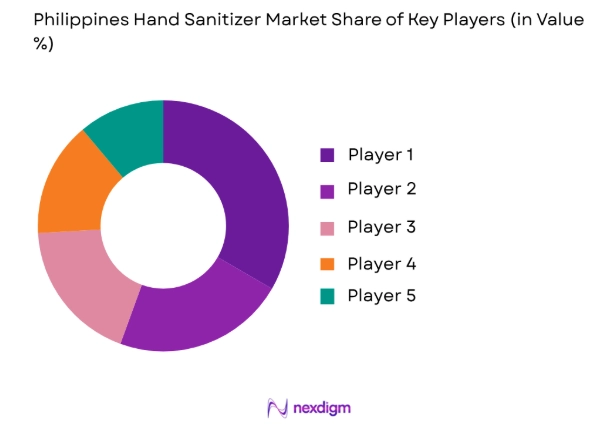
The Philippines Hand Sanitizer Market is moderately fragmented, with local hygiene and alcohol brands competing against pharmacy private labels, FMCG companies, and imported premium products. Green Cross, Hygienix, Cleene, Watsons, and Sanicare have strong retail visibility, while institutional buyers often rely on bulk suppliers and local manufacturers. Competition is shaped by alcohol content, FDA compliance, fragrance, skin-friendliness, packaging size, affordability, and distribution reach. FDA warnings against unnotified sanitizer products also make brand trust and registration compliance important competitive differentiators.
| Company | Establishment Year | Headquarters | Key Product Format | Main Channel Strength | Price Positioning | Institutional Presence | Online Availability | Market Positioning |
| Green Cross Inc. | 1952 | Muntinlupa, Philippines | ~ | ~ | ~ | ~ | ~ | ~ |
| Hygienix | 2008 | Philippines | ~ | ~ | ~ | ~ | ~ | ~ |
| Cleene | 2007 | Philippines | ~ | ~ | ~ | ~ | ~ | ~ |
| Watsons Philippines | 2002 | Metro Manila, Philippines | ~ | ~ | ~ | ~ | ~ | ~ |
| Sanicare | 1996 | Philippines | ~ | ~ | ~ | ~ | ~ | ~ |
Philippines Hand Sanitizer Market Analysis
Growth Drivers
Increasing Use in Healthcare and Institutional Settings
The Philippines Hand Sanitizer Market is supported by routine sanitizer usage across hospitals, clinics, workplaces, public buildings, and other institutional facilities. The country has a large addressable institutional user base, with the World Bank recording 115,843,670 people in the Philippines. Healthcare infrastructure spending also supports sanitizer procurement, as the Department of Budget and Management allocated PHP 28.58 billion for the Health Facilities Enhancement Program, compared with PHP 26.81 billion in the previous budget cycle. The Philippine Statistics Authority also reported an additional 303,000 employed persons in human health and social work activities in November 2024, strengthening hygiene product usage across healthcare workplaces.
Growth of Modern Retail and Online Sales Channels
The Philippines Hand Sanitizer Market is benefiting from wider access through pharmacies, supermarkets, convenience stores, and online platforms, as consumers increasingly purchase hygiene products through organized and digital channels. The Philippine Statistics Authority reported that the country’s digital economy reached PHP 2.25 trillion at current prices, while the World Bank recorded 115,843,670 people in the country, giving sanitizer brands a large consumer base for retail and online distribution. PSA-DICT survey results also showed that 36.7 out of every 100 internet users aged 10 years and above purchased goods or services online, supporting digital availability of sanitizer packs, refills, and institutional bundles.
Market Challenges
Regulatory Compliance and Product Quality Concerns
The Philippines Hand Sanitizer Market faces compliance pressure because hand sanitizers sold as cosmetic or hygiene products must meet product notification, labeling, and safety requirements. The Food and Drug Administration issued FDA Advisory No. 2024-0916 warning against the purchase and use of an unnotified hand sanitizer product, and also issued FDA Advisory No. 2024-0130 against an unnotified hand sanitizer spray. The FDA also maintains a list of unregistered health products covering January 2020 to January 2025, showing continuing regulatory monitoring. This creates challenges for informal sellers and pushes compliant brands to maintain registration, documentation, and quality assurance.
Raw Material Import Dependence
The Philippines Hand Sanitizer Market is exposed to imported alcohol supply because alcohol-based sanitizers require ethyl alcohol and related spirit inputs. World Integrated Trade Solution data from the World Bank shows that the Philippines imported 397,497,000 liters of denatured ethyl alcohol and other denatured spirits, including 276,889,000 liters from the United States and 90,019,000 liters from Brazil. The country also imported 191,203,000 liters of undenatured ethyl alcohol, including 49,043,300 liters from Brazil, 48,862,200 liters from Australia, and 38,325,300 liters from Pakistan. This import reliance can affect sanitizer producers when shipping, customs, or supplier availability changes.
Opportunities
Institutional Bulk Sales and B2B Partnerships
The Philippines Hand Sanitizer Market has an opportunity in institutional bulk sales across schools, hospitality, transport hubs, offices, and public facilities. The Department of Education recorded 23,845,025 enrolled learners for school year 2024–2025, including 280,736 learners in the Alternative Learning System, creating a large base of classrooms, clinics, canteens, and administrative facilities requiring hygiene supplies. Tourism-linked establishments also support bulk demand, as the Philippine Statistics Authority reported domestic tourism expenditure of PHP 3.16 trillion and inbound tourism expenditure of PHP 699.98 billion. These figures support demand from hotels, restaurants, airports, malls, event venues, and transport-linked commercial facilities.
Private Label Opportunities for Retail Chains
The Philippines Hand Sanitizer Market has an opportunity for private-label products through pharmacies, supermarkets, and online retail platforms because large retail networks can supply sanitizer under store-owned brands in bottles, sprays, refill packs, and travel-size formats. The World Bank recorded the Philippines population at 115,843,670 people, while PSA reported the digital economy at PHP 2.25 trillion, supporting a wide retail and e-commerce base for private-label hygiene products. The PSA-DICT survey also showed 36.7 out of every 100 internet users aged 10 years and above purchased goods or services online, allowing retail chains to sell sanitizer multipacks and refills directly through digital storefronts.
Future Outlook
The Philippines Hand Sanitizer Market is expected to grow at a CAGR of 6.4%, aligned with APAC hand sanitizer growth expectations and supported by healthcare hygiene, school and office reopening normalization, pharmacy retail penetration, and digital commerce growth. APAC hand sanitizer demand is projected to expand steadily as hygiene practices remain embedded in public spaces, healthcare facilities, malls, airports, restaurants, and households.Over the next five years, demand will shift from emergency pandemic purchasing to routine hygiene replenishment. Growth will be driven by premium skin-friendly formulations, pocket-size travel packs, scented sanitizers, refill packaging, and institutional bulk procurement. Hospitals, clinics, schools, BPO offices, malls, airports, hotels, and foodservice operators will remain important demand centers. Online platforms will also expand the market by improving access to multi-pack, refill, and imported products.
Major Players
- Green Cross Inc.
- Hygienix
- Cleene
- Watsons Philippines
- Sanicare
- Casino Ethyl Alcohol and Sanitizer
- Unilab Consumer Health
- Splash Corporation
- Human Nature
- Bench
- Guard
- Bestcare
- FamilyGuard
- Purell Philippines
- Local Private Label Brands
Key Target Audience
- Hand sanitizer manufacturers
- Personal care and hygiene product companies
- Pharmacy and drugstore chains
- Supermarket and hypermarket operators
- E-commerce and quick-commerce platforms
- Hospital, clinic, and healthcare procurement teams
- Investments and venture capitalist firms
- Government and regulatory bodies such as Food and Drug Administration Philippines, Department of Health Philippines, and Department of Trade and Industry Philippines
Research Methodology
Step 1: Identification of Key Variables
The initial phase involves constructing an ecosystem map for the Philippines Hand Sanitizer Market, covering manufacturers, importers, distributors, pharmacies, supermarkets, online platforms, and institutional buyers. The key variables include product type, pack size, alcohol content, channel mix, price tier, consumer frequency, and institutional procurement behavior. Secondary research is used to identify regulatory and demand-side indicators.
Step 2: Market Analysis and Construction
In this phase, historical demand is assessed using personal hygiene market indicators, APAC hand sanitizer benchmarks, retail distribution trends, and Philippines health and e-commerce data. Revenue construction follows a bottom-up approach by mapping retail and institutional demand across pharmacies, supermarkets, online channels, offices, schools, healthcare facilities, and hospitality sites. Product mix assumptions are validated against observed retail availability.
Step 3: Hypothesis Validation and Expert Consultation
Market hypotheses are validated through structured discussions with distributors, pharmacy category managers, institutional buyers, and FMCG sales teams. These interviews help test assumptions around gel dominance, pharmacy-led sales, price sensitivity, post-pandemic demand normalization, and the role of private-label products. Expert inputs are used to refine market shares and forecast assumptions.
Step 4: Research Synthesis and Final Output
The final phase consolidates secondary data, channel checks, expert inputs, and product-level observations into a unified market model. The synthesis validates market size, segmentation, competitive positioning, and forecast trajectory. The output is reviewed for consistency with regulatory conditions, consumer behavior, and macro indicators such as healthcare spending, urbanization, and digital commerce penetration.

- Executive Summary
- Research Methodology (Market Definitions and Assumptions, Abbreviations, Market Sizing Approach, Bottom-Up Revenue Mapping, Volume Consumption Mapping, Demand-Side and Supply-Side Triangulation, Primary Interviews with Manufacturers, Distributors, Retailers, Pharmacies, and Institutional Buyers, Regulatory Mapping Framework, Data Validation Models, Limitations and Future Assumptions)

- Definition and Scope
- Evolution of Hand Sanitizer Market in the Philippines
- Healthcare and Public Hygiene Linkages with Hand Sanitizer Consumption
- Business Cycle and Demand Seasonality
- Supply Chain and Distribution Value Chain
- Role of Government and Public Health Policies
- Import Dependence and Local Manufacturing Landscape

- Growth Drivers
Rising Hygiene Awareness Among Consumers
Increasing Use in Healthcare and Institutional Settings
Growth of Modern Retail and Online Sales Channels
Rising Demand for Convenient Personal Hygiene Products
Expansion of Hospitality, Education, and Corporate Sectors
Increasing Preference for Travel-Size and On-the-Go Sanitizers - Market Challenges
Declining Demand After Pandemic-Led Peak
Price Competition Among Local and Imported Brands
Raw Material Price Volatility
Regulatory Compliance and Product Quality Concerns
Consumer Shift Toward Soap and Handwash Alternatives
Counterfeit and Low-Quality Product Availability - Opportunities
Growth of Premium and Skin-Friendly Sanitizer Products
Expansion of Natural and Herbal Sanitizer Formulations
Private Label Opportunities for Retail Chains
Institutional Bulk Sales and B2B Partnerships
E-Commerce and Quick Commerce Expansion
Product Innovation in Fragrance, Packaging, and Format - Trends
Shift Toward Moisturizing and Non-Sticky Formulations
Rising Demand for Pocket-Sized Sanitizers
Increasing Use of Sanitizer Stations in Public Spaces
Growth of Fragrance-Based and Lifestyle-Oriented Products
Expansion of Eco-Friendly and Refillable Packaging
Digital-First Brand Building and Online Promotions - Regulatory Landscape
- SWOT Analysis
- Stakeholder Ecosystem
- Porter’s Five Forces
- Competitive Landscape Structure

- By Value, 2020–2025
- By Volume, 2020–2025
- By Average Selling Price, 2020–2025
- By Alcohol-Based vs Non-Alcohol-Based Contribution, 2020–2025

- By Product Type (in Value %)
Gel Hand Sanitizers
Liquid Hand Sanitizers
Foam Hand Sanitizers
Spray Hand Sanitizers
Hand Sanitizer Wipes - By Packaging Type (in Value %)
Small Bottles
Pump Bottles
Refill Packs
Sachets
Bulk Containers
Travel-Size Packaging - By End User (in Value %)
Households
Hospitals and Clinics
Schools and Universities
Corporate Offices
Hotels and Restaurants
Retail and Commercial Establishments
Government and Public Institutions - By Distribution Channel (in Value %)
Supermarkets and Hypermarkets
Pharmacies and Drugstores
Convenience Stores
Online Platforms - By Price Segment (in Value %)
Economy Segment
Mid-Priced Segment
Premium Segment
Private Label Segment - By Ingredient Type (in Value %)
Ethyl Alcohol-Based Sanitizers
Isopropyl Alcohol-Based Sanitizers
Benzalkonium Chloride-Based Sanitizers
Herbal and Natural Ingredient Sanitizers
Moisturizing and Skin-Friendly Formulations - By Customer Demographics (in Value %)
Urban Consumers
Semi-Urban Consumers
Rural Consumers
Working Professionals
Students
Healthcare Workers
Children and Family Users - By Region (in Value %)
Metro Manila
Luzon excluding Metro Manila
Visayas
Mindanao
Key Urban Centers
Emerging Provincial Markets

- Market Share Analysis
- Cross Comparison Parameters (Revenue by Product Category, Distribution Reach, SKU Portfolio, Average Selling Price, Retail Shelf Presence, Online Visibility, Institutional Sales Contribution %, Product Innovation, Brand Positioning)
- SWOT Analysis of Key Players
- Pricing Benchmarking
- Company Profiles
Green Cross
Casino Ethyl Alcohol and Sanitizer
Cleene
Hygienix
Watsons Philippines
Unilab Consumer Health
Splash Corporation
Human Nature
Bench
Sanicare
Guard
Bestcare
FamilyGuard
Purell Philippines
Local Private Label Brands

- Household Consumption Patterns
- Purchase Frequency and Basket Size
- Price Sensitivity and Brand Switching
- Brand Loyalty Analysis
- Pain Point Analysis
- Decision-Making Criteria
- Consumer TAM Analysis

- By Value, 2026-2035
- By Volume, 2026-2035
- By Average Selling Price, 2026-2035


 Request a Sample
 Ask for Customization
 Get a Quote
 Enquire Now