

 Download PDF
Market Overview
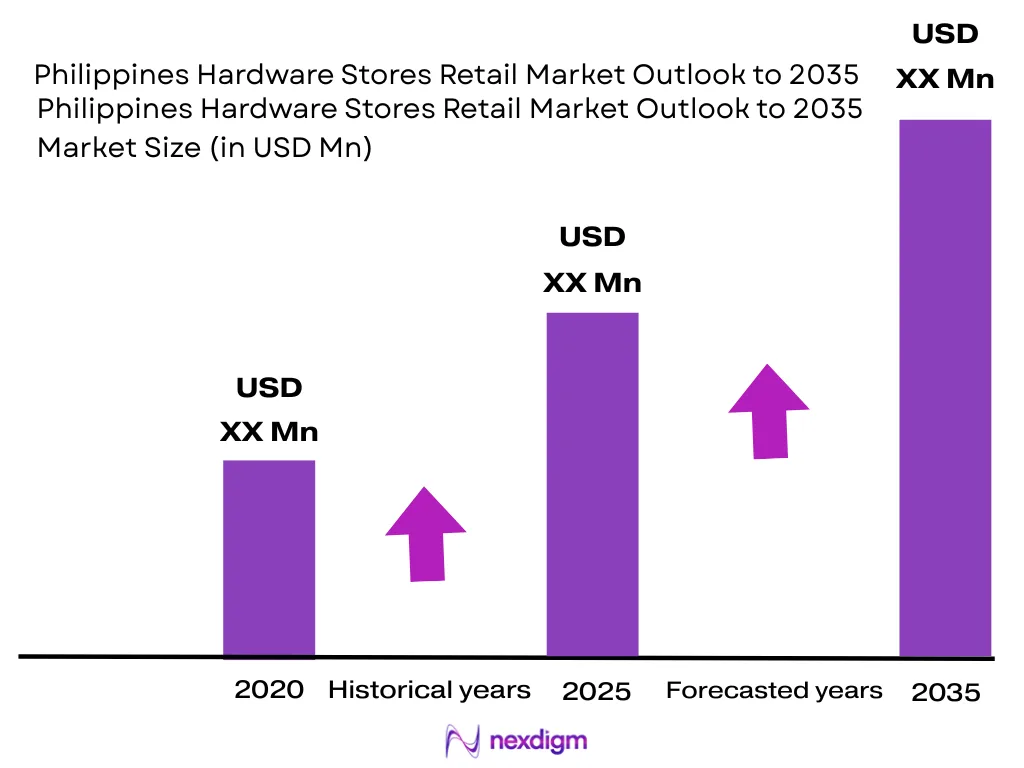
The Philippines Hardware Stores Retail Market is valued at ~ million, based on a five-year historical analysis. The market is driven by residential construction, repairs, renovations, contractor-led projects, DIY maintenance, electrical replacement, plumbing repairs, paints, tiles, tools and building-material demand. Construction activity increased from 171,268 approved constructions to 180,341 approved constructions, while GDP reached USD ~ billion and GDP per capita reached USD 3,984.8, supporting hardware retail demand. Metro Manila, Cebu, Davao, CALABARZON and Central Luzon dominate Philippines Hardware Stores Retail Market because they concentrate households, condominiums, subdivisions, commercial fit-outs, contractor activity, modern depot stores, malls and distributor warehouses. Metro Manila leads due to dense renovation demand and commercial maintenance, Cebu anchors Visayas construction and retail distribution, while Davao supports Mindanao hardware demand. Urban population reached 56,316,242, strengthening demand for tools, paints, plumbing, electrical, tiles and repair products.
Market Segmentation
By Product Type
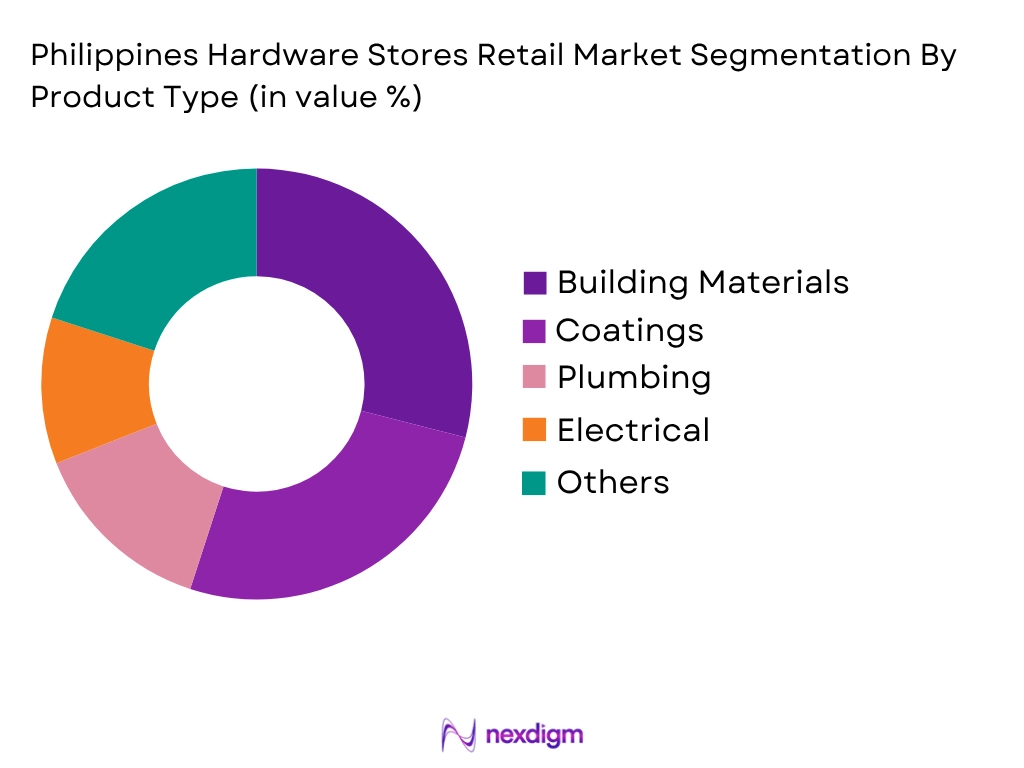
Philippines Hardware Stores Retail Market is segmented by product category into building materials, paints and coatings, plumbing and sanitary supplies, electrical and lighting supplies, tiles and flooring, hardware and fasteners, and tools and safety products. Recently, building materials have a dominant market share in the Philippines under the segmentation product category, due to steady demand for cement, steel bars, plywood, hollow blocks, roofing sheets, lumber, gypsum boards and aggregates from residential construction, small contractors, repairs and renovation projects. Building materials remain the anchor category for traditional hardware stores and modern depot formats because they drive repeat purchases from masons, carpenters, builders and project contractors. These products also generate linked demand for paints, plumbing materials, electrical fittings, tiles, sealants, waterproofing, tools and safety supplies.
By Store Format
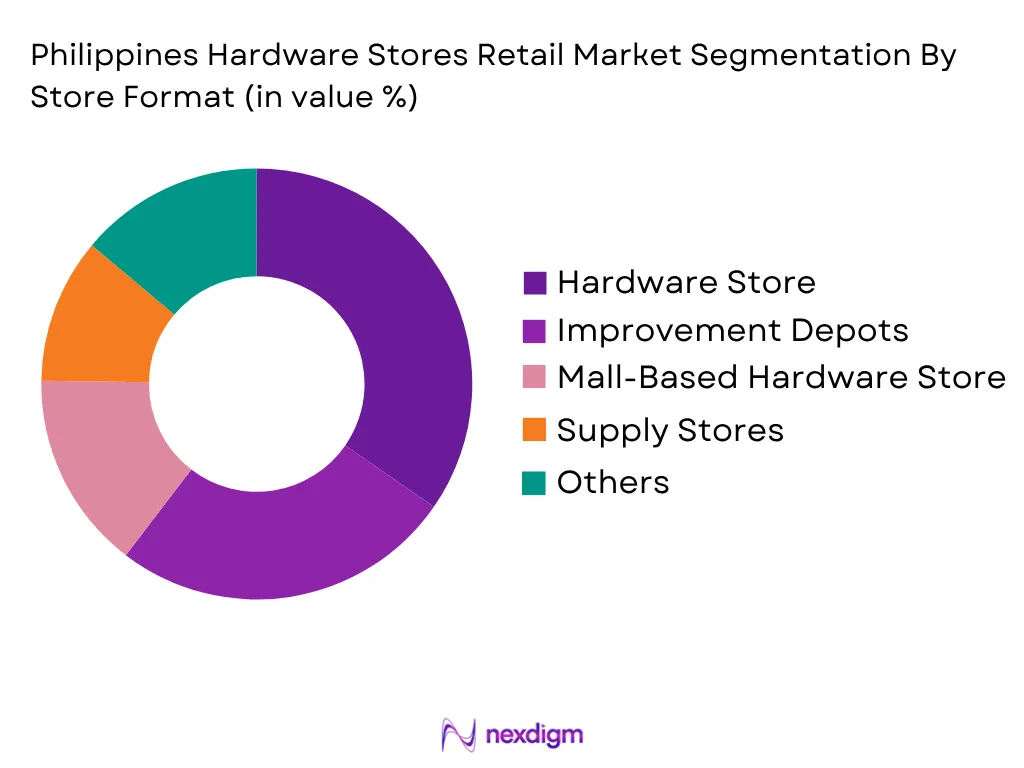
Philippines Hardware Stores Retail Market is segmented by store format into traditional neighborhood hardware stores, modern home improvement depots, mall-based hardware stores, contractor-focused supply stores, specialty trade stores, online and omnichannel hardware retail, and wholesale hardware and distributor warehouses. Recently, traditional neighborhood hardware stores have a dominant market share in the Philippines under the segmentation store format, because barangay-level stores remain closest to homeowners, small contractors, plumbers, electricians, carpenters and repair workers. These outlets handle urgent purchases of nails, screws, pipes, valves, wires, paint brushes, sealants, locks, adhesives, switches and basic tools. They are supported by proximity, flexible buying quantities, local relationships and immediate availability. Modern depots such as Wilcon Depot, CitiHardware, CW Home Depot and AllHome are expanding, but traditional stores remain important for daily repair and small-project transactions.
Competitive Landscape
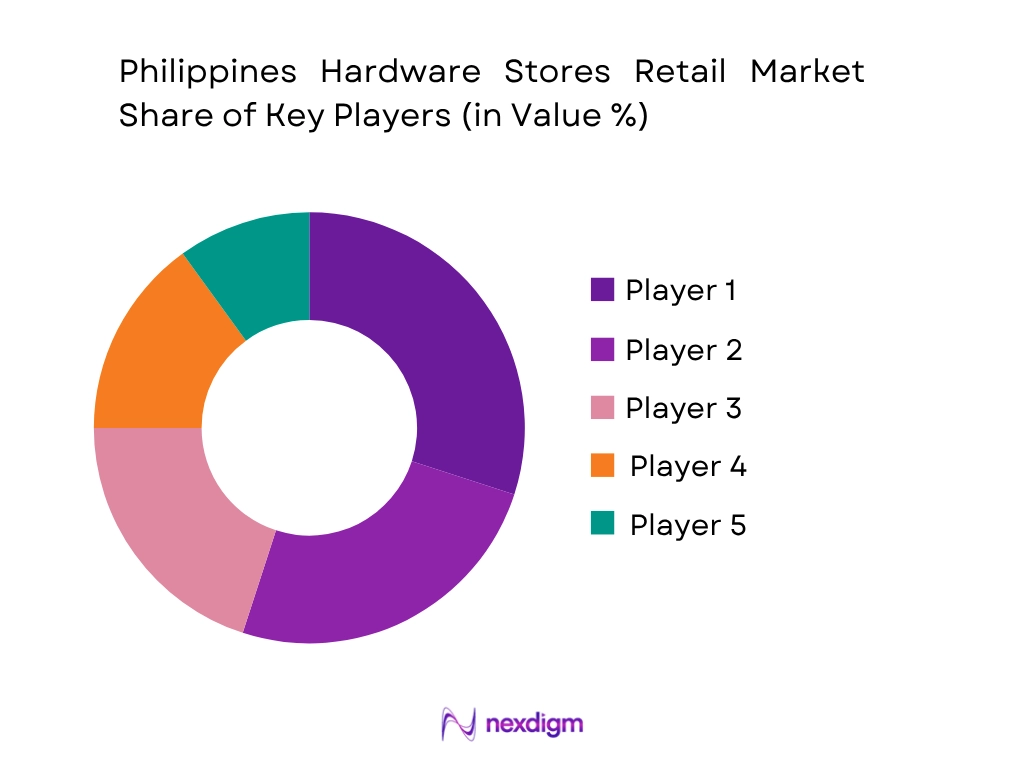
The Philippines Hardware Stores Retail Market is led by a mix of large-format depots, mall-based hardware chains, traditional hardware distributors, paint brands, building-material suppliers and specialist retailers. Wilcon Depot, CitiHardware, Ace Hardware Philippines, Handyman Do it Best and AllHome influence the organized market through store networks, broad SKU portfolios, contractor access, home improvement categories, branded products, online catalogues and delivery services. Traditional stores remain highly fragmented, especially outside major cities.
| Company | Establishment Year | Headquarters | Core Positioning | Product Strength | Sales Channel | Fulfillment Model | Price Tier | Market-Specific Capability |
| Wilcon Depot | 1977 | Quezon City | ~ | ~ | ~ | ~ | ~ | ~ |
| CitiHardware | 1998 | Davao City | ~ | ~ | ~ | ~ | ~ | ~ |
| Ace Hardware Philippines | 1997 | Metro Manila | ~ | ~ | ~ | ~ | ~ | ~ |
| Handyman Do it Best | 1994 | Quezon City | ~ | ~ | ~ | ~ | ~ | ~ |
| AllHome | 2011 | Las Piñas / Pasay | ~ | ~ | ~ | ~ | ~ | ~ |
Philippines Hardware Stores Retail Market Analysis
Growth Drivers
Construction Permit Activity Supporting Core Hardware Demand
Philippines Hardware Stores Retail Market is supported by active building-permit activity, because each approved residential, commercial and mixed-use construction project requires cement, steel bars, plywood, roofing, plumbing pipes, electrical wires, tiles, paints, fasteners and tools. The Philippine Statistics Authority reported 180,341 approved constructions in 2024, compared with 171,268 approved constructions in 2023. World Bank data also recorded Philippine GDP at USD 461.62 billion and GDP per capita at USD 3,984.8 in 2024, supporting construction-linked household and contractor purchases through traditional hardware stores, modern depots and contractor supply outlets.
Broad Economic Base Supporting Repair, Renovation and DIY Purchases
Philippines Hardware Stores Retail Market benefits from the country’s large consumer and services-led economic base, which supports household repair, condominium maintenance, small renovation, lighting replacement, plumbing repair, painting and DIY tool purchases. World Bank reported Philippine GDP growth at 5.7 in 2024, with GDP at USD 461.62 billion and GDP per capita at USD 3,984.8. The World Bank also reported GNI per capita at USD 4,470 in 2024. These macro indicators support retail demand for hand tools, paint accessories, faucets, locks, wires, switches, sealants and small fixtures across Metro Manila, Cebu, Davao and CALABARZON.
Market Challenges
Credit Conditions Affecting Contractor and Renovation Purchases
Philippines Hardware Stores Retail Market faces pressure from credit conditions because contractors, renovators and households often require working capital for bulk cement, steel, tiles, electrical supplies, plumbing fixtures, power tools and sanitaryware. The Bangko Sentral ng Pilipinas’ December 2025 monetary policy report stated that cumulative policy-rate cuts since August 2024 reached 175 basis points, showing that financing conditions remained a key macro issue during the period. Reuters reported that the Philippine central bank’s benchmark rate was expected at 4.25 in February 2026. These financing conditions affect contractor accounts, inventory purchases and household renovation spending.
Import and Inter-Island Supply Exposure Creating Stock Availability Risk
Philippines Hardware Stores Retail Market faces supply-chain risk because many power tools, fixtures, electrical items, locks, plumbing fittings, tiles, sanitaryware and specialty hardware products depend on imported supply and inter-island distribution. The Philippines is an archipelago of around 7,641 islands, which makes provincial replenishment, site delivery and bulky-material movement operationally complex. WITS/World Bank provides official merchandise-trade data infrastructure for import flows, while hardware retailers remain exposed to customs clearance, distributor warehousing and shipping schedules. This directly affects product availability for contractors, barangay hardware stores, depot chains and repair-focused customers across Luzon, Visayas and Mindanao.
Market Opportunities
Digital Access Supporting Online Hardware and Omnichannel Retail
Philippines Hardware Stores Retail Market has a growth opportunity in online catalogues, click-and-collect, marketplace listings, contractor reorder portals and digital product discovery. The Philippine Statistics Authority reported that household internet connection increased to 48.8 in 2024, while two in every three individuals aged 10 years and above used the internet. DICT’s 2024 National ICT Household Survey covered around 44,000 households, creating a reliable basis for digital access measurement. These indicators support online discovery for power tools, paints, switches, locks, faucets, lighting, garden tools and repair supplies before purchase through stores, apps or delivery channels.
Weather-Related Repair Demand Supporting Resilience Hardware Categories
Philippines Hardware Stores Retail Market has future growth opportunity in disaster-repair and resilience categories such as roofing sheets, sealants, plywood, tarpaulins, pumps, fasteners, waterproofing, emergency lighting and electrical repair supplies. The Asian Disaster Reduction Center, citing NDRRMC data, reported that a 2024 typhoon event affected 6,220,366 people, damaged 524 infrastructure locations, totally destroyed 1,200 houses and partially damaged 7,374 houses. Reuters also reported that the Philippines typically records about 20 tropical storms each year. These conditions support recurring hardware-store demand for post-storm home repairs, contractor callouts and local government maintenance procurement.
Future Outlook
The Philippines Hardware Stores Retail Market is forecast to grow at a CAGR of 8.2% during the outlook period, supported by residential construction, provincial home improvement demand, contractor-led projects, DIY repair adoption, building-material sales and modern depot expansion. Growth will be led by Metro Manila, CALABARZON, Central Luzon, Cebu, Iloilo, Bacolod, Davao and Cagayan de Oro. These locations combine housing projects, commercial maintenance, road-linked construction activity, mall-based retail, modern depot expansion and contractor procurement. Modern depots are expected to gain share through larger assortments, branded products, site delivery, contractor accounts, project quotations and online catalogues. However, barangay hardware stores will remain structurally important because they serve urgent, small-ticket, proximity-led repair purchases. The strongest growth opportunities will come from provincial depot expansion, digital contractor procurement, private-label hardware, waterproofing products, disaster-repair supplies, smart lighting, plumbing systems, bathroom fixtures and professional tools. Retailers with reliable stock availability, delivery scheduling and trade-customer programs will be better positioned.
Major Players
- Wilcon Depot
- CitiHardware
- Ace Hardware Philippines
- Handyman Do it Best
- AllHome
- CW Home Depot
- True Value Philippines
- MC Home Depot
- Federal Hardware
- Co Ban Kiat Hardware
- Belmont Depot
- Matimco
- Davies Paints Philippines
- Boysen Paints
- Atlanta Industries
Key Target Audience
- Hardware store chains and home improvement depot operators
- Traditional hardware retailers and neighborhood hardware store owners
- Building-material distributors and wholesale hardware suppliers
- Paints, coatings, plumbing, electrical and tool manufacturers
- Real estate developers, contractors and fit-out companies
- Investments and venture capitalist firms
- Government and regulatory bodies
- Logistics providers, regional distributors and contractor procurement platforms
Research Methodology
Step 1: Identification of Key Variables
The initial phase involves constructing an ecosystem map for Philippines Hardware Stores Retail Market, covering hardware retailers, depot chains, traditional stores, distributors, importers, contractors, builders, homeowners and institutional buyers. Key variables include construction activity, repair frequency, product category mix, store format, regional demand and contractor procurement behaviour.
Step 2: Market Analysis and Construction
In this phase, historical and current information is compiled across building materials, paints, plumbing, electricals, tiles, tools, fasteners, safety products and fixtures. Market construction is undertaken through top-down construction-linked demand assessment and bottom-up mapping of modern depots, neighborhood hardware stores, distributor warehouses and online channels.
Step 3: Hypothesis Validation and Expert Consultation
Market hypotheses are validated through computer-assisted telephone interviews with hardware retailers, depot managers, building-material distributors, contractors, plumbers, electricians, painters and renovation companies. These consultations provide insight into basket size, SKU movement, contractor buying, delivery needs, product quality concerns and regional demand variation.
Step 4: Research Synthesis and Final Output
The final phase combines secondary research, expert validation, company benchmarking and segmentation analysis into a structured market model. The output assesses market size, future outlook, product segmentation, store formats, competitive landscape, end-user demand, procurement models and investment opportunities in Philippines Hardware Stores Retail Market.

- Executive Summary
- Research Methodology (Market Definitions and Assumptions, Abbreviations, Market Sizing Approach, Top-Down Construction and Household Demand Mapping, Bottom-Up Store Revenue Assessment, Barangay Hardware Store Triangulation, Contractor Procurement Mapping, SKU-Level Basket Analysis, Import and Distributor Shipment Assessment, Store Network Benchmarking, Online Sales Estimation, Primary Interviews with Retailers/Distributors/Contractors/Developers/Hardware Store Owners, Limitations and Future Conclusions)

- Definition and Scope
- Overview Genesis
- Evolution of Hardware Retail and Home Improvement Formats
- Timeline of Major Hardware Store Chains and Depot Retailers
- Business Cycle
- Supply Chain and Value Chain Analysis

- Growth Drivers (Residential Construction, Infrastructure Activity, Home Renovation, DIY Repairs, Contractor Demand, Modern Retail Expansion, Online Catalogue Adoption)
- Market Challenges (Fragmented Traditional Retail, Import Dependence, Inventory Complexity, Logistics Constraints, Price Competition, Counterfeit Risk, Seasonality)
- Opportunities (Provincial Expansion, Digital Contractor Accounts, Private Label, Disaster-Repair Kits, Specialty Trade Retail, B2B Project Supply)
- Market Trends(One-Stop Home Improvement, Contractor Loyalty, Online Catalogues, Private Labels, Smart Home Hardware, Sustainable Materials)
- SWOT Analysis
- Porter’s Five Forces
- PESTLE Analysis

- By Value (2020-2025)
- By Volume (2020-2025)
- By Average Price, 2020-2025

- By Product Category (In Value %)
Building Materials
Hardware and Fasteners
Paints, Coatings and Surface Preparation
Plumbing and Sanitary Supplies - By Store Format (In Value %)
Traditional Neighborhood Hardware Stores
Modern Home Improvement Depots
Mall-Based Hardware Stores
Contractor-Focused Supply Stores
Specialty Hardware and Trade Stores - By Customer Type (In Value %)
DIY Homeowners
Residential Contractors and Builders
Carpenters, Masons, Plumbers and Electricians
Real Estate Developers and Project Contractors
Renovation and Fit-Out Contractors - By Region (In Value %)
National Capital Region
CALABARZON
Central Luzon
Central Visayas
Western Visayas

- Market Share of Major Players (Value Share, Volume Share, Store Count Share, Category Share, Regional Presence, Channel Share)
- Cross Comparison Parameters (Store Footprint, Contractor Account Capability, Product Category Breadth, Building Materials Depth, Delivery and Site Fulfillment Network, Online Catalogue and E-Commerce Capability, Private Label and Exclusive Brand Portfolio, Provincial Expansion Strength)
- SWOT Analysis of Major Players
- Pricing Analysis by Key SKUs
- Detailed Profiles of Major Companies
Wilcon Depot
CitiHardware
Ace Hardware Philippines
Handyman Do it Best
AllHome
CW Home Depot
True Value Philippines
MC Home Depot
Federal Hardware
Co Ban Kiat Hardware
Belmont Depot
Matimco
Davies Paints Philippines
Boysen Paints
Atlanta Industries

- DIY Homeowner Demand Analysis
- Contractor and Builder Demand Analysis
- Trade Professional Demand Analysis
- Real Estate Developer and Project Contractor Demand Analysis
- Renovation and Fit-Out Buyer Demand Analysis

- By Value (2026-2035)
- By Volume (2026-2035)
- By Average Transaction Value (2026-2035)


 Request a Sample
 Ask for Customization
 Get a Quote
 Enquire Now