
 Download PDF
Market Overview
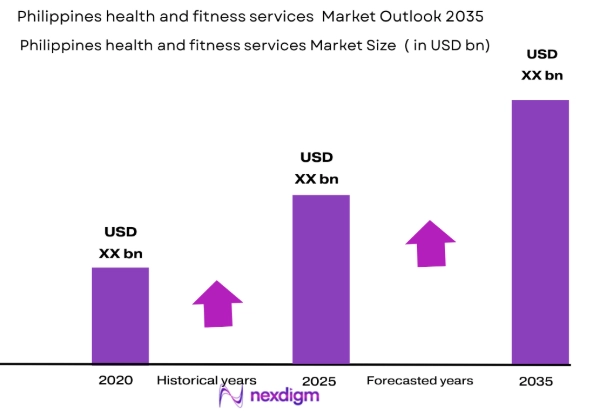
The Philippines health and fitness services market is part of the broader health and wellness industry valued at USD ~ billion in 2025, encompassing fitness centres, gym memberships, personal training, and wellness solutions. This valuation reflects rising consumer engagement with preventive health, driven by increasing awareness of lifestyle‑related diseases, expanding middle‑class income, and government initiatives to promote physical activity and well‑being. Urbanisation and social media influence on fitness behaviours further support demand for formal fitness services across demographic groups.
Within the Philippines, Metro Manila, Cebu City, and Davao City are the leading centres for health and fitness services due to their dense populations, higher disposable incomes, and concentrated infrastructure of gyms, wellness studios, and fitness brands. These metropolitan areas experience greater corporate wellness adoption and higher digital fitness uptake, supported by strong youth demographics and fitness influencers shaping lifestyle trends. The influx of international and domestic fitness operators in these cities reinforces their dominant positions.
Market Segmentation
By Service Type
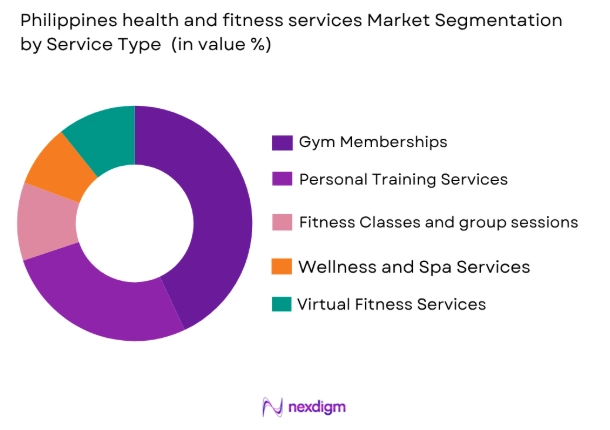
The Philippines health and fitness services market is segmented by service type into gyms & fitness clubs, personal training services, boutique and specialised classes, and digital/connected fitness services. Gyms & fitness clubs hold the largest market share, driven by traditional consumer preference for structured workout environments, access to equipment, and group classes popular among younger demographics. Fitness clubs also benefit from brand recognition and community support, which encourage retention. Alumni and student memberships further sustain this segment, while adoption of technology‑integrated offerings enhances user engagement. Digital/connected fitness is growing but remains smaller due to infrastructure and penetration limitations.
By End User
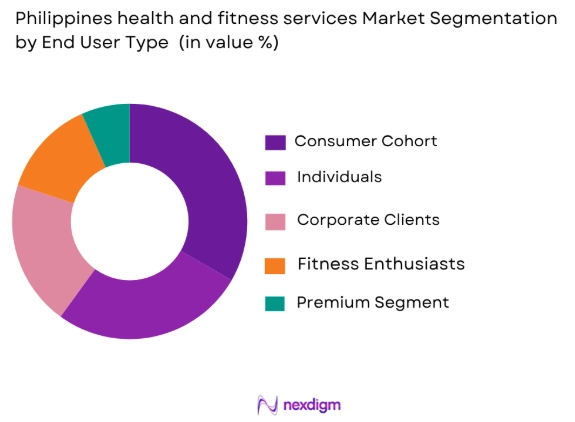
The market is also segmented by end user into individual consumers, corporate wellness programmes, and institutional/government health initiatives. Individual consumers dominate this segment, accounting for the largest share due to rising personal investment in health and fitness services. Growing awareness of preventive health, increasing participation in fitness classes, and social motivation from digital platforms drive individual engagement. While corporate wellness programmes are expanding, particularly among larger employers in urban zones, they remain smaller relative to direct consumer expenditure.Government‑supported campaigns on physical activity support broader participation, particularly in public sports initiatives.
Competitive Landscape
The Philippines health and fitness services market includes a mix of local and regional operators offering gyms, fitness clubs, and specialised fitness services. Competition is based on facility quality, service offerings, pricing, and community engagement. The sector is expanding as both new entrants and established players seek to capitalise on rising fitness demand and urban growth trends.
| Company Name | Establishment Year | Headquarters | Service Offering | Number of Locations | Estimated Membership Base | Target Market |
| Fitness First Philippines | 2002 | Metro Manila, PH | ~ | ~ | ~ | ~ |
| Anytime Fitness PH | 2002 | Metro Manila, PH | ~ | ~ | ~ | ~ |
| Gold’s Gym Philippines | 1998 | Metro Manila, PH | ~ | ~ | ~ | ~ |
| Slimmers World PH | 2000 | Metro Manila, PH | ~ | ~ | ~ | ~ |
| F45 Training Philippines | 2013 | Metro Manila, PH | ~ | ~ | ~ | ~ |
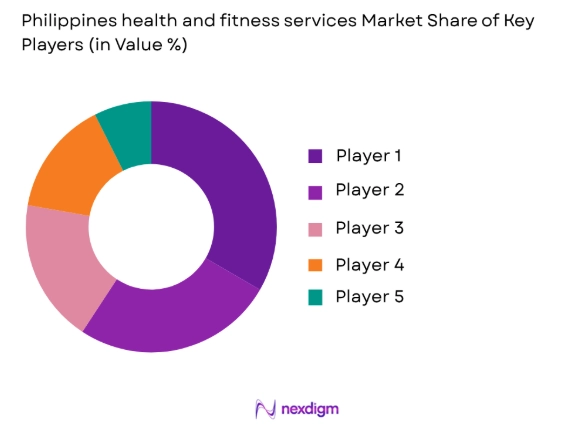
Philippines Health and Fitness Services Market Analysis
Growth Drivers
Increasing Health & Wellness Awareness and Fitness Services Demand
The Philippines’ fitness services demand is supported by a large addressable consumer base and improving income capacity. World Bank data reports Philippines GDP at US$461.62 billion in 2024 and GDP per capita at US$3,984.8, indicating a broader consumer economy able to support paid wellness, gym, coaching, and preventive-health services. Household spending capacity is also relevant: households and NPISH final consumption expenditure reached ₱20,137,692,097,500 in 2024, creating room for discretionary wellness activities such as fitness classes, personal training, and lifestyle programs.
Adoption of Digital Fitness Platforms and Virtual Classes
Digital fitness is supported by strong connectivity and mobile access. World Bank-linked data shows the Philippines had 134,739,000 mobile cellular subscriptions in 2023, giving fitness platforms a large base for app-based workouts, livestream classes, coaching subscriptions, and hybrid gym engagement. World Bank also approved a Philippines digital infrastructure project in October 2024 expected to benefit more than 20,000,000 Filipinos through improved broadband connectivity, which strengthens the operating environment for virtual fitness, wellness tracking, and remote coaching models.
Challenges
High Initial Consumer Investment and Membership Costs
Consumer affordability remains a constraint because fitness services compete with essential household spending. The Philippines’ GDP per capita stood at US$3,984.8 in 2024, while household final consumption expenditure reached ₱20,137,692,097,500, showing a large consumer market but also one where spending is distributed across food, transport, housing, health, education, and other essentials. For gyms, boutique studios, personal trainers, and digital subscriptions, this limits conversion among price-sensitive households and pushes providers to offer flexible plans, pay-per-session formats, and lower-commitment models.
Limited Access to High-Quality Equipment and Facilities in Rural Areas
Rural and underserved connectivity gaps restrict access to digital fitness, while physical facility gaps limit gym penetration outside major urban centers. World Bank’s 2024 broadband project noted that more than 20,000,000 Filipinos are expected to benefit from improved connectivity, and related project information refers to deployment across 772 sites and 10,259 underserved areas. This indicates that many communities still require infrastructure upgrades before virtual classes, AI coaching, connected equipment, and app-led wellness services can scale evenly across the country.
Opportunities
Expansion of Digital Fitness Platforms and Subscription Services
Digital fitness platforms have room to expand because the Philippines already has a large mobile-first population. World Bank-linked data recorded 134,739,000 mobile cellular subscriptions in 2023, while the country’s 2024 GDP reached US$461.62 billion. These conditions support app-based workouts, subscription fitness content, virtual coaching, habit-tracking tools, and hybrid gym memberships. Providers can use mobile channels to serve consumers beyond premium gym locations, especially as broadband programs expand access for millions of additional users.
Integration of AI/AR/VR into Fitness Programs
AI, AR, and VR fitness can grow as digital infrastructure improves and consumers become more reachable through mobile devices. The Philippines had 134,739,000 mobile cellular subscriptions in 2023, and World Bank’s 2024 connectivity project targets improved broadband access for more than 20,000,000 Filipinos. These numbers support future use cases such as AI workout personalization, form correction, gamified fitness, immersive group classes, and remote rehabilitation-style exercise programs, particularly for operators seeking to differentiate beyond traditional gym memberships.
Future Outlook
Over the next decade, the Philippines health and fitness services market is projected to grow steadily, supported by rising health consciousness, increased middle‑class spending on wellness, and continued investment in fitness infrastructure. Integration of digital fitness solutions, wearable technology, and app‑based platforms will broaden access and convenience, particularly among urban youth. Government initiatives promoting preventive health and lifestyle improvement are also expected to sustain demand. Based on current market expansion trends, the Philippines health and fitness services market is expected to grow at an approximate compound annual growth rate (CAGR) of 5.2% through 2035, reflecting moderate yet sustained growth driven by demographic and behavioural shifts.
Major Players
- Fitness First Philippines
- Anytime Fitness PH
- Gold’s Gym Philippines
- Slimmers World PH
- F45 Training Philippines
- Crunch Fitness PH
- Planet Fitness PH
- Snap Fitness Philippines
- 360 Fitness & Wellness
- Metro Gym & Fitness
- The Fitness Playground
- Anytime Pilates PH
- Yoga+ PH
- CrossFit Philippines Affiliates
- World Gym Philippines
Key Target Audience
- Investments and Venture Capitalist Firms
- Government and Regulatory Bodies (e.g., Department of Health Philippines, Philippine Sports Commission)
- Corporate Wellness Program Managers
- Fitness Club and Gym Owners/Operators
- Health Insurance Providers and Risk Management Firms
- Fitness Equipment Manufacturers and Distributors
- Digital Fitness Platform Developers
- Hospitality and Leisure Property Developers with Wellness Focus
Research Methodology
Step 1: Identification of Key Variables
This phase involves mapping the ecosystem of the Philippines health and fitness services market, including consumers, service providers, pricing models, regulatory conditions, and technology adoption. Secondary data from reputable sources and industry reports are reviewed to identify market drivers, segmentation variables, and key trends influencing demand and revenue.
Step 2: Market Analysis and Construction
Historical and current revenue data are compiled across service types and end users to assess market size and structure. Analysis covers gym and fitness centre revenues, personal training uptake, digital fitness adoption, and demographic engagement. Geographic and demographic patterns are examined to validate market estimates and segment contributions.
Step 3: Hypothesis Validation and Expert Consultation
Market hypotheses regarding growth drivers, barriers, and consumer behaviour are tested through consultations with industry stakeholders including gym operators, fitness trainers, and technology platform providers. Insights from structured interviews refine data assumptions and enhance understanding of competitive dynamics.
Step 4: Research Synthesis and Final Output
All collected data and insights are synthesised to produce comprehensive market projections and analyses. Forecast models leverage historical trends and macroeconomic indicators to estimate future growth and segment evolution. Findings are validated to ensure accuracy and relevance for market stakeholders.

- Executive Summary
- Research Methodology (Market Definitions and Assumptions, Abbreviations, Top‑Down & Bottom‑Up Sizing Approach, E‑Commerce & Retail Channel Data Sources, Primary Research Framework, Secondary Data Validation, Forecasting Models and Assumptions, Limitations and Sensitivity Analyses)

- Definition and Scope
- Ecosystem Genesis and Evolution of Health and Fitness Services Adoption
- Macro‑Economic and Fitness Demand Drivers
- HealthNology Adoption Index
- Service Dependency & Delivery Characteristics
- Infrastructure Mapping of Fitness Centers and Wellness Hubs

- Growth Drivers
Increasing Health & Wellness Awareness and Fitness Services Demand
Adoption of Digital Fitness Platforms and Virtual Classes
Rising Disposable Incomes and Premium Fitness Uptake
Corporate Wellness Initiatives and Employee Health Focus - Challenges
High Initial Consumer Investment and Membership Costs
Lack of Standardization and Quality in Fitness Services
Competition from Traditional Gyms and Informal Fitness Providers
Limited Access to High-Quality Equipment and Facilities in Rural Areas - Opportunities
Expansion of Digital Fitness Platforms and Subscription Services
Integration of AI/AR/VR into Fitness Programs
Growth of Wellness and Lifestyle Coaching Services
Corporate Wellness Programs and B2B Fitness Solutions - Trends
Shift to Home-Based Fitness Solutions and On-Demand Training
Growth of Digital and Hybrid Fitness Models
Emerging Interest in Holistic Health and Mental Wellness Programs
Rise in Affordable and Flexible Membership Plans - Government Regulations & Standards
Fitness Service Regulations and Certification Framework
Import Regulations on Fitness Equipment and Technology
Health and Safety Standards for Public Gyms and Wellness Centers
Energy Efficiency Guidelines for Fitness Equipment - SWOT Analysis
- Porter’s Five Forces
- Stakeholder Ecosystem

- By Retail Value, 2020-2025
- By Service Sales, 2020-2025
- By Average Membership Fee (AMF) and Service Tier, 2020-2025
- By Channel Contribution, 2020-2025

- By Service Type (In Value %)
Gym Memberships
Personal Training Services
Fitness Classes and Group Sessions
Wellness and Spa Services
Virtual Fitness Services - By Technology (In Value %)
Online Fitness Platforms
Mobile Fitness Apps
Wearable Fitness Technology
Traditional Fitness Services - By End‑User (In Value %)
Consumer Cohort
Individuals
Corporate Clients
Fitness Enthusiasts
Premium Segment
Price‑Sensitive Segment - By Distribution Channel (In Value %)
Gym Chains and Fitness Centers
Boutique Fitness Studios
Online Fitness Platforms
Corporate Wellness Programs

- Market Share by Value and Volume
- Cross‑Comparison Parameters (Service Portfolio Breadth, Technology Integration, Distribution Network Reach, Retail Touchpoints & Dealer Penetration, Brand Positioning, Price Point Clustering, Service & Wellness Footprint, After-Sales Revenue Streams, Service Quality Index, Consumer Satisfaction & Retention, Revenue and Growth Metrics)
- SWOT of Major Players
- Pricing Tier Benchmark Analysis
- Major Competitors
Anytime Fitness Philippines
Gold’s Gym Philippines
Fitness First Philippines
Slimmers World International
KFit
Curves Philippines
F45 Training
The Body Shop Gym
The Results Gym
Oxygen Fitness
Push Fitness
Celebrity Fitness
Urban Ashram Yoga
CrossFit Alabang
Gold’s Gym Alabang

- Trends and Preferences in Fitness Services
- Growing Adoption of Digital Fitness Services
- Impact of Corporate Wellness Programs on Service Demand
- Role of Social Media and Fitness Influencers in Service Usage

- By Retail Value, 2026-2035
- By Service Sales, 2026-2035
- By Average Membership Fee (AMF) and Service Tier, 2026-2035
- By Channel Contribution, 2026-2035


 Request a Sample
 Ask for Customization
 Get a Quote
 Enquire Now