

 Download PDF
Market Overview
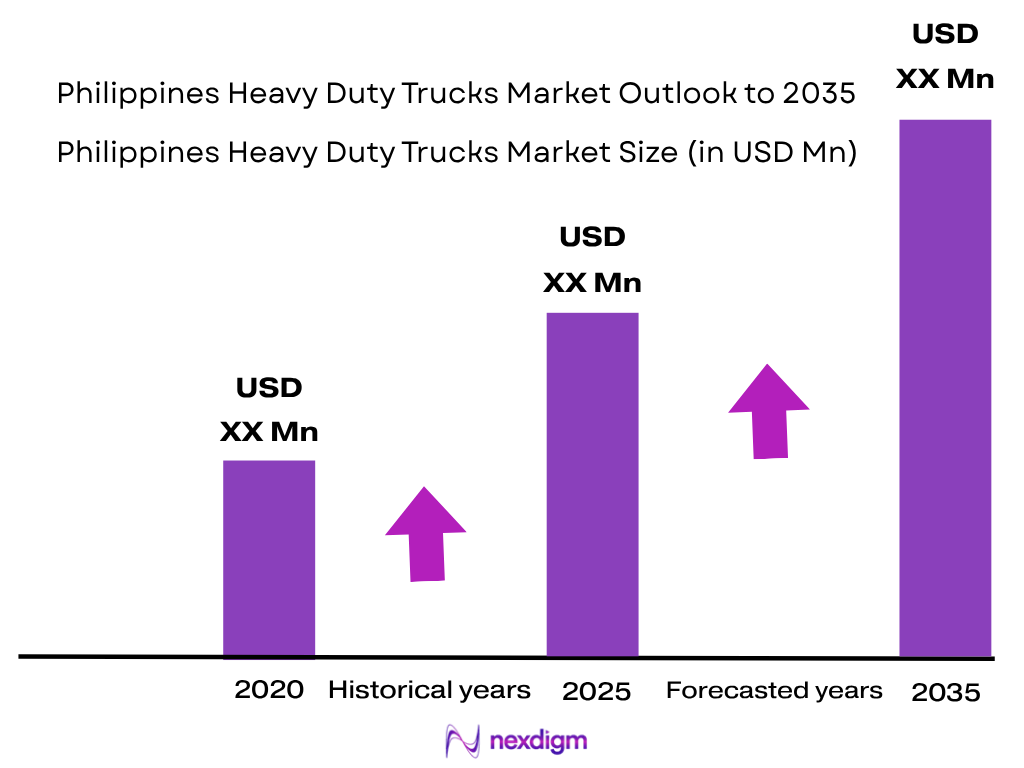
The Philippines Heavy Duty Trucks Market is valued at USD ~ billion in 2024, compared with USD ~ billion in 2023, supported by freight transportation demand, infrastructure construction, mining, agriculture, manufacturing, port activity and logistics expansion. The market is closely linked with commercial vehicle utilization, road-freight intensity and fleet replacement cycles. Heavy-duty tractor heads, rigid trucks, dump trucks and specialized chassis remain essential for moving high-payload cargo across Luzon, Visayas and Mindanao, while fleet operators increasingly prioritize uptime, fuel efficiency and lifecycle economics.
Metro Manila, Calabarzon, Central Luzon, Cebu and Davao represent the principal demand centers for heavy-duty trucks because they combine logistics activity, industrial production, ports, construction and large fleet-operating bases. Metro Manila functions as the country’s principal consumption and distribution hub, while Batangas and Cavite benefit from industrial estates and port connectivity. Central Luzon supports agriculture, manufacturing and North Luzon freight flows, Cebu serves as a major Visayas logistics hub, and Davao anchors distribution and agricultural supply chains in Mindanao. The country’s road network reached ~km in 2024, while registered motor vehicles totaled ~ million units, reinforcing the importance of road-based commercial transportation.
Market Segmentation
By Vehicle Type
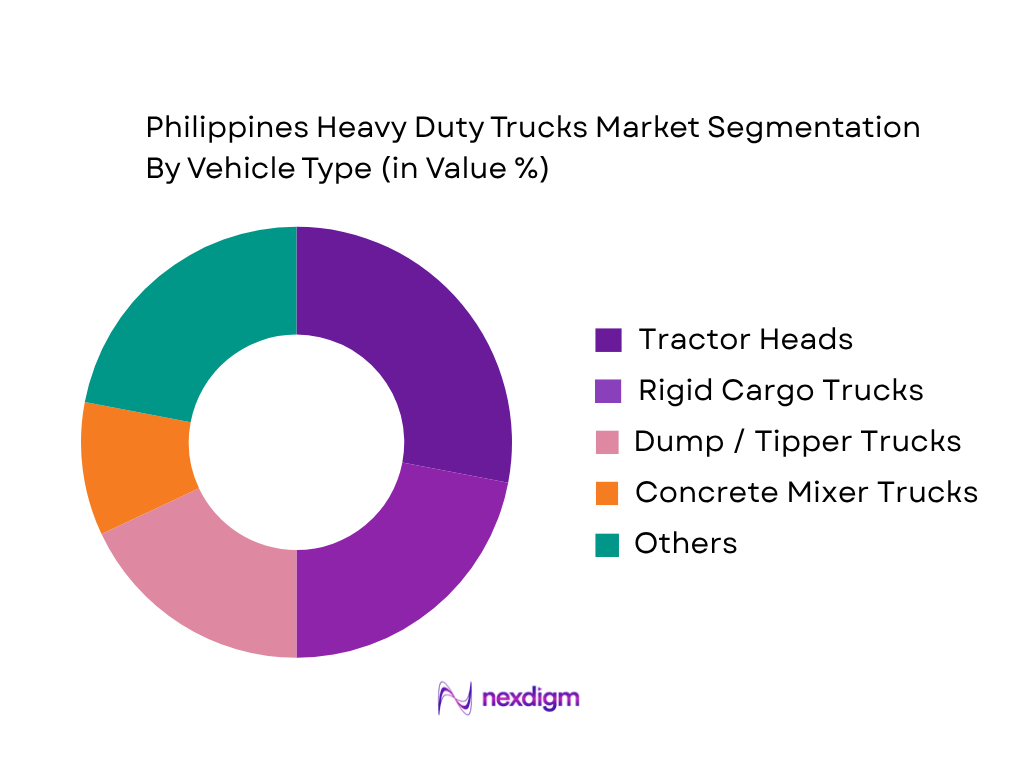
The Philippines Heavy Duty Trucks Market is segmented by vehicle type into tractor heads, rigid cargo trucks, dump trucks, concrete mixer trucks, tanker trucks, container trucks and specialized heavy-duty trucks. Tractor heads are expected to represent the dominant segment because they provide the flexibility required for long-haul freight, container movement and intercity logistics. Their operating configuration enables fleet operators to interchange trailers according to cargo requirements, improving asset utilization across distribution routes. Demand is reinforced by the country’s major ports and logistics corridors, where containerized freight requires high-capacity road transport. Tractor heads are also widely applicable to retail distribution, industrial cargo, construction materials and cross-island supply chains connected through roll-on/roll-off networks. Fleet owners generally favor established heavy-duty platforms because availability of spare parts, dealer support, driver familiarity and resale liquidity can materially influence operating economics. Continued development of logistics facilities, warehouses and industrial estates therefore supports sustained demand for tractor heads alongside replacement purchases from aging commercial fleets.
By Application
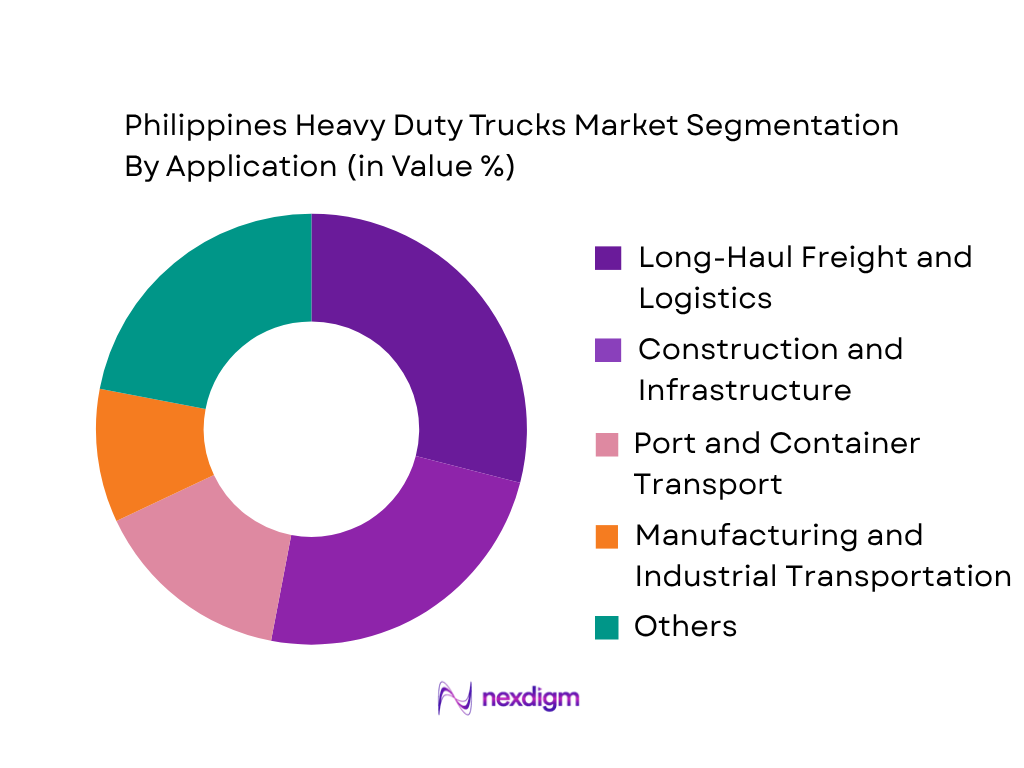
The Philippines Heavy Duty Trucks Market is segmented by application into long-haul freight and logistics, construction and infrastructure, mining and quarrying, agriculture and food logistics, port and container transport, oil and gas distribution, manufacturing and industrial transportation, waste management and municipal services. Long-haul freight and logistics is expected to command the largest share because heavy-duty trucks form the backbone of domestic cargo movement between production centers, ports, warehouses and consumption markets. The growth of modern logistics facilities increases the need for high-payload vehicles capable of maintaining frequent intercity cycles. Containerized trade also supports tractor-head utilization around major gateways, while retail and manufacturing supply chains require reliable movement of palletized and bulk cargo. Construction provides a separate demand pool for dump trucks, mixers and heavy rigid trucks, particularly around large infrastructure projects. Agriculture generates additional demand for bulk and temperature-sensitive transportation, while mining and quarrying create requirements for high-payload vocational vehicles. This diversified application base reduces dependence on any single freight segment and supports replacement as well as incremental fleet purchases.
Competitive Landscape
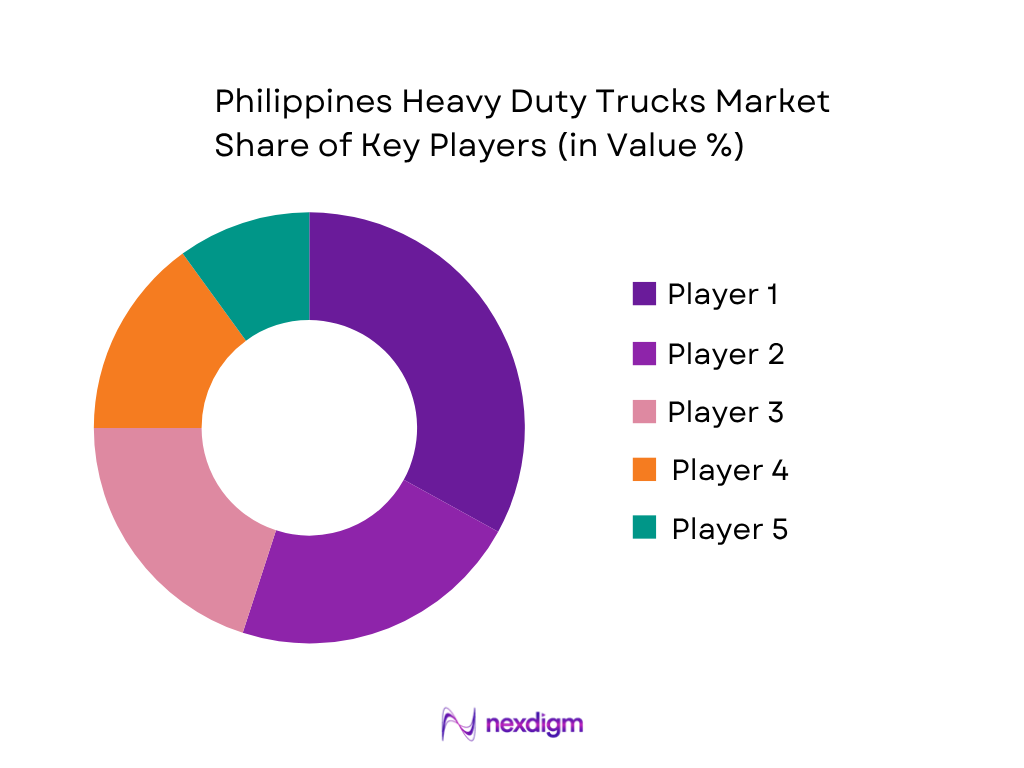
The Philippines Heavy Duty Trucks Market is characterized by strong participation from Japanese commercial-vehicle manufacturers, European truck brands and established local distributors. Competition is shaped not only by vehicle specifications but also by dealer reach, spare-parts availability, financing support, fleet uptime, after-sales service, residual value and suitability for Philippine road and payload conditions. Hino, Isuzu and Mitsubishi Fuso maintain strong positions across conventional fleet applications, while Volvo, Scania and UD Trucks compete in high-performance and long-haul applications. Local distributor capability remains an important competitive differentiator because fleet operators require dependable service coverage outside major metropolitan centers.
| Major Player | Established | Headquarters | Heavy-Duty Portfolio | Key Vehicle Strength | Dealer/Service Reach | Powertrain Focus | Fleet Technology |
| Isuzu | 1916 | Tokyo, Japan | ~ | ~ | ~ | ~ | ~ |
| Hino Motors | 1942 | Tokyo, Japan | ~ | ~ | ~ | ~ | ~ |
| Mitsubishi Fuso Truck and Bus Corporation | 1932 | Kawasaki, Japan | ~ | ~ | ~ | ~ | ~ |
| Volvo Trucks | 1927 | Gothenburg, Sweden | ~ | ~ | ~ | ~ | ~ |
| Scania | 1891 | Södertälje, Sweden | ~ | ~ | ~ | ~ | ~ |
Philippines Heavy Duty Trucks Market Analysis
Growth Drivers
Infrastructure Spending and Construction Activity
Infrastructure spending and construction activity provide a direct demand base for heavy-duty trucks used in earthmoving, aggregates transportation, cement distribution, equipment hauling and project logistics. Philippine Statistics Authority data show that construction grew 10.2% in 2024, making it one of the fastest-growing major industries and a significant contributor to overall economic expansion. The country’s GDP expanded 5.7% in 2024, while gross fixed capital formation increased 8.3% in 2024, according to the IMF. Regional construction activity was also particularly strong: Northern Mindanao’s construction industry expanded 11.5% in 2024, while Central Luzon recorded construction growth of 11.5%, according to PSA regional accounts. These indicators support sustained utilization of dump trucks, tractor heads, concrete mixers, low-bed heavy haulers and rigid cargo trucks for infrastructure and building projects. The Department of Public Works and Highways remains a major source of road, bridge and public-infrastructure activity, creating requirements for high-payload vehicles capable of operating on construction corridors. The heavy-duty truck opportunity therefore extends beyond new vehicle purchases to fleet replacement, specialized vocational configurations and higher-capacity equipment required for increasingly large infrastructure and industrial projects.
Logistics, Freight Volumes and Port-Linked Transportation
The Philippines’ archipelagic structure creates a particularly strong requirement for heavy trucks connecting ports, distribution centers, industrial estates, warehouses and consumption markets. Philippine Statistics Authority data recorded 30.00 million tons of domestic trade in 2024, compared with 27.66 million tons in 2023; food and live animals accounted for 8.55 million tons, while mineral fuels, lubricants and related materials represented 5.02 million tons. The Philippine Ports Authority reported that domestic cargo throughput reached 104.83 million metric tons in 2024, rising to 114.09 million metric tons in 2025, while total port cargo throughput reached 308.5 million metric tons in 2025. Road freight has become even more measurable through the Commodity Flow Survey: domestic commodities transported by road reached 28.28 million tons in 2025, and road movements reached 6.79 million tons in Q2 2026. These volumes directly support tractor heads, container carriers, rigid cargo trucks and specialized heavy-duty vehicles operating between ports and inland logistics nodes. E-commerce is adding another freight requirement: PSA valued the country’s digital economy at PHP 2.59 trillion in 2024, rising to PHP 2.74 trillion in 2025, with e-commerce forming a major component. Increasing cargo complexity and inter-regional distribution requirements consequently reinforce demand for higher-capacity trucks, fleet-management systems and dependable vehicle uptime.
Market Challenges
Road Congestion and Infrastructure Constraints
Road congestion and infrastructure limitations can reduce heavy-duty truck utilization by increasing journey times, fuel consumption, vehicle downtime and delivery uncertainty. The issue is particularly relevant because the Philippine freight system increasingly depends on road connections between ports, industrial areas, warehouses and regional consumption centers. PSA’s newly introduced Commodity Flow Survey provides a useful indication of the scale of road freight: 28.28 million tons of commodities moved through road transport in 2025, while road transport accounted for 6.79 million tons in Q2 2026. In that quarter, total domestic trade reached 10.57 million tons, with road transportation accounting for 64.3% of the recorded volume. This concentration means that congestion or capacity limitations can have an immediate effect on fleet productivity. Heavy-duty vehicles also face operating constraints from bridge classifications, road geometry, axle-load requirements and urban access restrictions, limiting the routes available to high-GVW configurations. The challenge is therefore not simply road quality; it concerns the ability to achieve commercially viable payload utilization while maintaining regulatory compliance and predictable delivery schedules. Operators may respond by deploying route-optimization systems, smaller specialized configurations for constrained corridors, night-time operations and higher-productivity vehicles, but these measures can increase fleet-management complexity.
Imported Vehicle and Component Dependence and Diesel Exposure
Dependence on imported vehicles, components, powertrain systems and petroleum products exposes Philippine heavy-duty truck operators to external supply-chain and fuel-related risks. Philippine Statistics Authority trade data recorded USD 127.60 billion of total imports in 2024, including USD 11.36 billion of transport equipment and USD 19.06 billion of mineral fuels, lubricants and related materials. Petroleum-importation statistics from the Department of Energy show that diesel imports reached 54.06 million barrels in 2024, compared with 51.07 million barrels in 2023. Heavy-duty trucking is particularly sensitive to diesel availability and consumption because long-haul tractors, rigid cargo vehicles, dump trucks and vocational fleets generally operate at high annual utilization. The exposure extends beyond fuel: imported truck platforms and components can lengthen procurement cycles when international shipping, currency movements or component shortages affect supply. Financing requirements compound the challenge because operators must fund high-value assets while maintaining sufficient working capital for fuel, maintenance and replacement parts. Smaller and fragmented fleet owners may therefore defer replacement purchases, retain older vehicles longer or select established platforms with readily available parts and service support. The resulting competitive advantage shifts toward manufacturers and distributors capable of maintaining strong inventories, localized technical support, financing partnerships and predictable aftermarket availability.
Market Opportunities
Fleet Electrification, Connected Heavy Trucks and Alternative Powertrains
The Philippines is establishing the policy and infrastructure framework necessary for gradual electrification of road transportation, creating a long-term opportunity for electric and alternative-powertrain heavy-duty vehicles. The Department of Energy states that transportation accounts for roughly one-third of the country’s final energy use and almost one-quarter of greenhouse-gas emissions, making transport electrification strategically relevant to national energy and emissions objectives. The Electric Vehicle Industry Development Act requires government and private fleets to target at least 5% EV penetration, while the associated framework also establishes requirements for charging infrastructure and EV deployment. At the same time, the Philippines’ digital economy reached PHP 2.59 trillion in 2024 and PHP 2.74 trillion in 2025, according to PSA, indicating a rapidly expanding digital ecosystem that can support connected-fleet services. For heavy-duty trucking, this creates opportunities extending beyond battery-electric vehicles to fleet telematics, remote diagnostics, driver-behavior monitoring, predictive maintenance and energy-management platforms. Urban and port-based delivery routes may provide particularly suitable operating environments for early electrification because predictable duty cycles can simplify depot charging. Manufacturers can also differentiate through integrated charging, financing, maintenance and fleet-management packages rather than selling vehicles alone. Alternative fuels and hybrid platforms can complement battery-electric trucks where long-distance payload requirements make immediate full electrification difficult.
Port Logistics Modernization and Specialized Heavy-Haul Vehicles
Modernization of port logistics, industrial supply chains and specialized freight operations creates an opportunity for higher-capacity and application-specific heavy-duty trucks. The Philippine Ports Authority reported 244.58 million metric tons of cargo throughput in 2024, increasing to 262.84 million metric tons in 2025, while container traffic increased from 6.43 million TEUs in 2024 to 7.14 million TEUs in 2025. PPA identified construction materials, infrastructure activity, mining and raw-mineral exports among the factors supporting cargo growth. These volumes strengthen the business case for tractor heads, container carriers, heavy-haul combinations, bulk-material trucks and specialized chassis optimized for port-to-warehouse and port-to-industrial movements. The opportunity is also supported by domestic trade: PSA recorded 60.19 million tons of domestic trade in 2025, including 28.28 million tons transported by road, demonstrating the importance of road links within the wider multimodal freight network. Heavy-duty truck manufacturers can capture this opportunity through application-specific specifications, higher payload configurations, automated transmission options, advanced braking systems, telematics and integrated fleet-management packages. Port operators and large logistics fleets can increasingly prioritize turnaround time, asset utilization and predictive maintenance rather than simply vehicle acquisition cost. This favors suppliers capable of combining trucks with service contracts, uptime guarantees, driver-support systems and digital fleet platforms, creating a broader commercial opportunity around specialized heavy-duty transportation solutions.
Future Outlook
The Philippines Heavy Duty Trucks Market is expected to maintain a positive long-term trajectory as freight volumes, infrastructure development, industrial activity and logistics requirements expand. Fleet modernization is likely to remain an important source of demand as operators replace aging vehicles with platforms offering improved fuel efficiency, safety and uptime. Growth in port-linked logistics and warehouse infrastructure should support tractor heads and container-hauling equipment, while construction and infrastructure investment should sustain demand for vocational trucks.
The market is also expected to gradually transition toward connected fleet management, automated diagnostics, advanced driver-assistance systems and lower-emission powertrains. However, adoption will depend on acquisition economics, charging or alternative-fuel infrastructure, fleet operating patterns and availability of qualified service personnel. Heavy-duty diesel vehicles are likely to remain important in applications where payload, range and refueling flexibility are critical.
Major Players
- Isuzu Motors Limited
- Hino Motors, Ltd.
- Mitsubishi Fuso Truck and Bus Corporation
- UD Trucks Corporation
- Volvo Trucks
- Scania
- Mercedes-Benz Trucks
- MAN Truck & Bus
- Hyundai Commercial Vehicles
- Sinotruk
- Shacman
- Foton Motor
- Dongfeng Commercial Vehicles
- FAW Trucks
- Iveco
Key Target Audience
- Heavy-Duty Truck OEMs and Commercial Vehicle Manufacturers
- Truck Importers, Authorized Distributors and Dealer Groups
- Logistics, Freight Forwarding and Third-Party Logistics Operators
- Construction, Infrastructure and Heavy-Equipment Fleet Operators
- Mining, Quarrying, Agriculture and Industrial Fleet Owners
- Investments and Venture Capitalist Firms (Private Equity Funds, Infrastructure Funds, Transportation-Focused Investors and Venture Capital Firms)
- Government and Regulatory Bodies (Department of Transportation, Land Transportation Office, Department of Public Works and Highways, Department of Trade and Industry, Department of Energy)
- Commercial Vehicle Financing and Fleet-Leasing Companies
Research Methodology
Step 1: Identification of Key Variables
The initial phase involves mapping the Philippines Heavy Duty Trucks Market ecosystem across OEMs, importers, distributors, fleet operators, logistics companies, construction contractors, ports and financing providers. Key variables include vehicle registrations, fleet replacement cycles, payload requirements, GVW categories, road freight activity, infrastructure expenditure and commercial vehicle utilization.
Step 2: Market Analysis and Construction
Historical market information is compiled across vehicle registrations, unit sales, fleet composition, vehicle classes, application demand and regional activity. The analysis distinguishes tractor heads, rigid trucks and vocational heavy-duty vehicles while evaluating demand generated by logistics, construction, ports, agriculture, mining and industrial transportation.
Step 3: Hypothesis Validation and Expert Consultation
Market hypotheses are validated through structured discussions with commercial vehicle distributors, fleet managers, transport operators, dealers and industry specialists. Discussions focus on purchasing criteria, fleet replacement timing, vehicle utilization, preferred configurations, financing practices, maintenance requirements, aftermarket support and emerging powertrain preferences.
Step 4: Research Synthesis and Final Output
The final stage triangulates secondary information, industry interviews, vehicle-registration information and company-level operating indicators. A bottom-up assessment of unit demand is reconciled with a top-down evaluation of freight activity, infrastructure development and commercial transportation requirements to produce the final market assessment and forecast.

- Executive Summary
- Research Methodology (Market Definition and Scope, Heavy Duty Truck Classification, GVW Thresholds, Category V Classification, New Vehicle Scope, CBU and CKD Treatment, Vehicle-Unit Reconstruction, Market Value Estimation, Top-Down Validation, Bottom-Up Dealer and OEM Analysis, CAMPI-TMA Reconciliation, LTO Registration Validation, Import-Export Analysis, Fleet Operator Interviews, Demand-Side Assessment, Supply-Side Assessment, Data Triangulation, Forecasting Framework, Scenario Modelling, Assumptions and Limitations)

- Definition and Scope
- Heavy Duty Truck Industry Evolution in the Philippines
- Philippine Commercial Vehicle Ecosystem Mapping
- Heavy Duty Truck Value Chain Analysis
- Heavy Duty Truck Supply Chain Analysis
- Philippine Heavy Vehicle Registration and Classification Framework
- Heavy Duty Truck Demand Centers

- Growth Drivers (Infrastructure Spending, Logistics and Freight Volumes, Port Expansion, Construction Activity, Manufacturing Output, E-Commerce Fulfillment, Agricultural Freight, Fleet Replacement and Inter-Island Distribution)
- Market Challenges (Road Congestion, Road and Bridge Weight Constraints, Imported Vehicle and Component Dependence, Financing Requirements, Diesel Exposure, Driver Availability, Aftermarket Parts Availability and Fragmented Fleet Ownership)
- Market Opportunities (Fleet Electrification, Connected Heavy Trucks, Advanced Driver Assistance Systems, Fleet Telematics, Predictive Maintenance, Port Logistics Modernization, Specialized Heavy-Haul Vehicles, Alternative Powertrains and Integrated Fleet Solutions)
- Market Trends (Fleet Modernization, Euro 4/Euro 5 Emission Technology, Automated Manual Transmission, Telematics Adoption, Fuel-Efficiency Optimization, ADAS, Fleet Digitization, Alternative Powertrains and Total-Cost-of-Ownership Procurement)
- Government and Regulatory Framework (Land Transportation Office Requirements, Department of Transportation Policies, Department of Public Works and Highways Regulations, DENR Emission Standards, Vehicle Inspection, GVW and Axle-Load Rules, Driver Licensing, Roadworthiness and Import Regulations)
- Porter’s Five Forces Analysis
- PESTLE Analysis
- SWOT Analysis

- By Market Value (2020-2025)
- By Vehicle Units Sold (2020-2025)
- By Average Selling Price (2020-2025)
- By Truck Configuration (2020-2025)
- By Body Type (2020-2025)
- By Powertrain (2020-2025)
- By End-Use Industry (2020-2025)
- By Fleet Ownership (2020-2025)

- By Gross Vehicle Weight / Payload Class (In Volume %)
Heavy Trucks
Extra-Heavy Trucks
Multi-Axle Heavy Trucks
Tractor Heads
Heavy-Haul Trucks
Rigid Heavy Trucks
Specialized Heavy Trucks - By Powertrain (In Volume %)
Diesel Heavy Duty Trucks
Battery Electric Heavy Duty Trucks
Hybrid Heavy Duty Trucks
CNG Heavy Duty Trucks
LNG Heavy Duty Trucks
Other Alternative-Fuel Heavy Trucks - By Truck Configuration (In Volume %)
4×2
6×2
6×4
8×4
8×6
10×4 and Multi-Axle Configurations
Tractor-Head Configurations
Articulated Truck Configurations - By Body Type / Application (In Volume %)
Tractor Heads
Cargo Trucks
Tipper and Dump Trucks
Container Trucks
Flatbed Trucks
Tanker Trucks
Concrete Mixer Trucks
Refrigerated Trucks
Crane Trucks
Garbage and Waste Trucks
Specialized Heavy Vehicles - By End-Use Industry (In Volume %)
Road Freight and Logistics
Port and Container Haulage
Construction and Civil Engineering
Manufacturing and Industrial Distribution
Mining and Quarrying
Agriculture and Agro-Industrial Logistics
Food and Beverage
Retail and E-Commerce Logistics
Oil, Gas and Petrochemicals
Power and Utilities
Waste Management
Government and Public Infrastructure - By Fleet Ownership (In Volume %)
Large Logistics Fleets
Construction Fleets
Port and Container Fleets
Manufacturing Fleets
Mining Fleets
Agricultural and Agro-Industrial Fleets
Government Fleets
Contract Logistics Fleets
SME Fleet Operators
Owner-Operators
Rental and Leasing Fleets

- Market Share of Major Players (By Vehicle Units, Market Value, Category V, GVW Class, Tractor Heads, Body Type, Powertrain, End-Use Industry and Fleet Ownership)
- Cross Comparison Parameters (Heavy Duty Truck Product Portfolio Breadth, GVW, Payload and Gross Combination Mass Capability, Engine Power, Torque and Driveline Performance, Fuel Efficiency and Total Cost of Ownership)
- SWOT Analysis of Major Players
- Detailed Profiles of Major Companies
Isuzu Philippines Corporation
Hino Motors Philippines Corporation
Sojitz Fuso Philippines Corporation
Foton Motor Philippines
UD Trucks Philippines
Volvo Trucks Philippines
Scania Philippines
MAN Automotive Concessionaires Corporation
Mercedes-Benz Trucks Philippines
Hyundai Trucks and Bus Philippines
JAC Motors Philippines
Dongfeng Philippines
Shacman Philippines
Sinotruk Howo Philippines
Tata Motors Philippines

- Logistics and Contract Freight Fleet Analysis
- Port and Container Haulage Fleet Analysis
- Construction and Civil Engineering Fleet Analysis
- Manufacturing and Industrial Fleet Analysis
- Mining and Quarrying Fleet Analysis
- Agriculture and Agro-Industrial Fleet Analysis
- Food and Beverage Logistics Fleet Analysis
- Retail and E-Commerce Logistics Fleet Analysis
- Oil, Gas and Petrochemical Fleet Analysis

- By Market Value (2026-2035)
- By Vehicle Units Sold (2026-2035)
- By Average Selling Price (2026-2035)
- By Truck Configuration (2026-2035)
- By Body Type (2026-2035)
- By Powertrain (2026-2035)
- By End-Use Industry (2026-2035)
- By Fleet Ownership (2026-2035)


 Request a Sample
 Ask for Customization
 Get a Quote
 Enquire Now