
 Download PDF
Market Overview
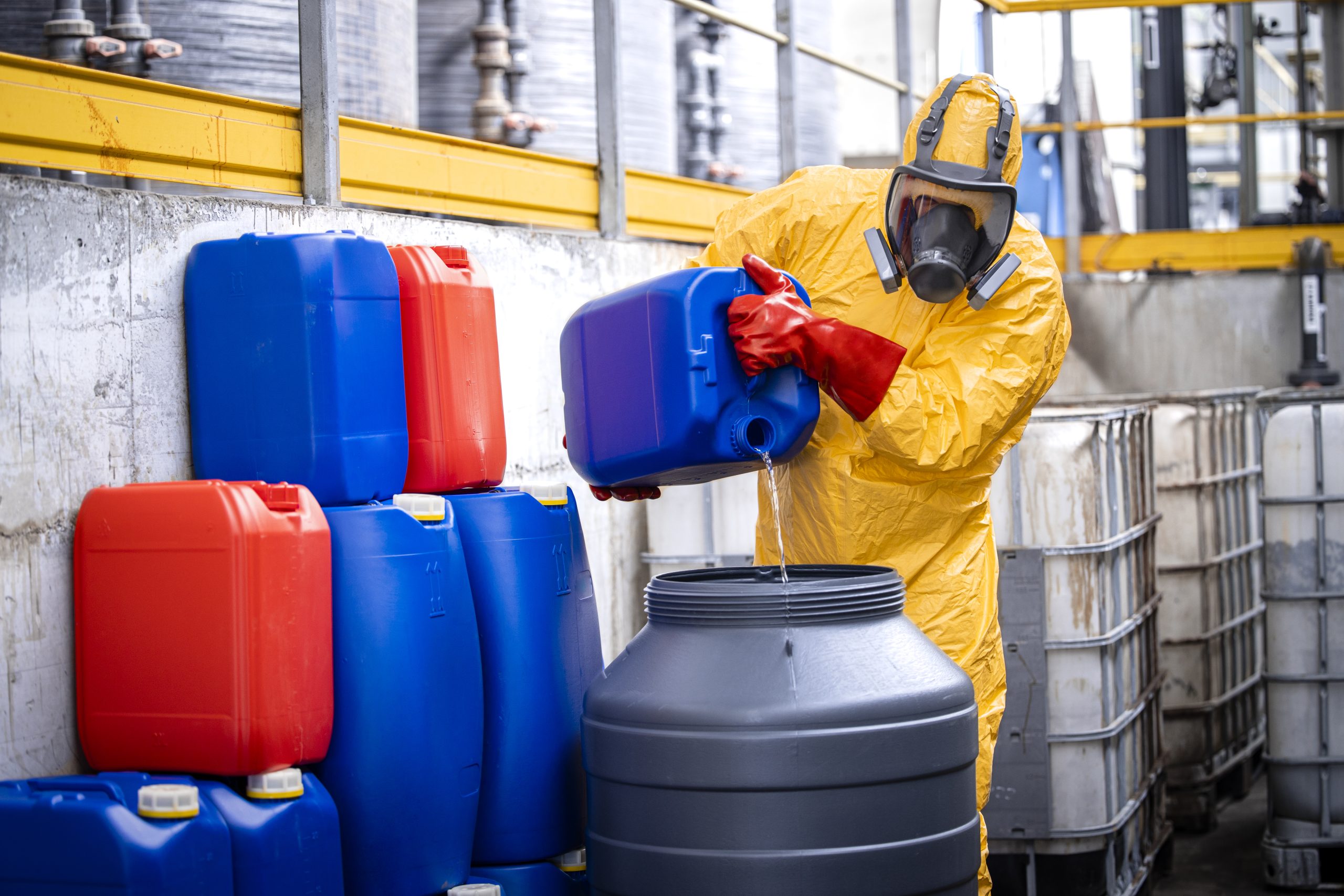
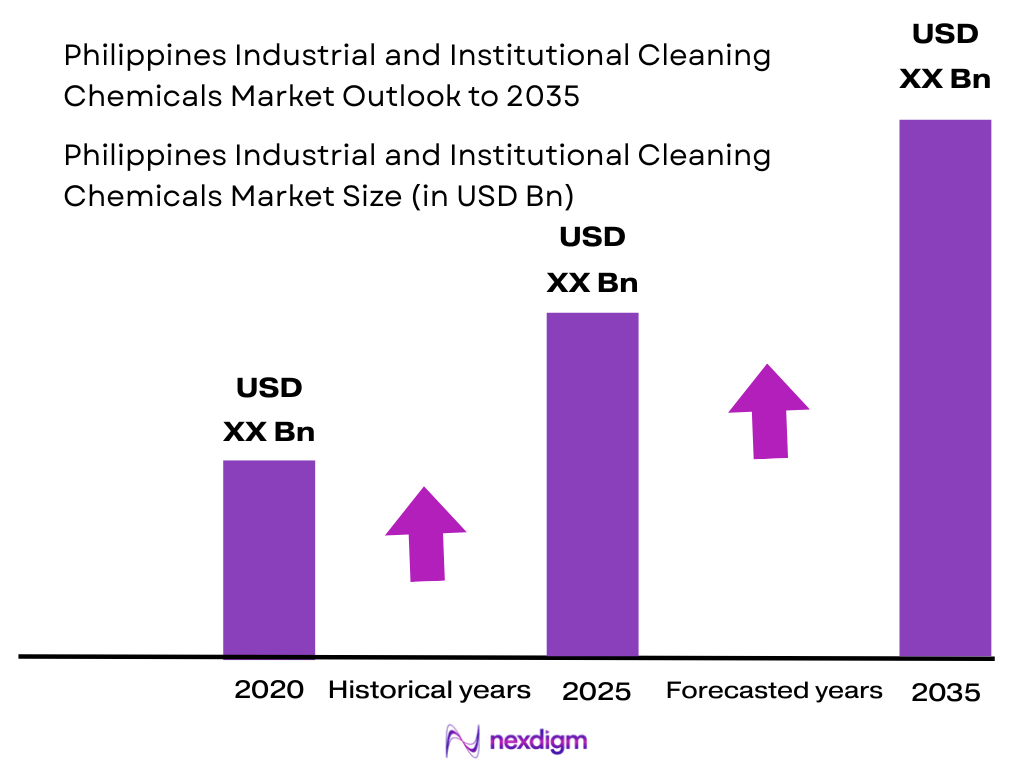
The Philippines Industrial and Institutional Cleaning Chemicals Market is valued at ~USD XX million, with demand linked to manufacturing, healthcare, hospitality, food processing, commercial facilities and outsourced cleaning services. The Philippine economy recorded GDP of USD 461.6 billion in 2024, compared with approximately USD 437 billion in 2023, while real GDP growth reached 5.7 in 2024 versus 5.5 in 2023. Manufacturing value added reached approximately USD 72.37 billion in 2024, providing a substantial industrial base for degreasers, disinfectants, equipment cleaners and process sanitation chemicals.
Dominant Cities and Industrial Hubs: Metro Manila, CALABARZON, Central Luzon and Central Visayas represent the principal demand centres because they combine manufacturing, healthcare, hospitality, commercial real estate, logistics and food-processing activity. PSA data shows NCR, CALABARZON and Central Luzon accounted for the largest regional contributions to services activity, while Central Visayas recorded the country’s fastest regional economic growth at 7.3 in 2024 and Central Luzon expanded by 6.5. Construction also generated PHP 563.89 billion nationally in 2024, supporting demand for cleaning chemicals across commercial and institutional facilities.
Market Segmentation
By Product Type
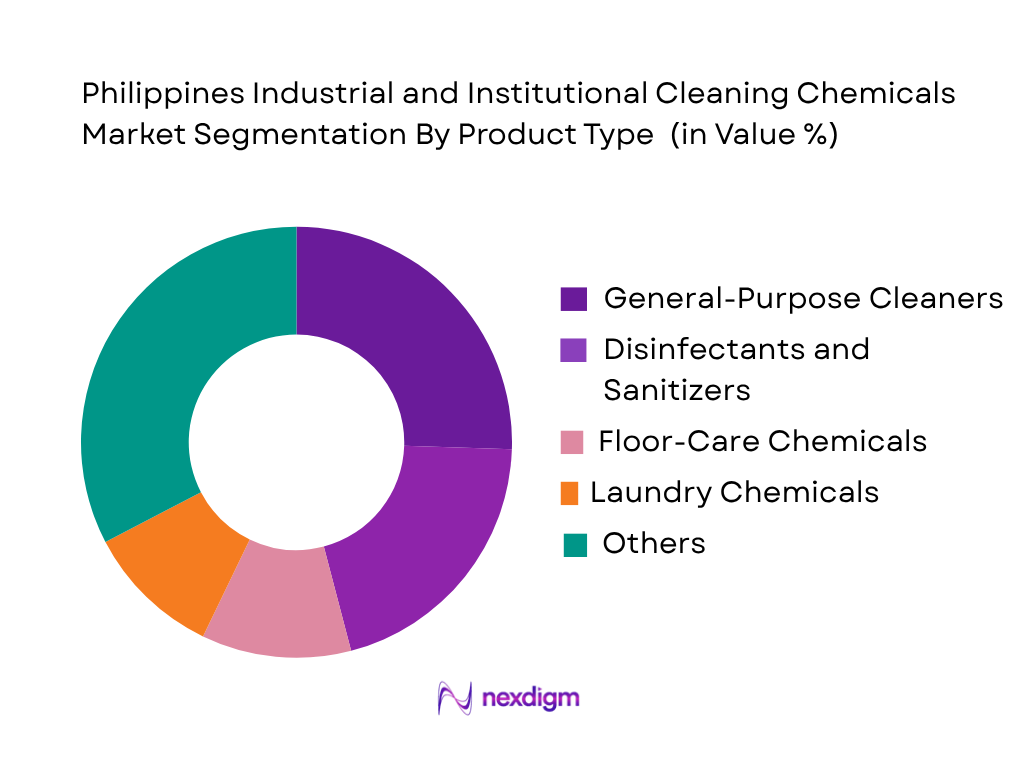
The Philippines Industrial and Institutional Cleaning Chemicals Market is segmented by product type into general-purpose cleaners, disinfectants and sanitizers, floor-care chemicals, laundry chemicals, warewashing chemicals, industrial degreasers, kitchen and food-service cleaners, glass and surface cleaners, restroom cleaners and specialty industrial cleaners. General-purpose cleaners are expected to represent the dominant sub-segment because they address the broadest range of institutional and industrial surfaces and can be deployed across offices, hotels, hospitals, retail facilities, restaurants and manufacturing premises. Their application across routine floor, wall, workstation, equipment and hard-surface cleaning creates recurring consumption rather than demand being restricted to specialized contamination events. Disinfectants and sanitizers remain particularly important for healthcare and food-service environments, while industrial degreasers have stronger penetration in manufacturing and maintenance operations. The market is also moving toward concentrated formulations, automated dosing and application-specific chemistry as professional users seek greater consistency in dilution, cleaning performance and chemical handling. This segmentation therefore captures both high-frequency routine cleaning and specialized industrial sanitation requirements.
By End-Use Industry
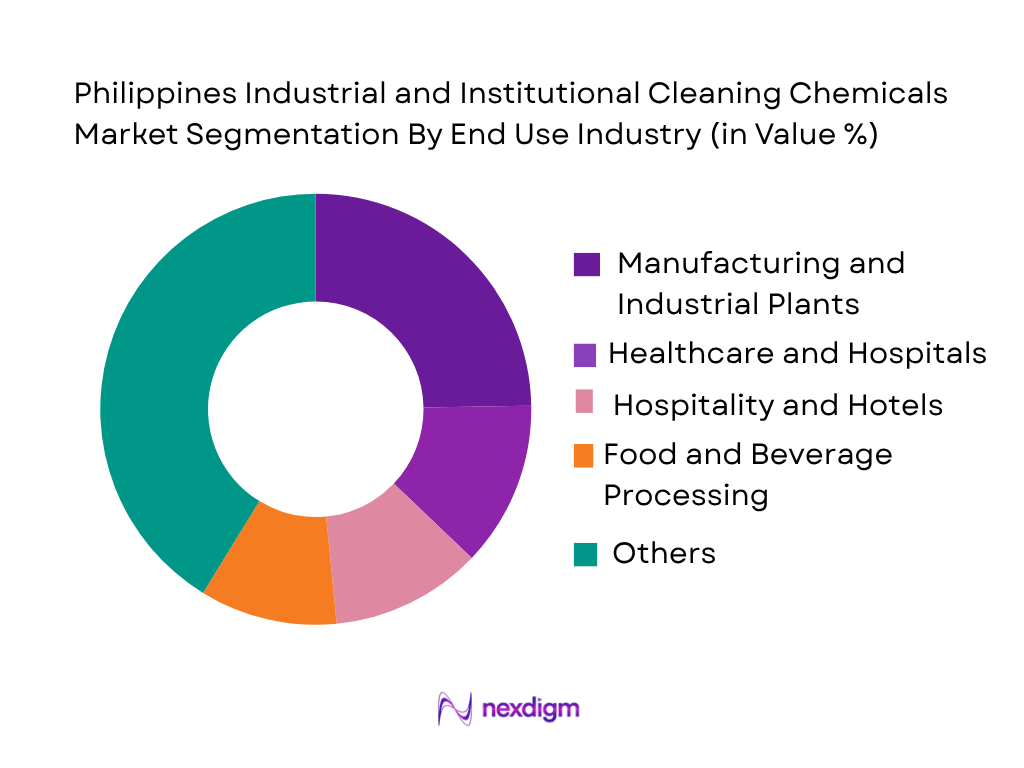
The Philippines Industrial and Institutional Cleaning Chemicals Market is segmented by end-use industry into healthcare and hospitals, hospitality and hotels, food and beverage processing, pharmaceutical manufacturing, electronics and semiconductor manufacturing, manufacturing and industrial plants, oil and gas, commercial offices, retail facilities, education, airports and transportation, ports and marine facilities, and government institutions. Manufacturing and industrial plants are positioned as the leading sub-segment because cleaning requirements extend beyond general housekeeping to machinery cleaning, parts washing, industrial degreasing, production-line sanitation and maintenance operations. The country’s manufacturing value added reached approximately USD 72.37 billion in 2024, demonstrating the scale of the industrial base requiring professional cleaning chemistry. Food processing, healthcare and hospitality create additional recurring demand through hygiene, sanitation and infection-control requirements. Pharmaceutical and electronics facilities increasingly require controlled-environment and low-residue cleaning chemistry, while commercial offices and retail properties create recurring demand through facility-management contracts. The breadth of industrial applications makes this end-use category particularly significant for suppliers offering technical formulations and integrated cleaning solutions.
Competitive Landscape
The Philippines Industrial and Institutional Cleaning Chemicals Market is characterized by multinational cleaning-chemistry suppliers, professional hygiene specialists and companies serving industrial and institutional customers through direct sales, distributors and facility-management relationships. Competitive differentiation centres on breadth of chemical portfolios, technical formulation capabilities, dosing systems, sustainability credentials, institutional contracts and coverage of specialized industries. The market’s industrial base, alongside expanding healthcare, hospitality and food-service activity, creates opportunities for suppliers able to provide application-specific chemistry rather than commodity cleaning products.
| Company | Establishment Year | Headquarters | Product Portfolio | Key I&I Applications | Distribution Model | Technology Focus | Sustainability Focus |
| Ecolab Inc. | 1923 | St. Paul, Minnesota, USA | Cleaning, sanitation and hygiene chemistry | Healthcare, hospitality, food processing, industrial | Direct and distributors | Dosing, sanitation systems, specialty chemistry | Water and chemical-use reduction |
| Diversey Holdings | 1923 | Fort Mill, South Carolina, USA | Professional cleaning and hygiene solutions | Healthcare, hospitality, commercial facilities | Direct and distribution | Automated dosing, floor care, disinfection | Concentrated and resource-efficient chemistry |
| BASF SE | 1865 | Ludwigshafen, Germany | Surfactants, specialty chemicals and cleaning ingredients | Industrial and institutional formulations | Direct and distribution | Specialty chemistry and formulation inputs | Bio-based and sustainable chemistry |
| Henkel AG & Co. KGaA | 1876 | Düsseldorf, Germany | Industrial and professional cleaning solutions | Manufacturing, maintenance and institutional cleaning | Direct and distributors | Industrial cleaning and process chemistry | Resource-efficient formulations |
| Reckitt Benckiser Group plc | 1823 | Slough, United Kingdom | Disinfection and hygiene products | Healthcare, institutional and commercial hygiene | Retail, institutional and distribution | Disinfection and hygiene chemistry | Product and packaging sustainability |
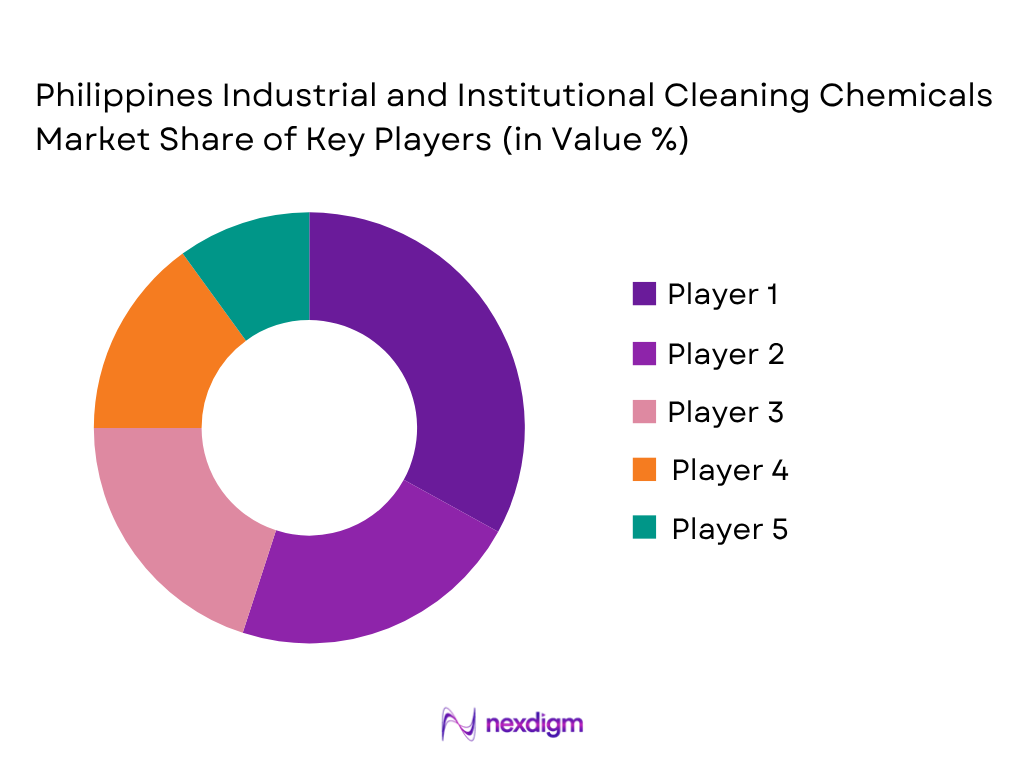
Philippines Industrial and Institutional Cleaning Chemicals Market Analysis
Growth Drivers
Manufacturing Activity
Manufacturing activity is a major demand generator for the Philippines Industrial and Institutional Cleaning Chemicals Market because factories require recurring cleaning of production lines, machinery, floors, components, processing areas and maintenance equipment. Philippine Statistics Authority national accounts show gross value added in manufacturing increased from PHP 3.78 trillion in 2023 to PHP 3.92 trillion in 2024, while food-product manufacturing increased from PHP 1.82 trillion to PHP 1.90 trillion at constant 2018 prices. The manufacturing sector’s 2024 average volume of production index also increased by 0.9, following 4.9 in 2023. These figures demonstrate a large operating base for industrial cleaners, degreasers, equipment-cleaning formulations and sanitation chemicals. Food manufacturing is particularly relevant because production facilities require regular cleaning of food-contact surfaces, processing equipment and production environments. Electronics manufacturing also strengthened in December 2024, with the volume of production index for computer, electronic and optical products increasing by 4.3 year-on-year. Consequently, demand extends from conventional industrial degreasers toward specialized, low-residue and surface-compatible cleaning chemistry. Continued manufacturing operations therefore create recurring chemical consumption rather than one-time demand, particularly where cleaning is integrated into production, maintenance and sanitation schedules.
Healthcare Infrastructure
Expansion and increasing expenditure across healthcare facilities is strengthening demand for disinfectants, sanitizers, surface cleaners, floor-care chemicals, laundry formulations and specialized cleaning products in the Philippines Industrial and Institutional Cleaning Chemicals Market. Philippine Statistics Authority data show that total health expenditure reached PHP 1.56 trillion in 2024, compared with PHP 1.33 trillion in 2023, while per-capita health expenditure increased from PHP 10,840 to PHP 12,751. The 2024 Annual Survey of Philippine Business and Industry recorded 8,181 formal-sector establishments engaged in human health and social work activities, including 930 hospital establishments and 6,240 medical and dental practice establishments. NCR alone contained 2,469 establishments in this broad health and social-work category. This expanding healthcare operating base requires systematic cleaning and disinfection across patient rooms, operating areas, treatment spaces, medical equipment, washrooms and healthcare laundry. Higher healthcare expenditure also supports investment in facility operations and infection-control practices, increasing the requirement for professionally specified cleaning chemistry. Demand is therefore not limited to general-purpose cleaners: healthcare facilities require formulations compatible with frequently cleaned surfaces and controlled sanitation procedures.
Market Challenges
Imported Raw Material Dependency
Dependence on imported raw materials and intermediate goods presents a structural challenge for the Philippines Industrial and Institutional Cleaning Chemicals Market because manufacturers and formulators may require imported surfactants, solvents, specialty additives, enzymes, biocides and other chemical inputs. Philippine Statistics Authority trade statistics show total imports reached USD 127.60 billion in 2024, compared with USD 126.21 billion in 2023. Raw materials and intermediate goods represented USD 46.47 billion of imports in 2024, while capital-goods imports reached USD 35.73 billion. The country’s largest individual import supplier was China at USD 32.83 billion, followed by Indonesia at USD 10.64 billion, Japan at USD 10.11 billion, South Korea at USD 9.63 billion and the United States at USD 8.17 billion. Although these figures cover the entire economy rather than cleaning chemicals alone, they demonstrate the importance of imported industrial inputs within Philippine manufacturing. For cleaning-chemical formulators, reliance on international supply chains can create exposure to shipping disruptions, foreign-supplier availability and longer replenishment cycles. This encourages manufacturers to strengthen inventory planning, diversify suppliers and evaluate local formulation or sourcing alternatives where technically feasible.
Regulatory Compliance and Chemical Handling
Regulatory compliance, hazardous-chemical handling and wastewater requirements create operational complexity for professional cleaning-chemical users in the Philippines Industrial and Institutional Cleaning Chemicals Market. The challenge is particularly relevant for concentrated acids, alkalis, solvents, disinfectants and other formulations that require appropriate storage, labelling, handling procedures and worker protection. Philippine industrial facilities also operate within a broader environmental-management framework covering chemical use, waste handling and wastewater discharge. The scale of industrial activity increases the relevance of these requirements: Philippine Statistics Authority data record PHP 3.92 trillion of manufacturing gross value added at constant 2018 prices in 2024, alongside PHP 1.90 trillion from food-product manufacturing. Construction activity also reached PHP 563.89 billion in 2024, up from PHP 515.30 billion in 2023, creating additional commercial and industrial facilities requiring cleaning systems. As professional customers increasingly standardize cleaning protocols, suppliers must provide safety documentation, appropriate dilution guidance and application instructions. Chemical handling requirements can also encourage customers to adopt closed dosing systems, concentrated products and safer formulations that reduce manual handling. Thus, compliance is both a cost and an important product-selection criterion across industrial and institutional applications.
Market Opportunities
Concentrated Cleaning Chemistry and Water-Efficient Cleaning
Concentrated and water-efficient cleaning chemistry presents a strong opportunity in the Philippines Industrial and Institutional Cleaning Chemicals Market because professional users can apply standardized dilution systems across manufacturing, healthcare, hospitality, food processing and commercial facilities. The opportunity is supported by the country’s expanding industrial and construction base: manufacturing gross value added reached PHP 3.92 trillion at constant 2018 prices in 2024, while construction gross value added reached PHP 1.66 trillion, compared with PHP 1.51 trillion in 2023. Commercial and institutional demand is also substantial, with 37,500 formal-sector accommodation and food-service establishments recorded by the Philippine Statistics Authority for 2024, employing 520,642 workers. These facilities require recurring floor, kitchen, restroom, laundry, surface and equipment cleaning. Concentrated chemistry can be integrated with automated dosing and dispensing systems, enabling consistent dilution and reducing unnecessary product handling. Water-efficient formulations are particularly relevant where cleaning programs involve repeated rinsing and large facility areas. The opportunity therefore extends beyond selling individual chemicals toward integrated chemical-and-dosing programs for multi-site customers. Suppliers that combine concentrated formulations with technical training, dosing equipment and application-specific protocols can address industrial productivity, sanitation consistency and resource-efficiency requirements simultaneously.
Food-Processing Sanitation and Healthcare Hygiene
Food-processing sanitation and healthcare hygiene represent attractive application opportunities because both sectors require recurring, application-specific cleaning and disinfection rather than occasional general-purpose cleaning. Philippine Statistics Authority data show food-product manufacturing gross value added increased from PHP 1.82 trillion in 2023 to PHP 1.90 trillion in 2024 at constant 2018 prices, while the volume of production index for food manufacturing increased by 0.6 in 2024 after declining by 1.5 in 2023. Healthcare provides another substantial demand base: total health expenditure reached PHP 1.56 trillion in 2024, and the country recorded 8,181 formal-sector establishments in human health and social work activities, including 930 hospitals. These operating environments require specialized chemistry for clean-in-place systems, open-plant cleaning, food-contact surfaces, equipment sanitation, patient-room disinfection, high-touch surfaces and healthcare laundry. This creates room for enzyme-based cleaners, low-residue disinfectants, concentrated sanitation products and automated dosing solutions. Suppliers can further differentiate through application protocols, technical support and chemical programs tailored to individual facility requirements. The opportunity is therefore centered on moving customers from commodity cleaning products toward validated, sector-specific sanitation systems that improve consistency while supporting operational and hygiene requirements.
Future Outlook
The Philippines Industrial and Institutional Cleaning Chemicals Market is expected to expand as industrial production, healthcare services, hospitality activity, food processing and commercial facility development increase the requirement for professional cleaning and sanitation. Demand is likely to shift toward concentrated formulations, specialized chemistry, automated dosing and environmentally preferable products. Growth in facility-management outsourcing should further encourage standardized chemical procurement across multi-site customers. Suppliers with strong technical support, regulatory documentation, local distribution and application-specific formulations are likely to be better positioned to capture future demand.
Major Players
- Ecolab Inc.
- Diversey Holdings
- BASF SE
- Henkel AG & Co. KGaA
- Reckitt Benckiser Group plc
- Unilever PLC
- The Procter & Gamble Company
- 3M Company
- SC Johnson Professional
- The Clorox Company
- Zep Inc.
- Spartan Chemical Company
- Christeyns NV
- Kärcher
- Kimberly-Clark Professional
Key Target Audience
- Industrial and institutional cleaning chemical manufacturers
- Professional hygiene and sanitation product distributors
- Facility management and contract cleaning companies
- Healthcare and hospital procurement departments
- Food and beverage processing companies
- Manufacturing and industrial plant operators
- Investments and venture capitalist firms (industrial chemicals, specialty chemicals and facility-services investments)
- Government and regulatory bodies (Philippine Food and Drug Administration, Department of Environment and Natural Resources, Environmental Management Bureau, Department of Labor and Employment)
Research Methodology
Step 1: Identification of Key Variables
The initial phase involves mapping the Philippines Industrial and Institutional Cleaning Chemicals ecosystem across manufacturers, importers, distributors, facility-management companies and major end users. Product-level variables include cleaner type, chemistry, formulation, application and dosage, while demand-side variables cover facility type, cleaning frequency, industrial activity and procurement structure.
Step 2: Market Analysis and Construction
Historical market information is compiled through supply-side and demand-side assessment covering professional cleaning chemicals used across healthcare, hospitality, food processing, manufacturing, pharmaceuticals, electronics, commercial facilities and transportation. Market construction incorporates product segmentation, end-use consumption patterns, distribution structures and regional demand centres.
Step 3: Hypothesis Validation and Expert Consultation
Market hypotheses are tested against industry information from chemical manufacturers, distributors, facility-management providers and major end users. Expert consultation is used to validate product adoption, formulation preferences, procurement practices, application intensity, technology adoption and the transition toward concentrated and sustainable cleaning chemistry.
Step 4: Research Synthesis and Final Output
The final analysis integrates secondary research, industry validation and market triangulation to establish a consistent view of market structure. Findings are cross-checked across product categories, end-use industries, distribution channels and geographic demand centres before developing the competitive assessment and forward-looking market outlook.

- Executive Summary
- Research Methodology (Market Definition, Product Scope, Product Inclusion and Exclusion Criteria, Market Taxonomy, Top-Down Market Sizing, Bottom-Up Market Sizing, Volume-to-Value Conversion, Supply-Side Mapping, Demand-Side Assessment, Import-Export Validation, Distributor Mapping, Facility-Level Consumption Analysis, End-User Interviews, Expert Validation, Data Triangulation, Forecasting Framework, Scenario Analysis, Assumptions and Limitations)

- Definition and Scope
- Industrial vs Institutional Cleaning Chemical Ecosystem
- Evolution of Professional Cleaning and Hygiene Chemistry in the Philippines
- Philippines Industrial and Institutional Cleaning Chemicals Value Chain
- Raw Material-to-Formulation Value Chain
- Domestic Blending, Formulation and Manufacturing Landscape

- Growth Drivers (Manufacturing Activity, Healthcare Infrastructure, Hospitality Expansion, Food Processing Growth, Facility Management Outsourcing, Commercial Real Estate Development, Pharmaceutical Manufacturing, Industrial Hygiene Requirements)
- Market Challenges (Imported Raw Material Dependency, Specialty Chemical Import Exposure, Regulatory Compliance, Hazardous Chemical Handling, Wastewater Discharge Requirements, Product Quality Variability, Fragmented Distribution, Skilled Workforce Availability)
- Market Opportunities (Concentrated Cleaning Chemistry, Water-Efficient Cleaning, Sustainable Surfactants, Enzyme-Based Cleaners, Low-VOC Formulations, Automated Chemical Dosing, Smart Dispensing, Food-Processing Sanitation, Healthcare Hygiene, Local Formulation and Manufacturing)
- Market Trends (Concentrated Formulations, Green Cleaning Chemistry, Enzymatic Cleaning, Low-Residual Disinfection, Automated Dosing, Smart Dispensing, Water-Efficient Cleaning, Sustainable Packaging, Digital Facility Management, Contract Cleaning Integration)
- Government and Regulatory Framework (Philippine FDA Requirements, Environmental Management Bureau Regulations, Chemical Control Orders, GHS Classification and Labelling, Hazardous Substance Management, Workplace Chemical Safety, Environmental Compliance, Wastewater Discharge, Food Hygiene, Healthcare Sanitation)
- SWOT Analysis
- Porter’s Five Forces Analysis
- PESTLE Analysis

- By Market Value (2020-2025)
- By Volume Consumption (2020-2025)
- By Product Category (2020-2025)
- By Chemistry Type (2020-2025)
- By Formulation Type (2020-2025)

- By Product Type (In Value %)
General-Purpose Cleaners
Disinfectants and Sanitizers
Floor Care Chemicals
Laundry Chemicals
Warewashing Chemicals
Kitchen and Food-Service Cleaners
Industrial Degreasers
Glass and Surface Cleaners
Restroom and Washroom Cleaners
Carpet and Upholstery Cleaners
Vehicle and Transportation Cleaners
Specialty Industrial Cleaners - By Chemistry Type (In Value %)
Alkaline Cleaning Chemistry
Acidic Cleaning Chemistry
Neutral Cleaning Chemistry
Solvent-Based Cleaning Chemistry
Surfactant-Based Cleaning Chemistry
Enzyme-Based Cleaning Chemistry
Biocide-Based Cleaning Chemistry
Oxidizing Cleaning Chemistry
Chelating and Builder-Based Chemistry
Bio-Based Cleaning Chemistry
Low-VOC Cleaning Chemistry - By Formulation Type (In Value %)
Ready-to-Use Liquids
Concentrated Liquids
Powders
Gels
Foams
Tablets and Solid Doses
Pre-Moistened Wipes
Low-Foam Formulations
High-Foam Formulations
Dilutable Professional Formulations - By End-Use Industry (In Value %)
Healthcare and Hospitals
Hospitality and Hotels
Food and Beverage Processing
Pharmaceutical Manufacturing
Semiconductor and Electronics Manufacturing
Oil and Gas
Petrochemicals and Chemicals
Manufacturing and Industrial Plants
Commercial Offices
Retail and Shopping Centres
Education and Institutional Facilities
Airports and Transportation
Ports and Marine Facilities
Government and Public Facilities - By Cleaning Application (In Value %)
Hard-Surface Cleaning
Floor Cleaning and Maintenance
Equipment and Machinery Cleaning
Clean-in-Place Cleaning
Open-Plant Cleaning
Industrial Degreasing
Parts and Component Cleaning
Automatic Warewashing
Laundry Cleaning
Restroom Sanitation
High-Touch Surface Disinfection
Cleanroom Cleaning
Precision and Specialty Cleaning - By Facility Type (In Value %)
Hospitals and Medical Centres
Hotels and Resorts
Restaurants and Commercial Kitchens
Food Processing Plants
Pharmaceutical Facilities
Electronics Manufacturing Plants
Industrial Manufacturing Facilities
Oil and Gas Facilities

- Market Share Analysis of Major Players (By Value, Product Category, Chemistry Type, Formulation Type, End-Use Industry, Application, Customer Type, Distribution Channel)
- Cross Comparison Parameters (Product Portfolio Breadth, Professional Cleaning SKU Coverage, Domestic Formulation Footprint, Specialty Chemistry Capability, Sustainable Chemistry Portfolio, Automated Dosing Capability, Distribution Network Reach, End-User Industry Coverage)
- Major Player SWOT Analysis
- Detailed Profiles of Major Companies
Ecolab Inc.
Diversey Holdings
BASF SE
Henkel AG & Co. KGaA
Reckitt Benckiser Group plc
Unilever PLC
The Procter & Gamble Company
3M Company
SC Johnson Professional
The Clorox Company
Zep Inc.
Spartan Chemical Company
Christeyns NV
Kärcher
Kimberly-Clark Professional

- Institutional Cleaning Consumption Behavior
- Industrial Cleaning Consumption Behavior
- End-User Procurement Preferences
- Healthcare Facility Purchasing Behaviour
- Healthcare Facility Purchasing Behaviour

- By Market Value (2026-2035)
- By Volume Consumption (2026-2035)
- By Product Category (2026-2035)
- By Chemistry Type (2026-2035)
- By Formulation Type (2026-2035)


 Request a Sample
 Ask for Customization
 Get a Quote
 Enquire Now