
 Download PDF
Market Overview
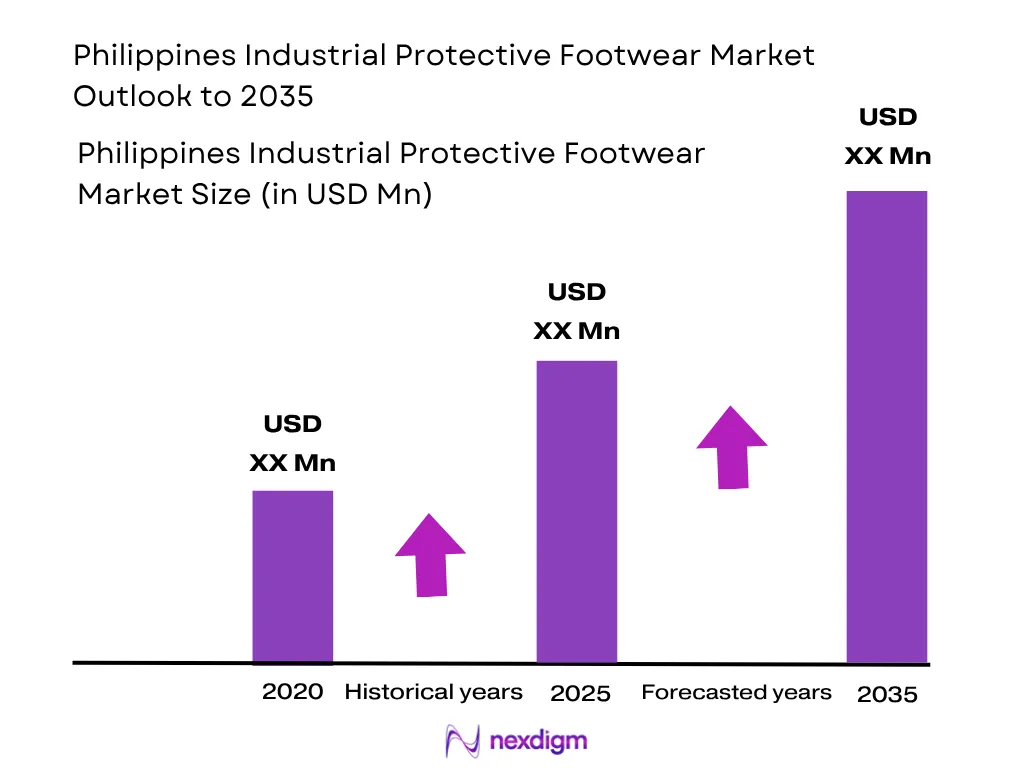
The Philippines Industrial Protective Footwear Market is valued at USD ~ million, based on a five-year historical analysis using Philippines PPE demand, industrial employment exposure, import-led safety footwear pricing, and corporate PPE procurement cycles. The broader Philippines PPE market reached USD ~ million, while the national labor force reached 50.79 million persons and GDP growth reached 5.6%, supporting employer-paid PPE demand across construction, manufacturing, logistics, utilities, mining, food processing, and electronics facilities. Growth is driven by mandatory workplace PPE provision, stronger safety audits, and industrial expansion.
Metro Manila, CALABARZON, Central Luzon, Cebu, and Davao dominate the Philippines Industrial Protective Footwear Market because they concentrate corporate procurement offices, industrial parks, logistics hubs, port-linked warehousing, construction activity, and export-oriented factories. CALABARZON’s economy reached PHP 3.10 trillion, reflecting its role as the country’s core industrial hub, while construction added 378,000 workers and manufacturing added 285,000 workers in the employment base. These cities and regions lead demand for steel toe, S1P/S3, anti-slip, waterproof, and ESD footwear used in daily industrial operations.
Market Segmentation
By Product Type
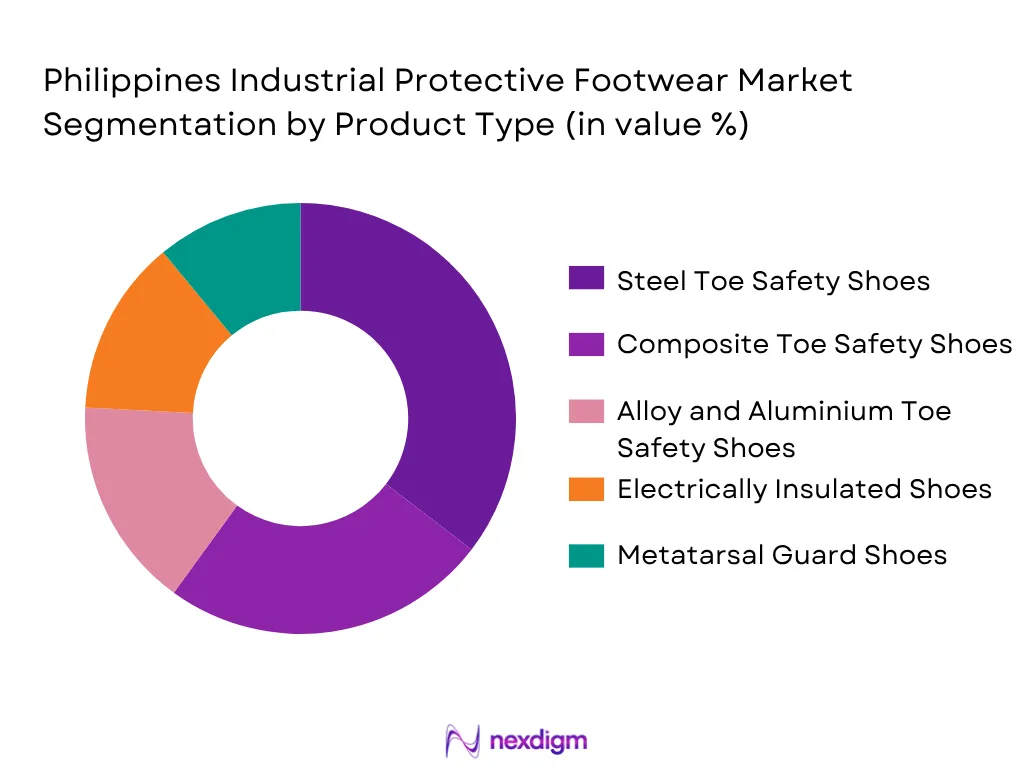
The Philippines Industrial Protective Footwear Market is segmented by product type into safety shoes, ankle safety boots, mid-cut and high-cut safety boots, PVC/rubber gumboots, and executive safety footwear. Safety shoes hold the dominant market share because they serve the broadest industrial workforce across manufacturing plants, warehouses, logistics depots, construction support functions, and facility maintenance teams. They are preferred by procurement teams because they provide toe protection, slip resistance, and puncture-resistant options at a lower average selling price than heavy-duty boots. Safety shoes are also easier to standardize across workers with different job roles, making them suitable for annual PPE issuance programs. In electronics, automotive components, warehousing, retail logistics, and light industrial production, low-cut or sporty safety shoes are favored over high-cut boots because they reduce worker fatigue in hot and humid work environments. The availability of steel toe and composite toe variants across local distributors further supports this segment’s leadership.
By End-Use Industry
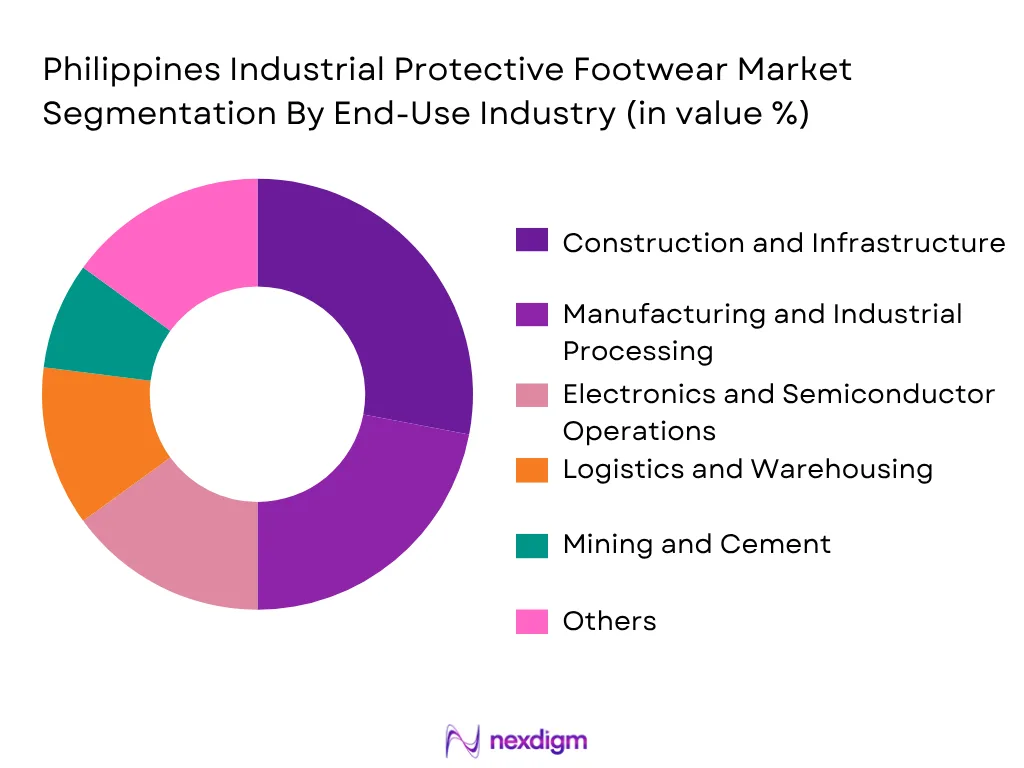
The Philippines Industrial Protective Footwear Market is segmented by end-use industry into construction and infrastructure, manufacturing and industrial processing, electronics and semiconductor operations, logistics and warehousing, mining and cement, oil & gas and utilities, food and beverage processing, and chemicals and pharmaceuticals. Construction and infrastructure hold the dominant market share because site workers require reinforced toe caps, puncture-resistant midsoles, anti-slip soles, and rugged uppers for falling-object hazards, sharp debris, wet concrete, and uneven terrain. Procurement is typically project-based, with large bulk orders placed during workforce mobilization for contractors, subcontractors, EPC firms, and civil works operators. The segment also has higher replacement intensity because outsole wear, stitching failure, sole separation, and water ingress occur faster on active sites than in indoor manufacturing. Public infrastructure, private real estate development, roads, ports, warehouses, and utilities construction continue to create recurring demand for economy and mid-range certified safety footwear.
Competitive Landscape
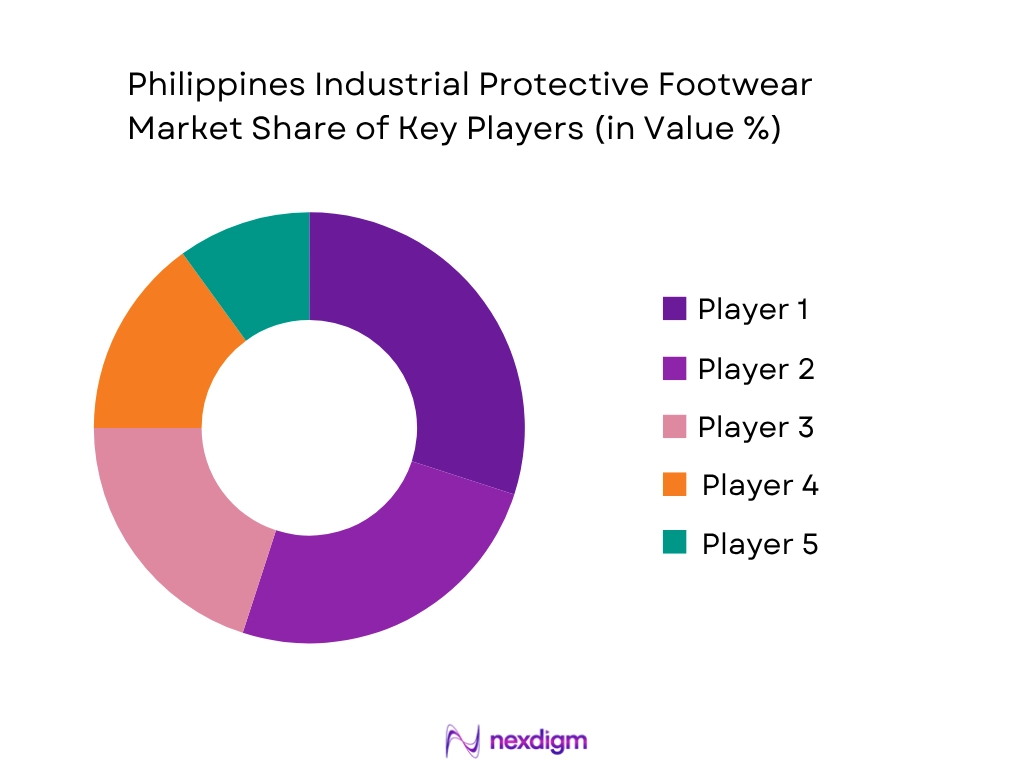
The Philippines Industrial Protective Footwear Market is moderately fragmented, with imported global brands, regional safety footwear specialists, and local PPE distributors competing on certification credibility, price, size availability, tender responsiveness, and industrial SKU depth. International brands such as Bata Industrials, Safety Jogger, Caterpillar Footwear, Skechers Work, and Timberland PRO are positioned in the organized and premium segments, while local distributors and online B2B suppliers compete strongly in economy steel toe shoes, PVC gumboots, and bulk contractor footwear.
| Player | Establishment Year | Headquarters | Core Footwear Positioning | Key Toe-Cap Portfolio | Certification/Protection Focus | Priority End Users | Philippines Channel Strength | Price Positioning | Market-Specific Advantage |
| Bata Industrials | 1894 | Lausanne, Switzerland | ~ | ~ | ~ | ~ | ~ | ~ | ~ |
| Safety Jogger | 2001 | Oudenaarde, Belgium | ~ | ~ | ~ | ~ | ~ | ~ | ~ |
| Caterpillar Footwear | 1994 | Rockford, Michigan, United States | ~ | ~ | ~ | ~ | ~ | ~ | ~ |
| Skechers Work | 1992 | Manhattan Beach, California, United States | ~ | ~ | ~ | ~ | ~ | ~ | ~ |
| Timberland PRO | 1952 | Stratham, New Hampshire, United States | ~ | ~ | ~ | ~ | ~ | ~ | ~ |
Philippines Industrial Protective Footwear Market Analysis
Growth Drivers
Employer-Paid PPE Mandates
Employer-paid PPE mandates are a direct growth driver for the Philippines Industrial Protective Footwear Market because protective equipment for the feet is legally positioned as an employer responsibility rather than an optional worker purchase. Republic Act No. 11058 states that every employer, contractor, or subcontractor must provide workers, free of charge, protective equipment for the “eyes, face, hands and feet” when hazardous work processes or environments require it. The same law also specifies that PPE must form part of the safety and health program and must be tested and approved by DOLE standards. This regulatory base is commercially relevant because the Philippines had 50.79 million people in the labor force and 48.84 million employed persons, creating a large employer-managed safety compliance base. Formal establishments with 10 or more workers employed 6.14 million persons in August, with the industry sector accounting for a large compliance-heavy workforce. For protective footwear suppliers, this supports recurring demand from onboarding, replacement issuance, contractor mobilization, and OSH audit compliance across construction, manufacturing, logistics, utilities, mining, food processing, and industrial services.
Source: Lawphil/Republic Act No. 11058, Philippine Statistics Authority. (Lawphil)
Industrial Workforce Expansion
Industrial workforce expansion supports the Philippines Industrial Protective Footwear Market because every additional site-based worker in manufacturing, construction, logistics, and transportation increases the need for toe protection, slip resistance, puncture resistance, and job-specific PPE issuance. The Philippine Statistics Authority reported 49.54 million employed persons in November, and industry accounted for 17.9 out of every 100 employed persons during the period. Manufacturing added 784 thousand employed persons year-on-year, while transportation and storage added 190 thousand, both of which are core footwear-consuming sectors because workers operate around machinery, forklifts, pallets, wet floors, loading docks, and heavy materials. The formal establishment base also shows industrial relevance: among establishments with 10 or more workers, total employment reached 6.14 million, while manufacturing alone employed 1.13 million people. Macroeconomic momentum reinforces this demand base, as World Bank country data placed Philippines GDP at USD 461.62 billion, and PSA reported construction as one of the highest contributors to full-year economic growth. These indicators show that protective footwear demand is tied to expanding industrial activity, not discretionary retail footwear consumption.
Market Challenges
Low-Cost Imports
Low-cost imports are a structural challenge for the Philippines Industrial Protective Footwear Market because price-sensitive buyers can access imported protective footwear and general footwear through a large import system. PSA reported total imported goods of USD 127.60 billion, with imported goods accounting for the larger part of the country’s USD 200.87 billion total external trade. For protective footwear specifically, World Bank WITS/UN Comtrade data shows that the Philippines imported 200,999 pairs of waterproof footwear incorporating protective features under HS 640110, with 191,387 pairs coming from China. This concentration creates intense price pressure on organized distributors carrying certified footwear, because low-cost products can enter through broad trading channels and compete in contractor, SME, and wholesale procurement. The challenge becomes sharper in tenders where buyers compare visible unit price before evaluating outsole durability, certification traceability, toe-cap performance, or puncture-resistant midsole quality. For the Philippines market, this import-heavy structure can compress distributor margins, reduce brand loyalty, and make it harder for premium certified footwear suppliers to justify total lifecycle value to cost-focused procurement teams.
Counterfeit Certification
Counterfeit certification is a major challenge for the Philippines Industrial Protective Footwear Market because the category depends on trust in safety claims such as steel toe protection, puncture resistance, anti-slip rating, ESD performance, and chemical/oil resistance. The risk is not limited to brand infringement; it directly affects worker safety when products appear compliant but lack verifiable test documentation. The Intellectual Property Office of the Philippines reported that the National Committee on Intellectual Property Rights seized PHP 40.99 billion worth of counterfeit products from January to December, with the Bureau of Customs accounting for PHP 34.70 billion of the haul. The Bureau of Customs also reported a separate operation in Binondo, Manila, where counterfeit goods worth about PHP 11 billion were seized. In a protective footwear context, this environment raises procurement risk for construction contractors, industrial plants, and logistics operators because uncertified shoes may pass visual inspection but fail under impact, compression, puncture, or wet-floor use. It also disadvantages legitimate suppliers that invest in certificates, product testing, and traceable import documentation.
Opportunities
ESD Specialization
ESD specialization is a strong opportunity in the Philippines Industrial Protective Footwear Market because the country’s electronics and semiconductor export base requires controlled static-discharge protection in production, assembly, testing, and cleanroom environments. PSA reported electronic products as the country’s top export commodity with USD 39.09 billion in total export earnings, while manufactured goods accounted for USD 58.39 billion of total exports. PSA also recorded electronic products as the highest-value import commodity at USD 27.38 billion, reflecting deep integration of electronics inputs, components, and production networks. This matters for protective footwear because electronics and semiconductor facilities need footwear that combines ESD control with toe protection, anti-static soles, cleanroom suitability, lightweight construction, and non-marking outsole performance. Even when electronics exports softened by USD 2.81 billion, the category remained the country’s leading export group, indicating that the operating base remains large enough for specialized PPE programs. Suppliers that can provide ESD-certified safety shoes, batch-level documentation, size availability, and plant-level replenishment can differentiate from generic steel toe footwear vendors in export-oriented factories.
Women’s Safety Footwear
Women’s safety footwear is an opportunity in the Philippines Industrial Protective Footwear Market because the industrial workforce is not exclusively male, while most economy safety footwear lines are still built around generic men’s lasts, wide fits, and heavier steel toe designs. World Bank labor data shows that women accounted for 41.39 out of every 100 persons in the Philippines labor force, and PSA reported 48.84 million employed persons nationally. Formal establishments with 10 or more workers employed 6.14 million people, including large employment pools in manufacturing, administrative support, wholesale/retail operations, logistics-linked services, and industrial facilities where women may work in production, quality inspection, packaging, electronics assembly, warehousing administration, and plant supervision. The market opportunity comes from better-fitting women’s safety shoes with smaller size runs, lighter composite toe caps, breathable uppers, slip-resistant soles, and ESD compatibility for electronics and cleanroom users. This is especially relevant because RA 11058 requires inclusive and gender-sensitive OSH measures, and employers must provide PPE suitable to the work hazard. Suppliers that address women-specific fit and comfort can reduce non-compliance caused by workers avoiding oversized or uncomfortable footwear.
Future Outlook
The Philippines Industrial Protective Footwear Market is forecast to expand at a CAGR of 7.1% during the 2026-2035 period, supported by formal OSH compliance, industrial park expansion, construction activity, and organized PPE procurement. Demand will move from basic steel toe footwear toward composite toe, lightweight, breathable, ESD, and S3-equivalent products. The strongest upside is expected from electronics manufacturing, logistics hubs, food processing, and contractor-managed infrastructure projects where PPE compliance is increasingly documented and audited.
Over the next phase, procurement teams will place greater emphasis on product certification, durability, comfort, and supplier reliability rather than only unit cost. Companies with size availability, rapid replenishment, technical documentation, and multi-site delivery will outperform price-only wholesalers. ESD footwear will grow faster than the general market due to electronics and semiconductor investments, while PVC/rubber gumboots will remain important in food, sanitation, wet processing, and agro-industrial operations.
Major Players
- Bata Industrials
- Safety Jogger
- Caterpillar Footwear
- Skechers Work
- Timberland PRO
- Dr. Martens Work
- Red Wing Safety
- Honeywell Safety Products
- Delta Plus
- Dunlop Protective Footwear
- uvex safety
- Portwest
- Cofra
- Jallatte
- Takumi Safety Shoes
Key Target Audience
- Industrial PPE manufacturers
- Safety footwear importers and distributors
- Construction and infrastructure contractors
- Manufacturing and industrial plant operators
- Electronics, semiconductor, and cleanroom facility operators
- Logistics, warehousing, and cold-chain companies
- Investments and venture capitalist firms
- Government and regulatory bodies (Department of Labor and Employment, Occupational Safety and Health Center, Bureau of Working Conditions, Philippine Economic Zone Authority, Bureau of Customs)
Research Methodology
Step 1: Identification of Key Variables
The initial phase involves mapping the Philippines Industrial Protective Footwear Market ecosystem across workers, employers, PPE distributors, importers, industrial parks, construction contractors, EHS teams, and procurement heads. Variables include safety footwear type, toe-cap material, certification class, end-use industry, channel type, regional demand cluster, average selling price, and replacement frequency.
Step 2: Market Analysis and Construction
The second phase compiles historical data from PPE market reports, labor force indicators, industrial output, construction activity, import classifications, and distributor price lists. Bottom-up analysis is built through SKU pricing, estimated pair movement by channel, and procurement frequency across construction, manufacturing, electronics, logistics, food processing, mining, oil & gas, and utilities.
Step 3: Hypothesis Validation and Expert Consultation
Market hypotheses are validated through interviews with PPE distributors, safety officers, procurement managers, site engineers, industrial wholesalers, and brand representatives. These consultations test assumptions around product mix, ESD adoption, steel-to-composite toe migration, regional availability, tender discounting, average replacement cycles, and price sensitivity across large enterprises and SMEs.
Step 4: Research Synthesis and Final Output
The final phase reconciles top-down PPE expenditure with bottom-up distributor and product-level analysis. Outputs are normalized by product type, end-use industry, certification requirement, price tier, and distribution channel. The result is a validated view of market size, competitive positioning, segment shares, procurement behavior, and future growth opportunities in the Philippines Industrial Protective Footwear Market.

- Executive Summary
- Research Methodology (Market Definitions and Scope, Abbreviations and Market Terminology, Market Sizing Approach, Demand-Side Research Approach, Supply-Side Research Approach, Price and Margin Validation, Limitations and Forecast Assumptions)

- Definition and Scope
- Market Genesis and Evolution
- Timeline of Major Brands, Importers, and Industrial PPE Distributors
- Business Cycle and Replacement Cycle
- Supply Chain and Value Chain Analysis
- Import Dependency and Local Distribution Structure
- Role of DOLE, OSHC, Corporate EHS Teams, and Procurement Departments
- Demand Concentration Across Luzon, Visayas, and Mindanao Industrial Corridors

- Growth Drivers (Employer-paid PPE mandates, industrial workforce expansion, infrastructure pipeline, electronics exports, logistics growth, safety audits)
- Market Challenges (Low-cost imports, counterfeit certification, size availability, humid climate wear-out, price-sensitive SME buying)
- Opportunities (ESD specialization, women’s safety footwear, tropical lightweight footwear, rental/managed PPE programs, regional industrial parks)
- Trends (Safety sneakers, composite toe migration, waterproofing, ESD control, online B2B procurement, private-label sourcing)
- Government Regulation and Compliance Landscape (RA 11058, DOLE Department Order, OSH Standards, PPE provision, employer liability, workplace safety audits)
- SWOT Analysis (Compliance demand, import exposure, distributor fragmentation, specialized footwear white spaces)
- Porter’s Five Forces Analysis (Brand power, distributor bargaining, buyer tender pressure, substitute risk, import rivalry)
- Stakeholder Ecosystem (DOLE, OSHC, importers, PPE distributors, EHS managers, procurement heads, contractors, workers, testing agencies)
- Pricing and Margin Stack (Factory price, import landed cost, VAT, distributor margin, dealer margin, tender discount, online retail price)
- Supply Chain Risk Analysis (China import dependency, shipping lead time, exchange-rate exposure, inventory holding, SKU stockouts)

- By Value (2020-2025)
- By Volume (2020-2025)
- By Average Selling Price (2020-2025)
- By Organized vs Unorganized Sales (2020-2025)
- By Import-Based vs Locally Distributed Supply (2020-2025)

- By Product Form (In Value%)
Safety Shoes
Ankle Safety Boots
Mid-Cut and High-Cut Safety Boots
PVC/Rubber Gumboots
Executive/Officer Safety Footwear - By Protection Class and Certification Requirement (In Value%)
Steel Toe Footwear
Composite Toe Footwear
S1P/S3 Puncture-Resistant Footwear
ESD and Anti-Static Safety Footwear
Chemical/Oil/Slip-Resistant Footwear - By Material and Sole Construction (In Value%)
Leather Safety Footwear
PU/Microfiber Safety Footwear
Rubber and PVC Protective Boots
Dual-Density PU/PU and PU/Rubber Sole Footwear
Breathable Mesh and Hybrid Safety Sneakers - By End-Use Industry (In Value%)
Construction and Infrastructure
Manufacturing and Industrial Processing
Electronics, Semiconductor, and Cleanroom Operations
Logistics, Warehousing, and Transportation
Mining, Quarrying, and Cement
Oil & Gas, Power, and Utilities
Food, Beverage, and Cold-Chain Processing
Chemicals, Pharmaceuticals, and Laboratories - By Distribution Channel (In Value%)
Direct Corporate Tender Sales
Industrial PPE Distributors
Safety Equipment Wholesalers and Dealers
Online B2B and E-Commerce Platforms
Hardware Stores and Industrial Retail Outlets - By Region and Industrial Cluster (In Value%)
National Capital Region and Greater Manila Area
CALABARZON
Central Luzon
Central Visayas
Davao Region and Northern Mindanao
Other Regional Industrial Areas - By Procurement Model (In Value%)
Employer-Issued Safety Footwear
Project-Based Bulk Procurement
Annual Framework Agreements
Employee Allowance and Reimbursement Purchases
Spot Replacement and Emergency Purchases - By Price Tier (In Value%)
Economy Safety Footwear
Mid-Range Certified Safety Footwear
Premium Imported Safety Footwear
Specialized ESD/Cleanroom Safety Footwear
Heavy-Duty Industrial Boots

- Market Share of Major Players (Value share, volume share, organized channel share, premium imported share, ESD footwear share)
- Cross Comparison Parameters (EN ISO/ESD certification portfolio, toe-cap technology mix, industrial SKU breadth, Philippines distributor coverage, B2B tender capability, ASP band and bulk discounting, industry-specific footwear specialization, after-sales sizing and replacement support)
- Competitive Positioning Matrix(Economy vs premium, general industrial vs specialized ESD, direct tender vs dealer-led, comfort-led vs durability-led)
- SWOT Analysis of Major Players (Brand equity, price competitiveness, availability, certification credibility, channel reach, specialized applications)
- Pricing Analysis by Key SKU Category (Steel toe low-cut shoes, composite toe boots, S1P/S3 footwear, ESD shoes, PVC gumboots, premium waterproof boots)
- Distributor and Channel Benchmarking (Metro Manila stock depth, CALABARZON serviceability, Cebu/Davao coverage, delivery lead time, MOQ flexibility)
- Detailed Profiles of Major Companies
Bata Industrials
Safety Jogger
Caterpillar Footwear
Skechers Work
Timberland PRO
Dr. Martens Work
Red Wing Safety
Honeywell Safety Products
Delta Plus
Dunlop Protective Footwear
uvex safety
Portwest
Cofra
Jallatte
Takumi Safety Shoes

- Demand and Utilization by Industrial Workforce Type (Permanent workers, contractors, outsourced labor, site visitors, engineers, supervisors)
- Purchasing Power and Budget Allocation (Per-worker PPE budget, replacement allowance, tender price ceiling, premium SKU adoption)
- End-User Compliance Requirements (Hazard assessment, site entry rules, audit readiness, safety documentation, footwear rating requirement)
- Needs, Desires, and Pain Points (Toe protection, anti-slip performance, comfort, breathability, waterproofing, durability, fit, availability)
- Decision-Making Process (EHS approval, procurement shortlist, user trial, supplier accreditation, price negotiation, repeat purchase)
- Procurement Cycle Mapping (New-hire issuance, annual replacement, project mobilization, damaged pair replacement, audit-triggered purchase)
- Product Return and Failure Analysis (Sole separation, toe cap discomfort, outsole wear, water ingress, stitching failure, size mismatch)

- By Value (2026-2035)
- By Volume (2026-2035)
- By Average Selling Price (2026-2035)
- By Organized vs Unorganized Sales (2026-2035)
- By Import-Based vs Locally Distributed Supply (2026-2035)


 Request a Sample
 Ask for Customization
 Get a Quote
 Enquire Now