
 Download PDF
Market Overview
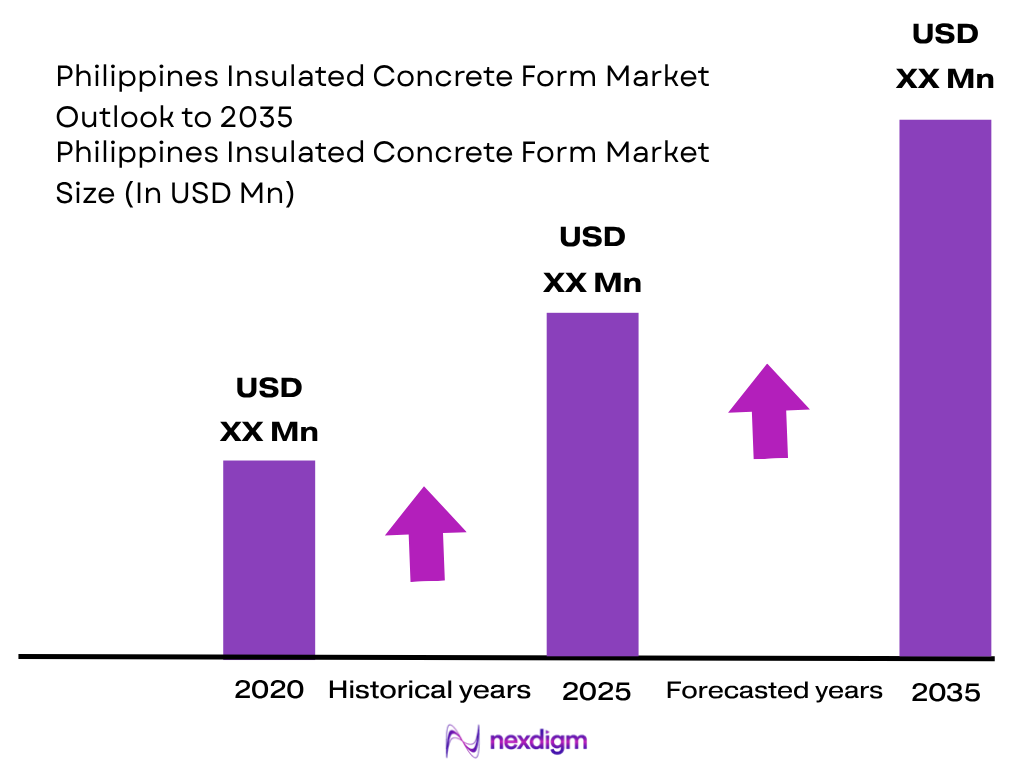
The Philippines Insulated Concrete Form Market is valued at approximately USD ~XX million, based on historical ICF wall-system adoption and addressable construction activity. The underlying construction base expanded from 171,268 approved constructions covering 41,472,200 m² in the preceding annual period to 180,341 constructions covering 42,837,581 m² in the latest period. Residential construction simultaneously increased from 112,399 projects and 18,131,455 m² to 116,427 projects and 19,748,190 m², strengthening the addressable base for insulated structural wall systems.
Metro Manila, CALABARZON, Central Luzon, Cebu and Davao represent the principal Philippines ICF demand clusters because they combine residential development, commercial construction, manufacturing activity and alternative-building-system supply. CALABARZON generated PHP 118.37 billion in construction value in the latest annual dataset, while NCR generated PHP 112.84 billion; CALABARZON also recorded 41,471 constructions. In NCR, fourth-quarter permits rose from 2,128 in the preceding comparable period to approximately 2,728, supporting concentrated demand around major urban construction markets.
Market Segmentation
By Formwork Architecture
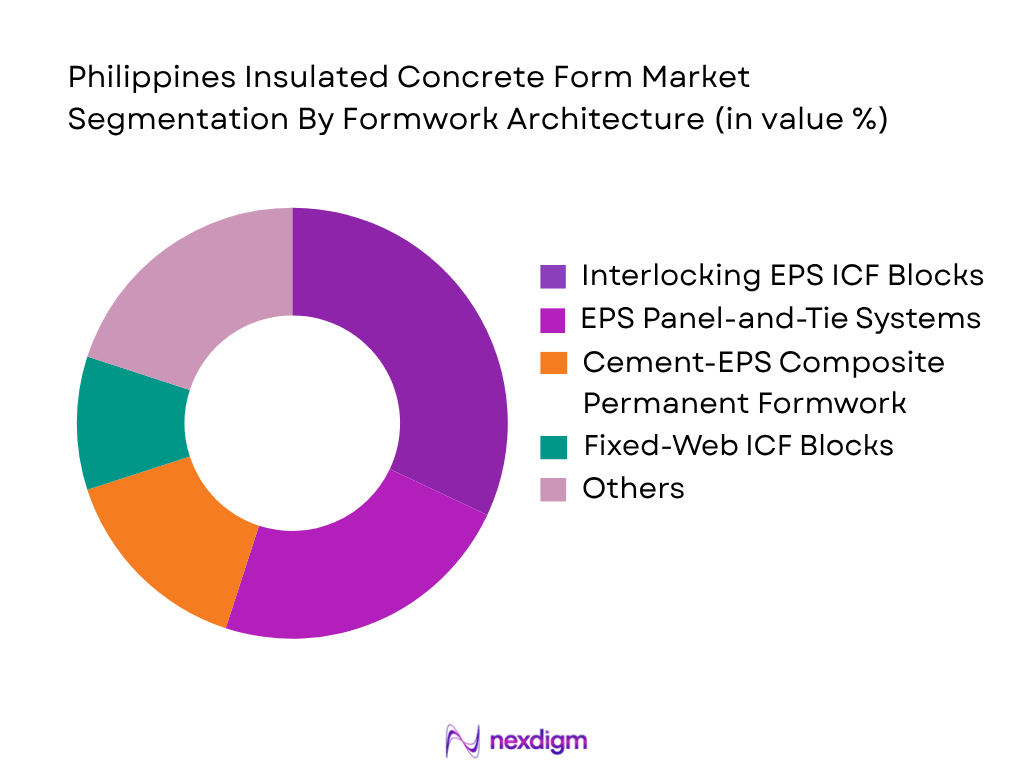
The Philippines Insulated Concrete Form Market is segmented into interlocking EPS ICF blocks, EPS panel-and-tie systems, fixed-web blocks, folding-web systems, cement-EPS composite permanent formwork, fiber-cement-EPS permanent formwork, variable-width systems and hybrid forms. Interlocking EPS ICF blocks hold the leading report-model share, supported by their compatibility with the country’s reinforced-concrete construction practices and their ability to combine permanent insulation with concrete formwork. BuildBlock’s presence through an international Philippine licensee supports the availability of established EPS ICF technology, while local alternative systems such as Ergo EBlocks demonstrate familiarity with permanent insulated formwork. EPS blocks are particularly applicable to single-family houses and repetitive low-rise projects because contractors can stack lightweight forms before installing reinforcement and placing concrete. This construction sequence fits locations where structural resilience to typhoons and seismic loads is a major specification consideration. Panel-and-tie and composite systems remain significant because local manufacturers already possess EPS-panel and lightweight-wall production capabilities, creating a potential manufacturing base for greater ICF localization.
By Building Type
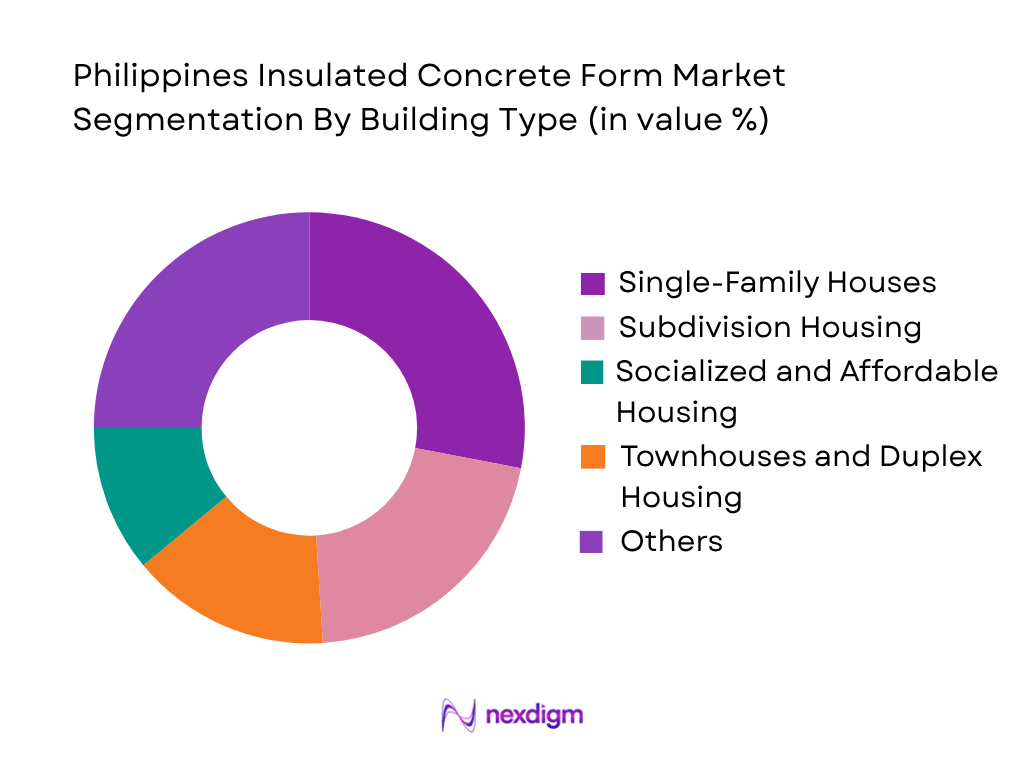
The Philippines Insulated Concrete Form Market is segmented into single-family houses, subdivision housing, socialized and affordable housing, townhouses, low-rise multi-family housing, condominiums, resorts, commercial buildings, institutional facilities and industrial buildings. Single-family and subdivision housing represents the dominant report-model segment, reflecting the compatibility of ICF with repetitive low-rise reinforced-concrete structures. PSA recorded 116,427 residential constructions covering 19,748,190 m² in 2024, with single-type houses generating PHP 156.08 billion in construction value. The socialized-housing pipeline provides another increasingly relevant application: the Social Housing Finance Corporation was implementing 10 4PH projects containing 39,132 housing units, including Crystal Peak Estates with 10,308 units, Valley View Township with 9,600 units, and People’s Ville with 7,200 units. Such repetitive developments allow manufacturers to standardize block dimensions, reinforcement details, concrete specifications and installer training. Condominiums remain less immediately suited to standard ICF adoption because high-rise developments typically employ established shear-wall, tunnel-form and precast construction systems.
Competitive Landscape
The Philippines Insulated Concrete Form Market remains fragmented and technology-led, with direct ICF suppliers competing against domestic EPS-composite wall systems, permanent formwork and conventional formwork technologies. BuildBlock has an identified Philippine international licensee, while the domestic ecosystem includes Ergo EBlocks and multiple AITECH-recognized lightweight or EPS-based wall-system manufacturers. Competitive positioning therefore depends not only on ICF block architecture but also on domestic manufacturing capability, disaster-resilient structural design, accreditation, installation support and the ability to integrate locally available concrete and reinforcement.
| Major Player | Establishment Year | Headquarters | System / Formwork Architecture | EPS / Insulation Capability | Philippine Manufacturing / Supply Position | Disaster-Resilient Structural Capability | Accreditation / Market Access Position | Installation & Technical Support |
| BuildBlock Building Systems | 2004 | Oklahoma City, USA | ~ | ~ | ~ | ~ | ~ | ~ |
| Penta-Continental / QuickPanel | 2018 | San Fernando, Pampanga | ~ | ~ | ~ | ~ | ~ | ~ |
| Forthress Philippines Corporation | 2013 | Makati, Metro Manila | ~ | ~ | ~ | ~ | ~ | ~ |
| SYU Group Systech / Polywall | 2016 | Meycauayan, Bulacan | ~ | ~ | ~ | ~ | ~ | ~ |
| FASI Forms Inc. | 2003 | Makati, Metro Manila | ~ | ~ | ~ | ~ | ~ | ~ |
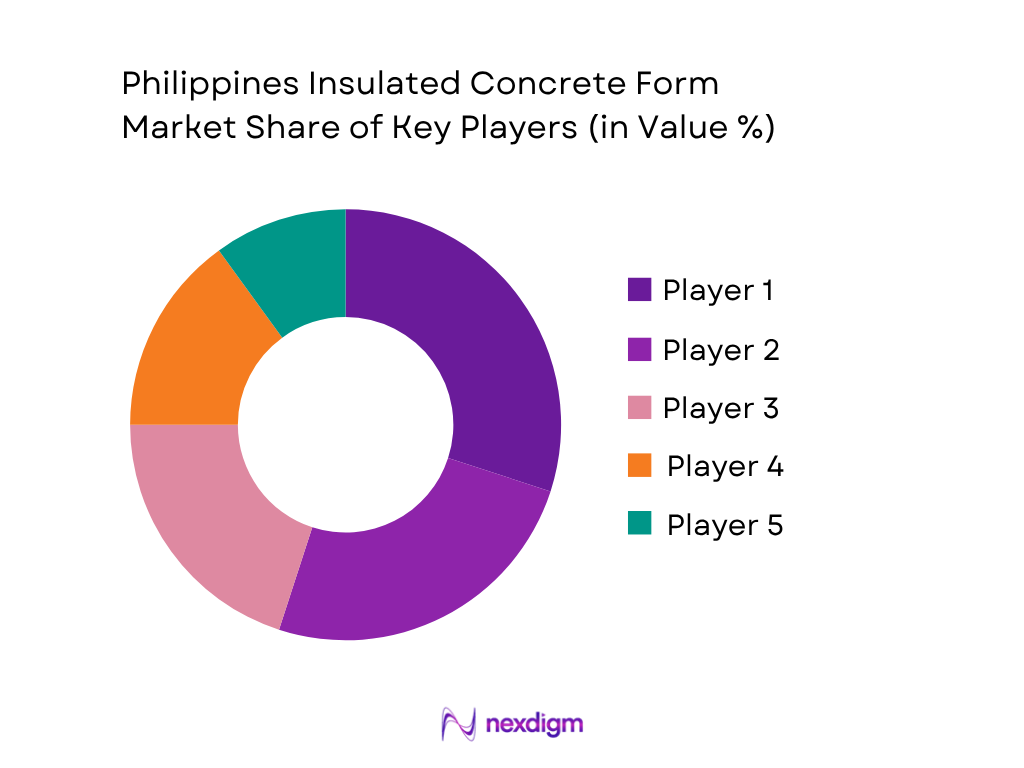
Philippines Insulated Concrete Form Market Analysis
Growth Drivers
Expansion of Residential and Low-Rise Construction Activity
Residential construction provides a substantial addressable application base for the Philippines Insulated Concrete Form Market because ICF systems are primarily suited to houses, townhouses, subdivisions and other repeat low-rise reinforced-concrete structures. Philippine Statistics Authority data recorded 116,427 residential constructions covering 19,748,190 square metres in 2024, while total approved construction reached 180,341 projects covering 42,837,581 square metres. Construction activity remained substantial in 2025, when the country recorded 181,832 approved constructions, including 117,832 residential buildings and 19,715,877 square metres of residential floor area. Single-type houses accounted for 100,552 residential constructions in 2025, creating a particularly relevant addressable pool for stackable EPS formwork and reinforced-concrete ICF walls. This housing structure favors systems that integrate insulation and permanent formwork while retaining concrete construction familiar to Philippine builders. The wider investment environment is supported by a 2024 Philippine GDP of USD 461.62 billion and GDP per capita of USD 3,984.8, according to the World Bank, providing a sizeable economic base for housing development, construction-material manufacturing and adoption of higher-performance building-envelope technologies.
Expansion of Government-Supported Housing and Repeatable Building Programs
Government-supported housing programs strengthen the Philippines Insulated Concrete Form Market because large, repeat developments can justify standardized form dimensions, engineered reinforcement schedules, dedicated installation crews and localized EPS production. The Social Housing Finance Corporation concentrated activity on 10 ongoing 4PH projects totaling 39,132 housing units in 2024. Major projects included Crystal Peak Estates with 10,308 units, Valley View Township with 9,600 units, People’s Ville with 7,200 units, Tandikan Ville with 6,030 units, and Tanauan Homes with 1,912 units. Housing development continued to broaden in 2025: People’s Ville had completed 14 residential buildings, with 4 buildings ready for turnover and 12 additional buildings under construction, while the broader SHFC portfolio comprised 81 ongoing 4PH projects. These repetitive developments create conditions in which ICF suppliers can move from bespoke individual-home installations toward project-scale wall packages, installer training and standardized structural details. The underlying macroeconomic environment remains supportive, with World Bank data placing Philippine GDP at USD 461.62 billion and GDP per capita at USD 3,984.8 in 2024, supporting continued investment in housing and industrialized construction technologies.
Market Challenges
Competition from Established Concrete, Masonry and Alternative Wall Systems
The Philippines Insulated Concrete Form Market faces a significant adoption challenge because its addressable construction base is already served by conventional reinforced concrete, concrete hollow blocks, precast systems and lightweight alternative wall technologies. The scale of conventional construction is considerable: the Philippine Statistics Authority recorded 180,341 approved constructions encompassing 42,837,581 square metres in 2024, including 116,427 residential projects and 39,238 non-residential projects. In 2025, total construction increased to 181,832 projects, while residential construction reached 117,832 projects. These volumes indicate a large construction ecosystem with established contractor practices, supply chains and structural specifications that new ICF systems must displace rather than simply serve. The challenge is particularly relevant in high-volume housing, where developers prioritize repeatable methods supported by trained subcontractors and widely available materials. Continued residential construction does not automatically translate into ICF demand, making contractor education, structural documentation, local component availability and project references critical. World Bank data show the Philippines generated USD 461.62 billion of GDP and USD 3,984.8 GDP per capita in 2024, supporting a large construction economy but simultaneously sustaining multiple competing building-system supply chains with established market access.
Vertical Housing Configuration Limits Immediate ICF Standardization
A second challenge for the Philippines Insulated Concrete Form Market is that a meaningful portion of government-backed urban housing is being developed through mid-rise and vertical configurations, which can require more complex structural engineering than conventional low-rise ICF applications. The Palayan City Township project covers 23 hectares and comprises 22 mid-rise buildings providing about 6,300 residential units; 1,076 units had already been completed during 2025. Bocaue Bulacan Manor is designed around 11 mid-rise buildings, each containing 14 floors, for a combined 4,342 residential units measuring between 24 and 27 square metres. These project formats favor highly repetitive structural systems but require ICF suppliers to demonstrate compatibility with multi-storey shear-wall design, reinforcement congestion, concrete pumping, floor connections, openings and construction-cycle requirements. This raises the technical threshold compared with detached houses where interlocking ICF blocks can be implemented with simpler structural layouts. Suppliers therefore need engineering validation and project-specific installation methodologies to access major government housing programs. The country’s 2024 macroeconomic base—USD 461.62 billion GDP and USD 3,984.8 GDP per capita—supports housing investment, but successful ICF participation depends on technical suitability for increasingly dense urban housing formats.
Market Opportunities
Localization of ICF Systems for a Large Residential Construction Base
Localization of EPS forms, connectors and installation capability represents a substantial future opportunity for the Philippines Insulated Concrete Form Market because the country already provides a large recurring residential construction base capable of supporting domestic production volumes. The Philippine Statistics Authority recorded 116,427 residential constructions covering 19,748,190 square metres in 2024, followed by 117,832 residential constructions covering 19,715,877 square metres in 2025. Of the latter, 100,552 projects were single-type houses, an especially suitable application category for modular ICF blocks and permanent EPS formwork. Current 2026 activity confirms that residential construction remains active: June recorded 11,392 residential constructions, including 9,272 single-type houses. These current volumes create future growth potential for local moulding of ICF blocks, polymer webs, corner forms and specialty components instead of dependence on bulky imported finished forms. Localization can also facilitate technical training and adaptation of block geometry to Philippine construction practices. This opportunity is supported by a 2024 national GDP of USD 461.62 billion and GDP per capita of USD 3,984.8, providing an economic foundation for investment in construction-material processing, tooling and specialized building-system manufacturing.
ICF Deployment in Large Socialized and Disaster-Resilient Housing Programs
Socialized housing provides a strong future commercialization opportunity for the Philippines Insulated Concrete Form Market because current government projects already demonstrate the scale required for repeat manufacturing and installation. SHFC concentrated on 10 4PH projects totaling 39,132 units in 2024, including 10,308 units at Crystal Peak Estates, 9,600 units at Valley View Township and 7,200 units at People’s Ville. The program’s active implementation expanded further, with SHFC reporting 81 ongoing 4PH projects in 2025. At People’s Ville, 14 residential buildings had been completed, 4 buildings were prepared for initial turnover and another 12 buildings remained under construction. Such large projects create an opportunity for ICF suppliers to offer standardized structural-wall packages incorporating permanent EPS insulation, reinforced-concrete cores, engineered openings and installation support. The opportunity is strongest where housing authorities and developers prioritize durable envelopes, repetitive construction and resilient structural systems rather than isolated component procurement. Existing project scale can justify dedicated moulds, contractor training and localized supply without relying on future demand estimates. Supporting this investment environment, World Bank data place Philippine GDP at USD 461.62 billion and GDP per capita at USD 3,984.8 in 2024.
Future Outlook
The Philippines Insulated Concrete Form Market is forecast to expand at approximately ~XX% CAGR during 2026–2035, with growth expected to be concentrated in low-rise housing, subdivisions, socialized housing, disaster-resilient residential construction and high-performance building envelopes. Greater localization of EPS moulding and ICF accessories should gradually improve system availability and contractor familiarity.
Housing provides the clearest volume platform. Philippine construction records show 116,427 residential constructions covering 19.75 million m² in 2024, compared with 112,399 residential projects covering 18.13 million m² in 2023. Single-house construction remains structurally important, making stackable ICF particularly relevant because the technology can be applied without the capital intensity associated with large precast factories.
Government-supported housing can create another pathway to scale. SHFC concentrated activity on 10 ongoing 4PH projects with 39,132 units, distributed across projects including Crystal Peak Estates, Valley View Township, People’s Ville and developments in Manila and Tanauan. Standardized housing layouts can support repeat ICF form dimensions, pre-engineered reinforcement schedules and dedicated installer crews, improving deployment efficiency as project volumes increase.
Major Players
- BuildBlock Building Systems
- Ergo EBlocks
- China-Philippines Wall Tech Systems / FahstWALL
- Forthress Philippines Corporation
- SYU Group Systech Corporation / Polywall
- Silvermane Impex and Global Trading Corporation / Hekimpan
- Penta-Continental Wall Panel Systems / QuickPanel
- JBC Innotech Corporation
- Acasys Development Corporation
- FASI Forms Inc.
- Nudura
- Amvic Building System
- Fox Blocks
- Element ICF
- SuperForm Products
Key Target Audience
- Insulated Concrete Form and Permanent Formwork Manufacturers
- Residential, Subdivision and Township Developers
- Socialized and Affordable Housing Developers
- Main Contractors and Specialized Concrete Wall Contractors
- EPS, Ready-Mix Concrete and Reinforcement Manufacturers
- Architects, Structural Engineering Practices and Building-System Specifiers
- Investments and Venture Capitalist Firms
- Government and Regulatory Bodies (Department of Human Settlements and Urban Development, National Housing Authority, Social Housing Finance Corporation, Department of Public Works and Highways, Department of Energy, Bureau of Fire Protection and Accreditation of Innovative Technologies for Housing)
Research Methodology
Step 1: Identification of Key Variables
The initial phase involves developing a detailed ecosystem map covering stakeholders in the Philippines Insulated Concrete Form Market, including EPS processors, ICF manufacturers, permanent-formwork suppliers, concrete producers, reinforcement suppliers, developers, contractors and housing agencies. Desk research is used to identify critical variables such as ICF wall area, form architecture, concrete-core configuration, insulation thickness, accreditation status, building applications, domestic manufacturing capability and imported-system availability.
Step 2: Market Analysis and Construction
Historical market construction combines top-down analysis of Philippine residential and non-residential building activity with bottom-up evaluation of ICF suppliers and competing permanent-wall technologies. Residential floor area, housing typology, subdivision development, socialized-housing projects and regional construction clusters establish the addressable demand base. Supplier activity, system architecture, EPS consumption, installed wall area, distribution capability and project references are then assessed to construct and cross-check market revenue and volume estimates.
Step 3: Hypothesis Validation and Expert Consultation
Market hypotheses are validated through computer-assisted telephone interviews and direct consultation with ICF suppliers, EPS manufacturers, housing developers, structural engineers, contractors, ready-mix producers and building-system installers. Discussions focus on block and panel preferences, structural reinforcement, concrete placement, typhoon and seismic design, thermal performance, fire requirements, AITECH accreditation, construction productivity and contractor familiarity. Expert inputs are used to validate penetration assumptions and identify practical barriers that secondary construction statistics cannot capture independently.
Step 4: Research Synthesis and Final Output
The final phase triangulates Philippine Statistics Authority construction statistics, housing-agency data, accreditation records, energy-efficiency requirements and supplier information with primary market intelligence. Bottom-up company and installed-wall estimates are reconciled against top-down addressable building construction to prevent overstating adoption of ICF in the wider concrete-wall market. The resulting model provides a validated assessment of competitive positioning, segmentation, localization opportunities, regulatory requirements and future adoption pathways for the Philippines Insulated Concrete Form Market.

- Executive Summary
- Research Methodology (Market Definition and Scope, Philippines Insulated Concrete Form Market Classification, ICF Wall System Demand Assessment, EPS Permanent Formwork Consumption Mapping, Reinforced Concrete Core Assessment, Domestic EPS and ICF Manufacturing Capacity Assessment, Import Dependency Analysis, EPS Resin and Polymer Feedstock Assessment, ICF Block and Panel Technology Mapping, Application-Level Demand Assessment, Building Type Demand Mapping, Disaster-Resilient Construction Assessment, Primary Industry Interviews, Top-Down Market Sizing, Bottom-Up Company Revenue and ICF Wall Area Assessment, Trade Flow Analysis, Data Triangulation, Pricing Assessment, Forecasting Framework)

- Definition and Scope
- Philippines Insulated Concrete Form Industry Evolution and Development of EPS Permanent Formwork, Reinforced Concrete Wall Systems and Alternative Building Technology Ecosystem
- ICF Block, EPS Panel, Polymer Web, Reinforcement and Concrete Core Industry Structure
- Philippines Insulated Concrete Form Value Chain Analysis
- Philippines Insulated Concrete Form Supply Chain Analysis
- EPS Resin Supplier, EPS Moulder, ICF Manufacturer, Permanent Formwork Producer, Reinforcement Supplier, Ready-Mix Concrete Producer, Distributor, Structural Engineer, Contractor, Developer and End-User Ecosystem Analysis
- Insulated Concrete Form Integration Across Single-Family Housing, Subdivisions, Socialized Housing, Condominiums, Resorts, Commercial Buildings, Institutional Facilities and Industrial Buildings

- Growth Drivers (Expansion of Single-Family and Subdivision Construction, Socialized Housing Development, Rising Residential Floor Area, Energy-Efficient Building Requirements, High Cooling Demand, Typhoon-Resilient Construction Requirements, Seismic-Resistant Reinforced Concrete Demand, Availability of Domestic EPS Manufacturing, Faster Wall Construction, Reduced Dependence on Conventional Removable Formwork)
- Market Challenges (Entrenched Concrete Hollow Block Construction, Limited Specialized ICF Installer Base, Low Architect and Contractor Familiarity, Imported Proprietary ICF Logistics, Concrete Pour and Form Pressure Management, EPS Fire-Performance Requirements, AITECH and Building Technology Accreditation Requirements, Competition from Precast and Lightweight Wall Panels, Project-Specific Structural Engineering, Limited Standardized Philippine ICF Specifications)
- Market Opportunities (Local ICF Block Manufacturing, Licensed ICF Production Expansion, Socialized Housing Applications, Disaster-Resilient Housing, Typhoon-Prone Coastal Housing, Energy-Efficient Villas and Subdivisions, Resort and Hospitality Construction, High-Density EPS Permanent Formwork, Local Polymer Tie Production, Integrated Wall-and-Roof Systems, Green Building Applications, Design-Supply-Install ICF Packages)
- Market Trends (Permanent EPS Formwork Adoption, Reinforced Concrete Shear-Wall Construction, High-Density Flame-Retardant EPS, Disaster-Resilient Building Systems, Energy-Efficient Building Envelopes, Alternative Housing Technology Accreditation, Prefabricated Wall Integration, Reduced Thermal Bridging, Concrete-EPS Composite Systems, Lightweight Permanent Formwork, Local Manufacturing and Technology Licensing)
- Regulatory and Standards Landscape (National Building Code of the Philippines, National Structural Code Requirements, Energy Efficiency and Conservation Act, Guidelines on Energy Conserving Design of Buildings, Philippine Green Building Code, Revised Fire Code of the Philippines, Bureau of Fire Protection Requirements, Accreditation of Innovative Technologies for Housing, DPWH Building Requirements, DHSUD Housing Technology Requirements, Philippine National Standards for EPS and Construction Materials)
- SWOT Analysis
- Porter’s Five Forces Analysis
- PESTLE Analysis
- Stakeholder Ecosystem
- Competition Ecosystem

- By Market Value (2020-2025)
- By ICF Wall Area Installed (2020-2025)
- By ICF Block and Panel Consumption Volume (2020-2025)
- By Domestic ICF and Permanent Formwork Production Value (2020-2025)
- By Domestic ICF and Permanent Formwork Production Volume (2020-2025)
- By ICF System Import Value (2020-2025)
- By ICF System Import Volume (2020-2025)
- By Average Selling Price (2020-2025)

- By Formwork Architecture (In Value %)
Interlocking EPS ICF Blocks
EPS Panel-and-Tie Systems
Fixed-Web ICF Blocks
Folding-Web ICF Systems
Cement-EPS Composite Permanent Formwork
Fiber-Cement-EPS Permanent Formwork
Variable-Width ICF Panel Systems
Hybrid and Specialty ICF Systems - By Insulation Material (In Value %)
Standard Expanded Polystyrene
High-Density Expanded Polystyrene
Flame-Retardant Expanded Polystyrene
Graphite-Enhanced Expanded Polystyrene
Recycled-Content Expanded Polystyrene
Cement-Bonded EPS Composite
Fiber-Cement-EPS Composite Systems
Hybrid High-Performance Insulated Formwork - By Application Type (In Value %)
External Structural Walls
Internal Load-Bearing Walls
Reinforced Concrete Shear Walls
Foundations and Stem Walls
Basement Walls
Retaining Walls
Party and Separation Walls
Swimming Pool Structures
Commercial Building Enclosures
Institutional Building Walls
Industrial Building Walls
Other Structural Concrete Applications - By Building Type (In Value %)
Single-Family Houses
Subdivision Housing
Socialized and Affordable Housing
Townhouses and Duplex Housing
Low-Rise Multi-Family Housing
Condominium and Apartment Buildings
Hotels and Resorts
Commercial and Mixed-Use Buildings
Educational and Healthcare Facilities
Industrial and Logistics Buildings
Government and Disaster-Resilient Housing - By Distribution and Project Delivery Model (In Value %)
Direct Manufacturer Supply
Licensed ICF Manufacturing
Authorized ICF Distributor
Construction Material Distributor
Contractor-Led Procurement
Developer Direct Procurement
Design-Supply-Install Packages
Imported Project-Based ICF Supply

- Market Share of Major Players (By Philippines Revenue, ICF Wall Area, Domestic Production Volume, ICF System Architecture, EPS Configuration, Building Type, Philippines Manufacturing and Distribution Footprint, Customer Segment Distribution)
- Cross Comparison Parameters (Philippines ICF Revenue, ICF Block and Permanent Formwork Architecture Breadth, Domestic EPS and ICF Manufacturing Capability, Concrete Core and Seismic Structural Configuration Flexibility, Thermal Fire and Typhoon-Resilience Performance Capability, Philippine AITECH Building Code and Product Accreditation Coverage, Philippines Distribution Project Supply and Installer Footprint, Structural Design Installer Training and On-Site Technical Support Capability)
- SWOT Analysis of Major Players
- Competitive Positioning Matrix
- ICF Block and Permanent Formwork Portfolio Benchmarking
- Pricing and ICF System Category Benchmarking
- Manufacturing, EPS Moulding and Permanent Formwork Technology Assessment
- Building Type and Customer Application Exposure Assessment
- Domestic Manufacturing Versus Imported ICF Supply Positioning
- Detailed Profiles of Major Companies
BuildBlock Building Systems
Ergo EBlocks
China-Philippines Wall Tech Systems Inc.
Forthress Philippines Corporation
SYU Group Systech Corporation
Silvermane Impex and Global Trading Corporation
Penta-Continental Wall Panel Systems Incorporated
JBC Innotech Corporation
Acasys Development Corporation
FASI Forms, Inc.
Nudura
Amvic Building System
Fox Blocks
Element ICF
SuperForm Products

- Residential Developer ICF Procurement Assessment
- Socialized Housing Developer ICF Requirement Analysis
- Private Homebuilder ICF Adoption Assessment
- Resort and Hospitality Developer ICF Assessment
- Commercial Developer ICF Requirement Analysis
- Industrial and Logistics Developer ICF Assessment
- Government and Disaster-Recovery Housing ICF Assessment
- Architect and Structural Engineer ICF Specification Analysis
- Main Contractor ICF Procurement Assessment
- Specialized ICF Installer Technical Requirement Assessment

- By Market Value (2026-2035)
- By ICF Wall Area Installed (2026-2035)
- By ICF Block and Panel Consumption Volume (2026-2035)
- By Domestic ICF and Permanent Formwork Production Value (2026-2035)
- By Domestic ICF and Permanent Formwork Production Volume (2026-2035)
- By ICF System Import Value (2026-2035)
- By ICF System Import Volume (2026-2035)
- By Average Selling Price (2026-2035)


 Request a Sample
 Ask for Customization
 Get a Quote
 Enquire Now