

 Download PDF
Market Overview
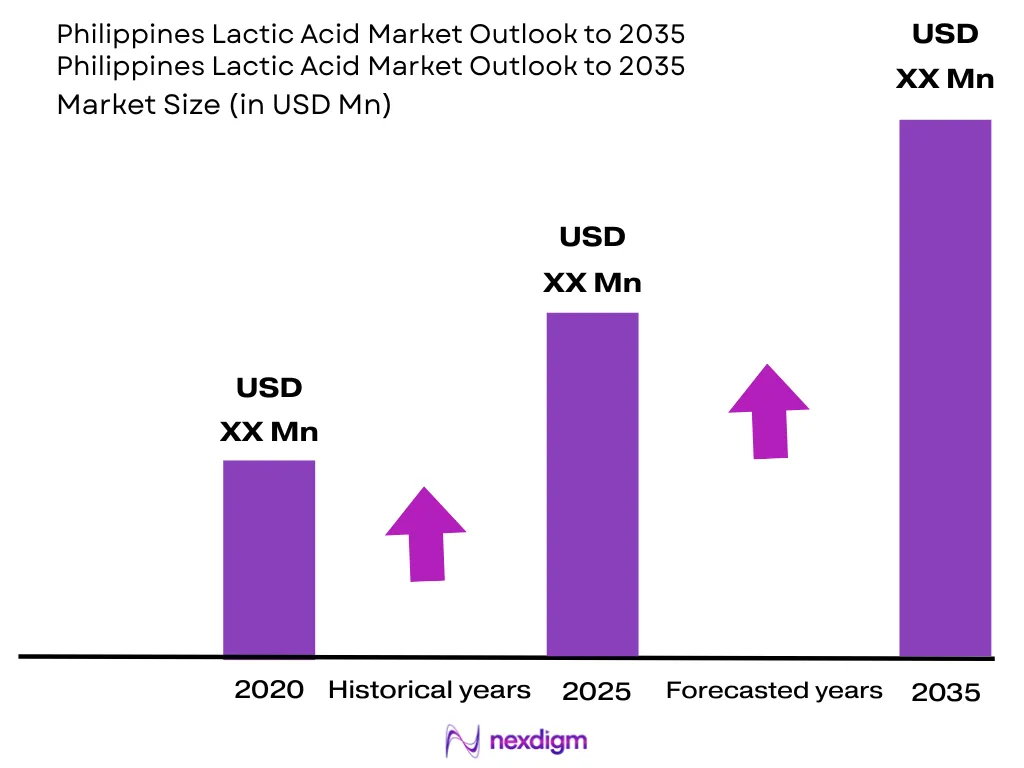
The Philippines Lactic Acid Market is valued at USD ~ Million in 2024 and is projected to grow at a CAGR of ~% during 2026–2035. Market expansion is supported by increasing demand from the food and beverage industry, pharmaceutical manufacturing, personal care products, and biodegradable material applications. The Philippines imported approximately USD 3.84 million worth of lactic acid, its salts, and esters in 2024, with China supplying USD 1.10 million and Thailand USD 1.04 million, highlighting the country’s dependence on imported lactic acid to satisfy domestic industrial requirements. Rising consumption of processed foods and specialty ingredients continues to support market demand.
Market Segmentation
By Raw Material
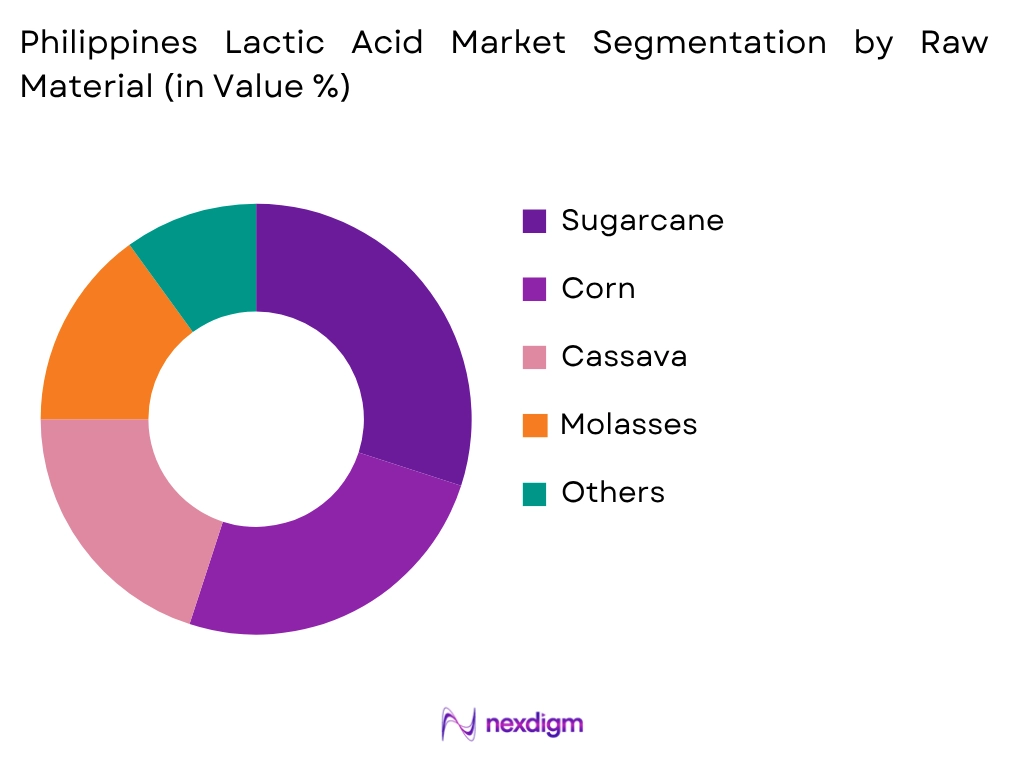
The Philippines Lactic Acid Market is segmented by raw material into Sugarcane, Corn, Cassava, Molasses, Sugar Beet, and Other Fermentable Feedstocks. Sugarcane accounts for the largest share owing to the country’s well-established sugar industry and abundant availability of sugarcane as a renewable fermentation feedstock. The Philippines remains one of Southeast Asia’s major sugar producers, enabling manufacturers to utilize sugar-derived carbohydrates for fermentation-based chemical production. Sugarcane-derived lactic acid is widely preferred for food-grade and biodegradable polymer applications because of its high fermentation efficiency, consistent quality, and sustainable production profile. In addition, increasing demand for bio-based chemicals, natural food ingredients, and environmentally friendly packaging solutions has reinforced the importance of sugarcane as the dominant raw material. Although commercial production remains limited and the country relies on imported lactic acid, sugarcane continues to represent the preferred feedstock for future domestic fermentation investments due to its established supply chain, renewable nature, and compatibility with industrial biotechnology processes.
By Application
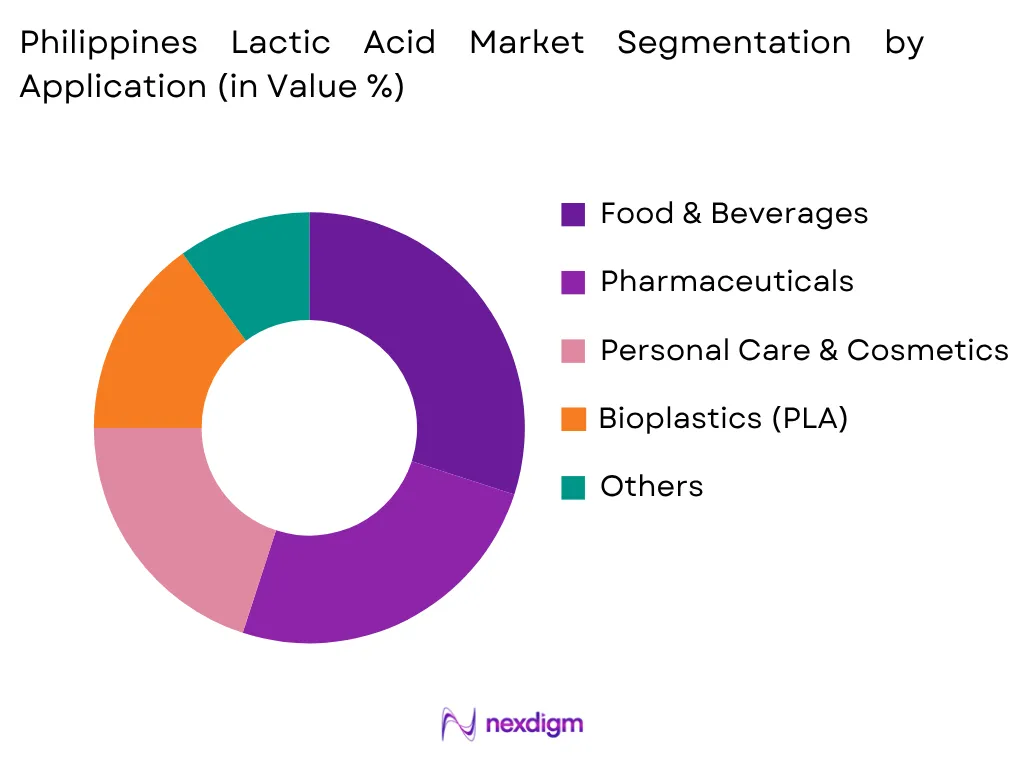
The Philippines Lactic Acid Market is segmented by application into Food & Beverage, Pharmaceuticals, Personal Care & Cosmetics, Bioplastics (PLA), Industrial Chemicals, and Home & Institutional Cleaning. The Food & Beverage segment dominates the market due to the widespread application of lactic acid as an acidulant, preservative, flavor enhancer, and pH regulator across processed foods, dairy products, beverages, meat products, bakery items, and confectionery. The Philippines has one of the largest food processing industries in Southeast Asia, supported by rising urbanization, increasing household consumption of packaged foods, and expanding modern retail channels. Growing demand for clean-label ingredients and naturally derived food additives has encouraged manufacturers to adopt fermentation-based lactic acid over synthetic alternatives. Furthermore, multinational food manufacturers operating in the country continue to introduce value-added processed food products requiring food-grade organic acids, while increasing exports of processed food products to regional markets further sustain demand. The consistent expansion of food manufacturing facilities and investments in product innovation continue to reinforce the Food & Beverage segment as the leading application in the Philippine lactic acid market.
Competitive Landscape
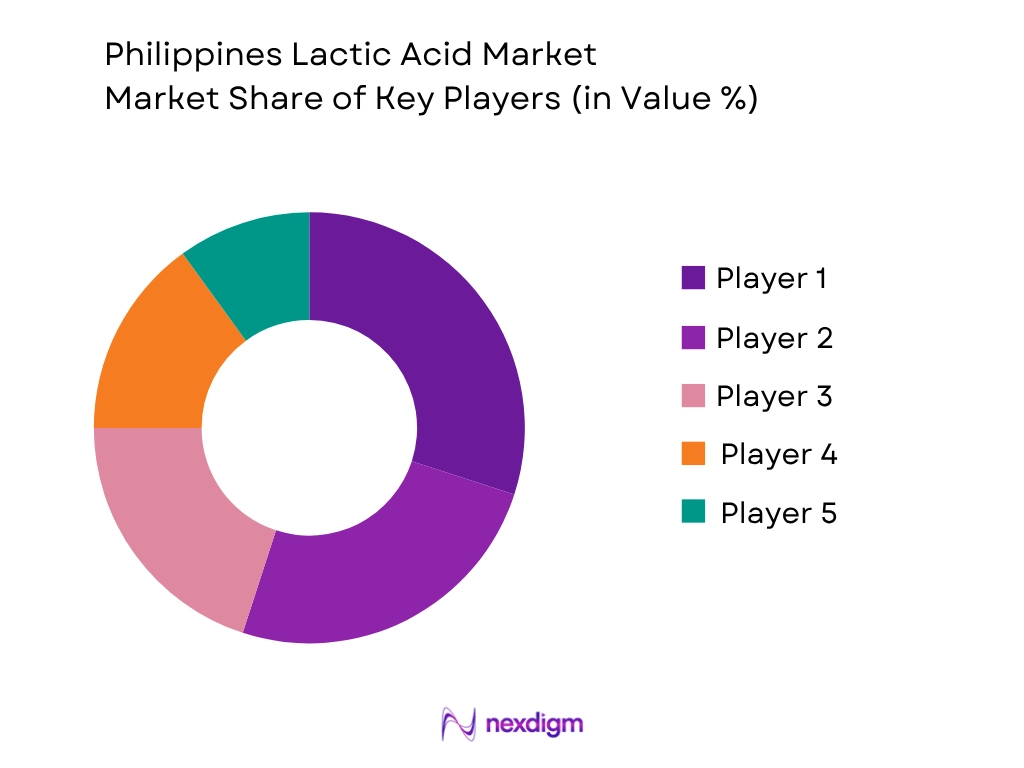
The Philippines Lactic Acid Market is characterized by the presence of multinational manufacturers, regional suppliers, and specialty chemical distributors that primarily cater to the food & beverage, pharmaceutical, personal care, and industrial sectors. Since domestic production of lactic acid is limited, the market is largely dependent on imports from major producing countries in Asia and Europe. Companies compete on the basis of product purity, regulatory compliance, product availability, pricing, distribution efficiency, technical support, and long-term supply agreements. As demand for sustainable ingredients and biodegradable materials continues to grow, leading global manufacturers are strengthening their partnerships with local distributors to expand their presence across the Philippines.
| Company | Establishment Year | Headquarters | Primary Product Portfolio | Lactic Acid Portfolio
|
Manufacturing Presence | Major End-Use Industries | Key Strategic Focus | Certifications & Compliance |
| Corbion | 1919 | ~ | ~ | ~ | ~ | ~ | ~ | ~ |
| Jungbunzlauer | 1867 | ~ | ~ | ~ | ~ | ~ | ~ | ~ |
| Cargill | 1865 | ~ | ~ | ~ | ~ | ~ | ~ | ~ |
| Galactic | 1994 | ~ | ~ | ~ | ~ | ~ | ~ | ~ |
| Henan Jindan Lactic Acid Technology | 1984 | ~ | ~ | ~ | ~ | ~ | ~ | ~ |
Philippines Lactic Acid Market Analysis
Growth Drivers
Expansion of the Food Processing Industry
The Philippines’ expanding food processing industry continues to be the primary driver for lactic acid consumption, as the compound is extensively used as an acidulant, preservative, pH regulator, and flavor enhancer in processed foods, dairy products, beverages, meat products, confectionery, and bakery applications. According to the Philippine Statistics Authority (PSA), domestic trade volume reached 30.00 million metric tons in 2024, increasing from 27.66 million metric tons in the previous year, with food and live animals accounting for 8.55 million metric tons, making it the country’s largest traded commodity group. The continued growth of food manufacturing has increased demand for specialty food ingredients, including fermentation-derived lactic acid. International trade data further reflects this trend, with the Philippines importing over USD 3.8 million worth of lactic acid, its salts, and esters in 2024. China supplied approximately USD 1.10 million, while Thailand contributed around USD 1.04 million, highlighting the country’s strong dependence on imported lactic acid for industrial food production. Rising consumption of packaged foods, urban lifestyles, and increasing investments in value-added food manufacturing continue to support sustained demand for food-grade lactic acid across the Philippines.
Growth of Pharmaceutical and Industrial Manufacturing
The continuous expansion of pharmaceutical production and specialty manufacturing is strengthening demand for pharmaceutical-grade and industrial-grade lactic acid throughout the Philippines. According to the World Bank, the Philippine economy remained one of Southeast Asia’s fastest-growing major economies during 2024, supported by strong industrial activity and manufacturing investments. Lactic acid is increasingly utilized in pharmaceutical formulations, controlled-release drug products, intravenous solutions, cosmetics, biodegradable polymers, and industrial chemicals. Trade statistics indicate that the Philippines imported nearly 1.95 million kilograms of lactic acid from major exporting countries during 2024, with 948,600 kilograms originating from Thailand and 771,017 kilograms from China, reflecting growing industrial utilization. Continuous government initiatives to promote manufacturing under industrial development programs, together with increasing foreign direct investment in pharmaceutical and specialty chemical production, are encouraging greater utilization of fermentation-derived ingredients. As multinational manufacturers expand their operations within industrial zones surrounding Metro Manila, Calabarzon, and Central Luzon, demand for high-purity lactic acid continues to increase across multiple downstream industries.
Market Challenges
Heavy Dependence on Imported Lactic Acid Supply
The Philippines remains highly dependent on imported lactic acid due to the absence of large-scale domestic commercial fermentation facilities. According to international trade statistics, imports of lactic acid, its salts, and esters exceeded USD 3.8 million during 2024, with China and Thailand together accounting for more than USD 2.13 million in export value to the Philippines. Import volumes reached 771,017 kilograms from China and 948,600 kilograms from Thailand, demonstrating the country’s reliance on external suppliers for industrial requirements. Such dependence exposes downstream industries to supply chain disruptions, shipping delays, exchange-rate volatility, and international freight constraints. Food manufacturers, pharmaceutical companies, and specialty chemical producers require uninterrupted access to high-purity lactic acid, making supply reliability a critical concern. Since domestic production capacity remains limited, manufacturers have relatively few local sourcing alternatives during periods of global logistics disruptions or raw material shortages, increasing procurement risks across the Philippine lactic acid value chain.
Limited Domestic Fermentation and Biotechnology Infrastructure
Although the Philippines possesses a strong agricultural base capable of supplying feedstocks such as sugarcane, corn, cassava, and molasses, commercial-scale fermentation infrastructure for producing lactic acid remains underdeveloped. As a result, industries continue relying on imported finished products rather than locally manufactured bio-based chemicals. Trade data indicates imports consistently exceeded USD 3.7 million in both 2023 and 2024, demonstrating limited progress toward domestic substitution. Scaling fermentation-based chemical production requires advanced biotechnology expertise, continuous raw material processing capabilities, specialized bioreactors, and significant industrial investment. While government agencies continue promoting manufacturing development and innovation, the commercialization of industrial biotechnology remains comparatively limited relative to neighboring countries. These structural limitations reduce opportunities for domestic value addition, constrain local production of food-grade and pharmaceutical-grade lactic acid, and increase long-term dependence on foreign suppliers serving the Philippine market.
Market Opportunities
Growing Demand for Sustainable Packaging and Bio-Based Materials
The increasing adoption of sustainable packaging solutions presents a significant opportunity for the Philippines Lactic Acid Market because lactic acid serves as the principal feedstock for producing polylactic acid (PLA), one of the world’s leading biodegradable polymers. The Philippines continues implementing environmental initiatives aimed at reducing plastic waste while encouraging greater adoption of environmentally sustainable packaging materials. Simultaneously, the country’s expanding food manufacturing industry continues generating higher demand for biodegradable food packaging and compostable materials. Imports of lactic acid exceeding USD 3.8 million during 2024 demonstrate the availability of industrial feedstock capable of supporting expanding downstream applications. Rising investments in sustainable consumer products, food packaging innovation, and environmentally responsible manufacturing provide favorable conditions for increased utilization of fermentation-derived lactic acid. As packaging manufacturers and consumer goods companies increasingly adopt circular economy practices, opportunities for suppliers of food-grade and polymer-grade lactic acid are expected to strengthen considerably across the Philippine industrial sector.
Expansion of Food Manufacturing and ASEAN Trade Integration
The Philippines’ strategic participation in regional ASEAN trade, combined with expanding domestic manufacturing activity, provides strong opportunities for future growth in lactic acid consumption. The Philippine Statistics Authority reported 30.00 million metric tons of domestic trade during 2024, illustrating the country’s expanding movement of industrial and food products. Food and live animals represented 8.55 million metric tons, highlighting continued growth in food manufacturing and distribution networks that require specialty ingredients such as lactic acid. Furthermore, major suppliers including China, Thailand, Malaysia, Belgium, and Singapore continue strengthening regional supply chains, improving product availability for Philippine manufacturers. Increasing investments in food exports, pharmaceutical production, biotechnology, and specialty chemicals are expected to create sustained demand for high-quality fermentation-derived ingredients. The country’s improving logistics infrastructure, industrial parks, and manufacturing incentives further position the Philippines as an attractive destination for future investments in bio-based chemicals and downstream lactic acid applications.
Future Outlook
The Philippines Lactic Acid Market is expected to demonstrate steady growth during the forecast period, supported by increasing consumption of processed food products, expansion of pharmaceutical manufacturing, and rising adoption of sustainable materials across packaging and industrial applications. The country’s growing manufacturing sector, favorable demographic profile, and increasing investments in food processing are expected to strengthen long-term demand for food-grade and pharmaceutical-grade lactic acid.
Major Players
- Corbion
- Jungbunzlauer Suisse AG
- Galactic
- Henan Jindan Lactic Acid Technology Co., Ltd.
- Cargill Incorporated
- Futerro
- NatureWorks LLC
- Musashino Chemical Laboratory Co., Ltd.
- BASF SE
- Foodchem International Corporation
- Merck KGaA
- Thermo Fisher Scientific
- Cellulac plc
- Vaishnavi Bio Tech International Limited
- Brenntag Philippines Inc.
Key Target Audience
- Food & Beverage Manufacturers
- Pharmaceutical Manufacturers
- Personal Care & Cosmetics Manufacturers
- Bioplastics and Sustainable Packaging Manufacturers
- Chemical Importers and Specialty Ingredient Distributors
- Investment and Venture Capital Firms
- Government and Regulatory Bodies (Department of Trade and Industry (DTI), Food and Drug Administration Philippines (FDA Philippines), Department of Science and Technology (DOST), Board of Investments (BOI), Department of Environment and Natural Resources (DENR))
- Industrial Biotechnology and Fermentation Companies
Research Methodology
Step 1: Identification of Key Variables
The initial phase involves developing a comprehensive ecosystem map of the Philippines Lactic Acid Market by identifying all major stakeholders, including raw material suppliers, manufacturers, importers, distributors, regulatory authorities, and end-user industries. Extensive secondary research is conducted using government publications, international trade databases, company annual reports, industry associations, and proprietary databases. This stage helps identify the key variables influencing market performance, including import dependence, application trends, pricing dynamics, regulatory developments, and industrial demand.
Step 2: Market Analysis and Construction
Historical market information is collected and analyzed to assess consumption patterns, trade statistics, production trends, application-wise demand, and industry structure. Both demand-side and supply-side analyses are performed to estimate market revenues and volume consumption across different segments. The collected data is further categorized by raw material, grade, application, distribution channel, and end-user industry to build a comprehensive understanding of the Philippines Lactic Acid Market.
Step 3: Hypothesis Validation and Expert Consultation
The preliminary market findings are validated through Computer-Assisted Telephone Interviews (CATIs) and structured discussions with manufacturers, importers, chemical distributors, food ingredient suppliers, pharmaceutical companies, and industry experts. These consultations provide valuable qualitative insights into procurement strategies, customer preferences, regulatory compliance, technological developments, and future industry trends. The feedback obtained is incorporated into the analysis to enhance the accuracy and reliability of market estimates.
Step 4: Research Synthesis and Final Output
The final stage integrates insights gathered from both primary and secondary research to produce a detailed assessment of the Philippines Lactic Acid Market. Data triangulation techniques are employed to validate market estimates, competitive positioning, segmentation analysis, and forecast assumptions. The completed report undergoes multiple quality checks to ensure consistency, accuracy, and practical relevance, providing stakeholders with a reliable and actionable market intelligence study.

- Executive Summary
- Research Methodology (Market Definitions and Assumptions, Abbreviations, Market Sizing Approach, Top-Down Analysis, Bottom-Up Analysis, Demand-Side Assessment, Supply-Side Assessment, Primary Industry Interviews, Secondary Research Validation, Data Triangulation, Forecasting Framework, Limitations and Future Conclusions)

- Definition and Scope
- Market Evolution and Industry Genesis
- Timeline of Major Industry Developments
- Lactic Acid Industry Value Chain Analysis
- Supply Chain Analysis

- Growth Drivers (Expansion of Food & Beverage Processing Industry, Increasing Demand for Natural Food Preservatives, Rising Bioplastics Adoption, Growth in Pharmaceutical Manufacturing, Expansion of Modern Retail & Processed Food Consumption)
- Market Challenges (Dependence on Imported Lactic Acid, Volatility in Agricultural Feedstock Supply, High Production & Logistics Costs, Limited Domestic Fermentation Capacity, Competition from Alternative Acidulants)
- Market Opportunities (Growth in Sustainable Packaging, Expansion of Functional Food Ingredients, Rising Demand for Pharmaceutical Excipients, Development of Local Bio-based Chemical Manufacturing, Increasing ASEAN Trade Integration)
- Market Trends (Clean Label Food Ingredients, Fermentation Technology Advancements, Bio-based Chemical Adoption, Increasing Use of PLA Packaging, Sustainable Manufacturing Practices)
- Government Regulations (Food Safety Regulations, FDA Product Registration Requirements, Environmental Management Regulations, Chemical Import & Customs Regulations, Product Labeling & Quality Compliance Standards)
- SWOT Analysis
- Porter’s Five Forces Analysis
- PESTLE Analysis
- Stakeholder Ecosystem
- Competition Ecosystem

- By Market Value (2020-2025)
- By Volume Consumption (2020-2025)
- By Average Selling Price (2020-2025)

- By Raw Material (In Value %)
Corn
Sugarcane
Cassava
Molasses
Sugar Beet
Other Fermentable Feedstocks - By Grade (In Value %)
Food Grade
Pharmaceutical Grade
Industrial Grade
Polymer Grade
Cosmetic Grade - By Application (In Value %)
Food & Beverage
Pharmaceuticals
Bioplastics (PLA)
Personal Care & Cosmetics
Industrial Chemicals
Home & Institutional Cleaning
Animal Feed - By End User Industry (In Value %)
Food Processing
Pharmaceutical Manufacturing
Chemical Manufacturing
Packaging Industry
Cosmetics & Personal Care
Animal Nutrition Industry - By Distribution Channel (In Value %)
Direct Industrial Sales
Chemical Distributors
Food Ingredient Suppliers
Pharmaceutical Ingredient Suppliers
Specialty Chemical Dealers
Online B2B Platforms

- Market Share of Major Players (By Value, Volume, Grade, Application)
- Cross Comparison Parameters (Product Portfolio Breadth, Product Purity Levels, Fermentation Technology, Production Capacity, Food & Pharmaceutical Certifications, Distribution Network Strength, ASEAN Supply Chain Presence, Sustainability Initiatives)
- SWOT Analysis of Major Players
- Pricing Analysis by Grade and Application
- Detailed Profiles of Major Companies
Corbion
Jungbunzlauer Suisse AG
Galactic
Henan Jindan Lactic Acid Technology Co., Ltd.
Cargill Incorporated
Futerro
NatureWorks LLC
Musashino Chemical Laboratory Co., Ltd.
Foodchem International Corporation
BASF SE
Merck KGaA
Cellulac plc
Vaishnavi Bio Tech International Limited
Thermo Fisher Scientific
Brenntag Philippines Inc.

- Consumption Pattern Assessment (Purchase Frequency, Application Mix, Grade Preference, Domestic vs Imported Supply, Procurement Volume)
- Purchasing Power Analysis
- Procurement Strategy Assessment
- Needs, Preferences and Pain Point Analysis
- Quality & Certification Preference Analysis
- Purchase Decision-Making Process
- Online vs Offline Procurement Analysis

- By Market Value (2026-2035)
- By Volume Consumption (2026-2035)
- By Average Selling Price (2026-2035)


 Request a Sample
 Ask for Customization
 Get a Quote
 Enquire Now