

 Download PDF
 Download PDF
Market Overview
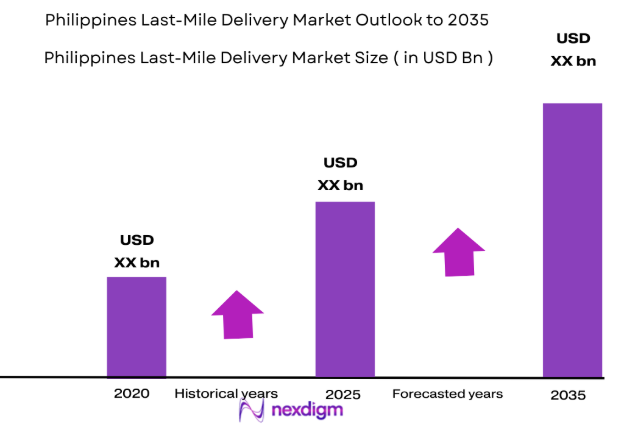
Latest industry financial disclosures from logistics platforms, national transport statistics, and e-commerce ecosystem reports indicate the Philippines Last-Mile Delivery Market generated approximately USD ~ billion in total service value. Demand expansion is primarily driven by rapid growth in online retail platforms, increasing smartphone penetration, and strong adoption of app-based delivery services across urban populations. Logistics providers are investing in rider fleets, digital route management platforms, and micro-fulfillment hubs to accelerate delivery timelines and support high parcel volumes from digital marketplaces and food delivery platforms.
Metro Manila functions as the operational center of the Philippines Last-Mile Delivery Market because of dense population clusters, large online retail penetration, and concentration of logistics distribution hubs. Cities such as Quezon City, Makati, Taguig, and Pasig host major fulfillment centers, technology platforms, and courier company headquarters. Cebu and Davao also play important roles due to strong regional trade flows and expanding urban consumer bases, while extensive motorcycle delivery networks help overcome congestion and infrastructure constraints in densely populated metropolitan corridors.
Market Segmentation
By Product Type
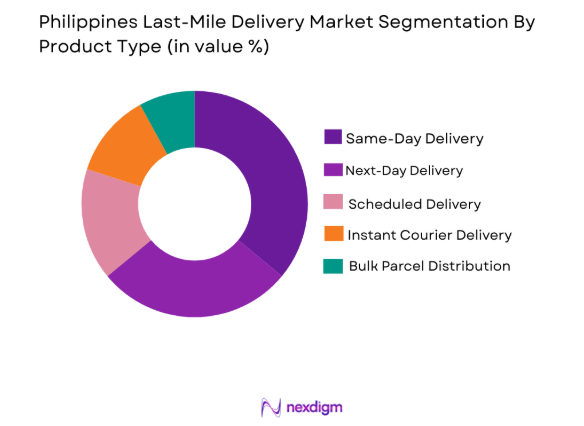
Philippines Last-Mile Delivery Market is segmented by product type into same-day delivery, next-day delivery, scheduled delivery, instant courier delivery, and bulk parcel distribution. Recently, same-day delivery has a dominant market share due to rapid expansion of e-commerce platforms and consumer demand for faster order fulfillment. Digital retail marketplaces and food delivery applications increasingly promise quick fulfillment timelines to enhance customer experience. Urban consumers rely heavily on mobile commerce platforms where convenience and delivery speed strongly influence purchasing decisions. Logistics providers therefore prioritize rider fleets and urban dispatch systems designed for rapid order processing and short delivery cycles.
By Platform Type
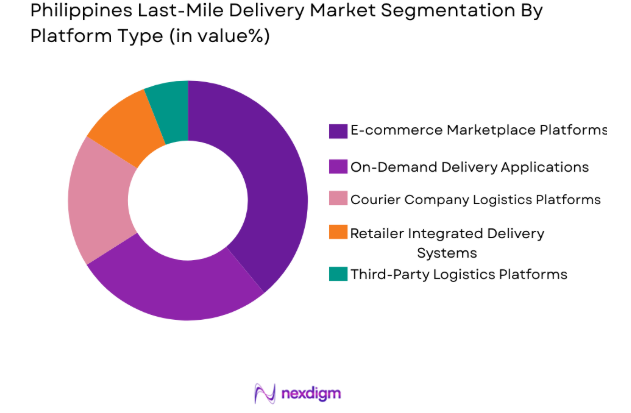
Philippines Last-Mile Delivery Market is segmented by platform type into e-commerce marketplace platforms, on-demand delivery applications, courier company logistics platforms, retailer integrated delivery systems, and third-party logistics platforms. Recently, e-commerce marketplace platforms have a dominant market share due to their extensive merchant networks and high order volumes generated through digital shopping applications. Major online marketplaces integrate logistics solutions directly within their platforms to ensure seamless order fulfillment and parcel tracking. These systems coordinate warehousing, dispatch operations, and rider networks through centralized technology infrastructure that improves operational efficiency.
Competitive Landscape
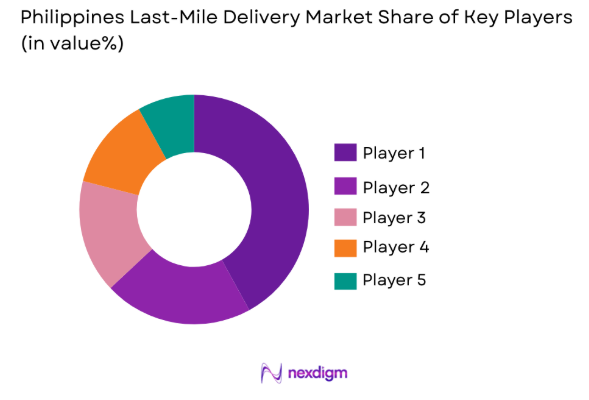
The Philippines Last-Mile Delivery Market features a competitive environment with a mix of international courier companies, regional logistics operators, and technology-driven delivery platforms. Market consolidation occurs through partnerships between e-commerce companies and logistics providers that expand nationwide delivery coverage. Major technology platforms influence market structure by integrating dispatch algorithms, rider networks, and digital payment systems, allowing them to process high volumes of delivery requests across urban and regional markets.
| Company Name | Establishment Year | Headquarters | Technology Focus | Market Reach | Key Products | Revenue | Fleet Size |
| Lalamove | 2013 | Hong Kong | ~ | ~ | ~ | ~ | ~ |
| GrabExpress | 2018 | Singapore | ~ | ~ | ~ | ~ | ~ |
| J&T Express | 2015 | Jakarta | ~ | ~ | ~ | ~ | ~ |
| Ninja Van | 2014 | Singapore | ~ | ~ | ~ | ~ | ~ |
| Entrego | 2016 | Philippines | ~ | ~ | ~ | ~ | ~ |
Philippines Last-Mile Delivery Market Analysis
Growth Drivers
Rapid Expansion of E-commerce Platforms Driving Parcel Volume
The Philippines Last-Mile Delivery Market is strongly supported by the rapid expansion of digital commerce platforms that generate substantial parcel shipment volumes across metropolitan regions and provincial cities. Online marketplaces continue expanding merchant networks and product offerings which encourages consumers to purchase goods through mobile applications and online storefronts. Logistics platforms respond by building extensive motorcycle rider fleets capable of navigating dense traffic environments and delivering small parcels efficiently. Digital payment systems integrated within online shopping platforms further simplify the purchasing process and increase transaction frequency. Retailers also invest in localized fulfillment centers positioned near urban residential zones to shorten delivery distances and accelerate order processing. Logistics technology platforms optimize route planning and dispatch scheduling to improve fleet utilization and delivery accuracy across metropolitan regions. These operational improvements collectively support large daily shipment volumes generated by online retail marketplaces. As consumer reliance on digital commerce continues increasing, last-mile delivery providers become essential infrastructure supporting the broader e-commerce ecosystem.
Widespread Smartphone Penetration and Mobile Application Adoption
The Philippines Last-Mile Delivery Market benefits significantly from widespread smartphone adoption and increasing reliance on mobile applications for retail purchases, food delivery, and courier bookings. Consumers use mobile applications to access integrated services including parcel tracking, digital payments, and instant delivery requests that simplify the logistics experience. Technology platforms collect real-time operational data through mobile interfaces, allowing dispatch systems to allocate delivery riders efficiently across high-demand locations. This connectivity improves operational visibility for logistics companies while also enhancing customer transparency regarding order status and estimated delivery times. Digital ecosystems linking merchants, riders, and customers create a scalable logistics infrastructure capable of managing millions of delivery requests across urban areas. Businesses also integrate delivery application programming interfaces into online storefronts so that logistics coordination occurs automatically when orders are placed. These systems significantly reduce manual coordination between retailers and courier providers. Continued expansion of mobile connectivity therefore strengthens the technological foundation supporting rapid growth in delivery service demand.
Market Challenges
Severe Urban Traffic Congestion Affecting Delivery Efficiency
The Philippines Last-Mile Delivery Market faces operational challenges due to severe traffic congestion across major metropolitan regions where road capacity struggles to accommodate dense vehicle volumes. Delivery riders frequently experience extended travel times when navigating congested urban corridors connecting commercial districts and residential neighborhoods. These delays reduce fleet productivity and increase operational costs because logistics providers must deploy larger rider fleets to maintain promised delivery timelines. Traffic congestion also complicates route optimization algorithms because travel speeds vary significantly depending on time of day and road conditions. Logistics companies therefore rely heavily on motorcycles and small vehicles capable of navigating narrow urban streets where larger delivery trucks cannot operate efficiently. Despite these adaptations, unpredictable traffic patterns continue affecting delivery reliability in densely populated cities. Infrastructure limitations including limited road expansion and aging transportation networks further constrain logistics efficiency. As urban populations continue increasing, congestion will remain a structural challenge influencing operational planning for last-mile logistics providers.
Fragmented Archipelagic Geography Increasing Logistics Complexity
The Philippines Last-Mile Delivery Market must operate within an archipelagic geography consisting of thousands of islands that complicate nationwide logistics coordination and distribution networks. Parcel shipments traveling between islands require coordination across maritime transport services, regional distribution hubs, and local delivery networks before reaching final customers. This fragmented geography increases logistics costs because shipments often involve multiple transportation modes including ships, trucks, and motorcycles. Delivery timelines become longer for customers located in remote islands or provincial communities that lack advanced distribution infrastructure. Logistics companies therefore establish regional hubs in key cities such as Cebu and Davao to support island distribution operations. These hubs act as transfer points where parcels are sorted and routed to smaller regional delivery networks. While such systems improve operational coordination, they still require complex logistics planning compared with mainland markets. The country’s geographic structure therefore remains a fundamental operational constraint affecting nationwide delivery efficiency.
Opportunities
Development of Urban Micro-Fulfillment Centers Supporting Faster Delivery
The Philippines Last-Mile Delivery Market has significant growth potential through development of urban micro-fulfillment centers that store high-demand consumer goods close to residential populations. These compact facilities enable retailers to process online orders quickly and dispatch parcels within shorter distances compared with centralized warehouses located outside metropolitan areas. Logistics companies collaborate with e-commerce retailers to establish strategically positioned fulfillment nodes within urban districts where online order volumes are highest. By storing frequently purchased products closer to consumers, delivery networks reduce travel distances and improve delivery speed. These facilities also enable same-day delivery services that are increasingly expected by digital shoppers using mobile commerce applications. Advanced warehouse management systems automate inventory tracking and dispatch coordination within these compact distribution hubs. Retailers and logistics providers therefore benefit from reduced transportation costs and improved delivery reliability. Expansion of micro-fulfillment infrastructure will continue strengthening the operational efficiency of urban delivery ecosystems.
Adoption of Electric Delivery Vehicles for Sustainable Logistics Operations
The Philippines Last-Mile Delivery Market is beginning to explore opportunities related to electrification of delivery fleets as logistics companies pursue lower operating costs and reduced environmental impact. Electric motorcycles and small delivery vans offer lower fuel expenses compared with conventional combustion vehicles widely used by courier networks. Government programs supporting clean transportation initiatives also encourage logistics providers to experiment with alternative energy vehicle fleets in urban areas. Electric vehicles are particularly suitable for last-mile delivery because daily travel distances are relatively short and vehicles frequently return to centralized dispatch hubs where charging infrastructure can be installed. Logistics companies therefore evaluate pilot programs that integrate electric motorcycles into their rider fleets for urban parcel distribution. These programs also align with broader sustainability commitments adopted by global courier companies operating in the region. Over time, expanding electric vehicle adoption could reduce logistics costs while improving environmental performance of urban delivery operations.
Future Outlook
The Philippines Last-Mile Delivery Market is expected to experience sustained expansion as digital commerce platforms continue increasing order volumes and urban consumers demand faster fulfillment services. Technology innovation including route optimization algorithms, automated parcel sorting, and mobile delivery applications will improve operational efficiency. Government infrastructure development programs supporting transportation networks and digital connectivity will further strengthen logistics capabilities. Growing investments in fulfillment centers and technology platforms are expected to enhance nationwide delivery coverage.
Major Players
- Lalamove
- GrabExpress
- J&T Express
- Ninja Van
- Entrego
- 2GO Express
- XDE Logistics
- DHL eCommerce Philippines
- JRS Express
- Flash Express Philippines
- Borzo Philippines
- Transportify
- FedEx Philippines
- UPS Philippines
- GoGo Xpress
Key Target Audience
- E-commerce retailers
- Logistics and courier companies
- Retail and consumer goods companies
- Food delivery platform operators
- Transportation infrastructure developers
- Investments and venture capitalist firms
- Government and regulatory bodies
Research Methodology
Step 1: Identification of Key Variables
Market researchers identify core variables influencing the Philippines Last-Mile Delivery Market including delivery demand, logistics infrastructure, fleet capacity, and e-commerce transaction volumes. Secondary data from logistics reports and government publications establishes the foundational dataset.
Step 2: Market Analysis and Construction
Collected information is structured through market modeling techniques that evaluate service categories, platform structures, and regional delivery activity. Market sizing incorporates logistics revenue flows generated from courier networks, on-demand delivery platforms, and e-commerce logistics services.
Step 3: Hypothesis Validation and Expert Consultation
Industry interviews with logistics executives, technology platform managers, and transportation specialists validate operational assumptions and refine market estimates. Expert insights help confirm trends related to fleet expansion, delivery technology adoption, and urban logistics infrastructure.
Step 4: Research Synthesis and Final Output
All validated insights are integrated into a structured market framework combining quantitative data analysis and qualitative industry evaluation. Final outputs present strategic insights regarding market growth drivers, operational challenges, and emerging logistics opportunities.

- Executive Summary
- Research Methodology (Definitions, Scope, Industry Assumptions, Market Sizing Approach, Primary & Secondary Research Framework, Data Collection & Verification Protocol, Analytic Models & Forecast Methodology, Limitations & Research Validity Checks)

- Market Definition and Scope
- Value Chain & Stakeholder Ecosystem
- Regulatory / Certification Landscape
- Sector Dynamics Affecting Demand
- Strategic Initiatives & Infrastructure Growth

- Growth Drivers
Rapid expansion of e-commerce platforms increasing parcel shipment volumes
Growing smartphone adoption enabling on-demand delivery applications
Urban population growth increasing demand for quick delivery services - Market Challenges
Traffic congestion in major cities affecting delivery efficiency
Fragmented logistics infrastructure across island regions
High operational costs related to fuel and fleet management - Market Opportunities
Expansion of micro-fulfillment centers supporting faster delivery networks
Integration of electric delivery vehicles for sustainable logistics operations
Growth of quick commerce grocery delivery services in urban areas - Trends
Increasing adoption of digital route optimization and delivery tracking systems
Rise of gig economy riders supporting flexible delivery networks - Government Regulations
- SWOT Analysis
- Porter’s Five Forces

- By Market Value, 2020-2025
- By Installed Units, 2020-2025
- By Average System Price, 2020-2025
- By System Complexity Tier, 2020-2025

- By System Type (In Value%)
Same-Day Delivery Systems
Next-Day Delivery Systems
Scheduled Delivery Systems
Crowdsourced Delivery Systems
Autonomous Delivery Systems - By Platform Type (In Value%)
E-commerce Marketplace Platforms
On-Demand Delivery Applications
Retailer Integrated Delivery Platforms
Courier Company Digital Platforms
Third-Party Logistics Technology Platforms - By Fitment Type (In Value%)
In-House Delivery Fleet
Third-Party Logistics Partnerships
Hybrid Delivery Networks
Crowdsourced Rider Networks - By End User Segment (In Value%)
E-commerce Retailers
Food Delivery Platforms
Retail and Consumer Goods Companies

- Market Share Analysis
- Cross Comparison Parameters (Delivery Speed, Coverage Network, Fleet Size, Technology Platform Integration, Pricing Structure, Customer Base, Service Reliability)
- SWOT Analysis of Key Competitors
- Pricing & Procurement Analysis
- Key Players
Lalamove
GrabExpress
J&T Express
Ninja Van
Entrego
2GO Express
XDE Logistics
DHL eCommerce Philippines
JRS Express
Flash Express Philippines
Borzo Philippines
Transportify
FedEx Philippines
UPS Philippines
GoGo Xpress

- E-commerce retailers expanding fulfillment networks to support faster order delivery
- Food delivery platforms increasing demand for rapid urban logistics services
- Retail chains integrating omnichannel delivery strategies to improve customer experience
- Small businesses adopting digital logistics platforms to reach wider consumer bases

- Forecast Market Value, 2026-2035
- Forecast Installed Units, 2026-2035
- Price Forecast by System Tier, 2026-2035
- Future Demand by Platform, 2026-2035


 Request a Sample
 Ask for Customization
 Get a Quote
 Enquire Now