
 Download PDF
 Download PDF
Market Overview
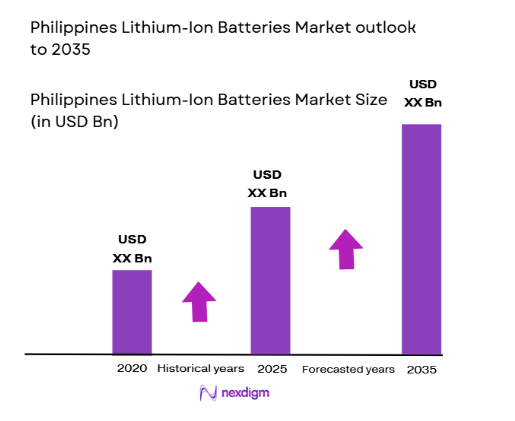
The Philippines lithium-ion batteries market reached a value of approximately USD ~ billion based on a recent historical assessment, supported by rapid electrification initiatives and growing demand for energy storage systems. The market is driven by increasing adoption of electric vehicles, rising renewable energy installations, and expanding consumer electronics usage. Government-backed clean energy programs and infrastructure investments have accelerated deployment of battery storage technologies, further strengthening market expansion across industrial and residential sectors.
Metro Manila, Cebu, and Davao dominate the Philippines lithium-ion batteries market due to strong industrialization, dense population, and established energy infrastructure. These regions benefit from higher electric vehicle adoption, extensive telecommunications networks, and concentrated manufacturing hubs. Additionally, proximity to ports and logistics networks facilitates battery imports and distribution. The dominance of these cities is also supported by government-led electrification projects and renewable energy integration initiatives, making them central to battery demand growth.
Market Segmentation
By Product Type
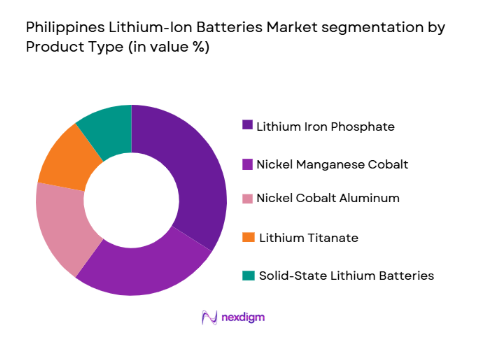
Philippines Lithium-Ion Batteries market is segmented by product type into Lithium Iron Phosphate, Nickel Manganese Cobalt, Nickel Cobalt Aluminum, Lithium Titanate, and Solid-State Lithium Batteries. Recently, Lithium Iron Phosphate has a dominant market share due to factors such as cost efficiency, enhanced thermal stability, longer lifecycle, and strong suitability for electric vehicles and stationary energy storage applications. Its growing preference is driven by safety advantages and reduced dependence on expensive cobalt materials, making it highly viable for large-scale deployment across renewable energy systems and transportation electrification.
By EndUser
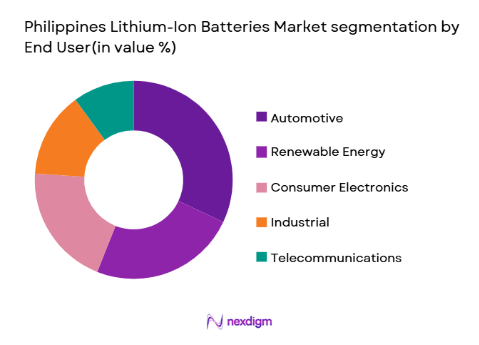
Philippines Lithium-Ion Batteries market is segmented by end user into Automotive, Renewable Energy, Consumer Electronics, Industrial, and Telecommunications. Recently, Automotive has a dominant market share due to factors such as increasing electric vehicle adoption, government incentives, and rising fuel costs driving electrification. Expanding charging infrastructure and growing investments in electric public transport systems have strengthened this segment. Consumer preference for sustainable mobility solutions and partnerships between automotive and energy companies have further accelerated demand within the automotive sector.
Competitive Landscape
The Philippines lithium-ion batteries market is moderately consolidated, with global manufacturers dominating supply chains and local players focusing on distribution and integration. Major companies leverage technological advancements, economies of scale, and established global networks to maintain competitive advantages, while partnerships with energy and automotive sectors strengthen their regional presence.
| Company Name | Establishment Year | Headquarters | Technology Focus | Market Reach | Key Products | Revenue | Battery Chemistry Focus |
| LG Energy Solution | 2020 | South Korea | ~ | ~ | ~ | ~ | ~ |
| Panasonic Energy | 1918 | Japan | ~ | ~ | ~ | ~ | ~ |
| Samsung SDI | 1970 | South Korea | ~ | ~ | ~ | ~ | ~ |
| BYD Company | 1995 | China | ~ | ~ | ~ | ~ | ~ |
| CATL | 2011 | China | ~ | ~ | ~ | ~ | ~ |
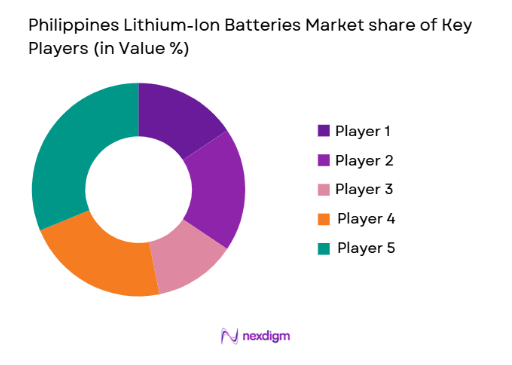
Philippines Lithium-Ion Batteries Market Analysis
Growth Drivers
Rising Electric Vehicle Adoption and Electrification Policies:
Rising electric vehicle adoption and electrification policies are significantly accelerating the Philippines lithium-ion batteries market, as increasing fuel costs and environmental concerns drive demand for sustainable mobility solutions. Government incentives supporting electric vehicle deployment have encouraged both manufacturers and consumers to transition toward electric mobility, resulting in higher battery demand. Expansion of charging infrastructure and integration of electric public transportation systems further support this growth. Automotive manufacturers are investing in localized production and partnerships to meet rising demand. Additionally, urban congestion and pollution concerns are influencing policy frameworks that favor electrification. Technological advancements in battery efficiency and cost reduction are making electric vehicles more accessible. Increasing awareness among consumers regarding environmental sustainability is also boosting adoption rates. The growth of ride-sharing and fleet electrification is further contributing to demand for lithium-ion batteries. As a result, the automotive segment continues to serve as a key growth engine for the overall market.
Expansion of Renewable Energy Integration and Grid Storage Needs:
Expansion of renewable energy integration and grid storage needs is another critical factor driving the Philippines lithium-ion batteries market, as the country increases its focus on sustainable energy sources. The growing installation of solar and wind energy systems requires efficient energy storage solutions to manage intermittency and ensure grid stability. Lithium-ion batteries offer high efficiency, scalability, and reliability, making them ideal for energy storage applications. Government initiatives promoting renewable energy projects have increased demand for advanced battery systems. Energy providers are investing in grid modernization and decentralized energy systems, further boosting adoption. Additionally, the need for backup power solutions in remote and off-grid areas is driving battery deployment. Technological advancements in battery management systems are improving performance and safety. Increased private sector participation in renewable energy projects is also contributing to demand. This trend is expected to significantly enhance the role of lithium-ion batteries in the country’s energy ecosystem.
Market Challenges
Dependence on Imported Raw Materials and Supply Chain Vulnerabilities:
Dependence on imported raw materials and supply chain vulnerabilities presents a major challenge for the Philippines lithium-ion batteries market, as the country lacks domestic reserves of critical minerals such as lithium and cobalt. This reliance exposes manufacturers to global price fluctuations and supply disruptions, which can significantly impact production costs. Geopolitical tensions and trade restrictions further exacerbate supply chain risks, affecting availability of key components. Limited local manufacturing capabilities increase dependency on foreign suppliers. Logistics inefficiencies and high transportation costs also contribute to overall expenses. Additionally, currency fluctuations can influence import costs, creating uncertainty for market participants. Efforts to establish local supply chains are still in early stages, limiting immediate mitigation options. The lack of integrated recycling infrastructure further compounds material dependency. These factors collectively hinder cost competitiveness and long-term sustainability of the market.
Limited Recycling Infrastructure and Environmental Compliance Issues:
Limited recycling infrastructure and environmental compliance issues pose another critical challenge for the Philippines lithium-ion batteries market, as the increasing use of batteries raises concerns about disposal and sustainability. The absence of well-developed recycling facilities leads to inefficient handling of end-of-life batteries, resulting in environmental risks. Regulatory frameworks governing battery disposal and recycling are still evolving, creating uncertainty for industry participants. High costs associated with recycling technologies limit widespread adoption. Additionally, lack of public awareness regarding proper disposal practices contributes to environmental hazards. The growing volume of used batteries intensifies the need for effective recycling systems. Companies face challenges in complying with environmental regulations while maintaining cost efficiency. Limited collaboration between stakeholders further slows progress in recycling infrastructure development. Addressing these issues is essential for ensuring long-term sustainability and regulatory compliance in the market.
Opportunities
Development of Local Battery Manufacturing and Assembly Ecosystems:
Development of local battery manufacturing and assembly ecosystems presents a significant opportunity for the Philippines lithium-ion batteries market, as it can reduce reliance on imports and enhance supply chain resilience. Establishing domestic production facilities would enable cost optimization and improve market competitiveness. Government incentives and policy support can encourage investments in local manufacturing. Collaboration with international technology providers can facilitate knowledge transfer and skill development. Increased domestic production can create employment opportunities and boost economic growth. Additionally, localized manufacturing can reduce transportation costs and lead times. The development of industrial clusters focused on battery production can further strengthen the ecosystem. Growing demand across automotive and energy sectors provides a strong foundation for investment. This opportunity is expected to drive long-term sustainability and growth in the market.
Expansion of Battery Recycling and Second-Life Applications:
Expansion of battery recycling and second-life applications offers another key opportunity for the Philippines lithium-ion batteries market, as it addresses sustainability challenges while creating new revenue streams. Recycling technologies can recover valuable materials such as lithium and cobalt, reducing dependence on imports. Second-life applications for used batteries in energy storage systems can extend their lifecycle and improve cost efficiency. Government policies supporting circular economy initiatives can drive adoption of recycling solutions. Increasing awareness of environmental sustainability is encouraging investments in recycling infrastructure. Partnerships between manufacturers and recycling companies can enhance efficiency. Technological advancements are improving the feasibility of material recovery processes. The growing volume of used batteries provides a substantial resource base for recycling. This opportunity aligns with global sustainability trends and supports long-term market development.
Future Outlook
The Philippines lithium-ion batteries market is expected to witness steady growth over the next five years, driven by expanding electric vehicle adoption and increasing renewable energy integration. Advancements in battery technology and cost reductions will enhance accessibility and performance. Government policies supporting clean energy and electrification will further strengthen market development. Growing investments in infrastructure and local manufacturing capabilities are anticipated to improve supply chain resilience and long-term sustainability.
Major Players
- Amperex Technology Limited
- LG Energy Solution
- Samsung SDI
- Panasonic Energy
- BYD Company
- EVE Energy
- SVOLT Energy Technology
- CALB Group
- Farasis Energy
- Gotion High-Tech
- Sunwoda Electronic
- Tianjin Lishen Battery
- Envision AESC
- Narada Power Source
- Phylion Battery
Key Target Audience
- Automotive manufacturers
- Renewable energy developers
- Industrial manufacturing companies
- Telecommunications providers
- Government and regulatory bodies
- Investments and venture capitalist firms
- Electric mobility solution providers
- Energy storage system integrators
Research Methodology
Step 1: Identification of Key Variables
Key variables such as demand drivers, supply chain dynamics, technology adoption, and regulatory frameworks were identified through extensive secondary research. Industry reports, government publications, and company disclosures were analyzed to establish foundational data points.
Step 2: Market Analysis and Construction
Market size estimation and segmentation were developed using a bottom-up and top-down approach. Data triangulation techniques ensured accuracy by validating findings across multiple sources and industry benchmarks.
Step 3: Hypothesis Validation and Expert Consultation
Preliminary findings were validated through expert consultations, including industry professionals and technical specialists. Insights from stakeholders helped refine assumptions and improve the reliability of market projections.
Step 4: Research Synthesis and Final Output
All validated data and insights were synthesized into a comprehensive report. Analytical frameworks and structured methodologies were applied to ensure consistency, clarity, and actionable insights.

- Executive Summary
- Research Methodology (Definitions, Scope, Industry Assumptions, Market Sizing Approach, Primary & Secondary Research Framework, Data Collection & Verification Protocol, Analytic Models & Forecast Methodology, Limitations & Research Validity Checks)

- Market Definition and Scope
- Value Chain & Stakeholder Ecosystem
- Regulatory / Certification Landscape
- Sector Dynamics Affecting Demand
- Strategic Initiatives & Infrastructure Growth

- Growth Drivers
Expansion of electric mobility initiatives across urban transport systems
Increasing renewable energy installations requiring energy storage solutions
Government incentives promoting battery manufacturing and adoption
Rising demand for portable consumer electronics
Growing investments in grid modernization and energy resilience - Market Challenges
High dependence on imported raw materials and components
Limited domestic recycling and battery disposal infrastructure
Fluctuations in lithium and cobalt prices affecting production costs
Technological constraints in local manufacturing capabilities
Regulatory uncertainties in battery safety and standards compliance - Market Opportunities
Development of localized battery assembly and manufacturing facilities
Expansion of battery recycling and second-life applications
Integration of lithium-ion batteries in off-grid renewable projects - Trends
Shift toward lithium iron phosphate chemistry for safety and cost benefits
Increasing adoption of battery swapping models in urban mobility
Advancements in fast-charging and high-density battery technologies
Collaborations between energy firms and automotive manufacturers
Growth of smart battery management systems with IoT integration - Government Regulations & Defense Policy
Implementation of clean energy transition policies supporting battery storage
Incentive schemes for electric vehicle adoption and infrastructure development
Standards enforcement for battery safety, transport, and recycling - SWOT Analysis
- Stakeholder and Ecosystem Analysis
- Porter’s Five Forces Analysis
- Competition Intensity and Ecosystem Mapping

- By Market Value, 2020-2025
- By Installed Units, 2020-2025
- By Average System Price, 2020-2025
- By System Complexity Tier, 2020-2025

- By System Type (In Value%)
Lithium Iron Phosphate Batteries
Nickel Manganese Cobalt Batteries
Nickel Cobalt Aluminum Batteries
Lithium Titanate Batteries
Solid-State Lithium Batteries - By Platform Type (In Value%)
Electric Vehicles
Energy Storage Systems
Consumer Electronics
Industrial Equipment
Renewable Energy Integration Systems - By Fitment Type (In Value%)
Embedded Battery Systems
Modular Battery Packs
Swappable Battery Systems
Integrated Storage Units
Retrofit Battery Solutions - By EndUser Segment (In Value%)
Automotive Manufacturers
Renewable Energy Developers
Electronics Manufacturers
Industrial and Manufacturing Units
Telecommunications Providers - By Procurement Channel (In Value%)
Direct OEM Supply Contracts
Government Procurement Programs
Third-Party Distributors
Online B2B Platforms
Energy Service Providers - By Material / Technology (in Value %)
Graphite Anode Technology
Silicon-Based Anode Technology
Cobalt-Based Cathode Chemistry
Nickel-Rich Cathode Chemistry
Solid Electrolyte Technology

- Market structure and competitive positioning
- Market share snapshot of major players
- CrossComparison Parameters (Battery Capacity, Energy Density, Charging Time, Lifecycle Durability, Cost Efficiency, Thermal Stability, Supply Chain Integration, Recycling Capability, Technology Type, EndUser Application)
- SWOT Analysis of Key Players
- Pricing & Procurement Analysis
- Key Players
Amperex Technology Limited
LG Energy Solution
Samsung SDI
Panasonic Energy
BYD Company
EVE Energy
SVOLT Energy Technology
CALB Group
Farasis Energy
Gotion High-Tech
Sunwoda Electronic
Tianjin Lishen Battery
Envision AESC
Narada Power Source
Phylion Battery

- Automotive sector driving demand through electrification of public and private transport
- Energy sector leveraging batteries for renewable integration and grid stability
- Consumer electronics industry sustaining consistent demand for compact battery solutions
- Industrial users adopting batteries for backup power and operational efficiency

- Forecast Market Value, 2026-2035
- Forecast Installed Units, 2026-2035
- Price Forecast by System Tier, 2026-2035
- Future Demand by Platform, 2026-2035


 Request a Sample
 Ask for Customization
 Get a Quote
 Enquire Now