

 Download PDF
Market Overview
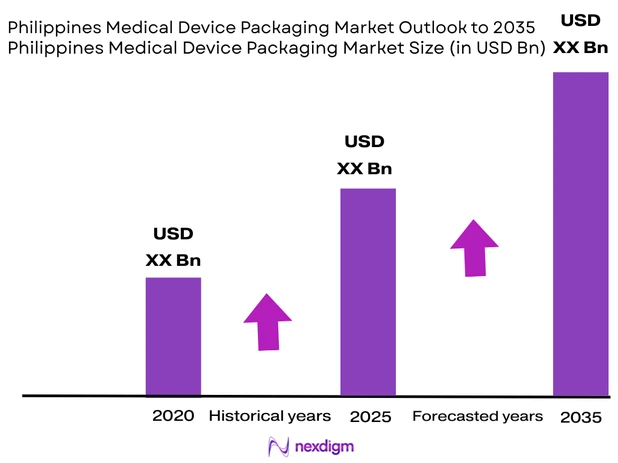
The Philippines Medical Device Packaging Market is valued at approximately USD ~ billion, compared with USD ~ billion in the preceding annual period. These values are placeholders because no government source separately reports medical-device-packaging revenue. Demand is supported by a population of 112,729,484, expanding hospital and diagnostic activity, and continued reliance on imported medical devices requiring sterile pouches, trays, labels, cartons and transport packaging. Metro Manila, CALABARZON, Central Luzon and Cebu dominate the Philippines Medical Device Packaging Market. Metro Manila concentrates the FDA, major hospitals, distributors and healthcare headquarters. Laguna, Cavite and Batangas provide electronics, plastics and export-manufacturing infrastructure, while Clark and Subic support international logistics. Cebu serves the central and southern islands through healthcare facilities, ports and distribution networks. PEZA’s promotion of pharmaceutical and medical-device economic zones further supports these industrial clusters.
Market Segmentation
By Packaging Format
The Philippines Medical Device Packaging Market is segmented into flexible sterile pouches, sterilization reels, thermoformed trays, form-fill-seal packaging, blister packs, rigid containers and protective transit packaging. Flexible sterile pouches hold the dominant position because they support syringes, wound-care products, diagnostic kits, catheters, dental consumables and surgical accessories while using less material than rigid systems. Medical paper–film and Tyvek–film configurations provide microbial protection, visibility and controlled peel opening. Standard pouch dimensions are also easier for domestic manufacturers and importers to source than custom trays requiring dedicated tooling. Sterilization reels support hospitals and packaging operations processing several device dimensions. Thermoformed trays remain important for implants, electronic components and sharp instruments requiring immobilization or puncture resistance. The Philippines’ archipelagic distribution system further favours lightweight packaging because medical products frequently move through multiple warehouses, ports and inter-island transport stages before reaching hospitals or laboratories.

By Packaging Material
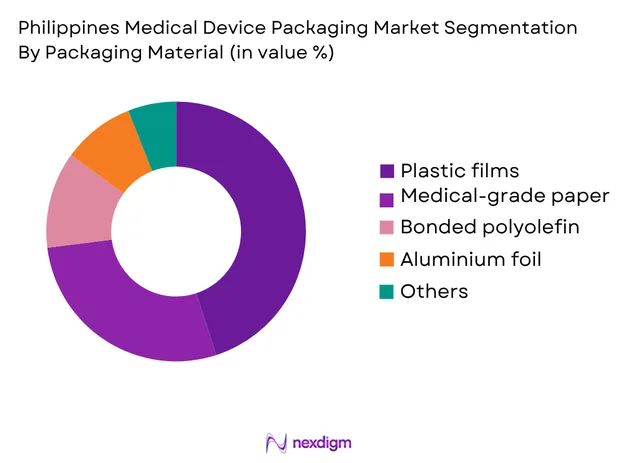
The Philippines Medical Device Packaging Market is segmented into plastic films and thermoforming sheets, medical-grade paper, spun-bonded polyolefin, medical-grade paperboard, aluminium laminates and specialty barrier materials. Plastic films and thermoforming sheets account for the dominant share because polyethylene, polypropylene, PETG, APET and multilayer structures provide transparency, moisture resistance, puncture protection and reliable heat sealing. These materials are used in pouch webs, diagnostic-kit packaging, trays, blisters and automated form-fill-seal systems. Medical-grade paper remains important for breathable sterilization reels and pouches, while spun-bonded polyolefin is used for stronger microbial-barrier performance and lower particulate generation. The country imports many specialist medical-grade substrates, giving an advantage to suppliers that maintain qualified local inventory. Substitution is difficult because a revised film, paper or coating may require new seal testing, sterilization assessment, aging studies and regulatory documentation before commercial use.
Competitive Landscape
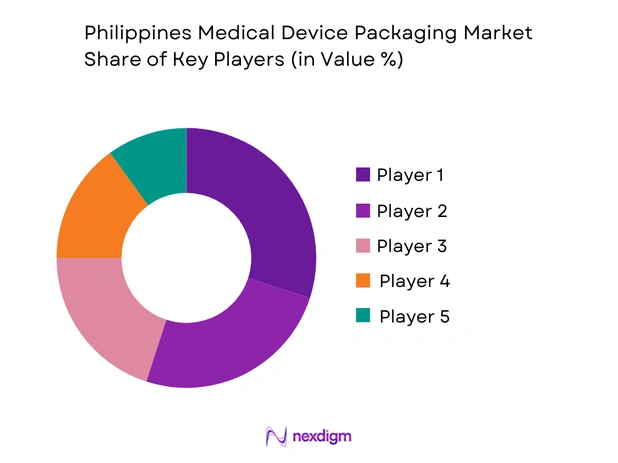
The Philippines Medical Device Packaging Market includes multinational sterile-packaging companies, local plastics and paperboard converters, and regional suppliers serving medical-device importers and manufacturers. International companies influence primary sterile barriers through established material platforms and global device-manufacturer relationships. Domestic converters compete through shorter lead times, local printing, customization and access to industrial zones. Competition increasingly depends on cleanroom capability, packaging validation, local inventory and familiarity with FDA registration requirements. The FDA’s risk-based framework requires Class A devices to obtain a Certificate of Medical Device Notification, while higher-risk products generally follow registration pathways and technical-document requirements.
| Company | Establishment year | Headquarters | Core packaging capability | Material expertise | Sterile-barrier capability | Validation support | Philippines relevance | Sustainability capability |
| Amcor | 1860 | Zurich, Switzerland | ~ | ~ | ~ | ~ | ~ | ~ |
| DuPont | 1802 | Wilmington, United States | ~ | ~ | ~ | ~ | ~ | ~ |
| Huhtamaki | 1920 | Espoo, Finland | ~ | ~ | ~ | ~ | ~ | ~ |
| San Miguel Yamamura Packaging | 1938 | Mandaluyong, Philippines | ~ | ~ | ~ | ~ | ~ | ~ |
| Steniel Manufacturing Corporation | 1986 | Cavite, Philippines | ~ | ~ | ~ | ~ | ~ | ~ |
Philippines Medical Device Packaging Market Analysis
Growth Drivers
Expansion of Healthcare Infrastructure and Medical-Device Consumption
The expansion of hospitals, diagnostic centres, primary-care facilities and home-health services is increasing demand for sterile pouches, sterilization reels, medical labels, diagnostic-kit packs and protective cartons in the Philippines. The country’s official population reached 112,729,484 in 2024, including 62.22 million people living in urban areas. This creates substantial requirements for syringes, catheters, wound-care products, rapid diagnostic tests and surgical consumables distributed through public and private healthcare networks. Economic activity also supports medical-product consumption: Philippine GDP reached USD 461.62 billion in 2024, while GDP per capita stood at USD 3,984.8. Real GDP increased by 5.7 units for every 100 units, compared with 5.5 units in 2023. Healthcare providers serving Metro Manila, CALABARZON, Central Luzon, Cebu and Davao require packaging capable of maintaining sterility during storage and transport. Flexible pouches are especially relevant because they reduce shipment weight while providing microbial protection and controlled opening. Growth in provincial healthcare access also increases demand for durable secondary cartons, moisture barriers and tamper evidence. Packaging suppliers that combine local inventory, validated sealing and inter-island distribution support can therefore capture demand created by the country’s expanding patient base and healthcare infrastructure.
Regulatory Digitalization and Stronger Product Traceability
The Philippines FDA’s transition toward risk-based and digitally managed medical-device authorization is increasing demand for controlled, traceable and accurately labelled packaging. From 10 March 2025, licensed medical-device establishments were required to submit initial Certificate of Medical Device Notification applications for Class A devices through the FDA eServices Portal. The FDA also issued updated guidelines covering electronic CMDN applications and continued implementing registration arrangements for Class B, C and D devices. Packaging is commercially affected because device identity, product owner information, intended use, lot details, storage conditions and other regulatory particulars must remain consistent across the application dossier, primary package and secondary carton. Digital authorization systems increase the value of suppliers offering electronic artwork management, barcode verification, serialized labels and documented change control. The regulatory driver is supported by an economy valued at USD 461.62 billion in 2024 and a population exceeding 112.7 million, creating a large base of registered products and distribution transactions. Packaging changes involving material, dimensions, labels or sterilization may require regulatory review or updated technical documentation. Device manufacturers and importers therefore prefer suppliers capable of maintaining approved specifications and audit-ready production records. This favours healthcare-focused converters over general packaging companies that cannot demonstrate material traceability, validated sealing and formal non-conformance procedures.
Market Challenges
Imported Medical-Grade Substrates and Supply-Chain Exposure
The Philippines Medical Device Packaging Market depends on imported medical-grade paper, Tyvek, PETG forming sheets, multilayer barrier films, specialist adhesives and package-testing equipment. These materials cannot be replaced through routine procurement because a change in film, coating or paper can alter seal strength, peel behaviour, microbial protection, sterilization resistance and shelf-life performance. Manufacturers may need to repeat seal-window studies, package-integrity tests, accelerated aging and distribution simulation before approving a substitute. The challenge is significant in an economy where GDP reached USD 461.62 billion and GDP per capita was USD 3,984.8 in 2024, because imported technical materials can consume substantial working capital relative to local operating budgets. The archipelagic distribution system adds further exposure: medical packaging materials may enter through major ports and then move to converters in Metro Manila, Laguna, Cavite or Cebu. Delays in international shipping or domestic port handling can interrupt qualified medical-device production. Suppliers must maintain safety stock, dual-source critical substrates and control storage conditions for moisture-sensitive materials. However, larger inventories increase warehousing and obsolescence risk, especially when customers use multiple low-volume package configurations. Dependence on imported inputs therefore constrains localization and gives an advantage to converters with regional procurement networks, approved substitute materials and reliable inventory planning.
Archipelagic Distribution and Limited Validation Capacity
The Philippines’ geography creates technical challenges for medical-device packaging because products must frequently withstand inter-island shipping, port transfers, road transport, high humidity and repeated warehouse handling. The country consists of thousands of islands, while healthcare demand is spread across Luzon, the Visayas and Mindanao. Packaging validated only for short urban distribution may experience compression, vibration, moisture ingress or label damage before reaching provincial hospitals. Official data show that the population reached 112.73 million in 2024, including 62.22 million urban residents, leaving a substantial population served through smaller cities, municipalities and geographically dispersed facilities. Validation capability is also concentrated around major industrial zones. Sterile packaging requires calibrated sealers, cleanrooms, package-integrity equipment, aging chambers and trained quality specialists. A general plastics or flexible-packaging converter may have extrusion and printing equipment but lack medical-device process qualification, microbial-barrier knowledge or controlled environmental production. Philippine GDP increased by 5.7 units for every 100 units in 2024, yet manufacturing and healthcare businesses continue competing for engineers, quality managers and automation specialists. Limited validation resources can delay package redesign, material substitution and new-device commercialization. Packaging suppliers must therefore invest in distribution testing, humidity resistance, electronic traceability and partnerships with qualified laboratories to serve customers beyond the main manufacturing centres.
Market Opportunities
Contract Packaging and Automated Quality Inspection
Contract medical-device packaging represents a future growth opportunity because many domestic manufacturers, importers and diagnostic companies cannot justify independent cleanrooms, validated sealing lines and package-testing laboratories. A shared provider can perform pouch sealing, thermoformed tray lidding, diagnostic-kit assembly, labelling, accelerated aging and sterilization coordination. Automated inspection can further differentiate these services. Connected sealers record temperature, pressure and dwell time, while vision systems identify seal contamination, wrinkles, missing kit components and incorrect labels. The opportunity is supported by a national population of 112,729,484 and GDP of USD 461.62 billion in 2024, which provide a broad healthcare and manufacturing base. The Philippines also recorded GDP growth of 5.7 units for every 100 units, demonstrating continued economic expansion. FDA digitalization increases the value of electronic batch records linking device lots, packaging-material batches, sealing parameters and inspection results. Contract providers can support Class A notification files and higher-risk device registration by maintaining controlled specifications and traceable production data. They can also localize secondary packaging for imported devices by adding Philippines-specific labels, instructions and responsible-party details. Current regulatory and manufacturing conditions therefore support future development of integrated packaging platforms combining cleanroom operations, digital inspection, short-run printing and regulatory documentation without relying on speculative future statistics.
Medical-Device Economic Zones and ASEAN Collaboration
The development of pharmaceutical and medical-device economic zones creates an opportunity to localize sterile-barrier conversion, diagnostic-kit packaging, precision trays and export-ready secondary packaging. PEZA and the Philippines FDA have cooperated on frameworks for pharmaceutical economic zones covering medical devices, manufacturing, research and related healthcare activities. These zones can bring device producers closer to plastics converters, electronics suppliers, toolmakers and logistics providers in CALABARZON, Central Luzon and other industrial corridors. The opportunity is supported by a 2024 economy valued at USD 461.62 billion, GDP growth of 5.7 units for every 100 units, and a population of 112.73 million. Regional collaboration is also important because the Philippines follows ASEAN-aligned medical-device principles and can serve neighbouring markets through standardized technical documentation and adaptable labels. International packaging companies can contribute medical-grade materials, sterile-barrier expertise and validation methods, while Philippine partners provide manufacturing facilities, lower-volume customization and regional distribution. Joint ventures can initially import qualified substrates and localize printing, pouch conversion, tray sealing and kit assembly. Over time, the same infrastructure can serve medical consumables, diagnostics and electronic devices produced inside economic zones. The Philippines’ electronics manufacturing capability further supports sensor housings, precision-moulded components and automated inspection systems, allowing packaging suppliers to move into higher-value healthcare manufacturing services.
Future Outlook
The Philippines Medical Device Packaging Market is forecast to expand at approximately % CAGR during the 2026–2035 period. The rate is a placeholder because no authoritative source separately publishes a medical-device-packaging forecast. Growth will be supported by healthcare infrastructure investment, medical-device imports, local manufacturing, diagnostic demand, regulatory digitalization and expansion of contract packaging. The country’s population reached 112,729,484, creating a broad underlying requirement for surgical products, diagnostic kits, maternal-health devices, wound-care products and home healthcare equipment. Distribution across thousands of islands makes package durability, moisture resistance and transport protection particularly important. Economic activity also supports healthcare consumption. Philippine GDP expanded by 5.7 units for every 100 units in 2024, compared with 5.5 units in 2023. Human health and social work activities subsequently became one of the faster-growing industries, reinforcing demand for devices and associated packaging. The Philippines FDA is continuing to digitalize medical-device authorization. From 10 March 2025, licensed establishments were directed to submit initial Certificate of Medical Device Notification applications for Class A devices through the FDA eServices portal. Digital submission encourages better control of product identity, packaging information, establishment licences and regulatory records. The FDA also extended regulatory flexibility for selected Class B, C and D devices during 2024, showing that the regulatory framework is still transitioning toward full risk-based implementation. Packaging suppliers must therefore monitor changes affecting labels, device classification, registration files and product variations.
Major Players
- Amcor
- Huhtamaki
- Berry Global
- DuPont
- Oliver Healthcare Packaging
- TekniPlex Healthcare
- Nelipak Healthcare Packaging
- Wipak Group
- STERIMED
- Constantia Flexibles
- Sonoco
- ProAmpac
- San Miguel Yamamura Packaging
- Universal Robina Corporation Flexible Packaging Division
- Steniel Manufacturing Corporation
Key Target Audience
- Medical device packaging manufacturers and sterile-barrier converters
- Medical device and in-vitro diagnostic manufacturers
- Medical device importers and marketing authorization holders
- Contract packaging and sterilization service providers
- Medical-grade polymer, paper and barrier-material suppliers
- Public and private healthcare procurement organizations
- Investments and venture capitalist firms
- Government and regulatory bodies (Philippines Food and Drug Administration, Department of Health, Philippine Economic Zone Authority, Department of Trade and Industry, Philippine Health Insurance Corporation and Bureau of Philippine Standards)
Research Methodology
Step 1: Identification of Key Variables
The first phase constructs an ecosystem map covering medical-device manufacturers, importers, packaging converters, material suppliers, sterilization providers, healthcare facilities and regulators. Critical variables include device volumes, packaging units per product, sterile-barrier formats, material consumption, cleanroom capacity, sterilization methods and import dependence.
Step 2: Market Analysis and Construction
Historical demand is assessed through medical-device imports, domestic production, packaging-converter revenues, hospital demand and material consumption. The top-down approach converts device-category supply into packaging units. The bottom-up approach aggregates pouch, tray, reel, label, carton and contract-packaging revenues before reconciliation through material yield and average unit realization.
Step 3: Hypothesis Validation and Expert Consultation
Market assumptions are validated through computer-assisted telephone interviews with packaging engineers, device manufacturers, importers, converters, hospital procurement teams and sterilization providers. Discussions examine packaging-format penetration, material sourcing, regulatory approval, validation timelines, inter-island distribution and outsourcing behaviour.
Step 4: Research Synthesis and Final Output
The final phase integrates FDA regulation, PSA economic indicators, PEZA industrial information, company disclosures and primary interviews. Market size is triangulated across revenues, unit demand, device consumption and material flow. Forecast assumptions incorporate healthcare growth, localization, regulatory digitalization, contract packaging, sustainability and ASEAN trade.

- Executive Summary
- Research Methodology (Market Definitions and Assumptions, Medical Device Packaging Taxonomy, Abbreviations, Market Sizing Approach, Top-Down Device Consumption Analysis, Bottom-Up Packaging Supplier Aggregation, Packaging Units per Device Assessment, Demand-Side Evaluation, Supply-Side Capacity Mapping, Import–Export Reconciliation, Healthcare Procurement Analysis, Primary Industry Interviews, Data Triangulation, Forecasting Framework, Scenario Analysis, Limitations and Future Conclusions)

- Definition and Scope
- Medical Device Packaging Market Evolution and Industry Genesis
- Timeline of Major Regulatory, Manufacturing and Packaging Developments
- Medical Device Packaging Business Cycle
- Packaging Demand Linkage with Medical Device Imports and Domestic Production
- Medical Device Classification and Packaging Requirement Mapping

- Growth Drivers (Expansion of Healthcare Infrastructure, Growth of Medical Device Imports, Diagnostic and Laboratory Demand, Universal Healthcare Implementation, Medical Consumables Manufacturing, Private Hospital Expansion, Electronics Manufacturing Linkages and Infection-Control Requirements)
- Market Challenges (Medical-Grade Material Import Dependence, Foreign-Exchange Exposure, Limited Cleanroom Conversion Capacity, Sterilization Bottlenecks, Long Packaging Qualification Cycles, Archipelagic Distribution Complexity, Skilled Validation Workforce Shortages and Sustainability–Sterility Trade-Offs)
- Market Opportunities (Localized Sterile Barrier Production, Medical-Grade Paper Conversion, Custom Thermoformed Trays, Contract Packaging Expansion, Rapid Diagnostic Kit Packaging, Automated Package Integrity Testing, ASEAN Export Platforms and Sustainable Healthcare Packaging)
- Market Trends (Paper–Film Sterilization Pouches, Tyvek-Based Barriers, Double Sterile Barrier Systems, Thermoformed Tray Optimization, Digital Package Prototyping, Automated Seal Inspection, Procedure-Kit Consolidation, Cleanroom Outsourcing and Digital Traceability)
- SWOT Analysis
- Porter’s Five Forces Analysis
- PESTLE Analysis

- By Market Value (2020-2025)
- By Packaging Units (2020-2025)
- By Medical-Grade Material Consumption (2020-2025)

- By Packaging Format (In Value %)
Flexible Sterile Pouches
Medical Paper–Film Pouches
Tyvek–Film Pouches
Sterilization Reels
Thermoformed Medical Trays
Header Bags - By Packaging Material (In Value %)
Medical-Grade Paper
Spun-Bonded Polyolefin and Tyvek
Polyethylene Films
Polypropylene Films
Polyethylene Terephthalate Films and Sheets
PETG Thermoforming Sheets - By End-User Organization (In Value %)
Domestic Medical Device Manufacturers
Multinational Medical Device Subsidiaries
Medical Device Importers and Marketing Authorization Holders
Contract Development and Manufacturing Organizations
Original Equipment Manufacturers
Department of Health Hospital Suppliers
Local Government Hospital Suppliers - By Geographic Market (In Value %)
National Capital Region
CALABARZON
Central Luzon
Central Visayas
Western Visayas
Davao Region
Northern Mindanao

- Market Share of Major Players
- Cross Comparison Parameters (Sterile Barrier Product Portfolio, Medical-Grade Material Expertise, Philippines Cleanroom Manufacturing Footprint, Sterilization Compatibility Coverage, Packaging Validation and Testing Capability, Philippine Medical Device Customer Coverage, Custom Tooling and Prototyping Capability, Sustainable Healthcare Packaging Portfolio)
- SWOT Analysis of Major Players
- Detailed Profiles of Major Companies
Amcor
Huhtamaki
Berry Global
DuPont
Oliver Healthcare Packaging
TekniPlex Healthcare
Nelipak Healthcare Packaging
Wipak Group
STERIMED
Constantia Flexibles
Sonoco
ProAmpac
San Miguel Yamamura Packaging
Universal Robina Corporation Flexible Packaging Division
Steniel Manufacturing Corporation

- Packaging Demand and Utilization Assessment
- Medical Device Manufacturer Procurement Criteria
- Packaging Supplier Qualification Process
- Packaging Engineer Decision-Making Process
- Regulatory and Quality Team Requirements
- Domestic Medical Device Manufacturer Analysis

- By Market Value (2026-2035)
- By Packaging Units (2026-2035)
- By Medical-Grade Material Consumption (2026-2035)


 Request a Sample
 Ask for Customization
 Get a Quote
 Enquire Now