
 Download PDF
Market Overview
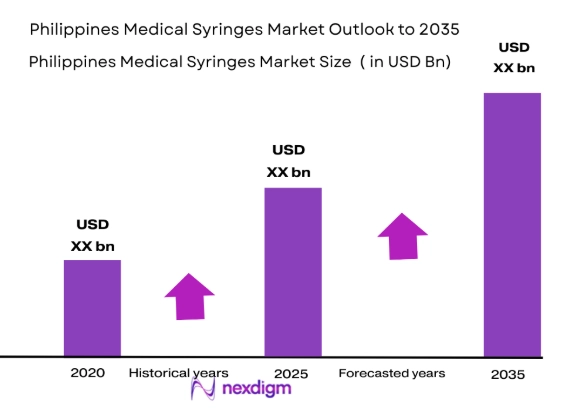
The Philippines medical syringes market is projected to reach a significant value, with the demand primarily driven by an increase in healthcare requirements, particularly for vaccines and insulin. As of a recent historical assessment, the market size in the Philippines stands at approximately USD ~ billion. This growth is propelled by a surge in diabetes cases, increasing vaccination programs, and advancements in syringe technology, such as safety and pre-filled syringes. Furthermore, government initiatives supporting healthcare infrastructure expansion contribute to the market’s positive trajectory.
Dominant cities such as Metro Manila and Davao are leading the market due to their strong healthcare infrastructure and large urban populations. Metro Manila, being the capital region, is home to numerous healthcare facilities and pharmaceutical companies that play a crucial role in the distribution and consumption of medical syringes. Davao and other growing urban centers also exhibit substantial demand for medical syringes, driven by both public and private healthcare investments aimed at improving the medical services across the region.
Market Segmentation
By Product Type
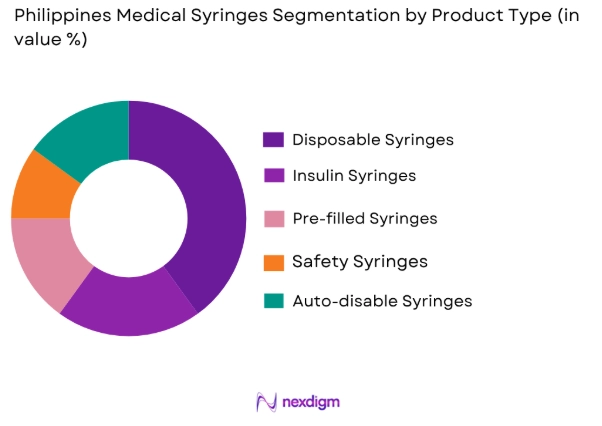
The Philippines medical syringes market is segmented by product type into disposable syringes, insulin syringes, pre-filled syringes, safety syringes, and auto-disable syringes. Recently, disposable syringes have captured a dominant market share due to their widespread use in hospitals, clinics, and home healthcare settings. The increasing demand for vaccinations, alongside the need for quick, single-use devices, has boosted the disposable syringe segment significantly. This is further supported by consumer preference for hygiene, ease of use, and affordability, making disposable syringes the go-to choice for most healthcare applications.
By End User Type
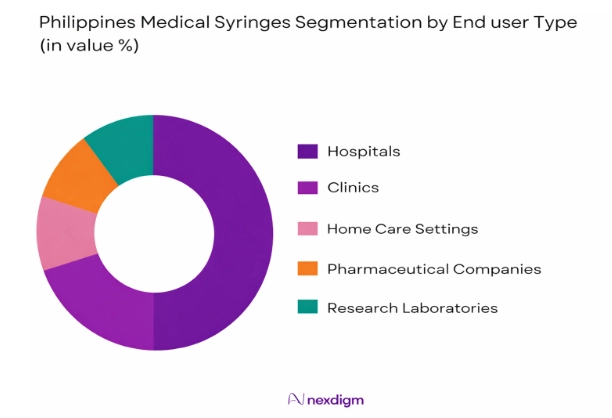
The market is also segmented by end user, consisting of hospitals, clinics, home care settings, pharmaceutical companies, and research laboratories. Among these, hospitals dominate the market due to the high volume of syringes used daily in various treatments, including surgeries, vaccinations, and routine healthcare procedures. Hospitals’ demand is heightened by the increasing number of chronic disease treatments requiring frequent injections, which significantly contribute to the high market share held by this sub-segment.
Competitive Landscape
The Philippines medical syringes market is highly competitive, with numerous players contributing to its growth. There is a constant drive for innovation, especially with the rise of safety syringes and pre-filled syringes to meet safety and efficiency demands. Major players are increasingly focusing on strategic acquisitions and collaborations to strengthen their market positions and expand their product portfolios. As the market consolidates, the influence of large multinational companies alongside local players becomes more evident, driving both competition and innovation.
| Company Name | Establishment Year | Headquarters | Technology Focus | Market Reach | Key Products | Revenue | Key Distribution Channel |
| Becton, Dickinson | 1897 | Franklin Lakes, NJ, USA | ~ | ~ | ~ | ~ | ~ |
| Terumo Corporation | 1921 | Tokyo, Japan | ~ | ~ | ~ | ~ | ~ |
| Smiths Medical | 1851 | Luton, UK | ~ | ~ | ~ | ~ | ~ |
| Medtronic PLC | 1949 | Dublin, Ireland | ~ | ~ | ~ | ~ | ~ |
| Nipro Corporation | 1954 | Osaka, Japan | ~ | ~ | ~ | ~ | ~ |
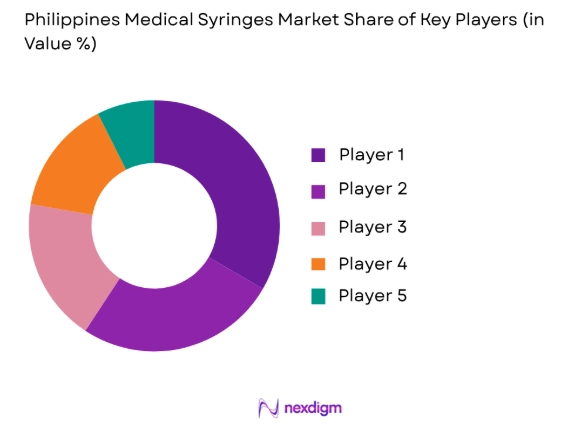
Philippines Medical Syringes Market Analysis
Growth Drivers
Expanding Immunization Programs and Public Health Initiatives
The Philippines’ national immunization efforts remain a core public health strategy, with the Department of Health’s Expanded Programme on Immunization delivering routine vaccines for measles, rubella, tetanus, diphtheria, and HPV across the country. National efforts have reduced the number of zero‑dose children from 1,000,000 in 2021 to 163,000 in 2023, reflecting intensification of vaccination campaigns and outreach. School‑based programs such as Bakuna Eskwela were reinstated to reach children with necessary vaccines, strengthening demand for safe syringes required in mass immunization operations where hundreds of thousands of doses are administered annually. These large‑scale immunization campaigns directly increase utilization of medical syringes.
Rising Prevalence of Chronic and Infectious Diseases
In 2024, public health surveillance detected notable infectious disease trends, including the Bangsamoro region’s measles outbreak with 2,064 confirmed cases and 14 deaths, prompting intensified vaccination and outbreak response interventions. Medical syringes are essential for immunization and the delivery of therapeutic injections in response to such outbreaks. Additionally, persistently low routine immunization coverage—only 62 percent of eligible children fully immunized in 2023—drives expanded immunization drives that rely on consistent syringe supply. These disease dynamics elevate syringe demand across both public health and clinical settings as part of efforts to control and prevent infectious disease burdens.
Challenges
Supply Chain Volatility and Import Dependence
The Philippines is heavily reliant on imported medical supplies; broader import data shows that goods worth USD 134.20 billion were imported in 2025, with substantial shares attributable to medical devices and components. Syringe supply chains are vulnerable to global logistics disruptions and foreign exchange volatility because local manufacturing capacity for high‑precision medical syringes is limited. This dependency can lead to inconsistent availability during spikes in demand, such as during mass immunization campaigns or epidemics, and increases exposure to external shocks in shipping routes, regulatory barriers, and supplier uncertainty. All of these factors can delay or limit syringe availability for healthcare providers.
Healthcare Budget Constraints and Procurement Cycles
Philippine healthcare financing remains challenged by comparatively low per‑capita spending; past assessments indicate the country spends approximately USD 50 per person on health care, which is significantly lower than regional peers. With finite budget allocations such as PHP 297.6 billion for the Department of Health in the 2025 national budget, procurement cycles for essential supplies like medical syringes must compete with other priorities within constrained health budgets. This environment can delay procurement approvals, limit buffer stock purchases, and lead to cyclical shortages of syringes between budget disbursement periods, hindering consistent supply in both government and private health facilities.
Opportunities
Public‑Private Partnerships in Healthcare Supply
The Philippine government’s health financing reforms and strategic initiatives encourage private sector collaboration to strengthen supply chains and delivery systems. Public‑private partnerships can leverage private logistics and distribution infrastructure to ensure steady syringe supply across regions, especially during expanded immunization programs that administer vaccines to hundreds of thousands of recipients. With routine immunization systems aiming for high coverage and emergency response needs during outbreaks, such partnerships can stabilize supply flow, reduce bottlenecks in remote areas, and integrate private sector efficiency with public health objectives. These collaborations benefit both national health goals and commercial syringe suppliers.
Adoption of Advanced Safety Syringe Technologies
Advances in syringe technology—such as safety and auto‑disable features—present opportunities to enhance infection control while reducing needlestick injuries in healthcare settings. The shift toward safety‑engineered syringes aligns with health system priorities to improve clinical safety standards across hospitals and community health centers. As immunization and injection procedures are performed at large scale, demand for these advanced syringes that prevent reuse and protect healthcare workers increases. Government health system modernization programs and infection prevention policies create a conducive environment for broader adoption of such technologies across public and private clinics
Future Outlook
The future of the medical syringes market looks promising, driven by continuous advancements in syringe technology, growing healthcare needs, and supportive government policies. Over the next few years, the market is expected to witness significant growth, particularly in the development of pre-filled and safety syringes, which will continue to dominate healthcare settings. Technological developments in connected devices will likely enhance syringe usage in digital health ecosystems, while demand for syringes in home care and self-medication will rise. Regulatory support and growing awareness about safety and efficiency in healthcare administration will contribute to the ongoing market expansion.
Major Players
- Becton, Dickinson and Company
- Terumo Corporation
- Smiths Medical
- Medtronic PLC
- Nipro Corporation
- Shanghai Fosun Pharmaceutical Group
- RWM Group
- HMD Global
- Indoplas Philippines, Inc.
- Philips Healthcare
- Johnson & Johnson Medical Devices
- Abbott Laboratories
- Beiersdorf
- Cook Medical
- McKesson Corporation
Key Target Audience
- Investments and venture capitalist firms
- Government and regulatory bodies
- Healthcare service providers
- Pharmaceutical manufacturers
- Medical device distributors
- Hospitals and clinics
- Home healthcare providers
- Medical supply retailers
Research Methodology
Step 1: Identification of Key Variables
Key variables such as product type, end users, and distribution channels were identified through extensive industry research, consultations with experts, and market surveys.
Step 2: Market Analysis and Construction
Comprehensive market analysis was conducted using historical data, industry reports, and current market trends to structure the market’s segmentation and demand patterns.
Step 3: Hypothesis Validation and Expert Consultation
Data from various sources was validated through consultations with industry experts, stakeholders, and market leaders to ensure accuracy and relevance.
Step 4: Research Synthesis and Final Output
The collected data was synthesized into actionable insights, ensuring that the final output accurately represents the current state and future projections of the market.

- Executive Summary
- Research Methodology (Market Definitions and Standardizations, Assumptions and Normalizations, Data Sources and Triangulation Logic, Bottom‑Up Market Sizing and Validation Approach, Top‑Down Opportunity Estimation Protocol, Primary Research Intercept Framework, Limitations and Future Method Refinements)

- Definition and Scope
- Market Genesis and Evolution
- Healthcare Infrastructure and Utilization Trends in the Philippines
- Industry Value Chain and Distribution Architecture

- Growth Drivers
Expanding Immunization Programs and Public Health Initiatives
Rising Prevalence of Chronic and Infectious Diseases - Challenges
Supply Chain Volatility and Import Dependence
Healthcare Budget Constraints and Procurement Cycles - Opportunities
Public‑Private Partnerships in Healthcare Supply
Adoption of Advanced Safety Syringe Technologies - Trends
Increasing Demand for Safety and Auto‑Disable Syringes
Shift Toward Digital Procurement and Inventory Management - Regulatory & Compliance Landscape
Market SWOT Analysis
Ecosystem Mapping
Porter’s Five Forces Analysis

- By Current Market Size – Value (PHP) & Volume, 2020‑2025
- By Market Density, 2020‑2025
- By Price Band Analysis, 2020‑2025

- By Product (In Value%)
Disposable Syringes
Insulin Syringes
Pre-filled Syringes
Safety Syringes
Auto-Disable Syringe - By End User (In Value%)
Hospitals
Clinics
Home Care Settings
Pharmaceutical Industry
Research Laboratories - By Distribution Channel (In value %)
Hospital Procurement & Tender
Pharmacy Retail Chains
Medical Distributors
Online Healthcare Platforms
Direct OEM Channel - By Price Tier (In value %)
Economy / Basic Syringes
Mid‑Tier
Premium / Safety Enhanced Syringes - By Feature Set (In value %)
Needle‑Attached Syringes
Needleless Injection Systems
Safety Shield/Auto‑Retractable Designs
Graduated Precision Systems - By Geography (In value %)
Metro Manila
Luzon (Outside Metro Manila)
Visayas
Mindanao

- Market Share by Value & Volume
- Brand Positioning / Value Proposition Mapping
- Cross‑Comparison Parameters (Company Overview Product Portfolio Breadth, Distribution and Sales Channels, After‑Sales Service & Warranty Coverage, Pricing and Contracting Strategies, Safety andQuality Certifications, Supply Chain & Logistics Efficiency, Manufacturing Footprint &Production Capacity, Healthcare Tendering Success & Government Contracts, R&D Commitment & Technology Adoption, Brand Loyalty and Institutional Preference)
- Competitor Analysis and Profiles
BD (Becton Dickinson)
Terumo Corporation
Smiths Medical
Nipro Medical Corporation
HMD Limited
Cardinal Health
Jiangsu Shenlong Medical Goods
Mediquip Ltd.
AstraZeneca Syringes Division
Local OEM & Private Label Syringe Manufacturers

- Healthcare Procurement Practices
- Usage Frequency and Preference Patterns
- Public vs Private Sector Procurement Dynamics
- Price Sensitivity and Value Perception

- By Current Market Size – Value (PHP) & Volume, 2026‑2035
- By Market Density, 2026‑2035
- By Price Band Analysis, 2026‑2035


 Request a Sample
 Ask for Customization
 Get a Quote
 Enquire Now